224 résultats
20172081502111907776Hua Mulan Cultural Business Co. Ltd. 2017. Soft Cover. Fine. The book is in fine condition. Hua Mulan Cultural Business Co., Ltd. paperback
19812111902160602233Culture publishing company 1981. Soft Cover. Fine. The book is in fine condition. Culture publishing company paperback
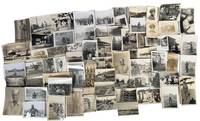
1941196921941. African American Army Transportation Corps photo archive depicting Black enlisted men and noncommissioned officers in wartime transport service occupation duty and domestic training between 1941 and 1952. The strongest identified material centers on the 3528th Transportation Corps Truck Company active from 1943 to 1946 and its successor the 551st Transportation Corps Truck Company active from 1946 to 1947. A captioned portrait places Joseph Galloway "somewhere in Belgium" on December 6 1944 ten days before Germany opened the Ardennes offensive that became the Battle of the Bulge. President Harry S. Truman issued Executive Order 9981 on July 26 1948 requiring "equality of treatment and opportunity" in the armed services but Army integration unfolded gradually through the occupation years and into the 1950s.<br /> <br /> Photo archive of 100 silver gelatin photographs ranging from 1.75 x 2.25 inches to 3.75 x 5.5 inches United States Belgium Japan and West Germany circa 1941-1952. More than half show Black soldiers in uniform including studio and outdoor portraits weapons training field scenes recruits and senior noncommissioned officers. Galloway poses with a pistol in Belgium; transport trucks appear in operation and maintenance; unit facilities domestic training camps interregimental competitions a 155 mm howitzer and soldiers beside a Sherman tank marked "Barbra" extend the record beyond portraiture. Occupation-era scenes include bombed urban landscapes in Japan locations identified as Osumi and Kyoto Black troops with Japanese civilians Buddhist monks at a temple and later service in West Germany including Bonn and Karlsruhe. Approximately one quarter bear manuscript captions identifying individuals dates or locations.<br /> <br /> In WWI many Black troops were denied combat roles and assigned to stevedore work labor battalions butchery companies road work hauling unloading ships and other manual support duties. The National Archives specifically notes that many Black units were kept from front-line fighting and "relegated to support duties." These Black soldiers served heavily in transportation engineering construction and supply roles during World War II making Army logistics one of the central places where African American military labor sustained Allied movement while the armed forces remained segregated. Several scenes place Black and White soldiers working alongside one another preserving the transitional military culture between wartime segregation and the uneven implementation of Truman's desegregation order. Light edge wear occasional creasing and minor surface abrasions to several prints; manuscript captions legible where present; no significant losses observed. Overall in very good condition. The archive gives named faces unit evidence vehicles weapons occupation landscapes and manuscript identifications across the decade when Black military service moved from segregated wartime labor toward formal integration. unknown
1875052767Westminster: Manuscript ALS. ca. 1875 1875. No Binding. Very Good. Original autograph letter signed ALS 'W. Gifford Palgrave' to "Dear Joseph" regretting he is unable to make the journey William Palgrave Gifford. Speaker's Court the Palace Westminster undated. 15x10 cm. In English. 2 pp. in good condition with a separate photographic portrait of Palgrave. William Gifford Palgrave was an English priest soldier traveller and Arabist author of A Personal Narrative of a Year's Journey through Central and Eastern Arabia 1862-1863. Palgrave was born in Westminster. He was the son of Sir Francis Palgrave and Elizabeth Turner daughter of the banker Dawson Turner. His brothers were Francis Turner Palgrave Inglis Palgrave and Reginald Palgrave. He was educated at Charterhouse School then occupying its original site near Smithfield and under the head-mastership of Dr Saunders afterwards Dean of Peterborough. Among other honours he won the school gold medal for classical verse and proceeded to Trinity College Oxford where he obtained a scholarship graduating First Class Lit. Hum. Second Class Math. 1846. He went straight from college to India and served for a time in the 8th The King's Regiment of Foot Bombay Native Infantry H.I.C. Shortly after this he became a Roman Catholic was ordained a priest and joined the order of the Jesuits Society of Jesus and served as a member of the order in India Rome and in Syria where he acquired a colloquial command of Arabic. He convinced his superiors to support a mission to the interior of Arabia which at that time was terra incognita to the rest of the world. He also gained the support of the French emperor Napoleon III representing to him that better knowledge of Arabia would benefit French imperialistic schemes in Africa and the Middle East. Palgrave then returned to Syria where he assumed the identity of a travelling Syrian physician. Stocking his bags with medicines and small trade goods and accompanied by one servant he set off for Najd in north-central Arabia. He travelled as a Christian. The service he would do for the Society of Jesus and the French empire would be as a spy not a missionary. Palgrave became friendly with Faisal bin Turki bin Abdullah Al Saud while in Riyadh Saudi Arabia. Faisal's son Abdul Rahman bin Faisal asked Palgrave to get him strychnine. Palgrave believed that Abdul wanted to poison his father. Palgrave was accused of espionage and was almost executed for his Christian beliefs. <br/> <br/> Manuscript ALS., [ca. 1875] unknown
0656348372.Ghardcover. Good. Access codes and supplements are not guaranteed with used items. May be an ex-library book. hardcover
239553Melbourne: Mitchell and Casey Printers: 1920 First Edition. Subsequently reprinted under the name V. Pretty in 1921. Decorated wrappers that is paper covers plus pp. 32 210 x 135 mm. In his Introduction Wells claims that the following sketches of life in the trenches are a faithful account of a soldiers life as it really is. Stripped of all gloss and glamor the realities of war are truthfully portrayed . Short and longer pieces cover topics such as A Story of Gallipoli Over the Top and Winter on the Somme but there is no doubt that a legend with mythic overtones has been born although it is a legend that is being built on a foundation of bloody-mindedness as much as heroism and finds expression here in the vernacular rather than the elegiac for example in verse two of Anzacs Some of you got the V.C./Some the Gallipoli trot/Some got a grave by the sea/And all of you got it damned hot. Three short tears to the leading edge of the front wrapper neatly repaired; wrappers foxed; has been folded vertically; a good copy and internally very good. unknown
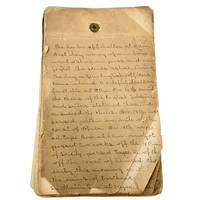
18990012049Donsol Pilar Manila Philippines New York Malta. Poor with no dust jacket. 1899-1901. Other. On offer is an unbelievable handwritten account of 19 months of action on the frontlines of the Philippine Insurrection the Philippine-American War between November 1899 and June 1901. An unknown American soldier writes of his experiences in a level of detail that cannot be overstated. This diary places the reader in the Philippines with shocking realism making this diary exceedingly rare. The 139 pages of this journalled account of events have been removed from a larger document and someone has pinned these loose pages together. This writing begins at the end of a sentence penned on presumably November 17 1899 and concludes half way through a sentence written on June 23 1901. There seem to be very few missing pages from within the journal and it reads very smoothly. The content is outstanding. The diary opens with our soldier diarist sailing from New York to the Philippines via the British Naval base at Gibraltar and the Suez Canal. He describes his experiences sailing sharing about a stop ashore in Malta a Thanksgiving spent at sea a concert enjoyed aboard the gunboat Nashville on the way to Manila and more. He arrives with his regiment in Manila on Dec 22 1899. The troops explore Manila and meet Filipino locals. In early January of 1900 they receive orders to head to southern Luzuon on the Kobbe Expedition which refers to General William Kobbes Expedition to Bicolandia. This expedition was in response to an urgent order from Washington to open up hemp ports of Southern Luzon due to an American hemp shortage. The problem was the port towns were largely controlled by Filipino Insurgents. Our diarist provides absolutely remarkable detail about Americas role in defeating the Insurgents and the tragedy of the Filipino peoples experience. Context indicates that our diarist was possibly a member of the 43rd Volunteer Infantry Regiments USV Company A. An excerpt that provides a sense of how our soldier explains the circumstances in the Philippines follows: Jan 16th we got the order to pack up and get ready to leave Mikata and to proceed to the Southern part of Luzon we were put aboard the transport Hancock which was at anchor in the Bay of Manila All combined we were named the Kobbe Expedition to the Southern Luzon to open up the Hemp ports and protect the natives from the Insurgents down there On the 21st of Jan 1900 our boats dropped anchor in a bay named the bay of Sorsogon in the Province of Albay All over this province there are large gangs of Insurgents holding the towns so at many towns our boys had a hard fight with the Insurgents before they could take the towns and the gun boat had to shell many of the towns. Our Regt. Occupied nine towns. Our detachment of A and D. Co. Were taken to a town named Donsol the gunboat Helena took us ashore from the Hancock On their arrival ashore they were met by a crowd of Philippinos. They had an order from the officers of the Insurgents it read saying that they would not haul down their colors nor surrender for three days. So our Major returned to the gunboat and a short conversation was held with the officers of the gun-boat and it was decided to prepare the gun boat for action and land all of us. If the Insurgents fired one shot at us the gun-boat would shell the town The hills were full of fleeing people. A detail of men were sent out on the hills at once then the Insurgents fired their first shot at us. Our boys had a warm fight for 15 minutes. They found the hills well entrenched and also found one big cannon. Lots of spears Bolas and wooden guns. They returned to town bringing in a few prisoners. A scouting party was seent and they saw a lot of Philippinos fleeing to the mountains. This town had a population of 10000 and three hundred were Insurrectors. The next thing we done was to find ourselves some good houses to live in. Outposts were put out all around the town. A few natives came across our post for a few nights and on the 22th Jan the Insurgents paid our town a visit setting fire to one of the big houses where our men were sleeping. Our men got out of the house without anyone being hurt. We surrounded the town fired a few volleys . Later in January our soldiers regiment goes on the first of many missions all of which he describes in glaring detail. On this mission the troops attempt to leave Donsol for Pilar when they run into trouble as the connecting bridge was destroyed by Insurgents. They make it to Pilar and find the town has been deserted. As they march back to Donsol they find someone has lit the bridge ablaze: Jan 28th We had a very hard time crossing the bridge burning our shoes and legs but we got safely on the Donsol side before the bridge fell with a crash into the river. We marched on we heard several shots from the Mauser and Remington rifles. Next we discovered a big fire and a call to arms and fire call was sounded The fire of the Insurgents got heavier. Our Major gave an order not to fire. He was going out in the front of our lines. He went out with a detail of men and discovered that our town was surrounded and the hills were full of Insurgents. He fired a few volleys then he came into town. The Insurgents answered him by firing a cannon. Then the Insurgents gave a yell and started to advance and we kept quiet and let them get close to our lines. Then we got the order to commence firing and the boys opened up all around the town and we soon put the Insurgents to flight firing a few shots as they ran. Next morning we discovered a few dead Insurgents close to our lines. The Insurgents almost always carry their dead and wounded along with them in their flight Our soldier does an absolutely phenomenal job of describing not only the day-to-day in Donsol where he spends majority of his time but also the various missions in which he participates. His words paint a fulsome picture of the war: 21st Feb at noon our Major asked for a detachment of men to volunteer to go up the river on a scouting expedition. I along with 12 more men went out of our company and 12 out of D. Co. Along with Capt. Hart of D. Co. And our Major left Donsol in a hard paddle boat and one white boat in tow On our way up the river we could see high hills on each side and the river was very narrow. There were many Insurgents outposts in the high trees all the way up and we fired at every one we saw. We went up a distance of 8 miles before we thought of coming home as it was getting late We had traveled one mile on our homeward way when the Insurgents fired on us from the left hand ashore. Our men in the rear boat fired a volley into the two Insurgents and were taking good aim for a second volley when the hills fairly echoed with the yells from the Insurgents. They then opened up on the right hand side which was aimed at the white boat hitting one of our men our company in the head and he was killed instantly. Then we answered their shots from each of our boats and from that time until we got back to Donsol we were under the hot fire of the Insurgents we could see the hills full of Insurgents and we had plenty to shoot at. We made every shot count. The insurgents even fired rocks at us from the high hills . More texture is added when our soldier discusses aspects of the war that dont involve active fire. Some examples follow: March 5th Gen Kobbe of the 8th Army Cor was here on a visit and he said these two companies were a very industrious lot of men and that the building of the stocade and trenches was a very sensible work he also brought us 17 of the Battery G 3rd Artillery men and one Hotch Kiss gun for reinforcements. April 10th the mail boat was here bringing the report of Gen. Pawa likely Jose Ignacio Paua an Insurgent Gen in Command of the Insurgent troops through this province. He surrender to our Colonel in Legaspi Legazpi and was sent to the Military Prison in Manila. April 21st We took a long march across the hills in a round about manner to a town named Sevilla merely an Insurgent camp. The town was deserted on our arrival. Fires were still burning in the houses. Everything was just as they had dropped it in their flight. We passed through the town and discovered many traps laid in the roads for us. One trap was an arrow trap on each side of the path in the bushes and by pulling a strong the arrows would stick into anyone going down the path. None of their traps caught us. Our soldier writes frequently about expeditions for which he volunteers. He describes a mission to Banningaran sic. En route the men captured Captain Hernandiz sic; possibly Adriano Hernández y Dayot and his family before being caught unprepared by the Insurgents who severely injured one of the American sargeants. On their hike back to Donsol they are again attacked by the Insurgents this time caught off guard as they attacked from the rear. And so it goes for many more months. Our author describes the movements of the men with whom he is stationed his commanding officers and the various wins and setbacks of both the Americans and the Insurgents. In May of 1901 our soldier and his regiment begin the process of boarding a ship to return to America. There is of course never a straightforward path and there are many bumps in the road. However our soldier does eventually board a ship and begins again to describe his journey in detail. The diary cuts off abruptly mid-sentence on June 23 1901 as our soldier is describing being at sea with nothing but a sailboat in sight for miles. While we do not know our soldiers identity we do know he was safely heading home at the conclusion of his diary. We know he was a highly motivated volunteer soldier who displayed total buy-in to the mission of the Americans in the Philippines and we know he was a gifted writer penning his experiences with such texture and realism that the reader feels as though they too have been on the front lines of a bloody wet miserable war in the Philippines - fighting for America and for the displaced Philippino people forced to flee from the Insurgents to the mountains. This journal measures 8x5 inches and contains 139 single-sided sheets. The pages were all loose so the author has pinned them together with a single round-headed fastener post. There are no covers to this journal. As a result the first and last few pages show obvious and significant wear and tear including a large corner of the first page being completely ripped off obstructing the text. The handwriting is quite legible. Overall Fair to Poor. ; Manuscripts; 8vo 8" - 9" tall; 139 pages . unknown
19349936Glasgow: Kinnaird Press. Glasgow Kinnaird Press n.d. 1934. First Edition. First Impression. Hardback. A very good copy. Sargent it seems has this down as one of the worst written Utopias. I'll let you judge. Inscribed by the author in pencil to the front endpaper. Spine tanned a little bumping A few spots of foxing. 9936 Hyraxia Books. n.d. 1934 . Very Good. Hardback. 1st Edition. 1934. Kinnaird Press hardcover
19762092902141505125Shingenronsha Publishing 1976. Soft Cover. Fine. Size: 46 size Shingenronsha Publishing paperback
19620001450KOREA. Very Good. 1962. Manuscript. On offer is a super manuscript relic of Canada's Korean War participation being a handwritten day book diary pages of a soldier with the famed French Canadian regiment the 'Van Doos'. The 2-ring 6 x 4 inch pages record terse fact filled sometimes intimate personal notations of this soldier's duties and life in the Korean Theatre. Some pages are missing but from April 2nd 1952 through November 3rd 1952 he notes 216 days in Korea at this point this serviceman provides an intimate picture of a support soldier laying cables building rafts laying out minefields and many times under attack. June July August and September are the most filled months and in roughly 137 pages one reads the day to day mundane and of course the definitely not mundane entries - how he was driving a jeep with a Sergeant and a military officer and the jeep was under mortar fire and it rolled over down an embankment. Other entries include: May 17th 1952 29 years old; check Vandoos reg. 2000 mine A/P minefield. Got shelled in the valley. 18 - 75 mm came in on us in ½ hour. No casualties; received letters from patootie. Wrote letter to patootie; started booby trap MF mine field; Sgt. Jackson went to battle school in Japan; attended class pontoon raft demonstration at Widgeon bridge; June 25th 7th Wedding Anniversary; mention of Operations Buster and Buckingham Noahs Ark; went over to Sgt's mess a HQ. Tied one on; constructed & operated close 50/60 raft all day; buffet lunch @ Vandoos HQs; took 5 L/Cpls up to Black Watch; almost got clobbered by a heavy mortar which landed 25' behind jeep and much more. One online source provides: BACKGROUND NOTES: The Royal 22e Régiment is an infantry regiment and the most famous francophone organization of the Canadian Forces. The regiment comprises three Regular Force battalions two Primary Reserve battalions and a band making it the largest regiment in the Canadian Army. The ceremonial home of the regiment is La Citadelle in Quebec City where the regimental museum is housed. The regiment is nicknamed the Van Doos an anglicized mispronunciation of vingt-deux "twenty-two" in French. The regiment's regimental headquarters is located in Quebec City with all three of its regular battalions stationed at various bases in the province of Quebec. The regiment serves as the "local" infantry regiment for Quebec. During the Korean War 1951-1953 the regiment expanded to three battalions each serving in turn as part of the Canadian brigade in the 1st Commonwealth Division. Thus the "Van Doos" represented one-third of Canada's infantry contingent throughout the war. Overall in very good condition save for one page chewed as noted by 'Kibbles'.; 12mo - over 6¾" - 7¾" tall; KEYWORDS: CANADIANA FRENCH CANADIAN REGIMENTS VAN DOOS VANDOOS 22ND REGIMENT KOREAN WAR SEOUL PYONG YANG OPERATION NOAHS ARK OPERATION BUCKINGHAM MINE FIELDS BLACK WATCH CANADA Personal Memoir Handwritten hand written autograph autographs signed letters document documents manuscript manuscripts writers writer author holograph personal ANTIQUITÉ CONTRAT VÉLIN MANUSCRIT PAPIER ANTIKE BRIEF PERGAMENT DOKUMENT . unknown
1930000769CAIRO EGYPT JERUSALEM ISRAEL. Very Good. 1930. On offer is a large oblong photo album circa 1935 to 1945 with over 180 mounted pictures and photographs providing a visual diary of one soldier's tour through Egypt and the Holy Land. Unique photos beautifully presented in a well kept cloth cover 10 x 13 inch album. ; Folio - over 12" - 15" tall; HANDWRITTEN MANUSCRIPT DOCUMENT LETTER AUTOGRAPH DIARY JOURNAL LOG KEEPSAKE WRITER HAND WRITTEN DOCUMENTS SIGNED LETTERS MANUSCRIPTS HISTORICAL HOLOGRAPH WRITERS DIARIES JOURNALS LOGS AUTOGRAPHS PERSONAL MEMOIR MEMORIAL PERSONAL HISTORY TRAVEL PHOTOGRAPHY INDIA ILLUSTRATED antiquité contrat vélin document manuscrit papier Antike Brief Pergament Dokument Manuskript Papier oggetto d'antiquariato atto velina documento manoscritto carta antigüedad hecho vitela documento manuscrito Papel PALESTINE ISRAEL BRITISH MANDATE BETHLEHEM EGYPT HOLY LAND JUDEA SAMARIA WEST BANK CAIRO JERUSALEM PHOTO ALBUM PHOTOGRAPHIC ALBUM . hardcover
0MV327New Market Virginia VA CIVIL WAR - VIRGINIA holograph letter written by Union solider from New Market VA. 4 pages unsigned so possibly incomplete but interesting content. To his father; ".I said I did not know whether I should ride my horse or get sent through by rail as far as Winchester / I saddled my horse and rode out about two miles / went to captain to see if I would be sent my rail - he said no because bridge was gone / railroad bridge at the ferry across the Potomac was washed away by heavy rain / must ride my horse or stay behind / packed my duds & mounted my horse in a drizling rain / passed through Charlestown where John Brown was tried and hung 8 miles from the Ferry & stopped about 4 miles from Berryville / took quarters in old deserted tavern with Marve / started for Woodstock where regiment was / orders - no women companions / took off my overcoat and rolled it and strapped my saber and pitol haversack & canteen to saddle this lightened my load / we did not pass near enough to the field of battle this side of Winchester to get sight of it though I saw where the skirmishing commenced on the road & our men drove them back onto the hill about a mile and a half before they made a stand behind the stone wall / some trees by the road were all picked up by rebel bullets and they probably sheltered some of our men and an old house was burnet down by a shell from our guns that sheltered them." Very good decscriptive letter. Very Good. 16mo - over 5¾" - 6¾" tall. Manuscript. unknown
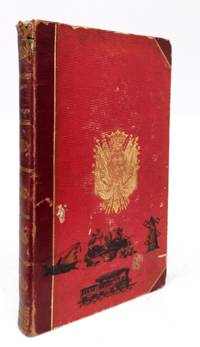
1824148954Paris: Chez C. J. Trouve 1824. Hardcover. Good. xxviii 224 p. 22 cm. Half red leather with red paper boards. Gold impressing. Marbled endpapers and text block edges. Black illustrations added to front cover. Stains to boards. Corners and edges worn tear in upper front hinge spine head chipped. Front endpaper loosening. Some foxing. French text. <br/><br/> Chez C. J. Trouve hardcover
1890620271890. unknown
19052111902160201333Toboukan 1905. Soft Cover. Fine. Volume: 1 Toboukan paperback
20146On letterheads of 44 Byranston Square W. London 11 and 12 May 1911. The two letters in good condition on lightly aged paper. ONE: 2pp. 12mo. He begins by stating that he 'knew Leonard pretty well in the 2nd Life Guards. he was a good fellow but rough and wild - he came from Mullingar my local capital a good man with a horn but too heavy for a groom'. He could not give Leonard 'a better character than the regiment has done' and if 'his knee is too bad for him to soldier it probably would prevent him being a groom anywhere . he occasionally came before me for punishment - and as a fellow countryman I took an interest in him'. While 'he could no doubt do very well in service' Longford is not sure he would 'like to have him as a chauffeur perhaps he might drive a motor bus or a taxi cab. I have a sneaking liking for him as you may gather and he will probably descend on me here in a day or two'. TWO: 1p. 12mo. He is 'out of London in Ireland' the following day bt asks him to 'let Leonard come to me Sunday or Monday'. On letterheads of 44 Byranston Square, W. [ London ] 11 and 12 May 1911. unknown
1334161135.Gpaperback. Good. Access codes and supplements are not guaranteed with used items. May be an ex-library book. paperback
1426959818.Gpaperback. Good. Access codes and supplements are not guaranteed with used items. May be an ex-library book. paperback
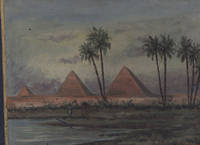
194045303Egypt & The Sudan: Photographs Taken By Donald Stone 1940-1944. 1940-1944. WORLD WAR II. First edition. 12" x 16" cloth string-tied album with an original color oil painting on the front cover of the Pyramids. Photographs by British soldier Donald Stone who was part of the RAF's 203 Group 1940-1944 headquartered in Khartoum. The album has 276 neatly mounted photographs with captions on both sides of 17 leaves each with a tissue guard. Additionally there are 23 loose photographs including 19 photographs of British planes in an envelop. These military photographs of aircraft were strictly forbidden during the War years. Also there are 2 pieces of printed ephemera including a menu for the 203 Group Xmas dinner in 1942 signed by the entire membership. An interesting album of people and places visited by this British airman throughout Egypt and the Sudan. Most of the photos are 2‑1/2" x 3-1/2" but many are larger. Laid-in is a three-page history of RAF Squadron 203. Very good with photographs in fine condition. Photographs Taken By Donald Stone, 1940-1944. hardcover
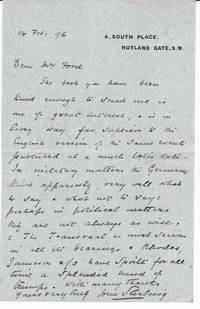
189635639London: 14 February 1896. 1896. Fine. - Letter filling one side of a 7 inch high by 4-3/8 wide sheet of light gray letterhead with the address printed in raised lettering at the top. Signed "John Sterling". Folded twice for mailing. Near fine. <p>Sterling writes to Mrs. Richard Ford thanking her for sending him a military book about the Jameson Raid. "It is of great interest & is in every way far superior to the English version of the same events published at a much later date. In military matters the Germans know apparently very well what to say & what not to say: perhaps in political matters they are not always as wise. The Transvaal is most serious in all its bearings & Rhodes Jameson & Co have spoilt for all time a splendid hand of trumps."<p>Major-General John Barton Sterling 1840-1926 entered the army in 1861 serving in Egypt and the Sudan. He was wounded at Tel-el-Kebir in 1882 and subsequently commanded the Coldstream Guards until his retirement in 1901. He was a member of the Royal Yacht Squadron and the Atheneum Club. At the Atheneum he befriended Kipling who wrote of him that he "dealt faithfully with me when I made technical errors in any tale of mine that interested him." "Something of Myself" page 143. [London]: 14 February, 1896. unknown
24038Ten of the poems dated to 1912; one from Burnham Beeches. Prose piece without date or place. Archaeologist poet soldier writer of crime fiction - it seems extraordinary that such a man should not have been accorded an entry in the Oxford DNB. In 2001 Napier University in Edinburgh published twenty-one of her father’s ‘Poems from the Great War’ transcribed from his notebook by his daughter Lady Jennifer MacLellan. At least ten of the eleven poems present here date from before the war. The are conventional in structure and somewhat immature in tone: the influence of Francis Thompson is apparent. The prose piece is altogether more successful. In choosing as his subject a fictitious individual with an almost primal connection with rock and stone Casson could almost be writing about himself. He was the author of ‘The Technique of Early Greek Sculpture’ 1933 and ‘Sculpture of To-day’ 1939 and carefully oversaw the transportation of the two and a half tons of sculptured marble and iron railings of Rupert Brooke’s monument to the remote olive grove where he is buried. All eleven poems present here are fair copies in autograph nor has the typescript prose piece any manuscript emendations. There is no indication that any of the items were ever published. The eleven poems are grouped over two bifoliums and two loose leaves each of the four groups dating from a different time. ONE: Six poems on a bifolium headed ‘Sept. 1912. M. F.’ 3pp 12mo. The first lines of the six poems are as follows. First poem twelve lines: ‘Little Brothers of the Grasses / Let me stay awhile with you.’ Second poem five lines: ‘On the warm stones beside the sea I lie’. The last four poems appear to have the collective title ‘Sea Sorrow.’ Third poem four lines: ‘Wild waves that fling their foam & fall’. Fourth poem eight lines: ‘O passionate waves that never tire!’ Fifth poem eight lines: ‘’Tween grey of the sea & grey of the sky’. Sixth poem four lines: ‘Over the downs at dusk of day’. TWO: Three poems on a single leaf headed ‘Burnham Beeches. / Oct. 1912. M. F.’ 1p 4to. First poem twelve lines: ‘Deep down in the woods when the leaves are falling’. Second poem six line: ‘A cold gold moon climbed up a steely sky’. Third poem sixteen lines: ‘Life like leaves that were green & now are sere’. THREE: Single poem twenty-one lines on bifolium headed ‘MÆSTITIA DIERVM NON REVOCANDARVM QUIA CONFECTARVM. / Nov. 1912.’ First of three stanzas: ‘Amind the singing of the stars / Amid the singing of the sea / The old dead days from devious ways / Came drifting drifting up the / hilltop still and secretly. / All grey the earth and grey the sky / As the ghosts of days went drifting by.’ FOUR: Single poem ten lines on one side of torn piece of paper. 1p landscape 12mo. Begins: ‘What has been and what is to be / Surges around and covers me.’ FIVE: Mimeographed typescript of a prose piece titled ‘THE MAN FROM THE HILLS’ with the author’s name given at top right as ‘S. CASSON.’ 5pp 4to. Printed on one side each of five leaves held together with a brass stud. Neatly folded twice. Reminiscences and assessment of the character of a almost certainly fictional departed friend of the narrator’s an otherworldly figure with a ‘close friendship of inanmate things’ and in particular stone ‘He told me once that the grandest feeling he had ever experienced was when he was crossing the Aegean and knew he was near Paros and its marble quarries.’. First paragraph reads: ‘His senses told him of the proximity of mountains just as we of cruder sensibility know when we are near the sea. He was not endowed with the more abnormal gifts of those in whose hands hazel twigs bend at the knowledge of flowing water or who can tell without enquiry what sort of men they were who scarred the hilltops with trenches or carved the slopes into lynchets. He was just an ordinary man but his capacities had bever been blunted with the trivialities of routine or the banal things of everyday existence.’ Ten of the poems dated to 1912; one from Burnham Beeches. Prose piece without date or place. unknown
2090502113714013Not Available N.A. Soft Cover. Fine. The book is in fine condition. Not Available paperback
133257419X.Gpaperback. Good. Access codes and supplements are not guaranteed with used items. May be an ex-library book. paperback
1851244220.Ghardcover. Good. Access codes and supplements are not guaranteed with used items. May be an ex-library book. hardcover
1024389367.Ghardcover. Good. Access codes and supplements are not guaranteed with used items. May be an ex-library book. hardcover