Thurston, JohnBiblio.com

15 758 résultats
20153727428Bloomsbury Professional 2015. This is an ex-library book and may have the usual library/used-book markings inside.This book has soft covers. In good all round condition. Library sticker on front cover. Please note the Image in this listing is a stock photo and may not match the covers of the actual item1250grams ISBN:9781784511036 Bloomsbury Professional paperback
2004235ml2004. Soft Cover. Good. Gd. condition - An examination of American Labor Law . KT2235ml paperback
187336099New Orleans: A. W. Hyatt Stationer and Printer 1873. First Edition. Wraps. Fair. Stitched printed wraps. Approx. 9" x 6". 24 pages. Blue paper covers with title on the front cover. Light soil and damp stains to the covers. Very light damp stains to the text. The author a land investor and attorney is complaining of the treatment received by Land Commissioner Willis Drummond including Drummond's attempts to have him disbarred. A. W. Hyatt Stationer and Printer unknown
20165574752Oxford University Press 2016. This is an ex-library book and may have the usual library/used-book markings inside.This book has hardback covers. Book contains pen markings. In poor condition suitable as a reading copy. Dust jacket in good condition. Please note the Image in this listing is a stock photo and may not match the covers of the actual item700grams ISBN:9780198759034 Oxford University Press hardcover
14502454001/01/1450. <blockquote><p>A very uncommon leaf from Livy very few manuscript examples having survived</p></blockquote><p>Rome having survived the invasions of the Celtic Gauls in the early 4th century BC set its sights on further expansion in the middle part of the century. They re-conquered those Latin and Etruscan towns that had left the fold during the Gallic occupation and in absorbing others reconsolidated their position as the dominant force in Latium and Central Italy. With their home turf secured or so it seemed the Romans looked south towards Campania.</p><p>At this time the Samnites had moved into the fertile lands of Campania from the south-central Appenines. They already controlled the towns of Capua and Cumae to the south of Rome and held sway to the east as well. Rome to protect its flanks while still in the midst of re-taking Latium and Etruria wisely entered into an alliance with the Samnites in 354 BC. Conflict with Samnium over Campanian dominance was inevitable however and would soon turn into a series of wars lasting from 343 - 290 BC.</p><p>The years surrounding the Samnite Wars were not only one of military prowess for Rome but of great public works as well. In 329 BC the Circus Maximus got one of many face-lifts throughout its history gaining permanent horse-stalls and starting gates. The first Roman road the Via Appia was constructed from Rome to Capua in 312 BC and the first aqueduct the Aqua Appia was also established at the same time. These magnificent structures not only were of great benefit to Rome and her people but proved the flourishing disposition of the state even during time of war and expansion. At the end of the Samnite Wars Rome held perhaps as many as 150000 people making it one of the largest cities in the Mediterranean region. As many as 1000000 people claimed citizenship to Rome and vastly larger numbers were obligated through Latin rights and allied status.</p><p>With the defeat of Samnium the last major Italian threat Rome was the master of nearly the entire Italian peninsula save for the Gauls occupying the Po valley in the north and the Greek holdout cities like Tarentum in the far south. This growing power soon gained the attention of regional powers in Greece and later the masters of the Mediterranean the Carthaginians.</p><p>Livy or Titus Livius 59 BC - 17AD wrote his history of Rome starting with the foundation myth of Aeneas 510 BC up to the successful German campaigns and death of Emperor Drusus 9 BC. This history comprised 142 books. Of those books 35 survive to present day with the bulk being the first 10 years Books 1-10 fragments of 11 Books 21-45 fragments of 91 and scattered quotations preserved in secondary works.</p><p>Though the accounts differ the destruction of Livy’s work has been attributed to the hand of Pope Gregory the Great 590–604 who was trying to eliminate pagan works from Christian hands. This biblioclasm whether it was through the Pope’s doing or through the natural loss of material to time has severed us from an important access point to Roman history as some of the material used by Livy has not been found in his source texts.</p><p>With the bulk of the texts destroyed Livy’s History of Rome passed into the Middle Ages primarily through summary and with the extreme length of the work the original Classical and Early Medieval manuscripts were not recopied and fell into decay and loss. Thus by the so-called 12th Century Renaissance Livy’s historical writing was quite rare. It was not until the 1300s that Livy regained popularity. Dante was one of those who respected Livy and in his Inferno the poet references Livy ""come Livïo scrive che non erra"" as Livy wrote who does not err.</p><p>The hunt was on for Livy’s lost manuscripts even just a fragmental scrap was a treasure worth finding in the 1300s. Even Pope Nicholas V turned his efforts towards finding these rare manuscripts some of which had been destroyed by his papal predecessor. The Italian Humanist period into the Renaissance increasingly sought any extant versions of this history; as the esteem for and ardent imitation of Greco-Roman culture increased so did the need for access points to this history. Entire country homes in Italy were sold to buy a single manuscript of Livy’s works copied by one of the men primarily responsible for the new handwriting style now known as the Humanist hand. Scholarship and commentary ranging from England by Dominican Friar Nicholas Trevet to Italy by Laurentius Valla paved the way for further analysis of the Roman historian.</p><p>This Italian manuscript leaf likely from the mid-1400s to the very early 1500s comprises part of Book 9 from BC 308. With only minor deviations from the Loeb Classical Library text which is the scholarly standard. These deviations indicate that this manuscript descends from a different stemma than the most common or most “correct†one which was for the Loeb edition further painting the picture of the Humanist effort to grasp this fading history from the jowls of history and the pains to retaining the original text despite the lack of exemplars.</p><p>In addition to representing an important moment in the recuperation of history the script throws us into modernity. Towards the end of the 14th century several Italian humanists including Niccolò Niccoli and Poggion Bracciolini began set about to reform the increasingly dense Gothic handwriting which had dominated book making since the mid-13th century. The Gothic script whose legacy in printing extends to 20th century German fraktur found in pre-war books was full of letters fused together ornate thorns and hairlines and single strokes called minims which became impossible to read. These 14th century Italians set about to recreate a script that utilized space between each letterform and simpler strokes— a new take on the handwriting endorsed by Charlesmagne himself for the education of his Holy Roman Empire. This script known as Humanist caught on and proliferated. By the time texts were bring printed at the end of the 15th century the printers looked to this script to make a font and further our modern Times New Roman font is based on the Humanist script which is in part why this text of Livy is so legible to us as a modern audience.</p><p>Pierre Maréchaux “The Transmission of Livy from the End of the Roman Empire to the Beginning of the Seventeenth Century: Distortion or Discovery a Story of Corruption†A Companion to Livy ed. Bernard Mineo John Wiley & Sons: 2014 pp. 437-452.</p><p><strong>More details</strong></p><p>LEAF FROM LIVY’S AB URBE CONDITAS in Latin text manuscript on parchment Northeastern Italy perhaps Padua 1456 Single column of 34 lines written in brownish ink in Humanist hand with some slant and ligatures. Letters beginning sections set in margins with two hatch marks in pen next to all but one of the initials. Single correction indicated by strike through with amended word written above line 15 recto; Ruled horizontally in red ink. Distinct hair and flesh sides. Modern pencil number 185 at the bottom left hand of the column on verso. Provenance: Sothebys March 1825 Payne and Foss 1825 Sothebys 1902 & 1923 Parke-Bernet 1941 Otto Ege. Gwara Handlist 52.</p><p><strong>Text & Translation:</strong></p><p>…ruperat Fabius consul nec dubia nec difficili victoria dimicat. Ipsum oppidum—nam ad moenia victor accessit—cepisset ni legati dedentes urbem exissent. Praesidio Perusiae imposito legationibus Etruriae amicitiam petentibus prae se Romam ad senatum missis consul praestantiore etiam quam dictator victoria triumphans urbem est invectus; quin etiam devictorum Samnitium decus magna ex parte ad legatos P. Decium et M. Valerium est versum; quos populus proximis comitiis ingenti consensu consulem alterum alterum praetorem declaravit.</p><p>XLI. Fabio ob egregie perdomitam Etruriam continuatur consulatus; Decius collega datur. Valerius praetor quartum creatus. Consules partiti provincias: Etruria Decio Samnium Fabio evenit. Is profectus1 ad Nuceriam Alfaternam cum pacem petentes quod uti ea cum daretur noluissent aspernatus essetoppugnando ad deditionem subegit. Cum Samnitibus acie dimicatum. Haud magno certamine hostes victi; neque eius pugnae memoria tradita foret ni Marsi eo primum proelio cum Romanis bellassent. Secuti Marsorum defectionem Paeligni eandem fortunam habuerunt.</p><p>Decio quoque alteri consuli secunda belli fortuna erat. Tarquiniensem metu subegerat frumentum exercitui praebere atque indutias in quadraginta annos petere. Volsiniensium castella aliquot vi cepit; quaedam ex his diruit ne receptaculo hostibus essent; circumferendoque passim bello tantum terrorem sui fecit ut nomen omne Etruscum foedus ab consule peteret. Ac de eo quidem nihil impetratum; indutiae annuae datae. Stipendium exercitu Romano ab hoste in eum annum pensum et binae tunicae in militem exactae; ea merces indutiarum fuit.</p><p>Tranquillas res iam in Etruscis turbavit repentina defectio Umbrorum gentis integrae a cladibus belli nisi quod transitum exercitus ager senserat. concitata omni iuventute sua et magna parte Etruscorum ad rebellionem compulsa tantum exercitum fecerant ut relicto post se in Etruria Decio ad oppugnandam inde Romam ituros magnifice de se ac contemptim de Romanis loquentes iactarent. Quod inceptum eorum ubi ad Decium consulem perlatum est ad urbem ex Etruria magnis itineribus pergit et in agro Pupiniensi ad famam intentus hostium consedit. Nec Romae spernebatur Umbrorum bellum et ipsae minae metum fecerant expertis Gallica clade quam intutam urbem incolerent Itaque legati ad Fabium consulem missi sunt ut si quid laxamenti a bello Samnitium esset in Umbriam propere exercitum duceret. Dicto paruit consul magnisque itineribus ad Mevaniam ubi tum copiae Umbrorum erant perrexit.</p><p>Repens adventus consulis quem procul Umbria in Samnio bello alio occupatum crediderant ita exter-ruit Umbros ut alii recedendum ad urbes munitas…</p><p>In the same year the consul Fabius fought a battle with the remnants of the Etruscan forces near Perusia—which together with other cities had broken the truce—and gained an easy and decisive victory. He would have taken the town itself—for after the battle he marched up to the walls—had not ambassadors come out and surrendered the place. Having placed a garrison in Perusia and having sent on before him to the senate in Rome the Etruscan deputations which had come to him seeking friendship the consul was borne in triumph into the City after gaining a success more brilliant even than the dictator’s; indeed the glory of conquering the Samnites was largely diverted upon the lieutenants Publius Decius and Marcus Valerius of whom at the next election the people with great enthusiasm made the one consul and the other praetor.</p><p>In recognition of his remarkable conquest of Etruria Fabius was continued in the consulship and was given Decius for his colleague. Valerius was for the fourth time chosen praetor. The consuls cast lots for the commands Etruria falling to Decius and Samnium to Fabius. The latter marched against Nuceria Alfaterna and rejecting that city’s overtures of peace because its people had declined it when it was offered them laid siege to the place and forced it to surrender. A battle was fought with the Samnites in which the enemy were defeated without much difficulty nor would the engagement have been remembered but for the fact that it was the first time that the Marsi had made war against the Romans. The Paeligni imitated the defection of the Marsi and met with the same fate.</p><p>Decius the other consul was also successful in war. When he had frightened the Tarquinienses into furnishing corn for the army and seeking a truce for forty years he captured by storm a number of strongholds belonging to the people of Volsinii. Some of these he dismantled lest they should serve as a refuge for the enemy and by devastating far and wide he made himself so feared that all who bore the Etruscan name begged the consul to grant them a treaty. This privilege they were denied but a truce for a year was granted them. They were required to furnish the Roman army with a year’s pay and two tunics for each soldier; such was the price they paid for a truce.</p><p>The tranquility which now obtained in Etruria was disturbed by a sudden revolt of the Umbrians a people which had escaped all the distress of war except that an army had passed through their territory. Calling up all their fighting men and inducing great part of the Etruscans to rebel they mustered so large an army that they boasted with much glorifying of themselves and fleering at the Romans that they would leave Decius behind them in Etruria and march off to the assault of Rome. When this purpose of theirs was reported to the consul Decius he hastened by forced marches from Etruria towards the City and encamped in the fields belonging to Pupinia eagerly waiting for word of their approach. At Rome no one made light of an Umbrian invasion. Their very threats had excited fear in those who had learnt from the Gallic disaster how unsafe was the City they inhabited. Accordingly envoys were dispatched to carry word to Fabius the consul that if there were any slackening in the Samnite war he should with all speed lead his army into Umbria. The consul obeyed the order and advanced by long marches to Mevania where the forces of the Umbrians at that time lay.</p><p>The sudden arrival of the consul whom they had believed to have his hands full with another war in Samniurn a long way from Umbria so dismayed the Umbrians that some were for falling back on their fortified cities and others for giving up the war…</p><p><img class=""alignnone wp-image-24457 size-post-window"" src=""https://cdn.raabcollection.com/wp-content/uploads/20231204150746/Folder-site-8-1600x1327.jpg"" alt="""" width=""1600"" height=""1327"" /></p> unknown
19989933072Oxford University Press 1998. This is an ex-library book and may have the usual library/used-book markings inside.This book has hardback covers. Clean from markings. In good all round condition. Dust jacket in good condition. Please note the Image in this listing is a stock photo and may not match the covers of the actual item800grams ISBN:9780198765295 Oxford University Press hardcover
36717Good. Standard used condition May have some wear highlighting notes creasing previous owner's name different cover images etc the dust cover may be missing Might be ex-library book Fast & reliable delivery Exceptional customer service May ship from alternate location depending on your zip code and availability X036 unknown
1347488456.Ghardcover. Good. Access codes and supplements are not guaranteed with used items. May be an ex-library book. hardcover
1332936059.Gpaperback. Good. Access codes and supplements are not guaranteed with used items. May be an ex-library book. paperback
2005407122005. ISBN-13: 978-1584775003; ISBN-10: 1584775009. Minor Raleigh C. A Republic of Nations: A Study of the Organization of a Federal League of Nations. New York: Oxford University Press 1918. xxxix 316 pp. Reprinted 2005 by The Lawbook Exchange Ltd. ISBN-13: 978-1584775003. ISBN-10: 1584775009. Hardcover. New. $95. Written a year before the Versailles Conference this book proposes the formation of a league of nations modeled on the government of the United States. Each nation would be akin to a U.S. state. Moving from theory to practice Minor offers an outline of the league and how it would function. The appendix contains the texts of the U.S. Constitution and a proposed constitution of a league of nations in parallel columns. A stimulating contribution to international law it is equally interesting for its thoughts on the U.S. Constitution. Minor 1869-1923 was a distinguished professor of constitutional and international law at the University of Virginia. unknown
20058311IB2005. The Hague Kluwer Law International 2005. 24 cm. X 375 p. Softcover. Versand aus Deutschland / We dispatch from Germany via Air Mail. Einband bestoßen daher Mängelexemplar gestempelt sonst sehr guter Zustand. Imperfect copy due to slightly bumped cover apart from this in very good condition. Stamped. paperback
2003w200528161Oxford 2003. 333pp. Black hardback with DJ VG index chapter notes A REVOLUTION IN FAVOR OF GOVERNMENT : Origins of the U.S. Constitution and the Making of the American State . First Printing. Hard Cover. Very Good/Very Good. Oxford Hardcover
2009361563Portland Oregon: Hart Publishing 2009. First Edition. Hardcover. As New/As New. 8vo 8" - 9" tall. Another fine contribution to the series Essays in European Law published in Europe by Bloomsbury and here in the U.S. by Hart Publishing. Superior copy gift-quality condition inside and out no discernible wear bright and shiny dust jacket. From the publisher's blurb "This volume of essays situated at the interface between legal doctrine and legal and political philosophy discusses the conceptual and normative issues posed by the right to inclusion and exclusion the EU claims for itself when enacting and enforcing immigration and asylum policy under the Area of Freedom Security and Justice. In particular the essays probe how this alleged right acquires institutional form; how the enactment and enforcement of the EU's external borders render possible and undermine the claim to such a right; and how the fundamental distinctions that underpin this alleged right such as inside/outside and citizen/alien are being disrupted and reconfigured in ways that might render the EU's civic and territorial boundaries more porous. The volume is divided into three parts. A first set of essays delves into the empirical aspects that define the institutional context of the EU's alleged jus includendi et excludendi. A second set of essays is theoretical in character and critically scrutinizes the basic distinctions that govern this alleged right. The third set of essays discusses politico-legal alternatives exploring how the conceptual and normative problems to which this alleged right gives rise might be dealt with both legally and politically. The contributors to the volume are Peter Fitzpatrick Bonnie Honig Dora Kostakopoulou Hans Lindahl Valsamis Mitsilegas Helen Oosterom-Staples Bert van Roermund Jo Shaw Bernhard Waldenfels Neil Walker and Ricard Zapata Barrero. The volume also includes a comprehensive introduction by the editor highlighting systematic connections between the three parts and individual essays which comprise it. A discussion of the issues posed by the right to inclusion and exclusion the EU claims for itself when enforcing immigration and asylum policy." Volume contains scholarly apparatus in the form of e.g. notes index and bibliography. xi 1 2-285 pp.Member I.O.B.A. C.B.A. and adherent to the highest ethical standards. Additional postage may be required for oversize or especially heavy volumes and for sets. Hart Publishing hardcover
2019037310NC.: Office of the Clerk of Court Western District of North Carolina: 2019. 416 pages. "Since 1872 the United States District Court for the Western District of North Carolina has served both the State of North Carolina and the nation." NEW HARDCOVER NEW DUST JACKET. Hard Cover. New/New. 8vo - over 7¾" - 9¾" tall. Office of the Clerk of Court, Western District of North Carolina: Hardcover
Q-0802710107Walker & Co. Hardcover. New. New. In shrink wrap. Looks like an interesting title! Walker & Co hardcover
1848090986.Gpaperback. Good. Access codes and supplements are not guaranteed with used items. May be an ex-library book. paperback
2009mon0000165039ISIS Audio Books 2009-02-01. Audio CD. Good. 4.4416 in x 19.6701 in x 19.0355 in. Ex-Library CD audiobook. Discs present in case with artwork. ISIS Audio Books unknown
2009mon0000167735ISIS Audio Books 2009-02-01. Audio CD. Good. 4.4416 in x 19.6701 in x 19.0355 in. Ex-Library CD audiobook. Discs present in case with artwork. ISIS Audio Books unknown
135793579X.Ghardcover. Good. Access codes and supplements are not guaranteed with used items. May be an ex-library book. hardcover
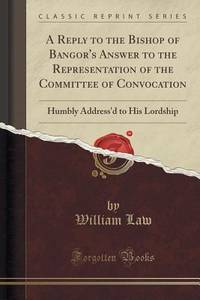
17181059271718. Dublin: Edwin Sandys for John Hyde Bookseller in Dame's Street. MDCCXVIII 1718. <br /> <br /> Small 8vo 76 1 ads pp. Disbound lacking half-title top edge trimmed with occasional loss of page numbers.<br /> <br /> § First published the previous year in London. One of three pamphlets William Law 1686-1761 contributed to the "Bangorian controversy" which erupted in 1717 when the bishop of Bangor Benjamin Hoadly delivered a sermon before the king in which he denied that the church had any doctrinal or disciplinary authority. In the war of words that ensued some 50 writers issued over 200 pamphlets. Law contributions in defense of church authority did much to bring him to public notice for the first time. A Practical Treatise upon Christian Perfection 1726 and A Serious Call to a Devout and Holy Life 1729 stern manuals for self-regulation and Christian conduct brought him some fame and the admiration of John Wesley among others though the two later quarreled. His later life and writings were strongly influenced by the German protestant mystic Jacob Boehme who was also an influence on William Blake. ESTC T172224. unknown
0332931978.Ghardcover. Good. Access codes and supplements are not guaranteed with used items. May be an ex-library book. hardcover
0259396400.Gpaperback. Good. Access codes and supplements are not guaranteed with used items. May be an ex-library book. paperback
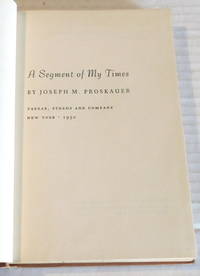
1950101195<p>New York: Farrar Straus and Company 1950. 1950. Good. - Octavo 8-1/4 inches high by 5-1/2 inches wide. Hardcover bound in peach cloth titled in gilt within a black panel on the spine. The edges of the soiled covers are rubbed with minor chipping to the head & tail of the faded spine. ix v & 270 pages. There is foxing to the rear endpaper and to the book's fore edge. Good.</p><p>First edition. Inscribed & signed by Joseph M. Proskauer on the front endpaper "For William Weiss my friend of many years and my valued colleague with warm regards / Joseph M. Proskauer".</p><p>The American lawyer judge philanthropist Joseph Meyer Proskauer 1877-1971 was partner in the firm Proskauer Rose. He was early in his career campaign adviser and speechwriter for his friend New York Governor Al Smith. Smith appointed him as a judge to the New York Supreme Court. He was subsequently appointed as an appellate judge in 1927. He chaired the New York State Crime Commission investigated organized crime from 1951 to 1953 and was involved in the creation of the Waterfront Commission.</p> New York: Farrar, Straus and Company, 1950. hardcover
1241156867.Gpaperback. Good. Access codes and supplements are not guaranteed with used items. May be an ex-library book. paperback
2010277132010. ISBN-13: 9781584770527; ISBN-10: 158477052X. Broom Herbert. A Selection of Legal Maxims Classified and Illustrated. Eighth American from the Fifth London Edition with References to American Cases. Originally published: Philadelphia: T. & J.W. Johnson & Co. 1882. lxxviii 993 i.e. 779 pp. Reprinted 2010 by The Lawbook Exchange Ltd. ISBN-13: 9781584770527; ISBN-10: 158477052X. Hardcover. New. $62.95 Reprint of the Eighth and last American edition of 1882. A substantial collection of legal maxims that is now an accepted classic. Each maxim is expertly translated and enhanced by Broom's knowledgeable explanatory essays that provide the source and meaning and are in themselves extremely well-annotated. Taken in light of his excellent classification system Broom's essays will facilitate an understanding of the principles of common law. "His is the very best book of the kind extant." Marvin Legal Bibliography 152. unknown