3 537 résultats
New English Original bdg. In publisher's special box. Folio. (33 x 29 cm). In English. 2 volumes set: (240 p., 5 unnumbered folded plates on pages; Second volume is a hard-case including two reprint panoramas and one reprint map: First panorama is a huge hand-coloured drawing shows Ottoman Palace across Sarayburnu; size 28x336 cm; Second panorama is a huge hand-coloured drawing shows Ottoman Palace across Sarayburnu again which is indicating Palace from a different angle; size 28x196 cm; and one map: 'Carta ufwer Orienten Med de Darom kring Grantzande Lander... (Turkey and its around map printed originally in early 18th century), descriptive text surrounding the map, size 65x85 cm. Cornelius Loos in the Ottoman world: Drawings for the King of Sweden, 1710-1711. [with] Panoramas & map [book]. Prep. by Lâle Uluç, David Jones, Klas Kronberg, Ersu Pekin. 2 volumes. [BOXED]. Cornelius Loos was one of the young military officers who followed Karl XII to the Ottoman Empire in 1709. From the royal headquarters in what is at present the republic of Moldova, Loos was sent to Istanbul on the King's orders in 1710. From there his journey was pursued by boat over the Mediterranean to Egypt and he returned by land through Jerusalem, Damascus, Aleppo, Konya and Izmir. Loos' mission was to make drawings of the "rarities and monuments" that he would encounter on his journey. Out of the drawings that have survived until today, one is from Palmyra, two from Rhodes and Bodrum and around forty aquarelle tush drawings from Istanbul. It is possible that part of the original drawings were destroyed in the "Skirmish at Bender" in 1713, while other works, due to various reasons, disappeared on their way to Sweden. The conserved drawings are kept at the Swedish National Museum and were exhibited there in 1985. (See catalogue titled "Cornelius Loos. Teckningar från en expedition till Främre Orienten 1719-1711", Stockholm, Nationalmuseum, 1985). The drawings represent a unique record of the urban landscape and the monuments in Istanbul in the early 18th century. The collection includes three great panoramas of the city seen from the Topkapi palace to the upper part of the Golden Horn. To the Loos paintings can be added the great Mecca painting brought to Sweden by Mikael Eneman and kept in the Uppsala University Library, and a small group of oil paintings brought back by Loos' travel companion Conrad Sparre, which are also kept in the art collection of Uppsala University. In addition there are travel accounts and correspondence from these journeys. (From the 'SRII's official site, Karin Adahl's project). "In January 1710 the Swedish king Charles XII, in exile in the Ottoman Empire, sent three of his officers on a journey from the royal camp near Bender in Moldova to travel to Constantinople and from there along the Eastern Mediterranean to Egypt. Their mission was 'to view the there existing rarities and monuments, to draw and to measure'. Cornelius Loos, one of the young officers, returned to his king in 1711 with more than 250 drawings. Only forty-nine, kept under the king's bed, survived a skirmish in the camp in 1713, the so called 'kalabalik' at Bender. King Charles had a vision to publish an encyclopaedic work about the Near East, a dream that was lost in the fire in the camp. The drawings were brought to Sweden when the king returned from the Ottoman Empire in 1714. He died in battle in Norway in 1718. Loos' drawings are unique documents of Constanttinople in the early 18th century, with large scale, detailed panoramas, important prospects of the interior of the Hagia Sophia and views from the Ottoman city. A big map is accompanied by minor drawings from the Black Sea, the Eastern Mediterranean and Egypt, as well as a spectacular set of water-colours of head dresses from the Ottoman world. The Loos collection of drawings is today kept in the National Museum in Stockholm.". Texts by Göran Baarnhielm, Ulla Ehrensvard, Nurhan Atasoy, Günsel Renda, Bo Lundstörm
11813P., Alcan, 1888, grand et fort in 8°, XXVII-519pp., plein maroquin marron de l'époque, dos à cinq faux-nerfs orné, triple filet doré encadrant les plats, titre de l'ouvrage frappé en doré au centre du plat supérieur, large dentelle intérieure, tranches dorées ; infimes frottis.
1939180510Japan. circa1939. 103 name or business cards mounted on 17 window-faced card leaves a little faded and a few tears in an album 26.2 x 18.3 cm; green linen boards gilt decorated spine a little chipped and rubbed but in remarkable original condition. An album of Japanese name cards collected in the late 1930s apparently by Bruce Rogers who held a post at the University of Oregon. The name cards which are organized roughly in alphabetical order in a purpose-made album offer a fascinating insight into the network of contacts of a western resident in prewar Japan. They include cards presented to Rogers by journalists academics businesspeople diplomats and others. Though quite a number of his contacts are Americans or other foreigners the majority are Japanese. There are three cards from George Albert Makinson 1886-1972 and his wife presented at the time when Makinson was US Consul General in Osaka a post he took up in1938 and a card presented by Parliamentary Lower House member Honda Yoshinari 1871-1952. Some of the cards include inscriptions thanking Rogers for hospitality and one particularly interesting one is inscribed with a message of introduction from a Japanese acquaintance asking for Rogers to be allowed to be present during an air-raid drill in Tokyo an omen of the approaching war. . hardcover
3231841-nnew. unknown
1901254, , 1901. In-8 de 440 pp., demi-basane brune.
238201Leipzig, S. Hirzel [Druck von Breitkopf & Härtel], 1881 - 1887 2 forts vol. in-8, LVIII pp., 562 pp. ; LXXXVII pp., 648 pp., demi-toile chagrinée Bradel noire à coins, dos ornés de filets dorés (reliure de l'éditeur).
231035Paris, Imprimerie royale, 1833 fort vol. in-4, titre, 550 pp., broché sous couverture d'attente de papier vert. Dos fendillé.
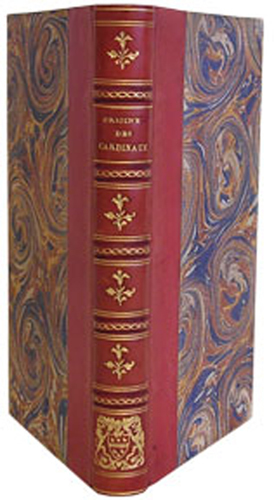
33482Petit in-12, demi-veau cerise, dos à nerfs ornés d'une guirlande et soulignés de doubles filets dorés, fleurons entrenerfs, armes dorées en pied, titre doré, tranches marbrées (rel. du XIXe), (4), 143, (1), 42, 112 p. Cologne, Pierre Ab Egmont [i.e. Bruxelles, François Foppens], 1665.
Petit in-12, demi-veau cerise, dos à nerfs ornés d'une guirlande et soulignés de doubles filets dorés, fleurons entrenerfs, armes dorées en pied, titre doré, tranches marbrées (rel. du XIXe), (4), 143, (1), 42, 112 p. Edition originale posthume "annexe aux Elzévier" et "très jolie édition imprimée par F. Foppens" (Willems) divisée en trois parties sous pagination particulière. La première contient le "Traité de l'origine des cardinaux", la seconde le traité "Des Légats…" la troisième, le "Traité de Pise…". Juriste lyonnais élève des Cujas, l'auteur devint l'un des aumôniers d'Henri IV puis de Louis XIII. Le 'traité des légats' est attribué à Jean-Denis de Sallo. Ce traité fut fait au sujet de la légation du cardinal Chisi qui devait venir en France en exécution du traité de Pise. (Brunet, II, 891. Willems, 2017). Joli exemplaire, frais, bien relié. Ex-libris imprimé de P. de la Morandière.
33495In-12, plein veau moucheté de l'époque, dos à nerfs orné de compartiments dorés, pièce de titre de maroquin rouge, tranches mouchetées (coiffe inf. et un coin usés, qqs épid.), (10), 274, (2) p., vignette de titre à la Sphère. Amsterdam, George Gallet, 1704.
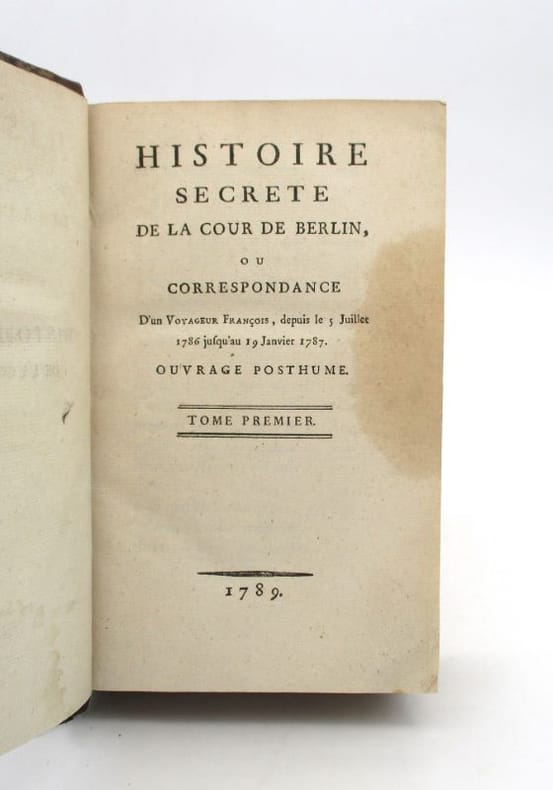
21086[Alençon, Malassis le Jeune], 1789. 2 tomes en 1 vol. in-8, 318-2 pp. + 376 pp., demi-basane brune, dos long orné de filets dorés, tranches mouchetées (dos légèrement insolé, petites épidermures, mouillure marginale aux premiers ff., rares rousseurs).
243397Paris, Félix Alcan [Typographie G. Chamerot], 1890 2 forts vol. in-8, LVIII pp., un f. n. ch., 500 pp. ; [2] ff. n. ch., 622 pp., un f. n. ch. d'errata, toile bleue, dos lisses ornés, pièces de titre et de tomaison, premières couvertures conservées (reliure du XXe siècle). Cachet (annulé).
244182S.l., 1778 in-8, titre, 39 pp., veau fauve marbré, dos lisse orné de grotesques en long, encadrement de triple filet doré sur les plats, tranches dorées (reliure de l'époque).
240672Iéna, Salomon Friedrich Bielk [Imprimerie Meyer°, 1750 in-12, [4] ff. n. ch. (titre, table des chapitres, préface), 373 pp., cartonnage Bradel de papier blanc, pièce de titre, tranches mouchetées de rouge (reliure de l'époque). Coins abîmés.
195529051Pierre de Tartas, Paris, 1955. In-4 en feuilles (33 x 26 cm), couverture estampée à froid, emboitage de l'éditeur. Edition originale publiée à l'occasion des cent cinquante ans de la Légion d'honneur et préfacée par René Coty, réunit les 10 textes suivants : Jules Renaud, Création de la Légion d'Honneur - Wilfrid Baumgartner, Les Finances - Léon Binet, Les Sciences et la Médecine - Maurice Genevoix, Les Lettres - Edouard Herriot, La Politique - Alphonse Juin, L'Armée - Carl Le Coq de Kerland, La Magistrature - Pierre Ricard, L'Industrie et le Commerce - Comte de Saint-Quentin, La Diplomatie - Georges d'Heylli et Pierre de Tartas, Le Palais de la Légion d'honneur. Elle est illustrée par Josso de 16 burins originaux (un frontispice, un titre gravé, 10 hors-texte (dont 3 sur double page et 4 in-texte) et de 11 bois représentant différentes médailles et imprimés in-texte à côté de la première initiale de chaque chapitre. Tirage limité à 400 exemplaires numérotés, celui-ci l'un des 50 exemplaires sur papier du Val de Laga à la main, nominatif (n° 46), comportant une suite des planches sur vélin de Rives et une suite des bois sur chine.- 2010g.C. - Rousseurs claires inégalement, suite en bel état de fraicheur. Peu courant
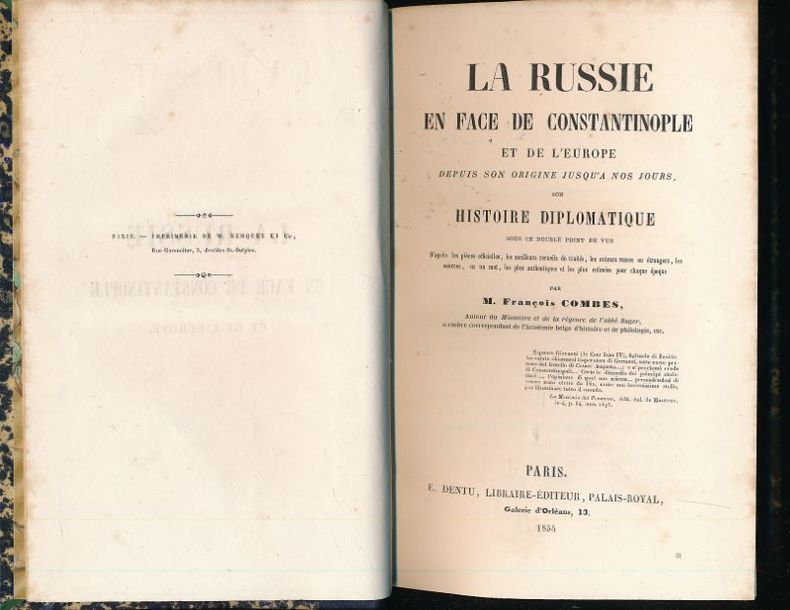
1854152429E. Dentu Paris, E. Dentu, 1854. In-8 relié demi basane noire, dos à nerfs soulignés de pointillés et filets dorés. xii + 536 pages. Rares rousseurs pâles. Bel exemplaire, peu courant.
Paris, E. Dentu, 1854. In-8 relié demi basane noire, dos à nerfs soulignés de pointillés et filets dorés. xii + 536 pages. Rares rousseurs pâles. Bel exemplaire, peu courant.
238567Paris, E. Dentu [Imprimerie Balitout], 1885 - 1889 5 vol. in-12, demi-percaline Bradel cerise, dos ornés de filets et fleurons dorés, pièces de titre noires (reliure de l'époque).
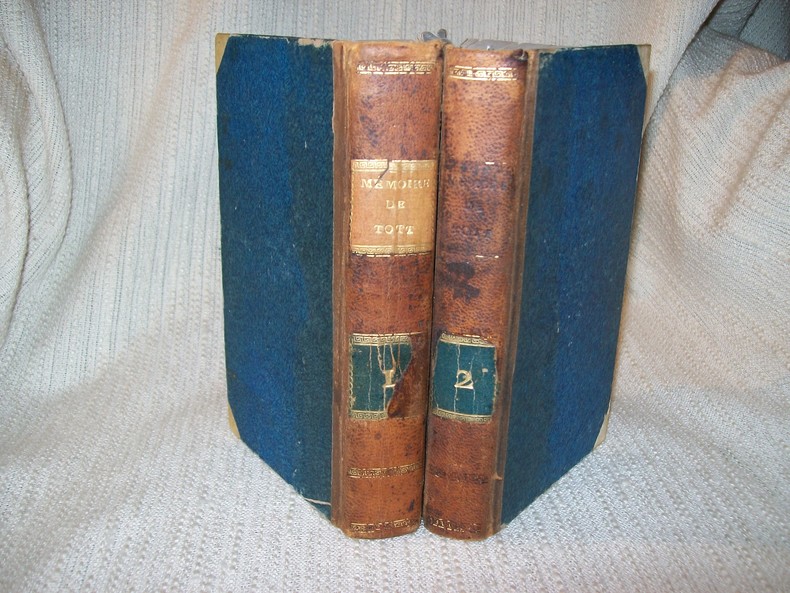
1785GITe002A Amsterdam 1785. 4 parties en 2 volumes in-12 1re) 1 feuillet non chiffré (titre) 4-222pp 2°) 1 feuillet non chiffré (titre) 4-207pp 3°) 1 feuillet non chiffré (itre) 4-183pp 4°) 1 feuillet non chiffré (titre) 4-152pp. Demi basane brune à petits coins de vélin ivoire, dos lisse orné de grecques dorées, pièce de titre ocre et de tomaison bleu nuit, plats de papier indigo, reliure de l'époque. Grecques sur les dos en partie effacée, manque la moitié de la pièce de tomaison du Tome I, sans la pièce de titre du Tome II, intérieur frais. Exemplaire bien complet des quatre parties et du texte.
Madrid, en la Oficina de Pantaleón Aznar, 1785. 8vo.; 2 hs., 202 pp. y 1 h., de Erratas, rasgada en su mitad inferior, sin pérdida de texto. Buen papel. Ejemplar carente de las dos láminas que suelen acompañar el ejemplar. Encuadernación moderna en media tela.
29222In-8, broché, couverture imprimée, (2) f., cxi, 297 p., non coupé. Paris, Paulin, 1841.
In-8, broché, couverture imprimée, (2) f., cxi, 297 p., non coupé. Edition originale de cet ouvrage, réunion de trois essais, dont "De l'état actuel des partis en France..." qui obtint un retentissement considérable dans les milieux libéraux, précédés d'une importante introduction (111 p.) datée de novembre 1841. "Ouvrage déterminant pour l'histoire politique du régime, car expliquant la rupture opérée chez les doctrinaires après l'arrivée de Guizot au pouvoir" (B. Yvert, 'Politique libérale', n°79). Fidèle à ses idéaux réformistes et libéraux, avec l'acuité et la pertinence visionnaire qui le caractérisait, Duvergier de Hauranne critique le nouveau ministère Guizot et la politique des doctrinaires, qu'il avait pourtant soutenus à ses débuts, égarés dans des querelles de personnes et de "prééminence". De dures attaques s'adressent au roi Louis Philippe, à sa dérive monarchique et la trahison des idéaux libéraux des débuts de son règne. L'auteur dresse un tableau de "l'état des partis en France" et propose des réformes. Quant à la diplomatie française, il critique ses errements et sa faiblesse coupable que ce soit sur la question d'Orient ou dans ses rapports avec ses voisins de Grande-Bretagne ou d'Allemagne. Très bon exemplaire, très frais, entièrement non coupé, tel que paru.
32 pages. Features: Cover photo of the U.S.S. West Virginia; New York's Little Joke on New York - a study of the prohibition referendum - an oasis that proved to be a mirage; The Sesqui-Centennial Nears Its End - article with photos; 'Coin' Harvey - Prophet of Monte Ne - he would build a pyramid in the Ozarks to tell posterity why our civilization has failed; Painless Taxation - The Refuge of Quack Politicians who advocate 'painless' taxation; The Greatest Need of the U.S. Navy - an adequate merchant marine; A Tale of The Islands That Dot Boston Harbor; Henry Ford's Page - today's farming problem; Editorials - Judge William S. Kenyon on Official Etiquette, Our new diplomacy, the very mushroom growth of jazz is enough to predict its ephemerality, New light on the Dawes Plan; Our Greatest Football Fable - The All American Team; The Tragic Story of the Jeannette Expedition - Part II of this photo-illustrated article ; Dances of Olden Times; The Lure of the Puppet - Marionettes date from the dawn of civilization; Chats with Office Callers; I Read in the Papers; Great photos inside back cover. Unmarked with average wear. A worthy vintage copy. Book
170396Londres, Samuel Harding, 1749 2 vol. petits in-8, [6]-358 et [2]-370 pp., avec un portrait-frontispice, basane fauve, dos à nerfs cloisonnés et fleuronnés, pièces de titre et de tomaison, tranches marbrées (reliure de l'époque). Deux coiffes rognées, coupes et coins frottés.
153326Londres, 1814 in-4, 2 pp. sur double feuille, tranches dorées.