17 206 résultats
23200Paris, Edouard Cornély & Cie, éditeurs, 1907. With portrait-frontispiece and 11 plates, 1 facsimile and 2 maps. xl, (2), 688 pp. 8vo. Contemporary half vellum, marbled boards, original covers preserved. Stammhammer, Bibliographie des Sozialismus, iii, p. 272. Original edition. Indispensible source for the study of the Icarian movement. The author made use of the archives of Beluze, today dispersed and even partly lost. The bibliography is the best known and most elaborate. - Wonderful copy: with a handwritten and signed dedication by Prudhommeaux on the half-title and with a coloured portrait of Cabet painted on the spine.
17106Paris, au Comptoir des imprimeurs-unis, 1848. (4), 188 pp. 16mo. Modern half morocco, spine with raised bands and gilt lettering, marbled boards, original covers preserved. DBMOF, iii, pp. 297-298. Second edition, revised and augmented, published in the same year as the first edition. 'Charles Renouvier, Philosophe, né à Montpellier en 1815, mort en 1903. Il s'intéressa de près au développement du saint-simonisme, et le libriarie d'ancien, Michel Bernstein, nous a communiqué les volumes de sa collection du Globe, où se lisaient quelques annotations de sa main' (Maitron). Gaston Richard, in his study La Question sociale et le Mouvement Philosophique au XIXe siècle states however: 'Renouvier avait adhéré dans sa jeunesse à l'école sociétaire de Charles Fourier. Il ne rompit jamais avec elle et tint toujours compte de ses jugements. La Critique philosophique qu'il fonda après 1870 admit des fouriéristes parmi ses collaborateurs, notamment Charles Pellarin'. The first edition of this text, also published in 1848, scandalized people and provoked the resignation of Carnot as minister. Renouvier recommended the abolition of interest on capital by means of credit institutions; to bring commerce and trade under the exclusive control of the government; pleading for progressive taxation aiming at complete equality. On the pages 137-141 of this improved edition, Renouvier explains his tax ideas in mathematical formulae. - A bit spotted and browned, very rare.
177747694Lausanne: Société Typographique 1777. Second Edition. Two volumes in one; small 12mo 16cm.; slightly later paper-covered boards manuscript private library spine labels all edges speckled red; 2viii248; 2iv250pp. Spine a bit sunned corners bumped light spotting to boards tiny rubberstamps of a Donaueschingen library to both title page versos else a Near Fine internally fresh copy half titles present. First published one year prior in 1776. Both a critique and history of European inequality by the French philosopher deeply influenced by the works of John Locke. Described as an "avant-garde thinker of utopian socialism" Sophus Reinert and Steven Kaplan eds. "The Economic Turn" 2019 p. 339 the Abbé de Mably 1709-1785 roundly rejected any institution that could reduce the well-being of one in favor of another among these the concept of private property. Indeed in Chapter IV in the first volume states that it be necessary for legislation to "turn all its forces against avarice and ambition" p. 96 our translation. A life-long friend of Jean-Jacques Rousseau the underlining theme of the work consistently circles back to the concept of "Nature" in this case self-preservation at present undermined by the state of society. Société Typographique unknown books
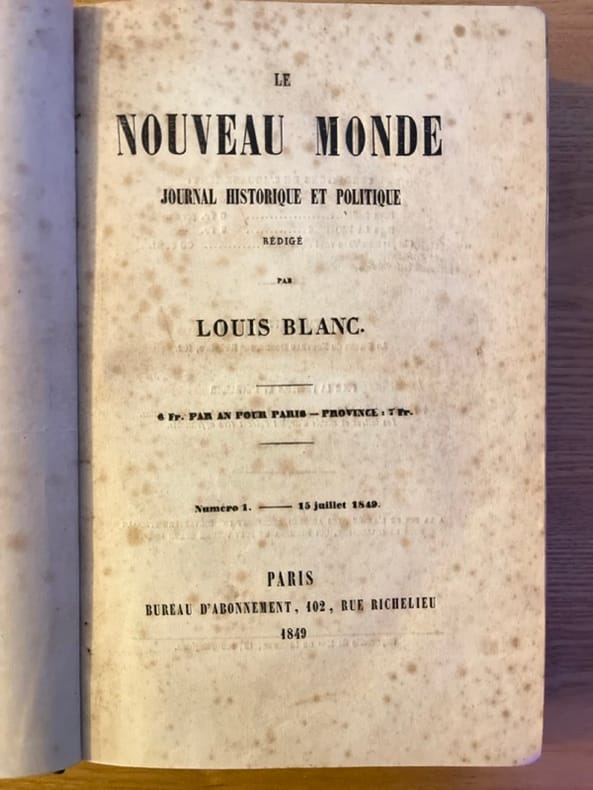
276du numéro 1 ( 15 juillet 1849 ) au numéro 12 ( 15 juin 1850 ) pagination distincte pour les quatre premiers numéros puis suivie petit in 4 relié demi basane 572 pages - quelques mouillures en bas de pages
1st edition. Stiff Wrappers, 4to, 8-36 pages each issue. In Yiddish. Daily writeups from the Workmens Circle Annual convention, here bound together with the annual joke issue, "Der Bezem, " a kind of April Fools Day-like response to the convention. This is not a kind of post-convention wrap-up, but rather daily news for the delegates as it unfolds. Most issues include numerous cartoons, photos, etc. Important Depression-era volume. "Aroysgegebn fun der konvenshon arandzshments komite; redagirt fun F. Gelibter un L. Ratman." Presume given only to delegates and not published and distributed further afield. We were unable to locate a single holding of this volumes anywhere, and only 3 holdings of any other volumes of it (Harvard, Brandeis, Illinois). SUBJECT(S) Jews -- United States - Congresses. Workmen's Circle (U. S. ) -- Congresses. Very Good Condition. Rare. (Y-4)
13039Paris, (Imprimerie de A. Vallée), 8 Mars-11 Mars 1871. 2 numbers of together 48 pp. Small 8vo. Modern cloth, black label with gilt lettering. Del Bo, Comune di Parigi, p. 5; Noël, Dictionnaire de la Commune, p. 199; Le Quillec, 324; Schulkind Commune Collection, p. 28; not in Lemonnyer, Les Journaux de Paris; not in Maillard; not in Drujon. All published. The publication was forbidden after the publication of nr 2 by order of General Vinoy, on March 11, 1871. Grousset founded also the well-known journal L'Affranchi.Paschal Jean François Grousset started as a doctor but became soon involved in politics and journalism opposing the Second Empire. He became director of La Marseillaise in which he launched a campaign against the prince Pierre Bonaparte. He was an active member of the Paris commune, was arrested and deported to Nouvelle-Calédonie from which he managed to escape with Jourde, Rochefort and 4 others: the only succesful escape in the history of the deportations!
13568Jersey, London, 1853-1856 (Paris, EDHIS, 1977). 132 nrs and 2 supplements, in 1 volume. Large folio. Imitation leather. Numbers 1-53 (30 novembre 1853-29 novembre 1854); numbers 1-53 (6 decembre 1854-28 decembre 1855); numbers 107-132 (1 mars 1856-28 aout 1856). The two supplements are to be found after number 45 of the first series and is entitled 'Discours de Victor Hugo prononcé le 27 septembre 1854 sur la tombe du Citoyen Felix Bony, proscrit français, mort a Jersey', the second is to be found after number one of the second series and is entitled 'Discours de Louis Kossuth.' Very well executed reproduction on good paper of the complete text of this famous international journal in a limited edition of 150 copies. The journal was severely prosecuted at the time throughout Europe. The editors were Victor Hugo, Louis Blanc, Felix Pyat, Pierre Leroux, Ledru-Rollin, Victor Schoelcher for the French, Alexander Herzen for the Russians, Dombrowski, Oborski, Zeno Swietoslawski and Worcel for the Polish, Louis Kossuth and Sandor Teleki for the Hungarians, Mazzini, Mazzolini, Aurelio Saffi for the Italians, W.W. Linton and G. Julian Harney for the English, Geurz for the Germans, and other famous collaborators such as Barbès, Jeanne Deroin, Constantin Pecqueur, etc.L'Homme was the first international journal and prosecuted in all European countries, it was created at the moment that almost all democratic and socialist journals had dissappeared in continental Europe. It is an indispensable source for the revolutionary and socialist movements in the 19th century, linking the 1848 revolution to the birth of the Workers' International in 1864, the revolution of September 1870, and the Commune of Paris.
237210Paris, Imprimerie de Mme Lacombe, 1849-1851 18 livraisons en 1 vol. gr. in-8, portrait de Louis Blanc, il manque les pages 41-42 du premier numéro, demi-percaline verte (reliure de l'époque). Plats frottés, coupes et coins très abîmés. Des rousseurs, parfois très fortes. Petites déchirures en marge inférieure de quelques pages, sans atteinte au texte.
Original Paper Wrappers, 8vo, ca. 100 pages. Monthly Bundist periodical ran from Vol. I, Nr, 1 (Oct. 1927) to 1932. 23 cm. In Yiddish. Unobtrusive Bund rubber stamp. Levin (1977) reports that it was in UNZER TSAYT that the very first reports of the Bund's split over the National Question with the Russian Social Democrats were published (in 1927). The Bund in Poland, here providing its unique Polish Jewish Socialist anti-Zionist perspective. The General Jewish Labour Bund in Lithuania, Poland and Russia (Yiddish: algemeyner yidisher arbeter-bund in lite, poyln un rusland), generally called The Bund or the Jewish Labour Bund, was a secular Jewish socialist party.... founded in Vilnius on October 7, 1897 ..In 1917 the Polish part of the Bund, which dated to the times when Poland was a Russian territory, seceded from the Russian Bund and created a new Polish General Labor Bund which continued to operate in Poland in the years between the two world wars .The Bund sought to unite all Jewish workers in the Russian Empire into a united socialist party, and also to ally itself with the wider Russian social democratic movement to achieve a democratic and socialist Russia. The Russian Empire then included Lithuania, Latvia, Belarus, Ukraine and most of present-day Poland, areas where the majority of the world's Jews then lived. They hoped to see the Jews achieve a legal minority status in Russia. Of all Jewish political parties of the time, the Bund was the most progressive regarding gender equality, with women making up more than one-third of all members. The Bund actively campaigned against anti-Semitism. It defended Jewish civil and cultural rights and rejected assimilation. However, the close promotion of Jewish sectional interests and support for the concept of Jewish national unity (klal yisrael) was prevented by the socialist universalism of the Bund. The Bund avoided any automatic solidarity with Jews of the middle and upper classes and generally rejected political cooperation with Jewish groups that held religious, Zionist or conservative views. Even the anthem of the Bund, known as "the oath" (di shvue in Yiddish), written in 1902 by Sh. An-ski, contained no explicit reference to Jews or Jewish suffering. At the heart of the vision of the future of the Bund was the idea that there is no contradiction between the national aspect on the one hand and the socialist aspect on the other. As a strictly secular organization, the Bund renounced the Holy Land and the sacred language (Hebrew) and chose to speak Yiddish .In its early years the Bund had remarkable success, gaining an estimated 30,000 members in 1903 and an estimated 40,000 supporters in 1906, making it the largest socialist group in the Russian Empire . the Bund was a founding collective member at the RSDLP's first congress in Minsk in March 1898. For the next 5 years, the Bund was recognized as the sole representative of the Jewish workers in the RSDLP, although many Russian socialists of Jewish descent, especially outside of the Pale of Settlement, joined the RSDLP directly .The Bund generally sided with the party's Menshevik faction led by Julius Martov and against the Bolshevik faction led by Vladimir Lenin during the factional struggles in the run-up to the Russian Revolution of 1917 .In the Polish areas of the [Russian] empire, the Bund was a leading force in the 1905 revolution. At that time the organization probably reached the height of its influence. It called for an improvement in living standards, a more democratic political system and the introduction of equal rights for Jews. At least in the early stages of the first Russian Revolution, the armed groups of the "Bund" were likely the strongest revolutionary force in Western Russia. During the following years, the Bund went into a period of decay .The Bund eventually came to strongly oppose Zionism, arguing that emigration to Palestine was a form of escapism. The Bund did not advocate separatism. Instead, it focused on culture, rather than a state or a place, as the glue of Jewish nationalism. . The Bund also promoted the use of Yiddish as a Jewish national language and to some extent opposed the Zionist project of reviving Hebrew. The Bund won converts mainly among Jewish artisans and workers, but also among the growing Jewish intelligentsia. It led a trade union movement of its own. It joined with the Poalei Zion (Labour Zionists) and other groups to form self-defense organisations to protect Jewish communities against pogroms and government troops. During the Russian Revolution of 1905 the Bund headed the revolutionary movement in the Jewish towns, particularly in Belarus and Ukraine ..In 1921, the Communist Bund [in the USSR] dissolved itself and its members sought admission to the Communist Party....Many former Bundists, like Mikhail Liber and David Petrovsky, perished during Stalin's purges in the 1930s. The Polish Bundists continued their activities until 1948. During the latter half of the 20th century the Bundist legacy was represented through the International Jewish Labor Bund, a federation of local Bundist groups around the world .Among the exiled Bundists who went on with Socialist politics in America was Baruch Charney Vladeck (18861938), elected to the New York Board of Aldermen as a Socialist in 1917 [and] 1937 [and] manager of The Jewish Daily Forward Moishe Lewis (18881950)....the father of David Lewis (19091981), a leader of the New Democratic Party in Canada .David Dubinsky (18921982), though never formally a member of the party, had joined the bakers' union, which was controlled by the Bund, and was elected assistant secretary within the union by 1906 ..He later became a member of the Socialist Party of America, helped found the American Labor Party in 1936 and was from 1932 till 1966 the leader of the International Ladies' Garment Workers' Union ..under the name Max Goldfarb, David Petrovsky (18861937) was a member of the Central Committee of the Jewish Socialist Federation of America, a member of the Socialist Party of America, and the labor editor of The Forward (Wikipedia). SUBJECT(S) : Jews -- Poland -- Periodicals. Jewish labor unions -- Periodicals. Socialism and Judaism -- Periodicals. Yiddish literature -- Poland -- Periodicals. OCLC Number: 642969688. OCLC lists only 4 runs (Arizona State, Stanford, LOC, U of Washington), all of which appear to be incomplete. Use wear, paper brwoning but not fragile. Good Condition. (y-1-11)
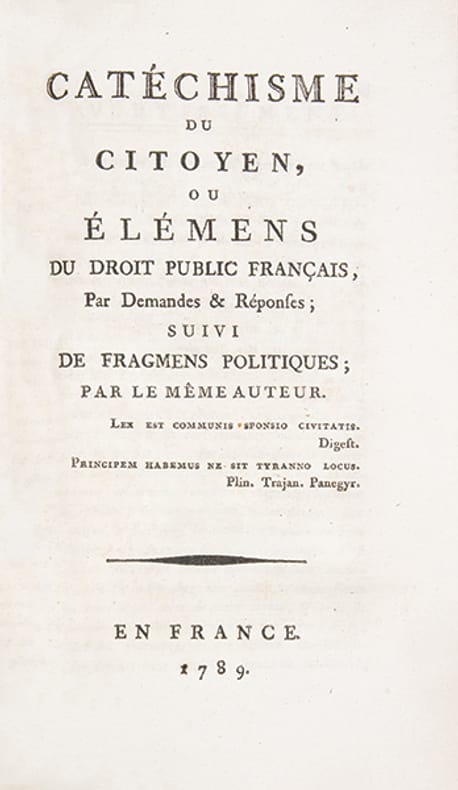
18078En France, 1788. 220, (2) pp. 8vo. Modern half red morocco, marbled boards, gilt lettering. INED 4025; Mornet 1363; Le Bucher Bibliographique, 607; Peignot, i, 298; Darnton, The Corpus of Clandestine Literature in France, 1769-1789, 81. One of the two issues of the improved 1788 edition, enlarged with the 'Fragmens politiques', including a.o. 'Réflexions sur les droits des Etats Généraux, relativement à la concession des subsides'; 'De l'autorité des magistrats', etc. The book was first published in 1775 and almost immediately forbidden and suppressed. The work is cited as one of the most radical and serious attempts to maximalize the theory of Rousseau's Contrat Social and stating that nothing supercedes the social contract and the "general will." "Written in response to Chancellor Maupeou's attack on the parlements in 1771, the Catéchisme contained a radical statement of the doctrine of national sovereignty, not simply in the abstract terms of Rousseau's Contrat Social or the more congested historical formulations of the parlementary Maximes du droit public français, upon both of which it drew, but in the more immediate question-and-answer form of a political catechism offering a direct response to a precisely defined act of royal despotism, and culminating in a clear choice between revolution and the destruction of the political order. "Once one has read it, one is not surprised that the partisans of despotism have made such efforts to annihilate it," commented Pidansat de Mairobert in his Mémoires secrets. (...... As a result, copies of the 1775 edition are extremely rare.) Yet the interest of the work remains, not simply because it offered the most radical expression of the principle of national sovereignty, but also because it reappeared in 1787 and went through several editions in 1788 buttressed with additional fragments called forth by the events of the Pre-Revolution" (see: Keith M. Baker, "A classical republican in eighteenth-century Bordeaux: Guillaume-Joseph Saige" in: Inventing the French Revolution, Cambridge, 1990, pp. 128-151). - Slightly stained at blank upper margin throughout.
37103In-8, broché, couverture papier d'origine, pièce de titre imprimée, xij, 158 p. Paris, Louis Colas, Treuttel et Wurtz, 1820.
In-8, broché, couverture papier d'origine, pièce de titre imprimée, xij, 158 p. Edition originale, rare, de cet ouvrage fondateur que de Gérando composa suite au concours lancé en 1816 par l'académie de Lyon sur le thème: "Indiquez les moyens de reconnaître la véritable indigence et de rendre l'aumône utile à ceux qui la donnent et à ceux qui la reçoivent". L'auteur conteste les théories malthusiennes et jette les bases des principes de la politique sociale moderne, en particulier sur la question du "droit à l'assistance", de l'intervention de l'État, d'une meilleure coordination entre action publique et privée... Il oppose aux formes "oisives" de la charité une assistance "active", fondée sur la prévention et une aide adaptée à chaque besoin. Le "visiteur du pauvre", clef de voûte de ce système, est l'administrateur qui assure, en relation directe avec les assistés, le contrôle et l'application de ces mesures. En annexe, un modèle de livret pour le suivi de chaque pauvre ("Endéiamètre") et des textes législatifs de 1816 qui avaient dirigé le travail de Gérando. Cf. "Observer, normaliser et réformer la société du premier XIXe s.. J.-M. de Gérando (1772-1842) au carrefour des savoirs", Colloque, mai-juin 2012 à Lille, dir. J.-L. Chappey, C. Christen et I. Moullier. Quelques accrocs de papier à la couverture. Auréole claire en coin des premiers feuillets, quelques rousseurs.
1788391221788 In-8 (193 x 120 mm), plein veau porphyre de l'époque, dos à 5 nerfs guillochés, orné de compartiments fleuronnés et garni d'un fer à l'urne répété, tranches mouchetées bleues, iv, [-5], 159 pages. En France, 1789.
176546404304A Amsterdam, Marc Michel Rey, 1765 ; in-8, basane fauve marbrée, armes dorées sur les plats, dos orné, tranches rouges. (Reliure du XIXe siècle dans un style XVIIIe) VII pp., 312 pp.Ouvrage posthume, publié par le Marquis de Paulmy, le fils de l’auteur. “L’évolution d’Argenson sur la base des principes dont on trouve les prémisses dans cet ouvrage (voir les développements consacrés à Lycurgue) radicalisa sa critique des vices de la propriété individuelle, jusqu’à faire de lui, ainsi que que le conclut Lichtenberger, citant Rathery, “un des grands précurseurs de nos réformes économiques et sociales”. Dans cet ouvrage, d’Argenson cherchait à “établir les principes d’un gouvernement démocratique et municipal. L’édition qui s’introduisait en France était très altérée, le véritable titre étant : Jusqu’où la démocratie peut s’étendre dans un Etat monarchique. On avait dû mettre beaucoup de cartons, et même adouci, le livre était poursuivi” - Belin. Le mouvement philosophique p. 182 - Jammes. Le bûcher bibliographique 481.INED p. 12 “ Sa doctrine économique a de nombreux points communs avec celle des disciples de Quesnay. Si les physiocrates ne reconnurent pas en Argenson un précurseur direct, du moins ils lui adressèrent les mêmes éloges qu’à Gournay”.Barbier 720 se trompe en donnant 1765 comme date de l’originale. Les Considérations ont été publiées pour la première fois en 1764 à Amsterdam chez Marc Michel Rey, le grand éditeur des Lumières. Cette édition de 1765 porte bien son adresse mais il s’agit d’une contrefaçon probablement parisienne. On connaît au moins trois contrefaçons de ce livre célèbre, publiées en 1764 et 1765. Voir Deux siècles de contrefaçon. Dijon, Univ. de Bourgogne et Bibl. municipales, 1987 pp. 26-27Exemplaire relié aux armes et portant l’ex-libris du Comte Balincourt, héritier de la bibliothèque P. Guiraudi (Reinaud et R. de Genas).
230813Paris, chez Langlois et Leclercq, 1847-1862 12 vol. in-8, demi-basane turquoise, dos lisse orné, couv. cons. (reliure de l'époque). Rousseurs. Dos passé.
232662Paris, A. Lacroix et Cie, 1878 15 tomes en 8 vol. in-12, demi-maroquin vert, dos à nerfs, tête dorée (reliure de l'époque). Rousseurs. Dos passé.
168505Paris, Prévot, Rouannet et Chamerot, 1841 in-8, 112 pp., broché. Qqs mouillures et rousseurs.
39519In-12 (178 x 115 mm), cartonnage éditeur polychrome daprès la maquette de Mario Prassinos, 382 p., (1) f. dachevé dimprimer. Paris, Gallimard, 1951.
18443216Paris Librairie de l’École sociétaire 1844 In-8 (22 x 14 cm.), XII-490 pp. demi-reliure chagrin havane, dos à nerfs.
190828102Paris 1908-1912 | 12.50 x 19 cm | 6 volumes reliés
4 fort volumes in-4, demi-toile grise, dos lisses, pièce de titre de maroquin rouge. Les quatre premiers volumes qui contiennent les dépositions de témoins. Bon exemplaire, relié, très frais.
238102Paris, Lib. Phalanstérienne, 1848 in-8, VII-264-21 pp. (Doctrine de l'harmonie universelle...), broché. Couverture très abîmée, dos renforcé.
In 8, pp. 80 con 1 ill. xil. a piena p. raff. una phalange per 1800 abitanti. Br. ed. con la pianta di un falansterio in 4o di copertina. Risposta all'astronomo Arago in occasione del suo discorso tenuto il 16 maggio 1840, in favore del suffragio universale e contro i falansteri: "nous ne poursuivons aujourd'hui qu'une seule chose, la realisation du systeme de l'organisation du travail qu'il a decouverte (Fourier) et decrit sous le nom de phalange et nous donnons a' M. Arago l'assurance formelle, que nous ne cherchons point a' cre'er dans le pays une parti contre la lune". Considerant coglie l'occasione per ribadire le idee fondanti del fourierismo e riconosce alle posizioni di Arago legate ai problemi della "cuncurrence anarchique", della "fe'odalite' industrielle" una coincidenza con le posizioni sostenute da Fourier a partire dal 1808, accusandolo, pero', di confondere i rimedi (suffragio universale). La seconda parte di questo scritto e' dedicato alla questione del diritto di proprieta', intimamente legato al diritto al lavoro. Queste teorie saranno in seguito sviluppate da Considerant nell'opera Theorie du droit de proprie'te' et du droit au travail del 1848. Nel 1849, costretto all'esilio in Belgio, parti' per gli Stati Uniti dove fondo', grazie ai finanziamenti dell'industriale Godin, il falansterio di La Reunion. L'esperienza falli' e Considerant si ritiro' a S. Antonio. Nel 1869, tornato in Francia, aderi' alla Prima internazionale e alla Comune di Parigi. Einaudi, 1242.
230377Paris, Librairie Phalanstérienne, décembre 1850 in-8, 63 pp., broché. Qqs rousseurs.
In 8, pp. 96. Macchie al marg. int. della prima e ultima carta. Minuscolo forellino di tarlo da p. 57 fino alla fine che lede qualche sporadica lettera del testo. Br. rifatta. Ed. orig. dell'opera di questo sociologo e botanico spagnolo. Ebbe prima la cattedra di botanica a L'Avana. Qui pubblico' la sua monumentale Historia fisica politica y natural de la isla de Cuba. Viaggio' molto, anche negli Stati Uniti e in Europa. Nel 1848 e' in Francia, con Prudhon tenta la creazione di un Banco popolare e lotta per la creazione di un nuovo e piu' giusto ordine sociale che corregga le storture generate dalla nuova societa' industriale. Non e' tuttavia un rivoluzionario - le sue idee sono tratte in gran parte da Fourier e Saint Simon - e crede che si possa giungere a dei cambiamenti sostanziali attraverso l'educazione. Nel 1845 fonda in Spagna 'El Porvenir', la prima rivista anarchica della penisola iberica, poi chiusa nell'arco di breve tempo.