17 203 résultats
1st edition. Original paper wrappers. 4to. Each issue is approximately 50 pages, 30 cm. In English. April, 1950 is a special issues celebrating the 7th Anniversary of the Warsaw Ghetto Uprising; May 1950 celebrates the second anniversaryof the founding of the State of Israel. From the height of the Cold War, Atom Spy, and Rosenbergs era. Jewish Life was a periodical that focused on the intersection of Jewish life and progressive politics. The periodical was under the auspices of the Communist Party until 1956. A notable contributor was Betty Friedan, whose 1963 "The Feminine Mystique" is credited with starting the modern feminist movement in the United States. (Horowitz, 2000) . SUBJECTS: Jewish way of life -- Periodicals. OCLC: 898470599. Very Good+ Condition. Stunning Copies(YID-33-75)
1st edition. Original paper wrappers. 4to. Each issue is approximately 50 pages, 30 cm. In English. August 1953 celebrates the "Legacy of the Rosenbergs." Nov 1953 features an essay by Charles Allen: "McCarthy--Enemy of the Negro People." April 1954 celebrates the 11th anniversary of the Warsaw Ghetto Uprising, with an illustration on the cover. May 1954 includes "The Jews and American Slavery,' by the editor, Morris U. Schappes, as well as reports on Jewish life in Eastern Europe. Aug 1954 Includes three essays on "Jews in Socialist Countries" as well as three essays on "The Jew in Fiction." Sept 1954 inclues two essays on McCarthyism, as well as "We were Always Part of America: Declaration of Committee for 300th Anniversary of Jews in USA." Oct 1954 includes "What to do About the H-Bomb?" as well as "Jewish Stake in the Elections," "Uriel Acosta: Unpublished Chapter by V.J. Jerome," and "An Interview with Ehrenburg" by Ben Cohen. From the height of the Cold War, Atom Spy, and Rosenbergs era. Jewish Life was a periodical that focused on the intersection of Jewish life and progressive politics. The periodical was under the auspices of the Communist Party until 1956. A notable contributor was Betty Friedan, whose 1963 "The Feminine Mystique" is credited with starting the modern feminist movement in the United States. (Horowitz, 2000) . SUBJECTS: Jewish way of life -- Periodicals. OCLC: 898470599. April 1954 issue is browning with some edgewear, all others are Very Good+ Condition. Stunning Copies (YID-33-75A)
tre volumi in 4°, bross. edit. con titoli, dorsi muti - esemplare di 250 copie roneate in proprio dai redattori di «AGR» e diffuse «fuori commercio» - prima edizione
1974501248Leipzig, 1974. Fol. 24 (dav. 21 farb.) Plakate in d. Originalgr. M. 12 S. Text. In OLwd.-Kassette. Etwas angeschmutzt. Innendeckel u. Tafeln verso m. Bibl.-St.
- Au bureau du Globe et de l'Organisateur, Paris 1831, 14x22cm, broché. - Troisième édition. Petits manques en tête et en pied du dos, un léger manque affectant un mors, rousseurs afectant essentiellement les premières et dernières pages, tampon de bibliothèque. Rare. [ENGLISH DESCRIPTION ON DEMAND]
- Imp. de Pierre Leroux, boussac 1848, 12x17,5cm, relié. - Nouvelle édition. Reliure en demi basane sapin, dos lisse orné de sextuples filets dorés comportant de très légères traces de frottements, frise dorée en queue, pièce de titre de maroquin rouge, une étiquette de classement de bibliothèque en queue du dos, plats de papier marbré, gardes et contreplats de papier à la cuve. Rares rousseurs, tampon imprimé de bibliophile en pied de la page de faux-titre en guise d'ex-libris. [ENGLISH DESCRIPTION ON DEMAND]
184821650Paris 1848 1 feuillet plié en deux sur papier crème manuscrit à l'encre brune sur les deux premières pages, format : 20,5 x 13,3 cm, adresse manuscrite au centre de la 4ème page ; Monsieur Louis Petit, sous directeur de la Cie des Remorqueurs de la Loire, quai Turenne, Nantes....avec cachet rond de la poste ; "Paris 27 Juin 48" en noir,
Dal numero 1 del 2 Gennaio 1862 al numero 52 del 25 Dicembre 1862
19358059Gründ 1935 In-4 cartonnage toilé de l’éditeur, couverture rempliée, 219 pp. en parti non coupé. 48 gravures hors-texte, 12 en couleurs. Couverture ternie, accroc d’humidité en pied. Int. très frais.
Very Good Arabic Early edition of a study on Saad Zaghloul and Adly ibn Khalil Yakan hostility in Egyptian Wafd Party. Zaghloul, (1857-1927), was an Egyptian statesman and patriot, leader of the Wafd Party, and of the nationalist movement of 1918-19, which led Britain to give Egypt nominal independence in 1922. He was briefly prime minister in 1924. Adly Yakan Pasha was an Egyptian political figure. He served as the 14th Prime Minister of Egypt between 1921 and 1922, again between 1926 and 1927, and finally in 1929. This book describes in all detail the veto of Adly Pasha on the Milner Report and the conflict between him and Zaghloul. Half leather bdg. made by "Abd al-Zahir" bindery of Egypt. Six raised bands to spine with Arabic letter gilt. Cloth boards. Demy 8vo. (21 x 15 cm). In Arabic. 200 p., portaits and b/w ills. Offset lithography. First and Only Edition. Scarce. OCLC 741068965, 23485359, 236001837, 4770913140 (Arab Union Catalog). Not translated into any Western languages.
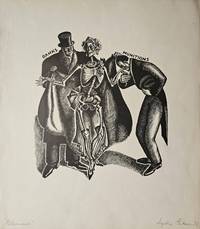
1936List3310United States 1936. Lithographic illustration measuring 12 x 13 ¾ inches. Unnumbered titled and signed recto in pencil matching handwriting of other known examples. Near Fine. A lithograph by American socialist artist Lydia Gibson 1891–1964. Gibson contributed artworks to radical publications including The Masses The Liberator New Masses and others. This illustration titled Glamour depicts two well-dressed gentlemen labeled “Banks†and “Munitions†courting a bejewelled lady skeleton whose tiara reads “Warâ€. More than a straightforward pacifist sentiment Gibson makes the now-familiar critique that industries that stand to profit off of war will ‘court’ it. A striking piece of twentieth-century socialist art. unknown
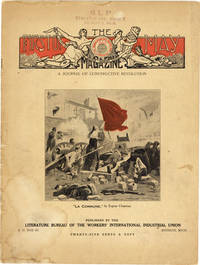
191943046Detroit / Troy: Literature Bureau of the Workers' International Industrial Union 1919 - 1923. First Edition. Quarto 30cm. Staple-bound pictorial card wrappers; 40pp; illus. Issue for 1919 in clean unmarked condition Very Good or better. Issue for 1923 worn with wrappers darkened and stained contents slightly age-toned with corner-creases and occasional thumb-soil; complete and just Good. Annual souvenir of the Workers' International Industrial Union. The WIIU the labor union arm of the Socialist Labor Party was effectively formed in 1908 following the split of the SLP faction from the Industrial Workers of the World; the group identified itself as the 'Detroit IWW' until 1915 at which point the name was changed to Workers International Industrial Union a typically De Leonist mouthful!. The WIIU never throve; its membership probably never numbered above about 2500 workers a number that dropped quickly following the death of Daniel De Leon in 1915. By the 1920s the WIIU was an afterthought and the group was finally disbanded in 1925.<br /> <br /> Contents include articles by Michael Altschuler Herman Richter W.J. Dodge Henry Kuhn and others; literary contributions by Samuel French Fred H. Hartmann Richard Le Galienne William Morris and Walt Whitman; portraits and reproductions of artworks by Eugene Higgins Jan Styka and Eugene Chaperon. An attractive and rather uncommon American labor souvenir book; OCLC notes 6 physical locations for any issue 2018; the 1923 issue printed on clearly inferior paper probably a reflection of the Union's impending demise appears to be in the catalogue of only a single OCLC member institution NYPL. Literature Bureau of the Workers' International Industrial Union unknown
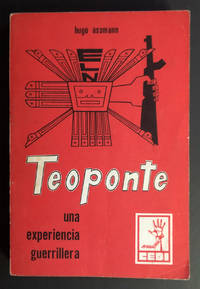
19713912<p>Oruro Bolivia: CEDI 1971. 1st edition. Soft cover. Very Good/No Jacket as issued. VG. 8vo 282pp printed wrappers. Rare original edition of this revolutionary memoir published in Bolivia. In Spanish. Unmarked copy a bit of reading wear.</p> Oruro, Bolivia: CEDI paperback
191943046Detroit / Troy: Literature Bureau of the Workers' International Industrial Union 1919 - 1923. First Edition. Quarto 30cm. Staple-bound pictorial card wrappers; 40pp; illus. Issue for 1919 in clean unmarked condition Very Good or better. Issue for 1923 worn with wrappers darkened and stained contents slightly age-toned with corner-creases and occasional thumb-soil; complete and just Good. Annual souvenir of the Workers' International Industrial Union. The WIIU the labor union arm of the Socialist Labor Party was effectively formed in 1908 following the split of the SLP faction from the Industrial Workers of the World; the group identified itself as the 'Detroit IWW' until 1915 at which point the name was changed to Workers International Industrial Union a typically De Leonist mouthful!. The WIIU never throve; its membership probably never numbered above about 2500 workers a number that dropped quickly following the death of Daniel De Leon in 1915. By the 1920s the WIIU was an afterthought and the group was finally disbanded in 1925.<br/><br/>Contents include articles by Michael Altschuler Herman Richter W.J. Dodge Henry Kuhn and others; literary contributions by Samuel French Fred H. Hartmann Richard Le Galienne William Morris and Walt Whitman; portraits and reproductions of artworks by Eugene Higgins Jan Styka and Eugene Chaperon. An attractive and rather uncommon American labor souvenir book; OCLC notes 6 physical locations for any issue 2018; the 1923 issue printed on clearly inferior paper probably a reflection of the Union's impending demise appears to be in the catalogue of only a single OCLC member institution NYPL. Literature Bureau of the Workers' International Industrial Union unknown books
Birobidzhan-Shtot [USSR], The Committee, 1974. Newspaper, Elephant Folio, 4 pages each issue. "Organ fonem Gegntlekhn Komitet fun der Komunistisher Partay fun Sovetntnforbond un fonem Gegentlekhn Sovet fun Deputatn fun di Arbetndike fun der Yidisher Avtonomer Gegnt. " Yiddish daily established in 1930 in the Jewish Autonomous region of the USSR. "Stalin's suppression of Yiddish culture in 1948-1952, however, stopped the production of Yiddish periodical literature [in the USSR] except in the Jewish Autonomous Region (Birobidzhan) , where the newspaper Birobidzhaner shtern (Birobidzhan Star) , which had begun publication in 1930, was able to continue" (Yivo, "Yiddish Newspapers and Periodicals, N. D. ) . No Copies listed on OCLC, and only 1 holding (Columbia) with microfilm (Y-35)
1925219460Berlin, Vlg. f. Sozialwiss. 1917-1925. OLwd. u. Hefte. 2 Rücken eingerissen, alle Rücken bestoßen. Einbde. etwas beschabt o. beschmutzt. Jg. 4 Einbd. locker in d. Bind., m. farb. Unterstreich., St. a. Tit. Fehlt: Jg. 7 Bd. 2 Titelbl. u. Inhaltsverz.
194065039CBMünchen, Franz Eher Nachf. GmbH, [1940]. Groß-4°. 37 x 29 cm. 131 (1) Seiten. Original-Halbleinenband mit goldgeprägtem Deckel- und Rückentitel.
230388Paris, Aristide Quillet, 1912 - 1921 12 vol. pet. in-8, nombreuses illustrations, percaline souple grenat, titre aux dos et sur les premiers plats (reliure de l'éditeur). Qqs infimes usures mais très bon exemplaire.
1945144431945. Paris Le Front Syndicaliste du n°4 novembre 1945 au n°33 février 1948 soient 29 n°s - Pliés 26 cm x 41 cm 4 pages - Textes non signés - Très bon état sauf le n°14 effrangé - Bulletin de la tendance non communiste de la C.G.T. qui allait faire scission au Congrès de 1947 et devenir F.O
1930219565Potsdam, Protte, 1930-33. Jg. 1-3 in Bibl.-Hlwdbdn. m. Rsign. St. a. Vorsatz. Sign. a. Tit. Jg. 4 H. 3 OU. M. Sign. a. Umschlag. Papierbed. gebräunt.
Geneve. 4to. 12 to 20 pages per issue. In Russian. An official publication of the Russian social-democratic workers' party. From October 1904October 1905 total of 16 issues were published. Includes: editorial on socialism and class warfare, materials on the Russian-Japanese war and the International Socialist congress in Amsterdam (Nr 1) , editorial on union of Russian workers and peasants in their struggle for democratization of Russia (Nr 5) , editorial on May day celebration in Russia (Nr 6) , a poem "The Last Tzar", editorial on revolutionary administration in Russia as a challenge to the discriminatory Russian elections laws (Nr 12) , editorial "On external peace and internal war" on the end of Russian-Japanese war and military purges against social upheavals in Russia (Nr 13) , first-hand account of the battleship "Potemkin" revolt in Odessa (Nr 14) . OCLC lists 2 copies worldwide (U of Michigan, U of Washington) . SUBJECT(S) : Socialism -- Russia -- Periodicals. Socialism -- Periodicals. Nr 1: minor text loss on several pages, in satisfactory condition (RUS-7-356) ; Nr 5: torn with minor text losses to several pages, in satisfactory condition (RUS-7-357) ; Nr 6: fragile and yellowed due to newsprint medium, otherwise intact in good condition (RUS-7-358) ; Nr 12: fragile and yellowed due to newsprint medium, otherwise intact in good condition (RUS-7-359) ; Nr 13: fragile and yellowed due to newsprint medium, otherwise in very good condition, some uncut (RUS-7-360) ; Nr 14: fragile and yellowed due to newsprint medium, uncut, in very good condition (RUS-7-361).
Varshe [Warsaw]: Farlag "di Velt", 1928. Paper Wrappers, 8vo, 95 pages. Monthly Bundist periodical ran from Vol. I, Nr, 1 (Oct. 1927) to 1932. 23 cm. In Yiddish. Unobtrusive Bund rubber stamp on some volumes. For example, Levin (1977) reports that it was in UNZER TSAYT that the very first reports of the Bund's split over the National Question with the Russian Social Democrats were published (in 1927). The Bund in Poland, here providing its unique Polish Jewish Socialist anti-Zionist perspective. The General Jewish Labour Bund in Lithuania, Poland and Russia (Yiddish: algemeyner yidisher arbeter-bund in lite, poyln un rusland), generally called The Bund or the Jewish Labour Bund, was a secular Jewish socialist party.... founded in Vilnius on October 7, 1897 ..In 1917 the Polish part of the Bund, which dated to the times when Poland was a Russian territory, seceded from the Russian Bund and created a new Polish General Labor Bund which continued to operate in Poland in the years between the two world wars .The Bund sought to unite all Jewish workers in the Russian Empire into a united socialist party, and also to ally itself with the wider Russian social democratic movement to achieve a democratic and socialist Russia. The Russian Empire then included Lithuania, Latvia, Belarus, Ukraine and most of present-day Poland, areas where the majority of the world's Jews then lived. They hoped to see the Jews achieve a legal minority status in Russia. Of all Jewish political parties of the time, the Bund was the most progressive regarding gender equality, with women making up more than one-third of all members. The Bund actively campaigned against anti-Semitism. It defended Jewish civil and cultural rights and rejected assimilation. However, the close promotion of Jewish sectional interests and support for the concept of Jewish national unity (klal yisrael) was prevented by the socialist universalism of the Bund. The Bund avoided any automatic solidarity with Jews of the middle and upper classes and generally rejected political cooperation with Jewish groups that held religious, Zionist or conservative views. Even the anthem of the Bund, known as "the oath" (di shvue in Yiddish), written in 1902 by Sh. An-ski, contained no explicit reference to Jews or Jewish suffering. At the heart of the vision of the future of the Bund was the idea that there is no contradiction between the national aspect on the one hand and the socialist aspect on the other. As a strictly secular organization, the Bund renounced the Holy Land and the sacred language (Hebrew) and chose to speak Yiddish .In its early years the Bund had remarkable success, gaining an estimated 30,000 members in 1903 and an estimated 40,000 supporters in 1906, making it the largest socialist group in the Russian Empire . the Bund was a founding collective member at the RSDLP's first congress in Minsk in March 1898. For the next 5 years, the Bund was recognized as the sole representative of the Jewish workers in the RSDLP, although many Russian socialists of Jewish descent, especially outside of the Pale of Settlement, joined the RSDLP directly .The Bund generally sided with the party's Menshevik faction led by Julius Martov and against the Bolshevik faction led by Vladimir Lenin during the factional struggles in the run-up to the Russian Revolution of 1917 .In the Polish areas of the [Russian] empire, the Bund was a leading force in the 1905 revolution. At that time the organization probably reached the height of its influence. It called for an improvement in living standards, a more democratic political system and the introduction of equal rights for Jews. At least in the early stages of the first Russian Revolution, the armed groups of the "Bund" were likely the strongest revolutionary force in Western Russia. During the following years, the Bund went into a period of decay .The Bund eventually came to strongly oppose Zionism, arguing that emigration to Palestine was a form of escapism. The Bund did not advocate separatism. Instead, it focused on culture, rather than a state or a place, as the glue of Jewish nationalism. . The Bund also promoted the use of Yiddish as a Jewish national language and to some extent opposed the Zionist project of reviving Hebrew. The Bund won converts mainly among Jewish artisans and workers, but also among the growing Jewish intelligentsia. It led a trade union movement of its own. It joined with the Poalei Zion (Labour Zionists) and other groups to form self-defense organisations to protect Jewish communities against pogroms and government troops. During the Russian Revolution of 1905 the Bund headed the revolutionary movement in the Jewish towns, particularly in Belarus and Ukraine ..In 1921, the Communist Bund [in the USSR] dissolved itself and its members sought admission to the Communist Party....Many former Bundists, like Mikhail Liber and David Petrovsky, perished during Stalin's purges in the 1930s. The Polish Bundists continued their activities until 1948. During the latter half of the 20th century the Bundist legacy was represented through the International Jewish Labor Bund, a federation of local Bundist groups around the world .Among the exiled Bundists who went on with Socialist politics in America was Baruch Charney Vladeck (18861938), elected to the New York Board of Aldermen as a Socialist in 1917 [and] 1937 [and] manager of The Jewish Daily Forward Moishe Lewis (18881950)....the father of David Lewis (19091981), a leader of the New Democratic Party in Canada .David Dubinsky (18921982), though never formally a member of the party, had joined the bakers' union, which was controlled by the Bund, and was elected assistant secretary within the union by 1906 ..He later became a member of the Socialist Party of America, helped found the American Labor Party in 1936 and was from 1932 till 1966 the leader of the International Ladies' Garment Workers' Union ..under the name Max Goldfarb, David Petrovsky (18861937) was a member of the Central Committee of the Jewish Socialist Federation of America, a member of the Socialist Party of America, and the labor editor of The Forward (Wikipedia). SUBJECT(S) : Jews -- Poland -- Periodicals. Jewish labor unions -- Periodicals. Socialism and Judaism -- Periodicals. Yiddish literature -- Poland -- Periodicals. OCLC Number: 642969688. OCLC lists only 4 runs (Arizona State, Stanford, LOC, U of Washington), all of which appear to be incomplete. Nr. 3-4 was printed as Nr. 3 (Dec. 15, 1927), but then has Nr. 4 (Dec. 20, 1927) on a superimposed lable--not sure if Nr. 3 actually existed or in what form. Interestingly, evey copy of this issue that we have ever seen has had pages 1-6 removed, perhaps by the publisher and related to the re-issuing as a later number. We offer pages 1-6 here in facimile. Good Condition. (Y-1-10) xx
15155(Paris, Imprimerie Everat, 1830). 2 works in 1 volume. 432 pp.; 8 pp. 8vo. Modern half morocco, marbled boards, spine gilt in compartments with gilt lettering. First work: Walch-Gerits, Supplement, 143; Kress C.2783; Goldsmiths 27194; Einaudi 1595. Third, revised and augmented edition. The preface, covering the pages 5-57 has been written by Enfantin and is followed by Gustave d'Eichtal's A un catholique sur la vie et le caractère de Saint-Simon, covering the pages 59-73. Second work: Walch-Gerits, Supplement, 22; Kress C.2441; Goldsmiths 26585; Einaudi 368.
24510Se vend à Nevers, Au Patriote de la Nièvre, 1885. 23, (1) pp. Small 8vo. Sewn, original printed covers. DBMOF, 15, pp. 256-257. Original edition. Jean Placide Turigny, opponent of the Empire, radical and finally socialist, collaborator for the democratic press, went into exile in Brussels after the 'coup d'état' of 1851 and played a very active role in the social movements of the time in his native region, the Nièvre. He founded 'La Tribune nivernaise', the 'Patriote de la Nièvre', and published articles and brochures and belonged to the 'milieu' from which, in 1897, the Fédération socialiste de la Nièvre was established.
166076Paris, Bureaux de la Phalange, 1843 in-16, 36 pp., cartonnage Bradel de papier marbré, pièce de titre en long, couverture imprimée conservée (reliure moderne). Bon exemplaire.