Weather Underground; Dohrn, Bernadine; Jones, Jeff; Ayers, Billy [Bill]; Sojourn, Celia; et alMareMagnum

14 578 résultats
"Here is PRAIRIE FIRE, our political ideology - a strategy for anti-imperialism and revolution inside the imperial US. This paper has been collectively adopted as the political statement of the Weather Underground. PRAIRIE FIRE is written to communist-minded revolutionaries, independent organizers and anti-imperialists. It is written as an argument against those who oppose action and hold back the struggle." - Opening statement by Bernadine Dohrn, Billy (Bill) Ayers, Jeff Jones and Celia Sojourn. pp. [6], 7- 186, [6]. Frequently illustrated with grainy black and white reproductions of photos. Includes list of books studied in the preparation of this work. Chapters include: Impressions of U.S. History; Imperialism in Crisis - The Third World; Imperialism in Crisis - The Home Front; Against the Common Enemy; and more. "We are a guerrilla organization. We are communist women and men, underground in the United States for more than four years... Our intention is to disrupt the empire... to incapacitate it... to forge an underground, a clandestine political organization engaged in every form of struggle, protected from the eyes and weapons of the state, a base against repression, to accumulate lessons, experience and constant practice, a base from which to attack." - page 1 of an earlier edition. Prior to publication the Weather Underground had already bombed multiple government buildings. Twenty-one years after publication, Ayers and Dohrn hosted a meeting at which Illinois state Sen. Alice Palmer introduced Barack Obama as her chosen successor. The rest is history. Clean and unmarked with moderate wear. Binding tight. Sunning to spine. A sound vintage copy of this work, the influence of which dominates headlines almost fifty years after publication . 8.5" x 5.5". Book
Original Paper Wrappers. 4to. issues are 16-20 pages each. 28cm. In Russian. Title translates to English as, "The Banner of Struggle." Published sporadically, and eventually annually, from 1924-1930. CONTENTS: Budet Burya! [A Storm is Coming!] --- V Zaschitu Russkikh Revolyutsionerov [In Defense of Russian Revolutionaries] --- Sotsial-Bessarabtsy [The Social Bessarabians] --- Mezhdunarodnoe Revolyutsionnoe Dvizhenie [International Revolutionary Movement] --- Kultura i Revolyutsiya [Culture and Revolution] --- K Godovschine Iyul'skikh Dney [The Anniversary of the July Days] --- K Desyatiletniyu "Velikoy Voyny" [On the Decade of the "Great War"] --- Krovavyye Maski [Bloody Mask] --- V Godovschinu Dekabr'skoy Boyni 1923 goda [On the Anniversary of the December 1923 Massacre] --- O Veilkom Krizise v Marksizme, Sotsializme, Demokratizme i Rabochem Dvizhenii [The Great Criss in Marxism, Socialism, Democracy and the Labor Movement] --- Vashi Voprosy i Nashi Otvety [Your Questions and Our Answers] --- Golos Revolyutsionerov iz Rossiyskikh Tyurem [The Voice of Revolutionaries from Russian Prisons] --- O Natsional'nykh Men'shinstvakh na Ukraine [On the National Mensheviks in Ukraine] --- Manifest k Trudyaschimsya Goroda I Derevni [Manifest to the Workers of Cities and Villages] --- S'ezd Mezhdunarodnago Byuro Rev.-Sots. Partiy [Congress of the International Bureau of the Rev.-Soc. Party] --- Stalin, Trotskiy ili Revolyutsiya [Stalin, Trotsky or Revolution] --- Nelegal'nye Dokumenty RKP [Illegal Documents of the RCP (Russian Communist Party)] --- Desyat' Let Oktryabr'skoy Revolyutsii [Ten Years From the October Revolution] --- Na Poroge Dvenadtsatogo Goda [On the Eve of the Twelfth Year] --- Osnovnye Prichiny Krizisa Sotsializma [The Main Causes of the Crisis of Socialism] --- Na Poroge Trinadtsatogo Goda [On the Eve of the Thirteenth Year]. The "Union of Socialists-Revolutionaries Maximalists was a political party in the Russian Empire, a radical wing expelled from the Socialist-Revolutionary Party in 1906. The Union united agrarian terrorists, the 'Moscow Opposition' and other radical dissidents from the PSR in an independent party. The Maximalists officially split off from the PSR at its Second Congress in Imatra in 1906. Maximalists played a role in both the Revolution of 1905 and the Revolution of 1917. Many former SR Maximalists eventually joined the Russian Communist Party (Bolshevik) .Maximalists were so called because they demanded the full implementation of the 'maximum programme' in the expected revolution: full socialisation of the land, factories and all other means of production. The orthodox Socialist-Revolutionaries wanted to start with land reform but defer socialisation of other means of production. The Maximalists also rejected the PSR's version of a 'two-stage' revolution, a theory associated with V.M. Chernov. According to Chernov, the coming revolution in Russia would not be purely 'bourgeois-democratic' as the Social-Democrats claimed, but would include social and economic as well as political reforms. It would be a 'popular-democratic' revolution, and would transition into a full-blown 'labour-socialist' revolution later on. The Maximalists rejected this as Social-Democratic 'attentism' and argued that the coming Russian revolution would not be able to stop half-way; it was the two-stage theory, not Maximalism, that was unrealistic if it thought the toiling masses, once liberated, would content themselves with a bourgeois republic and gradual reforms." (Wikipedia, 2012) OCLC lists 9 copies. Publisher's typo on final page of No. 20/21: issue listed as "No. 20-25". Pages darkened but not fragile; some edgewear. Issue no. 24-26 worn with minor closed tears along gutter margin. Issue no. 8 outer wrappers detached but present. No 12/13 with small loss of paper and a few words. Overall, in Very Good Condition, a scarce complete run of this important journal. (RUS-11-37)
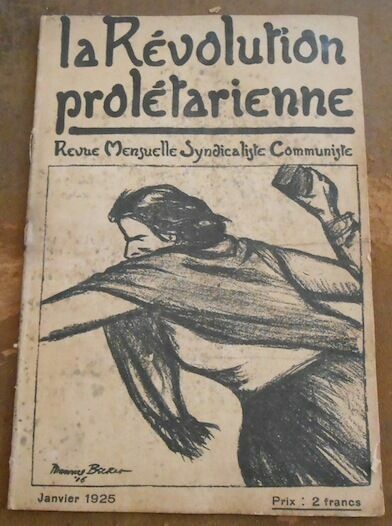
1925124121925. Paris La Révolution Prolétarienne du n°1 (janvier 1925) au n°112 (5 décembre 1930) ; D'abord mensuelle la revue est bimensuelle à partir de 1927 - Brochés 18 cm x 26 5 cm puis 20 5 cm x 26 5 cm à partir du n°49 (1 janvier 1928) 32 pages par numéro puis 16 puis 32 ; seule la couverture du premier numéro est illustrée ; de blanche elle deviendra orange au n°49 - Textes de Pierre Monatte Alfred Rosmer Maurice Chambelland Robert Louzon Léon Trotsky J. Péra R. Mouzeau V. Godonnèche G. Lacoste V. Delagarde Marthe Bigot C. Talès Marcel Martinet Boris Souvarine E. Berth Romain Rolland B. Giauffret Frans Liebaers Fernand Loriot Upton Sinclair Max Eastman etc.. - Etat moyen tous ces numéros ayant été mal reliés avec une toile collée ! mais ils sont complets - Très rare tête de collection
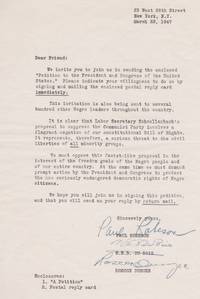
19471474<p>Robeson Paul W.E.B. Du Bois and Roscoe Dungee.</p><p>To the President and Congress of the United States of America Petition and Typed Letter Bearing Signatures of Robeson Du Bois and Dungee. New York: Communist Party USA 1947.</p><p><br />Single-page typed letter and two-page petition printed on rectos only. Each page 8 1/2 x 11 inches 215 x 280 mm.</p><p>A rare typed letter bearing signatures of Paul Robeson W.E.B. Du Bois and Roscoe Dungee asking recipients to sign a petition against banning the Communist Party USA. <strong>We believe the signatures were printed as does an autograph expert we consulted.</strong></p><p>In any case the three African-American leaders sprang into action after President Truman's Labor Secretary Lewis B. Schwellenbach told Congress that the Communist Party should be outlawed. Schwellenbach was concerned about Communist control and infiltration of labor unions and thought no Communist should be allowed to lead a union.</p><p>The letter is dated March 22 1947 and carries the address of 23 West 26th Street New York the Communist Party's headquarters at the time. The letter is aimed at African-American recipients: "This invitation to sign the petition is also being sent to several hundred other Negro leaders throughout the country."</p><p>According to the letter "It is clear that Labor Secretary Schwellenbach's proposal to suppress the Communist Party involves a flagrant negation of our constitutional Bill of Rights. It represents therefore a serious threat to the civil liberties of all minority groups." The authors urge recipients to mail back a postal reply card confirming they would sign the petition. The card is not present probably because it was mailed back to the Communist Party.</p><p>The petition which is also rare is addressed to the President and Congress urging them to reject Schwellenbach's "fascist-like proposal" to ban the Communist Party. The Party was not banned but the government regularly harassed and imprisoned its leaders in the 1940s and '50s.</p><p>Even though we believe the signatures on the letter were printed these materials are nonetheless rare. We have not found any institutional holdings of the letter or petition. None in commerce.</p><p>CONDITION: Pages lightly creased for mailing staple on petition badly rusted. A Very Good set. <strong>RARE</strong>.</p> [Communist Party USA]
90 pages. "Communist plotters, in the United States as elsewhere, are preparing for the conquest of political power. The discerning student, however, should consider how interventionism, under various enticing labels, is setting the stage for the final overthrow of the voluntary society, the market economy and constitutional government. [This work], by a world-famous expert, will prove a valuable aid to understanding in this field. It will help to explain the errors of those who believe a system based on individual freedom can be 'mixed' with socialism." - Foreword. Prior owner's details upon toned front free endpaper. Another person's name inside front board, otherwise contents clean and unmarked. Binding tight. Average wear to publisher's green cloth. Dust jacket not included. Greaves & McGee B-14. Book
18 voll. in 8 grande tutti ben rilegati in mz. tl. coeva con titoli e annate stampigliati in oro al dorso. Diciotto annate consecutive complete dal giugno 1944 al 1961 della rivista, fondata da Palmiro Togliatti, che fu l'espressione ideologica del PCI. La rivista inauguro' il corso delle sue pubblicazioni con il no 1 del giugno del 1944, dopo la liberazione di Roma, con il nome "La Rinascita" che poi divenne nel gennaio del '45 "Rinascita" con l'aggiunta del sottotitolo "Rassegna di politica e di cultura italiana". Il nome rimane invariato fino alla cessazione delle pubblicazioni nel 1989. La periodicita' fu mensile fino all'aprile del 1962 per divenire poi settimanale quando si affianco' alla rivista anche il supplemento "Il Contemporaneo". Rinascita conservo' l'originaria struttura editoriale sino ai primi anni Sessanta, quando vennero introdotti alcuni cambiamenti per renderla piu' aderente alle trasformazioni che investivano l'Italia in quel decennio. Dopo la morte di Togliatti, nel 1964, alla direzione si alternarono molti dirigenti del Partito: Gian Carlo Pajetta, Luca Pavolini, Alessandro Natta, Gerardo Chiaromonte, Alfredo Reichlin... Sospese la pubblicazione dall'agosto 1989 sino al gennaio 1990, quando usci' con un nuovo formato e una nuova numerazione, sotto la direzione di Alberto Asor Rosa. Togliatti, in due interventi nel primo numero, firmandosi nel primo Ercoli e nel secondo Togliatti, spiega che i comunisti rappresentavano l'avanguardia di tutte le forze nazionali, che il vecchio partito di sovversivi si era trasformato nel partito dell'unita' "della classe operaia, delle forze antifasciste, unita' di tutta la nazione...". Togliatti affida dunque a Rinascita il compito di costruire l'ideologia del "partito nuovo" pubblicando fin da subito articoli destinati a definire i caratteri del rinnovato Partito comunista. Oltre ad essere formalmente il direttore, Togliatti era anche personalmente coinvolto nella scelta degli articoli e nel controllo dei loro contenuto. I ledear del partito scrivevano su Rinascita cosi' come un nutrito gruppo di intellettuali, storici, filosofi, giuristi, critici letterari di estrazione non comunista. Tra i collaboratori politici: Pajetta, Pavolini, Natta, Chiaromonte, Coppola, Ferrara, Reichlin, Ledda, Pietro Ingrao, Armando Cossutta, Luciano Lama, Giorgio Amendola, Franco Calamandrei, Luigi Longo, Giorgio Napolitano. La rivista era principalmente caratterizzata da contributi di argomento socio politico ed economico, tuttavia un certo spazio era riservato anche alle arti e alla rassegna letteraria. Fra gli altri si segnalano interventi sul cinema di Carlo Lizzani, Vittorio De Sica, Virgilio Tosi, interventi sul teatro di Luchino Visconti, sulle biennali di Guttuso... Fra i critici letterari le principali firme erano Manacorda, Sapegno, Chiarini, Ferretti...
228826Bruxelles, à la Librairie romantique, 1828 2 tomes en 1 vol. in-8, VIII-325 pp. et 327-[5] pp., demi-veau fauve, dos lisse, flets dorés, tranches marbrées (reliure pastiche). Rousseurs, parfois prononcées.
186588031s. n. | Paris s.d. [1865] | 13.50 x 21 cm | deux pages sur un double feuillet
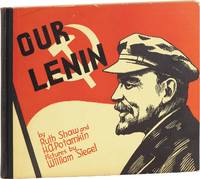
193481518New York: International Publishers 1934. First Edition. Oblong quarto 23cm x 27cm. Original cloth-backed pictorial boards; 62pp; illus. A remarkably bright unworn copy with minimal rubbing to board corners with the pictorial elements bright and unfaded. Internally clean and unmarked with joints and hinges tight; Near Fine. Lacking the scarce dustwrapper. There was also an issue in plain black bookcloth priority uncertain. <br /> <br /> A biographical encomium to Lenin for juvenile readers with illustrations by the New Masses cartoonist William Siegel. A great example of "party-approved" literature for children during the heyday of communism in America an unusually well-preserved copy. International Publishers unknown
1st edition. Period boards. 8vo. 161 pages. 26 cm. In Hebrew. Title translates to Jewish Law: Science Quarterly. A fascinating Zionist Hebrew journal from the early Soviet period providing insight into the rarely discussed topic of the Jewish legal revival movement that occurred in Palestine during the British Mandate. It deals with practical, modern applications of Jewish law that were, no doubt, highly influential on the development of law in modern Israel. Dikshtein was a leading advocate of creating a legal system based on Jewish law, but fit for statehood. (Likhovski, 2006) . He was a practicing lawyer in Europe before emigrating to Palestine. He was also awarded the Israel Prize for jurisprudence in 1957. (Wikipedia, 2018) . SUBJECTS: Jewish law -- Periodicals. OCLC lists three copies worldwide (HUC, Brandeis, Harvard) , none in New York. Ex-library with usual, minimal markings. Pages are browning, but clean. Overall Very Good Condition. (YID-30-39)
224046Paris, Imprimerie de Bajat, 1842 in-8, 166 pp. en numérotation continue, demi-basane noire, dos lisse orné (reliure de l'époque). Coupes et coins usés. Rousseurs, tache brune aux premiers feuillets.
1st edition. Bound in period boards cloth. Folio. Each issue is about 6 pages. In Russian. Vpered and Proletariy bound together. Vpered was the first Bolshevik weekly newspaper, published in Geneva from Dec. 22, 1904 (Jan. 4, 1905) to May 5 (18) , 1905, founded after the Mensheviks seized control of the central organ of the RSDLP, Iskra. The first issue alone contained The Autocracy and the Proletariat (an editorial) , On Good Demonstrations of Proletarians and Poor Arguments of Certain Intellectuals, Time to Call a Halt, and other articles by Lenin. The significance of Vpered in the history of the CPSU is defined by the fact that the paper was an ideological-political organ abroad that cooperated with the practical organ in Russiathe Bureau of Committees of the Majorityto give political and organizational shape to Bolshevism (The Great Soviet Encyclopedia, 3rd Edition. 1979) . Vpered articles include: Somneniya Dvuglavago Orla [Doubts About the Double-Headed Eagle] -- Politika Ustupok [Policy Concessions] -- Nachalo Revolyutsii v Rossii [The Beginning of the Revolution in Russia] -- Dolzhni-li My Organizovat Revolyutsiyu [Should We Organize a Revolution] -- Bankrotstvo Politseyskago Rezhima [Bankruptcy of a Police Regime] -- Bakinskiy Pogrom [Baku Pogrom] -- Marks ob Amerikanskom Chernom Peredele [Marx on American Black Redistribution] -- Vozrozhdenie Pravoslavnoy Tserkvi [The Rebirth of the Orthodox Church] -- Rol Organizatsiy v Narodnykh Dvizhenyakh [The Role of Organizations in the Peoples Movement]. Proletariy was published in Geneva from May 14 (27) until November 12 (25) , 1905, with a total of twenty-six issues during the heights of political and social unrest of the Revolution of 1905. Active in the work of the editorial board were V. Vorovsky A. Lunacharsky, and M. Olminsky. Proletariy continued the policy of the old, Leninist Iskra, and maintained full continuity with the Bolshevik newspaper Vpered. Proletariy articles include: Mezhdunarodnoe Znachenie Russkoy Revolyutsii [International Significance of the Russian Revolution] -- Demokraticheskiya Zadachi Revolyutsionnago Proletariata [Democratic Tasks of the Revolutionary Proletariat] -- Noviy Revolyutsionnyy Rabochiy Soyuz [New Revolutionary Workers Union] -- Rabochiy Klass I ego Vragi [The Working Class and Its Enemies] -- Russkiy Tsar Ischet Zaschity Svoego Naroda Y Turetskago Sultana [Russian Tsar Seeks Protection From His Own People With Turkish Sultan] -- Ocherki iz Revolyutsionnoy Borby Zapadno-Evropeyskago Proletariata [Sketched from the Revolutionary Fight of the Western European Proletariat] -- Edinenie Tsarya s Narodom I Naroda s Tsarem [Union of the Tsar and with the People and of the People with the Tsar] -- Pervaya Pobeda Revolyutsii [The First Victory of the Revolution]. Some pages are darkened, particularly at edges, but not fragile. Very Good condition. (RUS-11-10)
256 pages. "Author returned to America in 1934 after a year of studies in Italy, haunted by the possibility of a Fascist regime rising in her homeland. Befriended by a communist, she became one herself. Later, her horrified realisation of the true nature of her Russian masters led her to contact the F.B.I. and spy for them, while still working for the Soviets." - dust jacket. Bentley's story was serialized in McCall's magazine in 1951. Gift greetings atop front free endpaper, otherwise book unmarked with moderate external wear and soiling. Binding tight. Average wear to dust jacket which is now preserved in archival-grade Brodart. A sound copy. SEIDMAN B170, HAZLITT p.43, CONSTANTINIDES p.79. Book
[6]-512 pp. Index. Black and white photo frontispiece photo of Trotsky [1879-1940]. A sound working copy of this tumultuous and impactful life story published in the year following Trotsky's exile from the Soviet Union and ten years before his murder in Mexico. No dust jacket. Faint prior owner's name upon front free endpaper otherwise unmarked. Moderate scattered foxing. Somewhat above-average wear to publisher's red cloth which is sunned on spine and lettered in gilt. Binding intact with moderate lean. Chip from top corner of pages 7-16. Book
1951902Praha Prague: Nakladatelstvi Mir Drustevnà Práce 1951. First Edition. <br /><br />Small Quarto 10 7/8 x 9 1/4 inches; 275 x 235 mm 124 pages in illustrated boards. <br /><br />A collection of anti-Hitler and anti-U.S. cartoons by the great Soviet cartoonist Boris Efimov 1900-2008 whose name is rendered in Czech as Boris Jefimova. The anthology starts in the 1930s with the rise of Hitler and carries forward to the late 1940s attacking the Marshall Plan Wall Street fat cats the Western alliance and the U.S. position in Korea.<br /><br />By contrast and not surprisingly the Soviet Union is portrayed heroically having single-handedly defeated Hitler. Given the preponderance of Wall Street financiers in the cartoons Wall Street appears to be behind Western imperialism and belligerence and even abetted the rise of Hitler. The book opens with a quote from "J. Stalin" and contains 60 cartoons mostly in black-and-white but some containing deep red representing of course the supposed nobility of the Soviet Union and its allies. <br /><br />Copies of this Czech-language book are uncommon. OCLC lists just three institutional holdings: the College of William and Mary the National Library of the Czech Republic and the University of Leipzig. <br /><br />A very good striking example of Czech-Russian agitprop during the dark days of the Cold War. <b>SCARCE</b>. <br /><br />CONDITION: Light soiling and wear to the boards but the pages are clean and bright. Very Good or better. Nakladatelstvi Mir – Družzstevnà Práce hardcover books
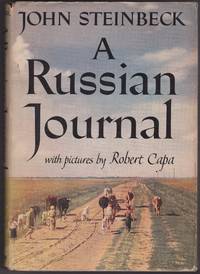
19482521New York: The Viking Press 1948. First Edition First Printing. <br /><br />Small Quarto 9 3/4 x 6 3/4 inches; 247 x 167 mm 220 pages in green and tan cloth in an unclipped illustrated dust jacket hard cover accompanied by four photographic prints. <br /><br />An account of a trip to the Soviet Union in 1947 by author John Steinbeck and photographer Robert Capa who visited while the country was attempting to recover from the devastation of World War II. They traveled to Moscow Stalingrad and other cities as well as to Ukraine and Georgia meeting numerous ordinary people while accompanied by a minder from the government. <br /><br />The New York Herald Tribune financed the trip and along with some other newspapers published articles by Steinbeck and photos by Capa. Indeed included here are three photographs that were used by one of the newspapers as indicated by layout instructions on the versos of the photos. There's also a later publicity photo of Steinbeck. One of the photos from the trip showing a Georgian restaurant in Moscow appears on page 47 of the book. Two of the trip photos are stamped on the versos with the notice that their reproduction could be used only with the "1948 Steinbeck-Capa articles on Russia" along with "Copyright 1948 by John Steinbeck." <br /><br />Our copy is a first printing of the first edition with "Printed by the Viking Press in April 1948" on the copyright page. The dust jacket carries a price of $3.75. <br /><br />A fascinating look at ordinary people in the Soviet Union as the country tried to rebuild following World War II accompanied by three photographs of scenes from the country and a publicity photo of Steinbeck. <br /><br />CONDITION: Book slightly cocked rear hinge loose corners rubbed spine ends bumped end papers slightly toned a couple of pages with vertical creases possibly a production error. Nearly Very Good in a Good dust jacket that has some loss to both spine ends as well as a few tears nicks toning foxing and stains. The four photographs have some nicks creases and soiling to the edges. The versos contain notes stamped instructions and captions pasted on the photo of Steinbeck has an article pasted to the verso. Some discoloration to two photos resulting from pasting of newspaper captions to the versos. The Viking Press hardcover
19990008049Boulder CO: Westview Press 1999. First English language edition. Hardcover. As New/issued without. 8vos; xxxiv 562; ix 389 pages maroon cloth in original shrinkwrap. Not x-library. Scarce. O.P. <br/><br/>This English translation contains an autobiography by Mironov which was not in the Russian edition. It details his anti-Marxism philosophy while a student in Leningrad. "The author has assimilated a large body of foreign scholarship primarily "new social history" produced by Anglo-American authors along with a sprinkling of more broadly European economic and demographic history from the 1970s and 1980s which is effectively incorporated into his own very deep empirical knowledge. . The reader does not find in this extensively researched account the standard Soviet answers to specific historical questions. Mironov has abandoned most Soviet cliches though he still assumes that laws of Russian history can be identified based on social science theory and quantitative analysis Elise Kimerling Wirtschafter." "This is a massterful work that provides other scholars with a wealth of useful information while confrontimg them with an argument that compels a response - William G. Wagner." Maps. Westview Press hardcover
In-4 p., mz. tela coeva, 33 fascicoli di pp. 8/12 ciascuno + 1 numero speciale, con illustrazioni in b.n. nel testo. Di questa importante rivista settimanale - organo centrale della gioventù socialista tedesca - pubblicata il mercoledì (i primi 12 numeri) e poi ogni sabato, offriamo la rara prima annata completa: dal n. 1 (27 novembre 1918) al n. 35 (23 agosto 1919) + il Numero Speciale (di 16 pp., con copertina a colori) pubblicato il 1° Maggio 1919. La numerazione subisce un “salto”: dal n. 17 (19 Aprile 1919) si passa al n. 20 (10 Maggio 1919), ma la rivista è completa poiché i nn. 18 e 19 non vennero pubblicati editorialmente. Su questo periodico apparve in originale anche un breve scritto di Rosa Luxemburg (sul n. 2, 4 Dicembre 1918) dal titolo “Die Sozialisierung der Gesellscahft” (”La Socializzazione della Società”) - “one of Luxemburg’s fullest discussion of the nature of post-capitalist society”. Esemplare ben conservato.
193386894S. n. | Lucerne 18 Août1933 | 14 x 21.50 cm | une page recto verso
175320432A Messine [Paris], Par une Société de libraires, 1753. 2 volumes in-12 de [2]-XLI-[1]-216 et [2]-307 pages, plein veau moucheté brun, dos lisse orné de filets et fleurons dorés, pièces de titre bordeaux. tranche rouges.
280 pages. Detailed index. Recommended reading list. This author recommended by USAF Brigadier General Ben Partin (Ret.) who rose to fame with his conclusive proof that the official version of events in Oklahoma City could not possibly have resulted in the destruction of the Alfred P. Murrah Building. The publishers were "...Convinced that an international conspiracy is in operation for the purpose of destroying our national and religious institutions in America." - from Foreward. Average wear to red card covers. Partial lean to spine. Binding intact. Unmarked. A sound copy. Singerman 922, Weems p.59. Book
[4], 5-398 pp. "The latest in the series of books about our times which this political pilgrim began with Insanity Fair in 1938, this is the story of a journey of discovery, geographical, social and political, in America. Readers know it is Douglas Reed's theory that the war which started in 1914 still goes on, embroiling all the Western world in a grand design for the reshaping of the globe, the final failure or success of which will determine the ultimate shape of the Twentieth Century." - dust jacket. Book unmarked with respectful wear to publisher's red cloth lettered in gilt. Slight lean to spine. Front free endpaper neatly removed. Above-average wear to price-clipped dust jacket now preserved in glossy new archival-grade Brodart. A sound vintage copy of this fascinating study. 20 x 14cm. Singerman 845. Book
FT) Original Newspaper. Folio. Issues are between 8-12 pages. In Russian. Title translates to English as, The Social Democrat. Subtitle: Tsentralnyy Organ Rossiyskoy Soctsialdemokraticheskoy Rabochey Partii [The Central Organ of the Russian Social Democratic Labour Party]. Contributing authors include Lenin, Trotsky and Martov. Includes supplement to number 19-20. The Social-Democrat was an illegal Russian newspaper, Central Organ of the R. S. D. L. P. , published from February 1908 to January 1917. Altogether 58 issues appeared. The first issue was put out in Russia, but further publication was arranged abroad, first in Paris, then in Geneva The Editorial Board was made up of representatives of the Bolsheviks, the Mensheviks and the Polish Social-Democrats. The paper was largely run by Lenin, [who] fought for a consistent Bolshevik line on the Editorial Board. From December 1911 Sotsial-Demokrat was edited by Lenin Lenin's articles published in Sotsial-Demokrat during the war played an important part in helping to apply the strategy and tactics of the Bolshevik Party on the questions of war, peace and revolution, in denouncing social-chauvinists, and uniting the internationalist forces in the world labour movement (Encylopedia of Marxism) . CONTENTS INCLUDES: Tsel' Bor'by Proletariata v Nashey Revolyutsii [The purpose of the Struggle of the Proletariat in our Revolution] Rabochaya Gruppa na Zhenskom Syezd [The Worker's Group at The Women's Congress] Itogi Syezda Fabrichno-Zavodskikh Vrachey [The results of the congress of factory physicians] Kont-Revolyutsiya I Burzhuaziya [Counter-revolution and Bourgeois] Klassy I Partii v ikh Otnosheniy k Religii I Tserkvi [Classes and parties in their relations to religion and Church] Vopros' o Professional'nykh Soyuzakh v 3-oy Dume [Questions on trade unions in the Third Duma] O Fraktsii "Vperedovtsev" [About the Faction "Vpered"] Fraktsiya Trotskogo I Partiynoe Polozhenie [Trotsky's faction and party position] Mezhdunarodny Sotsialisticheskiy Syezd v Kopengagen [The International Socialist Congress in Copenhagen] Krestyanskaya Reforma I Proletarski-Krestyanskaya Revolyutsiya [Peasant Reform and the Proletariat-Peasant Revolution]. Many pages darkened with rubbing and edgewear, creases throughout. Some markings in header and top margin, but all text is clear. Good Condition. (RUS-11-1a) xxxxxxxx
Documentation which has scarcely seen the light of day since the 1950s. This booklet, printed for the use of the committee, includes pages 468-491 and 611-620 from the printed hearings. Contains a chilling flowchart indicating the path of power down from the foundations through education, government, and subsequently down through their many subsidiary organizations. Printed in a small font so each page contains considerable text, much of it profoundly important. Moderate wear. Unmarked. Crease to lower corner. The Reece Committee and its work came to prominence decades later after Norman Dodd, Research Director for the Committee, came forward with stunning revelations of hidden findings of the Committee. Book
197116792Roma: Partito Comunista Italiano / Editoriali Fratelli Spada 1971. First Edition. Lithographed poster offset in three colors; 100cm x 70cm ca 40" x 28"; on heavy paper. Minor toning; light creases at margins; Near Fine - Grade A/A-. A bit of a puzzle: the poster appears to celebrate the twentieth anniversary of the formation of the Associazione Bandiera Rossa an Italian Trotskyist group; but the poster bears the imprint of the PCI the main-line Marxist-Leninist party in Italy -- an ideological implausibility even within the chaotic confines of Italian Marxism. Adding further to the confusion is a quotation from Antonio Gramsci founder of the PCI in upper right. In any case a terrific graphic attributed here to Luciano Prati whose name we encounter on a few late-70s Italian film posters but nowhere else. Duke University appears to be the only North American institution to hold a catalogued copy of this work. Partito Comunista Italiano / Editoriali Fratelli Spada unknown books