Marx, Karl Edited by Frederick EngelsBiblio.com
159 résultats
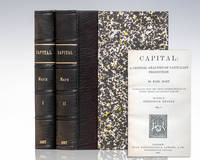
1887144183Swan Sonnenschein Lowery & Co: London 1887. Rare first edition in English published two years before the first American edition of Karl Marx’s seminal work in both economic and political thought. Octavo bound in half morocco over marbled boads raised bands. Translated from the third German edition by Samuel Moore and Edward Aveling. In very good condition with an ownership to the verso of volume one to the title page. Marx himself modestly described Das Kapital as a continuation of his Zur Kritik des Politischen Oekonomie 1859. It was in fact the summation of his quarter of a century's economic studies". The 'Athenaeum' reviewer of the first English translation 1887 later wrote: 'Under the guise of a critical analysis of capital Karl Marx's work is principally a polemic against capitalists and the capitalist mode of production and it is this polemical tone which is its chief charm.' The historical-polemical passages with their formidable documentation from British official sources have remained memorable; and as Marx". wrote to Engels while the volume was still in the press 'I hope the bourgeoisie will remember my carbuncles all the rest of their lives.' Carbuncles financial embarrassment and political preoccupations of many kinds hampered Marx's work on Das Kapital which he would never have completed but for the material and moral support of Engels"." PMM 359. "In his funeral eulogy for Karl Marx Engels concluded that 'Marx was above all a revolutionary". It is doubtful that any figure in history has inspired more violently contradictory opinions than Karl Marx" Downs 22. "Only this first part of Marx's magnum opus appeared in his lifetime" with its publication in German in 1867 PMM 359. The remainder was constructed by Engels from Marx's posthumous papers. Containing Marx's central concept of surplus value this first edition in English is translated from the third German edition of Moore and Aveling is edited by Engels and incorporates substantial revisions Marx made for the first French translation 1872-5. London hardcover
1887140948873London: Swan Sonnenschein Lowrey & Co 1887. First Edition. Near Fine. First British and first English-language edition of this world-changing Socialist text. xxxi 1 363; ii 365-816 pp. with appendix at rear of second volume most pages unopened. Bound by the Dragonfly Bindery in quarter calf with layered stain over marbled boards morocco title labels and gilt tooling to spines laid endpapers.<br /> Near Fine with scuffing to fore edge of Volume II textblock repaired tear and thumbing to Volume I prelims and moderate toning to contents. Housed in a custom double-volume clamshell case quarter chestnut morocco over marbled boards. A lovely copy of this groundbreaking work.<br /> <br /> <p> Das Kapital was already called "the Bible of the working classes" by the time it was published in England in 1887 four years after the author's death. The text is taken from the third German edition of the first volume the only one written by Karl Marx. The additional volumes written by Engels from his friend's notes were not translated into English until the 20th century. Upon the appearance of these two volumes in 1887 the Irish playwright George Bernard Shaw wrote of Marx:<br /> <br /> <p>"It is impossible to be sure that further historical research will confirm his interpretation of the past or experience verify his anticipations; but whilst capitalism lasts he will still make his mark upon his readers and through them on the world. Swan Sonnenschein, Lowrey, & Co unknown
1886138596Madrid: Dionisio de los Ríos 1886-87. Very rare first edition in Spanish an abridged translation of volume one of Marx's Das Kapital Capital. Its scarcity is explained by the brittle poor quality of the paper stock - the same used for printing Zafrilla's newspaper - and its small print run thought to number no more than 1000 copies in total. Pablo Correa y Zafrilla 1844-1888 was a federalist translator and lawyer. He was professionally attached to the prestigious Colegio de Madrid enjoyed a close friendship with Catalan federalist Francesc Pi i Margall and was appointed a deputy of the Cortes Generales in 1873 during the First Spanish Republic. He was also the editor of La República a newspaper which had announced its intention in early 1886 to publish a serialised translation of Capital which would be delivered bimonthly to its subscribers. It was decided that the pages would be twice the size of the newspaper's usual publications to account for the length of Marx's work and to prevent the individual parts from becoming too thick. Though he promised to work directly from the original German 1867 and said as much in his preface Zafrilla actually based his translation on the first edition in French translated by Joseph Roy and published in forty-four livraisons by Lachâtre from 1872 to 1875 see Ribas 1985 for a detailed analysis of the textual similarities between the French and Spanish text. The first part of Zafrilla's El Capital was sent to subscribers with a copy of the newspaper in February 1886 - the title page reflects the year of first delivery not final printing - and publication must have been completed by mid-1887 when La República was offering subscribers the option for one peseta of binding all the parts into one quarto volume in "elegantes tapas de tela" elegant cloth covers. Non-subscribers could purchase all the parts without cloth for 60 cents; it is possible that the printed wrapper dated 1887 which is sometimes mentioned in relation to Zafrilla's translation was produced for this purpose. It is estimated therefore that the print run can have been no more than a thousand copies in total with a few hundred of this amount reserved for subscribers the rest being made available for separate purchase Castillo p. 93. An unknown remainder of these was apparently later bound up for La República to offer as gifts to new subscribers or those who renewed their subscription for a further six months yet we have found no record of any other copy surviving with the exception of that cited by Ribas below. According to WorldCat no library is known to possess El Capital and no other copies are recorded as having appeared at auction. Pedro Ribas a renowned collector of Marxist literature states that he has handled just one in his lifetime that held at the Faculty of Law University of Salamanca p. 205. Zafrilla's translation received little to no comment in the contemporary press. When alluded to it was dismissed as being imperfect and incomplete particularly by El Socialista the periodical founded by the Spanish Socialist Workers Party PSOE in 1886. Brief excerpts from Marx's writings had been translated into Spanish before - beginning in 1872 when La Emancipación the Spanish IWMA organ published translations of Marx's preface to the first German edition and his letter to Lachâtre in the French edition Draper Chronicle 72:58 - but Zafrilla's translation was the first concerted effort to present in full the message of Capital to a Spanish audience. The present copy is a remarkable survival considering the complexity of its serialized publication. Tall quarto 233 x 165 mm. Complete with final blank leaf. Contemporary half cloth and marbled boards. Housed in a black cloth flat-back box by the Chelsea Bindery. Board edges and corners worn spine defective and skilfully repaired replacing missing portions at foot of spine and along front joint. One or two gatherings somewhat browned short marginal tear to one leaf tax stamp of the Spanish crown "timbre 3 pesetas 10 kilos Madrid" with their arms to page 156 partially obscuring the text; a very well preserved copy of a fragile book. Not listed in the standard Marx bibliographies. See Santiago Castillo "Marxismo y Socialismo en el siglo XIX español" in Manuel Ortiz Heras David Ruiz González & Isidro Sánchez Sánchez eds. Movimientos sociales y estado en la España contemporánea 2001 pp. 81126; Pedro Ribas "La primera traducción castellana de El capital 18861887" in Cuadernos Hispano-Americanos no. 420 June 1985. hardcover
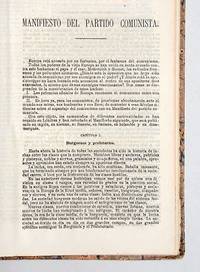
1872135988Madrid: de la viuda é hijos de Alvarez November-December 1872. The first appearance in Spanish of the Communist Manifesto First appearance of the Communist Manifesto in Spanish published within six issues of La Emancipación the official organ of the New Madrid Federation of the International. Issued every Saturday as a four-page folio news sheet the text of the Manifesto was printed in two columns across the lower half of each page of numbers 72-77 with separate pagination effectively printed as two pages on the lower portion of each page designed to be cut out and kept as a booklet with other texts following in later numbers. The Manifesto itself fills 22 pages with two additional texts "La Propriedad" 16 pages and "Manifesto inaugural de la Asociación internacional de los trabajadores" 7 pages continuing in later issues our copy of the journal ends with number 80 page 14 of "La Propriedad". The paper ceased publication with number 91 The translator José Mesa co-founder of the Internationale in Spain based his translation of sections I and II on a French text revised by Engels that had appeared in Le Socialiste in New York in 1872. Sections III and IV were translated from the German edition of 1872 Andréas 72 as well as the authors' preface of 24 June 1872. Andréas notes that there are a small number of changes omissions and free translations concluding that this first Spanish translation of the Manifesto is not absolutely complete. WorldCat and Andréas together locate just 5 copies at the National Library of Spain the Feltrinelli Foundation in Milan the Marx-Lenin Institute in Moscow the International Institute of Social History in Amsterdam and the Karl Marx Haus Friedrich Ebert Stiftung in Trier. 6 numbers bound in a vol. of the first 80 numbers of La Emancipación beginning with number 1 19 June 1871. Folio 410 x 475 mm. Contemporary brown cloth-backed marbled paper boards spine unlettered edges sprinkled red. Head of front joint split rear joint slightly rubbed with some wear. Tax stamp to final few numbers occasional marking repair to first leaf obscuring text bound without number 67; in very good condition. Andréas Le Manifeste Communiste de Marx et Engels 74. hardcover
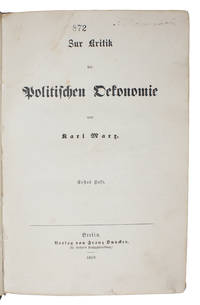
185958578Berlin Franz Duncker 1859. 8vo. Nice contemporary hafl calf with gilt lettering to spine. A bit of wear to extremities markings after old label to front board and signs of vague damp staining to front board. A mostly faint damp stain to outer inner corner throrughout but otherwise very nice. Title-page a bit dusty. Old library number 872 to front free end-paper and top of title-page and marginal pencil-annotations to a number of leaves. VIII 2 170 pp. Title-page with the ownership-signature of Alexander Appolonovich Manuilov to top of title-page and binding with his initials "A. M." in gold to the fot of spine. <br/><br/><em>Scarce first edition in a magnificent association-copy of the groundbreaking work in which Marx first presents his revolutionizing theories of capitalism forming the foundation for his main work "The Capital" which appeared eight year later. It is also in this milestone of political and economic thought that Marx presents his economic interpretation of history for the first time.Alexander Appolonovich Manuilov 1861-1929 was a Russian economist and politician famous not only as one of the founding members of the Constitutional Democratic party known as the Kadets but also as the Russian translator of Marx' "Zur Kritik." i.e. the present work. "Manuilov graduated from the law department of the University of Novorossiia Odessa 1883. He began scholarly and pedagogical work in political economy in 1888. In 1901 he became head of a subdepartment at Moscow University becoming assistant rector in 1905 and serving as rector from 1908 to 1911. He was dismissed by the tsarist government for attacking the "extremes" of Stolypin’s agrarian legislation. In the 1890’s he was a liberal Narodnik Populist later becoming a Constitutional Democrat Cadet and a member of the Central Committee of the Cadet Party. Manuilov’s draft on agrarian reform 1905 was the basis for the Cadets’ agrarian program. V. I. Lenin sharply criticized Manuilov calling him one of "the bourgeois liberal friends of the muzhik who desire the ‘extension of peasant land ownership’ but do not wish to offend the landlords" Poln. sobr. soch. 5th ed. vol. 11 p. 126 note.At the beginning of his scholarly career Manuilov accepted the labor theory of value. In 1896 he translated K. Marx’ work A Contribution to the Criticism of Political Economy Zur Kritik der Politischen Oekonomie. During the years of reaction he espoused subjectivist and psychological views in political economy. In 1917 he was minister of education of the Provisional Government. After the October Revolution in 1917 he emigrated but soon returned and cooperated with Soviet power. He participated in the orthographic reform 1918. In 1924 he became a member of the board of Gosbank State Bank. He taught in higher educational institutions. Changing to Marxist positions and relying on Lenin’s works he criticized the revisionists and neo-Narodniks on the agrarian question." Encycl. Britt.For many years the exclusive focus on "Das Kapital" meant that the "Kritik" was overlooked. Since the beginning of the 1960's however scholars have become increasingly aware of its importance as the blueprint for the social and economic theory Marx shall go on to develop see for example Raymond Aron "Le Marxisme de Marx" 1962. It is here that Marx outlines the research programme to which he shall devote the rest of his working life. He himself described "Das Kapital" as a continuation of his "Zur Kritik der politischen Oekonomie" see e.g. PMM 359 in which his primary concern is an examination of capital and in which he provides the theoretical foundation for his political conclusions later presented in "Das Kapital". "I examine the system of bourgeois economy in the following order: capital landed property wage-labour; the State foreign trade world market.The economic conditions of existence of the three great classes into which modern bourgeois society is divided are analysed under the first three headings; the interconnection of the other three headings is self-evident. The first part of the first book dealing with Capital comprises the following chapters: 1. The commodity 2. Money or simple circulation; 3. Capital in general. The present part consists of the first two chapters." Preface to the present work in the translation by S.W. Ryazanskaya of the Progress Publishers-edition Moscow 1977.Apart from the obvious importance of the work as the foundational precursor to what is probably the greatest revolutionary work of the nineteenth century the "Kritik" is of the utmost importance in the history of political and economic thought as it is here in the preface that Marx outlines his classic formulation of historical materialism. This preface contains the first connected account of what constitutes one of Marx's most important and influential theories namely the economic interpretation of history - the idea that economic factors condition the politics and ideologies that are possible in a society."The first work which I undertook to dispel the doubts assailing me was a critical re-examination of the Hegelian philosophy of law; the introduction to this work being published in the Deutsch-Franzosische Jahrbucher issued in Paris in 1844. My inquiry led me to the conclusion that neither legal relations nor political forms could be comprehended whether by themselves or on the basis of a so-called general development of the human mind but that on the contrary they originate in the material conditions of life the totality of which Hegel following the example of English and French thinkers of the eighteenth century embraces within the term "civil society"; that the anatomy of this civil society however has to be sought in political economy. The study of this which I began in Paris I continued in Brussels where I moved owing to an expulsion order issued by M. Guizot. The general conclusion at which I arrived and which once reached became the guiding principle of my studies can be summarised as follows. In the social production of their existence men inevitably enter into definite relations which are independent of their will namely relations of production appropriate to a given stage in the development of their material forces of production. The totality of these relations of production constitutes the economic structure of society the real foundation on which arises a legal and political superstructure and to which correspond definite forms of social consciousness. The mode of production of material life conditions the general process of social political and intellectual life. It is not the consciousness of men that determines their existence but their social existence that determines their consciousness. At a certain stage of development the material productive forces of society come into conflict with the existing relations of production or - this merely expresses the same thing in legal terms - with the property relations within the framework of which they have operated hitherto. From forms of development of the productive forces these relations turn into their fetters. Then begins an era of social revolution. The changes in the economic foundation lead sooner or later to the transformation of the whole immense superstructure." Preface to the present work in the translation by S.W. Ryazanskaya of the Progress Publishers-edition Moscow 1977.The work is a summation of Marx' many years of economic studies mainly undertaken at the Reading Room of the British Museum and it constitutes the first attempt at a general outline of his theories. Like his "Capital" the "Critique" was originally planned as a work in several volumes but only this first volume appeared. The work which was printed in a mere 1000 copies is scarce and rarely seen on the market. </em> unknown
187158474High Holborn for the Council by Edward Truelove 1871. Small 8vo. Near contemporary quarter cloth with silver lettering to front board. Binding with signs of use but overall good. One closed marginal tear and title-page with a few brownspots otherwise very nice and clean. 35 pp. <br/><br/><em>Exceedingly rare first edition with the names of Lucraft and Odger still present under "The General Council" of one of Marx' most important works his seminal defense of the Paris Commune and exposition of the struggle of the Communards written for all proletarians of the world. While living in London Marx had joined the International Working Men's Association in 1864 - "a society founded largely by members of Britain's growing trade unions and designed to foster international working class solidarity and mutual assistance. Marx accepted the International's invitation to represent Germany and became the most active member of its governing General Council which met every Tuesday evening first at 18 Greek Street in Soho and later in Holborn. In this role Marx had his first sustained contact with the British working class and wrote some of his most memorable works notably "The Civil War in France". A polemical response to the destruction of the Paris Commune by the French government in 1871 it brought Marx notoriety in London as 'the red terror doctor' a reputation that helped ensure the rejection of his application for British citizenship several years later. Despite his considerable influence within the International it was never ideologically homogenous. homas C. Jones: "Karl Marx' London".The work was highly controversial but extremely influential. Even though most of the Council members of the International sanctioned the Address it caused a rift internally and some of the English members of the General Council were enraged to be seen to endorse it. Thus for the second printing of the work the names of Lucraft and Odger who had now withdrawn from the Council were removed from the list of members of "The General Council" at the end of the pamphlet. "Marx defended the Commune in a bitterly eloquent pamphlet "The Civil War in France" whose immediate effect was further to identify the International with the Commune by then in such wide disrepute that some of the English members of the General Council refused to endorse it." Saul K. Padover preface to Vol. II of the Karl Marx Library pp. XLVII-XLVIII."Written by Karl Marx as an address to the General Council of the International with the aim of distributing to workers of all countries a clear understanding of the character and world-wide significance of the heroic struggle of the Communards and their historical experience to learn from. The book was widely circulated by 1872 it was translated into several languages and published throughout Europe and the United States." The Karl Marx ArchiveMarx concluded "The Civil War in France" with these impassioned words which were to resound with workers all over the world: "Working men's Paris with its Commune will be forever celebrated as the glorious harbinger of a new society. Its martyrs are enshrined in the great heart of the working class. Its exterminators history has already nailed to that eternal pillory from which all the prayers of their priests will not avail to redeem them."The address which was delivered on May 30 1871 two days after the defeat of the Paris Commune was to have an astounding effect on working men all over the world and on the organization of power of the proletarians. It appeared in three editions in 1871 was almost immediately translated into numerous languages and is now considered one of the most important works that Marx ever wrote. " "The Civil War in France" one of Marx's most important works was written as an address by the General Council of the International to all Association members in Europe and the United States.From the earliest days of the Paris Commune Marx made a point of collecting and studying all available information about its activities. He made clippings from all available French English and German newspapers of the time. Newspapers from Paris reached London with great difficulty. Marx had at his disposal only individual issues of Paris newspapers that supported the Commune. He had to use English and French bourgeois newspapers published in London including ones of Bonapartist leanings but succeeded in giving an objective picture of the developments in Paris. .Marx also drew valuable information from the letters of active participants and prominent figures of the Paris Commune such as Leo Frankel Eugene Varlin Auguste Serraillier Yelisaveta Tornanovskaya as well as from the letters of Paul Lafargue Pyotr Lavrov and others.Originally he intended to write an address to the workers of Paris as he declared at the meeting of the General Council on March 28 1871. His motion was unanimously approved. The further developments in Paris led him however to the conclusion that an appeal should be addressed to proletarians of the world. At the General Council meeting on April 18 Marx suggested to issue "an address to the International generally about the general tendency of the struggle." Marx was entrusted with drafting the address. He started his work after April 18 and continued throughout May. Originally he wrote the First and Second drafts of "The Civil War in France" as preparatory variants for the work and then set about making up the final text of the address.He did most of the work on the First and Second drafts and the final version roughly between May 6 and 30. On May 30 1871 two days after the last barricade had fallen in Paris the General Council unanimously approved the text of "The Civil War in France" which Marx had read out."The Civil War in France" was first published in London on about June 13 1871 in English as a pamphlet of 35 pages in 1000 copies. Since the first edition quickly sold out the second English edition of 2000 copies was published at a lower price for sale to workers. In this edition i.e. MECW Marx corrected some of the misprints occurring in the first edition and the section "Notes" was supplemented with another document. Changes were made in the list of General Council members who signed the Address: the names of Lucraft and Odger were deleted as they had expressed disagreement with the Address in the bourgeois press and had withdrawn from the General Council and the names of the new members of the General Council were added. In August 1871 the third English edition of "The Civil War in France" came out in which Marx eliminated the inaccuracies of the previous editions.In 1871-72 "The Civil War" in France was translated into French German Russian Italian Spanish Dutch Flemish Serbo-Croat Danish and Polish and published in the periodical press and as separate pamphlets in various European countries and the USA. It was repeatedly published in subsequent years.In 1891 when preparing a jubilee German edition of "The Civil War in France" to mark the 20th anniversary of the Paris Commune Engels once again edited the text of his translation. He also wrote an introduction to this edition emphasising the historical significance of the experience of the Paris Commune and its theoretical generalisation by Marx in "The Civil War in France" and also giving additional information on the activities of the Communards from among the Blanquists and Proudhonists. Engels included in this edition the First and Second addresses of the General Council of the International Working Men's Association on the Franco-Prussian war which were published in subsequent editions in different languages also together with "The Civil War France". Notes on the Publication of "The Civil War in France" from MECW Volume 22. Only very few copies of the book from 1871 on OCLC are not explicitly stated to be 2nd or 3rd editions and we have not been able to find a single copy for sale at auctions within the last 50 years. </em> hardcover
185258600New-York 1852. Bound in a later ab. 1900 red full cloth binding with silver lettering to front board. A bit of wear to capitals corners and extremities. Front free end-paper with small repairs and strengthening. A couple of closed tears to blank outer margin of title-page no loss and not affecting printingInner blank margins of the first few leaves strengthened far from affecting text. Occasionally a few marginal notes. and underlinings. A near contemporary notice in Russian about the work has been inserted between the title-page and the preface. All in all a good copy with no major flaws. IV 4 62 pp. <br/><br/><em>The exceedingly scarce first edition of one of the absolutely most important writings by Marx - his seminal essay on the French coup of 1851 which not only constitutes our principal source for the understanding of Marx' theory of the Capitalist state together with "The Civil War in France" but which is also the work in which Marx formulates for the first time his view of the role of the individual in history."This work i.e. "The Eighteenth Brumaire" written on the basis of a concrete analysis of the revolutionary events in France from 1848 to 1851 is one of the most important Marxist writings. In it Marx gives a further elaboration of all the basic tenets of historical materialism - the theory of the class struggle and proletarian revolution the state and the dictatorship of the proletariat. Of extremely great importance is the conclusion which Marx arrived at on the question of the attitude of the proletariat to the bourgeois state. He says - "All revolutions perfected this machine instead of smashing it.". Lenin described it as one of the most important propositions in the Marxist teaching on the state. In The Eighteenth Brumaire of Louis Bonaparte Marx continued his analysis of the question of the peasantry as a potential ally of the working class in the imminent revolution outlined the role of the political parties in the life of society and exposed for what they were the essential features of Bonapartism." note 1 in the Preface to the Third German Edition Engels 1885 ."The Eighteenth Brumaire of Louis Napoleon" was written between December 1851 and March 1852 and originally published - as it is here - in 1852 in "Die Revolution" a German monthly magazine established by Joseph Weydemeyer and published in New York. In this cornerstone of modern political thought Marx discusses the French coup of 1851 in which Louis-Napoléon Bonaparte assumed dictatorial powers and does so by treating actual historical events from the viewpoint of his materialist conception of history.Marx states that his purpose with the work is to "demonstrate how the class struggle in France created circumstances and relationships that made it possible for a grotesque mediocrity to play a hero's part" preface to the second edition 1869 and he famously formulates his view of the role of the individual in history "Men make their own history but they do not make it as they please; they do not make it under self-selected circumstances but under circumstances existing already given and transmitted from the past".If one wants to understand Marx' views on the capitalist state "The 18th Brumaire" is absolutely essential as it is to the understanding of the nature the rise and the meaning of fascism. Among Marxist scholars there's wide consensus about regarding Louis Bonaparte's coup and rise to power as a forerunner of the fascism that is to emerge the 20th century. In the words of Engels: "The fact that a new edition of "The Eighteenth Brumaire" has become necessary thirty-three years after its first appearance proves that even today this little book has lost none of its value. It was in truth a work of genius. Immediately after the event that struck the whole political world like a thunderbolt from the blue that was condemned by some with loud cries of moral indignation and accepted by others as salvation from the revolution and as punishment for its errors but was only wondered at by all and understood by none-immediately after this event Marx came out with a concise epigrammatic exposition that laid bare the whole course of French history since the February days in its inner interconnection reduced the miracle of December 2 to a natural necessary result of this interconnection and in so doing did not even need to treat the hero of the coup d'état otherwise than with the contempt he so well deserved. And the picture was drawn with such a master hand that every fresh disclosure since made has only provided fresh proofs of how faithfully it reflected reality. This eminent understanding of the living history of the day this clear-sighted appreciation of events at the moment of happening is indeed without parallel. .In addition however there was still another circumstance. It was precisely Marx who had first discovered the great law of motion of history the law according to which all historical struggles whether they proceed in the political religious philosophical or some other ideological domain are in fact only the more or less clear expression of struggles of social classes and that the existence and thereby the collisions too between these classes are in turn conditioned by the degree of development of their economic position by the mode of their production and of their exchange determined by it. This law which has the same significance for history as the law of the transformation of energy has for natural science - this law gave him here too the key to an understanding of the history of the Second French Republic. He put his law to the test on these historical events and even after thirty-three years we must still say that it has stood the test brilliantly." Preface to the Third German Edition Engels 1885.The work is incredibly scarce. OCLC lists no more than two copies in libraries world-wide: One in the USA: University of Wisconsin one in France: Bibliothèque Nationale. We have not been able to locate a single copy at auction over the last 60 years. </em> hardcover
186756311Hamburg Otto Meisner 1867. 8vo. Nice contemporary black half calf with gilt spine. Minor wear to hinges and capitals which have tiny barely noticeable professional restorations. Inner hinges re-enforced. Contemporary owner's names Emil Kirchner and Karl Kirchner 1887 to front free end-paper. Contemporary book-plate to inside of front board Ernst Ferdinand Kirchner. A very nice copy with just the slightest of occasional brownspotting. Housed in a very nice custom-made black full morocco box with gilt llettering to spine. XII 784 pp. <br/><br/><em>Scarce first edition of Marx' immensely influential main work arguably the greatest revolutionary work of the nineteenth century. With its attack on capitalists and capitalist mode of production this cornerstone of 19th century thought came to determine the trajectory of economics and politics of the Western world. Marx' groundbreaking "Das Kapital" originally appeared in German in 1867 and only the first part of the work appeared in Marx' lifetime. PMM 358. </em> unknown
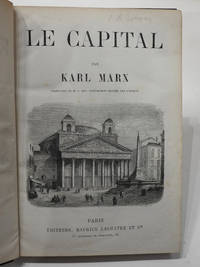
1872#10<p></p><p><strong>Karl Marx. </strong></p><p><strong>Le Capital.</strong> Traduction de M. J. Roy entièrement révisée par l'auteur.</p><p><em>Paris Librairie du Progrès 1872-1875.</em></p><p>English binding by Thompson Bros. Black half sheepskin with corners.</p><p>First edition of the French translation.</p><p>Presentation copy signed by Karl Marx in black ink on the title : <em>" To his friend Dakyns / Lond. 8 Oct. </em><em>Karl Marx ".</em></p><p>With 13 autograph corrections by the hand of Marx in black ink.</p><p><strong>Very precious copy inscribed to John Daykins a "born-communist".</strong></p><p>John Roche Daykins 1836-1910 was an English geologist who was in relations with Friedrich Engels.</p><p>Marx met him in 1869 and spoke of him as a <em>"marvelous compagnon".</em></p><p>Inscribed copies of the French edition of <em>Das Kapital</em> are scarce and the personality of the dedicatee makes this copy most precious.</p> Librairie du Progrès