MARX, KarlBiblio.com

5 793 résultats
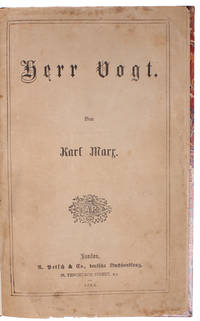
1860177307London: A. Petsch & Co. deutsche Buchhandlung 1860. First edition of the work that Marx took the best part of a year away from the writing of Capital to complete. It is an answer to the slanders against himself Engels and their supporters that appeared in Karl Vogt's 1859 pamphlet Mein Prozess gegen die Allgemeine Zeitung. "Herr Vogt is Marx's 'forgotten' work. Mentioned in passing - if at all - in biographical studies and scarcely at all in discussions of his writings it has remained for over a century largely neglected. Marx knew before its publication that many 'clever men' would be 'completely unable to grasp how I could squander my time on refuting such infantile nonsense'. What the clever men and their successors over the years could not or would not understand is that for Marx in 1860 as for Marxists today the defence and security of the revolutionary party was of paramount concern Vogt had taken the side of the petty-bourgeois democrats in 1848. Now he reached for the foulest slanders against Communists alleging that they engaged in secret and violent conspiracies and that Marx acted among them like a dictator. In this book Marx answers Vogt line for line and charge for charge. In the first chapters he holds up to ridicule Vogt's assertion that the Communists constituted a secret conspiratorial gang producing evidence from German emigrés which leaves the slanderer's arguments in tatters. Marx spares neither wit nor invective in demolishing his opponent" R. A. Archer. in the preface to his English translation of Herr Vogt 1982. Karl Vogt was "quietly teaching in Switzerland when an obscure German refugee newspaper in London accused him of being a paid agent of Napoleon III. The matter might have been forgotten if Liebknecht had not sent the accusation to the Allgemeine Zeitung which was published in Augsburg. Liebknecht was the London representative of the German newspaper. The Allgemeine Zeitung published the story. Vogt was incensed sued the newspaper for libel and although the case was dismissed he was able to claim a technical victory. He suspected quite wrongly that Marx was behind the attack. In fact Marx found little pleasure in the affair which dragged on for many weeks and was relieved when it was over. Matters might have rested in the peace of exhaustion but late in 1859 the bitterness flared up again. A small book appeared in Germany bearing the title Mein Prozess gegen die Allgemeine Zeitung. It was Vogt's account of his lawsuit against the Allgemeine Zeitung with a stenographic record of the court proceedings and whatever explanatory and contributory documents the author could lay his hands on. Vogt was a scientist and he took care that the documents should be quoted with exemplary accuracy. Occasionally he would give initials rather than full names but he was careful not to tamper with anything else. Here finally was the full evidence for Marx's treachery and duplicity as revealed in precise and objective testimony. There were no appeals to the gallery only the documents. Vogt's presentation was masterly and no one reading the book casually could imagine that it would be possible to rebut the evidence" Payne Marx a biography p. 318. Marx outraged at the attack replied in 1860 with Herr Vogt in which he denounced Vogt for intrigue slander and double-dealing. Octavo 226 x 149 mm printed in Gothic type. Original publisher's printed wrappers. Housed in a custom cloth box. Spine ends restored short tear at foot of rear joint corners a little dog-eared; a very good copy. Draper ST/M 51; Rubel 567. R. A. Archer Herr Vogt 1982. See Francis Wheen Karl Marx p. 238ff. hardcover
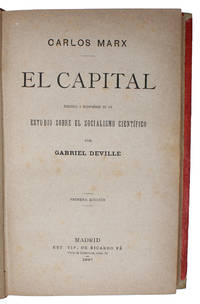
188758427Madrid Ricardo Fé 1887. 8vo. Contemporary brown half calf with gilt lettering and ornamentation to spine and red paper covered boards. Most leaves evenly browned due to the quality of the paper and some brownspotting to last few leaves. Overall a very good copy indeed of this otherwise fragile book. Socialismo Utopico. : pp. 1-91 1 frontispiece of Engels; La Ley de Los Salarios. : pp. 1-44 frontiespiece of Guesde; El Capital: pp. I-LVI 263 pp. <br/><br/><em>The exceedingly scarce first Spanish edition of the most important abridged version of Marx's Capital ever to have appeared published in the same year as what is generally accepted as the first Spanish edition of "Das Kapital" Zafrilla's abridged version - defectively translated from Roy's French version - which was published in newspaper installments 1886-87.This Spanish translation was made from the French of Gabriel Deville 1854 -1940 the great French socialist theoretician politician and diplomat who did more than almost anyone else to raise awareness of Karl Marx's theories of the weaknesses of capitalism - most effectively through the present work which came to have a profound influence upon the spreading of Marxist thought throughout the Spanish speaking part of the world. "The epitome here translated was published in Paris in 1883 by Gabriel Deville possibly the most brilliant writer among the French Marxians. It is the most successful attempt yet made to popularize Marx's scientific economics. It is by no means free from difficulties for the subject is essentially a complex and difficult subject but there are no difficulties that reasonable attention and patience will not enable the average reader to overcome. There is no attempt at originality. The very words in most cases are Marx's own words and Capital is followed so closely that the first twenty-five chapters correspond in subject and treatment with the first twenty-five chapters of Capital. Chapter XXVI corresponds in the main with Chapter XXVI of Capital but also contains portions of chapter XXX. The last three chapters-XXVII XXVIII and XXIX-correspond to the last three chapters-XXXI XXXII and XXXIII-of Capital." ROBERT RIVES LA MONTE Intruductory Note to the 1899 English translation.The Spanish translator of the work is Antonio Atienza a typographer and translator at the press of Ricardo Fé who in 1886 volunteered his work at the newly founded "El Socialista" the Spanish flagship publication of Marxist socialism. It was also in 1886 that Atienza translated the present work with the publication following in 1887. This translation happened almost simultaneously with the "translation" by Zafrilla which appeared in weekly installments in the rival newspaper "La Républica" and the two first versions of "Das Kapital" to appear in Spanish tell the story of more than just the desire to spread Marx's ideas in Spain. Both versions were part of an ongoing struggle between political parties vying for the loyalty of Spain's workers see more below. THE WORK IS OF THE UTMOST SCARCITY WITH MERELY THREE COPIES LISTED ON OCLC two in Bristish Library and one in Bibliothèque Nationale and none at auction over the last 40 years at least.Backgrund for the publication:Among the numerous nascent political organizations that sprouted in the last half of 19th century Spain many of them as a result to the tumultuous years after the so-called "Glorious Revolution" of 1868 was the Partido Socialista Obrero Español PSOE. The party was founded by Pablo Iglesias in 1879 and it was the second socialist party in Europe preceded only by the Sozialdemokratische Partei Deutschlands SPD. Notably of the original twenty-five founding members sixteen were typographers. March of 1886 was a turning point for the PSOE as they began to publish a weekly newspaper "El Socialista" in order to reach a wider audience throughout Spain and thus advance the Marxist socialist agenda of which the paper became the flagship. To this day it is the official paper of the PSOE the present ruling party in Spain although it was suppressed during the years of Franco's dictatorial regime and published sporadically in exile in France or clandestinely in Spain. It was again published regularly since 1978. The PSOE gave up Marxism in 1979 in favor of Democratic Socialism.In 1886 the translator of the present work Antonio Atienza was a typographer and translator at the press of Ricardo Fé. At the same time he volunteered his work at the newly founded El Socialista as the PSOE funds were quite limited-he wouldn't have a paid position in the paper until 1913. He translated articles by Engels Guesde and Buechner among others."Das Kapital" had been published twenty years earlier. That it took so long to reach Spain in book form reveals among other things that up to that moment most of Marx's thoughts had filtered through to the workers' unions and parties by way of the writings of his followers as they were interpreted and explained by the intellectuals in charge of these organizations. It is also evident that the complexity of the book wouldn't be of much use to the average worker factory and otherwise. Enter Deville's abridged version which was more accessible in that some of the most basic ideas of Marx were digested and re-explained. The point was not to publish a book that could only be only be understood by economists and philosophers but one that could be given to the workers. A rival party leftist party considered by the PSOE as bourgeois was the Partido Republicano Federal. One of its members Pablo Correa y Zafrilla undertook the task of translating the first volume of Das "Kapital". Quite usual for Spain at the time the translation was published in weekly instalments to subscribers of their newspaper "La República" starting in 1886 and ending in 1887. The paper then sold the cloth binding to its subscribers and offered to collect the installments to have the book bound for its customers. According to the ad in "La República" 22/1/1886 the translation is purportedly from the German original but it has been clearly demonstrated that it is a defective translation from the French translation of Roy Ribas. It seems very plausible that when the PSOE found out that someone else in Spain was beginning to publish a translation of the first volume of "Das Kapital" El Socialista decided to publish Deville's translation. In fact the publication of El Capital by "La República" was briefly mentioned once in "El Socialista" and not in flattering terms 7/10/1887. That a Marxist newspaper disparaged against the first Spanish publication of "Das Kapital" reveals among other things that they were not terribly excited about some other party's publication producing a defective rendering of their guiding principles. On the other hand that "La República" had decided to publish the book was probably brought about by the foundation of "El Socialista" as they saw that the PSOE now had the means to spread their ideas throughout the country. It is in no small way possible that the haste to publish the book brought about the many defects in the translation from the French of Roy as Correa hurried to finish it.José Mesa y Leompart a typographer translator and Marxist ideologue and activist had experienced the upheavals of the Commune of Paris during his exile after the 1868 revolution. He developed a friendship with Marx's son in law Paul Lafargue and his wife Laura Marx-who themselves had been in exile in Spain during 1871-72- as well as with Engels with whom he shared much correspondence and many other figures of the Marxist movement. He also met both Marx and Engels during their exile in London. His friendship with Pablo Iglesias was a major driving force behind the formation of the PSOE and he collaborated with El Socialista both as a writer and as a financial supporter. Mesa writes to Engels in April of 1887 lamenting that some Spanish thinkers were using Marx's theories and the policies of the German Socialist Party to deny the concept of class struggle despite the fact that "we have … proven to them that you and Marx have always said the opposite and having quoted to them the very clear statements of the German Socialist Party; but they remain unmovable and at some point they even wanted to publish the abridged Capital by Deville without the preface and with notes interpreting the meaning in their own way-which we have impeded-the Resumen abridgement of Deville will soon be published faithfully translated into Spanish."Therefore as early as April of 1887 the present translation was already in progress and in fact according to Mesa soon to be published so it was apparently very advanced. It is then quite possible that Antonio Atienza was commissioned to translate the Deville's abridgement a few months earlier and not unlikely as far as 1886 when "La República" was still publishing installments of the Correa translation. The PSOE is obviously trying to obscure and minimize Correa's translation by publishing the Deville book as the task of translating "Das Kapital" from the original would be lengthy and costly and it would have come out too late to ascertain their political hold on Marx's ideas. This translation of Deville then sees the light is in the very midst of the bickering between leftist parties and is in fact a product of the confrontations between leftist ideologies. It was finally published about nine months after Mesa's letter to Engels. The first announcement in "El Socialista" appears in their November 11th 1887 issue. The price is four pesetas or about the cost of an entire year's subscription to the paper although subscribers could purchase it at half price. Still given that many subscribers were workers of scarce means less than three hundred copies were sent out to the main Spanish cities and that the total edition was probably about a thousand copies at most.The scarcity of this book can be underlined if one considers the virulent war that was waged against all socialist and Marxist literature during and after the Spanish Civil War by the dictatorial regime of Francisco Franco. Book purges and burnings were considerable throughout Spain since the onset of the war in 1936. It is not that books were burnt sporadically and occasionally but rather they were destroyed in a systematic and terrifyingly efficient manner. As early as September of 1936 official orders were given to all civil governors mayors school inspectors in the nationalist areas to purge all "harmful" books such as pornography and books of a communist or Marxist content. Teachers librarians and private citizens often purged their own libraries public or personal of such works in order to comply with the official orders. Countless people were summarily executed for owning certain books that revealed their political tendencies. Obviously owning actual edition of a book by Marx was reason enough to be deemed guilty and likely executed. As the war advanced many other such official orders were issued and unfathomable numbers of books were burnt. To this is added that many libraries were burnt down during the bombardments that took place throughout the country and that all the libraries of the leftist parties were systematically destroyed. The end of the war in 1939 only made it official throughout the entire country that communist and socialist literature was banned. So even the few copies that might have survived the fires and the purges were surely disposed of by their owners. It is no small wonder that this particular copy did manage to survive.Withbound in the present volume is the first Spanish translation of Engels' "Socialism: Utopian and Scientific" and Jules Guesde's work on the Law of Wages. See:Ribas Pedro. "La primera traducción castellana de El capital 1886 - 1887" in Cuadernos Hispanoamericanos Madrid junio de 1985 pp. 201-210.Castillo Santiago. "Marxismo y socialismo en el siglo XIX español" in Movimiento sociales y estado en la España contemporánea Manuel Ortiz et al coord. Universidad de Castila-La Mancha 2001Boza Puerta Mariano and Sánchez Herrador Miguel Ãngel. "El martirio de los libros: una aproximación a la destrucción bibliográfica durante la Guerra Civil." In BoletÃn de la Asociación Andaluza de Bibliotecarios. Año nº 22 Nº 86-87 2007 págs. 79-96Tur Francesc. https://serhistorico.net/2018/04/04/el-bibliocausto-en-la-espana-de-franco-1936-1939/ </em> hardcover
186056420London 1860. 8vo. Bound partly uncut with the original wrappers in a nice recent half calf pastiche binding with four rasied bands and gilt lettering to spine. Front wrapper with marginal repairs and back wrappers with repairs with minor loss of text. Light brownspotting to first and last leaves. A fine copy. VI 2 1-191 1 -errata pp. <br/><br/><em>The rare first edition of Marx' landmark defense against defamation a seminal work in his struggle for a new human society. Written in the midst of his writing of "The Capital" "Herr Vogt" constitutes the work that took precedence over this most important critique of political economy and the work that gives us one of the most profound insights into the mind of the great Marx. "Herr Vogt" is furthermore the work that we have to thank for the influence that "The Capital" and Marxist socialism did come to have upon our society. "In 1857 Karl Marx resumed work on his critique of political economy a process that culminated in the publication of "Capital" a decade later. He wrote a rough draft the "Grundrisse" in 1857 and 1858 parts of which he then reworked into the "Contribution to the Critique of Political Economy" which was published in June 1859. Then in 1861 through 1863 he wrote a revised draft of the whole of "Capital" which was followed by a more polished draft written during 1864 and 1865. Finally he revised the first volume yet again during 1866 and 1867. It appeared in September 1867.The careful reader will have noticed a rather lengthy gap in this chronology. From the second half of 1859 through 1860 Marx was not working on his critique of political economy. What was he doing instead What was so important so much more of an urgent priority than his theoretical workThe answer is that Marx was fighting back against Carl Vogt's defamatory attack. He fought back in order to defend his reputation and that of his "party." . " Herr Vogt" the book Marx wrote in order to set the record straight." Klimann Marx' Struggle Against Defamation.Vogt was a prominent radical German politician and materialist philosopher who had immigrated to Switzerland where he served in parliament and was also a professor of geology. His position on the 1859 war over Italian unification had a pro-French tilt which resulted in the publication of a newspaper article and an anonymous pamphlet that alleged correctly that Vogt was being paid by the French government. Vogt believed Marx to be the source of the allegation and the author of the pamphlet.Vogt fought back by attacking Marx. He published a short book that described Marx as the leader of a band of blackmailers who demanded payment in return for keeping quiet about their victims' revolutionary histories. The book also contained a number of false and harmful allegations against Marx and Vogt did everything in his power to destroy Marx' reputation. Not only did he attack Marx personally he also falsified facts and made up untrue allegations to libel the Communist League portraying its members as conspirators in secret contact with the police and accusing Marx of personal motives.There is no doubt that this work of slander put both Marx' own future as well as that of the Communist League at stake. "Ferdinand Lassalle warned Marx that Vogt's book "will do great harm to yourself and to the whole party for it relies in a deceptive way upon half-truths" and said that "something must be done" in response quoted in Rubel 1980 p. 53. Frederick Engels also urged Marx to respond quickly and he provided a good deal of assistance when Marx wrote "Herr Vogt".Carl Vogt and the circumstances that gave rise to his defamatory attack against Marx and his "party" are dead and gone. But "Herr Vogt" and Marx's battle against defamation remain living exemplars of how one responds in a genuinely Marx-ian way-i.e. the way of Marx. Do not separate theory from practice or philosophy from organization. Do not retreat to the ivory tower or suffer attacks in silence; set the record straight. Use the bourgeois courts if necessary. Enlist the assistance of others." Klimann."Marx's Herr Vogt almost entirely unknown in the English-speaking world. It is nevertheless one of the most brilliant of his writings. Engels considered it better than the Eighteenth Brumaire; Lassalle spoke of it as "a masterpiece in every respect"; Ryazanov thought that "in all literature there is no equal to this book"; Mehring rightly wrote of its "being highly instructive even today"." Karl Marx on Herr Vogt - from The New International Vol. X No. 8 August 1944 pp. 257-260. Transcribed & marked up by Einde O'Callaghan for ETOL. </em> unknown
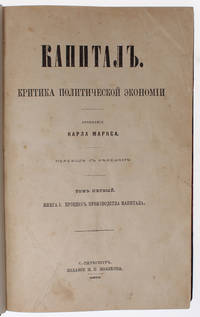
187260281S.-Peterburg N.I. Poliakov 1872. Large 8vo. In a nice recent half calf binding with gilt lettering to spine and five raised bands. First few leaves with light soling and a closed tear and a few marginal repairs to title-page. pp. 11-18 with repairs to upper outer corner. Closed tears to last leaf otherwise a fine copy. XIII 3 678 pp. wanting the half-title. <br/><br/><em>First Russian edition first issue with the issue-pointers being the first translation into any language of Marx' immensely influential main work probably the greatest revolutionary work of the nineteenth century.Marx' groundbreaking "Das Kapital" originally appeared in German in 1867 and only the first part of the work appeared in Marx' lifetime. The very first foreign translation of the work was that into Russian which considering Russian censorship at the time would seem a very unlikely event. But as it happened "Das Kapital" actually came to enjoy greater renown in Russia than in any other country; for many varying reasons it won a warm reception in many political quarters in Russia and it enjoyed a totally unexpected rapid and widespread success. The first Russian translation of "Das Kapital" came to have a profound influence the economic development of of Russia. It was frequently quoted in the most important economic and political discussions on how to industrialize Russia and the essential points of the work were seen by many as the essential questions for an industrializing Russia. " "Das Kapital" arrived in Russia just at the moment that the Russian economy was recovering from the slump that followed Emancipation and was beginning to assume capitalist characteristics. Industrialization raised in the minds of the intelligentsia the question of their country's economic destiny. And it was precisely this concern that drew Mikhailovsky and many of the "intelligenty" to "Das Kapital"." Resis p. 232.The story of how the first printing of the first translation of "Das Kapital" came about is quite unexpected. As the "triumph of Marxism in backward Russia is commonly regarded as a historical anomaly" Resis p. 221 so is the triumph of the first Russian edition of "Das Kapital". The main credit for the coming to be of the translation of "Das Kapital" must be given to Nicolai Danielson later a highly important economist in his own right. The idea came from a circle of revolutionary youths in St. Petersburg including N.F. Danielson G.A. Lopatin M.F. Negreskul and N.N. Liubavin all four of whom participated in the project. Danielson had read the work shortly after its publication and it had made such an impact on him that he decided to make it available to the Russian reading public. He persuaded N.I. Poliakov to run the risk of publishing it. "Poliakov the publisher specialized in publishing authors Russian and foreign considered dangerous by the authorities. Poliakov also frequently subsidized revolutionaries by commissioning them to do translations for his publishing house. Diffusion of advanced ideas rather than profit was no doubt his primary motive in publishing the book." Resis p. 222. Owing to Danielson's initiative Poliakov engaged first Bakunin and then Lopatin to do the translation. Danielson himself finished the translation and saw the work through press. It was undeniably his leadership that brought Marx to the Russian reading public. In fact with the first Russian edition of "Das Kapital" Danielson was responsible for the first public success of the revolutionizing work. "Few scholars today would deny that "Das Kapital" has had an enormous effect on history in the past hundred years. Nonetheless when the book was published in Hamburg on September 5 1867 it made scarcely a stir except among German revolutionaries. Marx complained that his work was greeted by "a conspiracy of silence" on the part of "a pack of liberals and vulgar economists." However desperately he contrived to provoke established economists to take up "Das Kapital"'s challenge to their work his efforts came to nought. But in October 1868 Marx received good news from an unexpected source. From Nikolai Frantsevich Danielson a young economist employed by the St. Petersburg Mutual Credit Society came a letter informing Marx that N. P. Poliakov a publisher of that city desired to publish a Russian translation of the first volume of "Das Kapital"; moreover he also wanted to publish the forthcoming second volume. Danielson the publisher's representative requested that Marx send him the proofs of volume 2 as they came off the press so that Poliakov could publish both volumes simultaneously. Marx replied immediately. The publication of a Russian edition of volume 1 he wrote should not be held up because the completion of volume 2 might be delayed by some six months in fact it did not appear in Marx' life-time and was only published ab. 17 years later in 1885; and in any case volume 1 represented an independent whole. Danielson proceeded at once to set the project in motion. Nearly four years passed however before a Russian translation appeared. Indeed a year passed before the translation was even begun and four translators tried their hand at it before Danielson was able to send the manuscript to the printers in late December 1871." Resis pp. 221-22. This explains how the book came to be translated but how did this main work of revolutionary thought escape the rigid Russian censors "By an odd quirk of history the first foreign translation of "Das Kapital" to appear was the Russian which Petersburgers found in their bookshops early in April 1872. Giving his imprimatur the censor one Skuratov had written "few people in Russia will read it and still fewer will understand it." He was wrong: the edition of three thousand sold out quickly; and in 1880 Marx was writing to his friend F.A. Sorge that "our success is still greater in Russia where "Kapital" is read and appreciated more than anywhere else." PMM 359 p.218. Astonishingly Within six weeks of the publication date nine hundred copies of the edition of three thousand had already been sold."Under the new laws on the press "Das Kapital" could have been proscribed on any number of grounds. The Temporary Rules held for example that censorship must not permit publication of works that "expound the harmful doctrines of socialism or communism" or works that "rouse enmity and hatred of one class for another." The Board of Censors of Foreign Publications was specifically instructed to prohibit importation of works contrary to the tenets of the Orthodox Church or works that led to atheism materialism or disrespect for Scriptures. Nor did the recent fate of the works of Marx and Engels at the hands of the censors offer much hope that "Das Kapital" would pass censorship. As recently as August 11 the censors of foreign works had decided to ban importation of Engels' "Die Lage der arbeitenden Klassen in England" and according to Lopatin the censors reprimanded Poliakov for daring to run announcements on book jackets of the forthcoming publication of "Das Kapital". By 1872 the censors had prohibited the importation and circulation of all works by Marx and Engels except one - "Das Kapital". The book as we shall see had already won some recognition in Russia shortly after its publication in Germany. Not until 1871 however did the censors render a judgment on the book when the Central Committee of Censors of Foreign Publications on the recommendation of its reader permitted importation and circulation of the book both in the original language and in translation. The official reader had described the book as "a difficult inaccessible strictly scientific work" implying that it could scarcely pose a danger to the state. . The length and complexity of the book prompted the office to divide the task of scrutinizing it between two readers D. Skuratov who read the first half of the book and A. De-Roberti who read the last half. Skuratov dutifully listed objectionable socialist and antireligious passages taking special note of Marx's harsh attack on the land reforms General Kiselev had instituted in the Danubian Principalities. But in his report Skuratov dismissed these attacks as harmless since they were imbedded in a "colossal mass of abstruse somewhat obscure politico-economic argumentation." Indeed he regarded the work as its own best antidote to sedition. "It can be confidently stated" he wrote "that in Russia few will read it and even fewer will understand it." Second he said the book could do little harm. Since the book attacked a system rather than individual persons Skuratov implied that the book would not incite acts threatening the safety of the royal family and government officials. Third he believed that the argument of the book did not apply to Russia. Marx attacked the unbridled competition practiced in the British factory system and such attacks Skuratov asserted could find no target in Russia because the tsarist regime did not pursue a policy of laissez faire. Indeed at that very moment Skuratov stated a special commission had drafted a plan that "as zealously protects the workers' well-being from abuses on the part of the employers as it protects the employers' interests against lack of discipline and nonfulfillment of obligations on the part of the workers." Repeating most of Skuratov's views De-Roberti also noted that the book contained a good account of the impact of the factory system and the system of unpaid labor time that prevailed in the West. In spite of the obvious socialist tendency of the book he concluded a court case could scarcely be made against it because the censors of foreign works had already agreed to permit importation and circulation of the German edition. With the last barrier removed on March 27 1872 the Russian translation of "Das Kapital" went on sale in the Russian Empire. The publisher translators and advocates of the book had persevered in the project for nearly four years until they were finally able to bring the book to the Russian reading public." Resis pp. 220-22. The Russian authorities quickly realized however that Skuratov's statement could not have been more wrong and the planned second edition of the Russian translation was forbidden; thus it came to be published in New York in 1890. That second edition is nearly identical to the first which can be distinguished by the misplaced comma opposite "p. 73" in the table of contents replaced by a full stop in the 2nd ed. and the "e" at the end of l. 40 on p. 65 replaced by a "c" in the 2nd ed. A third edition translated from the fourth German edition appeared in 1898. Volumes 2 and 3 of "Das Kapital" appeared in Russian translation also by Danielson in 1885 and 1896.See: Albert Resis Das Kapital Comes to Russia in: Slavic Review Vol. 29 No. 2 Jun. 1970 pp. 219-237. </em> hardcover
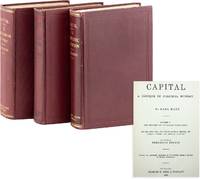
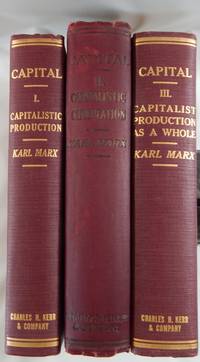
190688451Chicago Ill: Charles H. Kerr & Co. London: Swan Sonnenschein & Co. 1906 1907 1909. First Editions First Printings. Three Volumes. Octavo. 22.5cm. Publisher's deep maroon ribbed cloth titled in gilt to spines and ruled in blind to boards. 869pp.; 618pp.; 1048pp. Generally strong and tight; mild scuffing and to spine ends and corners and a few minor exterior stains. Spine gilt is significantly oxidized to Vol II as is usually seen on the first printing; internally clean and fresh some very light spotting in places mainly confined to the page edges. A very good handsome set of first printings. <br /> <br /> A full set of first printings of this bibliographically complex edition issued over the course of three years. Marx published the first volume of his epic analysis of capitalism in German in 1867. The first translation into English was of Volume 1 only and was accomplished by Edward Aveling and Samuel Moore in 1887 based on the revised 4th German edition as edited by Engels. The 1906 first American printing under the Charles Kerr impint as here largely follows this translation with the subsequent translation work for Volumes II and III being performed by Ernest Untermann. Thus the earliest printings of the Kerr edition comprise the first complete edition of Capital in the English language. The printing was done in Chicago by James Higgins Kerr's printer of choice making this also the first complete edition of Capital to be printed entirely by a union-run print shop. Untermann did most of his translation work from remote Florida beginning the effort in 1905 discovering in the process a number of indices footnotes and at least ten pages of text that Aveling and Moore had not included in their London edition - making the Kerr edition the most complete up to its time. <br /> <br /> Kerr burned through the first two-thousand copy print run of Volume I almost immediately and rushed to get Volume II out by July 1907. It's very possible that financial constraints were already making themselves known by Volume II as Kerr was selling the books at a loss to encourage sales; the almost ubiquitous oxidation of the gilt on Vol II is likely a result of experimental economy that swiftly failed. Vol III returns to the higher standards of the first volume. The bindings on the first printings also feature a triple blind rule to the ribbed cloth boards with subsequent printings having double rules. Kerr's reprint system seems to have incorporated dates on the title pages for some length of time with the dates on the copyright pages remaining unchanged; after a certain point around the early 1920's reprints were issued without dates to the title pages and any volume without a date can safely be deemed a post-1920s reprint. Issues of Kerr's International Socialist Review from the period of printing recount in detail some of his problems and concerns publishing and selling the work with detailed data on dates numbers of copies and the firm's hopes for the completed book. <br /> <br /> Genuine first printing sets of this important edition are tremendously scarce in commerce. The lack of any real bibliographical authority for the American edition combined with Kerr's generally lax approach to differentiating printings has over the years led to frequent errors and misjudgments on the part of cataloguers including in full disclosure ourselves. After a good deal of research most in the advertising pages of the International Socialist Review we're confident we've finally got it right. Charles H. Kerr & Co. [London: Swan Sonnenschein & Co.] unknown
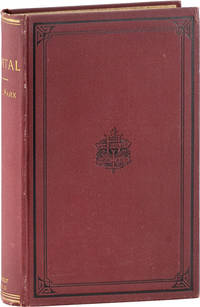
190918341Chicago: Charles H. Kerr & Company 1909. First US editions. Hardcover. Very good. Three volumes 8vo. Red cloth blocked in gilt on the spines. Volume I is the 1906 US firs tprinting; Volume II is the 1907 US first printing; and Volume II is the 1909 US first printing. Volume II spine gilt dulled a comon issue with this volume some rubbing to the spine and inner hinges neatly repaired. Volumes I and II are in very good condition. Inner hinges of volume I neatly repaired; spine of Volume III is rubbed in places else this is a very good set.<br /> <p><br /> The Kerr edition is the first US edition of Marx's complete three volume work usually known by its German title Das Kapital. Only the first volume was published in Marx's lifetime; it appeared in the US in 1890. Engels completed the work using Marx's notes and published them in Germany in 1885 and 1894 respectively. This American issue was translated from the third German edition by Samuel Moore and Edward Aveling and revised and amplified from the fourth German edition by Ernest Untermann.Vol. I from the second German edition by Ernest Untermann Vol II and from the first German edition by Untermann Vol III. <br /> <p><br /> A PMM selection.<br /> <p>. Charles H. Kerr & Company hardcover
1881137927The Hague: Liebers & Co 1881. The rare first Dutch edition First appearance in Dutch of Marx's Lohnarbeit und Kapital with a flattering dedication to Marx by the translator and compiler Ferdinand Domela Nieuwenhuis 1846-1919 a Dutch socialist. "Originally a Lutheran pastor 1870-1879 he left the church founded the socialist weekly Recht voor Allen 1879. He played a leading part in developing the Social-Democratic movement in the Netherlands; was elected to parliament for a term 1881-1891; disappointed in legislating social reform he turned to anarchism 1890s. He authored a number of propaganda brochures." Draper: The Marx-Engels Glossary p. 154. Nieuwenhuis sent a copy of the work to Marx on 8 January 1881 Marx replying in a letter of 22 February in which he expresses a desire to make a list of changes and corrections for a second edition but regrets that personal difficulties prevent him from so doing. A second edition was published in 1889. Octavo 204 x 126 mm. viii 82 pages. Disbound preserved in a glassine wrapper under acetate. Housed in a black cloth flat-back box by the Chelsea Bindery. Spine re-glued. Paper stock lightly browned a few small marginal chips occasional pencil markings; a very good copy. WorldCat locates 5 copies in the Netherlands 3 in Germany and 1 in the USA. hardcover
1933188698Chicago: Charles H. Kerr & Company 1933. Hardcover. All 3 Volumes Near Fine in red cloth. Vol. I printed 1906. Vol. II printed 1933. Vol. III printed 1909. Charles H. Kerr & Company hardcover
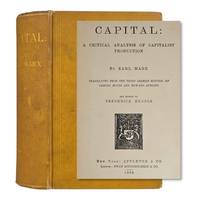
1889140942049New York: The Humboldt Publishing Company 1889. First American Edition. Near Fine. 1889. First American edition translated from the third German edition by Samuel Moore and Edward Aveling and edited by Frederick Engels. Two editions were published in America in 1889 the other by Appleton with the priority undecided. Bound in publisher's original maroon buckram tripple-ruled in black spine lettered in gilt patterned endpapers. Near Fine with light rubbing and soiling to cloth light fading to spine small water droplet to top edge of textblock. Front inner hinge exposed but binding firm front free endpaper is detached and laid in and with a single-digit number inked to the top corner. Pages toned. Marx's groundbreaking work of political economy Das Kapital a spark which would eventually ignite many of the largest conflagrations of the 20th century. The Humboldt Publishing Company unknown
1889694 - 650 - 736<p><em>First American edition preceding the later Humboldt text in America by twenty months</em></p><p><strong>Publisher and Year</strong>: New York: Appleton & Co. 1889</p><p><strong>Edition</strong>: First American edition one of just 500 copies published in January 1889.1-4 Translated from the third German edition by Samuel Moore and Edward Aveling. The present work consists of the first and only volume to be fully written by Marx with the next two installments completed by Engels and published in English in 1907 and 1909.</p><p>Other than the title page the text of the 1889 Appleton edition is identical to the first British edition London: Swan Sonnenschein & Co. 1887 and was bound from sheets printed in the U.K. but was issued in one volume rather than two. For this edition the British firm printed and sold 500 sets of sheets to Appleton & Co. marking the first time that an American firm was listed as a publisher on the printed sheets. Note that in 1887 about half of the 500 copies of the first British edition were exported and bound in the United States but the sheets were not printed with credit to the two American distributors though both firms did make later alterations to advertise their involvement.1</p><p>The next appearance of the book in America came a full twenty months after the Appleton edition New York: The Humboldt Publishing Company 1890. Though the Humboldt edition was the earliest to be physically printed in the United States the text was an unauthorized piracy of the Moore-Aveling translation.1 The Humboldt edition was issued in serialized wrappers from September to October in 1890 and then in cloth by November of that year at the latest ~5000 copies were ultimately printed.15-8</p><p><strong>Condition and Description</strong>: Thick octavo publisher's ochre cloth stamped in gilt and blind pale-yellow endpapers 816 pp. Boards soiled with some rubbing and handling wear. Tips bumped and exposed. Gilt still legible. Some stains to the edges of the text block not intruding upon the text except for in one small instance on the upper part of the final blank. Hinges loose but holding with splits to the endpapers at the gutters but the webbing remains intact a common fault given the considerable weight and thickness of the text block. The text itself remains firmly bound with all pages attached. Tanning to the first two blanks from something that had been laid in. Previous owner's name in ink to the third blank page Louis Walldorf a member of the Socialist Labor Party in the 1890s. No other writing or underlining. A few scattered instances of light foxing and finger smudging. Without any restoration or repair. An 1899 card from The Labor Lyceum a socialist organization based in Rochester N.Y. is laid in. The card advertises an event "The 'People's Parliament'" consisting of a series of lectures and open debates concerning questions "vital.to the working people." The card in addition to ownership by a member of the Socialist Labor Party reflects the use of this copy in the American socialist movement in the late nineteenth century.</p><p><strong>Provenance: </strong>Louis Walldorf b. 1832 a German immigrant watchmaker and socialist political activist. In March of 1892 Walldorf was nominated by his ward to be an executive board member of The Socialist Labor SLP party in Rochester N.Y. where he resided. Later that year the SLP nominated their first candidates for president and vice president of the United States even though the official party platform was to abolish both offices. Walldorf remained a resident of Rochester throughout the 1890s and The Labor Lyceum card was plausibly his given where the advertised event was held.</p><p><strong>References:</strong></p><p>1. "Karl Marx Capital First American Editions." Article issued by the Karl Marx Library in Luxembourg.</p><p>2. The Publisher's Weekly 1888 Dec 29. Vol 34 Issue 26. Appleton's edition listed under "Will publish next week."</p><p>3. The Publisher's Weekly 1889 Jan 12. Vol 35 Issue 2. Appleton's edition listed under "Just published"</p><p>4. The Daily Inter Ocean 1889 Jan 12. Appleton's edition listed under "Books Received"</p><p>5. The Humboldt Library of Science issues of Marx's The Capital 135-138. Parts were dated Sep 1 Sep 15 Oct 1 and Oct 15 of 1890 on the front wrappers. Refer to the example sold by Swann Galleries on May 5th 2022.</p><p>6. Copies in wrappers were reprinted monthly from January 1891 to April 1891 with such copies bearing those dates on the front wrappers. Refer to the set listed by Antiquariat Inlibris.</p><p>7. The Nation 1890 November 6 Vol 51 Issue 1323. Humboldt edition advertised at $1.20 four parts in wrappers and $1.75 cloth</p><p>8. The Nation 1890 November 12 Vol 51 Issue 1324. Humboldt edition advertised at $1.20 four parts in wrappers and $1.75 cloth</p><p>-<br />Inventory ID: 694 - 650 - 736</p> Appleton & Co. hardcover
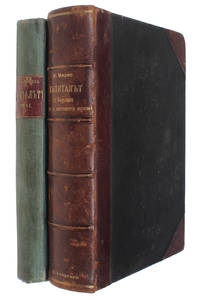
191057297Blagoev-translation: Sofia presumably 1910 but august 1909 stated on last leaf of preface & Ba Blagoev-translation: 8vo. In a contemporary full cloth binding with red leather title-label with gilt lettering to spine. Spine with wear and light soiling to extremities. Hindges a bit weak First 10 leaves with stain in margin otherwise a good copy. 6 XXXI 1 675 1 pp.Bakalov-translation: 8vo. In contemporary half calf with five raised bands and gilt lettering to spine. Wear to extremities and hindges a bit weak Repair to inner margin of title-page. Internally fine and clean. XXX 2 598 2 pp. frontiespiece of Marx. Withbound is "Karl Marx and His Time": 1-180 pp. <br/><br/><em>A most interesting set consisting of the two first Bulgarian translations of Marx' 'Das Kapital'. Quite extraordinary in the history of translations of 'Das Kapital' two Bulgarian translation appeared presumably simultaneously and both translations seems to have been actively used though the 20ies and 30ies and they were reprinted simultaneously in 1930-31 both edited by Todor Pavlov. To our best knowledge Bulgarian is the only language which have had two complete translation published at the same time.The Bakalov-translation is certainly published in 1910. The Blagoew-translation printed in Sofia has often been referred to as being printed in 1909 and has occasionally been referred to as the first translation of the two solely because his foreword was proceeded by "August 1909". That the book was actually printed in 1909 has however recently been disputed. Both translators were well aware of each other and perhaps Blagoew simply wrote "August 1909" to gain primacy in being the first to have a complete translation published: "I was not able to prove this but this is either a typo unlikely or was Blagoev's way to acquire primacy over the other translation from 1910 that of Georgi Bakalov" Panayotov Capital without Value: The Soviet-Bulgarian Synthesis. Translator Dimitar Blagoev the founder and leader of the Bulgarian Worker's Social Democratic Party became or Narrow Socialists or Tesniaki became the the first Marxist propangandist in Bulgaria. About the present translation Blagoev said: "The translation was made from Russian but we can rightly say that it came from Russian as well as from Russian German and French. We all had four Russian issuesbut the basis for this was the last Russian translation which was edited by G. P. Struwe as it came closest to the original. In all this however we had to compare almost line by line with the original of the last fourth German edition of Friedrich Engels and the French translation which was specially reviewed by Marx himself."Blagoev was also a prominent proponent of ideas for the establishment of a Balkan Federation leading the Narrow Socialists into the Communist International in 1919 where the party changed its name to the Bulgarian Communist Party. However during this period Blagoev and the party as a whole did not completely adopt Bolshevik's positions on the basic questions. This determined the party's policies during the Vladaya Soldiers' Rebellion of 1918 and the military coup of 9 June 1923 when the party adopted a position of neutrality. He was also an opponent of the failed September Uprising and thought that there were no ripe conditions for a revolution in Bulgaria yet.A partial translation by Blagoev only 122 pp was published in 1905 and is of the utmost scarcity. Georgi Bakalov published his translation from the German in his hometown Stara Zagora. The publisher was The Liberal Club which was a printshop rather than a proper publisher. He was also a member of Bulgarian Social Democratic Party as of 1891 and likely much similar to many of the early Bulgarian socialists was active in education and socalled 'uchitelsko delo' teachers' affairs. In 1891-93 he studied in Geneva and quickly befriended Plekhanov whom he translated in the 1890s.OCLC only list no copies of either translation. We know however that a copy of both translations are held in the SS. Cyril and Methodius National Library Bulgaria. </em> hardcover
190558543Kapitalut: Balchik Izdanie na Krist'o Ivanov 1905. Speech On the Question of Free Trade: Sofia 8vo. In contemporary red half calf. Extremities with wear. Previous owner's name in contemporary hand to upper part of both title-pages. Light browning throughout and a few occassional underlignings in text mainly in "A speech on free trade". Kapitalut: XXXVIII 122 pp. Rech za.: 27 1. <br/><br/><em>The exceedingly rare first partial Bulgarian translation of Marx's 'Das Kapital' heft. 1. Translator Dimitar Glagoev who eventually in 1909-10 made the first complete translation was the founder and leader of the Bulgarian Worker's Social Democratic Party became or Narrow Socialists or Tesniaki became the the first Marxist propangandist in Bulgaria. The present publication is presumably printed in very low number and are of the utmost scarcity; OCLC locate no institutional holdings We know of one copy in the SS. Cyril and Methodius National Library Bulgaria and no copy has been up for auction the past 50 years.Extradited in 1885 by the Russian government Blagoev returned to Bulgaria settled in Sofia and began to propagate socialist ideas. In July 1891 on the initiative of Blagoev the social democratic circles of Tarnovo Gabrovo Sliven Stara Zagora Kazanluk and other cities united to form the Bulgarian Social Democratic Party BSDP. The Marxist nucleus of the BSDP was opposed by a group who were essentially opposed to making the social democratic movement into a party. In 1893 this group led by Yanko Sakazov founded a reformist organization the Bulgarian Social Democratic Union. In 1894 Blagoev's supporters agreed to unite with the Unionists in the interests of working class unity and took the name Bulgarian Social Democratic Workers Party. Blagoev founder and became the leader of its left wing which split from the BSDWP in 1903 to found the Bulgarian Social Democratic Workers' Party Narrow Socialists. Under his guidance the foundations of the class trade-union movement was laid in 1904. Blagoev was also a prominent proponent of ideas for the establishment of a Balkan Federation leading the Narrow Socialists into the Communist International in 1919 where the party changed its name to the Bulgarian Communist Party. However during this period Blagoev and the party as a whole did not completely adopt Bolshevik's positions on the basic questions. This determined the party's policies during the Vladaya Soldiers' Rebellion of 1918 and the military coup of 9 June 1923 when the party adopted a position of neutrality. He was also an opponent of the failed September Uprising and thought that there were no ripe conditions for a revolution in Bulgaria yet.From 1897 to 1923 Blagoev directed the publication of the party's theoretical organ the journal "Novo Vreme" which published more than 500 of his articles. The first complete Bulgarian translation were published in 1909/1910. </em> unknown
1889140941076New York: The Humboldt Publishing Company 1889. First American Edition. Near Fine. First American edition translated from the third German edition by Samuel Moore and Edward Aveling and edited by Frederick Engels. Two editions were published in America in 1889 the other by Appleton with the priority undecided. Bound in publisher's original maroon buckram tripple-ruled in black spine lettered in gilt patterned endpapers. Near Fine with light wear to cloth at spine ends and corners subtle repairs visible at spine joints spine discolored. Front inner hinge and front free endpaper repaired; rear inner hinge slightly cracked. Pages toned. Marx's groundbreaking work of political economy Das Kapital a spark which would eventually ignite many of the largest conflagrations of the 20th century. The Humboldt Publishing Company unknown
120778London Swan Sonnenschein and Co. 1889. . First Stereotype edition third appearance in English overall; 8vo 23 x 15 cm; ownership inscription in pen to front free endpaper recto old residue to front pastedown a little toned; publisher's blind-stamped maroon cloth lettered in gilt to spine within single gilt filet border small puncture hole slightly soiled and discoloured spine ends neatly repaired very good; xxxi 1 816pp.<br /> Although designated 'Stereotype Edition' on the title page the setting is in fact identical to the first American edition printed the same year with the dual imprint 'New York: Appleton & Co. London: Swan Sonnenschein & Co.'<br /><br />The ownership inscription to the front free endpaper is dated '5/11/88' suggesting this edition with the sole London imprint was brought to the press towards the end of 1888 the publication date being for-dated to the following year. We can trace no interim publication between this edition and the first English edition which was brought to the press in 1896 and reprinted the following year.<br /><br />Das Kapital was the summation of over twenty-years of research in the reading rooms of the British Museum and followed on from his earlier work on political economy Zur Kritik der Politisches Oekonomie printed in 1859. <br /><br />Only the first volume A critical analysis of capitalist production was complete at the time of Marx's death in 1883 with this translation by Samuel Moore and Edward Aveling published in London 4 years later. The second and third volumes of Marx's work were published posthumously in 1885 and 1894 but not translated into English until Kerr's edition was printed in 1906 to 1909.<br /><br />Despite the German edition volume two being available in 1885 Engels in his preface to this translation explained that he deliberately held off including it in this edition as he felt any translation of the second volume would be incomplete without the translation of the third which had not yet be published. <br /><br />'Aveling was the husband of Marx's youngest daughter Eleanor and Moore an old friend an unwilling businessman like Engels who later turned to the law and ended as a magistrate in Nigeria.' PMM. <br /><br />'The history of the twentieth century is Marx's legacy. Stalin Mao Che Castro - the icons and monsters of the modern age have all presented themselves as his heirs. Whether he would recognise them as such is quite another matter . Nevertheless writing one hundred years after his death half the world's population was ruled by governments that professed Marxism to be their guiding faith. His ideas have transformed the study of economics history geography sociology and literature. Not since Jesus Christ has an obscure pauper inspired such global devotion - or been so calamitously misinterpreted' Francis Wheen in his Introduction to Karl Marx 1999.<br /><br />Scarce. OCLC records just 4 copies of this edition in institutional collections worldwide Trinity College Cambridge University of Southern California Newberry Library Illinois and University of Hong Kong.<br /> London, Swan Sonnenschein and Co., 1889. hardcover
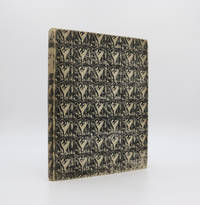
29638London: The Curwen Press for The Fleuron Ltd. 1928. First edition. First edition. Limited edition. Quarto. Publisher's original white cloth printed in black with a wood engraving design by Paul Nash title in black to the spine. Title page vignette head-piece and decorated initial letter by Edward Bawden coloured in green and pink. With 31 sheets of pattern papers printed at The Curwen Press 10 of which are produced from wood engravings. Each sheet is folded twice and uncut to the folded edge as issued. A very good copy the binding square and firm with bumping to the spine tips and corners and rubbing to the black printed design at the edges. The contents with a little offsetting to the endpapers and the occasional finger mark to the margins of the introduction are otherwise fine bright and fresh throughout. Issued in an edition of 145 copies for sale in the UK from which this example is numbered 49. There was also an edition of 75 copies issued by Random House for sale in America. With an eight page introduction by Paul Nash in which he relates the history of patterned papers. A beautiful volume. Further details and images for any of the items listed are available on request. Lucius Books welcomes direct contact with our customers. London: The Curwen Press for The Fleuron Ltd. 1928 hardcover
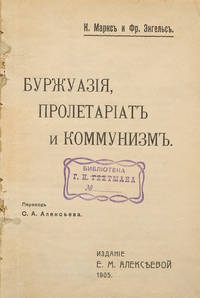
19055608<p><strong>First legal Russian edition of '<em>The Communist Manifesto'</em> by Karl Marx and Friedrich Engels. </strong>Published on May 1905. One of 10 000 copies published.</p><p>About fifteen editions of the Manifesto were published in Russia within several months following the Revolution of 1905.<br />This is a rare edition of the Manifesto. Bert Andréas never saw it nor the original edition nor its photocopy. He did not find any copies outside the USSR in 1963.</p><p>We also couldn't trace any copy in OCLC.</p><p>>Andréas No 428.</p> E.M. Alekseev hardcover
1885122813Copenhagen: N. Cohens Bogtrykkeri 1885 & 1887. Capital in Danish First edition in Danish of Das Kapital. Marx's seminal work first appeared in German in 1867 and the first translation of the work was that into Russian 1872. The first English translation appeared after the Danish in 1887. "The history of the twentieth century is Marx's legacy. Stalin Mao Che Castro - the icons and monsters of the modern age have all presented themselves as his heirs. Whether he would recognise them as such is quite another matter. Nevertheless within one hundred years of his death half the world's population was ruled by governments that professed Marxism to be their guiding faith. His ideas have transformed the study of economics history geography sociology and literature. Not since Jesus Christ has an obscure pauper inspired such global devotion - or been so calamitously misinterpreted" Francis Wheen in his introduction to Karl Marx 1999. 2 vols in 1 quarto. Modern red buckram spine lettered in gilt top edge sprinkled black. Without the half-titles "Socialistisk Bibliotek Vol. IV-V". Previous ownership inscription in blue ink to front free endpaper with the quotation "The expropriators are expropriated. p. 462 I" inscribed underneath in red ink; library stamp to vol. 2 p. 1. Spine slightly faded ends a little bruised and rubbed contents evenly browned with some chipping to page edges as usual due to paper quality front and rear gutters and several page edges neatly reinforced using Japanese tissue overall a very good clean copy of a fragile publication. See Printing and the Mind of Man 359 first edition. hardcover
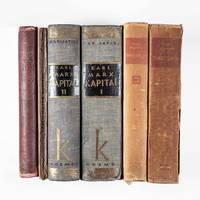
1954503831954. First & Second editions. 1 Dimitar Blagoev trans. Капиталътъ: Критика на ПолитичеÑката ЕкономиÑ. Томъ Първи/ KapitalÅt: Kritika na Politicheskata Ekonomiya. TomÅ PÅrvi Capital: A Critique of Political Economy. Vol.1 FIRST BULGARIAN EDITION. Ð¡Ð¾Ñ„Ð¸Ñ Sofia. Партийната СоциалиÑтичеÑка Книжарница и Печатница The Party Socialist Bookstore and Printing House. ca. 1909. First Bulgarian edition. Small quarto. 675pp. 1. Period red buckram boards with gilt lettering ruling and tooling on the front cover and spine. Decorative endpapers. The extremely scarce first Bulgarian edition of the first part of Karl Marx's seminal work Capital Das Kapital originally published in German in 1867. Eventually the work comprised three volumes with the second and third parts published after Marx's death by his colleague Friedrich Engels.<br /> <br /> This edition was published by the bookstore of the Bulgarian Social Democratic Workers' Party later the Bulgarian Communist Party who's founder leading Balkan Marxist Dimitar Blagoev 1856-1924 translated this edition. In 1905 Blagoev published a scarce partial translation of the work but it wasn't until 4 year later that this full translation was released to the Bulgarian public. The date of August 1909 is given at the end of Blagoev's introduction although the title page does not list a publication date. There is some debate as to weather this or another edition translated by Bulgarian writer historian and socialist Georgi Bakalov 1873-1939 with a title page listing the publication date as 1910 should be considered the first Bulgarian edition. However given the earlier 1909 date in this introduction and the fact that Blagoev was already translating the work four years earlier suggests that this translation probably supersedes the other. As stated in this edition this edition was based on the 1906 Russian edition. The text throughout contains copious scholarly footnotes. The front of the book contains a detailed table of contents and a page containing a small b/w photographic reproduction after a portrait of Karl Marx immediately following the title page. It is believed that ultimately only the first volume of Das Kapital was translated by Blagoev and not the others.<br /> <br /> Text in Bulgarian in Cyrillic script.<br /> <br /> Binding with some rubbing and bumping to extremities including the head and tail of the spine. Some light smudges scratches and stains to the covers and spine with gilt a bit rubbed. Interior with some sporadic light marginal notes and/or underlining in regular and red colored pencil to few pages throughout the text as well as some sporadic minor smudges. Book block quite tight overall. Binding in good interior in very good- condition overall. Extremely scarce. g to vg-. <br /> Hardcover.<br /> <br /> Only one confirmed copy of this full translation in OCLC.<br /> <br /> <br /> <br /> 2 Porobić M. MoÅ¡a Pijade and R. Bosanac Rodoljub ÄŒolaković translators; Svetomir Lazarevic ed. Kapital. Kritika PolitiÄke Ekonomije. Proces Proizvodnje Kapitala WITH Prometni Proces Kapitala SCARCE FIRST COMPLETE SERBO-CROATIAN TRANSLATION BOTH THE FIRST AND SECOND VOLUMES. Belgrade. Kosmos. 1933-1934. First Serbo-Croatian edition. Quarto. Vol.1: 837pp. 2. Vol.2: 549pp. 2. Blue-grey cloth boards with gilt and black lettering on the front covers and spines. A complete set of both the first and second volumes of Karl Marx's magnum opus "Kapital" here fully translated into Serbo-Croatian for the first time. Among the notable aspects of the these volumes is that the translation was done in collaboration between two major Communist political and cultural figures in Yugoslavian history Marxist theorist MoÅ¡a Pijade 1890-1957 and writer and political activist Rodoljub ÄŒolaković 1900-1983 while serving in prison together as political dissidents. The second volume was translated by Pijade alone. Both men were seen as influential Yugoslavian Marxist figures and both played prominent roles in the Yugoslav Partisan resistance to the Axis-powers' occupation during WWII. After the war and the reestablishment of Yugoslav governance Pijade became a significant figure in politics and government and a close confidant of Yugoslav leader Josip Broz Tito while ÄŒolaković became a prolific writer. These volumes were published by Kosmos as the third and six parts respectively of their series of philosophical publications and were the sole volumes to been printed with text in Roman script until 1940. At the time of publication both MoÅ¡a Pijade and Rodoljub ÄŒolaković were still imprisoned and so were credited under the pseudonyms of M. Porobić and R. Bosanac respectively. The final pages of each volume contain an index a table of contents and publisher's advertisements.<br /> <br /> Text throughout in Serbo-Croatian in Roman script.<br /> <br /> Bindings with some bumping to corners and some minor to moderate rubbing to extremities as well as some minor to light rubbing to the gilt. Vol.1 with some rubbing and tearing at the tail of the spine along the front hinge as well as a few small abrasions to the back cover. Vol.1 with starting at the interior covers. Vol. 2 with starting at the interior front cover and p.550 and a signed inscription to the previous owner on the front free endpaper. Pages throughout both volumes with some minor to light age toning along the edges as well as some very sporadic minor to light water stains smudges and/or underlining in pencil. Bindings in good to very good- condition. Interior in good to very good- condition overall. Quite scarce. g to vg-. Hardcover. <br /> <br /> The previously issued 1924 Serbian edition of Kapital was issued in Belgrade and was a translation of the widely and internationally circulated digest of the work done by Julian Borchardt 1868-1932. This 1933-1934 edition contains the first complete translation done by MoÅ¡a Pijade and was seen as among a number of reasons for his arrest in the first place. These two volumes are considered the first full translation of the work into Serbo-Croatian.<br /> <br /> <br /> <br /> 3 Julian Borchardt ed.; MoÅ¡a Pijade trans. Kapital. Kritika PolitiÄke Ekonomije. Popularno Izdanje Popular Edition FIRST SERBIAN EDITION. Belgrade. Izdavac̆ka Knjiz̆arnica Gece Kona. 1924. First Serbian edition. Quarto. 198pp. 3. Purple printed wrappers with black lettering on the front cover. This "popular edition" is considered the very first edition of Karl Marx's seminal work "Kapital" to be translated into the Serbian language. It is based on the internationally popular digest version of all three volumes of the work first published in Germany in 1919 prepared and edited by German socialist journalist and politician Julian Borchardt 1868–1932 here credited as "Julian Borhart". This translation was done by prominent Yugoslav Marxist theorist partisan and politician MoÅ¡a Pijade 1890-1957. His work on this translation and other political activities and agitations were the reasons for which Pijade was imprisoned by the Yugoslav government in 1925. He became a prominent member of the Yugoslav partisan resistance during WWII becoming a close confidant and ally to future Yugoslav leader Josip Broz Tito and later serving in prominent roles in the post-war government.<br /> <br /> Other international editions of Borchardt's abridged version of the work were published including German English and Russian. It would be another 9 years before the work was fully translated in Yugoslavia.<br /> <br /> Text throughout in Serbian printed in Roman script.<br /> <br /> Wrappers with some rubbing sunning and light chipping to extremities. Spine cocked and creased. Covers lightly stained and smudged with the name of a previous owner in ink at the top of the front cover. Interior with age toning to pages as well as some sporadic minor to light water stains and/or creasing throughout. Wrappers in good- interior in good condition overall. g- to g. Softcover.<br /> <br /> A complete 2-volume edition of both the first and second parts of Kapital was translated in Serbo-Croatian by Pijade along with prominent Yugoslav Marxist Rodoljub ÄŒolaković 1900-1983 while the two men were political prisoners which would be released 1933-1934.<br /> <br /> <br /> <br /> 4 Zevi Woyslawski; Yitzhak Man translators. Ha-Kapital Das Kapital FIRST COMPLETE HEBREW EDITION 2 vols. complete. Merhavia. Sifriat Poalim/ Ma'anit/ Ha-Shomer Hatzair. 1947-1954. First Hebrew edition. Quartos. Vol.1: 763pp. 1. Vol. 2: 516pp. Tan and red cloth boards with red lettering on the front cover and spine. Ribbon markers. First volume with b/w frontispiece portrait of Marx. The first full Hebrew translation of Karl Marx's magnum opus "Das Kapital" complete in two parts by Zevi Woyslawski 1889-1957 and Yitzhak Man 1890-1956. This edition was published at Kibbutz Merhavia in Israel the headquarters of the leftist Zionist movement Ha-Shomer Hatzair and released by their publishing house Sifriat Poalim. The set includes both the complete first part of Das Kapital Der Produktionprocess des Kapitals and the second part Der Zirkulationsprozess des Kapitals. Their had been previous attempts to published Das Kapital in Hebrew but this was the first successfully produced full translation.<br /> <br /> Text in Hebrew.<br /> <br /> Bindings with sunning to spines and water stains to the top edges of the book blocks. Water stains and smudges to the covers of the first volume. Hinges of the spine lightly rubbed. Light chipping to the tail of the spine of the second volume. Interior gutters of volumes reinforced with Japan tissue. Bindings in good to very good- interiors in very good to very good condition overall. Bindings protected in modern mylar. Scarce. g to vg. Hardcover.<br /> <br /> Hebrew title: הק×פיט×ל: ביקורת הכלכלה ×”×ž×“×™× ×™×ª<br /> Author: ק×רל מ×רקס<br /> Publication: מרחביה : ספרית ×¤×•×¢×œ×™× / ×ž×¢× ×™×ª הוצ×ת הקיבוץ ×”×רצי השומר הצעיר<br /> <br /> <br /> WITH<br /> <br /> 5 Henryk Gustaw Lauer; Jerzy Heryng; MieczysÅ‚aw Kwiatkowski; Ludwik Selen translators and editors; David Riazanov catalog. Kapital: Krytyka Ekonomji Politycznej. Tom 1. Przebieg Wytwarzania KapitaÅ‚u "Kapital Volume 1": Bound in 2 volumes COMPLETE SECOND POLISH EDITION MISSING TITLE PAGES. Warsaw. Spółdzielnia KsiÄ™garska "Książka"/ KsiÄ™garnia i Wydawnictwo "Tom". 1926-1933. Second Polish edition. Small quartos. Vol.1: xxxi 2 5-154pp. 1 157- 555pp. 2. Vol.2: xxxiii-xxxvii 1 557- 905pp. 3. Bound in black buckram boards with gilt lettering on the spines. This 2-volume set collects the second Polish translation of Volume 1 of Karl Marx's groundbreaking seminal work of political economy "Kapital". The set brings together the entirety of the contents of the first volume of Kapital originally issued in 3 separate parts in 1926 1929 and 1933. The Polish translations of the prefaces of the earlier editions from Marx and Engels 1867-1886 are included in addition to the more contemporary preface from the translators xxxiii-xxxviii. The translation and editing of the text for this edition was done by group of prominent figures in the Polish Communist Party including Henryk Gustaw Lauer 1890-1937 Ludwik Selen Jerzy Heryng 1886-1937 and MieczysÅ‚aw Kwiatkowski. The final extensive reference section "Katalog" at the end of vol.2 includes an extensive glossary of published works historical figures and other terms referenced by Marx in the original text compiled by pioneering Marx scholar David Riazanov 1870-1938 as well as a full detailed table of contents and errata. The text throughout these volumes is accompanied by extensive scholarly footnotes as well as occasional statistical tables an/ or charts. A planned planned follow-up to this work translating the second volume of Kapital during this period was never completed.<br /> <br /> Text in Polish.<br /> <br /> Binding with some light to moderate bumping and rubbing to corners. Heads and tails of spines lightly chipped. Edges of book blocks with some water spots and/or stains. Interiors with all title pages from the original issues missing. Edges of the pages in some sections lightly age toned. Book blocks tight overall. Binding in good to good interiors in good to very good- condition overall. Scarce. g to vg-. Hardcover. unknown
188655866Torino Unione Tipografico-Editrice 1886. Royal8vo. Bound uncut and largely unopened with the original printed wrappers in a very nice recent red half calf binding with marbled paper covered boards. Half-title and title-page browned. Published as "Biblioteca dell'Economista" Third Series volume 9. An unusually fine copy. Il Capitale: 685 pp. Entire volume: 4 903 1 pp. <br/><br/><em>First full Italian translation of Marx' landmark work constituting what is arguably the greatest revolutionary work of the nineteenth century. The work proved immensely influential in both communist and fascist circles. Antonio Gramsci founding member and one-time leader of the Communist Party of Italy PCI based much of his theoretical and practical work on the present translation of Marx' work and Ezra Pound read this Italian translation which is among the most heavily marked annotated volumes in his personal library and was horrified by the accounts of the exploitation of labor given by Marx which eventually grew into his sympathy for fascism and Mussolini's socialist roots. Rainey Textual Studies in the Cantos.The translation was done in nine installments beginning in 1882 but was not published until 1886. The translation however remained relatively unknown: "It was difficult in Italy during that period late 19th century to obtain Marx's works. With the exception of Cafiero's hard to find summary and some other summarizing pamphlets published by another Southern scholar Pasquale Martiguetti of Benevent those Italians who sought to consult Marx were forced unless they could read the original German to have recourse to the French translation of the first volume of 'Capital' published in 1875. True in 1886 Boccardo had published in Biblioteca dell'Economista an Italian translation of 'Capital' but this was inaccessible to those of modest means." Piccone Italian Marxism.The first edition of the work originally appeared in German in 1867 and only the first part of the work appeared in Marx' lifetime.Bert Andréas 154Einaudi not numbered between no. 3769 and 3770Mattioli 2287 a reprint from 1916. </em> hardcover
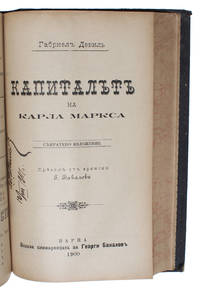
190057116Varna 1900. 8vo. In contemporary half calf with four raised bands to spine. Extremities with wear. Frontboard missing parts of cloth. Two bands on spine missing some of the leather. Verso of front free end paper with notes in contemporary hand and previous owner's name to title-page of all three works. A few occassional marginal lignings in pencil otherwise internally good and clean. Predpostavkit na sotsializma i zadachitu.: XII 257 1 XIV pp. Marksovata Istoricheska Teoria: 86 2 pp. Kapitalutu: IV 5-284 pp. <br/><br/><em>The exceedingly scarce first Bulgarian edition of the most important abridged version of Marx's Capital ever to have appeared published five years before the first partial translation and whole 9 years before the first full Bulgarian translation. Translator Christian Rakovsky later became head of Soviet Ukraine and leader of the left opposition in the Soviet Union after 1928 was one of Trotsky's few intimate friends."The epitome here translated was published in Paris in 1883 by Gabriel Deville possibly the most brilliant writer among the French Marxians. It is the most successful attempt yet made to popularize Marx's scientific economics. It is by no means free from difficulties for the subject is essentially a complex and difficult subject but there are no difficulties that reasonable attention and patience will not enable the average reader to overcome. There is no attempt at originality. The very words in most cases are Marx's own words and Capital is followed so closely that the first twenty-five chapters correspond in subject and treatment with the first twenty-five chapters of Capital. Chapter XXVI corresponds in the main with Chapter XXVI of Capital but also contains portions of chapter XXX. The last three chapters-XXVII XXVIII and XXIX-correspond to the last three chapters-XXXI XXXII and XXXIII-of Capital." ROBERT RIVES LA MONTE Intruductory Note to the 1899 English translation.Translator Christian Rakovsky dominated the socialist movement in the Balkans during the two decades before the first world war and was probably the most influential character in spread of socialism in Europe. Trotsky wrote of him: " Ch.G. Rakovsky is internationally one of the best known figures in the European Socialist movement" and G.D.H. Cole wrote in The Second International "No other Socialist spans the Balkans in the same way as Rakovsky nor is there any of comparable importance."In 1913 Rakovsky was an organizer and leader of the Rumanian Socialist Party which later joined the Communist International. The party was showing considerable growth. Rakovsky edited a daily paper which he financed as well."He received his initial education at Kotel. At the age of fourteen in a period when as he says in his Autobiography in this volume "even the youngest students were passionately interested in politics" he was excluded from all Bulgarian schools after organizing a school riot which it took a company of soldiers to suppress. After a year in his father's house "reading indiscriminately everything that came to hand" he was readmitted to school only to be expelled again after a year this time for good. The occasion this time was his collaboration with his friend and mentor E. Dabev one of the veterans of the Bulgarian revolutionary movement. Dabev 1864-1946 edited the first marxist weekly in Bulgaria in 1886. He published in it Marx's Wage Labour and Capital. In 1890 already a marxist Rakovsky aided Dabev in preparing the publication of Engels's Development of Scientific Socialism in particular in adapting Vera Zasulich's introduction to Bulgarian conditions. In this final year in school Rakovsky also produced with a friend a clandestine newspaper called Zerkalo "Mirror" which his Autobiography describes as having "something of everything: Rousseau's educational ideas the struggle between rich and poor the misdeeds of teachers etc. ." He was now seventeen years old. That same year he left Bulgaria to study medicine in Geneva."In Geneva in 1892 Rakovsky began to edit and publish the Bulgarian journal Social Democrat which not only in its title but also in its contents resembled the Russian journal. Jointly with his companion Savva Balabanov and with the active collaboration of Plekhanov Rakovsky continued the journal for two years. Social Democrat grouped around itself in Bulgaria the supporters of the Bulgarian Social Democratic Union. This group opposed itself to the Bulgarian Social Democratic Party founded in 1891 by Dimitar Blagoev who led the left wing of the movement and later in 1919 the Bulgarian Communist Party and made the full translation of Das Kapital in 1909. Fagan Biographical Introduction to Christian Rakovsky.OCLC list no copies. </em> hardcover
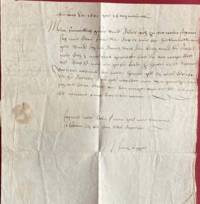
15403134Leuven 1540 1540. Autograph letter on paper in brown ink signed and dated 28 May 1540. Features a seal with a lily emblem. Text in German. In fine condition. Autograph letter on paper in brown ink signed and dated 28 May 1540. Features a seal with a lily emblem. Text in German. 1 page approx. 230 × 220 mm. <p><br /> An early letter from Markus Fugger reporting unrest in Hungary.<br /> <p><p><br /> This letter written by the eleven-year-old Markus Fugger is addressed to his "Segam" possibly a servant or caregiver in his father’s household. Markus greets them warmly inquires about a young lady named Jacobina thanks her for her ring and reflects on a recent accident involving a carriage expressing gratitude for emerging unharmed. He also reports troubling news from Hungary and Bohemia describing the unrest with the striking phrase: "They want to take our lives.â€<br /> <p><p><br /> Markus Fugger 1529–1597 the eldest son of Anton Fugger was heir to the family’s vast financial empire which dominated European banking trade and mining during the Renaissance. A humanist bibliophile and later a prominent figure in Augsburg’s civic life Markus was also known for his scholarly pursuits and cultural interests. The Fugger family renowned as the "Bankers of Kings" played a crucial role in financing major European powers including the Holy Roman Empire.<br /> <p><p><br /> At the time this letter was written Hungary was in turmoil caught between Ottoman expansion and Habsburg control which threatened the Fugger family’s mining and trade interests in the region. The letter reflects Markus’s early exposure to the complexities of his family’s business and the challenges they faced during this period of instability.<br /> <p><p><br /> Believed to be the earliest known letter from Markus Fugger this document offers rare insight into his youth the Fugger family’s history and the political tensions of 16th-century Europe. A transcription and biographical details are included with the transcriber speculating that it may have been written in Leuven during Markus’s studies though no evidence in the text confirms this.<br /> <p>. unknown
189059553New York: Humboldt Publishing Co N.d. 1890. First Humboldt Edition. First printing. Presumed later issue with ads undated but listing up to nos. 142-143 of the "Humboldt Library of Science" Wollstonecraft Vindication of the Rights of Woman issued in 1890. Octavo 24cm. Publisher's red cloth titled in gilt on spine with designs stamped in black on front cover in blind on rear cover; floral endpapers; xviii1-506pp;44pp ads. Bookplate to front pastedown of Jefferson D. Stewart Louisville Kentucky banker and financier whose pencil ownership signature dated 1895 also appears on the title page. An exceptional copy in the publisher's cloth binding minutely rubbed at joints and board corners; floral endpapers so prone to splitting at the hinges are fully intact and the text is fresh bright and unmarked. Very close to a fine copy and easily the best we have handled.<br /> <br /> The early publication history of this first volume of Marx's Capital in America is bibliographically complex at times stubbornly ambiguous and not seldom misrepresented. The earliest copies to appear for sale in America were imported sheets of the Swan Sonnenschein London edition of 1887 bound and distributed in America through two New York agents in one case identified on the pastedowns Julius Bordello in another Scribner & Welfored on a tipped-in slip see Philip Foner "Marx's 'Capital' in the United States" Science & Society Fall 1967. In 1889 Sonnenschein produced a stereotyped edition which was distributed in America through yet a third agent D. Appleton whose name appeared as co-publisher on the title page making this the first edition to carry any textual indication of an American publisher. Any of these three editions have some claim to being called the "First American Edition" notwithstanding the fact that none were printed in America. <br /> <br /> Beginning in January of 1890 Humboldt Publishing Co. a small New York radical publisher issued what it claimed to be "the only American edition - carefully Revised" of Capital. This was in fact an unauthorized reprinting of the Moore - Aveling translation issued without the permission of Marx's family the translators or the European publishers. To save on distribution costs Humboldt resorted to a standard 19th-century publishing ploy and issued the work as a four-part serial nos. 135-138 in its "Humboldt Library of Science" series at the time periodicals were subject to much lower postal rates than bound books. Around the same time - priority has never to our knowledge been established - Humboldt issued some of its printed sheets of Capital in the one-volume cloth edition we have here. This may be properly described as the first book edition of Capital to be printed in the United States. <br /> <br /> Unsurprisingly given the somewhat haphazard nature of 19th-century radical publishing some ambiguities remain. First it is clear from the dates of catalogued copies that Humboldt issued Capital at least twice in serial format - copies exist of issues 135-138 dated January to April 1890; other copies numbered identically exist dated October 1 to October 15 1890 see "Karl Marx Capital First American Editions" online resource . Second based on inspection of copies in our hands and other catalogued copies in commerce we note that the clothbound issue appeared with at least three different states of publisher's advertisements following the text - some with ads dated 1889 presumably the earliest issue; others as with our copy with undated ads but datable from contents to mid-to-late 1890; others with no ads at all. We suspect but cannot prove that the first two issues of the cloth edition correspond with the two known serial issues the first in January the second in October of 1890. Copies without ads were likely issued later to use up remaining sheets.<br /> <br /> Finally there is a question not previously commented upon in any of the scholarship we have consulted regarding Humboldt's claim that this "only American edition" was "carefully Revised." Some previous cataloguers have suggested that the Humboldt edition was a literal reprint of the Sonnenschein stereotype edition of 1889. But this makes little sense; Humboldt could not conceivably have had access to Sonnenschein's stereotype plates and besides the format and pagination of the two editions are entirely dissimilar. Was Moore & Aveling's translation in fact edited for American readers and if so to what degree This cataloguer has now spent sufficient time in a side-by-side comparison of the Humboldt and Sonnenschein via Hathi Trust editions to reach a preliminary conclusion that the only "revisions" consist in the alteration of British spellings to their American equivalents throughout the text e.g. "labor" for "labour"; "characterize" for "characterise" etc. No alterations to the substance of Moore and Aveling's translation appear to our eyes - though to be sure this is a lengthy work and we have performed only a random sampling of the text; an exhaustive comparison of the texts has never to our knowledge been carried out and this would seem to be a fruitful subject for research. <br /> <br /> 1. Foner Philip. "Marx's Capital in the United States." In Science & Society v. 31 no 4 Fall 1967 pp 461-66.<br /> 2. Amink Babak. "A Brief History of the Dissemination and Reception of Karl Marx's Capital in the United States and Britain." In World Review of Political Economy v.7 no. 3 Fall 2016 pp.334-349. <br /> 3. "Karl Marx Capital First American Editions" web article at Karl Marx Library Luxembourg <br /> <br /> NOTE: The second and third volumes had not yet been completed by Engels at this date and would not appear in the U.S. until the 1909 Kerr edition. Humboldt Publishing Co unknown
189021801New York: The Humboldt Publishing Co 1890. First US edition. Hardcover. Very good. First edition printed in America. Tall 8vo. xviii 506pp. Brick red ribbed cloth blocked in blind on the boards and with a gilt spine title with black lines. Translated from the German by Samuel Moore and Edward Aveling. Edited by Frederick Engels. Cloth is rubbed at edges and hinges else this is a very good copy. <br /> <p><br /> The bibliography of this edition is a little complex. In 1890 the Humboldt Publishing Company published this edition in English of Das Kapital in four separate parts bound in stapled wrappers. Later probably the following year some copies were disassembled and bound into a single volume as in the present case. The wrappered edition contained publisher's ads. These were sometimes bound into the single volumes sometimes not and in one case only a couple of ads were bound in. Some bindings were blocked in black on the boards some not. There are reports that the publisher reprinted the text in 1891 or 1892 without the permission of the Marx family which may explain the variants. <br /> <p><br /> This copy has no ads nor black blocking on the boards but has certainly been bound from parts. The now unused stab holes are plainly evident in the gutters in several places especially near the beginning and ending of the part pages. In addition both pp. 255 and 383 show rust marks and glue residue from the wrappers.<br /> <p><br /> Even though another edition was published in the US in 1889 by Appleton the sheets are said to have been printed in England with the US title pages printed in Scotland thus making clear that this Humboldt edition was the first American printing of Das Kapital.<br /> <p><br /> The first German edition is listed in PMM.<br /> <p>. The Humboldt Publishing Co hardcover
189018763New York: Humboldt Publishing Co 1890. Hardcover. Very Good/No Jacket. <p>New York: Humboldt Publishing Co. 1890.<br /> <br /> FIRST EDITION PRINTED IN AMERICA.</p> <br /> <p>Original cloth lettered in gilt.<br /> 506 pages.</p> <br /> <p>Very Good. Tight binding; clean pages and covers; a little erasure mark on front endpaper; moderate wear; nicer than most maybe all examples on the market.<br /> <br /> Very scarce first American printed edition.</p> . New York: Humboldt Publishing Co hardcover
1896012738London: Swan Sonnenschein & Co 1896. Book measures 22.5x15.cm. Collation xxxi1816pp half title present. Bound in original publishers green cloth with gilt lettering marble endpapers. Cloth very lightly rubbed gilt lettering slightly faded some minor cloth repairs. Binding in very good firm condition. Internally name inscription on endpaper possibly written in crown faded name on title page hardly noticable some light spotting mainly to first 30 pages. Pages in good clean condition. A very nice copy. . Cloth. Very Good. 8vo. Swan Sonnenschein & Co Hardcover