Marx - EngelsBiblio.com
5 793 résultats
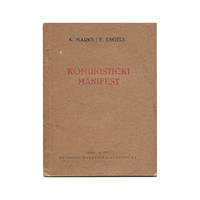
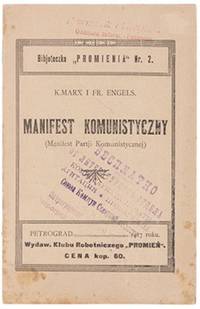
191797<p><b>Very rare Polish edition of the Manifest of the communist party published the year before the Russian revolution. </b></p><p>"<i>One of the outstanding political documents of all times."</i>PMM</p><p><i>Bibliographie deutscher Literatur polnischer Ubersetzung</i> J. St Buras p.422.</p><p><i>"The Manifest gained wordly recognition with the Russian revolution of October 1917</i>." J. Elleinstein <i>Histoire mondiale des socialismes</i></p><p>On January 24th 1917 president Wilson in his address to the Senate speaks of an independent autonomous unified Poland and the new Russian government promises an "independent Polish state" on March 29th 1917.</p><p>The Polish conservatives who may have had Russian feelings ignore them since the Revolution and turn to Vienna for their interests. </p><p><i>"The fact that a new Polish edition of the Communist Manifesto has become necessary gives rise to various thoughts.</i></p><p><i>First of all it is noteworthy that of late the Manifesto has become an index as it were of the development of large-scale industry on the European continent. In proportion as large-scale industry expands in a given country the demand grows among the workers of that country for enlightenment regarding their position as the working class in relation to the possessing classes the socialist movement spreads among them and the demand for the Manifesto increases. Thus not only the state of the labor movement but also the degree of development of large-scale industry can be measured with fair accuracy in every country by the number of copies of the Manifesto circulated in the language of that country.</i></p><p><i>Accordingly the new Polish edition indicates a decided progress of Polish industry. And there can be no doubt whatever that this progress since the previous edition published ten years ago has actually taken place. Russian Poland has become the big industrial region of the Russian Empire. The disadvantages — for the Polish manufacturers and the Russian government — are manifest in the rapid spread of socialist ideas among the Polish workers and in the growing demand for the Manifesto.</i></p><p><i>But the rapid development of Polish industry outstripping that of Russia is in its turn a new proof of the inexhaustible vitality of the Polish people and a new guarantee of its impending national restoration. And the restoration of an independent and strong Poland is a matter which concerns not only the Poles but all of us. A sincere international collaboration of the European nations is possible only if each of these nations is fully autonomous in its own house. It can be gained only by the young Polish proletariat and in its hands it is secure. For the workers of all the rest of Europe need the independence of Poland just as much as the Polish workers themselves." </i>F. Engels<i> London February 10th 1892</i></p><p><b>A partly uncut copy preserved in its contemporary wrappers as issued. </b></p><p><b>A very rare edition.</b></p><p>Our searches in the international public institutions have allowed us to locate only one copy: <i>Hoover Institute of War California</i> USA.</p><p>Provenance : Library of <i>Marcel Bekus</i> with library stamp ; presence of two library stamps on the cover.</p><p>"The personality and history of<i> Marcel Bekus deserve attention. Present in Russia in 1905 close to the Anarchists he goes to Spain during the civil war and dies there in 1938. Some fifty years later his grandson opens his cellar and finds numerous brochures and posters perfectly preserved." </i><i>Matériaux pour l'histoire de notre temps</i>Année 1991 XXIV N°24 pp.29-30</p><p><i>Marcel Bekus</i> 1888-1939 rallies the Revolution in 1905 in Russia and is then deported to Siberia. Once freed he develops an interest in the French Revolution and in the Russian one of 1917. </p><p>In 1919 he arrives in Paris and continues to frequent revolutionary circles.</p> paperback
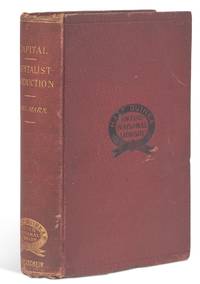
18912634<p>Fourth English edition; 8vo; original maroon cloth with gilt lettering to spine. Translated from the third German edition by Samuel Moore and Edward Aveling and edited by Frederick Engels. Very good spine ends and corners bumped and some wear to the extremities.</p> Swan Sonnenschein & Co hardcover
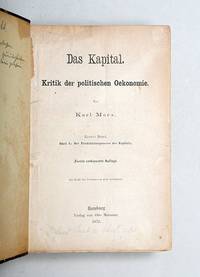
1872145418Hamburg: Otto Meissner 1872. In contemporary half sheep Second edition of volume one of Marx's polemical masterpiece of political economy revised by the author from the first edition of 1867. Only the first volume of this most influential of books was published in Marx's lifetime and though the later volumes were edited by Engels from the author's manuscript the revised edition of volume I was edited by Marx himself and contains the first printing of his ten page afterword. It was the summation of over twenty years research in the reading rooms of the British Museum and followed on from his earlier work Zur Kritik der politischen Oekonomie printed in 1859. Octavo 212 x 135 mm. Contemporary purple half sheep spine lettered in gilt mottled paper sides. Bound without half-title and terminal advertisement leaf. Pencilled annotations. Somewhat worn front free endpaper lacking rear endpapers with pencilled scribbling and contemporary ownership stamp to rear free endpaper contents browned stained and foxed a few signatures standing a little proud paper repairs to title page and to fore edge of pp. 3-10 not affecting text frequent paper repairs in gutter often with loss to lettering pp. 359-362 reinserted at head various minor chips occasionally with some loss to lettering. A sound copy in a contemporary German binding. Rubel 633. unknown
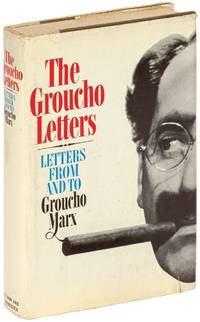
1967540788New York: Simon and Schuster 1967. Hardcover. Fine/Near Fine. First edition. Fine in near fine dust jacket with a couple of tiny tears. Cheekily Inscribed by the legendary comedian to fellow legend Elizabeth Taylor: "To Liz - Maybe some day you'll have Burton - My best Groucho." A significant association. Simon and Schuster hardcover
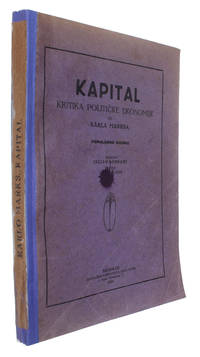
192456992Beograd Izdavacka Knjizarnica Gece Kona 1924. 8vo. In the original printed wrappers. Spine renewed preserving most of the original spine. Ink stain to front wrapper. Previous ower's name to top of title-page. First leaves with a few underlignings otherwise internally fine and clean. 198 4 pp. <br/><br/><em>Rare first Serbian translation of Marx's Das Kapital. Translator Mosa Pijade a Serbian Sephardic Jew were sentenced 20 years of prison in 1925 because of 'revolutionary activities' partly because of making the present translation. In prison he meet Josip Broz-Tito and Pijade became Tito s right hand one of the leaders of Tito s Partisans during WWII and after the war the President of the Yugoslavian Parliament.During WWII Pijade became one of the leaders of Tito s partisans and after the war the President of the Yugoslavian Parliament between 1954 and 1955. In 1948 Pijade convinced Tito to allow the Yugoslav Jews to immigrate to Israel. The book was issued by Geca Kon Géza Kohn a Jewish publisher born in Hungary who owned the biggest publishing house in Yugoslavia operating from 1901 until the occupation by Germany in 1941. After the Germans marched into Belgrade Kon was arrested and shot. Most of his family who were also active in the business were taken to a concentration camp in Vojvodina and shot in the same year. OCLC only list three copies: University of Pittsburgh Philosophical Faculty; Ljubljana and Zagreb City Library </em> unknown
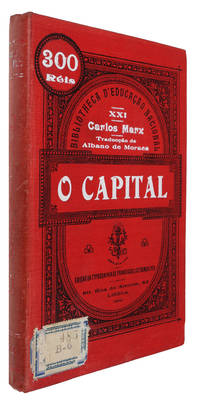
191262679Lisboa De Francisco Luiz Goncalves 1912. 8vo. In the original red printed cloth-binding with black and white lettering. Spine with loss of the white lettering. Paper-label pasted on to lower inner margin of front board. Very light wear to extremities Internally very fine and clean. 240 pp. <br/><br/><em>The exceedingly scarce first Portuguese edition of the most important abridged version of Marx's Capital ever to have appeared published fifty-six years before the first full Portuguese but published in Brazil translation and whole sixy-two years before the first full translation published in Portugal. Curiously two translations of the present work were made 1912 but the present translation seems to have priority see Bastien "Readings and Translations of Karl Marx in Portugal". After the 1933 rise of Salazar's dictatorial Estado Novo regime suppression of the relatively newly founded Communist party grew. Members were arrested tortured and executed and many were sent to the Tarrafal concentration camp in the Cape Verde Islands. Communist literature suffered an equally repressive fate hence the rarity of the present work. Marxism and especially Marxist writing caught on comparatively late in Portugal: "As for the Socialist Party - supposed to be the main expression of Marxism - it revealed itself unable to stimulate effective theoretical and doctrinal efforts. Its existence was an example of ambiguity and inconsequence. Its political programme went on mixing Marxian elements associationist tradition and positivist thinking. Its strategy balanced continuously between an alliance with republican politicians and the maintenance of political autonomy. Its tatics balanced between electoral abstencionism and an involvement in election processes that never led it to a relevant position in parliament. Even its international relations showed a lasting ambiguity: it had been created according to the instructions of the Marxist majority at the Hague Congress when most of its members tended to support political abstencionism. When the formation of the Second lnternacional was taking place in Paris in 1889 Portuguese socialists tried to join the Marxist congress after being present at the possibilist congress. In 1920 they decided to join the Third lnternacional what was not accomplished at the same time that an internal reformist turn was taking place." Bastien "Readings and Translations of Karl Marx in Portugal". "The epitome here translated was published in Paris in 1883 by Gabriel Deville possibly the most brilliant writer among the French Marxians. It is the most successful attempt yet made to popularize Marx's scientific economics. It is by no means free from difficulties for the subject is essentially a complex and difficult subject but there are no difficulties that reasonable attention and patience will not enable the average reader to overcome. There is no attempt at originality. The very words in most cases are Marx's own words and Capital is followed so closely that the first twenty-five chapters correspond in subject and treatment with the first twenty-five chapters of Capital. Chapter XXVI corresponds in the main with Chapter XXVI of Capital but also contains portions of chapter XXX. The last three chapters-XXVII XXVIII and XXIX-correspond to the last three chapters-XXXI XXXII and XXXIII-of Capital." ROBERT RIVES LA MONTE Intruductory Note to the 1899 English translation. Capital de Marx also had a Portuguese edition at this time or better two different editions both in 1912 but only in translation of the survey of Book I published in France by Gabriel Deville in 1883 Marx 1912a and Marx 1912b. This version omitted material dealt with in at least four chapters of the original text and was not particularly appreciated by Engels. It was a simplified text aimed at supporting the training of socialist militants and that made it possible for them to have access indirect to the work of Marx. The other summaries and anthologies of Capital which with a purpose similar to that of Deville circulated in Europe during this period or ignored in Portugal as was the case with Carlo Cafiero or were only occasionally mentioned as was the case with Paul Lafargue and Karl Kautsky in its French versions. OCLC list two copies both in the US. </em> hardcover
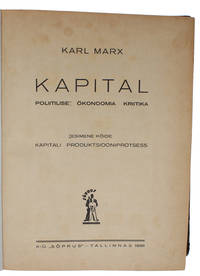
193659261Tallinn Kirjastusühing "Soprus" 1936 4to. In contemporary half calf with gilt lettering to spine. Extremities with light wear and corners bumped. Housed in a nice full black cloth clamshell box with black leather title-label to spine with lettering in silver. Otherwise fine and clean. 8 9-43 3 640 pp. <br/><br/><em>The rare first complete Estonian translation of Karl Marx's 'Das Kapital'. The comparatively late translation was due to the fact that German was Estonia’s official language and the language of grammar school and higher education prior to 1918/1920. It was replaced by Russian starting in the 1890s. Translator Nigol Andresen 1899-1985 worked as a teatcher at various Estonian High Schools from 1918 to 1932. In 1932 he was dismissed for political reasons because of his membership in the Estonian Social Democratic Labor Part. In the same year he was elected to the Estonian Parliament to which he formally belonged until 1937. In 1934 Andresen was expelled because of his contacts with the Communist Party from the Social Democratic Labor Party. He was then union secretary and became after the Sovietization in 1940 a proponent of the new communist system. In a short period under the Vares Cabinet he functioned as foreign minister.At the outbreak of the German-Soviet War in 1941 he went to the Soviet Union and lived in Moscow. After returning to Estonia he was from 1946 to 1949 Member of the Supreme Soviet of the Estonian Soviet Socialist Republic. However at the infamous eighth plenum of the Estonian Communist Party of March 1950 he fell out of favor and was imprisoned. Only in 1955 he was released from custody. </em> hardcover
188555207København Copenhagen 1885-87. 4to. In contemporary half cloth with gilt lettering to spine. Even browning as usual due to the paper quality. An envelope pasted on to front free end-paper containing Danish articles on Marx. Previous owner's name to title-pages. A fine and clean copy with both half-titles present "Socialistisk Bibliotek" Vol. IV-V. Vol 1: 2 473 1; Vol 2: VII; 1; 4 363 1 pp. <br/><br/><em>First edition of the first Danish translation of "Das Kapital". The translation is remarkable in several respects - the Danish Social-democratic party was one of the first labour organizations in the world to publish the two volumes of "The Capital" the translation of the first volume preceded both the English and the Italian and the translation of the second volume is the second in the world to appear only preceded by the Russian from 1885 - furthermore these two translations were the only two to appear of volume two until after Engels' death in 1895. After having been in a serious crisis at the end of the 1870'ies the labour movement in Denmark turned things around in the 1880'ies primarily with the aid of Marx. Marx' theories and his connection between theoretical and practical politics became the foundation for the Social Democrats. In 1884 the Danish Social Democratic Party got its two first members of parliament elected and many workers wished to become politically active. Also in Denmark the class struggle had properly begun.As Marx was the foundation for the beginning success of the Social Democrats the Party decided that it would translate and publish all the most important works by Marx - of course most importantly "The Capital". This translation was to become "a new and powerful weapon for the Danish Labour Party in the agitation for the socialist principles". The translation of "The Capital" was made by the linguist and journalist Hans Vilhelm Lund 1840-1893 who worked at the paper Social-Demokraten in the 1880'ies and 90'ies. The translation is famed for being extremely true to the original and virtually flawless. In order to reach as wide a relevant audience as possible the price was kept as low as it could be. It still constituted a full day's wages for a skilled worker namely 2 kroner - still about 1/7 of the German edition. In spite of all the efforts to distribute the translation it did not become a bestseller and in 1911 the remainders were issued with a new title-page in 1911. PMM 359 - first edition. </em> hardcover
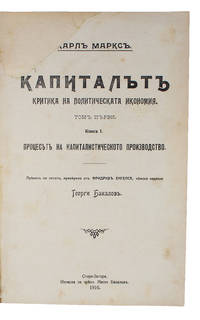
191056711Stara Sagora 1910. 8vo. Contemporary half cloth with gilt lettering to spine. Spine with wear. Upper inner corner of title-page with repair missing the 'K' in 'Karl'. Two last leaves with marginal repairs not affecting text. Light occassional brownspots throughtout. XXX 2 598 2 pp. frontiespiece of Marx. <br/><br/><em>The very rare full Bulgarian translation by Georgi Bakalov from 1910 published simultaneously with Dimitar Blagoev's translation. Quite extraordinary two different Bulgarian translations both complete were made at the same time.Interestingly both translations seems to have been actively used though the 20ies and 30ies and both translations were reprinted simultaneously in 1930-31 both edited by Todor Pavlov. To our best knowledge Bulgarian is the only language which have had two complete translation published at the same time. Georgi Bakalov published his translation from the German in his hometown Stara Zagora. The publisher was The Liberal Club which was a printshop rather than a proper publisher. He was also a member of Bulgarian Social Democratic Party as of 1891 and likely much similar to many of the early Bulgarian socialists was active in education and socalled 'uchitelsko delo' teachers' affairs. In 1891-93 he studied in Geneva and quickly befriended Plekhanov whom he translated in the 1890s.OCLC only list no copies </em> hardcover
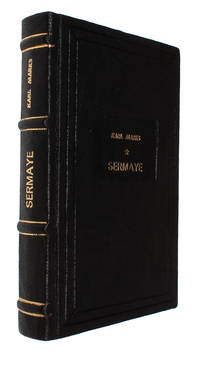
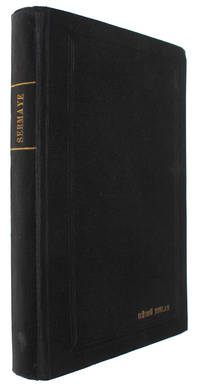
193359547Istanbul Sirketi Mürettibye Matbaasi 1933. 8vo. In a recent full black leather binding with four raised bands and gilt lettering to spine and front board. Blindtooled frames to front and back board. A fine and clean copy. 7 1 5-305 1 errata-leaf pp. <br/><br/><em>Rare first Turkish book-length appearance of Marx’s landmark ‘Das Kapital’ being a translation of the most important abridged version of Marx's Capital ever to have appeared Haydar Rifat’s Yorulmaz 1933 translation Sermaye which was based on an abridged French version 1897 of the original by Gabriel Deville. Exerting great effort for the formation of the leftist thought and discourse in the late Ottoman and early Republican periods Haydar Rifat was a prominent translator acting as a culture entrepreneur in the cultivation of leftist ideas. In his preface to Sermaye Rifat notes that only passing remarks are made on Marx’s works in the faculties of law and political sciences and accounts for his attempt to further introduce Marx and his ideology to the academia and the public as follows: Das Kapital Karl Marx’s masterpiece has been translated into all major languages and numerous commentaries and interpretations on this work have been published by experts in modern countries. The translations commentaries and interpretations of this work are so abundant that they quantitatively surpass the commentaries on all Holy Books; indeed the works produced by various experts with different approaches under the title “Marxist Library†can fill up buildings. Front the present work. "The epitome here translated was published in Paris in 1883 by Gabriel Deville possibly the most brilliant writer among the French Marxians. It is the most successful attempt yet made to popularize Marx's scientific economics. It is by no means free from difficulties for the subject is essentially a complex and difficult subject but there are no difficulties that reasonable attention and patience will not enable the average reader to overcome. There is no attempt at originality. The very words in most cases are Marx's own words and Capital is followed so closely that the first twenty-five chapters correspond in subject and treatment with the first twenty-five chapters of Capital. Chapter XXVI corresponds in the main with Chapter XXVI of Capital but also contains portions of chapter XXX. The last three chapters-XXVII XXVIII and XXIX-correspond to the last three chapters-XXXI XXXII and XXXIII-of Capital." ROBERT RIVES LA MONTE Intruductory Note to the 1899 English translation. “He also refers to how he has had to deal with the challenges arising from the translation of certain terms and/or the absence of any expert on the field whom he could consult: While doing this short translation I have encountered many difficulties. It is necessary to find equivalents for new terms or rather the terms which are new for us. The trouble arose not just from finding Turkish equivalents in line with the new course our language has taken it also concerns the difficulty in finding any equivalent. Some of these words and terms were used for the first time while I have replaced some others with alternative words and terms though they have been in use for the past five or ten years. I almost never go out. On those rare occasions when I leave home and go out I can find almost nobody whom I can consult and discuss my translation. Rifat 1933 7†Rifat concludes his lengthy preface with a humble almost apologetic note stating that he would be more than willing to correct any mistakes in his translation that could potentially cause his readers difficulty and that he had consulted a whole list of experts mainly economists about the equivalents of certain terms and the general content of the translation. The preface actually ends with a list of the names of the experts to whom Rifat had sent a copy of his translation†Konca The Turkish Retranslations of Marx’s Das Kapital as a Site of Intellectual and Ideological Struggle Rifat’s translation immediately triggered a series of articles and critiques in various journals and papers upon its publication. </em> hardcover
193359614Istanbul Sirketi Mürettibye Matbaasi 1933. 8vo. In contemporary full black cloth binding with gilt lettering to spine. Blindtooled frames to front and back board. Previous owner's name "Hüsnû Hizlan" in gilt lettering to front board. A fine and clean copy. 7 1 5-305 1 errata-leaf pp. <br/><br/><em>Rare first Turkish book-length appearance of Marx’s landmark ‘Das Kapital’ being a translation of the most important abridged version of Marx's Capital ever to have appeared Haydar Rifat’s Yorulmaz 1933 translation Sermaye which was based on an abridged French version 1897 of the original by Gabriel Deville. Exerting great effort for the formation of the leftist thought and discourse in the late Ottoman and early Republican periods Haydar Rifat was a prominent translator acting as a culture entrepreneur in the cultivation of leftist ideas. In his preface to Sermaye Rifat notes that only passing remarks are made on Marx’s works in the faculties of law and political sciences and accounts for his attempt to further introduce Marx and his ideology to the academia and the public as follows: Das Kapital Karl Marx’s masterpiece has been translated into all major languages and numerous commentaries and interpretations on this work have been published by experts in modern countries. The translations commentaries and interpretations of this work are so abundant that they quantitatively surpass the commentaries on all Holy Books; indeed the works produced by various experts with different approaches under the title “Marxist Library†can fill up buildings. Front the present work. "The epitome here translated was published in Paris in 1883 by Gabriel Deville possibly the most brilliant writer among the French Marxians. It is the most successful attempt yet made to popularize Marx's scientific economics. It is by no means free from difficulties for the subject is essentially a complex and difficult subject but there are no difficulties that reasonable attention and patience will not enable the average reader to overcome. There is no attempt at originality. The very words in most cases are Marx's own words and Capital is followed so closely that the first twenty-five chapters correspond in subject and treatment with the first twenty-five chapters of Capital. Chapter XXVI corresponds in the main with Chapter XXVI of Capital but also contains portions of chapter XXX. The last three chapters-XXVII XXVIII and XXIX-correspond to the last three chapters-XXXI XXXII and XXXIII-of Capital." ROBERT RIVES LA MONTE Intruductory Note to the 1899 English translation. “He also refers to how he has had to deal with the challenges arising from the translation of certain terms and/or the absence of any expert on the field whom he could consult: While doing this short translation I have encountered many difficulties. It is necessary to find equivalents for new terms or rather the terms which are new for us. The trouble arose not just from finding Turkish equivalents in line with the new course our language has taken it also concerns the difficulty in finding any equivalent. Some of these words and terms were used for the first time while I have replaced some others with alternative words and terms though they have been in use for the past five or ten years. I almost never go out. On those rare occasions when I leave home and go out I can find almost nobody whom I can consult and discuss my translation. Rifat 1933 7†Rifat concludes his lengthy preface with a humble almost apologetic note stating that he would be more than willing to correct any mistakes in his translation that could potentially cause his readers difficulty and that he had consulted a whole list of experts mainly economists about the equivalents of certain terms and the general content of the translation. The preface actually ends with a list of the names of the experts to whom Rifat had sent a copy of his translation†Konca The Turkish Retranslations of Marx’s Das Kapital as a Site of Intellectual and Ideological Struggle Rifat’s translation immediately triggered a series of articles and critiques in various journals and papers upon its publication. </em> hardcover
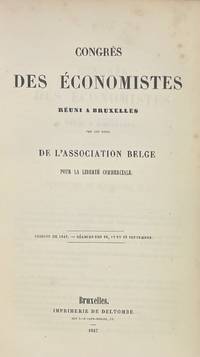
18473297Bruxelles: Imprimerie de Deltombe 1847. First edition. In later wrappers. Paper tanned occasional foxing. Otherwise in fine condition. First edition. In later wrappers. 5 2-211 1 p. <p><br /> Rare printed proceedings of the first international congress of economists in Brussels featuring Karl Marx's attendance and his early engagement in public economic debates.<br /> <p><p><br /> This volume documents the proceedings of the first-ever international conference of economists held in Brussels from September 16 to 18 1847 under the auspices of the Association belge pour la Liberté commerciale. Directed by Charles Joseph Marie Ghislain de Brouckere the conference was a landmark event gathering leading economists lawyers and businessmen to debate issues of free trade and economic policy.<br /> <p><p><br /> A significant aspect of this congress is the participation of Karl Marx whose presence is recorded on the official list of participants "Marx homme de lettres et économiste à Bruxelles" p. 7. At the time Marx was living in Brussels and his involvement in the congress marked a crucial moment in his engagement with economic theory and the broader socialist movement. Although Marx was prevented from speaking his attendance along with other members of the Communist League such as Friedrich Engels was notable for their intent to challenge bourgeois economics and advocate for working-class interests.<br /> <p><p><br /> The congress became a site of contention between the bourgeois majority and the Communist group particularly after Georg Weerth's speech which sharply criticized the benefits of free trade as espoused by the free traders. Engels later provided a detailed report of these events in the Deutsche-Brüsseler-Zeitung highlighting the tensions and the exclusion of Marx's voice from the official proceedings.<br /> <p><p><br /> This book is a rare primary source for the study of 19th-century economic thought and a crucial document for understanding the early public activities of Karl Marx just months before the publication of the Communist Manifesto. It offers invaluable insights into the ideological battles that shaped modern economic and political thought.<br /> <p>. Imprimerie de Deltombe unknown
19302550Hungary 1930. In later cloth. Collection stamps. In very good condition. In later cloth. 18 p. Mimeographed. The title page is missing a drawing of the title page have been put on the fist page. Extremely rare illegal Hungarian editon of The Communist Manifesto from the 30s. The pages were mimeographed in different places because it was banned to publish the book Thats the reason it is printed on different kind of papers in different ink. From the collection Barta Gabor who got it from Edit Wagner Provenience letter from Gabor Barta is added. unknown
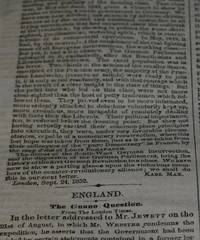
18521630New York: Greeley & McElrath 1852. First edition. With the article Revolution and Counter-Revolution in Germany on pp. 7–8. First edition. With the article Revolution and Counter-Revolution in Germany on pp. 7–8. Folded once. First sheet torn at spine. A few leaves with small tears at foldings. A tiny loss to a few letters with no effect on legibility on p. 7. Paper discolored. Chipped at edges. First edition. With the article Revolution and Counter-Revolution in Germany on pp. 7–8. 12 p. <p><br /> The ultimate article of the series of Revolution and Counter-Revolution in Germany written by Engels and published under the byline of Marx.<br /> <p><p><br /> Revolution and Counter-Revolution in Germany was written after Charles Dana the managing editor of the powerful progressive Republican newspaper the New-York Daily Tribune approached Karl Marx early in 1851 with the idea that he should contribute topical and historical writings to the newspaper. Dana and Marx met first in Germany some three years before when Dana reported the American press about the revolutionary movements in Europe. <br /> <p><p><br /> Marx being engaged in economic research was unable to fulfill the commission thus he asked his friend and co-thinker Friedrich Engels on August 14 1851 to write "a series of articles about Germany from 1848 onwardsâ€. MECW p. 629 “Engels agreed and in the course of thirteen months he wrote 19 articles about the German revolution of 1848–49. … Engels used as the main source of reference a file of the Neue Rheinische Zeitung apart from some additional material given him by Marx whom he constantly consulted and who read every article before mailing it.†MECW p. 629 <br /> <p><p><br /> In these articles Engels examines the economic basis and social development of Germany at the time of the Revolution shows that the uprising was defeated because of the liberal bourgeoisie and concludes that bold and resolute action is essential for the victory of a revolution. MECW pp. xiv–xv His “work lays down basic principles of Marxist teaching on armed insurrection. Engels formulates for the first time the idea that »insurrection is an art quite as much as war«â€. MECW p. xv<br /> <p><p><br /> The series was printed in the Tribune between October 25 1851 and October 23 1852 over the signature of Karl Marx the paper's official London-based correspondent. <br /> <p><p><br /> Until the correspondence between Marx and Engels was published in 1913 Revolution and Counter-Revolution in Germany was regarded as Marx’s text. Its first separate edition was prepared by Eleanor Marx-Aveling Marx’s daughter in 1896 and in the same year a German translation was also published. While in the Tribune the articles were printed under a general title and numbered in Roman figures in the book the articles are titled the present nineteenth piece bears the title The Close of the Insurrection.<br /> <p><p><br /> Bibl.: Marx/Engels Collected Works Vol 11. The Collected Works of Karl Marx and Friedrich Engels. The Collected Works of Karl Marx and Frederick Engels. Volume 11. Marx and Engels 1851–1853. <br /> <p>. [Greeley & McElrath] unknown
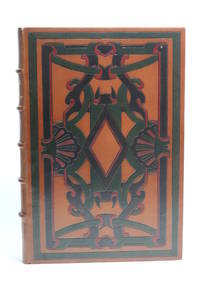
190073265Nantes: Emile Grimaud et fils 1900. Fine. Emile Grimaud et fils Nantes 30 juillet 1900 19.50 x 27.50 cm relié First edition illustrated with fifty-nine engravings on copper and wood by Auguste Lepère one of 220 numbered copies on pure Arches laid paper with the Nantes watermark the only issue this one printed specially for M. Join-Lambert. Full tawny calf binding spine with five raised bands date at foot boards richly decorated with a broad design of compartments interlacing and shells inlaid with green mahogany and black calf in the Renaissance taste silk moiré doublures framed with seven gilt fillets endpapers of matching silk covers and spine preserved top edge gilt slipcase with rubbed and peeling headcaps Art Nouveau binding signed with the monogram DLR at foot of first board. Our copy is enhanced with one of the destroyed wood-engraved plates from the first series ""Rue des Barres - Rue Grenier sur l'eau - Sortie de l'exposition"" given to the Nantes museum. Rare and very handsome copy perfectly executed in an elegant binding with Art Nouveau decoration. Emile Grimaud et fils hardcover
198091428A. Volk. New. 1980. Hardcover. 3872521217 . FREE UPGRADE to Courier/Priority Shipping Upon Request - IN STOCK AND IMMEDIATELY AVAILABLE FOR SHIPMENT - Flawless copy brand new pristine never opened -- Text in German. 356 pages. Überlieferung Ueberlieferung Catalogue Raisonne Catalog Raisonné Complete Works Leben Und Werk Oeuvre-Katalog Kritischem Oeuvrekatalog Raisonnee A. Volk hardcover
1894124940Saint Petersburg: Ministerstvo Vnutrennikh Del 1894. Marx's Kapital finally banned from Russian public libraries Extremely rare example of a Russian index librorum for public libraries recording the first - and rather late - attempt to censor the works of Marx listing the first two volumes of Das Kapital being the first edition of volume one in Russian 1872 and the first edition of volume two 1885. Scarce no other examples traced on WorldCat or KVK. "By an odd quirk of history the first foreign translation of Das Kapital to appear was the Russian which Petersburgers found in their bookshops early in April 1872. Giving his imprimatur the censor one Skuratov had written 'few people in Russia will read it and still fewer will understand it.' He was wrong; the edition of three thousand sold out quickly; and in 1880 Marx was writing to his friend F. A. Sorge that 'our success is still greater in Russia where Kapital is read and appreciated more than anywhere else'" PMM. As the worker's movement gained momentum it was decided to censor Kapital. This pamphlet based on a resolution dated 1 January 1894 selects works for removal and destruction from public libraries and reading rooms and was intended strictly for internal use; a printed note forbids further publications or other disclosure of any part of it. Among other famous works affected by this censor's ban are Tolstoy's Kreutzer Sonata in all editions translations of various works by Herbert Spencer John Stuart Mill Emile Zola and works on socialism such as The Eight Hours Day by Sidney Webb and Harold Cox. Also included was a translation of James Bryce The American Commonwealth. Octavo 242 x 168 mm. Original buff wrappers printed in black 16 pp. sewn. Previous ownership stamp of A. Martynov to title page in purple ink. Wrappers creased with some marks three small closed tears to extremities contents toned else a fresh copy of a fragile publication. See Printing and the Mind of Man 359 first edition of the first volume of Das Kapital. unknown
194559904Preveo M. Pijade Belgrad Biblioteka Marksizma-Lenjinizma 1945. 8vo 195 x 145 mm. In the original printed wrappers. A few small nicks to wrappers and a few occassional light markings in margin. Otherwise a fine and clean copy. 64 3 pp. <br/><br/><em>First Croatian translation of the Communist Manifesto translated by Moša Pijade 1890 – 1957 a Yugoslav communist politician and Tito’s close friends. Pijade also translated the introductions to previous translations to other languages to help the reader to understand the importance of the work. Pijade artist art critic and author was born in Belgrade and of Sephardic Jewish parentage. He joined the Communist party in the 1920s in which he was active as a writer for various newspapers and magazines. After having translated ‘Das Kapital’ in 1924 Pijade was arrested and sentenced to 20 years in prison because of his ‘revolutionary activities’ a sentence for which he served 14 years. In the prison Moša Pijade befriended Josip Bros-Tito who was also imprisoned for his illegal communist activities and the two men became good friends. During WWII Pijade became one of the leaders of Tito’s partisans and after the war the President of the Yugoslavian Parliament between 1954 and 1955. In 1948 Pijade convinced Tito to allow the Yugoslav Jews to immigrate to Israel. </em> unknown
1890017498Hamburg: Otto Meissner 1890-94. Quattro libri in 3 volumi 14x22 cm. 1 Erster Band. Buch I: Der Produktionsprocess des Kapitals. Vierte durchgesehene Auflage. Quarta edizione 1890. 2: Zweiter Band. Buch II: der Cirkulationsprocess des Kapitals. Zweite Auflage. Seconda edizione 1893. 3: Dritter Band erster Theil. Buch III: Der Gesamtprocess der kapitalistischen Produktion. Kapitel I bis XXVIII. Zweiter Theil. Buch III: Der Gesamtprocess der kapitalistischen Produktion. Kapitel XXIX bis LII. Herausgegeben von Friedrich Engels. Le due parti in un volume in PRIMA EDIZIONE. 1894. Si tratta quindi della prima edizione completa del Capitale curato da Engels e pubblicato da Meissner. Al momento dell'uscita del terzo libro gli altri due erano rispettivamente alla quarta e alla seconda edizione. Legatura coeva in buona mezza pelle con titolo e fregio dorato al dorso piatti e risguardie con carta marmorizzata. Fenditura alla cerniera anteriore del vol 2 che ha anche un timbro di biblioteca alla pagina di titolo altrimenti ottime condizioni. Otto Meissner unknown
0110-25Hamburg Otto Meissner 1872-1903. 3 Teile in 4 Bdn. Mischauflage: Bd. 1: 2. verb. Aufl.; Bd. 2 1903: 3. Aufl.; Bd. 3: 1. Aufl. 1894. 8°. Titel v. Bd. 1 fehlt liegt in Kopie bei 1 Bl. 826 v. 830 S.; XXVII 500 S.; XXVIII 448 S.; IV 422 S. Spätere HLn-Bde. mit Rückentitel./Later half cloth. Titeblatt u. die letzten beiden Bll. fehlen bei Bd. 1 Bd. III/2 auf S. 251 mit kl. Randabriss ohne Textverlust teils leicht gebräunt oder etwas stockfleckig sonst gut erhalten./The title page and the last 2 pages of vol. 1 are missing copies enclosed. vgl. PMM 359 - In 4 Bänden komplette Mischauflage des erstmals ab 1867 erschienenen Werkes. Die beiden Teilbände des 3. Bandes liegen in Erstausgaben von 1894 vor der 1. Band in zweiter Auflage der 2. Band in dritter Auflage dies ist die erste Auflage nach Engels Tod 1895. Beim 1. Band fehlt das Titelblatt sowie die letzten beiden Blätter Register u. Errata. Complete made-up copy first published in 1867. The two partial volumes of volume 3 are in first editions from 1894 the 1st volume in second edition the 2nd volume in third edition. This is the first edition after Engels' death. The title page and the last 2 pages of vol. 1 are missing copies enclosed. Hamburg, Otto Meissner 1872-1903. hardcover
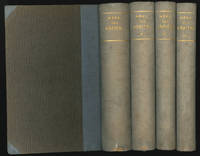
193318342Chicago: Charles H. Kerr & Company 1933. Early U. S. Editions. Hardcover. Very good. Three volumes 8vo. Red cloth blocked in gilt on the spines. Volume I is the 1909 printing; Volume II is the 1933 printing; and Volume II is the 1909 first printing. Inner hinges of volume I neatly repaired; spine of Volume III is rubbed in places else this is a very good set.<br /> <p><br /> The Kerr edition is the first US edition of Marx's complete three volume work usually known by its German title Das Kapital. Only the first volume was published in Marx's lifetime; it appeared in the US in 1890. Engels completed the work using Marx's notes and published them in Germany in 1885 and 1894 respectively. This American issue was translated from the third German edition by Samuel Moore and Edward Aveling Vol. I from the second German edition by Ernest Untermann Vol II and from the first German edition by Untermann Vol III. <br /> <p><br /> A PMM selection.<br /> <p>. Charles H. Kerr & Company hardcover
1883010153Hamburg 1883-1885: Verlag von Otto Meissner 1883. Book. Very Good Plus. Half Faux Leather. 8vo - over 7¾" - 9¾" tall. xxiii 1 808 xxvii 526 pages. Two volumes The 3rd revised edition of the first volume of Das Kapital edited by Friedrich Engels after the death of Karl Marx with First Edition of the second volume of Kapital edited by Engels and published 1885. .Newly rebound in half maroon faux leather over red linen boards spine embossed similar to the original new parchment end papers the title and final pages of both volumes now ensconced in rice paper due to brittle paper. The faint embossed stamp of Indianapolis Public Library at title pages also stamped Indianapolis Public Library bottom edge of page blocks pencil gift markings at copyright pages no other markings internally clean bright and unmarked. RARE early printing third revised edition of the first volume and a 1st Ed. of the second volume of this foundational work of materialist philosophy a towering economic critique of the 19th century. Verlag von Otto Meissner Hardcover
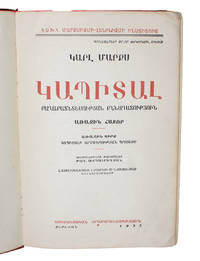
193354792Erevan Kusakts'akan Hratarakch'ut'yun 1933 - 1949. Royal8vo. 4 volumes all in the original red in four different nuances full cloth with embossed title to front boards and spine. Light soiling to extremities on all four volumes expecially volume 1 with heavy soiling. Hindges a bit weak. All volumes internally fine and clean. XL745 3 pp.; XXVII 492 4 pp.; XXVI 452 pp.; 4 452 pp. <br/><br/><em>The rare first Armenian translation of Karl Marx's Das Kapital. "Fifty years after the death of Karl Marx the Communist Party of Armenia published in 1933 the first Armenian translation of book one of 'Das Kapital'. After a long fight against the Ottoman Empire Armenia had become part of the Transcaucasian Socialist Federative Soviet Republic in 1922. The famous Armenian historian and linguist Tadeos Ayrapetovich Avdalbegyan 1885-1937 made the translation according to the tenth and last German edition 1922 by the Meissner publishing house. Book two followed in 1936 but book three was only published after World War II in 1947 and 1949. The changing name of the editor reflects the history of soviet Armenia over the years." Karl Marx Memorial Library Luxembourg - http://karlmarx.lu </em> hardcover
191854737Helsinki Työväen Kirjapaino 1918. 8vo. In publisher's original red cloth with gilt lettering. Wear to extremities. Gilting on spine almost gone. Hindges very weak book block almost detached from binding. Internally fine and clean. 4 XX 712 1 79 3 pp. <br/><br/><em>The rare first complete Finnish translation of Marx' landmark work constituting what is arguably the greatest revolutionary work of the nineteenth century."Shortly before Word War I the young economist and socialist member of parliament Edward Gylling inspired a Finnish edition of "Capital". It was published with the help of the Finnish literature Promotion Fund SKE. Volume one was translated by OV Louhivuori who later became the principal of the School of Economics." Karl Marx Memorial Library Luxembourg - http://karlmarx.lu </em> hardcover
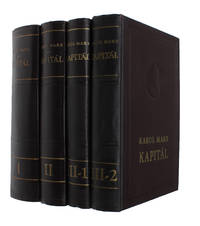
59733Bratislava Vydalo Slovenské vydavatel'stvo politickej literatúry 1955 - 1958. 8vo. 4 volumes all in publisher's original full cloth. Gilt lettering to spines and front boards and Marx in profile blind-stamped to front boards. A very fine and clean set. 918 2 pp fontiespiece of Marx; 590 2 pp; 515 4 pp; 541 4 pp. <br/><br/><em>Rare first Slovakian translation of Marx’ landmark work ‘Das Kapital’. A Czech translation was made in 1913 which due to similarities between the languages for a while made a Slovakian translation superfluous. Because of the dominance from the Soviet a need for a Slovak translation rose and a complete transition of all three volumes were published between 1955 and 1958. In the Czech lands and Slovakia the study of economics developed later than in the West European countries. An urgent need for economic study arose only in the 19th century when the disintegration of feudal relations and the development of capitalism were accompanied by a national revival. Marxist economic theory was somewhat slow to gain a following in the Czech lands and Slovakia. </em> hardcover