Steinbeck, JohnBiblio.com
11 195 résultats
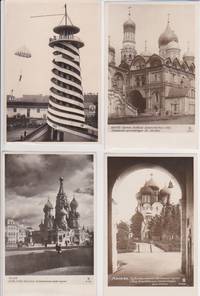
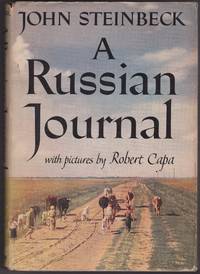
19482521New York: The Viking Press 1948. First Edition First Printing. <br /><br />Small Quarto 9 3/4 x 6 3/4 inches; 247 x 167 mm 220 pages in green and tan cloth in an unclipped illustrated dust jacket hard cover accompanied by four photographic prints. <br /><br />An account of a trip to the Soviet Union in 1947 by author John Steinbeck and photographer Robert Capa who visited while the country was attempting to recover from the devastation of World War II. They traveled to Moscow Stalingrad and other cities as well as to Ukraine and Georgia meeting numerous ordinary people while accompanied by a minder from the government. <br /><br />The New York Herald Tribune financed the trip and along with some other newspapers published articles by Steinbeck and photos by Capa. Indeed included here are three photographs that were used by one of the newspapers as indicated by layout instructions on the versos of the photos. There's also a later publicity photo of Steinbeck. One of the photos from the trip showing a Georgian restaurant in Moscow appears on page 47 of the book. Two of the trip photos are stamped on the versos with the notice that their reproduction could be used only with the "1948 Steinbeck-Capa articles on Russia" along with "Copyright 1948 by John Steinbeck." <br /><br />Our copy is a first printing of the first edition with "Printed by the Viking Press in April 1948" on the copyright page. The dust jacket carries a price of $3.75. <br /><br />A fascinating look at ordinary people in the Soviet Union as the country tried to rebuild following World War II accompanied by three photographs of scenes from the country and a publicity photo of Steinbeck. <br /><br />CONDITION: Book slightly cocked rear hinge loose corners rubbed spine ends bumped end papers slightly toned a couple of pages with vertical creases possibly a production error. Nearly Very Good in a Good dust jacket that has some loss to both spine ends as well as a few tears nicks toning foxing and stains. The four photographs have some nicks creases and soiling to the edges. The versos contain notes stamped instructions and captions pasted on the photo of Steinbeck has an article pasted to the verso. Some discoloration to two photos resulting from pasting of newspaper captions to the versos. The Viking Press hardcover
19990008049Boulder CO: Westview Press 1999. First English language edition. Hardcover. As New/issued without. 8vos; xxxiv 562; ix 389 pages maroon cloth in original shrinkwrap. Not x-library. Scarce. O.P. <br/><br/>This English translation contains an autobiography by Mironov which was not in the Russian edition. It details his anti-Marxism philosophy while a student in Leningrad. "The author has assimilated a large body of foreign scholarship primarily "new social history" produced by Anglo-American authors along with a sprinkling of more broadly European economic and demographic history from the 1970s and 1980s which is effectively incorporated into his own very deep empirical knowledge. . The reader does not find in this extensively researched account the standard Soviet answers to specific historical questions. Mironov has abandoned most Soviet cliches though he still assumes that laws of Russian history can be identified based on social science theory and quantitative analysis Elise Kimerling Wirtschafter." "This is a massterful work that provides other scholars with a wealth of useful information while confrontimg them with an argument that compels a response - William G. Wagner." Maps. Westview Press hardcover
In-4 p., mz. tela coeva, 33 fascicoli di pp. 8/12 ciascuno + 1 numero speciale, con illustrazioni in b.n. nel testo. Di questa importante rivista settimanale - organo centrale della gioventù socialista tedesca - pubblicata il mercoledì (i primi 12 numeri) e poi ogni sabato, offriamo la rara prima annata completa: dal n. 1 (27 novembre 1918) al n. 35 (23 agosto 1919) + il Numero Speciale (di 16 pp., con copertina a colori) pubblicato il 1° Maggio 1919. La numerazione subisce un “salto”: dal n. 17 (19 Aprile 1919) si passa al n. 20 (10 Maggio 1919), ma la rivista è completa poiché i nn. 18 e 19 non vennero pubblicati editorialmente. Su questo periodico apparve in originale anche un breve scritto di Rosa Luxemburg (sul n. 2, 4 Dicembre 1918) dal titolo “Die Sozialisierung der Gesellscahft” (”La Socializzazione della Società”) - “one of Luxemburg’s fullest discussion of the nature of post-capitalist society”. Esemplare ben conservato.
280 pages. Detailed index. Recommended reading list. This author recommended by USAF Brigadier General Ben Partin (Ret.) who rose to fame with his conclusive proof that the official version of events in Oklahoma City could not possibly have resulted in the destruction of the Alfred P. Murrah Building. The publishers were "...Convinced that an international conspiracy is in operation for the purpose of destroying our national and religious institutions in America." - from Foreward. Average wear to red card covers. Partial lean to spine. Binding intact. Unmarked. A sound copy. Singerman 922, Weems p.59. Book
[4], 5-398 pp. "The latest in the series of books about our times which this political pilgrim began with Insanity Fair in 1938, this is the story of a journey of discovery, geographical, social and political, in America. Readers know it is Douglas Reed's theory that the war which started in 1914 still goes on, embroiling all the Western world in a grand design for the reshaping of the globe, the final failure or success of which will determine the ultimate shape of the Twentieth Century." - dust jacket. Book unmarked with respectful wear to publisher's red cloth lettered in gilt. Slight lean to spine. Front free endpaper neatly removed. Above-average wear to price-clipped dust jacket now preserved in glossy new archival-grade Brodart. A sound vintage copy of this fascinating study. 20 x 14cm. Singerman 845. Book
FT) Original Newspaper. Folio. Issues are between 8-12 pages. In Russian. Title translates to English as, The Social Democrat. Subtitle: Tsentralnyy Organ Rossiyskoy Soctsialdemokraticheskoy Rabochey Partii [The Central Organ of the Russian Social Democratic Labour Party]. Contributing authors include Lenin, Trotsky and Martov. Includes supplement to number 19-20. The Social-Democrat was an illegal Russian newspaper, Central Organ of the R. S. D. L. P. , published from February 1908 to January 1917. Altogether 58 issues appeared. The first issue was put out in Russia, but further publication was arranged abroad, first in Paris, then in Geneva The Editorial Board was made up of representatives of the Bolsheviks, the Mensheviks and the Polish Social-Democrats. The paper was largely run by Lenin, [who] fought for a consistent Bolshevik line on the Editorial Board. From December 1911 Sotsial-Demokrat was edited by Lenin Lenin's articles published in Sotsial-Demokrat during the war played an important part in helping to apply the strategy and tactics of the Bolshevik Party on the questions of war, peace and revolution, in denouncing social-chauvinists, and uniting the internationalist forces in the world labour movement (Encylopedia of Marxism) . CONTENTS INCLUDES: Tsel' Bor'by Proletariata v Nashey Revolyutsii [The purpose of the Struggle of the Proletariat in our Revolution] Rabochaya Gruppa na Zhenskom Syezd [The Worker's Group at The Women's Congress] Itogi Syezda Fabrichno-Zavodskikh Vrachey [The results of the congress of factory physicians] Kont-Revolyutsiya I Burzhuaziya [Counter-revolution and Bourgeois] Klassy I Partii v ikh Otnosheniy k Religii I Tserkvi [Classes and parties in their relations to religion and Church] Vopros' o Professional'nykh Soyuzakh v 3-oy Dume [Questions on trade unions in the Third Duma] O Fraktsii "Vperedovtsev" [About the Faction "Vpered"] Fraktsiya Trotskogo I Partiynoe Polozhenie [Trotsky's faction and party position] Mezhdunarodny Sotsialisticheskiy Syezd v Kopengagen [The International Socialist Congress in Copenhagen] Krestyanskaya Reforma I Proletarski-Krestyanskaya Revolyutsiya [Peasant Reform and the Proletariat-Peasant Revolution]. Many pages darkened with rubbing and edgewear, creases throughout. Some markings in header and top margin, but all text is clear. Good Condition. (RUS-11-1a) xxxxxxxx
Documentation which has scarcely seen the light of day since the 1950s. This booklet, printed for the use of the committee, includes pages 468-491 and 611-620 from the printed hearings. Contains a chilling flowchart indicating the path of power down from the foundations through education, government, and subsequently down through their many subsidiary organizations. Printed in a small font so each page contains considerable text, much of it profoundly important. Moderate wear. Unmarked. Crease to lower corner. The Reece Committee and its work came to prominence decades later after Norman Dodd, Research Director for the Committee, came forward with stunning revelations of hidden findings of the Committee. Book
197116792Roma: Partito Comunista Italiano / Editoriali Fratelli Spada 1971. First Edition. Lithographed poster offset in three colors; 100cm x 70cm ca 40" x 28"; on heavy paper. Minor toning; light creases at margins; Near Fine - Grade A/A-. A bit of a puzzle: the poster appears to celebrate the twentieth anniversary of the formation of the Associazione Bandiera Rossa an Italian Trotskyist group; but the poster bears the imprint of the PCI the main-line Marxist-Leninist party in Italy -- an ideological implausibility even within the chaotic confines of Italian Marxism. Adding further to the confusion is a quotation from Antonio Gramsci founder of the PCI in upper right. In any case a terrific graphic attributed here to Luciano Prati whose name we encounter on a few late-70s Italian film posters but nowhere else. Duke University appears to be the only North American institution to hold a catalogued copy of this work. Partito Comunista Italiano / Editoriali Fratelli Spada unknown books
Edizione originale del primo omaggio della Rivoluzione bolscevica a Karl Marx. Un volume (18x26 cm) di (8)-187 pagine; ritratto in antiporta. In lingua russa (caratteri cirillici). Legatura coeva sovietica in mezza tela muta, piatti con carta marmorizzata. Ottime condizioni. Prima edizione di questa raccolta di articoli di capi del movimento comunista, Lenin, Rosa Luxembourg, Mehring, Kamenev. Nella prefazione Zinoviev racconta la genesi di questa opera, progettata nel 1908 per celebrare il 25esimo anniversario della morte di Marx, ma proibita dalla polizia zarista, e quindi pubblicata solo all'indomani della Rivoluzione d'Ottobre.
334 pages including index. "The thrust of this challenging book is that America is the first society to move beyond the industrial age into the new "technetronic" era, and that this transition affects directly both our international and our domestic problems. Part 1 describes the impact of the scientific revolution on world affairs in general and on the Third World in particular, and exposes the ambiguous position of its principal disseminators, the US. Part 2 examines how this has effected the content, style, and format of man's political outlook on his global reality. Part 3 assesses the contemporary relevance of communism to the problems of modernity. Part 4 focuses upon the US, a society that is both a social pioneer and a guinea pig for mankind, and examines the crisis of American institutions and values during the current transition - as well as the challenge posed by the New Left. Part 5 outlines in broad terms the general direction the US might take in order to make an effective response to its foreign and domestic dilemmas." - from dust jacket (not included). "This is one of the most original books on political and social thought to appear in recent years. The author projects the impact of technology and electronics on the political and social values of the United States, the Soviet Union and other 'post-industrial' states. As a study of global society in transition, this seminal work is bound to elicit major controversy and will be difficult to ignore." - Foreign Affairs. Bit of soiling to fore-edge else clean and unmarked with light wear. Light wear to dust jacket now preserved in archival-grade Brodart. A quality copy. Book
Documentation which has scarcely seen the light of day since the 1950s. Printed for the use of the committee, this booklet contains pages 627-665b from the printed hearings. Includes 20 tables, 12 charts and 10 data sheets. Printed in a small font so each page contains considerable text, much of it profoundly important. Moderate wear. Unmarked. Crease to lower corner. The Reece Committee and its work came to prominence decades later after Norman Dodd, Research Director for the Committee, came forward with stunning revelations of hidden findings of the Committee. Book
19302279Moscow: Various Publishers 1930s. <br /><br />Thirty black-and-white postcards each measuring 5 3/4 x 3 7/8 inches 147 x 98 mm all unused and unmounted. <br /><br />A collection of postcards depicting scenes in Moscow during the tumultuous 1930s when Stalin was expanding his power and killing off his opponents. The scenes include workers' houses hotels department stores and cathedrals that the Bolsheviks closed and turned into museums. Other scenes show Arbat Square Pushkin's monument the race course Dynamo stadium the Izvestia building Moscow University and more. <br /><br />Seventeen of the cards have brief captions in English and sometimes in French and German in addition to Russian. <br /><br />A wonderful series of vibrant images of Moscow in one of the most significant decades in Soviet history. <br /><br />CONDITION: One card lightly trimmed at the edges a few minor stains to the versos of some cards. Overall Very Good or better. Various Publishers
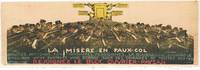
192982982Impression illegible: Bloc Ouvrier-Paysan 1929. Original lithographed poster 40cm x 120cm ca 16" x 47". Minuscule losses at margins not approaching image; closed tears; impression slightly weak; Very Good professionally backed on linen B/B.<br /> <br /> An ephemeral work produced for the short-lived Bloc Ouvrier-Paysan Workers & Peasants Party a Communist splinter group which existed in France only from 1929-30. The poster invites white-collar workers including artisans civil servants and pensioners to join the Bloc to save themselves from being crushed under the weight of bourgeois capitalism. The image depicts the bourgeoisie personified in the form of high rents food goods taxes and transportation costs being pulled forward by a horde of civil servants under harness. Copies located at Hoover Institution and the archives of the Department of Correze France; none others in institutional collections or commerce. Bloc Ouvrier-Paysan unknown
193426222New York: Workers Library Publishers n.d. but ca.1934. Original poster offset printed in black on white stock measuring 67.5cm x 80.5cm. Light wear to extremities old horizontal and vertical folds with attendant creasing; Very Good.<br /> <br /> Propaganda poster advertising eight penny pamphlets published by the Workers Library; pricing ensured that even the lowliest worker would be able to afford something to read. The poster pictures titles by Israel Amter Elizabeth Lawson Herbert Benjamin and Sadie Van Veen. Issued by the National Committee Unemployed Councils proceeds presumably went to aid the unemployed and anti-hunger organizations. Not found in OCLC. Workers Library Publishers unknown
193426222New York: Workers Library Publishers n.d. but ca.1934. Original poster offset printed in black on white stock measuring 67.5cm x 80.5cm. Light wear to extremities old horizontal and vertical folds with attendant creasing; Very Good. Propaganda poster advertising eight penny pamphlets published by the Workers Library; pricing ensured that even the lowliest worker would be able to afford something to read. The poster pictures titles by Israel Amter Elizabeth Lawson Herbert Benjamin and Sadie Van Veen. Issued by the National Committee Unemployed Councils proceeds presumably went to aid the unemployed and anti-hunger organizations. Not found in OCLC. Workers Library Publishers unknown books
16934Par-tout (Holland), Chez le vrai sage, 1760. 2 works bound in 1 volume. 130 pp.; 211, (5) pp. 12mo. Contemporary marbled calf, spine gilt with raised bands, label with gilt lettering, front cover with repair. First work: Not in Camus; Weller, ii, 129; Conlon 51:635 (listing an edition printed in 'Francfort et Leipsic' in 62 pages only); Holzmann & Bohatta, 11995; INED 1907 & 1872 (for Formey's work). One of at least two editions printed in the year of its first publication.Rare and important treatise on legal reform in which Frederic collaborated with Cujacius. The work is both historical and political and discusses the origins of law in Greece, Rome, France, England and Germany, their structure and classification and how national culture influences the development and adaptation of laws. Formey's treatise covers the pp. 86-130. It argues in favour of interest as long as the interest is "honnête". - Small stamp in blank portion of half-title.Second work: Kress 5457; INED 3318; Goldsmiths 9074; Einaudi 4031 (all listing the first edition); Le Bucher bibliographique, 780; Weller, ii, p. 140. According to Lichtenberger in his Le Socialisme au XVIIIe siècle, this is, if not the most important socialist work of the 18th century, at least one of the most important works, and it is the theoretical foundation of his famous Naufrage des isles flottantes; ou Basiliade .......'Morelly argued that the code of nature was completely communistic. Starting out from the proposition that moral evil, the essence of which was avarice, could be explained by social conditions Morelly portrayed and advocated an ideal communistic society in which it would be 'impossible to be depraved.' (.....) In many respects Morelly's system anticipates the rationalistic utopianism of Fourier' (Kingsley Martin in ESS, vol. xi, pp. 10 ff).Morelly was 'tremendously influential in inspiring utopian socialism, for his theories are reflected in almost every one of the schemes of the Utopian socialists. In fact we must regard him, if not the founder, at least as the most conspicious forerunner of the Utopian Socialists. (.....) Of the writers of his time he was the one who saw most clearly the need of a new system to replace the old; he alone was truly constructive, for he actually outlined a new social structure which he thought would meet the needs should ancient society be overthrown. While others deserve merit as critics and analysts and destroyers, he alone deserves the name of utopianist at this early period' (Hertzler, J.O. The history of Utopian Thought, p. 186 ff). The work was severely prosecuted in France. This edition was apparently printed in Holland and destined for the French market. - A very nice volume with two important texts.
Libreria Feltrinelli, 1967. In-16, 40 volumi, brossura. Offriamo la collana completa in 40 numeri editi dal 1967 al 1970 dalla libreria Feltrinelli. Pagine leggermenente ingiallite per la qualita' della carta, peraltro in buono stato. Riportiamo l'elenco
FT) Original Newspaper. 4to. Most issues are 16 pages each. In Russian. Title translates to English as, Social Democrat: Labor Newspaper. There were, of course, numerous publications titled Rabochaya Gazeta; This incarnation, published in exile in Geneva in the period leading up to the Revolution of 1905, appears to be quite scarce. CONTENTS: Klass Protiv Klassa [Class Against Class] --- Mezhdunarodnyy Sotsialisteskiy Sezd v Amsterdame [International Socialist Congress in Amsterdam] ---Politicheskaya Stachka Italyanskikh Rabochnikh [Politicial Strike of the Italian Workers] --- Posledniy Tsar [Last Tsar] --- Revolyutsionnaya Rabota v Chernomorskom Flot [Revolutionary Work in the Black Sea Float] --- Ofitsery I Soldaty v Revolyutsii [Officers and Soldiers in the Revolution] . No listings on OCLC. Pages tanned with wear along edges. Some closed tears but no loss of text. Good+ Condition. Very Rare. (RUS-11-22A)
"The story of the revolution to come through communism as it was yesterday, as it is today, and as it will be tomorrow.... Fiction based on historical facts of Communist methods and techniques and knowledge of the secret powers operating in the background to create revolutionary situations with a view to overthrowing organized governments of the world." - from title page. Above-average but not excessive wear. Light pencil markings to margins of early pages. Binding intact. A worthy copy. Most notable for its reference to the use of water fluoridation as a means of 'vitiating the populace' in 'regions of the country where resistance was most apt to develop". Book
S.e., 1902. In-4, 3 volumi, mezza tela. Offriamo tutto il pubblicato di questa rara e importante rivista quindicinale diretta da Enrico Ferri. In buono stato
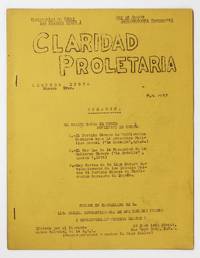
19376146New York: Revolutionary Workers League 1937. About very good. Two issues each 13pp. Folio. Mimeographed front wrapper stapled. One cover loosening. Moderate toning and dust soiling. Two issues of the scarce New York Spanish-language periodical Claridad Proletaria "El Organo en Castellano de la Liga Obrera Revolucionaria de los Estados Unidos." The Revolutionary Workers League was formed by American Trotskyist and Communist Party leader Hugo Oehler in 1935. The first issue present here dated September 1936 contains articles describing the revolutions in Spain and Latin America as well as pieces on the various internecine fights between the Trotskyist Stalinsist and other Communist factions during the 1930s. The second dated February 1937 is dedicated entirely to events in Spain and the role of Partido Obrero de Marxista Unificacion Workers' Party of Marxist Unification. OCLC locates a small smattering of individual issues. Revolutionary Workers League unknown
13603Heraklion Crete Greece. 12 January 1947. 4pp. 8vo. 96 lines of text. On paper ruled for accounts. On lightly-aged paper with loss to corners and at central edge affecting a few lines of text. Accompanying the letter is a translation 2pp. 8vo by Colin Jordan with the assistance of Dr Loukas Christodloulos. The letter is of great interest casting light on Leigh Fermor's activities in Crete in the period following the Second World War. The identity of 'Haris' is not immediately apparent: he does not appear to feature in George Psychoundakis's account of the Cretan resistance 'The Cretan Runner' 1955 which was translated by Leigh Fermor. Addressing 'Mr. Leigh Fermor' the author of the letter begins in reproachful terms: 'After my third letter you remain silent. I write now with a big question mark: why this is happening and why you are ignoring my thoughts and my offer in general' He asks Fermor 'for the sake of our friendship and co-operation and for our land of Crete' to guide him in his thoughts and to advise him in his actions 'and to help me in my efforts against the slanderers and the malevolent enemies of our union'. He desires Leigh Fermor's 'co-operation against the transformation of Crete and Greece my country into a Soviet protectorate.' He proceeds to report on 'the situation that exists': 'The Communist newspaper "Free Crete" has begun again a serious campaign against the English generally and in particular against us Major Fielding Major Alexander Wallace 'Xan' Fielding who like Leigh Fermor was in the SOE in Crete during the war and Kyrios Giorgos. They claim that the crimes of killing a villager from Potamiko Nikos Komi of another from Heraklion prior to the referendum others from Apokoronou and from Hania family murders for revenge and political party murders were done by you that you organized them that is and ordered their execution by your people.' A further claim is that 'from the time of the occupation' Leigh Fermor has been 'organizing here the ground for the occupation of Crete by the English and the creation of military bases since Alexandria is hostile towards Egypt and you are using that against her'. In his view it is easy to refute the Apokorona and Hania murder charges 'since it's commonly known that they were done by locals for revenge and due to political hatred and had nothing whatsoever to do with our work. The murder of the police officer from Heraklion happened before your arrival here in September. As for the killing of Komi at Potamiko the same man wrote a letter that he did it because of personal motives and not following orders from yourself.' He proposes to write 'to the newspapers of the Right-wing here that your visit to Crete was entirely a holiday trip to see your friends and that the villager's murder was done before you came. Also that the Hana murder had other purposes and that you and the English generally have never thought of occupying Crete and that you have always acted from friendship. I will also go to the prison and I will oblige Nikos Komis to sign a letter of protest against the writings of the "Free Crete" newspaper.' He will take responsibility for the publication 'as I did a few days ago when I published articles about English/Greek friendship in the <.>IDI and PATRIDA newspapers. Regarding 'the Communist nightmare that threatens all of us with destruction': 'Once again I give my life and for that thought I would gladly sacrifice. The communists know this and consider me their enemy like nobody else.' He ends with an enquiry regarding 'the Anglo-Greek Society at Heraklion that you had promised back in September'. Heraklion [Crete, Greece]. 12 January 1947. unknown
18771Heraklion Crete Greece. 12 January 1947. 4pp. 8vo. 96 lines of text. On paper ruled for accounts. On lightly-aged paper with loss to corners and at central edge affecting a few lines of text. Accompanying the letter is a translation 2pp. 8vo by Colin Jordan with the assistance of Dr Loukas Christodloulos. The letter is of great interest casting light on Leigh Fermor's activities in Crete in the period following the Second World War. The identity of 'Haris' is not immediately apparent: he does not appear to feature in George Psychoundakis's account of the Cretan resistance 'The Cretan Runner' 1955 which was translated by Leigh Fermor. Addressing 'Mr. Leigh Fermor' the author of the letter begins in reproachful terms: 'After my third letter you remain silent. I write now with a big question mark: why this is happening and why you are ignoring my thoughts and my offer in general' He asks Fermor 'for the sake of our friendship and co-operation and for our land of Crete' to guide him in his thoughts and to advise him in his actions 'and to help me in my efforts against the slanderers and the malevolent enemies of our union'. He desires Leigh Fermor's 'co-operation against the transformation of Crete and Greece my country into a Soviet protectorate.' He proceeds to report on 'the situation that exists': 'The Communist newspaper "Free Crete" has begun again a serious campaign against the English generally and in particular against us Major Fielding Major Alexander Wallace 'Xan' Fielding who like Leigh Fermor was in the SOE in Crete during the war and Kyrios Giorgos. They claim that the crimes of killing a villager from Potamiko Nikos Komi of another from Heraklion prior to the referendum others from Apokoronou and from Hania family murders for revenge and political party murders were done by you that you organized them that is and ordered their execution by your people.' A further claim is that 'from the time of the occupation' Leigh Fermor has been 'organizing here the ground for the occupation of Crete by the English and the creation of military bases since Alexandria is hostile towards Egypt and you are using that against her'. In his view it is easy to refute the Apokorona and Hania murder charges 'since it's commonly known that they were done by locals for revenge and due to political hatred and had nothing whatsoever to do with our work. The murder of the police officer from Heraklion happened before your arrival here in September. As for the killing of Komi at Potamiko the same man wrote a letter that he did it because of personal motives and not following orders from yourself.' He proposes to write 'to the newspapers of the Right-wing here that your visit to Crete was entirely a holiday trip to see your friends and that the villager's murder was done before you came. Also that the Hana murder had other purposes and that you and the English generally have never thought of occupying Crete and that you have always acted from friendship. I will also go to the prison and I will oblige Nikos Komis to sign a letter of protest against the writings of the "Free Crete" newspaper.' He will take responsibility for the publication 'as I did a few days ago when I published articles about English/Greek friendship in the <.>IDI and PATRIDA newspapers. Regarding 'the Communist nightmare that threatens all of us with destruction': 'Once again I give my life and for that thought I would gladly sacrifice. The communists know this and consider me their enemy like nobody else.' He ends with an enquiry regarding 'the Anglo-Greek Society at Heraklion that you had promised back in September'. Heraklion [Crete, Greece]. 12 January 1947. unknown
Very Good Turkish Original newspaper of "Ilerici Yapi-Is" [i.e. Progressive Construction and Repair Workers' Union of Turkey], a workers' union that was founded in Istanbul in 1974 under the name of Ilerici Yapi-Is, joined DISK the same year and changed its name to Ilerici Yapi-Is in 1978. 57x41 cm. In Turkish. 8 p. 3rd issue of this rare trade union periodical published by "Ilerici Yapi-Is", with a very attractive Mao portrait (the best-known photo of his youth) and a poem by Che Guevara, with an annotation "The memory of the great leader of the Chinese Proletariat, Mao Zedong, will shed light on the liberation struggle of the oppressed peoples of the world."