4 867 résultats
184776786Ulster: N.p. 1847. Calligraphic and illuminated folded vellum document measuring 20 x 21 inches and with blue double-rule border and four armorial bearings including that of Martin in the upper left corner and the royal arms of Queen Victoria; signed by "W Betham Ulster King of Arms of all Ireland" at lower folded edge; accompanied by Betham's red wax seal in a cylindrical gilt metal skippet with crown relief. Skippet has come free of the ribbon but is present and in good condition. A very good examplar.This somewhat tragic grant of arms was granted to Jone Gonne Bell a cousin of Mary Letitia Martin upon their marriage his his change of name from Bell to Martin. Mary Letitia Martin was an Irish writer who was known as the "Princess of Connemara" as she was borne into the chief landowning family of Connemara the Martins of Ballynahinch Castle. An autodidact she was well read and fluent in numerous languages. She published two books in her lifetime and a third was published posthumously. As we can see she married her cousin in 1847 but when her father died two years later and she inherited the estate she soon found herself penniless due to the great famine. She and Arthur left Ireland for Belgium where she secured a living by writing for periodicals. In 1850 the same year as her autobiographical novel Julia Howard was published they set sail for America. She had her child prematurely on that voyage and ten days after arriving in New York both she and her baby died.Sir William Betham 1779–1853 was an Irish officer of arms an author and a member of the American Antiquarian Society. He served as Ulster King of Arms from 1820 until his death more than thirty years later. N.p. hardcover
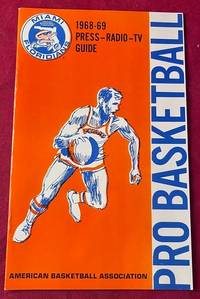
19688944Miami FL: The Miami Floridians 1968. First Edition. Original wraps. Near Fine. 5 X 8 Inches. 12 PP. Original 1968 press guide to the short-lived "Miami Floridians" basketball team in the short lived NBA rival association the American Basketball Association ABA. This was the first year the Floridians played in the league having just rebranded from the Minnesota Muskies. Original stapled binding clean and tight. The Miami Floridians unknown
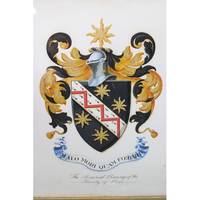
53030Roding Essex: Prior c.1860 . 19th Century Victorian Hand Painted & Illuminated Coat of Arms or Armorial Bearings for the Family of Prior 'Malo Mori Quam Foedari' with a Detailed Hand Written History in England & Ireland Both sides Glazed. The picture is in excellent period condition and measures 28 cm by 22 cm Family history records show: Captain Thomas Prior married Hon. Elizabeth Fairfax daughter of Ferdinando Fairfax 2nd Lord Fairfax of Cameron and Lady Mary Sheffield. He died in 1690. He lived at Roding Essex England and then moved to Rathdowney County Laios Ireland. Prior Thomas 1681�1751 founder of the Dublin Society and philanthropist was born in Garrison House Rathdowney Queen's Co. Laois second son among five children of Col. Thomas Prior and his first wife whose name is unknown. According to unverified family history his father secretly married again after the death of his first wife this time to the good-looking daughter of a small farmer; they had two sons. His grandfather Thomas Prior an English captain came to Ireland in 1636 and under the act of settlement obtained 500 acres of land in Rathdowney. After a period of ill health Prior retired to his estate in Rathdowney during the summer of 1751 and he died 21 October 1751 aged 70. He was buried in the Rathdowney churchyard and his tombstone inscribed �Thomas Prior Esq. who spent a long life in unwearied endeavours to promote the welfare of his country� was later relocated inside the adjacent church. His exact place of burial is now unknown. In his will Prior disinherited his estranged two half-brothers and left his estate to his cousin John Murray Prior only son of his aunt Mary. In 1726 Prior�s uncle Richard died at Ely and by his will bequeath to his �loving nephew Thomas Prior� some 40 acres of land in the parish of Leverington in the isles of Ely and a leasehold estate in the town of Cambridge as well as the More-Houses. "Malo mori quam foedari" "I would rather die than be dishonored". ".This drawing of the crest is by T. L. Murray-Prior It appears that T. L. Murray-Prior had tried to find out what the Prior coat of arms were and got it slightly wrong. On 23 November 1885 he wrote about the crest in his Family Bible. Part of what he wrote is hard to read now but appears to describe his crest as he drew it: that the family arms are �Sa. on a bend arm three chevronels gn. between stars of eight point wavy�. Motto: Malo mori quam foedari. Seat: Rathdowney Queens County. This all was part of his determination to assert his family's gentry status and despite the family no longer owning Rathdowney. T. L. Murray-Prior achieved confirmation of his family's gentry status in October 1888 when as described in Burke's entry 'Prior of Netherfield' in his Landed Gentry book T.L. Murray-Prior 'obtained confirmation of Arms from the Ulster King of Arms 1888 - Quarterly 1 and 4 vert on a bend ermine three chevronels gules PRIOR; 2 and 3 per fess gules and or four mullets countercharged MURRAY.'." - See Wikipedia Murray-Prior [ Roding, Essex: Prior (c.1860) ] . unknown
2081502112302172Shochiku N.A. Soft Cover. Fine. The book is in fine condition. Shochiku paperback
18725Communist Party of Great Britain London. International Committee 16 King Street London W.C.2. 26th March 1946. 5pp. 8vo. On five foolscap leaves with duplicate copy of p.4 present. In good condition lightly aged. The report is single-spaced and leaning towards the factual rather than the polemical with the introduction subdivided into sections on 'Strategic importance of Egypt' 'Economic position of Egypt' 'The Land' 'Crops' and 'Banks' followed by sections on 'Role of Industry in Economic Life of Country' 'The Egyptian Bourgeoisie and British Imperialism' with subsections on those with 'Tendencies to oppose British Imperialism': 'Industrialists' 'Mesr Group' 'Saadist Party' 'Big Landowners' 'What Constitutes the National Movement' subsections: 'Peasantry' 'Workers' 'Petty Bourgeoisie and intelligentsia' 'Main Political Parties and their Character' subsections: 'Chaab-Ittehad' 'LIberal-Constitutional Party' 'Saadist' 'Kotla' 'The Wafd' 'Moslem Brothers' 'The Palace'. From the papers of Jimmy Shields of the International Department of the Communist Party of Great Britain. No other copy traced. [ Communist Party of Great Britain, London. ] International Committee, 16, King Street, London, W.C.2. 26th March 1946. unknown
18721The Press Office of the Polish Embassy in London. Three numbers: No. 5 16 July 1946; No. 14 19 September 1946; No. 51 28 June 1947. Printed by St. Clements Press Ltd. Portugal Street London W.C.2.' . The three items are each 4pp. 4to in bifoliums and uniform in design. Each carrying a number of articles in small print. Each on aged paper and with wear to margin along outer edge but with text clear and undamaged. No. 5 includes articles titled: 'Referendum Results' 'Poland's National Day' 'Polish-British Relations' 'Poland's Independence and Freedom Secured M. Bierut speaks to Democratic Party Congress' 'A Polish Economic System'. No. 14 has in it articles on 'Mr. Byrnes v. Potsdam' 'Appeal to Polish Soldiers in Britain Marshal Zymierski's Declaration' 'Alliances - Elections - Frontier Declaration by the Polish Foreign Minister' 'Polish Army To-day'. No. 51 includes: 'Poland and Mr. Marshall's Proposals' 'Polish Prime Minister on Home and Foreign Problems Statement to the Parliament'. From the papers of Jimmy Shields of the International Department of the Communist Party of Great Britain and each carrying his ownership signature at the head of the first page. Now rare. [ The Press Office of the Polish Embassy in London. ] Three numbers: No. 5, 16 July 1946; No. 14, 19 September 1946; No. 51, 28 unknown
18722Issued by Tass Agency Chronicle House 72-78 Fleet Street E.C.4. London. No. 8669 28 June 1947. 5pp. folio. Duplicate typescript on three leaves. In fair condition on aged paper. The first article produced on the eve of Indian independence begins: 'Moscow radio broadcast an account of a lecture given by Corresponding Member of the USSR Academy of Sciences Zhukove on "The Situation in India" at the Polytechnical Museum in Moscow.' It proceeds with a summary of Zhukov's lecture the view he expounds including the following: 'Britain's new policy derives from the economic changes which took place in India during the years of the Second World War. India's big bourgeoisie made profits from the war and have become richer and at the same time more compliant towards Britain. The bourgeoisie's fear of the popular masses is greater than their fear of Britain.' The second articles is pure propaganda beginning: 'A vast territory of over 1158000 sq. miles lies in the North-East of the Soviety Union. In Tsarist days it was known as "the Siberia of Siberia." It is now the Yakut Autonomous Soviet Socialist Republic - a part of the Russian Federation - which is just celebrating the 25th anniversary of its foundation says a TASS message.' From the papers of Jimmy Shields of the International Department of the Communist Party of Great Britain. No other copy traced. Issued by Tass Agency, Chronicle House, 72-78 Fleet Street, E.C.4., London. No. 8669, 28 June 1947. unknown
1968LFA-126728372N° 43 (Mai 1968): 126 pages, format 205 x 270 mm, illustré, broché couverture couleurs, bon état
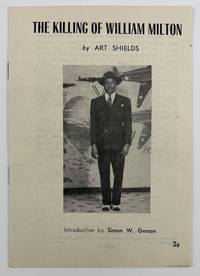
19484781New York: The Daily Worker 1948. Near fine. 16pp. Illustrated. Original pictorial self wrappers stapled. Mild toning and light wear. A scarce account of the events surrounding the death of William Milton described as "a useful hard-working law-abiding citizen.a devoted husband and loving father.sympathetic to his neighbors' problems.what people call a good man" who was also "a Negro and so marked out for that special torture that American society visits upon men and women who are colored." On July 14 1948 Milton was killed by Brooklyn Patrolman Peter Kilcommons in the hallway of his own building. Milton and three friends ran from police after being thrown out of a Williamsburg bar by a racist bartender named Charles Kennefick who "didn't want Negroes around." Kilcommons chased Milton to his front door then shot him once in the back and twice in the chest in front of about ten witnesses including Milton's wife Irene and their son Eugene Milton. Eugene describes the incident in a heartbreaking passage: "I saw Daddy drop as the first bullet hit him. I saw Daddy drop and then stagger inside. Kilcommons and O'Neil were shooting at him as he went in." There are also further accounts of the shooting recorded here from young neighbors. The text also includes the measures sought by the Committee for Justice in the Milton Case. The Committee argued for the dismissal and indictment of Kilcommons and O'Neil the dismissal of Police Commissioner Wallander financial support for Irene Milton and for continued support of Milton's brother Joseph who was with William in the bar on the fateful night. Joseph was charged with felonious assault on the bartender Kennefick after William was killed likely as a cover for the police in William's killing. Shields argues a motive for the arrest and beating of Joseph Milton: "The cops were trying to make him confess that William and himself had started the fight. The cops thought that such a 'confession' would give them an 'out' for the killing."<br /> <br /> A possible motive for the killing of William Milton also emerged after his murder. Milton was a member of the Communist Party and a community activist in New York who was often critical of the police violence he encountered in the city. He would also bring copies of The Daily Worker to his neighbors and was instrumental in organizing a renter's strike in a nearby building. Milton was especially vocal in his criticism of police following the killing of two African-American men by a police officer named Joseph Romeika in Freeport Long Island. Four young African-American siblings named Ferguson - Charles Joseph Alonzo and Richard - three of whom were U.S. Army veterans were refused coffee by a white manager of a diner. After they vigorously protested the manager called the police on the brothers. They left but were soon confronted by Romeika a rookie police officer. Romeika lined the men up and after two of the brothers protested Romeika kicked them in the groin and shot them an eerily-similar situation to the one that eventually led to Milton's murder.<br /> <br /> The author of the present work Art Shields was a legendary labor journalist who had previously written about the Sacco & Vanzetti case and would spend his career on the side of unions and laborers notably miners. He was highly critical of police actions such as the one recorded here which he described "as brutal a homicide as if the cops had been working for Heinrich Himmler the Nazi Gestapo leader instead of for Police Commissioner Arthur Wallander of New York." The Introduction was written by Simon W. Gerson one of the foremost leaders of the Communist Party in the United States and editor of The Daily Worker who writes passionately about the murder of Milton: "Yes William Milton lived under Jim Crow right here in New York. In fact he died from Jim Crow. He was lynched my friends lynched. What matter is it if a man is lynched by a hempen rope from a Georgia cottonwood-tree or lynched by a police revolver in the trigger-happy hands of a Brooklyn cop" The penultimate page of the pamphlet contains a group photograph which includes Gerson along with a Brooklyn councilman Mrs. Joseph Milton Irene Milton and Eugene Milton "at Madison Sq. Garden Rally" presumably in support of the Committee for Justice in the Milton Case. An important story that still resonates today about police crimes against the African-American population. The Daily Worker unknown
15201Manuscrit in-4 (22,5 x 17,5 cm). XIXe siècle. Bradel usagé. Des rousseurs. 92 feuillets illustrés de dessins originaux à l'encre, suivis d'une table manuscrite des armoiries représentées.
1856AQ242771856. Manuscript on paper. Single bifolium. With original stamped envelope. Old horizontal and vertical folds. Short tears at folds cross-written on terminal page. Envelope worn and soiled. An autograph letter in the hand of private Thomas Arms of the 12th Royal Lancers addressed to his sister written at Scutari Istanbul 17th January 1856 two months prior to the cessation of hostilities during the Crimean War. Arms references his participation in the Battle of Tchernaïa the fall of Sebastopol and the conditions he and his fellow soldiers had to endure: 'You wished for some small token from Sebastopol but I had nothing but a Russian musket and bayonet and those I sold to one of our officers as I have no means of sending it to England.things are very dear 1lb of bread here is 1/6 meat we cannot buy for any price we give 2 shillings for a bottle of porter or ale and we are only getting half allowance of rum to what we used to get and there it is a great deal of gambling amongst the troops'. The cross-written portion of the letter is of particular note for a passing mention of reformer of army medical services and of nursing organisation Florence Nightingale 1820-1910: 'Dear sister their sic are some kind ladies in these hospitals and kind nurses here to attend upon you. Miss Nightingale is here and Miss Roberts and some more very amicable from England'. . unknown
193256488New York: Macmillan Co. 1932. 4to. xv 1 217 1 pp. Colour-tinted frontisp. 55 plates. Brick-red publisher’s cloth gilt lettering front cover & spine w/ d.j. minor chipping & edgwear to fore-edges some scuffing across lower fore-edge front cover still NF/VG- partially unopened and uncut copy from the collection of Mabel E. Clark with her bookplate on front pastedown. First edition of this finely illustrated and well-written automobile travel account through Northern Italy. Dorothy Arms recounts folk legends views of flowering fields pastoral lakes all illustrated with fine etchings and pen & ink drawings of Arms noted for his technically flawless interpretations of Gothic Cathedrals. Macmillan Co., hardcover
1947LFA-126724423Une revue de 24 pages, format 150 x 230 mm, illustrée, brochée, publiée en 1947, bon état
201701763S.l., Exposition internationale paais soubise, 1950 ; in-8, br.
201504709Paris, Compagnie francaise des arts graphiques , 1941 ; in-12, 93 pp., br.
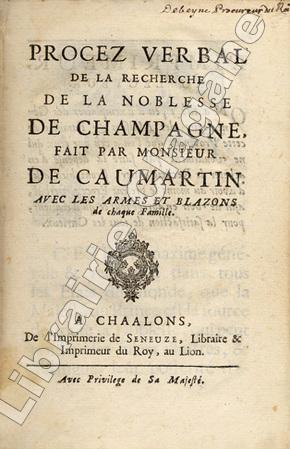
167310661À Chaalons, Imprimerie de Seneuze, s.d. (achevé d'imprimer le 1er septembre 1673) ; in-8 ; plein veau marbré, dos à nerfs décoré et doré, pièce de titre grenat, tranches rouges (reliure de l'époque) ; 160 pp.
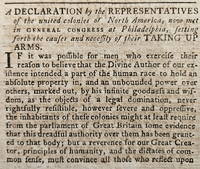
17753823<p>The complete text of the <em>Causes and Necessity of their Taking Up Arms</em> appears on pages 2 and 3 of the newspaper.</p><p>The Second Continental Congress convened in Philadelphia on May 10 1775 only about seven months after the First Continental Congress had adjourned. But with the battles at Lexington and Concord occurring in April 1775 hostilities had begun and the Congress needed to act. The action was the issuance on July 6 of the "Causes and Necessity of Taking Up Arms" a pivotal founding document that laid out the colonies' justification for war while making it clear that it was a defensive action and not a declaration of independence.</p><p>An initial draft of the <em>Causes </em>was rejected by the Congress as being too harsh. Thomas Jefferson and John Dickinson produced the new draft which the Congress approved. In the end the <em>Causes</em> was a masterful blend of airing grievances and reaching out for reconciliation while also clearly stating that independence was on the table if necessary.</p><p>While the British Parliament was the primary intended audience of the <em>Causes</em> it was also critical that the document satisfy the strongly divided Congress itself. At the time there was extreme tension between those advocating for independence and those in favor of a peaceful reconciliation. The final document provided enough justification to satisfy both sides - and allowed the journey to nationhood to continue to the next watershed moment the Declaration of Independence just a year later.</p><p>In addition to the important publication of the <em>Causes</em> this issue of the Virginia Gazette includes a brief mention debunking a report of an engagement in the days following that at Bunker Hill. It also prints "General Gage's false and audacious account of the late battle near Boston Bunker Hill."</p><p>As an aside it should be noted that during 1775 there were <u>three newspapers</u> all named the <em>Virginia Gazette</em> and all published concurrently in Williamsburg. They are easily distinguished by their respective publishers Pinkney in the case of the offered newspaper.</p><p>A rare and important paper very nicely preserved.</p><p><strong>Reference: </strong> Brigham <em>History and Bibliography of American Newspapers 1690 1820</em> noting holdings only at Library of Congress and New York Historical Society.</p><p><strong>Condition: </strong>Disbound; untrimmed. Expected age toning. Small ink blot in masthead and a spot of foxing to the first leaf. Overall a very good example.</p><p>ICN 7811.</p> John Pinkney
196762610New Milford CT: N. Flayderman & Co. Inc. 1967. 4to. 6 153 15 pp. Frontisp. illustrated title 100’s of illustrations throughout. Brown publisher’s cloth decorative black lettering front cover & spine minor shelfwear w/ d.j. minor scuffing edgewear rubbing still VG/VG- copy. Second printing of this invaluable facsimile printing of the famed Schuyler Hartley & Graham catalogue offering an essential reference for Civil War era arms & ammunition uniforms horse equipment flags guidons Masonic goods and coats of arms. N. Flayderman & Co., Inc., hardcover
192961264Hartford CT & London: Colt’s Patent Fire Arms Manufacturing Co. ca. 1929. 8vo. 45 1 pp. Over 100 illusts. photos & diagrams. Brown illustrated softcovers armorial and Colt logo front cover in green & black minor dustsoiling edgewear still VG. Early printing A-70-10th of this nicely illustrated catalogue first issued in 1922 of Colt revolvers and automatics including the New Service Double Action Revolver Colt New Service Target Colt Official Police Colt “Detective Special†Colt “Camp Perry†Model Colt Automatic .38 caliber Military Model Automatic Pistol decorative grips medallion inserted for ivory and pearl handle grips and parts. Colt’s Patent Fire Arms Manufacturing Co., paperback
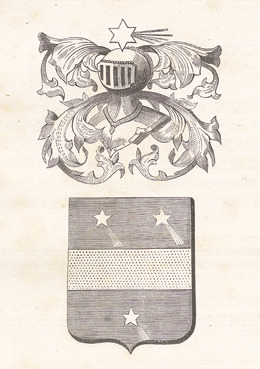
16619Paris, Bureaux Héraldiques, (circa 1854-1866) ; in-4, toile écru, grande pièce de titre rouge sur le plat ; 9, (1) pp., couverture de papier glacé blanc imprimée en doré : armes des de Comeau, d’azur à la fasce d’or, accompagnée de trois comètes d’argent posées 2 et 1, l’écu timbré d’un casque, ayant pour cimier une comète. Joint, un manuscrit petit in-4, broché Notisse sur la famille de Comeau faite par Richard de Comeau 16 ff. et 1 f. ajouté de notes, en plus des notes en bas de pages.
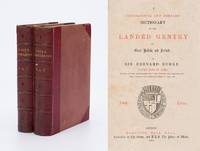
186331234AB1863. Fourth Edition. Two Volumes complete set. London Harrison Pall Mall Bookseller to the Queen and H.R.H. The Prince of Wales 1863. Slim-Quarto 175 cm x 25 cm. XVIII 1759 pages Two Volumes with continued pagination. Hardcover / Original red half-leather with original marbled endpapers. Both Volumes in protective Mylar. Very good condition with only minor signs of wear. Both Volumes firm and strong in their bindings. This is the original set of the Family of Daniel Conner Esq of Manch House County Cork with manuscript hand-written annotations and additions to the entry on page 280 of the set "Conner of Manch" explaining the Lineage of Daniel Conner Esq. Cornelius Conner connection to the Coppinger Family etc. hardcover
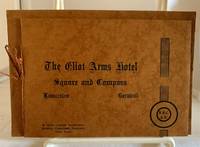
1920A47330Cornwall England: The Eliot Arms Hotel. 1920. Other. Very Good. C1920's This brochure is in Very Good condition and was issued without a dust jacket but have a mailing envelope with the hotel's imprint on the reverse. This is an oblong brochure with a string binding. The covers are of heavy cardstock as are the inner pages. There is photo of the hotel on the first text page. I The brochure and its contents are in clean bright condition. The text pages are clean and bright. The reverse of the last text page includes "Suggested Motor Runs" that can be taken by motorists from the hotel. including Kennard's House Camelford Bodmin and more. "The Eliot Arms or Square & Compass Square and Compass Tregadilett was once a Freemason’s Lodge for French prisoners of war on parole in Launceston: History supplied by R. F. Gilbert The original building was built in the 14th century and it became a coaching inn during 1625. The Inn fell into disarray in the early 19th century becoming a blacksmith’s shop until 1840 when it reverted back to a pub and the second name ‘Eliot Arms’ was added. The French POW’s lodge is thought to have existed for five to seven years of the war and this is shown by two certificates of ‘The Lodge Consulate Maconne’ dated 1762 and 1763; one in French and one in English issued to Robert Martin organist at St Mary Magdalene Church. Both certificates had French signatures five on the one of 1762 and four on the other dated 1763. Several of the Frenchmen joined the Dunheved Lodge which must have existed during 1756-1773. The Eliot is reputed to be haunted by a not unfriendly ghost which is said to have been seen by customers and staff in recent years. Mr T Richards landlord of the Eliot Arms Compass made an application to the Bench for an hours extension on the occasion of the Polyphant Cricket Club dinner given by Dr Serpell. The application was granted. ." from The Post and Weekly Feb 1911; Put in world history. Pictured 12/5/23 . The Eliot Arms Hotel unknown
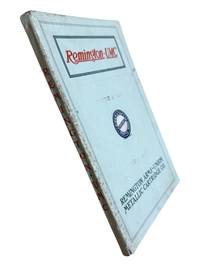
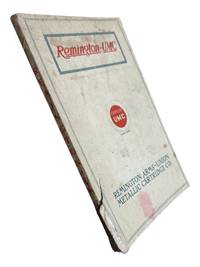
19139186New York: Remington Arms-Union Metallic Cartridge Co 1913. 8vo 212pp. Illustrations. Publisher's pale green wraps lettered in gray and red. Seattle sporting good store stamp and label to front cover some foxing along spine and stain to rear cover. Clean internally and very good. <br /> <br /> Iconic early 20th century illustrated catalogue from Remington. Scarce. Remington Arms-Union Metallic Cartridge Co unknown
19119185New York: Remington Arms-Union Metallic Cartridge Co 1911. 8vo 191pp. Illustrations. Publisher's plain wraps lettered in gray and red. Some soiling and staining to covers base of spine split. Clean internally and very good. <br /> <br /> Iconic early 20th century illustrated catalogue from Remington. Scarce. Remington Arms-Union Metallic Cartridge Co unknown
197659994Dallas TX: Taylor Publishing Co. 1976. 4to. xxviii 523 1 pp. Illustrated title numerous colour plates many photo illustrations diagrams charts. Embossed black publisher’s simulated calf raised embossed Colt on front cover raised gilt lettering front cover & spine slight shelfwear NF/VG. First edition thus of this lavishly illustrated history of Colt revolvers and automatics including the New Service Double Action Revolver Colt Army Special Double Action Revolver Officers’ Model Target Police-Positive Special Bisley Model Target the discontinued Colt Automatic Pistol Military Model .45 caliber .38 caliber Military Model Automatic Pistol decorative grips medallion inserted for ivory and pearl handle grips and parts. Taylor Publishing Co., unknown