Shields AF A FBiblio.com

3 526 résultats
2007CBS-9781588296337Sp Springer 2007. New. Sp Springer unknown
2007CBS-9781588296337Sp Springer 2007. New. Sp Springer unknown
2007Adhya-9781588296337SPRINGER 2007. Hardcover. New. SPRINGER hardcover
2007Adhya-9781588296337SPRINGER 2007. Hardcover. New. SPRINGER hardcover
1856AQ242771856. Manuscript on paper. Single bifolium. With original stamped envelope. Old horizontal and vertical folds. Short tears at folds cross-written on terminal page. Envelope worn and soiled. An autograph letter in the hand of private Thomas Arms of the 12th Royal Lancers addressed to his sister written at Scutari Istanbul 17th January 1856 two months prior to the cessation of hostilities during the Crimean War. Arms references his participation in the Battle of Tchernaïa the fall of Sebastopol and the conditions he and his fellow soldiers had to endure: 'You wished for some small token from Sebastopol but I had nothing but a Russian musket and bayonet and those I sold to one of our officers as I have no means of sending it to England.things are very dear 1lb of bread here is 1/6 meat we cannot buy for any price we give 2 shillings for a bottle of porter or ale and we are only getting half allowance of rum to what we used to get and there it is a great deal of gambling amongst the troops'. The cross-written portion of the letter is of particular note for a passing mention of reformer of army medical services and of nursing organisation Florence Nightingale 1820-1910: 'Dear sister their sic are some kind ladies in these hospitals and kind nurses here to attend upon you. Miss Nightingale is here and Miss Roberts and some more very amicable from England'. . unknown
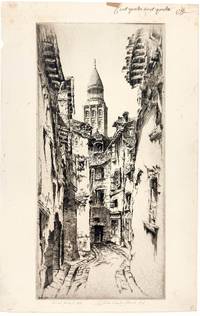
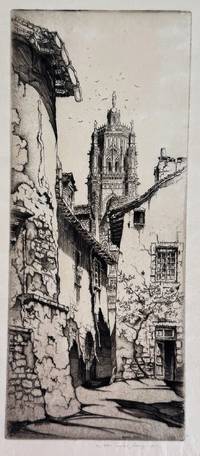
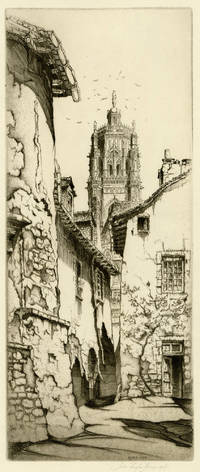
192823171928. Etching with drypoint on antique cream laid paper 12 x 5 9/16 305 x 142 mm; sheet 13 1/4 x 8 1/2 inches 337 x 216 mm. Signed dated and inscribed in the lower margin in pencil. Although Fletcher specifies only 2 trial proofs Arms himself has inscribed "Trial Proof VII" in pencil in the lower margin. An impression aside from the regular edition of 100 printed on 18th century paper with a contemporary inscription in ink in the upper right corner which reads "Cent quatre vingt quatre" one hundred twenty four. There are some areas of light discoloration in the margins that date to the origin of the paper. Printed by Frederick Reynolds assisted by Henry Carling. A magnificently detailed impression in excellent condition. <br /> <br /> Fletcher 212. Périgueux has one of the most extensive old towns in the Dordogne department in France. The Périgueux Cathedral was originally built in the 12th century but it was rebuilt by the architect Paul Abadie between 1852 and 1895. The base of the bell tower was part of the original church. Today the square bell tower has three tiers pierced with arches that support a tall dome. In Arms' etching the bell tower looms above a narrow cobblestone alley lined with ancient stone buildings. In perhaps a tribute to Whistler Arms left building surfaces unmarked by his etching needle. Light vertical passages draw the viewer's eye toward the darker more detailed center of the image. One's eyes move upward with the play of shadow texture and light toward the imposing domed bell tower.<br /> <br /> Born in 1887 in Washington DC John Taylor Arms studied at Princeton University and ultimately earned a degree in architecture at the Massachusetts Institute of Technology in 1912. With the outbreak of W.W.I Arms served as an officer in the United States Navy and it was during this time that he turned his focus to printmaking having published his first etching in 1919. His first subjects were the Brooklyn Bridge near the Navy Yard and it was during his wartime travel that Arms created a series of extraordinarily detailed etchings based on gothic cathedrals and churches he visited in France and Italy the plate for Guardians of the Spire was created in 1921. He used what was available to him namely sewing needles and a magnifying glass to create the incredibly rich and fine detail that his etchings are known for. Upon his return to New York after the war Arms enjoyed a successful career as a graphic artist created a series of etchings of American cities and published Handbook of Print Making and Print Makers Macmillan 1934. He served as President of the Society of American Graphic Artists and in 1933 was made a full member of the National Academy of Design. Arms died in Fairfield Connecticut in 1953. unknown
193710391937. Etching on antique cream laid paper with an "England" watermark; 13 7/8 x 8 5/8 inches 353 x 221 mm full margins. Signed dated titled numbered "III" and inscribed in pencil. One of approximately 175 third state of 4 impressions before the inscription was removed. In superb condition. French Church Series No. 39. Paper: Arms was typical of the artists of this period - he was obsessed with paper a mania for collecting paper that could/would improve an edition. The quantity he left after his death distributed by his wife to fellow artists witnesses his love for finely made paper -paper interesting because of texture color distinctive weave. The earliest paper known to have been used by Arms came from a Baptismal Register Kirchen Ordnung The Reformed Church Middletown Dauphin County Pennsylvania 1708 bought in a bookshop in Philadelphia. His early prints 1915-1919 evidence paper taken from old books with gilded edges. Some prints appear on stationary from the Cisalpine Napoleonic Italy still bearing the estampe of the office or department; others carry penned ink page numbers taken from old ledgers of the Eighteenth Century-all beautiful shades of grey blue and green handmade ribbed and otherwise. Some of his color aquatints were printed on full sheets of heavy chine or Japanese vellum giving a sense of luxury in the richness of the stock and the width of the margins. There was a myriad of modern papers gleaned in England France Italy and the United States. <br /> <br /> -William Dolan Fletcher A Man For All Times p. 15. unknown
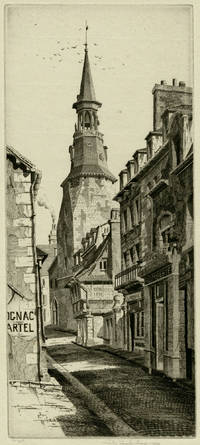
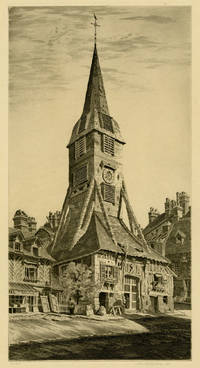
193210431932. Etching on green-hued antique laid Japon paper 9 7/16 x 4 1/16 240 x 104 mm full margins. Signed dated and inscribed "Ed. 100 II." One of a total edition on 124 impressions printed by David Strang. French Series No. 33. In superb condition with one spot of light brown discoloration in the lower right margin well outside of image area.<br /> Fletcher 246. This etching was awarded the Bronze Medal of Honor in Graphics Annual Exhibition Painters and Sculptors Society of New Jersey Jersey City NJ 1951.<br /> <br /> Paper: Arms was typical of the artists of this period - he was obsessed with paper a mania for collecting paper that could/would improve an edition. The quantity he left after his death distributed by his wife to fellow artists witnesses his love for finely made paper -paper interesting because of texture color distinctive weave. The earliest paper known to have been used by Arms came from a Baptismal Register Kirchen Ordnung The Reformed Church Middletown Dauphin County Pennsylvania 1708 bought in a bookshop in Philadelphia. His early prints 1915-1919 evidence paper taken from old books with gilded edges. Some prints appear on stationary from the Cisalpine Napoleonic Italy still bearing the estampe of the office or department; others carry penned ink page numbers taken from old ledgers of the Eighteenth Century-all beautiful shades of grey blue and green handmade ribbed and otherwise. Some of his color aquatints were printed on full sheets of heavy chine or Japanese vellum giving a sense of luxury in the richness of the stock and the width of the margins. There was a myriad of modern papers gleaned in England France Italy and the United States. <br /> <br /> -William Dolan Fletcher A Man For All Times p. 15. unknown
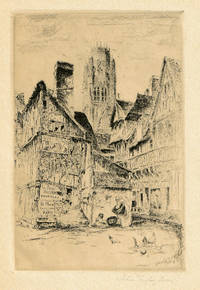
19258291925. Etching on cream wove paper 6 x 4 inches 153 x 102 mm full margins. Signed in pencil lower margin. From the edition of 150 printed by Frederick Reynolds. <br /> <br /> Fletcher 163. This work was commissioned by The Print Connoissuer and served as the frontispiece for the October 1925 issue.<br /> <br /> Illustrated on p. 52 Dorothy Noyes Arms Churches of France<br /> <br /> Note: according to Fletcher Arms was assisted in work on this plate by Kerr Eby both concluding "neither very successful. unknown
192620491926. Etching on extremely delicate antique Japon laid paper 12 x 5 305 x 127 mm; sheet 15 3/4 x 7 1/8 inches 400 x 178 mm full margins. In very good condition. A magnificently detailed and rich impression with rich burr and good inking on rare paper. Fletcher states that even though the plate was completed in 1926 it was not published until 1927.<br /> <br /> Fletcher 189. Born in 1887 in Washington DC John Taylor Arms studied at Princeton University and ultimately earned a degree in architecture at the Massachusetts Institute of Technology in 1912. With the outbreak of W.W.I Arms served as an officer in the United States Navy and it was during this time that he turned his focus to printmaking having published his first etching in 1919. His first subjects were the Brooklyn Bridge near the Navy Yard and it was during his wartime travel that Arms created a series of extraordinarily detailed etchings based on gothic cathedrals and churches he visited in France and Italy the plate for Guardians of the Spire was created in 1921. He used what was available to him namely sewing needles and a magnifying glass to create the incredibly rich and fine detail that his etchings are known for. Upon his return to New York after the war Arms enjoyed a successful career as a graphic artist created a series of etchings of American cities and published Handbook of Print Making and Print Makers Macmillan 1934. He served as President of the Society of American Graphic Artists and in 1933 was made a full member of the National Academy of Design. Arms died in Fairfield Connecticut in 1953. unknown
192710441927. Etching on antique wove Catalunya-Spain watermarked paper 12 x 5 inches 305 x 127 mm full margins. Signed and dated in pencil lower margin. In excellent condition with light toning along the left margin outside of the image area. An impression from the regular edition of 120 printed by Frederick Reynolds. <br /> <br /> Fletcher 189. Paper: Arms was typical of the artists of this period - he was obsessed with paper a mania for collecting paper that could/would improve an edition. The quantity he left after his death distributed by his wife to fellow artists witnesses his love for finely made paper -paper interesting because of texture color distinctive weave. The earliest paper known to have been used by Arms came from a Baptismal Register Kirchen Ordnung The Reformed Church Middletown Dauphin County Pennsylvania 1708 bought in a bookshop in Philadelphia. His early prints 1915-1919 evidence paper taken from old books with gilded edges. Some prints appear on stationary from the Cisalpine Napoleonic Italy still bearing the estampe of the office or department; others carry penned ink page numbers taken from old ledgers of the Eighteenth Century-all beautiful shades of grey blue and green handmade ribbed and otherwise. Some of his color aquatints were printed on full sheets of heavy chine or Japanese vellum giving a sense of luxury in the richness of the stock and the width of the margins. There was a myriad of modern papers gleaned in England France Italy and the United States. <br /> <br /> -William Dolan Fletcher A Man For All Times p. 15. unknown
194410151944. Etching on bluish-grey antique laid paper 5 x 3 5/8 inches 127 x 93 mm signed dated and inscribed "III" in pencil lower margin. A proof impression from the third state of 3 after the reduction of the plate and before the regular edition of 72. Printed by David Strang. In very good condition with some minor reddish toning around the extreme sheet edges and in a stripe occurring diagonally across the top sheet area all well outside of image area.<br /> <br /> Fletcher 340B. Demonstration Series No. 93<br /> Mexican Series No. 1 3rd state<br /> <br /> Note: Fletcher states that there is confusion regarding the third state in its edition. On prints in the Arms family collection the size is 3 proofs plus an edition of 36 however Fletcher reports that in 1949 Arms told him there were only two proofs and an edition of 72. Fletcher states to own an impression of this work which is annotated "III Ed. 72."<br /> <br /> Paper: Arms was typical of the artists of this period - he was obsessed with paper a mania for collecting paper that could/would improve an edition. The quantity he left after his death distributed by his wife to fellow artists witnesses his love for finely made paper -paper interesting because of texture color distinctive weave.<br /> <br /> The earliest paper known to have been used by Arms came from a Baptismal Register Kirchen Ordnung The Reformed Church Middletown Dauphin County Pennsylvania 1708 bought in a bookshop in Philadelphia.<br /> <br /> His early prints 1915-1919 evidence paper taken from old books with gilded edges. Some prints appear on stationary from the Cisalpine Napoleonic Italy still bearing the estampe of the office or department; others carry penned ink page numbers taken from old ledgers of the Eighteenth Century-all beautiful shades of grey blue and green handmade ribbed and otherwise. Some of his color aquatints were printed on full sheets of heavy chine or Japanese vellum giving a sense of luxury in the richness of the stock and the width of the margins. There was a myriad of modern papers gleaned in England France Italy and the United States. -William Dolan Fletcher A Man For All Times p. 15. unknown
2010657870Knopf 2010. First Edition. Unknown. Fair/Fair. THE AUTHOR'S PERSONAL COPY - David Shields' own personal working copy of his most influential and controversial book REALITY HUNGER with his extensive notes and markings for appearances and teaching. Heavily annotated and marked up. A fair copy at best shows heavy wear and signs of use. If you want one copy of a book intimately connected with the author from his heavy post-publication use - this would be it. First edition stated hardcover in jacket. Knopf unknown
1996635611Knopf 1996. First Edition. Hardcover. Fair/Very Good. AUTHOR'S OWN UNIQUE ANNOTATED COPY. This unique copy which Shields has marked 'reading' on frnt endpaper was the extensively marked and annotated copy he used for readings and appearances. It includes the taped insertion of one 7-line printed text his intro and numerous marked pages with ecisions notes etc. The text and binding are heavily worn clearly in use for some time. A great window into the creative and performative process of this noted author of Reality Hunger and other works co-star and co-author of James Franco's film 'I Think You're Totally Wrong: A Quarrel'. Knopf hardcover
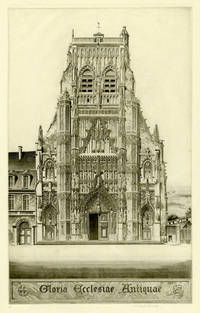
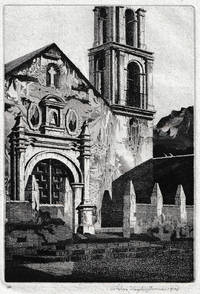
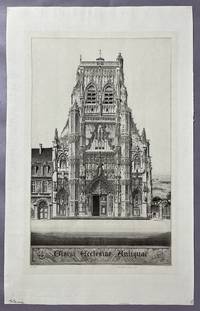
19370059521937. No Binding. Fine. Etching. John Taylor Arms. American Artist 1887-1953. Fletcher 307 iii/IV edition 75. Image size: 13 7/8 x 8 5/8 inches; paper size: 18 1/4 x 11 1/2 inches. SIGNED and dated 1937 in pencil. Inscribed "Ed.75 III." A fine impression with full margins printed on J. WHATMAN watermarked paper. The raisonne lists an edition of 175 for this state. Depicting the western façade of the abbey church of Saint-Riquier which is considered one of the most beautiful examples of Flamboyant Gothic architecture in the Hauts-de-France region in northern France. John Taylor Arms is considered one of the most famous printmakers of the first half of the century. He is mostly noted for his etchings of medieval architecture as this etching attests. His work can be found in most major collections of American prints. <br/> <br/> unknown
200953561BECK C.H. 2009. 1. hardcover. Sirmkovrilo! Originaleldono! Unverkäufliches Leseexemplar! BECK, C.H. hardcover
13104Arms John Taylor. BEAVER HOUSE AU NORD. Fletcher 88. Etching 1920. An Artist's Proof printed by Fredrick Reynolds. Signed and dated in pencil by Arms lower right and incscribed "Artist's Proof" lower left. The edition was 75 of which 10 impressions were titled "Au Nord."5 7/8 x 7 7/8 inches 150 x 201 mm. framed to 17 x 18 inches. In excellent condition. This print is scarce. unknown
13103Arms John Taylor American 1887-1953. LA COLEGAITA TORO. Fletcher 284. Etching 1935. Edition of 153. Signed by Arms in ink lower right and inscribed by him in ink lower left "Private Collection b ii." In excellent condition. 9 3/4 x 12 3/4 inches 248 x 324 mm. plate framed to 18 3/4 x 21 1/2 inches. Spanish Church series #12. Fletcher lists this as one of Arms' "Preferred Plates" and which he apparently kept in his own collection. unknown
13105Arms John Taylor. PUERTA DEL OBISPO ZAMORA THE BISHOP'S DOOR ZAMORA. Fletcher 266. Etching 1933. Edition 160 of which this is likely one of the 25 printed by Rigal in 1933 135 were printed in 1937-38 by Strang. Listed by Flether as one of Arms' "Preferred Plates." Spanish Church Series #9. 12 1/2 x 7 1/8 inches 318 x 183 mm. plate framed to 23 x 17 1/4 inches. In excellent condition. unknown
2013Adhya-9781848606647SAGE PUBLISHING 2013. Hardcover. New. SAGE PUBLISHING hardcover
2013Adhya-9781848606647SAGE PUBLISHING 2013. Hardcover. New. SAGE PUBLISHING hardcover
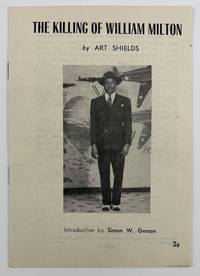
19484781New York: The Daily Worker 1948. Near fine. 16pp. Illustrated. Original pictorial self wrappers stapled. Mild toning and light wear. A scarce account of the events surrounding the death of William Milton described as "a useful hard-working law-abiding citizen.a devoted husband and loving father.sympathetic to his neighbors' problems.what people call a good man" who was also "a Negro and so marked out for that special torture that American society visits upon men and women who are colored." On July 14 1948 Milton was killed by Brooklyn Patrolman Peter Kilcommons in the hallway of his own building. Milton and three friends ran from police after being thrown out of a Williamsburg bar by a racist bartender named Charles Kennefick who "didn't want Negroes around." Kilcommons chased Milton to his front door then shot him once in the back and twice in the chest in front of about ten witnesses including Milton's wife Irene and their son Eugene Milton. Eugene describes the incident in a heartbreaking passage: "I saw Daddy drop as the first bullet hit him. I saw Daddy drop and then stagger inside. Kilcommons and O'Neil were shooting at him as he went in." There are also further accounts of the shooting recorded here from young neighbors. The text also includes the measures sought by the Committee for Justice in the Milton Case. The Committee argued for the dismissal and indictment of Kilcommons and O'Neil the dismissal of Police Commissioner Wallander financial support for Irene Milton and for continued support of Milton's brother Joseph who was with William in the bar on the fateful night. Joseph was charged with felonious assault on the bartender Kennefick after William was killed likely as a cover for the police in William's killing. Shields argues a motive for the arrest and beating of Joseph Milton: "The cops were trying to make him confess that William and himself had started the fight. The cops thought that such a 'confession' would give them an 'out' for the killing."<br /> <br /> A possible motive for the killing of William Milton also emerged after his murder. Milton was a member of the Communist Party and a community activist in New York who was often critical of the police violence he encountered in the city. He would also bring copies of The Daily Worker to his neighbors and was instrumental in organizing a renter's strike in a nearby building. Milton was especially vocal in his criticism of police following the killing of two African-American men by a police officer named Joseph Romeika in Freeport Long Island. Four young African-American siblings named Ferguson - Charles Joseph Alonzo and Richard - three of whom were U.S. Army veterans were refused coffee by a white manager of a diner. After they vigorously protested the manager called the police on the brothers. They left but were soon confronted by Romeika a rookie police officer. Romeika lined the men up and after two of the brothers protested Romeika kicked them in the groin and shot them an eerily-similar situation to the one that eventually led to Milton's murder.<br /> <br /> The author of the present work Art Shields was a legendary labor journalist who had previously written about the Sacco & Vanzetti case and would spend his career on the side of unions and laborers notably miners. He was highly critical of police actions such as the one recorded here which he described "as brutal a homicide as if the cops had been working for Heinrich Himmler the Nazi Gestapo leader instead of for Police Commissioner Arthur Wallander of New York." The Introduction was written by Simon W. Gerson one of the foremost leaders of the Communist Party in the United States and editor of The Daily Worker who writes passionately about the murder of Milton: "Yes William Milton lived under Jim Crow right here in New York. In fact he died from Jim Crow. He was lynched my friends lynched. What matter is it if a man is lynched by a hempen rope from a Georgia cottonwood-tree or lynched by a police revolver in the trigger-happy hands of a Brooklyn cop" The penultimate page of the pamphlet contains a group photograph which includes Gerson along with a Brooklyn councilman Mrs. Joseph Milton Irene Milton and Eugene Milton "at Madison Sq. Garden Rally" presumably in support of the Committee for Justice in the Milton Case. An important story that still resonates today about police crimes against the African-American population. The Daily Worker unknown
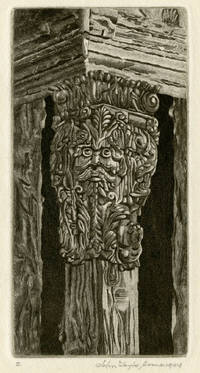
194412611944. Etching on cream wove paper 3 3/16 x 1 9/16 inches 81 x 41 mm full margins. Signed dated and inscribed "II" in pencil lower margin and with an inscription and dedication in the artist's hand in the lower margin. From the second state of 2 before the reduction of the plate. Fletcher states a total of three trial proofs an unknown number of first state impressions and a regular edition of 136 second state impressions. We believe this impression may be an unrecorded second state trial proof impression. In very good condition with notations in pencil in the margins and paper tape at the top corners on the verso and a dog-eared upper right corner well outside of image area. <br /> <br /> Fletcher 382. No. 32 from the Miniature Series <br /> No. 12 from the English Series <br /> <br /> The inscription in Arms's hand reads: An experiment on wood textures! To my friend FitzRoy Carrington J.T.A. <br /> <br /> FitzRoy Carrington was born in Surbiton Surrey in England; he was educated at Victoria College Jersey before coming to New York City in 1886. He worked for Frederick Keppel & Co. a dealer of etchings and engravings between 1892 and 1913 and became a member of the firm in 1899. In 1911 the year before he published Prints and their Makers 1912 he became the editor of The Print Collector's Quarterly. After 1913 he became a lecturer on the history of engraving at Harvard University and a curator of prints at the Museum of Fine Arts Boston. He subsequently authored Engravers and Etchers: Six Lectures Delivered on the Scammon Foundation at the Art Institute of Chicago 1917 and On Print Collecting 1929. He died in 1954. -Dumbarton Oaks Research Library and Collection. unknown
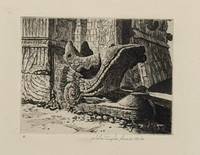
194022851940. Etching on antique watermarked fine Barcelona cream laid paper 1 7/8 x 2 /12 inches 49 x 64 mm full margins. Signed dated and inscribed "II" in pencil in the lower margin. In excellent condition with a 3-digit accession number written in pencil in the lower margin on the recto. Likely one of only 16 proof impressions of the second state of 2 aside from the regular edition of 276. Printed by Charles S. White. Miniature Series #27; Yucatán Series No. 1. <br /> <br /> Fletcher 344. Born in 1887 in Washington DC John Taylor Arms studied at Princeton University and ultimately earned a degree in architecture at the Massachusetts Institute of Technology in 1912. With the outbreak of W.W.I Arms served as an officer in the United States Navy and it was during this time that he turned his focus to printmaking having published his first etching in 1919. His first subjects were the Brooklyn Bridge near the Navy Yard and it was during his wartime travel that Arms created a series of extraordinarily detailed etchings based on gothic cathedrals and churches he visited in France and Italy the plate for Guardians of the Spire was created in 1921. He used what was available to him namely sewing needles and a magnifying glass to create the incredibly rich and fine detail that his etchings are known for. Upon his return to New York after the war Arms enjoyed a successful career as a graphic artist created a series of etchings of American cities and published Handbook of Print Making and Print Makers Macmillan 1934. He served as President of the Society of American Graphic Artists and in 1933 was made a full member of the National Academy of Design. Arms died in Fairfield Connecticut in 1953. unknown
193210421932. Etching on elaborately watermarked antique cream laid Dard Hunter paper 13 5/8 x 7 1/78 inches 347 x 181 mm full margins. Signed titled dated and inscribed "Ed. 100 II." From the edition of a total of 162 impressions printed by Henry Carling in 1932. In excellent condition with natural toning and no visible defects. A fine impression with all of the fine lines printing cleary.<br /> <br /> Fletcher 248; French Church Series No. 34. Born in 1887 in Washington DC John Taylor Arms studied at Princeton University and ultimately earned a degree in architecture at the Massachusetts Institute of Technology in 1912. With the outbreak of W.W.I Arms served as an officer in the United States Navy and it was during this time that he turned his focus to printmaking having published his first etching in 1919. His first subjects were the Brooklyn Bridge near the Navy Yard and it was during his wartime travel that Arms created a series of extraordinarily detailed etchings based on Gothic cathedrals and churches he visited in France and Italy. He used what was available to him namely sewing needles and a magnifying glass to create the incredibly rich and fine detail that his etchings are known for. Upon his return to New York after the war Arms enjoyed a successful career as a graphic artist created a series of etchings of American cities and published Handbook of Print Making and Print Makers Macmillan 1934. He served as President of the Society of American Graphic Artists and in 1933 was made a full member of the National Academy of Design. unknown