112 résultats
180785583J. Johnson in St. Paul's Church Yard 1807. Hardcover. Very Good. 1807 2 volume set full leather bindings 4th edition London. Bookplates to front pastedowns both volumes. Volume one shows borer damage to margins not to text. Also shows contemporary ownership ink to title. Text is unmarked bindings are tight. Spines are sunfaded. oversized and overweight. Please email for photos. J. Johnson in St. Paul's Church Yard hardcover
180930964Un des ouvrages les plus influents de l'histoire de la pensée économique Paris & Genève, J. J. Paschoud, 1809. 3 vol. (120 x 195 mm) de 424, 395 et 392 p. Demi-veau brun, dos ornés de fleurons à froid et roulettes dorées, pièces de titre et de tomaison, tranches jaunes mouchetées (reliure légèrement postérieure). Édition originale de la traduction française.
1807314917London: Printed for J. Johnson in St. Paul's Church-Yard by T. Bensley 1807. Fourth edition. 2 vols. 8vo. Contemporary mottled calf marbled edges. Rebacked in gilt calf one hinge tender. Fourth edition. 2 vols. 8vo. Malthus is as controversial as he is influential. "The central idea of the essay . was a simple one. The population of a community . increases geometrically while food supplies increase only arithmetically. If the natural increase in population occurs the food supply becomes insufficient and the size of the population is hecked by 'misery'" PMM. PMM 251 first edition; Kress 5219 Printed for J. Johnson in St. Paul's Church-Yard, by T. Bensley unknown books
1807314917London: Printed for J. Johnson in St. Paul's Church-Yard by T. Bensley 1807. Fourth edition. 2 vols. 8vo. Contemporary mottled calf marbled edges. Rebacked in gilt calf one hinge tender. Fourth edition. 2 vols. 8vo. Malthus is as controversial as he is influential. "The central idea of the essay . was a simple one. The population of a community . increases geometrically while food supplies increase only arithmetically. If the natural increase in population occurs the food supply becomes insufficient and the size of the population is hecked by 'misery'" PMM. PMM 251 first edition; Kress 5219 Printed for J. Johnson in St. Paul's Church-Yard, by T. Bensley unknown
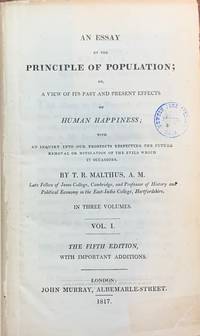
18177080<p><em>An Essay on the Principle of Population or A View of its Past and Present Effects on Human Happiness; With An Inquiry into our Prospects Respecting the Future Removal or Mitigation of the Evils which it Occasions.</em><br /><br />8vo. Modern ½-brown calf leather binding over marbled boards gilt decorated spine with 5 raised bands two black and red gilt lettered morocco labels; new endpapers added. London: Printed for John Murray 1817. <strong>Fifth Edition with Important Additions.</strong> <strong>3 volumes. </strong><br /><br /><em>An Essay on the Principle of Population </em>was first published anonymously in 1798 through J. Johnson London. The author was soon identified as The Reverend Thomas Robert Malthus. In 1803 a second and much enlarged edition was published with the author acknowledged. Later editions were taken from the second edition and there are additional changes throughout the sixth edition. It has been acknowledged as one of the most influential economic works in history. Library stamps on the title pages; some numbers in pencil on the copyright pages; title page of volume 1 worn with a small tape repair; o/w Fine. Rare.</p> Printed for John Murray hardcover
1806ZB1325657London: J. Johnson 1806. Price HAS BEEN REDUCED by 10% until Monday June 29 SALE item 2 vols. xvi 505 58 index vii 559 pp. contemporary full leather bindings now dry and worn a few areas of the spine of the first volume now lacking the leather covering masonic library and private book plate to the front paste down of each volume scant foxing else internally clean and tight. - If you are reading this this item is actually physically in our stock and ready for shipment once ordered. We are not bookjackers. Buyer is responsible for any additional duties taxes or fees required by recipient's country. Photos available upon request. London: J. Johnson hardcover
1853133496London: Simpkin and Marshall 1853. Presentation copy to the editor of The Economist Second edition presentation copy of Malthus's Definitions edited and with a new preface notes and additional remarks by John Cazenove 1788-1879 an intimate friend and protégé of Malthus who described him as "a very clever man and good political economist." Cazenove's writings are "a worthwhile contribution to political economy in their own right and an important part of the anti-Ricardian tradition" New Palgrave. This copy is inscribed on the half-title: "To the Editor of The Economist with Mr Cazenove's Comps." The founder and first editor of The Economist was James Wilson 1805-1860 a businessman economist and Liberal politician who continued as editor until 1857. Octavo. Original green cloth printed paper label to front board yellow coated endpapers. Pencil annotation to one or two pages. Spine ends and corners rubbed joints with short splits to extremities occasional marginal finger marks: a very good copy. Sraffa 3702. hardcover
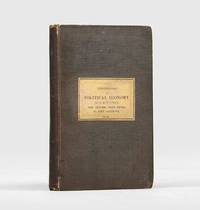
1836ELTinMAL26London: William Pickering 1836. 1836. 8vo. pp. liv 1 leaf 446. untrimmed & partly unopened in original cloth spine dull & frayed at ends label chipped. Second Enlarged Edition of Malthus's chief contribution to general economic theory in which he explains in particular his differences with Ricardo. ".Ricardo's work.started with the Wealth of Nations and recoined the latter's theoretical contents by a method that centered in the concept of value. Exactly the same thing is evidently true of the work of Malthus.Except for his theory of saving and investment which on the face of it seems to be Malthus's own all the elements that enter into the analytic apparatus of that work and even its terminological arrangements point to the First Book of the Wealth of Nations. Only whereas Richardo recoined the doctrine of the Wealth by means of the labor-quantity theory of value Malthus recoined it by the means of the theory of value that A.Smith actually used namely the theory of supply and demand.whereas Ricardo's analytic apparatus is geared to the problem of distribution.Malthus.geared his apparatus to the analysis of the whole economic process.Therefore Malthus should.stand in the history of analysis not only as the author of a valid alternative to Ricardo's theory but as the sponsor or rather as one of the sponsors of the victorious one." Schumpeter This edition enlarged with additions from Malthus's own manuscript was published two years after the author's death and includes William Otter's important Memoir pp. xiii-liv one of the chief original authorities for James Bonar's Malthus and His Work 1886. Einaudi 3681. Goldsmiths' 29340. Kress C.4188. McCulloch p. 18. NCBEL III 1294. Palgrave II p. 677. Schumpeter p. 482-83. Hardcover. London: William Pickering, 1836. Hardcover
180940999Washington City: Roger Chew Weightman 1809. 2 volumes 8vo. 8 1/4 x 5 inches. Vol. 1 xvi 510 xxxiv pp.; Vol. 2 vii 542 pp. Contemporary tree calf skilfully rebacked. Spines gilt ruled forming six compartments lettering pieces in the second compartmenrs<br/> <br/> Provenance: Possibly John Barclay 1749-1824 former Mayor of Philadelphia from 1791 to 1793<br/> <br/> First American edition of a fundamental text of Modern Economics.<br/> <br/> Thomas Robert Malthus was an English economist cleric and scholar influential in the fields of political economy and demography. Malthus came to prominence for his publication of the present work first published in 1798. Between 1798 and 1826 Malthus published six versions of the essay updating each edition to incorporate new material to address criticism and to convey changes in his own perspectives on the subject. Writing in response to Jean-Jacques Rousseau and William Godwin specifically their approaches to the improvement of society Malthus opposed the optimistic view in 18th-century Europe that saw society as improving and in principle as perfectible. Malthus saw population growth as inevitable whenever conditions improved thereby precluding real progress towards a utopian society: "The power of population is indefinitely greater than the power in the earth to produce subsistence for man." Malthus laid the "theoretical foundation of the conventional wisdom that has dominated the debate both scientifically and ideologically on global hunger and famines for almost two centuries" Daoud. He remains a much-debated writer.<br/> <br/> Shaw 17975; Daoud Ade "Robbins and Malthus on scarcity abundance and sufficiency: The missing sociocultural element" in American Journal of Economics and Sociology 69.4: 1206-1229; Harvey David "Population Resources and the Ideology of Science"in Economic Geography 503: 256277. Roger Chew Weightman unknown
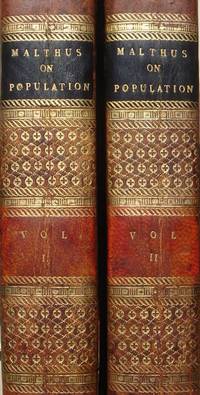
180752022<p>HANDSOME COPY IN CONTEMPORARY BOLDLY SPECKLED CALF<br />2 vols. tall 8vo. iii-xvi 580; iii-viii 484 58 indexpp. contemporary boldly speckled calf smooth spines richly decorated in gilt in panels using two different designs black lettering and russet numbering labels gilt board edges gilt rolled spines a trifle chaffed at headbands some cracking at ends of some joints but overall a very nice copy.<br />Near contemporary pencilled shelf number "D198" of Lord Dunraven of Adare Manor Co. Limerick on endpaper.<br /><br />KRESS B5219<br />This is edition incorporates the substantial revisions and additions which Malthus had made for his third edition of 1806. They are listed and described in full in his preliminary 'Advertisement' to that edition also printed here. The most substantial of the changes made was that "The chapters which were the fourth and sixth of the second book are nearly rewritten on account of an error into which the author had fallen in an attempt to estimate the fruitfulness of marriages and the number born living to be married from the data in registers" 'Advertisement'. Furthermore he added as an appendix here vol.2 p.429-484 his important Reply to the Chief Objections to the second edition of 1803. This appendix he had also published separately in quarto "for the accomodation of the purchasers of the former edition" 'Advertisement'.Malthus recommends that "those who have not the leisure or inclination to read the entire work will find in the appendix such notice of its most prominent arguments as will give them a good general idea of the aim and bent of the whole". In it he writes "My object is to correct some of the misrepresentations which have gone abroad respecting two or three of the most important points of the Essay. . The first grand objection that has been made to my principles is that they contradict the original command of the Creator to increase and multiply and replenish the earth . The next grand objection which has been urged against me is my denial of the right of the poor to support. . and lastly and rather a matter of feeling than of argument. Many persons have accused him of excessive pessimism in throwing a darker shade over our views of human nature and tending particularly to narrow our prospects of future improvement". All of these objections he attempts to refute.<br />From the library of Edwin R. W. Wyndham-Quin Viscount Adare F.R.S. of Adare Manor Co. Limerick.</p> Printed for J. Johnson .. by T. Bensley hardcover
1806156997London: for J. Johnson by T. Bensley 1806. The foundation text of modern demography Third edition the first edition to be published in two octavo volumes the format which was to remain the standard in Malthus's lifetime. This third edition has important alterations and additions particularly the appendix in which Malthus replied to some of his many critics; it follows the first edition of 1798 in a single octavo volume and the expanded second edition in quarto in 1803. Malthus's treatise on population is one of the most important and influential works in the history of economic thought and the foundation text of modern demography. "For today's readers living in a post-Malthus era the world's population problems are well known and serious but no longer sensational. It is difficult therefore to appreciate the radical and controversial impact made by the Essay at the time of publication. It challenged the conventional notion that population growth is an unmixed blessing. It discussed prostitution contraception and other sexual matters. And it gave vivid descriptions of the horrendous consequences of overpopulation and of the brutal means by which populations are checked" ODNB. Despite its unpopularity with liberal critics Malthus's principle of population became accepted as a central tenet of classical political economy and Charles Darwin acknowledged Malthus's influence in the development of his theory of natural selection. 2 vols octavo 209 x 128 mm. Bound without half-titles. Recent half calf red morocco label marbled sides. A few contemporary annotations in vol. II. Repairs to closed tears at head of A7 and A8 into text without loss slight sporadic spotting light dampstaining at lower outer corner of vol. II towards rear. A very good copy. Einaudi 3689; Goldsmiths' 19210; Kress B5067. unknown
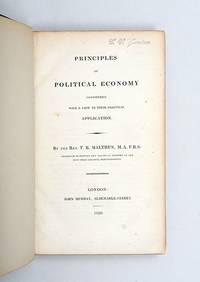
1820158341London: John Murray 1820. From the library of a neo-Malthusian First edition with the stamp on the title page of Carel Victor Gerritsen 1850-1905 the radical Dutch politican who founded the Nieuw-Malthusiaansche Bond Neo-Malthusian League in 1881; like Malthus Gerritsen deemed unchecked population growth the root of society's ills and proposed - unlike Malthus - the use of contraception to restrain it. Principles of Political Economy was conceived as a series of tracts rather than a comprehensive and systematic treatise. Malthus published it to establish his own position against that of Ricardo with whom he had been having an ongoing debate about the nature of labour demand and profit. Unlike Ricardo Malthus supported the active encouragement of demand and in so doing was seen by John Maynard Keynes as a forerunner of his own thought. "Malthus was proposing investment in public work and private luxury as a means of increasing effective demand and hence as a palliative to economic distress. The nation he thought must balance the power to produce and the will to consume" DSB. "The Principles had only a limited impact at the time and was severely criticized by J. R. McCulloch and Ricardo; the latter prepared extensive critical notes. But more recently it has received greater recognition largely as a result of the comments by J. M. Keynes in the 1930s. Keynes argued that Malthus's theory of effective demand provided a scientific explanation of unemployment and that the hundred-year domination of Ricardo over Malthus had been a disaster for the progress of economics. Keynes believed that if economics had followed Malthus instead of being constrained by Ricardo in an artificial groove the world would be a much wiser and richer place" ODNB. Octavo 215 x 132 mm. Recent brown morocco red morocco label marbled endpapers. Neat ink ownership signature to front free endpaper. Sporadic light foxing short closed tear not affecting text at head of L2. A very good copy. Goldsmiths' 22767; Kress C.577. unknown
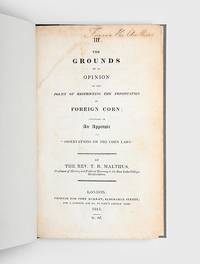
1815172737London: Printed for John Murray and J. Johnson and Co. 1815. Malthusian economics stress-tested First edition presentation copy inscribed in a secretarial hand "From the Author" at the head of the title page. The Grounds of an Opinion is a rare Malthusian argument in favour of economic interventionism supporting the restrictions imposed by the Corn Laws on foreign grain. In his wider work on population and poverty Malthus promoted an essentially laissez-faire approach to political economy. In the Essay on the Principles of Population 1798 for example he rejected poor relief and centralized intervention as fatally detrimental to the work ethic of the poor. The Grounds of an Opinion therefore shocked his circle of Whiggish friends but Malthus justified his deviation on grounds of national security: encouraging domestic production was the only way to ensure self-sufficiency in food within a fickle and changeable continent. Malthus's presentation may have been less effective than he hoped. A leaf of contemporary manuscript notes tipped in after p. 4 records considerable dissatisfaction with Malthus's "most extraordinary assertion". Octavo 208 x 128 mm pp. ii 48; lacking terminal advertisement leaf. Recent brown quarter calf grey paper-covered boards. Infrequent 20th-century pencil annotations to contents. Light foxing vertical tear to title page neatly repaired and upper inner corner replaced: a very good copy. Einaudi 3672; Goldsmiths' 2177; Kress B6535; Mattioli 2214; Sraffa 3690. hardcover
180955964Washington City: Printed and published by Roger Chew Weightman another issue of the same printing was published at Georgetown by J. Milligan 1809. First American from the third London edition. 8vo. 2 volumes: xvi 510 xxxiv; vii 542 pp. Half-title to each volume present. Here Malthus "laid down his famous principle that population increases in a geometrical and subsistence only in an arithmetical ratio and argued that population is necessarily limited by the 'checks' of vice and misery" DNB. PMM 251 for the first edition published London 1798. American Imprints 17975. Recent quarter-calf and marbled boards new leather spine labels. Persistent light foxing but a very good copy in an attractive new binding. 2458. <br/><br/> Printed and published by Roger Chew Weightman (another issue of the same printing was published at Georgetown by J. Milligan) hardcover books
180775775hLondon: Printed for R. Johnson in St. Paul's Church-Yard by T. Bensley Bolt Court Fleet Street 1807. Book. Very Good. Hardcover. 8vo - over 7¾ - 9¾" tall. Two-volume set in full tree-calf with gilt spines. Professionally re-backed with original spines relaid. Moderate handling and bumping to covers. Edges and endpapers toned. Armorial bookplate of Sir Edward Strachey Baronet Sutton Court Somerset inside front covers; early owner's name in ink to free endpapers. Otherwise clean tight and unmarked -- no foxing or staining to text. Very neat -- a sound and handsome set. Half-titles present; extensive index. xvi580viii48460indexpp. Printed for R. Johnson in St. Paul's Church-Yard, by T. Bensley, Bolt Court, Fleet Street Hardcover
1820BB0781London: John Murray Albermarle-Street 1820. First Edition. Paper-covered Boards. First Edition with the rare 4-page publisher's catalog dated April 1820 of this classic of economic theory. 8vo: vi601 1pp. "London: Printed by C. Roworth Bell-yard Temple-bar." on colophon and title-page verso as called for. Uncut in the original publisher's drab blue paper-covered boards largely unopened with brown paper spine and remnants of original printed label. Internally fresh and bright with only occasionally spotting original spine largely perished but restored sensitively by an expert conservationist the boards somewhat stained and bumped but thoroughly original hinges reinforced. Small owner's book label probably contemporary partly effaced reading T Cobb. Clamshell case with leather spine label gilt. An unsophisticated copy of a truly scarce in publisher's binding important and desirable book a cornerstone of economic thought and a major influence on other scientific endeavors including the principles of evolution developed by Charles Darwin and Alfred Russell Wallace. Goldsmiths'-Kress 22767. Kress C577. Lowndes 1459. The title of Malthus's final major work is "something of a misnomer as the book was conceived as a series of tracts rather than a comprehensive and systematic treatise. . . . The Principles had only a limited impact at the time and was severely criticized by J. R. McCulloch and David Ricardo; the latter prepared extensive critical notes. But more recently it has received greater recognition largely as a result of the comments by John Maynard Keynes in the 1930s. Keynes argued that Malthus's theory of effective demand provided a scientific explanation of unemployment and that the hundred-year domination of Ricardo over Malthus had been a disaster for the progress of economics. Keynes believed that if economics had followed Malthus instead of being constrained by Ricardo in an artificial groove the world would be a much wiser and richer place." ODNB N. B. With few exceptions always identified we only stock books in exceptional condition carefully preserved in archival removable mylar sleeves. All orders are packaged with care and posted promptly. Satisfaction guaranteed. Fine Editions Ltd is a member of the Independent Online Booksellers Association and we subscribe to its codes of ethics. John Murray, Albermarle-Street unknown
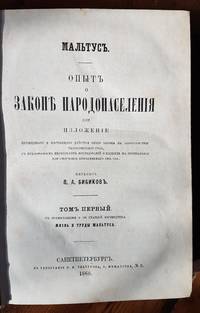
1868178<p><strong>Scarce first Russian edition of a major landmark of economic literature the <em>Essay on the Principle of Population</em></strong> first published in English in 1798.</p><p><strong>With much added material.</strong> The translator P. A. Bibikov was a historian philosopher and literary critic who had already translated Smith's Wealth of Nations in 1866. With this background he added a wealth of material to this edition making it more than just a translation but also an a posteriori analysis. Next to the 80 pages on Malthus' life and works Bibikov added in a rich appendix translations of foreign commentators as well as his own footnotes relating to Russia. Very interestingly he updated and commented the many pages Malthus had already devoted to the Russian case. The appendix includes texts by Townsend Garnier Chernyshevskiy and Prudhon as well as a convenient 20-pp. alphabetical index.</p><p>"The central idea of the essay - and hub of the Malthusian theory - was a simple one. If the natural increase in population occurs the food supply becomes insufficient and the size of the population is checked by 'misery' - that is the poorest sections of the community suffer disease and famine. Malthus recognises two other possible checks to population expansion: first 'vice' - that is homosexuality prostitution and abortion all totally unacceptable to Malthus; and second 'moral restraint' - the voluntary limitation of the product of children by the postponement of marriage." PMM.</p><p>Provenance: Unidentified symbolistic booklabel to upper endpapers; small Baltic bookseller's stamps to lower endpapers.</p><p>Physical description:Two volumes 8vo. 476 pp. incl. half-title title and table of contents at end; 468 pp. incl. table of contents. Later plain brown cloth author titled in ink on the spines.</p><p>Condition:Very occasional light spotting.</p> Glazunov, Skt. Peterburg, hardcover
1809CLL-280Genève, J.-J. Paschoud, 1809 3 tomes en un volume in-8 de XXIII, (1), 424, (6) - (4), 395, (3) - (4), 392 pp., 16 pp. de catalogue d'éditeur, demi-veau havane, dos lisse orné de filets, roulettes et palettes dorés, tranches paille (reliure de l'époque).
1809103515A Paris et à Genève, chez J.J. Pashoud, 1809, in-8, 3 vol. de I : 424-[6] pp. + II: [4]-395-[3] pp. + III : [6]-392-[5] pp, Demi-veau de l'époque, dos lisses filetés ornés en doré de roulettes et fers rocaille, Première traduction française, très augmentée par Pierre Prévost, pour qui l'ouvrage magistral de Malthus "a pour objet principal de diriger la bienveillance, vertu familière". Thomas-Robert Malthus (1766-1834) avec un siècle d'avance annonçait le principe qui sera repris par Keynes, de la demande effective opposée à la loi des débouchés. Publié originellement en anglais de façon anonyme en 1798, cet essai phare de la pensée économique et démographique du XIXe siècle instaure une réflexion sur le rapport entre le développement de la population et celui des subsistances qui amène à la conclusion que ce sont les salaires qui déterminent le chiffre de la population. Le second thème essentiel de la pensée malthusienne est sa critique du système anglais de lois sur les pauvres (Poor Laws) qui, selon lui, amplifie la pauvreté de manière générale. Excellent exemplaire en jolie reliure de l'époque, dos très légèrement frottés, petit accroc en tête d'une coiffe. Couverture rigide

1827122073London: John Murray 1827. First Edition. hardcover. near fine. viii 261pp. 8vo rebound in 3/4 red leather gilt-lettered spine; half-title expertly repaired otherwise fine. London: John Murray 1827. First Edition. Near fine.<br/><br/> A critique of the terms used by French economists Adam Smith Jean-Baptiste Say James Mill David Ricardo J.R. McCulloch and Samuel Bailey followed by the author's classification. Kress C. 1924. NCBEL III 1294. Palgrave II p.677.<br/><br/> John Murray unknown books
1827122073London: John Murray 1827. First Edition. hardcover. near fine. viii 261pp. 8vo rebound in 3/4 red leather gilt-lettered spine; half-title expertly repaired otherwise fine. London: John Murray 1827. First Edition. Near fine.<br/> <br/> A critique of the terms used by French economists Adam Smith Jean-Baptiste Say James Mill David Ricardo J.R. McCulloch and Samuel Bailey followed by the author's classification. Kress C. 1924. NCBEL III 1294. Palgrave II p.677.<br/> <br/> John Murray unknown
1817157003London: John Murray 1817. The foundation text of modern demography Fourth edition of Malthus's Essay first published in 1798 one of the most important and influential works in the history of economic thought and the foundation text of modern demography. 2 vols octavo 203 x 126 mm. With half-titles. Contemporary calf spines lettered in gilt. Contemporary ownership signature to title pages bookplate of one C. W. Clementine dated 1901 to front pastedowns. Slight scratch to rear cover of vol. I endpapers toned and a little soiled slight worming in fore margin of vol. II not affecting text an excellent copy in a well-preserved contemporary binding. unknown
18208125London: John Murray 1820. 1820 vi 601 1 p. First edition. It has a good quality mid-twentieth century binding with a polished morocco spine marbled boards and vellum corners. The spine with gold lines and a contrasting label. Minor rubs to the spine ends otherwise in very good condition. There is an undated pencil note on the title page '£45 Repair'. The text with a few signs of use and some pale paper toning. IMPORTANT COOPERATIVE MOVEMENT PROVENANCE: The title page is inscribed at the head 'Society for promoting Working Men's Assocns / 34 Castle Place -- Oxford Street with a shelfmark R31'. The Society was founded in 1849 by the Christian Socialists in an attempt to found self governing workshops. Lower down the title page is the oval stamp of Ormond Street Working Mens College which still exists in Camden. Founded in 1854 by Frederick Denison Maurice Wiki describes it as 'The Working Men's College is among the earliest adult education institutions established in the United Kingdom and Europe's oldest extant centre for adult education. Founded by Christian socialists at its inception it was at the forefront of liberal education philosophy.' At different times its teachers included Thomas Hughes whose latin lectures were apparently not so popular as his boxing club F.J. Furnival and E.M. Forster. London: John Murray, hardcover
1820242928London: John Murray 1820. First edition. vi 601 pp. 1 vols. 8vo 219 x 132 mm. Bound in later half cloth and marbled boards paper label. Very good. First edition. vi 601 pp. 1 vols. 8vo 219 x 132 mm. First edition of this important classic of economic theory. "There can be no doubt that Malthus' importance for economists today rests mainly on his Principles of Political Economy. It was because of this latter work that J. M. Keynes 1933 reinstated Malthus as a major figure in modern economic thought" New Palgrave. "One of the founders of modern economics" Malthus was credited by Keynes with framing the theory "that a lack of effective demand can cause economic crises" PMM 251. "In his Principles of Political Economy Malthus was proposing investment in public works and private luxury as a means of increasing effective demand and hence as a palliative to economic distress. The nation he thought must balance the power to produce and the will to consume" DSB IX:70. Goldsmith 22767; Lowndes 1459; Kress C577 John Murray unknown books
180993446Paris: J. J. Paschoud 1809. The most influential work of its era on population in a contemporary binding First French edition translated by Pierre Prévost. First published in English in 1798 it was perhaps the most influential work of its era on population arguing that the growth of a population would always outrun its ability to feed itself. The first edition was so successful that Malthus soon elaborated on it under his real name culminating in the sixth edition of 1826 which was a scholarly expansion of the first. A political economist who occupies a hallowed place in the history of biology Malthus was acknowledged by both Charles Darwin and Alfred Russel Wallace as a key influence in developing the theory of natural selection. 3 vols octavo. Contemporary quarter calf marbled boards brown morocco labels spines lettered in gilt with gilt and black motifs edges uncut. Board edges slightly faded and a little scuffed joints tender tips bumped and lightly rubbed. A very good set. Carpenter XXXII 7; Kress B.5591. hardcover