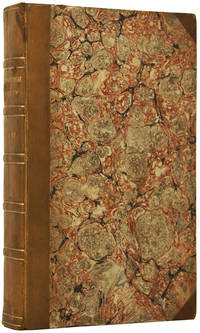
Malthus, DanielBiblio.com

443 résultats
17163115621716. 4 pp. Small splits at old folds old reinforcement to center fold very good. 4 pp. The bill of one John Boundy as issued by Daniel Malthus 1651-1717 apothecary to Queen Anne and George I and great-grandfather of the economist Thomas Robert Malthus. Items charged include various juleps cordials and draughts linseed oil chamomile flowers marshmallow leaves purging potions King's drops quieting powders etc. Attested paid to estate of Mr. Malthus at end by Tho. Graham and docketed paid £58 July 10 1718. With 4 small circular stamps with the motto of the Earl of Fortescue "Forte Scutum Salus Ducum" "A Strong Shield is the Salvation of Leaders" unknown
1821040304Boston MA: Wells and Lilly 1821. Book. Very Good. Full-Leather. First American Edition. 8vo - over 7¾" - 9¾" tall. Original full tree calf gilt on burgundy title label mounted on upper spine. Rubbed along edges some surface cracking/crazing rubbed joints and spine extremities. Foxed endpapers some toning and scattered foxing to interior but otherwise intact with firm binding. Former owner's signature on front flyleaf. viii472 pp. Exceptionally scarce first American edition issued a year after the first British edition of 1820. Wells and Lilly Hardcover
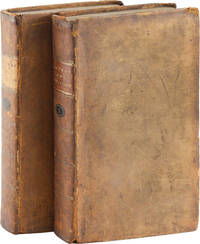
180755024London: Printed for J. Johnson in St Paul's Church-Yard by T. Bensley 1807. Fourth edition. Octavo 22cm in two volumes. In contemporary brown calf seven sets of double gilt rules to spine titled in gilt on red leather spine label numbered on black leather spine labels blind tool to board edges all edges sprinkled grey; plain endpapers; vol. I: i-xvi 1-580pp; vol. II: i-viii 1-484 60pp. Sturdy copies much rubbed vol. I slightly cocked lower front joint of vol. I and upper front joint of vol. II cracking vol. II lacking spine label scratch to upper board of vol. II endleaves and some prelims foxed but otherwise internally free from soil: Good or better. <br /> <br /> The fourth edition of Malthus' widely influential discussion of overpopulation. Malthus 1766-1834 argued that population "increases geometrically while food supplies increase only arithmetically" and that some misery was inevitable unless population growth could be restrained. He proposed "moral restraint" as a solution. Many of his theories have now been largely rejected but "the Essay was highly influential in the progress of thought in early nineteenth-century Europe" and "his influence on social policy whether for good or evil was considerable." The first edition was shorter; "later editions were considerably altered and grew bulkier as Malthus defended his views against a host of critics" Printing and the Mind of Man. KRESS B.5219. GOLDSMITHS 19373. PMM 251 1st edn. Printed for J. Johnson in St Paul's Church-Yard, by T. Bensley unknown
1806236862London: Printed for T. Johnson 1806. Third edition. xvi 505 1 blank 60 index pp.; vii 1 blank 559 1 pp. 2 vols. 8vo. Contemporary three-quarter calf; joints cracked two boards detached; rubbed and scuffed; scattered foxing throughout; withal a good serviceable copy. Third edition. xvi 505 1 blank 60 index pp.; vii 1 blank 559 1 pp. 2 vols. 8vo. GERITS: Third edition the first to be published in 2 volumes and the first published after the Great Quarto edition of 1803 of one of the most important and influential books in the history of economic thought. The third edition contained numerous revisions among which was a text entitled A Reply to the Chief Objections which have been urged against the Essay on the Principle of Population which was also published separately so that it might be bound with earlier ones. Kress B.5067; Goldsmiths 19210; Einaudi 3669; Carpenter Economic Bestsellers XXXII 3; PMM 251 for the first edition; Blaug Great Economists before Keynes p. 141ff Printed for T. Johnson unknown
PJH55320J. P. Aillaud Paris 1820. VG bright set in contemporary slightly worn and scuffed calf bindings with red and black title labels to each spine. 501 452pp. 1st French Edition published same year as the English Edition. Two Volumes. From the collection of Professor Malcolm Deas 1941-2023 an Emeritus Fellow of St Antony's College Oxford and University Lecturer in the Government and Politics of Latin America 1966-2008 J. P. Aillaud (Paris) 1820 unknown
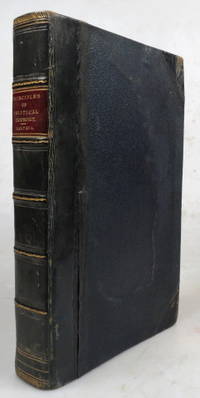
182046619London: John Murray 1820. First edition 8vo vi 601 1 pp. Contemporary black half calf a little rubbed covers very slightly damp stained and bowed gilt spine and red label. "The Principles had only a limited impact at the time. more recently it has received greater recognition largely as a result of the comments by J. M. Keynes in the 1930s. Keynes argued that Malthus's theory of effective demand provided a scientific explanation of unemployment and that the hundred-year domination of Ricardo over Malthus had been a disaster for the progress of economics. Keynes believed that if economics had followed Malthus instead of being constrained by Ricardo in an artificial groove the world would be a much wiser and richer place." ODNB. Goldsmiths 22767. Kress C577. London: John Murray unknown
1820002253London England: John Murray 1820. 1st Edition . Half-Leather. Fair. Contemporary calf with hand marbled covers; leather spine dry flaking and rubbed with small piece missing and gold stamped title barely visiible; covers detached; front paste down with previous owner's book plate and name neatly in black ink; foxing throughout text otherwise very good without markings; 8vo; with 601 pages. <br/> <br/> John Murray hardcover
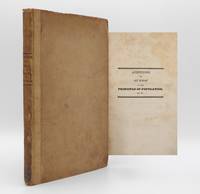
1831376545Georgetown D. C.: Published by Charles Cruikshank Rind's Press 1831. First American edition first published in London in 1817. 8vo. Original cloth backed tan boards printed paper label reading "Additions / to an / Essay /on / Population / by T.B. Malthus" uncut partially unopened. Some spotting and browning of binding rubbing with some wear to extremities some foxing and spotting of leaves insect trail along lower inner hinge marginal tears on R4 and Cc4 not affecting text. A very good copy in brown cloth clamshell box with leather spine label. First American edition first published in London in 1817. 8vo. Very scarce. This work contains new chapters additions and corrections included in the fifth edition separately published with a new title page and pagination for those who already had the earlier editions. <br /> <br /> The Contents leaf lists: Book II Chapters I Checks to Population in France and VII Checks to Population in England; Book III Chapters II Of Systems of Equality IV Of Emigration VI Of Poor Laws VIII-XIV the Agricultural and Commercial Systems Corn Laws Exportation and Importation and "Of increasing Wealth as it affects the Condition of the Poor; Book IV Chapters VI "Effects of the Knowledge of the Principal Cause of Poverty on Civil Liberty" XII "Different Plans of Improving the Condition of the Poor considered" and the Appendix. There are new chapters on the Poor and Corn Laws. A revised chapter on rent and especially the change in Chapter III which formely dealt with Godwin and his "Systems of Equality" now relate to Robert Owen his Utopian systems and his "New View of Society". <br /> <br /> In 1817 at the height of his success Robert Owen addressed the House of Commons speaking on his methods and ideas. Owen had disagreed with Malthus' theories of population. In 1824 Owen had come to America and purchased what became New Harmony a communal society experiment. It was not successful and Owen returned to England in 1828. The Appendix contains Malthus' responses to the publication of Principles of Population and Production by Mr. Wayland and An Inquiry into the Principle of Population by James Grahame. Each chapter notes where the additions should be placed referring to the English edition of 1807 and American edition of 1809. Goldsmiths' Kress Library 26723.2; Kress C2883; Kress B6973 Goldsmiths' 21762 Einaudi 3664 last three for London ed. Published by Charles Cruikshank, Rind's Press unknown
181539958London: Printed for John Murray 1815. Third edition. 47 1 pp. 1 vols. 8vo. Disbound with paper strip on spine pale dampstain to upper margin throughout not affecting text. Third edition. 47 1 pp. 1 vols. 8vo. Kress B 6539; Goldsmith 21179 Printed for John Murray unknown
198952510130017Cambridge University Press 1989. First Edition. Hardcover. New. HARDCOVERS. 2 VOLUME SET. Unused unmarked and unblemished copies. 1ST PRINTING 1989. Covers are brown cloth boards with gilt lettering inside burgundy circle.; 100% Satisfaction Guaranteed! Ships same or next business day! Cambridge University Press hardcover
1997x-0714647500Frank Cass & Co 1997. Hardcover. New. 1st edition. 151 pages. 9.75x6.50x0.75 inches. Frank Cass & Co hardcover
180950942Georgetown J. Milligan 1809. First American edition. Hardcover. Index at the end of the first volume. The signatures of three early owners of the book appear on the endpapers. Both volumes are internally complete and firm but the backstrips of both volumes are perished and the covers of volume one are loose while the front cover of volume two is detached and the back cover is missing. Both volumes have major damp stains: in volume one it affects the bottom inside quadrant of the page of the first third of the book while in volume two it affects the outside edge of the last quarter of the book. . Two volumes separately paged. A binding copy of the first American edition of a landmark book in the history of social thought. Georgetown, J. Milligan hardcover
181751078London John Murray 1817. 8vo. Bound in three nice uniform contemporary half calf with five raised bands and gilt lettering to spine. Spines with wear. Front board and spine detached from book-block on volume 1. Ex-libris pasted on to pasted down front free end-paper on all three volumes. A fine set. <br/><br/><em>The fifth edition of this political and economic classic which constitutes Malthus' first major publication and his main work because of which he is considered the father of demography and one of the main sources of inspiration for Darwin and Wallace.This present fifth edition contain several important additions price of grain and the third chapter of Book III was completely rewritten. The book then as now is considered highly controversial and it has influenced all demographers ever since as well as being of immense importance to the study of economic theory and genetic inheritance. "The "Essay" was highly influential in the progress of thought in the early nineteenth-century Europe. "Parson" Malthus as Cobbett dubbed him was for many a monster and his views were often grossly misinterpreted. But his influence on social policy whether for good or evil was considerable. The Malthusian theory of population came at the right time to harden the existing feeling against the Poor Laws and Malthus was a leading spirit behind the Poor Law Amendment Act of 1834." PMM 251.Thomas Robert Malthus 1766-1834 called the "enfant terrible" of the economists was an English demographer statistician and political economist who is best known for his groundbreaking views on population growth presented in his "Essays on the Principle of Population" which is based on his own prediction that population would outrun food supply causing poverty and starvation. Among other things this caused the legislation which lowered the population of the poor in England. Malthus actually turned political economic and social thought upside down with this work which has caused him to be considered one of the 100 most influential persons in history Hart The 100: A Ranking of the most Influential Persons in History 1978. Of course he was condemned by Marx and Engels and opposed by the socialists universally but the work was of immense impact on not only politics economics social sciences etc but also on natural sciences. "Later in the "Origin of Species" he Darwin wrote that the struggle for existence "is the doctrine of Malthus applied with manifold force to the whole animal and vegetable kingdoms; for in this case there can be no artificial increase of food and no prudential restraint from marriage" p. 63. Alfred Russel Wallace who arrived at a worked-out formulation of the theory of evolution at almost precisely the same time as Darwin acknowledged that "perhaps the most important book I read was Malthus's "Principles of Population" My Life p. 232. Although there were four decennial censuses before Malthus' death he did not himself analyze the data although he did influence Lambert Quetelet and Pierre Verhulst who made precise statistical studies on growth of populations in developed countries and showed how the early exponential growth changed to an S curve." DSB IX p. 69. As Malthus realized that his theories were not satisfactorily presented or sufficiently demonstrated in the first edition from 1798 he travelled for three years through Europe gleaning statistics and then published the second edition in 1803. Among other places he travelled through Northern Germany and his detailed diaries of these journeys provided him with some of the evidence necessary for the development of his theory on population growth. The observational information that he gathered on his travels in Europe were crucial to the development of his theories which also means that the work is of great interest for other European countries and not only Britain. "In 1819 the Royal Society elected Malthus to a fellowship. He was also a member of the French Institute and the Berlin Academy and a founding member of the Statistical Society 1834." DSB IX p. 67. Printing and the Mind of Man 251 first edition. Einaudi 3670Mattioli 2210Goldsmith 21761Kress B6974 </em> hardcover
18265784691John Murray 1826. Volume 1. This is an ex-library book and may have the usual library/used-book markings inside.This book has hardback covers. In good all round condition. Sixth edition. Medium 8vo with marbled boards and black leather half binding. Raised bands gilt lettering and gilt borders on backstrip. Bumped corners and some minor chipping and general wear. Interior is secure clean and clear save for some foxing. Trimmed. Please note the Image in this listing is a stock photo and may not match the covers of the actual item850grams ISBN: John Murray hardcover
49070Edinburgh: Archibald Constable and Company 1815. CONTEMPORARY REVIEWS. Octavo pp.8 560 2. In contemporary tan half calf with raised bands gilt titles to spine and marbled boards. All edges flecked blue / grey. Some light edge wear; a few marks to spine. Very good indeed. Works reviewed include Wordsworth's 'The Excursion'; 'Publications concerning the Revival of the Slave Trade'; James Hogg's 'The Queen's Wake'; Scott's 'Waverley' and 'The Lord of the Isles'; Lewis and Clarke's 'Travels to the Source of the Missouri River'; Mungo Park's 'The Journal of a Mission to the Interior of Africa'; and Thomas Malthus' 'Observations on the Effects of the Corn Laws' and 'The Grounds of an Opinion on the Policy of Restricting the Importation of Foreign Corn'. Edinburgh: Archibald Constable and Company, 1815 unknown
1809191317Georgetown: J. Milligan 1809. 1st American Edition. Hardcover. Fair missing covers leather spine heavily worn pages have foxing spots binding split and several pages loose but all appear to be present with minor tears here and there Sold as a reading copy or binding set WAF. Missing covers and worn leather spine. Vol. 1: XVI 510 XXXIV pp. Vol. 2: vii 1 542 pp. This is the first American edition. Volumes 1 2 of a 2 volume set. Includes index. Scarce and worthy of rebinding. J. Milligan hardcover
1815BOOKS062718ILondon: John Murray 1815. HC. very good bound in maroon buckram cloth hardcover SEE NOTE. . AND GENERAL WEALTH OF THE COUNTRY. An exceptionally nice original copy of the Third Edition however in the right margin there is a pinhole not affecting text through the pages. 48pp. John Murray unknown
1995331885Norwalk Connecticut: Easton Press 1995. First Edition; First Printing. Hardcover. Near Fine Leather Bound. Printed on archival paper with gilded edges. The endsheets are of moire fabric with a silk ribbon page marker. Smyth sewing and concealed muslin joints to ensure the highest quality binding. This book is in full leather with hubbed spines.; Collector's Edition. Easton Press hardcover
19070His Majesty's Receipt of Exchequer London. 9 February no year . 1p. 8vo. In poor condition aged and worn with loss to edges and holing around the signature. Begins with manuscript text in square brackets: 'The -9 Day of ffebry <.> Received by me Daniel Malthus Execd as P Margin Of the Right Honourable Robert Earl of Northampton One of the Four Tellers of His Majesty's Receipt of Exchequer the Sum of Fifty Pounds .'. The annuity has been raised on 'Rates and Duties upon all Wines imported into Great Britain and for raising a certain Sum of Money for the Service of the year 1745'. According to T. R. Malthus's entry in the Oxford DNB his father 'being an only son of seven children appears to have inherited considerable wealth and property and these independent means enabled him to travel and to cultivate his literary artistic theatrical and scientific interests. He entered Queen's College Oxford in 1747 but did not graduate. He was an admirer of Rousseau who once visited The Rookery when Malthus was an infant. He was said to have published some literary pieces anonymously but the statement by an obituarist that he had translated works from French and German was firmly contradicted by Malthus. He supported the views of the marquis de Condorcet and William Godwin on the perfectibility of mankind but also encouraged his son's publication of opposing views. Aspects of his behaviour—for example the unconventional education he chose for Malthus and his refusal to allow his wife to wear her wedding ring—were regarded as eccentric and perhaps show the influence of Rousseau. He married on 6 May 1752 Henrietta Catherine Graham 1733–1800 his second cousin the daughter of Daniel Graham 1695–1778 apothecary to George II and George III. She can be seen as a young girl with her brother and two sisters in Hogarth's painting The Graham Children 1742 now in the National Gallery London. Malthus was the sixth of their seven children two boys and five girls. His Majesty's Receipt of Exchequer, London. 9 February [ no year ]. unknown
1995183217Norwalk Connecticut: Easton Press 1995. First Edition; First Printing. Hardcover. Near Fine Leather Bound. Book accented in 22kt gold. Printed on archival paper with gilded edges. The endsheets are of moire fabric with a silk ribbon page marker. Smyth sewing and concealed muslin joints to ensure the highest quality binding. This book is in full leather with hubbed spines. Faint spotting on side text block gilt. ; First Easton Press Edition.; 8vo 8" - 9" tall. Easton Press hardcover
199596838Norwalk Connecticut: Easton Press 1995. First Edition; First Printing. Hardcover. Fine Leather Bound. Book accented in 22kt gold. Printed on archival paper with gilded edges. The endsheets are of moire fabric with a silk ribbon page marker. Smyth sewing and concealed muslin joints to ensure the highest quality binding. This book is in full leather with hubbed spines. ; First Easton Press Edition.; 8vo 8" - 9" tall. Easton Press hardcover
19892080502106913526Not Available 1989. Soft Cover. Fine. The book is in fine condition. Not Available paperback
1990mon0000369194Cambridge University Press 23/02/1990 00:00:01. paperback. Very Good. HARDBACK 2 Vol set. Cambridge University Press paperback
181771430<p> Volume I xvi 496 pages. Volume II iv 507 pages. Volume III iv 500 pages.</p> Published by John Murray hardcover
189311039Torino: Ermanno Loescher 1893. 1893. Good. - Small quarto 9-5/8 inches high by 6-3/4 inches wide rebound without original wraps in dark green cloth titled in gilt with decorations in gilt on the spine. The covers are slightly warped & the binding is bumped & rubbed affecting the titling. The head of the spine is chipped & frayed. 167 pages plus errata/corrigenda page. The pastedowns & endpapers are darkened & there is scattered foxing & light staining. Good. <p>First edition. The text is in Italian.<p>The book is inscribed by the author but the inscription & signature have been partially cut off in rebinding.<p>"This interesting work proposes to examine by the light of scientific criticism the theory of Malthus and the principal objections that have been brought against it. The author turns his attention first to pointing out the irrefutability of the biological tendency as Malthus has shown it and the necessity which devolves upon political economy to recognize it as a fundamental law. Lebrecht does not ignore the objections raised by various writers against this tendency; on the contrary he estimates them with praiseworthy impartiality; yet after careful examination he believes that they are not destructive of the theory.He does not deny that the coefficient of procreation is essentially economic and that poverty is one of its potent factors; yet he affirms that the prolific action of poverty can be remedied by moral influences. From a review of the book by Achille Loria and Cornelia H. B. Rogers in "Annals of the American Academy of Political and Social Science Vol. 4 May 1894 p. 134.<p>Rare. Torino: Ermanno Loescher, 1893. paperback