Malthus, Thomas RobertBiblio.com
542 résultats
2007x-1602068623Cosimo Inc 2007. Hardcover. New. 324 pages. 8.60x5.60x1.20 inches. Cosimo Inc hardcover
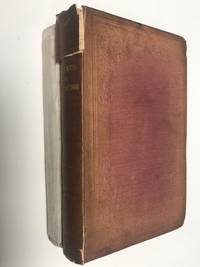
1826015875London: John Murray 1826 Book. Fair. Hardcover. 5th or later Edition. 1826 Sixth edition 2 volume set published 1826 The final revised text Good/Reasonable Condition: see notes Vol I: xviii 535pp. Vol 2: iv 528pp CONDITION Set Needs Rebinding Vol I Original Buckram Top of Spine is Loose; see photo Contents tight and clean Viol II No Binding Slight Browning on Title-Page Pencil Scribbles on the back of the last flyleaf Contents tight and clean. John Murray hardcover
2008SKU0635060Oxford University Press 2008-08-01. paperback. New. 7x5x0. New Textbook Ships with Tracking Oxford University Press paperback
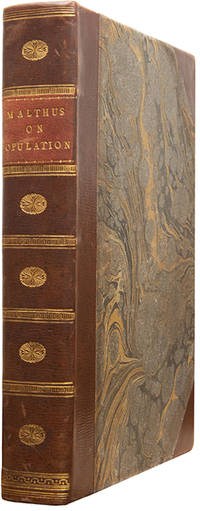
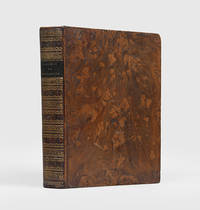
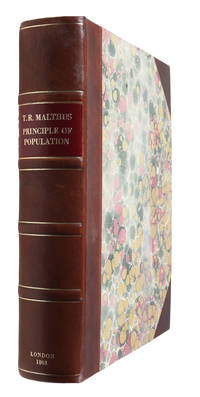
112135London T. Bensley for J. Johnson 1803. . Second edition substantially revised; 4to 27.5 x 22 cm; a few pencil annotations C4 cancelled and signed C3 title neatly tipped on to following leaf small chip lower edge b2 occasional spotting; modern half brown morocco gilt spine in 6 compartments contrasting red morocco lettering-piece very good; viii 4 610pp.<br /> The second edition substantially revised and in essence a 'new work' in which Malthus defends his views against a host of critics Preface.<br /><br />'The central idea of the essay and the hub of Malthusian theory was a simple one. The population of a community Malthus suggested increases geometrically while food supplies increased only arithmetically. If the natural increase in population occurs the food supply becomes insufficient and the size of the population is checked by 'misery' that is the poorest sections of the community suffer disease and famine. The Essay was highly influential in the progress of thought in early nineteenth-century Europe' PMM.<br /><br />In this enlarged edition Malthus made clear what was only implicit in the first that prudential restraint should if humanly possible be 'moral restraint' that is delayed marriage accompanied by strictly moral pre-marital behaviour although he admitted that moral restraint would not be easy and that there would be occasional failures. Whereas in the first edition he had said that all the checks to population would involve either misery or vice in the second edition he attempted to lighten this 'melancholy hue' first edition p.iv and 'to soften some of the harshest conclusions of the first essay' second edition p.vii by arguing that moral restraint if supported by an education emphasising the immorality of bringing children into the world without the means of supporting them would tend to increase rather than diminish individual happiness.<br /><br />'His work was an important influence on both Darwin and Wallace in their formulation of the concept of natural selection. It also had a profound influence on the decrease in size of families down to the present time' Garrison-Morton.<br /> Cf.PMM 251; Garrison-Morton 1693; Goldsmiths 18640; Kress B.4701. London, T. Bensley for J. Johnson, 1803. unknown
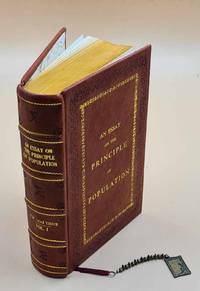
2022BIBSD0138182972022. Full Leather Bound. NEW. Size: 14.60 x 22.86 cms A Unique Premium Leather-Bound book for elite readers/collectors of old rare books. An Original Leather is being used for binding this book with Golden Leaf Printing and designing on Spine front and Back of the book with edge gilding. WE HAVE MULTIPLE OPTIONS IN COLOR OF LEATHER RED GREEN BLUE MAGENTA TAN PURPLE DEEP BROWN BLACK AND WITH DIFFERENT COLOR LABELS. YOU MAY CHOOSE ANY COLOR OF YOUR CHOICE AND MAIL US. This service is chargeable. Original edition was published in 1806 and this unique edition is Reprinted in 2022 with the help of original edition. Black & white printing on high quality natural shade paper with sewing binding for longer life professionally processed without changing its contents. As these are old books we processed each page manually on computer and make them readable. We give our best to give you the best book but in some cases we have to adjust few pages which are blur or missing or black spots. We hope that you understand these issues in these old treasure. This is an important book for the readers who want to know more about our old treasure. Our dedicated team is trying to bring these rare books back to the shelves. We are also giving service of printing the hard-to-find books which are not listed in our store. Hope you will like it and give your comments and suggestions. Lang: - English Vol: - Volume 1 Pages 584. Product Disclaimer: Please be aware that because leather is a natural material slight discoloration or change in texture may be visible. FOLIO EDITION Size 12x19 Inches IS ALSO AVAILABLE ON REQUEST. Please Note - Text Dark and Text Light hardcover
45409494like new. unknown
5705272-nnew. unknown
45565278like new. unknown
elala6131Washington City: Roger Chew Weightman 1809. First American Edition based on the revised and enlarged third London edition of 1806 of one of the most important and influential works in the history of economic and social thought. “’Malthus’s law’ that population increases at a greater rate than the means of subsistence was one of the first and is still one of the most widely debated of modern economic theories. The work aroused a storm of controversy since Malthus held that checks on the growth of population would be necessary a theory which is still not finally extinguished. Malthus has exercised a strong influence not merely in economics but in the whole realm of social theory.†PMM Goldsmiths’ 19819. Kress B.5542. Palgrave II pp. 668-677. Shaw & Shoemaker 17975. cfNCBEL III 1294. cfGarrison & Morton 1693. cfPrinting and the Mind of Man. 251. 2 Volumes. 8vo. pp. xvi 510 xxxivindex; vii 1 542. complete with half-titles. contemporary tree calf rebacked several small library rubberstamps some foxing & browning throughout as usual – more extensive on outer leaves. elala6131 Washington City: Roger Chew Weightman, 1809 unknown
1022934678.Ghardcover. Good. Access codes and supplements are not guaranteed with used items. May be an ex-library book. hardcover
50152869like new. unknown
20191-3337756328hansebooks 2019. Paperback. New. 8.46x5.98x1.06 inches. hansebooks paperback
46332563like new. unknown
1803182784London: printed for J. Johnson by T. Bensley 1803. Malthus softens his conclusions The Great Quarto edition notionally the second edition following the first of 1798 but so substantially enlarged rewritten and re-titled as to be effectively a new book. The Essay was one of the most influential works in the history of economic thought arguing the link between food supply and population size and the inevitability of famine and suffering once population exceeded its limits. "For today's readers living in a post-Malthus era the world's population problems are well known and serious but no longer sensational. It is difficult therefore to appreciate the radical and controversial impact made by the Essay at the time of publication. It challenged the conventional notion that population growth is an unmixed blessing. It discussed prostitution contraception and other sexual matters. And it gave vivid descriptions of the horrendous consequences of overpopulation and of the brutal means by which populations are checked" ODNB. In the second edition Malthus "made clear what was only implicit in the first that prudential restraint should if humanly possible be 'moral restraint' - that is delayed marriage accompanied by strictly moral pre-marital behaviour although he admitted that moral restraint would not be easy and that there would be occasional failures. Whereas in the first edition he had said that all the checks to population would involve either misery or vice in the second edition he attempted to lighten this 'melancholy hue' and 'to soften some of the harshest conclusions of the first essay' by arguing that moral restraint if supported by an education emphasizing the immorality of bringing children into the world without the means of supporting them would tend to increase rather than diminish individual happiness" ODNB. Quarto 269 x 205 mm pp. viii 4 610. Contemporary tree calf rebacked and recornered with original spine laid down spine gilt in compartments with black morocco label. Twentieth-century bookplate of Virginia bibliophile and historian Christopher Clark Geest. Scattered light foxing else a very good copy. Einaudi 3668; Goldsmiths' 18640; Kress B.4701. unknown
1990mon0000369194Cambridge University Press 23/02/1990 00:00:01. paperback. Very Good. HARDBACK 2 Vol set. Cambridge University Press paperback
18265784691John Murray 1826. Volume 1. This is an ex-library book and may have the usual library/used-book markings inside.This book has hardback covers. In good all round condition. Sixth edition. Medium 8vo with marbled boards and black leather half binding. Raised bands gilt lettering and gilt borders on backstrip. Bumped corners and some minor chipping and general wear. Interior is secure clean and clear save for some foxing. Trimmed. Please note the Image in this listing is a stock photo and may not match the covers of the actual item850grams ISBN: John Murray hardcover
180362792London Printed for J. Johnson by T. Bensley 1803. Large 4to. Later brown hcalf with four raised bands single gilt lines and red leather title-label to spine. First three and last 14 leaves a bit brownspotted title-page and last two leaves marginally repaired at hinge otherwise a very nice clean and solid copy. VIII 4 610 pp. <br/><br/><em>The Great Quarto-edition of Malthus' milestone work the first and most influential book on population. Although being the second edition after the anonymously printed first of 1798 it is so significantly altered revised and expanded that it is considered a new work rather than a new edition. Malthus himself also thought of it as such. It is nearly four times the length of the 1798 essay the title has been changed the title of the first: "An Essay on the Principle of Population as it Affects the Future Improvement of Society with Remarks on the Speculation of Mr. Godwin M. Condorcet and Other Writers" and it is published with Mathus' name as the author not anonymously. All later editions were minor revisions of this heavily expanded and altered second one. "In the course of this inquiry I found that much more had been done than I had been aware of when I first published the essay. The poverty and misery arising from a too rapid increase of population had been distinctly seen and the most violent remedies proposed so long ago as the times of Plato and Aristotle. And of late years the subject had been treated in such a manner by some of the French economists occasionally by Montesquieu and among our own writers by Dr. Franklin Sir James Steuart Mr. Arthur Young and Mr. Townsend as to create a natural surprise that it had not excited more of the publick attention" Preface to the second edition p. IV. The controversial views because of which the work became so influential are most provocative and eyeopening in the second edition in which Malthus for instance for the first time advocates moral restraint meaning sexual abstinence and late marriage and elaborately explains his comparison between the increase of population and food. "The "Essay" was highly influential in the progress of thought in the early nineteenth-century Europe. "Parson" Malthus as Cobbett dubbed him was for many a monster and his views were often grossly misinterpreted. But his influence on social policy whether for good or evil was considerable. The Malthusian theory of population came at the right time to harden the existing feeling against the Poor Laws and Malthus was a leading spirit behind the Poor Law Amendment Act of 1834." PMM 251. Thomas Robert Malthus 1766-1834 called the "enfant terrible" of the economists was an English demographer statistician and political economist who is best known for his groundbreaking views on population growth presented in his "Essays on the Principle of Population" which is based on his own prediction that population would outrun food supply causing poverty and starvation. Among other things this caused the legislation which lowered the population of the poor in England. Malthus actually turned political economic and social thought upside down with this work which has caused him to be considered one of the 100 most influential persons in history Hart The 100: A Ranking of the most Influential Persons in History 1978. Malthus was naturally condemned by Marx and Engels and opposed by the socialists universally but the work had an enormous impact on not only politics economics and social sciences but also on natural sciences. For instance both Darwin and Wallace considered Malthus a main source in their development of the theory of natural selection considering him a great philosopher and his Essay on Population one of the most important books ever. "Malthus’s idea of man’s "Struggle for existence" had decisive influence on Charles Darwin and the theory of evolution. Other scientists related this idea to plants and animals which helped to define a piece of the evolutionary puzzle. This struggle for existence of all creatures is the catalyst by which natural selection produces the "survival of the fittest". Thanks to Malthus Darwin recognised the significance of intraspecies competition between populations of the same species e.g. the lamb and the lamb not just interspecies competition between species e.g. the lion and the lamb. Malthusian population thinking also explained how an incipient species could become a full-blown species in a very short timeframe." The second edition must be considered the most important of all the editions. This is far more a work on the problems of over-population than it is a response to Godwin and Condorcet on their works whic is the main concern of the first edition. "Not so much shocked by his own conclusions in his "Essay on Population" first ed. 1798 as driven by a naturally inquiring mind he travelled for three years through Europe gleaning statistics and then published a second edition 1803." Catlin A History of the Political Philosophers 1939 p. 377. PMM 251 first edition. </em> hardcover
1116833352.Gpaperback. Good. Access codes and supplements are not guaranteed with used items. May be an ex-library book. paperback
1807AQ28409London: Printed for J. Johnson.by T. Bensley 1807. In two volumes. xvi 580; vii 484pp 60. With half-titles. Contemporary gilt-ruled half-calf marbled paper boards contrasting green and tan calf lettering-pieces marbled edges. Lightly rubbed corners exposed. Hinges exposed later inked ownership inscription of Arthur Johnson to recto of front blank fly-leaf of Vol. I very occasional light spotting. The fourth edition greatly extended from the anonymous first of 1798 of this cornerstone of early studies of demography and an influential work in the history of political economy. Contrary to the prevailing Whig theory of history English cleric and scholar Thomas Robert Malthus 1766-1834 argued that the agricultural output of modern Britain would not be able to support the rapid population growth witnessed in the eighteenth-century and thus that society would return to earlier subsistence levels following catastrophic outbreaks of disease and famine. The second edition of 1803 was substantially revised and extended to include observations made from European data and most notably the recognition that human agency and especially moral restraint could alleviate the plight of the poorest elements of society. The third edition of 1806 added an appendix in which Malthus replied to his many contemporary critics. This fourth edition incorporates all of the previous revisions and additions. Provenance: Arthur Henry Johnson 1845-1927 historian and chaplain of All Souls College Oxford; author of inter alia The history of the Worshipful Company of the Drapers of London Oxford 1914-22 and The disappearance of the small landowner Oxford 1909. . Fourth edition. 8vo. Printed for J. Johnson...by T. Bensley hardcover
0521071348New. Brand new and still unused unknown
1140856987New. Brand new and still unused unknown
1995070005The Easton Press. A new leather bound hardcover; still in cellophane wrapping. We are a brick-and-mortar store and sell our own inventory. . New. Hardcover. 1995. The Easton Press hardcover
1025636171.Ghardcover. Good. Access codes and supplements are not guaranteed with used items. May be an ex-library book. hardcover
1798116955London: J. Johnson 1798. First edition of this cornerstone text of modern economics. Octavo bound in three quarters calf. Laid in is a clipping from an original manuscript signed by Malthus and entirely in his hand which reads in part "If at one time such a given product would make an effectual demand for certain commodities the conditions of the supply of which are supposed to remain the same it would immediately cease to make such effectual." Signed by Malthus in the lower right corner "Malthus." The verso features two further partial lines of text relating to supply and demand. In near fine condition. First editions of Malthus' magnum opus are exceptionally scarce. “Malthus was one of the founders of modern economics. His Essay was originally the product of a discussion on the perfectibility of society with his father who urged him to publish. Thus the first edition published anonymously was essentially a fighting tract but later editions were considerably altered and grew bulkier as Malthus defended his views against a host of critics… The Essay was highly influential in the progress of thought in early 19th-century Europe and his influence on social policy was considerable… Both Darwin and Wallace clearly acknowledged Malthus as a source of the idea of ‘the struggle for existence†PMM 251. J. Johnson unknown
0486456080.Gpaperback. Good. Access codes and supplements are not guaranteed with used items. May be an ex-library book. paperback