Malthus, Thomas RobertBiblio.com

542 résultats
1017616892.Ghardcover. Good. Access codes and supplements are not guaranteed with used items. May be an ex-library book. hardcover
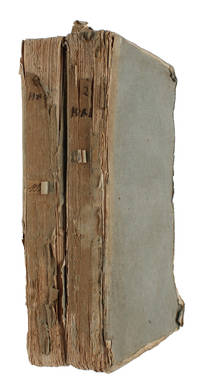
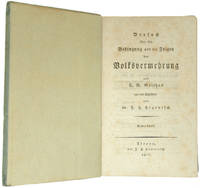
180760615Altona J.F. Hammerich 1807. 8vo. 2 volumes both uncut in the original blank wrappers. Wear to extremities front wrapper on vol. 1 detached and with tear. Missing ab. half of the paper on spines. Internally fine and clean. XVI 368; VIII 358 1 pp. <br/><br/><em>Rare first German edition of this political and economic classic which constitutes Malthus' first major publication and his main work because of which he is considered the father of demography and one of the main sources of inspiration for Darwin and Wallace. It is the first translation of the "Principle on Population" into any language and it influenced German politics tremendously.The first edition was printed anonymously in London in 1798 and in 1803 the second edition which also according to Malthus himself can be said to constitute a new work appeared; -the great quarto edition from 1803 is thoroughly revised and much enlarged the title has been changed and Malthus' name appears on the title-page for the first time it is on this edition that all the preceding editions are based and in consequence also the early translations. All the later editions were minor revisions of the second one. In 1806 the third edition appeared and as soon as 1807 the first German one which is translated from the revised third edition "Die gegenwärtige Uebersetzung ist nach der dritten Ausgabe Oktav London 1806. Die Quartausgabe ist minder vollständig" Vorwort p. V. New revisions of the text kept appearing till the sixth edition in 1826. The book then as now is considered highly controversial and it has influenced all demographers ever since as well as being of immense importance to the study of economic theory and genetic inheritance. "The "Essay" was highly influential in the progress of thought in the early nineteenth-century Europe. "Parson" Malthus as Cobbett dubbed him was for many a monster and his views were often grossly misinterpreted. But his influence on social policy whether for good or evil was considerable. The Malthusian theory of population came at the right time to harden the existing feeling against the Poor Laws and Malthus was a leading spirit behind the Poor Law Amendment Act of 1834." PMM 251.Thomas Robert Malthus 1766-1834 called the "enfant terrible" of the economists was an English demographer statistician and political economist who is best known for his groundbreaking views on population growth presented in his "Essays on the Principle of Population" which is based on his own prediction that population would outrun food supply causing poverty and starvation. Among other things this caused the legislation which lowered the population of the poor in England. Malthus actually turned political economic and social thought upside down with this work which has caused him to be considered one of the 100 most influential persons in history Hart The 100: A Ranking of the most Influential Persons in History 1978. Of course he was condemned by Marx and Engels and opposed by the socialists universally but the work was of immense impact on not only politics economics social sciences etc but also on natural sciences. "Later in the "Origin of Species" he Darwin wrote that the struggle for existence "is the doctrine of Malthus applied with manifold force to the whole animal and vegetable kingdoms; for in this case there can be no artificial increase of food and no prudential restraint from marriage" p. 63. Alfred Russel Wallace who arrived at a worked-out formulation of the theory of evolution at almost precisely the same time as Darwin acknowledged that "perhaps the most important book I read was Malthus's "Principles of Population" My Life p. 232. Although there were four decennial censuses before Malthus' death he did not himself analyze the data although he did influence Lambert Quetelet and Pierre Verhulst who made precise statistical studies on growth of populations in developed countries and showed how the early exponential growth changed to an S curve." DSB IX p. 69. As Malthus realized that his theories were not satisfactorily presented or sufficiently demonstrated in the first edition from 1798 he travelled for three years through Europe gleaning statistics and then published the second edition in 1803. Among other places he travelled through Northern Germany and his detailed diaries of these journeys provided him with some of the evidence necessary for the development of his theory on population growth. The observational information that he gathered on his travels in Europe were crucial to the development of his theories which also means that the work is of great interest for other European countries and not only Britain. "In 1819 the Royal Society elected Malthus to a fellowship. He was also a member of the French Institute and the Berlin Academy and a founding member of the Statistical Society 1834." DSB IX p. 67. Printing and the Mind of Man 251 first edition. </em> unknown
0366353764.Gpaperback. Good. Access codes and supplements are not guaranteed with used items. May be an ex-library book. paperback
95379Altona I. F. Hammerich 1807. . First German edition 2 vols 8vo 20 x 12.5 cm. pp. xvi 368; pp. vii 358; very slight spotting to vol. 1. Contemporary half-brown leather binding; flat spine gilt bands separating compartments compartments 1 3 5 and 6 contain gilt floral decoration compartments 2 and 4 contain gilt lettering including translator's name and title gilt library stamp to both upper boards library stamps to verso of both upper boards and title pages pencil markings to verso of upper boards and endpapers; rubbed water or possibly glue marks to verso of upper boards and endpapers.<br /> Rare first German edition and first translation into a foreign language of this important work by the father of Malthusianism.<br /><br />Malthus' original work written in English was first published anonymously in 1798. It discusses the problem of the gap between population growth which is potentially exponential and the growth of food supply which is not. The work arose from a discussion between Malthus and his father about the possibility of a better society and went on to have an enormous impact on social policy. Ultimately Malthus believed population growth would always outrun food supply and therefore the betterment of society was impossible without stern limits on reproduction. For this reason he is often associated with Darwin. His views became popular again in the XX century largely due to the work of John Maynard Keynes. <br /><br />'The essay exercised a strong influence on European intellectual development at the beginning of the nineteenth century. the Socialists fought him unanimously. and the Conservatives were happy that somebody was fighting against the spread of revolutionary ideas from the continent.' Carter/Muir.<br /><br />Thomas Malthus 1766 - 1834 was born into a family of intellectuals and his father was a great friend of the philosopher David Hume. He took holy orders in 1797 but in 1805 decided to become a professor teaching history and the relatively new subject of political economy at the East India Company college in Haileybury. He was elected a member of the Royal Society in 1819 and in 1834 founded the Statistical Society of London.<br /> Altona, I. F. Hammerich, 1807. hardcover
1017986878.Ghardcover. Good. Access codes and supplements are not guaranteed with used items. May be an ex-library book. hardcover
180752195Altona J.F. Hammerich 1807. Contemp. hcalf. Gilt spine titlelabel in leather letters worn. Light wear to top of spine and corners. Spine rubbed. Some wear to edges of covers. A stamp on title-page. XVI 368; VIII 358 2 pp. A few leaves in the first quire disbound. Scattered brownspots and a few marginal underlinings on the first 20 leaves. <br/><br/><em>Rare first German edition of this political and economic classic which constitutes Malthus' first major publication and his main work because of which he is considered the father of demography and one of the main sources of inspiration for Darwin and Wallace. It is the first translation of the "Principle on Population" into any language and it influenced German politics tremendously.The first edition was printed anonymously in London in 1798 and in 1803 the second edition which also according to Malthus himself can be said to constitute a new work appeared; -the great quarto edition from 1803 is thoroughly revised and much enlarged the title has been changed and Malthus' name appears on the title-page for the first time it is on this edition that all the preceding editions are based and in consequence also the early translations. All the later editions were minor revisions of the second one. In 1806 the third edition appeared and as soon as 1807 the first German one which is translated from the revised third edition "Die gegenwärtige Uebersetzung ist nach der dritten Ausgabe Oktav London 1806. Die Quartausgabe ist minder vollständig" Vorwort p. V. New revisions of the text kept appearing till the sixth edition in 1826. The book then as now is considered highly controversial and it has influenced all demographers ever since as well as being of immense importance to the study of economic theory and genetic inheritance. "The "Essay" was highly influential in the progress of thought in the early nineteenth-century Europe. "Parson" Malthus as Cobbett dubbed him was for many a monster and his views were often grossly misinterpreted. But his influence on social policy whether for good or evil was considerable. The Malthusian theory of population came at the right time to harden the existing feeling against the Poor Laws and Malthus was a leading spirit behind the Poor Law Amendment Act of 1834." PMM 251.Thomas Robert Malthus 1766-1834 called the "enfant terrible" of the economists was an English demographer statistician and political economist who is best known for his groundbreaking views on population growth presented in his "Essays on the Principle of Population" which is based on his own prediction that population would outrun food supply causing poverty and starvation. Among other things this caused the legislation which lowered the population of the poor in England. Malthus actually turned political economic and social thought upside down with this work which has caused him to be considered one of the 100 most influential persons in history Hart The 100: A Ranking of the most Influential Persons in History 1978. Of course he was condemned by Marx and Engels and opposed by the socialists universally but the work was of immense impact on not only politics economics social sciences etc but also on natural sciences. "Later in the "Origin of Species" he Darwin wrote that the struggle for existence "is the doctrine of Malthus applied with manifold force to the whole animal and vegetable kingdoms; for in this case there can be no artificial increase of food and no prudential restraint from marriage" p. 63. Alfred Russel Wallace who arrived at a worked-out formulation of the theory of evolution at almost precisely the same time as Darwin acknowledged that "perhaps the most important book I read was Malthus's "Principles of Population" My Life p. 232. Although there were four decennial censuses before Malthus' death he did not himself analyze the data although he did influence Lambert Quetelet and Pierre Verhulst who made precise statistical studies on growth of populations in developed countries and showed how the early exponential growth changed to an S curve." DSB IX p. 69. As Malthus realized that his theories were not satisfactorily presented or sufficiently demonstrated in the first edition from 1798 he travelled for three years through Europe gleaning statistics and then published the second edition in 1803. Among other places he travelled through Northern Germany and his detailed diaries of these journeys provided him with some of the evidence necessary for the development of his theory on population growth. The observational information that he gathered on his travels in Europe were crucial to the development of his theories which also means that the work is of great interest for other European countries and not only Britain. "In 1819 the Royal Society elected Malthus to a fellowship. He was also a member of the French Institute and the Berlin Academy and a founding member of the Statistical Society 1834." DSB IX p. 67. Printing and the Mind of Man 251 first edition. </em> hardcover
180731326Altona J.F. Hammerich 1807. 8vo. Bound in the two orig. blue cardboardbindings. The backs have been professionally restored preserving the orig. printed paper title-labels and cont. paper library-labels at lower backs. Occasional brownspotting due to the paper-quality but all in all a very nice and attractive copy. XVI 4 368; VIII 358 1 pp. Some of the first leaves of the "Erstes Buch" in the first volume have been misbound but are all present. <br/><br/><em>Rare first German edition of this political and economic classic which constitutes Malthus' first major publication and his main work because of which he is considered the father of demography and one of the main sources of inspiration for Darwin and Wallace. It is the first translation of the "Principle on Population" into any language and it influenced German politics tremendously.The first edition was printed anonymously in London in 1798 and in 1803 the second edition which also according to Malthus himself can be said to constitute a new work appeared; -the great quarto edition from 1803 is thoroughly revised and much enlarged the title has been changed and Malthus' name appears on the title-page for the first time it is on this edition that all the preceding editions are based and in consequence also the early translations. All the later editions were minor revisions of the second one. In 1806 the third edition appeared and as soon as 1807 the first German one which is translated from the revised third edition "Die gegenwärtige Uebersetzung ist nach der dritten Ausgabe Oktav London 1806. Die Quartausgabe ist minder vollständig" Vorwort p. V. New revisions of the text kept appearing till the sixth edition in 1826. The book then as now is considered highly controversial and it has influenced all demographers ever since as well as being of immense importance to the study of economic theory and genetic inheritance. "The "Essay" was highly influential in the progress of thought in the early nineteenth-century Europe. "Parson" Malthus as Cobbett dubbed him was for many a monster and his views were often grossly misinterpreted. But his influence on social policy whether for good or evil was considerable. The Malthusian theory of population came at the right time to harden the existing feeling against the Poor Laws and Malthus was a leading spirit behind the Poor Law Amendment Act of 1834." PMM 251.Thomas Robert Malthus 1766-1834 called the "enfant terrible" of the economists was an English demographer statistician and political economist who is best known for his groundbreaking views on population growth presented in his "Essays on the Principle of Population" which is based on his own prediction that population would outrun food supply causing poverty and starvation. Among other things this caused the legislation which lowered the population of the poor in England. Malthus actually turned political economic and social thought upside down with this work which has caused him to be considered one of the 100 most influential persons in history Hart The 100: A Ranking of the most Influential Persons in History 1978. Of course he was condemned by Marx and Engels and opposed by the socialists universally but the work was of immense impact on not only politics economics social sciences etc but also on natural sciences. "Later in the "Origin of Species" he Darwin wrote that the struggle for existence "is the doctrine of Malthus applied with manifold force to the whole animal and vegetable kingdoms; for in this case there can be no artificial increase of food and no prudential restraint from marriage" p. 63. Alfred Russel Wallace who arrived at a worked-out formulation of the theory of evolution at almost precisely the same time as Darwin acknowledged that "perhaps the most important book I read was Malthus's "Principles of Population" My Life p. 232. Although there were four decennial censuses before Malthus' death he did not himself analyze the data although he did influence Lambert Quetelet and Pierre Verhulst who made precise statistical studies on growth of populations in developed countries and showed how the early exponential growth changed to an S curve." DSB IX p. 69. As Malthus realized that his theories were not satisfactorily presented or sufficiently demonstrated in the first edition from 1798 he travelled for three years through Europe gleaning statistics and then published the second edition in 1803. Among other places he travelled through Northern Germany and his detailed diaries of these journeys provided him with some of the evidence necessary for the development of his theory on population growth. The observational information that he gathered on his travels in Europe were crucial to the development of his theories which also means that the work is of great interest for other European countries and not only Britain. "In 1819 the Royal Society elected Malthus to a fellowship. He was also a member of the French Institute and the Berlin Academy and a founding member of the Statistical Society 1834." DSB IX p. 67. Printing and the Mind of Man 251 first edition. </em> unknown
180736928Altona J.F. Hammerich 1807. 8vo. Bound in the two nice cont. uniform cardboardbindings w. marbled paper. Gilt lines and gilt title-labels to spines. Some wear w. minor loss of paper to capitals hinges and corners. Small hole to paper as well as to leather title-label of spine of volume two. Some brownspotting but overall a nice and atrractive copy. Lacking the half-tilte for the first book merely stating "Erstes Buch". XVI 368; VIII 358 1 pp. <br/><br/><em>Rare first German edition of this political and economic classic which constitutes Malthus' first major publication and his main work because of which he is considered the father of demography and one of the main sources of inspiration for Darwin and Wallace. It is the first translation of the "Principle on Population" into any language and it influenced German politics tremendously.The first edition was printed anonymously in London in 1798 and in 1803 the second edition which also according to Malthus himself can be said to constitute a new work appeared; -the great quarto edition from 1803 is thoroughly revised and much enlarged the title has been changed and Malthus' name appears on the title-page for the first time it is on this edition that all the preceding editions are based and in consequence also the early translations. All the later editions were minor revisions of the second one. In 1806 the third edition appeared and as soon as 1807 the first German one which is translated from the revised third edition "Die gegenwärtige Uebersetzung ist nach der dritten Ausgabe Oktav London 1806. Die Quartausgabe ist minder vollständig" Vorwort p. V. New revisions of the text kept appearing till the sixth edition in 1826. The book then as now is considered highly controversial and it has influenced all demographers ever since as well as being of immense importance to the study of economic theory and genetic inheritance. "The "Essay" was highly influential in the progress of thought in the early nineteenth-century Europe. "Parson" Malthus as Cobbett dubbed him was for many a monster and his views were often grossly misinterpreted. But his influence on social policy whether for good or evil was considerable. The Malthusian theory of population came at the right time to harden the existing feeling against the Poor Laws and Malthus was a leading spirit behind the Poor Law Amendment Act of 1834." PMM 251.Thomas Robert Malthus 1766-1834 called the "enfant terrible" of the economists was an English demographer statistician and political economist who is best known for his groundbreaking views on population growth presented in his "Essays on the Principle of Population" which is based on his own prediction that population would outrun food supply causing poverty and starvation. Among other things this caused the legislation which lowered the population of the poor in England. Malthus actually turned political economic and social thought upside down with this work which has caused him to be considered one of the 100 most influential persons in history Hart The 100: A Ranking of the most Influential Persons in History 1978. Of course he was condemned by Marx and Engels and opposed by the socialists universally but the work was of immense impact on not only politics economics social sciences etc but also on natural sciences. "Later in the "Origin of Species" he Darwin wrote that the struggle for existence "is the doctrine of Malthus applied with manifold force to the whole animal and vegetable kingdoms; for in this case there can be no artificial increase of food and no prudential restraint from marriage" p. 63. Alfred Russel Wallace who arrived at a worked-out formulation of the theory of evolution at almost precisely the same time as Darwin acknowledged that "perhaps the most important book I read was Malthus's "Principles of Population" My Life p. 232. Although there were four decennial censuses before Malthus' death he did not himself analyze the data although he did influence Lambert Quetelet and Pierre Verhulst who made precise statistical studies on growth of populations in developed countries and showed how the early exponential growth changed to an S curve." DSB IX p. 69. As Malthus realized that his theories were not satisfactorily presented or sufficiently demonstrated in the first edition from 1798 he travelled for three years through Europe gleaning statistics and then published the second edition in 1803. Among other places he travelled through Northern Germany and his detailed diaries of these journeys provided him with some of the evidence necessary for the development of his theory on population growth. The observational information that he gathered on his travels in Europe were crucial to the development of his theories which also means that the work is of great interest for other European countries and not only Britain. "In 1819 the Royal Society elected Malthus to a fellowship. He was also a member of the French Institute and the Berlin Academy and a founding member of the Statistical Society 1834." DSB IX p. 67. Printing and the Mind of Man 251 first edition. </em> hardcover
A clean, unmarked book with a tight binding. Full green cloth boards. Previous owner's name label on copyright page. Price-clipped dust jacket shows light wear. 602 pages.
19872081402110001891Not Available 1987. Soft Cover. Fine. Number of books: 1 Not Available paperback
19862091502133901796Iwanami Bunko white belt 107-5 1986. Soft Cover. Fine. Volume: 1 Iwanami Bunko white belt (107-5) paperback
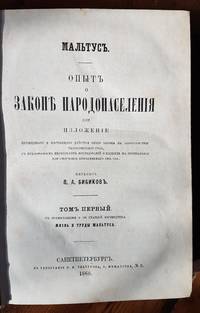
1868178<p><strong>Scarce first Russian edition of a major landmark of economic literature the <em>Essay on the Principle of Population</em></strong> first published in English in 1798.</p><p><strong>With much added material.</strong> The translator P. A. Bibikov was a historian philosopher and literary critic who had already translated Smith's Wealth of Nations in 1866. With this background he added a wealth of material to this edition making it more than just a translation but also an a posteriori analysis. Next to the 80 pages on Malthus' life and works Bibikov added in a rich appendix translations of foreign commentators as well as his own footnotes relating to Russia. Very interestingly he updated and commented the many pages Malthus had already devoted to the Russian case. The appendix includes texts by Townsend Garnier Chernyshevskiy and Prudhon as well as a convenient 20-pp. alphabetical index.</p><p>"The central idea of the essay - and hub of the Malthusian theory - was a simple one. If the natural increase in population occurs the food supply becomes insufficient and the size of the population is checked by 'misery' - that is the poorest sections of the community suffer disease and famine. Malthus recognises two other possible checks to population expansion: first 'vice' - that is homosexuality prostitution and abortion all totally unacceptable to Malthus; and second 'moral restraint' - the voluntary limitation of the product of children by the postponement of marriage." PMM.</p><p>Provenance: Unidentified symbolistic booklabel to upper endpapers; small Baltic bookseller's stamps to lower endpapers.</p><p>Physical description:Two volumes 8vo. 476 pp. incl. half-title title and table of contents at end; 468 pp. incl. table of contents. Later plain brown cloth author titled in ink on the spines.</p><p>Condition:Very occasional light spotting.</p> Glazunov, Skt. Peterburg, hardcover
Mm 140x215 Brossura editoriale con bandelle, pagine 350.Opera in buone condizioni. SPEDIZIONE IN 24 ORE DALLA CONFERMA DELL'ORDINE. WORLDWIDE DELIVERY.
41917 x 23,5 The Journal of European Economic History, volume 27, number 1 (Spring 1998), 137-202. Extract. Couverture cartonnée de la revue, agrafes au dos. Exemplaire en parfait état.(C11) Livre
41917 x 23,5 The Journal of European Economic History, volume 27, number 1 (Spring 1998), 137-202. Extract. Couverture cartonnée de la revue, agrafes au dos. Exemplaire en parfait état.(C11) Livre
In-16°, in brossura editoriale, pp. 128. Della collana Uomini e Problemi.
pp. 128, cm 19x12, bross., tracce di fioriture
1923B296Berlin, Hans Robert Engelmann, 1923. kartoniert, 8°, 175 S., Inhalt: Der drohende Mangel an Brennstoff und die hieraus sich ergebenden Gefahren - Die drohende Überbevölkerung und ihre Gefahren (Die todbringenden Ursachen der Verminderung der Völker, Die einer Volksvermehrung vorbeugenden Ursachen, Die jetzige Überbevolkerung und ihre Gefahren, Die Notwendigkeit einer Nachkommenschaftseinschränkung) - Der Weltkrieg und die Weltnot
1980273698Paris Dunod / Bordas 1980. XIV, 269 S. Lit.verz. Br.
in 16 (18x11) Brossura; pp.165; buono
2008BN179356Cambridge University Press 2008. 2008. Softcover. T. R. Malthus <br/><br/>T. R. Malthus Pullen Thomas Robert Malthus Cambridge University Press paperback
163234728Paris, Pierre Gvillemot, 1632. 8vo. Cont. full limp vellum, remains of ties. Titlelabel in red leather on back, this with a small nick. Top of spine strenghtened with a strip of vellum. Engraved title with Neptun & Mars. (6),277,(10) pp., 28 half-page textengravings and 15 large wood-cut illustrations. A few scattered brownspots. A good copy.
163234728Paris Pierre Gvillemot 1632. 8vo. Cont. full limp vellum remains of ties. Titlelabel in red leather on back this with a small nick. Top of spine strenghtened with a strip of vellum. Engraved title with Neptun & Mars. 627710 pp. 28 half-page textengravings and 15 large wood-cut illustrations. A few scattered brownspots. A good copy. <br/><br/><em> Second enlaged edition of this scarce treatise of fireworks for war and recreation. The work is divided in five sections: the first 56 pp. to war pp. 57-146 to 'recreation' and pp. 147-277 to sundials fortification geometry and arithmetics. Of the English edition of 1629 Cockle says "This work though in advance of anything so far written on the subject in English does not attain to the standard of Thibourel and Appier. Yet it is with foreign treatises it must be weighed for Malthus received his training in pyrotechnics abroad.It was Malthus who about the year 1634 introduced the mortar into the French service." - Klaus Jordan: 2328 ed. 1629 - Chris Philip: M 040.3 - Cockle Nos 118 a. 939. </em> hardcover
DIDIER 1963 463 PP. FONDO DI MAGAZZINO: SEGNI DEL TEMPO ALLA COPERTINA, PER IL RESTO CONDIZIONI ECCELLENTISSIME, CONSIDERATI GLI OLTRE 50 ANNI DEL VOLUME. Parole e frasi comuni Alarcos Alroy amour anglais apparaît aspects Benjamin Disraeli Besso biographique Book Bradenham Byron caractéristique caractérologique Carlyle Carrier Pigeon Cazamian conception Coningsby Contarini Fleming critiques décors Dickens Disraëli doctrines doute Earl of Beaconsfield effet Egremont Endymion English essentiel faiblesse Fakredeen Falconet fantaisie George Eliot great haut Henrietta Temple héros disraéliens Hughenden Ibid idées imagination intellectuelle intrigues Ixion Jeune Angleterre Juifs l'action l'ambition l'aristocratie l'auteur l'esprit l'héroïne l'humour l'imagination l'intrigue l'ironie l'œuvre disraélienne Lady Bradford Leslie Stephen littéraire London Londres Lord Beaconsfield Lord Bentinck Lord Monmouth Lothair manifeste mentors Millbank Monypenny morale note Novels œuvre parfois Peel pensée personnages personnalité disraélienne philosophie Phoebus politique Popanilla psychologique race raciale réalité religieuses révèle rôle romancier romanesque romans de Disraëli romans disraéliens satire scène semble sentiment Sidonia social souplesse souvent style surtout Sybil Tancred tendances Thackeray thèmes Theodora thèse Torysme trilogie type valeur Venetia victorienne Vivian Grey Whig Young Duke
65104n° 385 - janvier 1955 - nouvelle série - revue illustrée - in-4 broché - 32 pages