542 résultats
pp. 128, cm 19x12, bross., tracce di fioriture
In-16°, in brossura editoriale, pp. 128. Della collana Uomini e Problemi.
41917 x 23,5 The Journal of European Economic History, volume 27, number 1 (Spring 1998), 137-202. Extract. Couverture cartonnée de la revue, agrafes au dos. Exemplaire en parfait état.(C11) Livre
Mm 140x215 Brossura editoriale con bandelle, pagine 350.Opera in buone condizioni. SPEDIZIONE IN 24 ORE DALLA CONFERMA DELL'ORDINE. WORLDWIDE DELIVERY.
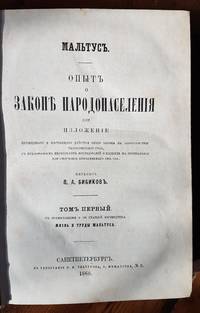
1868178<p><strong>Scarce first Russian edition of a major landmark of economic literature the <em>Essay on the Principle of Population</em></strong> first published in English in 1798.</p><p><strong>With much added material.</strong> The translator P. A. Bibikov was a historian philosopher and literary critic who had already translated Smith's Wealth of Nations in 1866. With this background he added a wealth of material to this edition making it more than just a translation but also an a posteriori analysis. Next to the 80 pages on Malthus' life and works Bibikov added in a rich appendix translations of foreign commentators as well as his own footnotes relating to Russia. Very interestingly he updated and commented the many pages Malthus had already devoted to the Russian case. The appendix includes texts by Townsend Garnier Chernyshevskiy and Prudhon as well as a convenient 20-pp. alphabetical index.</p><p>"The central idea of the essay - and hub of the Malthusian theory - was a simple one. If the natural increase in population occurs the food supply becomes insufficient and the size of the population is checked by 'misery' - that is the poorest sections of the community suffer disease and famine. Malthus recognises two other possible checks to population expansion: first 'vice' - that is homosexuality prostitution and abortion all totally unacceptable to Malthus; and second 'moral restraint' - the voluntary limitation of the product of children by the postponement of marriage." PMM.</p><p>Provenance: Unidentified symbolistic booklabel to upper endpapers; small Baltic bookseller's stamps to lower endpapers.</p><p>Physical description:Two volumes 8vo. 476 pp. incl. half-title title and table of contents at end; 468 pp. incl. table of contents. Later plain brown cloth author titled in ink on the spines.</p><p>Condition:Very occasional light spotting.</p> Glazunov, Skt. Peterburg, hardcover
19872081402110001891Not Available 1987. Soft Cover. Fine. Number of books: 1 Not Available paperback
19862091502133901796Iwanami Bunko white belt 107-5 1986. Soft Cover. Fine. Volume: 1 Iwanami Bunko white belt (107-5) paperback
A clean, unmarked book with a tight binding. Full green cloth boards. Previous owner's name label on copyright page. Price-clipped dust jacket shows light wear. 602 pages.
1161846840.Ghardcover. Good. Access codes and supplements are not guaranteed with used items. May be an ex-library book. hardcover
1144840031.Gpaperback. Good. Access codes and supplements are not guaranteed with used items. May be an ex-library book. paperback
1340652064.Ghardcover. Good. Access codes and supplements are not guaranteed with used items. May be an ex-library book. hardcover
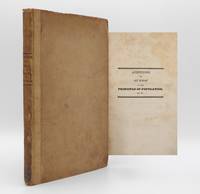
1831376545Georgetown D. C.: Published by Charles Cruikshank Rind's Press 1831. First American edition first published in London in 1817. 8vo. Original cloth backed tan boards printed paper label reading "Additions / to an / Essay /on / Population / by T.B. Malthus" uncut partially unopened. Some spotting and browning of binding rubbing with some wear to extremities some foxing and spotting of leaves insect trail along lower inner hinge marginal tears on R4 and Cc4 not affecting text. A very good copy in brown cloth clamshell box with leather spine label. First American edition first published in London in 1817. 8vo. Very scarce. This work contains new chapters additions and corrections included in the fifth edition separately published with a new title page and pagination for those who already had the earlier editions. <br /> <br /> The Contents leaf lists: Book II Chapters I Checks to Population in France and VII Checks to Population in England; Book III Chapters II Of Systems of Equality IV Of Emigration VI Of Poor Laws VIII-XIV the Agricultural and Commercial Systems Corn Laws Exportation and Importation and "Of increasing Wealth as it affects the Condition of the Poor; Book IV Chapters VI "Effects of the Knowledge of the Principal Cause of Poverty on Civil Liberty" XII "Different Plans of Improving the Condition of the Poor considered" and the Appendix. There are new chapters on the Poor and Corn Laws. A revised chapter on rent and especially the change in Chapter III which formely dealt with Godwin and his "Systems of Equality" now relate to Robert Owen his Utopian systems and his "New View of Society". <br /> <br /> In 1817 at the height of his success Robert Owen addressed the House of Commons speaking on his methods and ideas. Owen had disagreed with Malthus' theories of population. In 1824 Owen had come to America and purchased what became New Harmony a communal society experiment. It was not successful and Owen returned to England in 1828. The Appendix contains Malthus' responses to the publication of Principles of Population and Production by Mr. Wayland and An Inquiry into the Principle of Population by James Grahame. Each chapter notes where the additions should be placed referring to the English edition of 1807 and American edition of 1809. Goldsmiths' Kress Library 26723.2; Kress C2883; Kress B6973 Goldsmiths' 21762 Einaudi 3664 last three for London ed. Published by Charles Cruikshank, Rind's Press unknown
0530645386.Ghardcover. Good. Access codes and supplements are not guaranteed with used items. May be an ex-library book. hardcover
1817231696London : John Murray 1817. 1st edition. Hardcover. Contemporary aniline calf over marble boards. Front hinge loose with wear to the spine bands and panel edges. A good copy. Physical description; iv 327 1 p. ; 22 cm. Includes bibliographical references.Subjects; Population.Malthusianism. Population control. Population growth.Referenced by: Kress Lib B.6973. London : John Murray hardcover
181722733London: John Murray 1817. First edition. 1 vols. 8vo. Rebound in later buckram. Title a little foxed contents generally clean. First edition. 1 vols. 8vo. Issued in conformity with but separately from the fifth edition - the penultimate edition before the sixth and final one in his lifetime. Kress B.6973; Goldsmith 21762 John Murray unknown
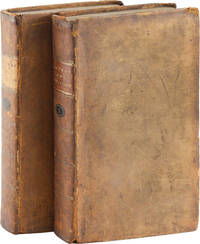
180755024London: Printed for J. Johnson in St Paul's Church-Yard by T. Bensley 1807. Fourth edition. Octavo 22cm in two volumes. In contemporary brown calf seven sets of double gilt rules to spine titled in gilt on red leather spine label numbered on black leather spine labels blind tool to board edges all edges sprinkled grey; plain endpapers; vol. I: i-xvi 1-580pp; vol. II: i-viii 1-484 60pp. Sturdy copies much rubbed vol. I slightly cocked lower front joint of vol. I and upper front joint of vol. II cracking vol. II lacking spine label scratch to upper board of vol. II endleaves and some prelims foxed but otherwise internally free from soil: Good or better. <br /> <br /> The fourth edition of Malthus' widely influential discussion of overpopulation. Malthus 1766-1834 argued that population "increases geometrically while food supplies increase only arithmetically" and that some misery was inevitable unless population growth could be restrained. He proposed "moral restraint" as a solution. Many of his theories have now been largely rejected but "the Essay was highly influential in the progress of thought in early nineteenth-century Europe" and "his influence on social policy whether for good or evil was considerable." The first edition was shorter; "later editions were considerably altered and grew bulkier as Malthus defended his views against a host of critics" Printing and the Mind of Man. KRESS B.5219. GOLDSMITHS 19373. PMM 251 1st edn. Printed for J. Johnson in St Paul's Church-Yard, by T. Bensley unknown
180775775hLondon: Printed for R. Johnson in St. Paul's Church-Yard by T. Bensley Bolt Court Fleet Street 1807. Book. Very Good. Hardcover. 8vo - over 7¾ - 9¾" tall. Two-volume set in full tree-calf with gilt spines. Professionally re-backed with original spines relaid. Moderate handling and bumping to covers. Edges and endpapers toned. Armorial bookplate of Sir Edward Strachey Baronet Sutton Court Somerset inside front covers; early owner's name in ink to free endpapers. Otherwise clean tight and unmarked -- no foxing or staining to text. Very neat -- a sound and handsome set. Half-titles present; extensive index. xvi580viii48460indexpp. Printed for R. Johnson in St. Paul's Church-Yard, by T. Bensley, Bolt Court, Fleet Street Hardcover
1020321849.Ghardcover. Good. Access codes and supplements are not guaranteed with used items. May be an ex-library book. hardcover
1021167355.Gpaperback. Good. Access codes and supplements are not guaranteed with used items. May be an ex-library book. paperback
1021681350.Gpaperback. Good. Access codes and supplements are not guaranteed with used items. May be an ex-library book. paperback
1019370831.Ghardcover. Good. Access codes and supplements are not guaranteed with used items. May be an ex-library book. hardcover
1803143843London: T. Bensley 1803. Rare second edition of this cornerstone text of modern economics. Quarto bound in full diced morocco raised bands gilt titles and tooling to the spine front and rear panels marbled endpapers. In very good condition. An exceptional presentation. “Malthus was one of the founders of modern economics. His Essay was originally the product of a discussion on the perfectibility of society with his father who urged him to publish. Thus the first edition published anonymously was essentially a fighting tract but later editions were considerably altered and grew bulkier as Malthus defended his views against a host of critics… The Essay was highly influential in the progress of thought in early 19th-century Europe and his influence on social policy was considerable… Both Darwin and Wallace clearly acknowledged Malthus as a source of the idea of ‘the struggle for existence†PMM 251. T. Bensley hardcover
180345423London: Printed for J. Johnson. by T. Bensley. 1803. Second edition or "A New Edition Very Much Enlarged". 4to. viii iv 610 pp. 19th century half speckled calf over marbled boards gilt rules to the spine gilt lettered green label all edges marbled. Binding expertly resewn and the joints neatly repaired occasional foxing mostly mild an attractive copy. First published anonymously in 1798 Malthus drew upon the works of Hume and Smith amongst others to explain his conservative conception of population control. "The central idea of the essay. was a simple one. The population of a community. increases geometrically while food supplies increase only arithmetically. The 'Essay' was highly influential in the progress of thought in early 19th century Europe. it came at the right time to harden the existing feeling against the Poor Laws" - Printing and the Mind of Man 251. Citing examples from other societies and sources not hitherto known to him Malthus rewrote and extended his essay significantly enough for him to consider this an entirely "new work" in his introduction to this edition. He expanded and refined his theory of positive checks on population growth those that increase the death rate and negative ones those that inhibit birth rates slightly softening his tone by arguing for greater moral restraint as opposed to the bleaker and cruder mechanisms of hunger disease and war to keep population numbers down and therefore keep overall prosperity up. Despite being hugely influential in economic and philosophical terms Malthus has always been a divisive figure and his arguments remain controversial to this day. London: Printed for J. Johnson... by T. Bensley... unknown
1298468272.Gpaperback. Good. Access codes and supplements are not guaranteed with used items. May be an ex-library book. paperback