Malthus T[homas] R[obert]Biblio.com

100 résultats
180912840Paris and Geneva: Chez J.J. Paschoud 1809. 3 volumes. First Edition in French. Provenance: With the contemporary engraved bookplate of H. Trouchin and that of the subsequent owner Pierre Sciclounoff. 8vo very handsomely bound in a fine French binding of contemporary half calf over speckled boards spines with gilt ruled bands red morocco title label and green morocco volume label lettered in gilt. xxiii 424 3 ad; 395 3; 392. A very fine and handsome set very clean and sturdy in absolutely period state. The first French edition of Malthus’ landmark work. The translation from the English is by Pierre Prevost probably from the third English edition which was corrected and expanded by Malthus. French editions of Malthus are uncommon and this set is in exceptional condition in its original and contemporary state.<br> Originally written in response to a discussion with the author's father on the perfectibility of society the book was reprinted several times with many alterations and additions as Malthus defended his views against a host of critics.<br> "The central idea of the essay--and the hub of Malthusian theory--was a simple one. The population of a community Malthus suggested increases geometrically while food supplies increase only arithmetically. If the natural increase in population occurs the food supply becomes insufficient and the size of the population is checked by 'misery'--that is the poorest sections of the community suffer disease and famine. Malthus recognized two other possible checks to population expansion: first 'vice'--that is homosexuality prostitution and abortion all totally unacceptable to Malthus; and second 'moral restraint'--the voluntary limitation of the production of children by the postponement of marriage. This was the solution to the population problem that Malthus advocated. The 'Essay' was highly influential in the progress of thought in early nineteenth-century Europe" PMM. Marx Engels Paley Darwin Wallace Keynes and Ricardo were all influenced by Malthus--either working off his ideas or reacting against them. Chez J.J. Paschoud hardcover
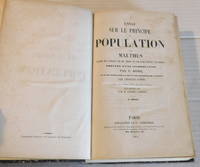
1852101094<p>Paris: Guillaumin et Cie Libraires 1852. 1852. Good. - Octavo 9-5/8 inches high by 6-1/2 inches wide. Hardcover bound into black & white marbled boards backed with a black cloth spine titled & ruled in gilt on the spine. The covers are rubbed & soiled. lvi & 688 pages. There is foxing throughout particularly at the front & rear. Good.</p> Paris: Guillaumin et Cie, Libraires, 1852. hardcover
180931327Paris & Genève Chez J.J. Paschoud 1809. 8vo. Bound in three nice uniform cont. hcalfbdgs. w. gilt backs red leather title-labels w. gilt lettering and gilt round green tome-labels on backs. Capitals w. a bit of wear. Internally nice and clean. W. half-titles in all three volumes and advertisement-leaf in vol. one. XIII 1 424 5; 6 395 1; 4 392 pp. <br/><br/><em>First French edition of this political and economic classic which constitutes Malthus' first major publication and his main work because of which he is considered the father of demography and the main source of inspiration of Darwin and Wallace.The first edition was printed anonymously in London in 1798 and in 1803 the second edition which also according to Malthus himself can be said to constitute a new work appeared; -the great quarto edition from 1803 is thoroughly revised and much enlarged the title has been changed and Malthus' name appears on the title-page it is on this edition that all the preceding editions are based and in consequence also the early translations. All the later editions were minor revisions of the second one. In 1807 the fourth edition appeared and in 1809 the first French one which is translated from the revised fourth edition "A la suite de cette préface on trouve dans la 4.e édition sur laquelle je traduis une notice de tous les changements que la 3.e édition a apportés à la 2.e. Le plus considérable est celui qui a rapport à l'estimation de la fécondité des mariages. Il est absolument inutile pour les lecteurs francois de connoître le détail minutieux des autres changemens qui ne peuvent intéresser que les acquéreurs des précédentes éditions. P.P.p" Préface p. xxiij. New revisions of the text kept appearing till the sixth edition in 1826.The book then as now is considered highly controversial and it has influenced all demographers ever since as well as being of immense importance to the study of economic theory and genetic inheritance. "The "Essay" was highly influential in the progress of thought in the early nineteenth-century Europe. "Parson" Malthus as Cobbett dubbed him was for many a monster and his views were often grossly misinterpreted. But his influence on social policy whether for good or evil was considerable. The Malthusian theory of population came at the right time to harden the existing feeling against the Poor Laws and Malthus was a leading spirit behind the Poor Law Amendment Act of 1834." PMM 251.Thomas Robert Malthus 1766-1834 called the "enfant terrible" of the economists was an English demographer statistician and political economist who is best known for his groundbreaking views on population growth presented in his "Essays on the Principle of Population" which is based on his own prediction that population would outrun food supply causing poverty and starvation. Among other things this caused the legislation which lowered the population of the poor in England. Malthus actually turned political economic and social thought upside down with this work which has caused him to be considered one of the 100 most influential persons in history Hart The 100: A Ranking of the most Influential Persons in History 1978. Of course he was condemned by Marx and Engels and opposed by the socialists universally but the work was of immense impact on not only politics economics social sciences etc but also on natural sciences. "Later in the "Origin of Species" he Darwin wrote that the struggle for existence "is the doctrine of Malthus applied with manifold force to the whole animal and vegetable kingdoms; for in this case there can be no artificial increase of food and no prudential restraint from marriage" p. 63. Alfred Russel Wallace who arrived at a worked-out formulation of the theory of evolution at almost precisely the same time as Darwin acknowledged that "perhaps the most important book I read was Malthus's "Principles of Population" My Life p. 232. Although there were four decennial censuses before Malthus' death he did not himself analyze the data although he did influence Lambert Quetelet and Pierre Verhulst who made precise statistical studies on growth of populations in developed countries and showed how the early exponential growth changed to an S curve." DSB IX p. 69.As Malthus realized that his theories were not satisfactorily presented or sufficiently demonstrated in the first edition from 1798 he travelled for three years through Europe gleaning statistics and then published the second edition in 1803. Among other places he travelled through France and Switzerland in 1802 and his detailed diaries of these journeys provided him with some of the evidence necessary for the development of his theory on population growth. The observational information that he gathered on his travels in Europe were crucial to the development of his theories which also means that the work is of great interest for other European countries and not only Britain. "In 1819 the Royal Society elected Malthus to a fellowship. He was also a member of the French Institute and the Berlin Academy and a founding member of the Statistical Society 1834." DSB IX p. 67. Printing and the Mind of Man 251 </em> hardcover
180993446Paris: J. J. Paschoud 1809. The most influential work of its era on population in a contemporary binding First French edition translated by Pierre Prévost. First published in English in 1798 it was perhaps the most influential work of its era on population arguing that the growth of a population would always outrun its ability to feed itself. The first edition was so successful that Malthus soon elaborated on it under his real name culminating in the sixth edition of 1826 which was a scholarly expansion of the first. A political economist who occupies a hallowed place in the history of biology Malthus was acknowledged by both Charles Darwin and Alfred Russel Wallace as a key influence in developing the theory of natural selection. 3 vols octavo. Contemporary quarter calf marbled boards brown morocco labels spines lettered in gilt with gilt and black motifs edges uncut. Board edges slightly faded and a little scuffed joints tender tips bumped and lightly rubbed. A very good set. Carpenter XXXII 7; Kress B.5591. hardcover
1841018705Bruxelles: Société Typographique Belge Wahlen 1841. .suivi de quelques recherches relatives à l'espérance de guérir ou d'adoucir les maux qu'elle entraine. Traduit de l'anglais sur la 5me édition par P. Prevost et G. Prevost de Génève. Nouvelle édition revue corrigee et augmentee . d'apres MM. Balbi et d'Omalius d'Halloy. Due volumi 19 cm di 4-422 e 4-448 pagine. Qualche fioritura. Timbro di possesso Polesini alle pagine di titolo; ex libris al retro della copertina. In lingua francese. Brossura editoriale una gora e dorsi restaurati muti. Société Typographique Belge, Wahlen unknown
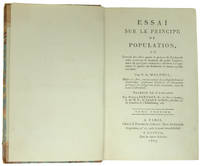
180365276London: Printed for J. Johnson.by T. Bensley 1803. The Economics of Population<br> <br> MALTHUS Thomas Robert. An Essay on the Principle of Population; Or a view of its past and present effects on Human Happiness; With an Inquiry into our prospects respecting the future removal or mitigation of the evils which it occasions. A new edition very much enlarged. London: Printed for J. Johnson. by T. Bensley 1803.<br> <br> Second edition enlarged and revised. Quarto. viii 4 610 pp.<br> <br> Contemporary calf skillfully rebacked to style and with corners renewed. Spine decoratively tooled in gilt compartments with burgundy morocco gilt lettering label. Endpapers renewed. Occasional light foxing. Title-page with publisher's diagonal paper flaw crease. Overall very good.<br> <br> A completely revised and greatly expanded edition of the most influential work on population ever written. Malthus published the first edition of his Essay in 1798 and was apparently unprepared for the torrent of controversy that his ideas provoked. His response to the public outcry was to spend the next five years refining and expanding his theories for this second edition so much so that "in its present shape it may be considered a new work and I should probably have published it as such omitting the few parts of the former which I have retained but that I wished it to form a whole of itself and not to need a continual reference to the other." preface<br> <br> Malthus' basic argument--that population increases geometrically at a greater rate than does the means of subsistence which increases arithmetically--was one of the earliest modern economic and social theories and his contention that it would eventually become necessary for society to impose some form of restraint on over-population provided the premise for heated socio-economic debate for almost two centuries.<br> <br> Kress B4701. See Printing and the Mind of Man 251.<br> <br> HBS 65276.<br> <br> $6500. Printed for J. Johnson...by T. Bensley unknown
1815181657London : Printed for John Murray Albemarle Street; and J. Johnson and Co. St. Paul's Church Yard 1815. First Edition. Hardback. Good copy in the original wrappers bound in later 19th century aniline calf over marble boards. Gilt-blocked black leather label to the spine. Spine bands and panels edges somewhat dust-dulled and rubbed as with age. Previous owner's notes/annotations attached to back of title page. Scattered marginal foxing. Remains particularly well-preserved overall; tight bright clean and strong. ; 8vo 8"" - 9"" tall; 48 pages; Description: 48p. 23cm. Subjects: Malthus T. R. Thomas Robert 1766-1834. - Observations on the corn laws. Corn laws Great Britain. Grain trade - Great Britain. Corn - Prices - Great Britain. Agriculture - Economic aspects - Great Britain. Publisher's 8 page catalogue to the rear and dated February 1815. Spine title reads: Malthus - Import of Corn - 1815. London : Printed for John Murray, Albemarle Street; and J. Johnson and Co. St. Paul's Church Yard hardcover
189311039Torino: Ermanno Loescher 1893. 1893. Good. - Small quarto 9-5/8 inches high by 6-3/4 inches wide rebound without original wraps in dark green cloth titled in gilt with decorations in gilt on the spine. The covers are slightly warped & the binding is bumped & rubbed affecting the titling. The head of the spine is chipped & frayed. 167 pages plus errata/corrigenda page. The pastedowns & endpapers are darkened & there is scattered foxing & light staining. Good. <p>First edition. The text is in Italian.<p>The book is inscribed by the author but the inscription & signature have been partially cut off in rebinding.<p>"This interesting work proposes to examine by the light of scientific criticism the theory of Malthus and the principal objections that have been brought against it. The author turns his attention first to pointing out the irrefutability of the biological tendency as Malthus has shown it and the necessity which devolves upon political economy to recognize it as a fundamental law. Lebrecht does not ignore the objections raised by various writers against this tendency; on the contrary he estimates them with praiseworthy impartiality; yet after careful examination he believes that they are not destructive of the theory.He does not deny that the coefficient of procreation is essentially economic and that poverty is one of its potent factors; yet he affirms that the prolific action of poverty can be remedied by moral influences. From a review of the book by Achille Loria and Cornelia H. B. Rogers in "Annals of the American Academy of Political and Social Science Vol. 4 May 1894 p. 134.<p>Rare. Torino: Ermanno Loescher, 1893. paperback
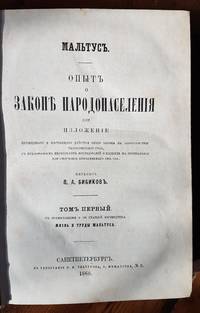
1868178<p><strong>Scarce first Russian edition of a major landmark of economic literature the <em>Essay on the Principle of Population</em></strong> first published in English in 1798.</p><p><strong>With much added material.</strong> The translator P. A. Bibikov was a historian philosopher and literary critic who had already translated Smith's Wealth of Nations in 1866. With this background he added a wealth of material to this edition making it more than just a translation but also an a posteriori analysis. Next to the 80 pages on Malthus' life and works Bibikov added in a rich appendix translations of foreign commentators as well as his own footnotes relating to Russia. Very interestingly he updated and commented the many pages Malthus had already devoted to the Russian case. The appendix includes texts by Townsend Garnier Chernyshevskiy and Prudhon as well as a convenient 20-pp. alphabetical index.</p><p>"The central idea of the essay - and hub of the Malthusian theory - was a simple one. If the natural increase in population occurs the food supply becomes insufficient and the size of the population is checked by 'misery' - that is the poorest sections of the community suffer disease and famine. Malthus recognises two other possible checks to population expansion: first 'vice' - that is homosexuality prostitution and abortion all totally unacceptable to Malthus; and second 'moral restraint' - the voluntary limitation of the product of children by the postponement of marriage." PMM.</p><p>Provenance: Unidentified symbolistic booklabel to upper endpapers; small Baltic bookseller's stamps to lower endpapers.</p><p>Physical description:Two volumes 8vo. 476 pp. incl. half-title title and table of contents at end; 468 pp. incl. table of contents. Later plain brown cloth author titled in ink on the spines.</p><p>Condition:Very occasional light spotting.</p> Glazunov, Skt. Peterburg, hardcover
1815BOOKS062718ILondon: John Murray 1815. HC. very good bound in maroon buckram cloth hardcover SEE NOTE. . AND GENERAL WEALTH OF THE COUNTRY. An exceptionally nice original copy of the Third Edition however in the right margin there is a pinhole not affecting text through the pages. 48pp. John Murray unknown
181539958London: Printed for John Murray 1815. Third edition. 47 1 pp. 1 vols. 8vo. Disbound with paper strip on spine pale dampstain to upper margin throughout not affecting text. Third edition. 47 1 pp. 1 vols. 8vo. Kress B 6539; Goldsmith 21179 Printed for John Murray unknown
1829147796London: J. Murray 1829. First appearance in print of these two papers by Malthus on the subject of value as contained in parts I pp. 171-180 and II pp. 74-81 of the first volume of the Transactions of the Royal Society of Literature here bound together. The papers were read before the society by Malthus in May 1825 and November 1827. In the first paper Malthus argues that "the natural and necessary conditions of the supply of all commodities not subject to a monopoly are represented and measured by the labour which they will ordinarily and on an average command and that no other object whatever can be substituted for labour or can represent and measure the natural and necessary conditions of the supply of commodities" p. 171. It was essentially a repetition of the arguments in Malthus's Measure of Value 1823. The second paper's aim was to show that when the term "value of a commodity" is used without referring to some other commodity in which it is to be estimated the term is "generally understood to refer and can only refer correctly to the conditions of its supply or the natural and necessary costs of its production" p. 74. The paper appears to have been intended as a development of the themes treated in his Definitions in Political Economy published earlier in 1827. 2 works bound in 1 vol. quarto 275 x 211 mm. With 21 plates of which 2 folding in first part; 7 plates of which 2 folding in second part. Twentieth-century blue quarter calf spine lettered gilt blue mottled sides marbled endpapers. With the book label to the front pastedown of the Ducs de Luynes at the Château de Dampierre. Residue from label removal at the foot of spine peripheral rubbing skilfully retouched contents clean and crisp. A very good copy. unknown
184611941Paris: Guillaumin et Cie. 1846. 233x145mm. 9¼x5¾". Paris Guillaumin & Cie. 1846. En 4º 233 x 145mm. xxxvi-550 pp. Encuadernación de la época en holandesa piel. Segunda edición francesa de esta importante obra de economÃa polÃtica publicada por vez primera en inglés en 1820. Aunque Malthus es más conocido por los puntos de vista sobre la población contenidos en su<em> Ensayo sobre población</em> no cabe duda de que su importancia para los economistas de hoy se basa principalmente en sus <em>Principios de economÃa polÃtica</em>. Fue debido a este trabajo que J.M. Keynes reinstaló a Malthus como una figura importante en el pensamiento económico moderno en un momento en que la redundancia autoinducida del <em>Ensayo sobre la población</em> estaba a punto de reducir a Malthus a la categorÃa de monumento histórico. Los <em>Principios de EconomÃa PolÃtica</em> de Malthus fueron influenciados por los <em>Principios de EconomÃa PolÃtica y Tributación</em> de David Ricardo. Muy buen ejemplar. Guillaumin et Cie. hardcover
182046619London: John Murray 1820. First edition 8vo vi 601 1 pp. Contemporary black half calf a little rubbed covers very slightly damp stained and bowed gilt spine and red label. "The Principles had only a limited impact at the time. more recently it has received greater recognition largely as a result of the comments by J. M. Keynes in the 1930s. Keynes argued that Malthus's theory of effective demand provided a scientific explanation of unemployment and that the hundred-year domination of Ricardo over Malthus had been a disaster for the progress of economics. Keynes believed that if economics had followed Malthus instead of being constrained by Ricardo in an artificial groove the world would be a much wiser and richer place." ODNB. Goldsmiths 22767. Kress C577. London: John Murray unknown
18208125London: John Murray 1820. 1820 vi 601 1 p. First edition. It has a good quality mid-twentieth century binding with a polished morocco spine marbled boards and vellum corners. The spine with gold lines and a contrasting label. Minor rubs to the spine ends otherwise in very good condition. There is an undated pencil note on the title page '£45 Repair'. The text with a few signs of use and some pale paper toning. IMPORTANT COOPERATIVE MOVEMENT PROVENANCE: The title page is inscribed at the head 'Society for promoting Working Men's Assocns / 34 Castle Place -- Oxford Street with a shelfmark R31'. The Society was founded in 1849 by the Christian Socialists in an attempt to found self governing workshops. Lower down the title page is the oval stamp of Ormond Street Working Mens College which still exists in Camden. Founded in 1854 by Frederick Denison Maurice Wiki describes it as 'The Working Men's College is among the earliest adult education institutions established in the United Kingdom and Europe's oldest extant centre for adult education. Founded by Christian socialists at its inception it was at the forefront of liberal education philosophy.' At different times its teachers included Thomas Hughes whose latin lectures were apparently not so popular as his boxing club F.J. Furnival and E.M. Forster. London: John Murray, hardcover
1821040304Boston MA: Wells and Lilly 1821. Book. Very Good. Full-Leather. First American Edition. 8vo - over 7¾" - 9¾" tall. Original full tree calf gilt on burgundy title label mounted on upper spine. Rubbed along edges some surface cracking/crazing rubbed joints and spine extremities. Foxed endpapers some toning and scattered foxing to interior but otherwise intact with firm binding. Former owner's signature on front flyleaf. viii472 pp. Exceptionally scarce first American edition issued a year after the first British edition of 1820. Wells and Lilly Hardcover
18363620869William Pickering 1836. Spine in poor conidition. Browning of pages.This book has hardback covers. Ex-library With usual stamps and markings In poor condition suitable as a reading copy. No dust jacket. Please note the Image in this listing is a stock photo and may not match the covers of the actual item750grams ISBN: William Pickering hardcover
1820884511London: 1820. Some light foxing to the title page otherwise a superior copy in the original papercovered boards with paper spine label. Malthus' Principles of Political Economy did not have its full impact on economic theory until it was revived by J.M. Keynes and P. Sraffa in the twentieth century. Math and technology aside Malthus argues not that society tends toward cannibalistic starvation but that either society will "preventatively" control its population or nature will "correctively" reduce population"Several philosophers and speculatists had supposed that a certain state of society very different from any that has hitherto existed was in itself practicable; and that if it were realised it would be productive of a far greater degree of human happiness than is compatible with the present institutions of society."21 Malthus' argument as stated by Hazlitt is that if man were to give up his existing social institutions then there would be as much bad as good come of it. "For says Mr Malthus though this improved state of society were actually realized it could not possibly continue but must soon terminate in a state of things pregnant with evils for more insupportable than any we at present endure.". First Edition. Contemporary Blue Cloth. Excellent. 8vo. Hardcover
1820143844London: John Murray 1820. Rare first edition of Malthus' classic work. Octavo bound in full diced morocco raised bands gilt titles and tooling to the spine front and rear panels marbled endpapers. In near fine condition. An exceptional presentation. Thomas Malthus was an English economist known for his work in the fields of political economics and demography. His theory that prosperity and production lead not to utopia but to population growth and thereby back to social imbalance known as the "Malthusian trap" was expounded in his Essay on the Principle of Population 1789 one of his most notable and debated works. His Principles of Political Economy was written as a polemic against David Ricardo's On the Principles of Political Economy and Taxation and Say's Law arguing that demand did not grow simultaneously with supply but that they should be analyzed independent of each other expounding ideas which became influential on Keynsian economics. Both these works were divisive incurring backlash and support amongst notable economists. The bleak message of his Principle of Population rendered Malthus a notorious figure: Ebenezer Scrooge from A Christmas Carol for example justifies his refusal to give charity as a Malthusian attempt to control the population. John Murray hardcover
1820002253London England: John Murray 1820. 1st Edition . Half-Leather. Fair. Contemporary calf with hand marbled covers; leather spine dry flaking and rubbed with small piece missing and gold stamped title barely visiible; covers detached; front paste down with previous owner's book plate and name neatly in black ink; foxing throughout text otherwise very good without markings; 8vo; with 601 pages. <br/> <br/> John Murray hardcover