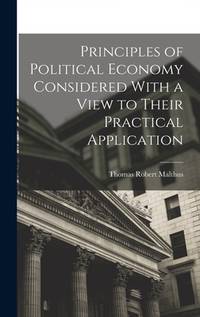
Malthus, T RBiblio.com
542 résultats
0484769146.Ghardcover. Good. Access codes and supplements are not guaranteed with used items. May be an ex-library book. hardcover
1331374057.Gpaperback. Good. Access codes and supplements are not guaranteed with used items. May be an ex-library book. paperback
In 8, pp. 55 + (1). Timbretto di possesso al p. ant. Mancanza del lembo sup. est. del p. ant. D. rifatto. Qualche alone ai margg. delle cc. Br. ed. Nel saggio l'A. ripercorre le posizioni degli economisti che precedettero Malthus sulla questione demografica connessa allo sviluppo delle risorse produttive (Quesnay, Richetti, Genovesi, Beccaria, Verri, Ortes, Filangieri) per poi soffermarsi sulla dottrina dell'economista inglese.
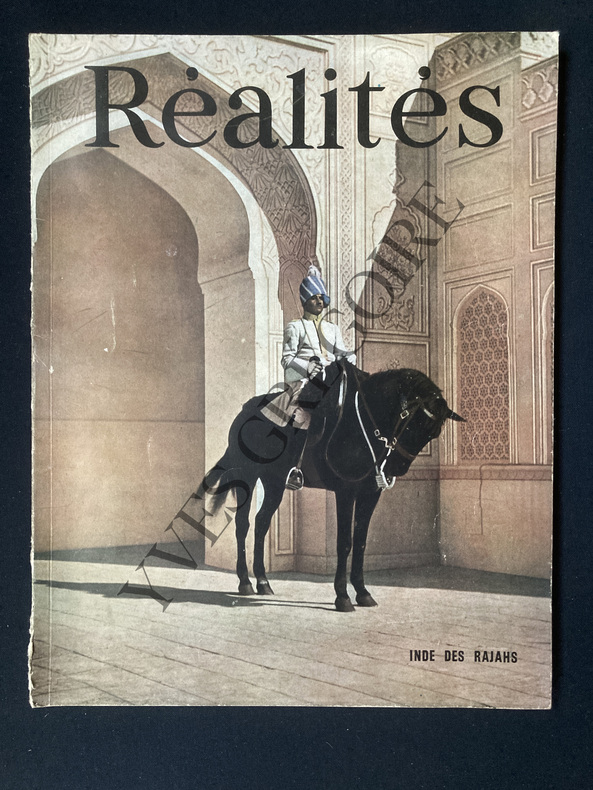
65104n° 385 - janvier 1955 - nouvelle série - revue illustrée - in-4 broché - 32 pages
1949ABE-1172568004390 PAGES FORMAT 24,5 CM X 31,5 CM-EN COUVERTURE "INDE DES RAJAHS"-SIR STAFFORD CRIPPS, 10P PAR J.R.PECHERAL-INDE DES RAJAHS, 5P-L'ACADEMIE FRANCAISE, 8P PAR HENRI PERRUCHOT, PHOTOS ACADEMICIENS-TRANSFUGES SOVIETIQUES, PHOTO TROTSKI, 8P-LA PASSION SELON REMBRANDT, 4P-REVOLUTION AGRICOLE AUX USA, 9P-LA MODE, 7P, DIOR-FORMULES DE COOPERATION ENTRE CAPITAL ET TRAVAIL, 8P-MARIVAUX TRIOMPHE AU MARIGNY ET AU FRANCAIS, 2P, 4 PHOTOS, MADELEINE RENAUD, MICHELINE BOUDET, ROBERT HIRSCH-PUBLICITES PLEINE PAGE
1997x-0714647500Frank Cass & Co 1997. Hardcover. New. 1st edition. 151 pages. 9.75x6.50x0.75 inches. Frank Cass & Co hardcover
1997x-0714644048Frank Cass & Co 1997. Paperback. New. 1st edition. 168 pages. 9.50x6.25x0.75 inches. Frank Cass & Co paperback
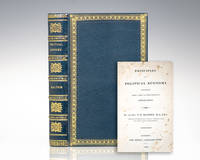
1820119668London: John Murray 1820. First edition of this classic work regarding nature of labor demand and profit. Octavo original boards retaining the original paper spine label. In very good condition. Ownership inscription from the African Society and stamp to the title page. Rare in the original boards. "There can be no doubt that Malthus' importance for economists today rests mainly on his Principles of Political Economy. It was because of this latter work that J. M. Keynes 1933 reinstated Malthus as a major figure in modern economic thought" New Palgrave. "In his 'Principles of Political Economy' Malthus was proposing investment in public work and private luxury as a means of increasing effective demand and hence as a palliative to economic distress. The nation he thought must balance the power to produce and the will to consume" DSB. "The Principles had only a limited impact at the time and was severely criticized by J. R. McCulloch and Ricardo; the latter prepared extensive critical notes. But more recently it has received greater recognition largely as a result of the comments by J. M. Keynes in the 1930s. Keynes argued that Malthus's theory of effective demand provided a scientific explanation of unemployment and that the hundred-year domination of Ricardo over Malthus had been a disaster for the progress of economics. Keynes believed that if economics had followed Malthus instead of being constrained by Ricardo in an artificial groove the world would be a much wiser and richer place" ODNB. John Murray hardcover books
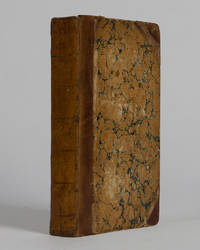
1820242928London: John Murray 1820. First edition. vi 601 pp. 1 vols. 8vo 219 x 132 mm. Bound in later half cloth and marbled boards paper label. Very good. First edition. vi 601 pp. 1 vols. 8vo 219 x 132 mm. First edition of this important classic of economic theory. "There can be no doubt that Malthus' importance for economists today rests mainly on his Principles of Political Economy. It was because of this latter work that J. M. Keynes 1933 reinstated Malthus as a major figure in modern economic thought" New Palgrave. "One of the founders of modern economics" Malthus was credited by Keynes with framing the theory "that a lack of effective demand can cause economic crises" PMM 251. "In his Principles of Political Economy Malthus was proposing investment in public works and private luxury as a means of increasing effective demand and hence as a palliative to economic distress. The nation he thought must balance the power to produce and the will to consume" DSB IX:70. Goldsmith 22767; Lowndes 1459; Kress C577 John Murray unknown books
182123029Boston: Wells and Lilly 1821. First American edition of this landmark work in political economy. Octavo bound in three quarters leather over marbled boards black leather morocco spine label. In near fine condition. In his Principle of Political Economy Malthus was proposing investment in public works and private luxury as a means of increasing effective demand and hence as a palliative to economic distress. The nation he thought must balance the power to produce and the will to consume" DSB. Wells and Lilly hardcover books
182066825"If Only Malthus Instead of Ricardo Had Been the Parent Stem From Which Nineteenth-Century Economics Proceeded What a Much Wiser and Richer Place the World Would be Today" MALTHUS Thomas Robert. Principles of Political Economy. Considered with a View to Their Practical Application. London: John Murray 1820. First edition. Octavo. vi 12-601602. Original boards uncut. With original paper label on spine. Hinges expertly and almost invisibly repaired. Old bookplate from "The Library of Victoria" with no other library markings. A very clean copy internally fine. Very scarce in original boards. Housed in a custom quarter black morocco clamshell gilt-stamped. First edition of Malthus' principal contribution to economic theory. Schumpeter describes Malthus' work in relation to that of his predecessors Adam Smith and Ricardo as follows: "Ricardo's work.started with the Wealth of Nations and recoined the latter's theoretical contents by a method that centered in the concept of value. Exactly the same thing is evidently true of the work of Malthus.except for his theory of saving and investment which on the face of it seems to be Malthus's own all the elements that enter into the analytic apparatus of that work and even its terminological arrangements point to the First book of the Wealth of Nations. Only whereas Ricardo recoined the doctrine of Wealth by means of the labor-quantity theory of value Malthus recoined it by the means of the theory of value that A. Smith actually used namely the theory of supply and demand.whereas Ricardo's analytic apparatus is geared to the problem of distribution.Malthus. geared his apparatus to the analysis of the whole economic process.Therefore Malthus should.stand in the history of analysis not only as the author of a valid alternative to Ricardo's theory but as the sponsor or rather as one of the sponsors of the victorious one." "Although Malthus is best known for the views on population contained in his Essay on Population.there can be no doubt that his importance for economists today rests mainly on his Principles of Political Economy 1820. It was because of the latter work that J. M. Keynes reinstated Malthus as a major figure in modern economic thought". New Palgrave. Cress C577. HBS 66825. $7500 John Murray hardcover books
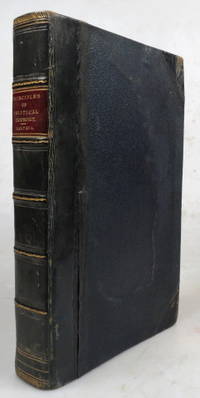
182046619London: John Murray 1820. First edition 8vo vi 601 1 pp. Contemporary black half calf a little rubbed covers very slightly damp stained and bowed gilt spine and red label. "The Principles had only a limited impact at the time. more recently it has received greater recognition largely as a result of the comments by J. M. Keynes in the 1930s. Keynes argued that Malthus's theory of effective demand provided a scientific explanation of unemployment and that the hundred-year domination of Ricardo over Malthus had been a disaster for the progress of economics. Keynes believed that if economics had followed Malthus instead of being constrained by Ricardo in an artificial groove the world would be a much wiser and richer place." ODNB. Goldsmiths 22767. Kress C577. London: John Murray unknown
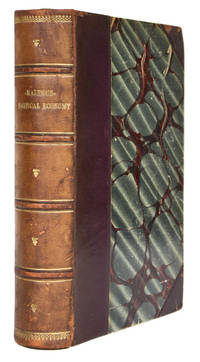
18208125London: John Murray 1820. 1820 vi 601 1 p. First edition. It has a good quality mid-twentieth century binding with a polished morocco spine marbled boards and vellum corners. The spine with gold lines and a contrasting label. Minor rubs to the spine ends otherwise in very good condition. There is an undated pencil note on the title page '£45 Repair'. The text with a few signs of use and some pale paper toning. IMPORTANT COOPERATIVE MOVEMENT PROVENANCE: The title page is inscribed at the head 'Society for promoting Working Men's Assocns / 34 Castle Place -- Oxford Street with a shelfmark R31'. The Society was founded in 1849 by the Christian Socialists in an attempt to found self governing workshops. Lower down the title page is the oval stamp of Ormond Street Working Mens College which still exists in Camden. Founded in 1854 by Frederick Denison Maurice Wiki describes it as 'The Working Men's College is among the earliest adult education institutions established in the United Kingdom and Europe's oldest extant centre for adult education. Founded by Christian socialists at its inception it was at the forefront of liberal education philosophy.' At different times its teachers included Thomas Hughes whose latin lectures were apparently not so popular as his boxing club F.J. Furnival and E.M. Forster. London: John Murray, hardcover
1821040304Boston MA: Wells and Lilly 1821. Book. Very Good. Full-Leather. First American Edition. 8vo - over 7¾" - 9¾" tall. Original full tree calf gilt on burgundy title label mounted on upper spine. Rubbed along edges some surface cracking/crazing rubbed joints and spine extremities. Foxed endpapers some toning and scattered foxing to interior but otherwise intact with firm binding. Former owner's signature on front flyleaf. viii472 pp. Exceptionally scarce first American edition issued a year after the first British edition of 1820. Wells and Lilly Hardcover
18363620869William Pickering 1836. Spine in poor conidition. Browning of pages.This book has hardback covers. Ex-library With usual stamps and markings In poor condition suitable as a reading copy. No dust jacket. Please note the Image in this listing is a stock photo and may not match the covers of the actual item750grams ISBN: William Pickering hardcover
1820884511London: 1820. Some light foxing to the title page otherwise a superior copy in the original papercovered boards with paper spine label. Malthus' Principles of Political Economy did not have its full impact on economic theory until it was revived by J.M. Keynes and P. Sraffa in the twentieth century. Math and technology aside Malthus argues not that society tends toward cannibalistic starvation but that either society will "preventatively" control its population or nature will "correctively" reduce population"Several philosophers and speculatists had supposed that a certain state of society very different from any that has hitherto existed was in itself practicable; and that if it were realised it would be productive of a far greater degree of human happiness than is compatible with the present institutions of society."21 Malthus' argument as stated by Hazlitt is that if man were to give up his existing social institutions then there would be as much bad as good come of it. "For says Mr Malthus though this improved state of society were actually realized it could not possibly continue but must soon terminate in a state of things pregnant with evils for more insupportable than any we at present endure.". First Edition. Contemporary Blue Cloth. Excellent. 8vo. Hardcover
1820143844London: John Murray 1820. Rare first edition of Malthus' classic work. Octavo bound in full diced morocco raised bands gilt titles and tooling to the spine front and rear panels marbled endpapers. In near fine condition. An exceptional presentation. Thomas Malthus was an English economist known for his work in the fields of political economics and demography. His theory that prosperity and production lead not to utopia but to population growth and thereby back to social imbalance known as the "Malthusian trap" was expounded in his Essay on the Principle of Population 1789 one of his most notable and debated works. His Principles of Political Economy was written as a polemic against David Ricardo's On the Principles of Political Economy and Taxation and Say's Law arguing that demand did not grow simultaneously with supply but that they should be analyzed independent of each other expounding ideas which became influential on Keynsian economics. Both these works were divisive incurring backlash and support amongst notable economists. The bleak message of his Principle of Population rendered Malthus a notorious figure: Ebenezer Scrooge from A Christmas Carol for example justifies his refusal to give charity as a Malthusian attempt to control the population. John Murray hardcover
ria9783865507549_inpPaperback. New. New Book; Fast Shipping from UK; Not signed; Not First Edition; Thomas Robert Malthus 1766-1834 was an English demographer and political economist best known for his pessimistic but highly influential views on population growth. For most of his life he was professor of modern history and political paperback
199012049Verona: Stamperia Valdonega per COFIDE Compagnia Finanziaria De Benedetti 1990. Ottimo stato. Mezza pelle editoriale con cofanetto cm 25x17 pp 16 388 6. Prefazione di Carlo De Benedetti. Strenna della Compagnia Finanziaria De Benedetti stampata dalla Stamperia Valdonega in 349 esempari su carta Magnani di Pescia. Esemplare #274. Stamperia Valdonega per COFIDE Compagnia Finanziaria De Benedetti unknown
5070583-nnew. unknown
5070583like new. unknown
45125897like new. unknown
123522London John Murray 1820. . First edition; 8vo 21 x 13.5 cm; moderate spotting front free endpaper just starting to become loose at head of gutter margin remains of a library label to front pastedown; contemporary half calf marbled paper boards spine lettered in gilt dulled; vi 601 1pp.<br /> The first edition of Malthus' treatise on political economy.<br /><br />The book was conceived as a series of tracts rather than a comprehensive and systematic treatise though Malthus published it to establish his own position against that of Ricardo with whom he had been having an ongoing debate about the nature of labour demand and profit. 'In his 'Principles of Political Economy' Malthus was proposing investment in public work and private luxury as a means of increasing effective demand and hence as a palliative to economic distress. The nation he thought must balance the power to produce and the will to consume' DSB.<br /><br />'The Principles had only a limited impact at the time and was severely criticized by J. R. McCulloch and Ricardo; the latter prepared extensive critical notes. More recently it has received greater recognition largely as a result of the comments by J. M. Keynes in the 1930s. Keynes argued that Malthus's theory of effective demand provided a scientific explanation of unemployment and that the hundred-year domination of Ricardo over Malthus had been a disaster for the progress of economics. Keynes believed that if economics had followed Malthus instead of being constrained by Ricardo in an artificial groove the world would be a much wiser and richer place.' ODNB.<br /> Goldsmiths' 22767; Kress C.577. London, John Murray, 1820. hardcover
1820002253London England: John Murray 1820. 1st Edition . Half-Leather. Fair. Contemporary calf with hand marbled covers; leather spine dry flaking and rubbed with small piece missing and gold stamped title barely visiible; covers detached; front paste down with previous owner's book plate and name neatly in black ink; foxing throughout text otherwise very good without markings; 8vo; with 601 pages. <br/> <br/> John Murray hardcover
95378London John Murray 1820. . First edition; 8vo; small ownership stamp to lower outside corner of title-page small early 20th century bookseller's label to lower outside corner of verso of upper free endpaper a little age-toning and small ink smudge to title nineteenth century half calf over marbled boards rubbed at extremities spine faded a very good copy; vi 601 pp.<br /> The book was conceived as a series of tracts rather than a comprehensive and systematic treatise though Malthus published it to establish his own position against that of Ricardo with whom he had been having an ongoing debate about the nature of labour demand and profit. 'In his 'Principles of Political Economy' Malthus was proposing investment in public work and private luxury as a means of increasing effective demand and hence as a palliative to economic distress. The nation he thought must balance the power to produce and the will to consume' DSB.<br /><br />'The Principles had only a limited impact at the time and was severely criticized by J. R. McCulloch and Ricardo; the latter prepared extensive critical notes. More recently it has received greater recognition largely as a result of the comments by J. M. Keynes in the 1930s. Keynes argued that Malthus's theory of effective demand provided a scientific explanation of unemployment and that the hundred-year domination of Ricardo over Malthus had been a disaster for the progress of economics. Keynes believed that if economics had followed Malthus instead of being constrained by Ricardo in an artificial groove the world would be a much wiser and richer place.' ODNB.<br /> Goldsmiths' 22767; Kress C.577. London, John Murray, 1820. hardcover