542 résultats
Mm 125x195 Brossura cucita di pp. 439, in buono stato. SPEDIZIONE IN 24 ORE DALLA CONFERMA DELL'ORDINE.
Mm 145x215 Collana "Politica e società". Brossura editoriale di V-292 pagine. Esemplare in ottime condizioni. SPEDIZIONE IN 24 ORE DALLA CONFERMA DELL'ORDINE.
Mm 140x215 Brossura editoriale con bandelle, pagine 350.Opera in buone condizioni. SPEDIZIONE IN 24 ORE DALLA CONFERMA DELL'ORDINE. WORLDWIDE DELIVERY.
126979 May 1827. 'L. I. Fields' i.e. Lincolns Inn Fields London. 2pp. 12mo. 40 lines. Bifolium. Good on aged paper. The reverse of the second leaf carries half of a red wax seal as well as the address to 'James Loch Esqr Bloomsbury Square'. The letter begins: 'My dear Loch Some friends of mine from the Country are desirous of seeing Lord Stafford's & Lord Grosvenor's pictures some time next week; & they understand that the obtaining of Tickets is not a matter of course but that some little interest is necessary.' He asks for assistance 'with regard to Cleveland House . for Mrs Johnston & party about 5 or 6 persons'. He is going 'to the Cambridge Election' on the following day and thinks that it will be 'very keenly contested'. On his return he hopes 'to attend the Council of the London University' when he hopes 'that Horner's business will be finally & satisfactorily settled'. He has heard 'nothing more about Silk Gowns' but 'Willy Brougham . persists in retaining his appointment and will not be scared into resignation like Plunkett by the Chancery Lawyers.' In the last paragraph he deprecates the news that 'Lord Exeter is to have one of the blue Ribbands though he is no friend of Canning's & indeed closely connected with the high Tory opposition'. This is in his view 'one among many instances of C's weakness & entire dependence upon the higher power.' There is no mention of Loch in Lady Seymour's 'The "Pope" of Holland House Selections from the Correspondence of John Whishaw and his Friends 1813-1840' 1906 and the year 1827 is skirted over. 9 May [1827]. 'L. I. Fields' [i.e. Lincolns Inn Fields, London]. unknown
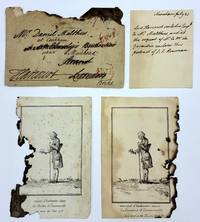
17791748Original manuscript / ink drawing. c.1779-1788. Pen and ink portrait of Jean Jacques Rousseau in the garden at Ermenonville titled beneath "venant d'herboriser dans les Jardins d'Ermenonville au mois de Juin 1778" along with a printed version of the image signed Mayer Georg Friedrich Meyer engraved by J. M. Moreau in 1779. Each 15 x 10cm. Accompanied by an ink manuscript letter 10.5 x 8cm headed "Nuneham July 21" presenting the images: "Lord Harcourt sends his compts. to Mr. Malthus and at the request of Mr. le Mqs. de Girardin encloses this portrait of J: J: Rousseau". Contained within the original postal cover addressed to Mr. Daniel Malthus redirected from his London address to Cookham signed at the foot by Harcourt under the parliamentary privilege franking system with additional "free" handstamps to the front panel and further postal markings to the reverse the specific types of postal markings on the cover indicate a date range of 1779-1788. The ink portrait engraved portrait and postal cover all have historical burn marks and associated loss as well as toning and light foxing; the letter remains in good order. A fascinating and intimate gift linking several late eighteenth-century intellectuals all connected to the French philosopher Jean Jacques Rousseau in the form of two portraits of the philosopher one ink one engraved sent from Rousseau's last pupil René de Girardin Marquis of Vauvray 1735-1808 via the radically-inclined politician and gardener George Harcourt 2nd Earl Harcourt 1736-1809 to the father of the famous economist Thomas Malthus Daniel Malthus 1730-1800 himself a friend of Rousseau.</p><p>The present portrait depicts Rousseau in the final weeks of his life 'botanizing' in the garden at Ermenonville the first French landscape garden created by his pupil René de Girardin who here sends the portrait. Ermenonville was itself inspired by Rousseau's ideas created by Girardin as an illustration of his philosophical and social beliefs regarding the place of man in nature. Within the garden Girardin began construction of a house for Rousseau modelled after the "Élysée" of Julie in Rousseau's novel <em>La Nouvelle Héloïse</em>. Rousseau himself visited the garden in May 1778 staying in a small thatched cottage where he remained until his death in July that year. Girardin subsequently made a tomb for Rousseau at Ermenonville which became a destination of pilgrimage for his admirers until his body was re-interred at the Pantheon in Paris in October 1794. Following Rousseau's death Girardin and two other of his friends of prepared a complete edition of his works using the manuscripts of some of his most important writings including <em>Les Confessions </em>and <em>Les Rêveries du promeneur solitaire</em> which he had left behind at Ermenonville. This new edition was published in Geneva between 1780 and 1782 and contributed greatly to the spread of Rousseau's ideas throughout France and beyond in the years leading up to the French Revolution.</p><p>The original drawing of Rousseau at Ermenonville was executed by the German artist Georg Friedrich Meyer 1733-1779 who also resided with Girardin at Eremenonville during his final years and where he became well acquainted with Rousseau. Other similar versions of this drawing by Meyer exist one being in the collection of the Fine Art Museum of San Francisco and it is unclear as to whether the present pen and ink drawing is an original work by Meyer or a contemporary copy of the engraving - either way its origin from the hands of Girardin himself provide it with sufficient interest. </p><p>The present two portraits subsequently made their way to the politician George Harcourt 2nd Earl Harcourt previously Viscount Nuneham a supporter of John Wilkes friend of Catherine Macaulay opponent of the war against the American colonies and pioneering garden designer. Here he apparently acted as an intermediary in this distinguished friendship circle sending the pictures on to Daniel Malthus - enlightened gentlemen friend of David Hume and Rousseau and father to Thomas Malthus.</p><p>Daniel Malthus had first become acquainted with Rousseau when he visited him at Môtiers in May 1764. He later invited Rousseau and his wife Thérèse to stay at his estate "The Rookery" near Dorking Surrey during the couple's visit to England in 1766 with Malthus hoping to find them a place to settle nearby. They visited the Malthus home for a day with Hume about three weeks after Thomas's birth but ultimately settled in Derbyshire for the remainder of their visit. Daniel and several family members subsequently went north to visit Rousseau joining him on botanical expeditions - a shared passion. Rousseau and Malthus maintained a lifelong correspondence and botanical exchange with the pair enthusiastically swapping English and French literature botanical specimens and philosophical musings. Later in life Rousseau would divide his personal herbarium among his friends sending parts of it to Daniel who also ultimately purchased his botanical library.</p><p>Daniel Malthus was - like Girardin - a dedicated Rousseauist using like many enlightened families of the period Rousseau's <em>Émile</em> as a guide to the education of his children; as he described in a letter to Rousseau of 1768 his children botanized in their local area went on nature walks carried out farm work and conducted their own little experiments. Indeed in his last known letter to Rousseau he declared "if I am ever known it will be as the friend of Rousseau". He would however ultimately be best known by his progeny Thomas who would go on to famously argue against the writings of the thinkers who proclaimed humanity's perfectibility preferred by his father including Rousseau William Godwin and the Marquis de Condorcet. Regardless of this Daniel keenly supported his adult son's endeavours with Thomas's earlier unorthodox education itself also having played a key role in shaping his knowledge of natural law and mathematics. MacDonald J. Marc "Malthus and the Philanthropists 1764–1859: The Cultural Circulation of Political Economy Botany and Natural Knowledge" Social Sciences 2017 61 4. [Original manuscript / ink drawing]. unknown
189311039Torino: Ermanno Loescher 1893. 1893. Good. - Small quarto 9-5/8 inches high by 6-3/4 inches wide rebound without original wraps in dark green cloth titled in gilt with decorations in gilt on the spine. The covers are slightly warped & the binding is bumped & rubbed affecting the titling. The head of the spine is chipped & frayed. 167 pages plus errata/corrigenda page. The pastedowns & endpapers are darkened & there is scattered foxing & light staining. Good. <p>First edition. The text is in Italian.<p>The book is inscribed by the author but the inscription & signature have been partially cut off in rebinding.<p>"This interesting work proposes to examine by the light of scientific criticism the theory of Malthus and the principal objections that have been brought against it. The author turns his attention first to pointing out the irrefutability of the biological tendency as Malthus has shown it and the necessity which devolves upon political economy to recognize it as a fundamental law. Lebrecht does not ignore the objections raised by various writers against this tendency; on the contrary he estimates them with praiseworthy impartiality; yet after careful examination he believes that they are not destructive of the theory.He does not deny that the coefficient of procreation is essentially economic and that poverty is one of its potent factors; yet he affirms that the prolific action of poverty can be remedied by moral influences. From a review of the book by Achille Loria and Cornelia H. B. Rogers in "Annals of the American Academy of Political and Social Science Vol. 4 May 1894 p. 134.<p>Rare. Torino: Ermanno Loescher, 1893. paperback
Mm 140x220 Collana "Campi del sapere" - Brossura editoriale con bandelle, 248 pagine. Copia in condizioni pari al nuovo, ovvero mai letta. SPEDIZIONE IN 24 ORE DALLA CONFERMA DELL'ORDINE.
1815181657London : Printed for John Murray Albemarle Street; and J. Johnson and Co. St. Paul's Church Yard 1815. First Edition. Hardback. Good copy in the original wrappers bound in later 19th century aniline calf over marble boards. Gilt-blocked black leather label to the spine. Spine bands and panels edges somewhat dust-dulled and rubbed as with age. Previous owner's notes/annotations attached to back of title page. Scattered marginal foxing. Remains particularly well-preserved overall; tight bright clean and strong. ; 8vo 8"" - 9"" tall; 48 pages; Description: 48p. 23cm. Subjects: Malthus T. R. Thomas Robert 1766-1834. - Observations on the corn laws. Corn laws Great Britain. Grain trade - Great Britain. Corn - Prices - Great Britain. Agriculture - Economic aspects - Great Britain. Publisher's 8 page catalogue to the rear and dated February 1815. Spine title reads: Malthus - Import of Corn - 1815. London : Printed for John Murray, Albemarle Street; and J. Johnson and Co. St. Paul's Church Yard hardcover
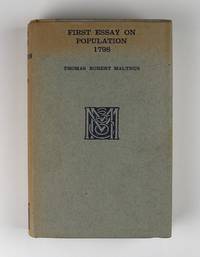
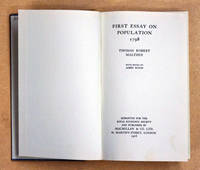
1926WRCLIT66274London: Macmillan & Co. Ltd. 1926. Linen and boards paper label to spine. Facsimile reprint for the Royal Economic Society. Notes by James Bonar. Additional spine label inserted in rear. Toning to edges of boards a bit rubbed and darkened at spine else very good without dust jacket. Macmillan & Co. Ltd. hardcover books
192623332<p>London: Macmillan 1926. hardbound. Very Good in G-VG dustwrapper/Dustwrapper. 8vo. Nice edition of Malthus' Essay on Population reprinting the 1798 original with additional notes by James Bonar; published by Macmillan for the Royal Economic Society; half cloth with grey sides title label to spine replacement label bound in to rear endpapers; endpapers prelims and text block foxed occasional foxing in text o.w. Very Good throughout; mild foxing to edges of boards; dustwrapper tanned to spine and top 4cm of front panel o.w. G-VG.</p> Macmillan hardcover
94317London Macmillan & Co 1926. 8° IX 396 S. XXVII Notes HLwd. Stemp. a Vors. sonst tadell. 010 London, Macmillan & Co, 1926 unknown
1926022745London: Reprinted for the Royal Economic Society and Published By Macmillan & Co. 1926. Book. Half Cloth Paper-Covered Bds. Reprint of 1798 Edition. ix 396p. xxvii p. of notes. A near fine copy with an extra spine-label laid-in at the back and an attractive bookplate on the front paste-down endpaper no d.j. Size: 8vo - over 7¾" - 9¾" tall. Reprinted for the Royal Economic Society and Published By Macmillan & Co. hardcover
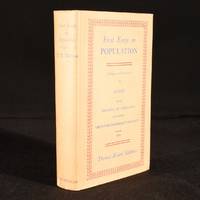
1966948Q29London: Macmillan 1966 . Cloth. Fine/Near Fine. 8.5" by 5.5". None. An excellent facsimile edition of Thomas Robert Malthus's eighteenth-century essay on population with the publisher's dust wrapper. A reprint in facsimile of Thomas Robert Malthus' 'An Essay on the Principle of Population'. Bound in the publisher's cloth with the original price-clipped dust wrapper. Originally published in 1798 this work was written by English economist scholar and cleric Thomas Robert Malthus. In 'An Essay on the Principle of Population' Malthus proposed that an increase in a nation's food production would lead to population growth meaning the initial benefits would only be temporary. With notes by Scottish historian and economist James Bonar to the rear of the work. Bound in the publisher's cloth with the original price-clipped dust wrapper. Externally excellent with minor shelf wear only. Dust wrapper is also excellent with light edge wear and a touch of sunning to the spine. Internally firmly bound. Pages are bright and clean. Fine Macmillan hardcover
19762080502107001749Iwanamishoten 1976. Soft Cover. Fine. Number of pages: 295p Plate size: 15cm Iwanamishoten paperback
Z1-S-008-02813W. Pickering. Used - Good. Spine hinge damaged. Ships from UK in 48 hours or less usually same day. Your purchase helps support Sri Lankan Children's Charity 'The Rainbow Centre'. Ex-library so some stamps and wear but in good overall condition. 100% money back guarantee. We are a world class secondhand bookstore based in Hertfordshire United Kingdom and specialize in high quality textbooks across an enormous variety of subjects. We aim to provide a vast range of textbooks rare and collectible books at a great price. Our donations to The Rainbow Centre have helped provide an education and a safe haven to hundreds of children who live in appalling conditions. We provide a 100% money back guarantee and are dedicated to providing our customers with the highest standards of service in the bookselling industry. W. Pickering unknown
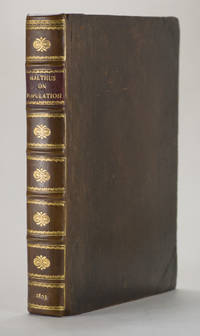
180365276The Economics of Population MALTHUS Thomas Robert. An Essay on the Principle of Population; Or a view of its past and present effects on Human Happiness; With an Inquiry into our prospects respecting the future removal or mitigation of the evils which it occasions. A new edition very much enlarged. London: Printed for J. Johnson. by T. Bensley 1803. Second edition enlarged and revised. Quarto. viii 4 610 pp. Contemporary calf skillfully rebacked to style and with corners renewed. Spine decoratively tooled in gilt compartments with burgundy morocco gilt lettering label. Endpapers renewed. Occasional light foxing. Title-page with publisher's diagonal paper flaw crease. Overall very good. A completely revised and greatly expanded edition of the most influential work on population ever written. Malthus published the first edition of his Essay in 1798 and was apparently unprepared for the torrent of controversy that his ideas provoked. His response to the public outcry was to spend the next five years refining and expanding his theories for this second edition so much so that "in its present shape it may be considered a new work and I should probably have published it as such omitting the few parts of the former which I have retained but that I wished it to form a whole of itself and not to need a continual reference to the other." preface Malthus' basic argument--that population increases geometrically at a greater rate than does the means of subsistence which increases arithmetically--was one of the earliest modern economic and social theories and his contention that it would eventually become necessary for society to impose some form of restraint on over-population provided the premise for heated socio-economic debate for almost two centuries. Kress B4701. See Printing and the Mind of Man 251. HBS 65276. $6500 Printed for J. Johnson...by T. Bensley unknown books
0460006924.Ghardcover. Good. Access codes and supplements are not guaranteed with used items. May be an ex-library book. hardcover
197600003634W W Norton & Co Inc 1976. Third printing. Paperback. New. r. 260 pages. <br/><br/> W W Norton & Co Inc, paperback
180365276London: Printed for J. Johnson.by T. Bensley 1803. The Economics of Population<br> <br> MALTHUS Thomas Robert. An Essay on the Principle of Population; Or a view of its past and present effects on Human Happiness; With an Inquiry into our prospects respecting the future removal or mitigation of the evils which it occasions. A new edition very much enlarged. London: Printed for J. Johnson. by T. Bensley 1803.<br> <br> Second edition enlarged and revised. Quarto. viii 4 610 pp.<br> <br> Contemporary calf skillfully rebacked to style and with corners renewed. Spine decoratively tooled in gilt compartments with burgundy morocco gilt lettering label. Endpapers renewed. Occasional light foxing. Title-page with publisher's diagonal paper flaw crease. Overall very good.<br> <br> A completely revised and greatly expanded edition of the most influential work on population ever written. Malthus published the first edition of his Essay in 1798 and was apparently unprepared for the torrent of controversy that his ideas provoked. His response to the public outcry was to spend the next five years refining and expanding his theories for this second edition so much so that "in its present shape it may be considered a new work and I should probably have published it as such omitting the few parts of the former which I have retained but that I wished it to form a whole of itself and not to need a continual reference to the other." preface<br> <br> Malthus' basic argument--that population increases geometrically at a greater rate than does the means of subsistence which increases arithmetically--was one of the earliest modern economic and social theories and his contention that it would eventually become necessary for society to impose some form of restraint on over-population provided the premise for heated socio-economic debate for almost two centuries.<br> <br> Kress B4701. See Printing and the Mind of Man 251.<br> <br> HBS 65276.<br> <br> $6500. Printed for J. Johnson...by T. Bensley unknown
237568Paris, Guillaumin, 1852 grand in-8, LX-688 pp., portrait, demi-chagrin rouge à coins, dos à nerfs orné, tête dorée (reliure de l'époque).
244594Paris, Guillaumin, 1845; grand in-8, LX-687 pp., broché. Dos abîmé. Rousseurs.
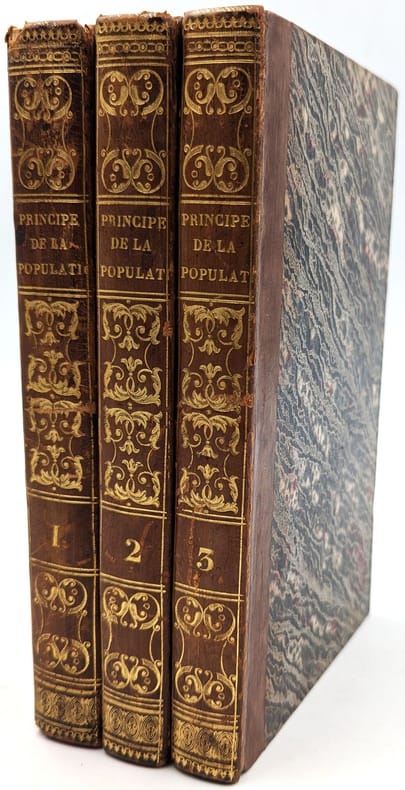
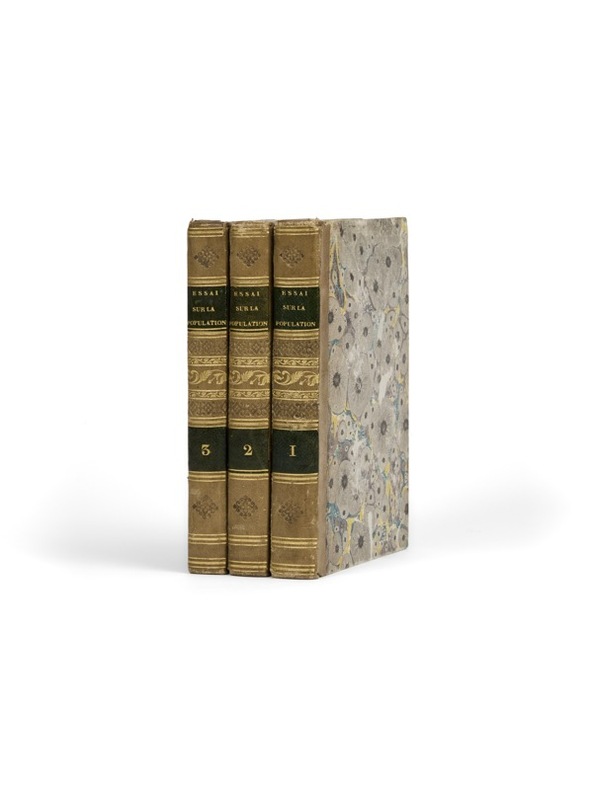
1809103515A Paris et à Genève, chez J.J. Pashoud, 1809, in-8, 3 vol. de I : 424-[6] pp. + II: [4]-395-[3] pp. + III : [6]-392-[5] pp, Demi-veau de l'époque, dos lisses filetés ornés en doré de roulettes et fers rocaille, Première traduction française, très augmentée par Pierre Prévost, pour qui l'ouvrage magistral de Malthus "a pour objet principal de diriger la bienveillance, vertu familière". Thomas-Robert Malthus (1766-1834) avec un siècle d'avance annonçait le principe qui sera repris par Keynes, de la demande effective opposée à la loi des débouchés. Publié originellement en anglais de façon anonyme en 1798, cet essai phare de la pensée économique et démographique du XIXe siècle instaure une réflexion sur le rapport entre le développement de la population et celui des subsistances qui amène à la conclusion que ce sont les salaires qui déterminent le chiffre de la population. Le second thème essentiel de la pensée malthusienne est sa critique du système anglais de lois sur les pauvres (Poor Laws) qui, selon lui, amplifie la pauvreté de manière générale. Excellent exemplaire en jolie reliure de l'époque, dos très légèrement frottés, petit accroc en tête d'une coiffe. Couverture rigide
R150030669GONTHIER.. 1964.. In-12. Broché. Bon état, Couv. convenable, Dos satisfaisant, Intérieur frais. 236 pages. 1ère de couverture illustrée en couleurs.. . . . Classification Dewey : 300-SCIENCES SOCIALES
180930964Un des ouvrages les plus influents de l'histoire de la pensée économique Paris & Genève, J. J. Paschoud, 1809. 3 vol. (120 x 195 mm) de 424, 395 et 392 p. Demi-veau brun, dos ornés de fleurons à froid et roulettes dorées, pièces de titre et de tomaison, tranches jaunes mouchetées (reliure légèrement postérieure). Édition originale de la traduction française.
1963125826Seghers, 1963, in-8°, 373 pp, préface, introduction et traduction par le docteur Pierre Theil, broché, couv. illustrée, bon état