LEROY-ALLAIS , J.Livre Rare Book
542 résultats
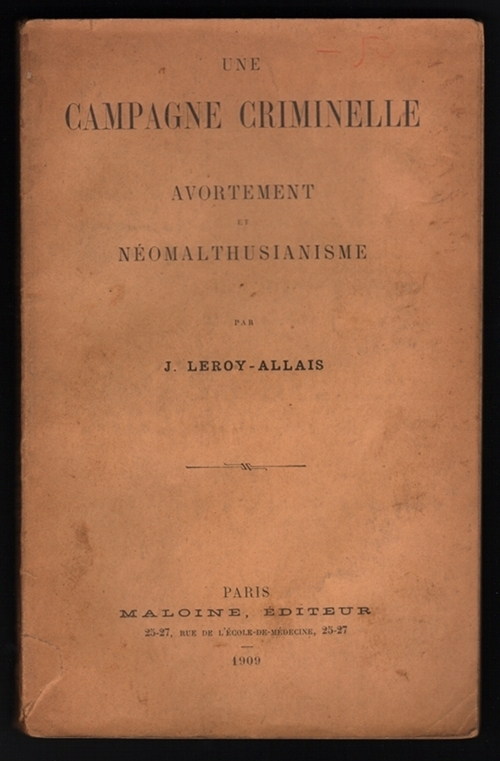
621MALOINE, éditeurs, Paris 1909
1379292573.Ghardcover. Good. Access codes and supplements are not guaranteed with used items. May be an ex-library book. hardcover
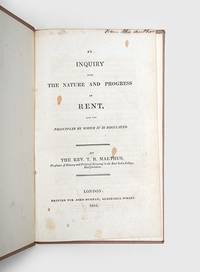
1815168217London: for John Murray; 1815. A major contribution to rent theory First edition first issue presentation copy inscribed in a secretarial hand "from the author" on the title page. The pamphlet is the first expression of Malthus's view for which he is credited as among the founders of the classical theory of rent. "Together with the population principle the theory of rent was one of the chief ideas contributed by Malthus to the re-evaluation of Smith's political economy which took place during the first decades of the nineteenth century" Winch p. 349. Malthus developed the idea from his lectures while professor of history and political economy at the East India College. Its publication grew out of a private debate between Malthus and Ricardo. In response Ricardo expounded on Malthus's ideas and their synthesis was the basis of English thought on rent for the rest of the century. The second issue names J. Johnson and Co. in the imprint. Provenance: with the bookplate of the Dutch economist Arnold Heertje 1934-2020. Octavo 207 x 127 mm pp. iv 62. Twentieth-century pink paper boards red morocco label to spine. Superficial split to front joint contents spotted. A good copy. Black 2877; Einaudi 3673; Goldsmiths' 21130; Hollander 2323; Kress B.6536; McCulloch p. 32. Donal Winch Riches and Poverty 1996. hardcover
116208118X.Ghardcover. Good. Access codes and supplements are not guaranteed with used items. May be an ex-library book. hardcover
0332559939.Ghardcover. Good. Access codes and supplements are not guaranteed with used items. May be an ex-library book. hardcover
1330908910.Gpaperback. Good. Access codes and supplements are not guaranteed with used items. May be an ex-library book. paperback
1806236862London: Printed for T. Johnson 1806. Third edition. xvi 505 1 blank 60 index pp.; vii 1 blank 559 1 pp. 2 vols. 8vo. Contemporary three-quarter calf; joints cracked two boards detached; rubbed and scuffed; scattered foxing throughout; withal a good serviceable copy. Third edition. xvi 505 1 blank 60 index pp.; vii 1 blank 559 1 pp. 2 vols. 8vo. GERITS: Third edition the first to be published in 2 volumes and the first published after the Great Quarto edition of 1803 of one of the most important and influential books in the history of economic thought. The third edition contained numerous revisions among which was a text entitled A Reply to the Chief Objections which have been urged against the Essay on the Principle of Population which was also published separately so that it might be bound with earlier ones. Kress B.5067; Goldsmiths 19210; Einaudi 3669; Carpenter Economic Bestsellers XXXII 3; PMM 251 for the first edition; Blaug Great Economists before Keynes p. 141ff Printed for T. Johnson unknown books
1807314917London: Printed for J. Johnson in St. Paul's Church-Yard by T. Bensley 1807. Fourth edition. 2 vols. 8vo. Contemporary mottled calf marbled edges. Rebacked in gilt calf one hinge tender. Fourth edition. 2 vols. 8vo. Malthus is as controversial as he is influential. "The central idea of the essay . was a simple one. The population of a community . increases geometrically while food supplies increase only arithmetically. If the natural increase in population occurs the food supply becomes insufficient and the size of the population is hecked by 'misery'" PMM. PMM 251 first edition; Kress 5219 Printed for J. Johnson in St. Paul's Church-Yard, by T. Bensley unknown books
180955964Washington City: Printed and published by Roger Chew Weightman another issue of the same printing was published at Georgetown by J. Milligan 1809. First American from the third London edition. 8vo. 2 volumes: xvi 510 xxxiv; vii 542 pp. Half-title to each volume present. Here Malthus "laid down his famous principle that population increases in a geometrical and subsistence only in an arithmetical ratio and argued that population is necessarily limited by the 'checks' of vice and misery" DNB. PMM 251 for the first edition published London 1798. American Imprints 17975. Recent quarter-calf and marbled boards new leather spine labels. Persistent light foxing but a very good copy in an attractive new binding. 2458. <br/><br/> Printed and published by Roger Chew Weightman (another issue of the same printing was published at Georgetown by J. Milligan) hardcover books
180345495London: Printed for J. Johnson by T. Bensley 1803. Second enlarged edition. Large 4to pp. viii 3contents 1errata 610. Bound in contemporary full calf rebacked at an early time with the original spine laid down. Ownership signature on the endpaper of "N.W. Ridley Colborne" on the endpaper and "Horace W. Baddle 1859" on the top of the title page. Some light intermittant spotting and staining but a nice clean copy with wide margins. Garrison-Morton 1693; Carpenter XXXII 2; Einaudi 3668; Goldsmiths' 18640; Kress B.4701; Mattioli 2207 See Printing and the Mind of Man # 251. The great quarto edition of Malthus' masterpiece a very important work in the field of economics and a source of Darwin's "idea of 'the struggle for existence'" PMM The ReverendThomas Robert Malthus FRS 1766 - 1834 was a British scholar influential in political economy and demography. He has become widely known for his theories concerning population and its increase or decrease in response to various factors. The six editions of his Principles of Population published from 1798 to 1826 observed that sooner or later population gets checked by famine disease and widespread mortality. The central idea is a simple one: that population expands geometrically while food production grows arithmetically. This edition though being the second may be considered as a new work which Malthus himself also claimed; -it is thoroughly revised and much enlarged nearly four times the length of the original essay the title has been changed the title of the first is merely: "An Essay on the Principle of Population as it Affects the Future Improvement of Society with Remarks on the Speculation of Mr. Godwin M. Condorcet and Other Writers" He notes: "In the course of this inquiry I found that much more had been done than I had been aware of when I first published the essay. The poverty and misery arising from a too rapid increase of population had been distinctly seen and the most violent remedies proposed so long ago as the times of Plato and Aristotle. And of late years the subject had been treated in such a manner by some of the French economists occasionally by Montesquieu and among our own writers by Dr. Franklin Sir James Steuart Mr. Arthur Young and Mr. Townsend as to create a natural surprise that it had not excited more of the publick attention" Preface to the second edition p. IV. "The "Essay" was highly influential in the progress of thought in the early nineteenth-century Europe. "Parson" Malthus as Cobbett dubbed him was for many a monster and his views were often grossly misinterpreted. But his influence on social policy whether for good or evil was considerable. The Malthusian theory of population came at the right time to harden the existing feeling against the Poor Laws and Malthus was a leading spirit behind the Poor Law Amendment Act of 1834." PMM 251. Printed for J. Johnson, by T. Bensley unknown books
1809101490Washington: Printed and Published by Roger Chew Weightman 1809. First American edition of this cornerstone text of modern economics. Octavo 2 volumes bound in contemporary calf rebacked red and black morocco spine labels gilt titles. Previous owner's inscription to front free endpaper "An application was made to Bishop Watson to answer this book on the grounds that it discouraged benevolence. He declined excusing himself however unfavorably saying that he saw its object was to prove that population could not increase beyond the level of rules of self-evident truth. A much better employment would have been to discover means of resistance that might supply the increasing wants of the population." Bishop Richard Watson served as the Bishop of Llandaff from 1782 to 1816 and published a number of political pamphlets contributing to the Revolution Controversy regarding the fundamental politics of the French Revolution. Watson corresponded with and published several counterarguments to the works of Thomas Paine and Thomas Robert Malthus among others. In very good condition with some browning to the text as usual sporadic foxing. Rare and desirable. Malthus was one of the founders of modern economics. His Essay was originally the product of a discussion on the perfectibility of society with his father who urged him to publish. Thus the first edition published anonymously was essentially a fighting tract but later editions were considerably altered and grew bulkier as Malthus defended his views against a host of critics. The Essay was highly influential in the progress of thought in early 19th-century Europe and his influence on social policy was considerable. Both Darwin and Wallace clearly acknowledged Malthus as a source of the idea of 'the struggle for existence" PMM 251. Printed and Published by Roger Chew Weightman unknown books
180610970London: J. Johnson in St. Paul's Church-Yard 1806. Third Edition. Leather bound. Very good. The Third Edition of An Essay On the Principle of Population by Thomas Malthus. Octavo two volumes xvi 505pp 70pp index; vii 559pp. Period full calf titles in gilt on spines over black labels gilt decorations on spines. Previous ownership inscriptions on front endpapers of both volumes. Bookseller's label on front pastedown endpaper of Volume I. Leather is worn with some loss at top of spine of both volumes. Text block stable in both volumes general and even toning to leaves. Text block free of any marks or notations. Goldsmiths 19210 Kress B5067. The first edition of An Essay on the Principle of Population as It Affects the Future Improvement of Society was published anonymously by Malthus in 1798 as a pamphlet. The book received wide attention for Malthus's argument that hopes for human happiness are in vain because population will outrun the growth of production. He believed that the human population would continue to grow unchecked resulting in long term human poverty now known as the Malthusian Law of Population. Until this point fertility was viewed as a national imperative and a path to continued economic improvement. This work by Malthus changed the national mindset in Great Britain about childbearing. This work first appeared in book form in 1803 with this copy being the third edition published in 1806. J. Johnson, in St. Paul's Church-Yard unknown books
181751078London, John Murray, 1817. 8vo. Bound in three nice uniform contemporary half calf with five raised bands and gilt lettering to spine. Spines with wear. Front board and spine detached from book-block on volume 1. Ex-libris pasted on to pasted down front free end-paper on all three volumes. A fine set.
180362792London, Printed for J. Johnson, by T. Bensley, 1803. Large 4to. Later brown hcalf with four raised bands, single gilt lines and red leather title-label to spine. First three and last 14 leaves a bit brownspotted, title-page and last two leaves marginally repaired at hinge, otherwise a very nice, clean, and solid copy. VIII, (4), 610 pp.
1817140901001London: John Murray 1817. Hardcover. Very Good. xvi 496 p; iv 507 p; 500 p. "The fifth edition with important additions." Complete and unrestored in three volumes. Original boards with orginal paper spines most of which are not surprisingly gone given their fragility. In protective mylar wraps. Very Good condition overall: bindings degraded over time but completely unrestored and text in very nice shape. Clean pages-- no marks-- generally bright for age. Some foxing throughout text and typical waviness. Bumped corners. Not ex-library! Old London bookseller's stamp on front paste downs. Secodn volume front cover creased missing small strip o paper. Third volume front board detached the other covers are intact; the mylar wraps keep them all in place. Nice condition overall. A greatly revised and expanded edition of Malthus' most famous work the second-to-last published during his lifetime. Contains revisions of his views on rent a deeper look at how the political organization of states was determined by population and what limits to population growth were already occurring in Europe and an appendix with replies to critics. An enormously influential and controversial work that inspired Charles Darwin and Alfred Russel Wallace. John Murray hardcover books
1798116955London: J. Johnson 1798. First edition of this cornerstone text of modern economics. Octavo bound in three quarters calf. Laid in is a clipping from an original manuscript signed by Malthus and entirely in his hand which reads in part "If at one time such a given product would make an effectual demand for certain commodities the conditions of the supply of which are supposed to remain the same it would immediately cease to make such effectual." Signed by Malthus in the lower right corner "Malthus." The verso features two further partial lines of text relating to supply and demand. In near fine condition. First editions of Malthus' magnum opus are exceptionally scarce. Malthus was one of the founders of modern economics. His Essay was originally the product of a discussion on the perfectibility of society with his father who urged him to publish. Thus the first edition published anonymously was essentially a fighting tract but later editions were considerably altered and grew bulkier as Malthus defended his views against a host of critics. The Essay was highly influential in the progress of thought in early 19th-century Europe and his influence on social policy was considerable. Both Darwin and Wallace clearly acknowledged Malthus as a source of the idea of 'the struggle for existence" PMM 251. J. Johnson unknown books
2007448692007. ISBN-13: 9781584777281; ISBN-10: 1584777281. One of the Most Influential Works on Political Economy Malthus Thomas Robert. An Essay on the Principle of Population as it Affects the Future Improvement of Society with Remarks On the Speculation of Mr. Godwin M. Condorcet and Others. Originally published: London: J. Johnson 1798. ix 396 pp. Reprinted 2007 by The Lawbook Exchange Ltd. ISBN-13: 9781584777281; ISBN-10: 1584777281. Hardcover. New. $125. Reprint of the very rare first edition. One of the most influential works on political economy it had a profound effect on social policy during the nineteenth century especially on the development of harsher poor laws in Great Britain. It was the guiding spirit behind the Poor Law Amendment Act of 1834. The central point of the Essay is that population increases geometrically while food supplies increase arithmetically which will eventually lead to starvation and disease in the poorest sections of the community. In order to prevent this from happening he posits people especially the poor should have children later in life and limit the size of their families. unknown books
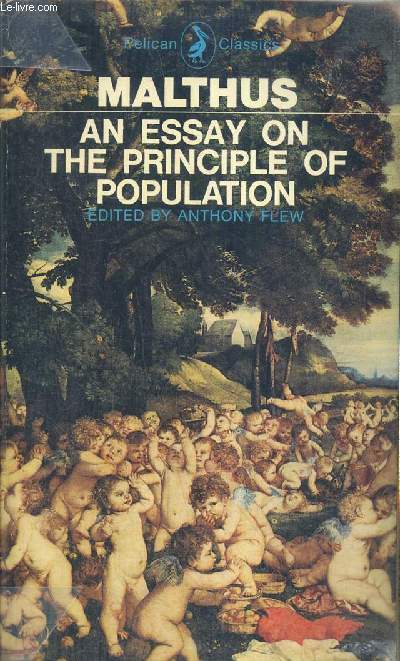
1979RO80260974Penguin Books. 1979. In-12. Broché. Bon état, Couv. convenable, Dos satisfaisant, Papier jauni. 291 pages. Annotation au stylo en page de titre. Texte en anglais.. . . . Classification Dewey : 420-Langue anglaise. Anglo-saxon
1970UMALESS00LAWPenguin 1970. Very Good. Malthus Thomas Robert. An Essay on The Principle of Population. Flew Antony. New York: Penguin 1970. 291pp. Indexed. 12mo. Paperback. Book condition: Very good with lightly bumped edges and subtly rubbed extremities. Contemporary owner's name penned on first page . Penguin paperback books
1997503560Routledge / Thoemmes 1997. Hardcover. VERY GOOD. 535 528pp. Red cloth sewn binding. Complete in 2 volumes facsimile of the 1826 John Murray edition. Vol. II front board dented some wear to text but unmarked and sound. Routledge / Thoemmes hardcover
64429London: for J. Johnson St. Paul's Church-Yard By T. Bensley 1806. Demography FIRST TWO VOLUME EDITION. Octavos 22 x 14 x 8cm pp.xvi; 505; 63 pp.viii; 559; 1. Brown half calf marbled paper over boards. Gilt ruling and red labels containing gilt titles to spines. All edges speckled blue. Interior relatively bright and clean a few leaves spotted/marked. Infrequent pencil annotations throughout each volume. Small ownership inscription in both volumes to a front blank leaf. Toning to corners of all endpapers. Marbled boards rubbed some wear to calf spines and extremities. Very good. Rev. Thomas Robert Malthus FRS 1766-1834 known as Thomas Malthus or Robert Malthus his preference was an English demographer and political economist. He is best known for his pessimistic but highly influential views on population growth. In 'An Essay on the Principle of Population' 1798 Malthus made the famous prediction that population would outrun food supply leading to a decrease in food per person. London: for J. Johnson, St. Paul's Church-Yard, By T. Bensley, 1806 unknown
180775775hLondon: Printed for R. Johnson in St. Paul's Church-Yard by T. Bensley Bolt Court Fleet Street 1807. Book. Very Good. Hardcover. 8vo - over 7¾ - 9¾" tall. Two-volume set in full tree-calf with gilt spines. Professionally re-backed with original spines relaid. Moderate handling and bumping to covers. Edges and endpapers toned. Armorial bookplate of Sir Edward Strachey Baronet Sutton Court Somerset inside front covers; early owner's name in ink to free endpapers. Otherwise clean tight and unmarked -- no foxing or staining to text. Very neat -- a sound and handsome set. Half-titles present; extensive index. xvi580viii48460indexpp. Printed for R. Johnson in St. Paul's Church-Yard, by T. Bensley, Bolt Court, Fleet Street Hardcover
1020321849.Ghardcover. Good. Access codes and supplements are not guaranteed with used items. May be an ex-library book. hardcover
1021167355.Gpaperback. Good. Access codes and supplements are not guaranteed with used items. May be an ex-library book. paperback
1021681350.Gpaperback. Good. Access codes and supplements are not guaranteed with used items. May be an ex-library book. paperback