Election of 1856ABAA
114 résultats
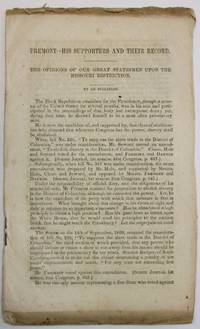
185618521Indianapolis 1856. 16pp disbound. Scattered foxing. Good. <br/><br/> A Democratic presidential campaign pamphlet. It charges that during the brief time that Fremont "the Black Republican candidate for the Presidency" was a U.S. Senator his votes-- opposing the abolition of slavery in the District of Columbia-- showed him "to be a most ultra pro-slavery man." The hypocritical Republicans "use the language of patriotism and of love for the Union.whilst their votes their acts and their organization lead only to a dissolution and all the evils that must follow." The Know-Nothings are just as bad: they "have waged a cruel and relentless war upon foreigners and members of the Roman Catholic church. These classes have been proscribed." Moreover "Abolitionism and Know-nothingism were allies." <br/>FIRST EDITION. LCP 3837. 112 Eberstadt 150d. Not in Sabin Decker Miles. unknown books
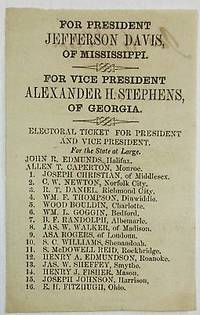
186133882Richmond 1861. Small broadside ticket 3" x 4-3/4". Very good. <br/><br/> A rare Virginia Confederate electoral ticket for the Confederacy's first and only national election: Jefferson Davis for President Alexander Stephens for Vice President. Also listed are two at-large electors and sixteen others by District. <br/>Variant of Parrish & Willingham 5367 5368; Crandall 2744 noting "four variant printings and sizes"; and Hummel 4667-4669. OCLC 58833485 2- U GA Boston Ath. 702707722 1- Yale as of June 2017 different dimensions. unknown books
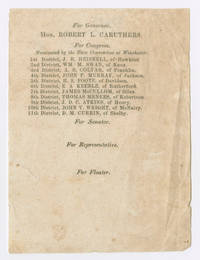
1863WRCAM53688Winchester 1863. Broadside 5 x 3 3/4 inches. Toned minor soiling and wrinkling. Very good. An exceedingly rare Confederate Tennessee state election ticket from 1863 nominating Robert L. Caruthers for governor and eleven others as state senators. In 1863 state elections were due in Tennessee. The state was fractured by war and secession and both Unionists and Confederates expressed the desire to hold elections for state government. Confederate supporters held a convention in Winchester and nominated a governor the State Legislature and members for the Confederate Congress. It was a bit of a fool's errand. <br> <br> Isham G. Harris who still considered himself the governor of Tennessee issued a proclamation calling for the election to be held on the first Thursday in August. Just who voted and how many or how few will probably never be known. According to historians the State Archives in Nashville are scant and inconclusive; returns from only thirty-two counties are found some of which reported the vote of only one civil district. Not a single report was from West Tennessee counties and only eight Middle Tennessee counties made returns. Robert L. Caruthers was elected governor on the face of returns but he was never inaugurated and thus never served a day as governor of Tennessee. No Confederate State Legislature ever convened either. The Confederate Congressmen were the only lucky ones. Those who were elected in 1863 took their seats in Richmond however briefly. <br> <br> George Webb notes this copy in his NOT IN ALLEN bibliography in 2013. Not in Parrish & Willingham. The only other copy or shall we say copies resides at the Library of Virginia in an uncut sheet of six tickets. This will likely be the only copy ever available in the marketplace. WEBB NOT IN ALLEN 199 this copy. unknown books
184034201Washington: Blair & Rives 1840. Folio 8 3/4" x 12". 416pp. Nos. 1-27 of Volume VI; May 16 1840 - October 26 1840 plus No. 27 the final issue recording detailed election results from January 1841. Boards detached endpapers filled with local political tickets. Scattered foxing light wear about Good.<br/><br/> A detailed contemporary report of the 1840 presidential campaign from the perspective of this Democratic publication. It begins with the Democrats' National Convention in Baltimore with the speeches proceedings and Address to the People. A campaign biography of Van Buren the Democrats' candidate and Blair & Rives's as well is included plus discussion of all the issues: slavery abolition internal improvements tariff banks the Whigs' repeatedly referred to as the 'Federal' Party in order to drive home the Democrats' point that the Whigs were descended from the discredited Hartford Convention Federalists muddled program and candidate William Henry Harrison "still shrouded in mystery. Blair & Rives unknown books
185225283New York 1852. 16pp untrimmed uncut and folded. Dusted lightly worn some spine splitting. Good.<br/><br/> A Democratic Party rally during the 1852 presidential campaign endorsing "with joyous hearts the names of Franklin Pierce and William R. King as the favored standard bearers of our political faith in the present campaign. In looking over the troubles and darkness which hung around our National Convention the name of Pierce was discovered like an oasis in our desert to cheer and gladden us all." <br/> This is a variant printing. Our copy's title ends as noted above; the title of the other issue ends with 'Also Kentucky and Virginia Resolutions of 1798 and 1799.' Our issue does not print those Resolutions. Pages 15-16 print the list of Evening Post Documents for the 1852 campaign. <br/>OCLC 319715221 2as of 7/12. See Sabin 89203 and OCLC 21984603 5 for the other issue. unknown books
187632441Washington 1876. 8pp caption title as issued. Disbound a bit roughly in the blank inner margin. Good.<br/><br/><br/> Despite its claims the Democratic Party is not "devoted to a pure high-toned efficient well-conducted civil service." In control of the House of Representatives the Democrats have turned out Union soldiers in droves and have appointed former Confederates to office in their place. Several columns listing names prove the point. <br/>OCLC records a number of institutional locations. unknown books
187615830New York 1876. Caption title as issued. Printed in double columns. 4pp. Disbound a bit roughly else Very Good. unknown books
184411033New-York 1844. 16mo. 152 28 adv. pp. Sewn lacks wraps. A bit of chipping at edges. Good to Good. <br/><br/> An attack on the turncoat John Tyler who was the Whig Harrison's Vice President but betrayed the Whig cause after his own accession to the Presidency upon Harrison's death in 1841. The author supports Henry Clay for President. <br/>BAL 11051. AI 44-3548 5. unknown books
185634450Washington: Published by the Granite State Club of Washington 1856. 24pp. Caption title as issued. Stitched untrimmed curled or lightly chipped at blank extremities. Printed in two columns per page. Very Good.<br/><br/> Opposing the Republican Party and John C. Fremont's bid for the presidency this pamphlet charges that "Black Republican members of Congress" sought "to drive out pro-slavery settlers from Kansas which has resulted in the recent scenes of violence and bloodshed there." Proof of the charge is found in the published proceedings of the Emigrant Aid Society as well as other documents. The Republicans' purpose "of getting up a war in Kansas" is "to help elect Fremont. For the greater the disturbance in Kansas the more clear would be the apparent 'villainy' of repealing the Missouri compromise."<br/> Further proof is found in the proceedings "of the Black Republican Abolition Convention that nominated Fremont." The Conspiracy -- including participation by the "Coal-Black Republicans"-- is examined in all its details. <br/>Not in Sabin or LCP although there are a number of institutional locations. Published by the Granite State Club of Washington unknown books
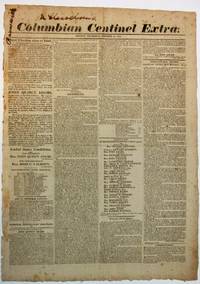
182437247Boston 1824. Elephant folio broadsheet printed in four columns on recto six columns on verso verso consisting of many advertisements several illustrated. 15-1/4" x 21-1/2." Very Good. Ownership signatures at top margin: "Mr. Cleaveland" and "Brunswick."<br/><br/> The Centinel issued this rare Extra to urge the election of John Quincy Adams to the presidency. The list of Adams electors is printed along with the proceedings at the October 27 "Federal Republican Meeting" in Boston "friendly to the election of John Quincy Adams to the Presidency." The Address at that Meeting reviews the other presidential candidates. Henry Clay "is a stranger to your habits and interests." A man of the West "The star of your empire he would have go from your part of it far West." Andrew Jackson places "liberty in danger." Votes for Crawford of Georgia only "tend to make Jackson your President."<br/>Not in American Imprints. Not at the web sites of AAS or MA Hist. Soc. as of November 2020. unknown books
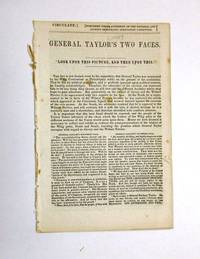
184820489Washington 1848. 8pp printed in double columns caption title as issued. Disbound else Very Good. <br/><br/> A scarce 1848 campaign pamphlet attacking Whig presidential candidate Zachary Taylor who "has no political principles and is perfectly ignorant upon political matters." On the burning issue of the Wilmot Proviso-- whether slavery ought to exist in the territories acquired from Mexico-- Taylor is a hypocrite: "At the North he is represented to be in favor of the Wilmot Proviso." But "at the South his advocates contend that he is opposed.because he is a southern man and a slaveholder and therefore identified with southern interests." <br/> A Louisiana slaveholder Taylor surprised everyone after his election when he supported immediate statehood for California with its anti-slavery Constitution. <br/>Wise & Cronin 44 Taylor. Not in Sabin Miles Eberstadt Decker LCP. unknown books
184819495np 1848. 16pp caption title as issued. Tanned several leaves trimmed closely at the fore-edge with slight loss. Good. A rare 1848 campaign pamphlet attacking Taylor and sketching the biography of Lewis Cass a man "of the highest order of talent" who has filled "almost every grade of office from the lowest to the highest and most responsible in the service of his country. From the first start in life he has been a Democrat. He received the first office he ever held from that great apostle of Democracy Thomas Jefferson in 1807." Taylor by contrast is a "spectacle" as a candidate-- lacking any political opinions and without even a political party to which he can claim loyalty. A General in the Mexican War he nevertheless allowed himself to be the candidate of the Whigs "who have sympathised with the public enemy who have traitorously given him 'aid and comfort' who have voted for the disgrace of their country in Congress by alleging that the war was unconstitutionally commenced." FIRST EDITION. Not in Sabin Miles Eberstadt Decker. Not located in NUC or on OCLC. unknown books
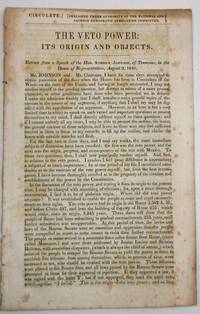
18487855Washington 1848. 8pp caption title as issued. Disbound else Very Good. <br/><br/> A rare 1848 Democratic campaign pamphlet defending President Polk's vetoes. The veto power says his supporter Andrew Johnson "was established to enable the people to resist and repel encroachments on their rights." Since the country's founding Presidents have exercised the veto only 25 times. <br/> The document also includes Virginia Congressman Bayly's 1848 speech concurring with Johnson; and "Judge Story's Opinion on the Veto" taken from his Commentaries. <br/>Not in Sabin Eberstadt. OCLC 24637860 1- Lancaster Hist. Soc. 976424705 1- U VA as of January 2021. unknown books
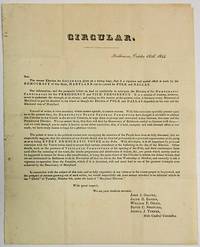
184434342Baltimore 1844. Folio printed sheet folded to 8" x 10". Caption title as issued. 1 3 blanks pp. Last page addressed to a man in Westminster Maryland and postmarked Baltimore Oct. 21. Old folds from mailing red seal remnant on last page. Very Good.<br/><br/> Members of the Maryland Democratic State Central Committee pledge "that we are determined in Baltimore to do" all that is necessary for the Polk-Dallas ticket. This includes "the presence of Vigilance Committees at the opening of the Polls and their continuance there until after the counting of the votes." Baltimore was the scene of many riots in the first half of the 19th century political and otherwise.<br/>Not located on OCLC as of December 2017. unknown books
187215895np 1872. 8pp. Folded with caption title as issued. Light wear trimmed closely at the top without loss of text but affecting several page numbers. Good. Demonstating the abuses heaped upon our great presidents beginning with George Washington and ending with Grant. Charles Sumner whose criticisms of corrupt practices in the first Grant Administration were particularly sharp is excoriated. unknown books
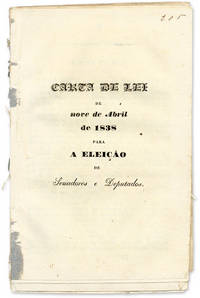
1838609821838. Portugal Election Law. Carta De Lei De Nove De Abril De 1838 Para E Eleicao de Senadores E Deputados Half-title. Porto: Imprensa Constitucional 1838. 33 pp. Folding table. Disbound stab-stitched pamphlet. Light toning foxing to a few leaves early hand-lettered page numbers to upper corners of leaves. $75. The Portuguese law of 1838 governing national elections containing 92 articles with numerous statistical tables relating to district representation. unknown books
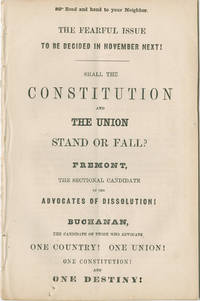
185624482<p>"<i>What a Combination! Seward Greeley Bennet Watson Webb H. Ward Beecher &c. There can be no doubt that this goodly company will speedily be increased by the addition of Fred. Douglass and his black republicans… The only candidate to arrest this tide of demoralization and sectionalism is James Buchanan.</i>"</p><p>This pro-Buchanan election of 1856 pamphlet attacks the first Republican presidential candidate John C. Frémont. Quoting from the speeches and writings of William Lloyd Garrison Horace Greeley Wendell Phillips Salmon P. Chase Henry Ward Beecher William H. Seward Joshua R. Giddings this pamphlet ignores distinctions between abolitionists racial egalitarians more limited opponents just of the expansion of slavery into the territories or those who fought the kidnapping of free African Americans under the Fugitive Slave Law. It paints all with the same broad brush as "Black Republican" extreme abolitionists who were willing to destroy the Union rather than remain in it with slaveholders.</p> <b>ELECTION OF 1856.</b>Printed Document. <i>The Fearful Issue to Be Decided in November Next! Shall the Constitution and the Union Stand or Fall Fremont The Sectional Candidate of the Advocates of Dissolution! Buchanan The Candidate of Those Who Advocate One Country! One Union! One Constitution! and One Destiny!</i> 1856. 24 pp. 5 x 8½ in.<p><b><br /></b></p><p><b>Excerpts:</b></p><p>Before Title: "<i>Read and hand to your Neighbor.</i>"</p><p>"<i>We propose showing by indubitable testimony that John C. Fremont's leading friends are now the open enemies of the Federal Constitution… the enemies of one-half of the States of the Union; the enemies of the laws of Congress; and the enemies to equality of the States.</i>" 3</p><p>"<i>In a speech delivered at the New England Anti-Slavery Convention on the 29th of May 1856 by Wm. Lloyd Garrison we have a flood of light shed on the relation between abolitionism and republicanism which divests the subject of all doubt or uncertainty.</i>" 4</p><p>"<i>William H. Seward was known at the Abolition Convention at Philadelphia… as one of Fremont's warmest supporters. Indeed it is well known that to Chase Seward and Greeley Fremont is mainly indebted for his nomination: they defeated McLean.</i>" 7</p><p>"<i>Nathaniel P. Banks Abolitionist and Disunionist was elected Speaker of the House by a solid sectional vote: he did not get one vote from the South.No man has exhibited such ferocious hostility to the fugitive slave law to the compromise measures and to the Federal Constitution. His speeches full of treason and of war would fill a volume.</i>" 8 and 9</p><p>"<i>Every leading committee has an Abolition Disunionist for chairman and a Disunion majority! There some thirty-five committees in the House… Black Republicans monopolized all the great committees. Thus was the work of Disunion formally begun in the Congress of the United States! This monstrous act unprecedented in all our history was the deliberate work of the men who now surround Fremont.</i>" 10</p><p>"<i>The reverend agitator Ward Beecher is out for Fremont in the last number of his 'Independent.' He is probably next to Garrison and Phillips the most profligate calumniator of the Constitution and the Union.</i>" 19</p><p>"<i>What a Combination! Seward Greeley Bennet Watson Webb H. Ward Beecher &c. There can be no doubt that this goodly company will speedily be increased by the addition of Fred. Douglass and his black republicans. Every Black Republican in Congress from New York is now the earnest advocate of Fremont.</i>" 20</p><p>"<i>We aver that there is not an Abolitionist or Disunionist in Pennsylvania who is not an active and open friend of John C. Fremont for the Presidency. David Wilmot and William F. Johnston lead the motley crew both recreants from the Democratic party because the Democratic party respected the Constitution of the United States and would not desert its injunctions… The only candidate to arrest this tide of demoralization and sectionalism is James Buchanan. It is against him and against the Constitution that this combination has been formed.</i>" 23</p><p>"<i>in the South every vote thrown for Mr. Fillmore is more or less an aid to John C. Fremont to the extent that it may weaken James Buchanan.</i>" 24</p><p>"<i>We would speak of Mr. Fillmore with entire respect. His speech at Albany was patriotic and forcible but it cannot be denied that out of New York in the North all those who pretend to support him will be called upon in the State elections to unite against the Democratic party with the friends of Fremont otherwise known as the Black Republicans.</i>" 24</p><p><b>Historical Background</b></p><p>James Buchanan won with 1.8 million votes and 174 electoral votes from 19 states. Fremont received 1.3 million votes winning 11 northern states with 114 electoral votes. American Party "Know Nothing" candidate and former President Millard Fillmore received 873000 votes winning Maryland's 8 electoral votes. Frémont received no votes at all in 10 of the 14 slave states and fewer than 1200 votes total in the other 4 slave states.</p><p><b>John C. Frémont</b> 1813-1890 "the Pathfinder" was a legendary explorer who achieved military victories in California during the Mexican War. He entered politics as California's first senator and then became the first Republican presidential candidate in 1856. During the Civil War Lincoln removed Frémont from command in Missouri after he unilaterally declared martial law and threatened to confiscate all property including slaves of Southern sympathizers. Lincoln gave Frémont command of an army in western Virginia where he was defeated by Stonewall Jackson in the Battle of Cross Keys. After Frémont refused to serve under General John Pope Lincoln never again gave him a field command contributing to a personal grudge. In 1864 Frémont abandoned his third-party campaign for the presidency in September after Lincoln agreed to remove U.S. Postmaster General Montgomery Blair from office.</p><p><b>Condition</b></p><p>Disbound minor pin holes very good.</p> books
186033068Washington City: Issued by the National Democratic Executive Committee 1860. 8pp caption title as issued. Disbound tanned light dustsoiling. Good.<br/><br/> Breckinridge Buchanan's Vice President was the 1860 presidential standard-bearer of the Southern Rights branch of the Democratic Party which had split with Stephen Douglas supporters during the 1860 nominating convention. Douglas had defied Buchanan and broken with him over the Kansas issue. This campaign piece demonstrating Northern support for the Breckinridge-Lane ticket charges the Douglas faction with unfairness hypocrisy and illegal attempts to silence the Southern Democrats at the abortive Democratic Convention at Baltimore. <br/>LCP 4504. Issued by the National Democratic Executive Committee unknown books
185623950Washington 1856. 16pp disbound printed in double columns. Last leaf browned else Very Good. This is one of several variant titles-- the first two clauses appear identical in all versions-- charging Fremont the first Republican presidential candidate with financial improprieties while disbursing officer in California in the 1840's. This one also accuses him of exaggerating his military achievements which were minimal at best. Cowan 222. Rocq 16684. LCP 1239. unknown books
185619546Washington 1856. 14 2 blank pp. Disbound partly loosened. Tanned with some foxing and light wear. Good. <br/><br/> "Principally of his frauds in the purchase of horses in 1846 and 1847 while disbursing officer in California." Cowan. "Carelessness recklessness favoritism and connivance with the claimants." That's the verdict on Fremont. The pamphlet examines "the chief dealings of Colonel Fremont as a disbursing officer during the campaign in California whilst he commanded the volunteers" during 1846-1847. Tables facts figures are produced and analyzed. <br/>FIRST EDITION. Cowan 222. Rocq 16684. Not in Eberstadt Decker. unknown books
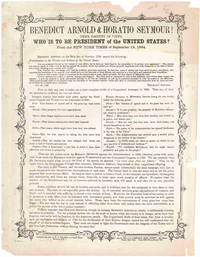
1868WRCAM48472Brooklyn: D.S. Holmes 1868. Broadside 13 x 10 inches. Some small tears chipping and loss at top and right edges. Minor foxing. Very good. Broadside printed for the U.S. Presidential Campaign of 1868 which pitted former New York governor Horatio Seymour against Gen. Ulysses S. Grant. This broadside points out Seymour's Copperhead tendencies and statements made by him in 1864 linking him to similar sentiments made by the notorious traitor Benedict Arnold. Seymour's Copperhead utterances during the war haunted his campaign and he lost decisively to Grant. The text printed here strives to demonstrate: <br> <br> ".the points made by Horatio Seymour against the Administration in 1864 are identical point by point with those made by Benedict Arnold against Washington and the Continental Congress in 1780.The Copperhead chiefs of these times who draw so lavishly upon the sophistries and fallacies of 1780 for the furtherance of their factious designs cannot too well understand that the sequel to all this is endless disgrace. They must not expect to fight the Government with weapons of the Tories and of the blue-light Federalists without sharing the same fate." D.S. Holmes unknown books
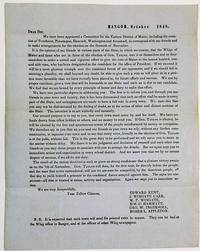
184834421Bangor 1848. Folio sheet folded to 7-3/4" x 10". Printed on first page only; second page blank; third page with a manuscript letter urging the recipient whose last name is Chandler to campaign vigorously for the Taylor-Whig ticket. Very Good.<br/><br/> A plea to get out the vote for Taylor. "If Gen. Taylor is elected he will be elected by the free and spontaneous action of the people uninfluenced by money or corruption.The signs are auspicious-- all that is wanted is union activity and organization." The printed letter is signed in type by Edward Kent J. Wingate Carr W.P. Wingate Wm. C. Hammatt Geo. W. Ingersoll and Moses L. Appleton. unknown books
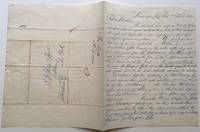
1840273086Washington 1840. unbound. 2 pages front and back 10 x 8 inches written by George Folts of Washington City to his brother James at Albany New York October 3rd 1840 concerning their misguided notion that Martin Van Buren the Democratic Party nominee for President would win the State of Ohio in the Presidential election despite the fact that his Whig opponent William Henry Harrison resides there in part: ".We have assurances from the best sources that Ohio will be ours in November.at all events from present appearances our chance seems much the best. All eyes are turned towards the Empire State it is the battle ground if she will prove true to her best interests and all will be well. Mr. Durham the bearer of this formerly of Albany now a Clerk in this office leaves tomorrow. He is a clever fellow and a good Democrat." Note: George Folts received his Clerks job in Washington through the patronage system. Usual folds plus some pencil underlining; very good- condition.<br/><br/> "We have assurances from the best sources that Ohio will be ours in November"<br/><br/> unknown books
193624942<p>This sheet contains five rough sketches of graphics calling on the workers and voters of America to support Franklin D. Roosevelt's reelection in 1936. They did in record numbers.</p> <b>PRESIDENTIAL ELECTION OF 1936.</b>Typed Document Signed. Artwork by Franz Felix and Ideas and Copy by Richard Barron "Set of Rough Sketches Containing Some Suggested Promotion Ideas to be Used in the 1936 Democratic Presidential Campaign" July 2 1936. 1 p. 12 x 10½ in.<p><b><br /></b></p><p><b>Excerpts:</b></p><p>"<i>1. Sounding the call against 'economic royalists' in the spirit of 1776.</i>"</p><p>"<i>2. Appropriating the well-known symbol of violence</i> upraised fist<i> diverting it to peaceful democratic use. To include the farmer phrase the appeal: TOILERS OF AMERICA – UNITE FOR ROOSEVELT.</i>"</p><p>"<i>3. The statue of 'The Thinker' as a symbol of the man today who thinks the toiler with brawn and brain.everyman.</i>"</p><p>"<i>4. Direct appeal to radical labor and leftists in general.</i>"</p><p>"<i>5. Another way of appealing to the working class men and women.</i>"</p><p>"<i>This collaborative effort respectfully submitted for consideration to the Chairman of the Democratic National Committee Mr. James A. Farley.</i>"</p><p><b>Historical Background</b></p><p>After unseating incumbent Republican President Herbert Hoover in 1932 President Franklin D. Roosevelt ran for reelection in 1936. His Republican opponent was Governor Alf Landon of Kansas. Although the Great Depression had entered its eighth year Roosevelt's New Deal policies were broadly popular. He won the highest share of the popular and electoral vote since the uncontested 1820 election. Roosevelt attracted more than 60 percent of the popular vote and won the electoral votes of 46 states; Landon won the electoral votes of only Maine and Vermont.</p><p>Democratic Party chairman James Farley had predicted that Roosevelt would lose only Maine and Vermont. After the results of the 1936 election Farley quipped that the nation needed to revise the conventional political wisdom of "As Maine goes so goes the nation" to "As Maine goes so goes Vermont."</p><p>These ideas for campaign imagery employed or modified common images to support Roosevelt's campaign. One drew on the imagery of artist Archibald Willard's 1875 painting <i>The Spirit of '76</i> and employed three figures of workers to match the subjects of Willard's image. Another appropriated the upraised fist as a symbol of violence and repurposed it as a symbol of defiant unity against "<i>economic royalists</i>." A third used an image of <i>The Thinker</i>by French sculptor Auguste Rodin 1840-1917 to appeal to thinking voters. Another image appeals to the fears of radicals that the alternative to Roosevelt is "<i>Reaction</i>."</p><p>Richard Barron and artist Franz Felix submitted these ideas to Democratic National Committee chairman James A. Farley on July 2 1936 three weeks before the Democratic Party held its convention in Philadelphia. There is no evidence that these images were used in the campaign and it is possible that Farley rejected them. At the end of the campaign the Democratic National Committee had a campaign deficit of approximately $850000. To help offset those expenses the treasurer convinced President Roosevelt to sign 2500 brief Forewords which were bound into <i>The Democratic Book 1936</i> and sent to donors of $250. Purchases brought in more than $400000 for the party and led Republicans to charge corrupt practices for allowing corporations to contribute to the campaign by buying copies.</p><p><b>Franz Felix</b> 1892-1967 was born in Vienna Austria and developed an ability as a child to draw portraits in charcoal. He studied portraiture in Vienna and immigrated to the United States shortly after World War I. He settled in San Francisco where he established himself as a portrait artist and commercial illustrator. In the late 1920s he moved to New York and established a studio in the suburb of Spring Valley where he produced book and magazine illustrations. During World War II he painted a series of murals of wartime activities of Spring Valley residents.</p><p><b>James A. Farley</b> 1888-1976 was born in New York into an Irish Catholic family. After his father died he helped his mother with a small business to support the family. After graduating from Packard Business College in New York City where he studied bookkeeping and other business skills Farley got a job with the U.S. Gypsum Corporation. He served as a Democratic town clerk in Stony Point New York and became chairman of the county's Democratic Party in 1918. He organized upstate Democrats and helped elect Alfred E. Smith as Governor that year. He served in the New York State Assembly in 1923 but was defeated at the next election for supporting the repeal of Prohibition. As chair of the state Athletic Commission Farley fought for the civil rights of African American athletes. Farley founded he General Builders Corporation from smaller firms to become New York City's largest building supply company. Farley directed Franklin D. Roosevelt's narrowly successful New York gubernatorial campaign in 1928 and his reelection in 1930. Farley served as chairman of the New York State Democratic Committee from 1930 to 1944 and helped build the national New Deal coalition that elected Roosevelt to the Presidency four times. In 1932 Farley became the chairman of the Democratic National Committee and in 1933 U.S. Postmaster General. He held both positions until 1940. Farley and Roosevelt broke on the two-term tradition of the Presidency in 1940 and he later helped propose the 22nd Amendment to the U.S. Constitution limiting a person to two elections as president approved by Congress in 1947 and ratified in 1951. Farley became chairman of the board of the Coca-Cola Export Corporation in 1940 and held that position for more than thirty years.</p> books
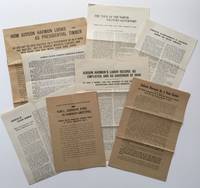
1912371Columbus Oh 1912. About very good. Eight pieces including one 12pp. pamphlet and seven broadsides and bifolia. Old folds light wear. Several items evenly tanned. An informative group of eight extremely scarce or unrecorded pieces promoting the presidential campaign of Ohio Governor and former U.S. Attorney General Judson Harmon in 1912. Harmon eventually lost out to Woodrow Wilson at the Democratic National Convention. The most substantial piece a twelve-page pamphlet concerning Harmon's "presidential timber" located only at the Ohio History Center lavishes praise upon his character and provides a lengthy discussion and defense of his legislative record as Governor. The remaining pieces are not recorded by OCLC and include an endorsement from the late mayor of Cleveland Tom L. Johnson a broadside comparing Harmon's record with Wilson's a four-page endorsement by Charles H. Wirmel leader of the Ohio Steam Engineers Union a broadside printing of endorsements from Progressive leaders in the Democratic Party and two printings of remarks made by Harmon before Democratic Party gatherings. Scarce and ephemeral material on the Democratic contest for the presidential nomination in 1912. unknown books