210 résultats
18256784Paris: Dondey-Dupre Pere et Fils 1825. Hardcover — Tapa dura. 133x80mm. 5¼x3¼". Paris Dondey-Dupre Pere et Fils 1825. En 12º 133 x 80mm. 110 pp. 1 h. Encuadernación de la época en piel. Primera edición francesa. La Constitución Federal de los Estados Unidos Mexicanos de 1824 entró en vigor el 4 de octubre de ese año después del Imperio Mexicano de AgustÃn de Iturbide. En la nueva Constitución la República tomaba el nombre de Estados Unidos Mexicanos y era definida como una República Federal Representativa. Esta traducción francesa es rara en comercio. Dondey-Dupre Pere et Fils hardcover
182328505Santiago de Chile: Imprenta Nacional 1823 or 1824. Small 4to 22 cm; 8". 81 1 blank pp. <br><br>Sixth Chilean constitution the first having been the Reglamento para el arreglo de la Autoridad Ejecutiva Provisoria de Chile 1811. The author here was Mariano Egaña 17931846 "one of the two or three best-read Creole intellectuals of the time. . . . but The constitution was far too complex to be applied to Chile or anywhere else" Collier & Sater History of Chile pp. 4849. This constitution and its 277 articles were replaced by the Ensayo Federal de 1826. <br>Â Â Â Â <br>Â Â Â Â Briseño I 74; Palau 59709. 20th-century Spanish sheep. Stitching holes in inner margins. Very clean. A very good copy. Imprenta Nacional unknown books
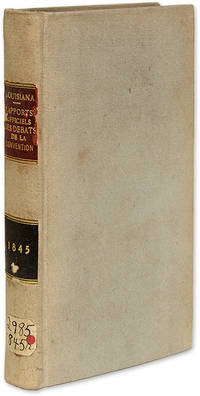
1845700771845. French-Language Account of Louisiana's 1845 Constitutional Convention Louisiana. Constitution of 1845. Foullouze Foulhouze James Reporter. Rapports Officiels Des Devats sic de la Convention la Louisiane. New Orleans: J. Bayon Imprimeur de la Convention 1845. i 460 11 pp. Text in parallel columns. Octavo 9-1/2 x 6-1/4. Later library cloth red and black calf lettering pieces and paper location label to spine endleaves added. Some soiling and light shelfwear some chipping to edges of lettering pieces. Light browning and foxing to text early mark sin pencil to a few passages lower corners lacking from a few leaves with no loss to text library stamp to title page "8049" in early hand to its verso. $1850. Only edition. Louisiana's first constitution was adopted in 1812 its second in 1845. More liberal than its predecessor it expanded white male suffrage established public schools and granted the right of appeal to felons sentenced to death or hard labor. The final 11 pages contain a French translation of the 1845 Constitution. Also issued in English Foullouze's report is not to be confused with the Official Reports of Debates 1844 a different account by an anonymous author. The French edition of Foullouze's report is scarce the English edition in rare. Jumonville Bibliography of New Orleans Imprints 1390. Babbitt Hand-List of Legislative Sessions and Session Laws 150. unknown books
183218408Bogotá: Tipografia de Bruno Espinosa 1832. Small 4to. lvii 1 pp. <br><br>Official printing of the first Colombian constitution after the dissolution of the Republic of Gran Colombia 182230 and the short period of revolving leadership 183032. The constitution decentralized power vesting it in the states which then proceeded to snipe at one another; eventually civil war broke out. In 1842/3 a peace was achieved and in 1843 a new constitution with centralized power was promulgated. Searches of WorldCat locate only six copies in the U.S. <br>Â Â Â Â <br>Â Â Â Â Not in Palau Contemporary calf over paste boards; spine lacking; covers barely holding on. Serious worming to preliminaries and title-page costing letters. Worming in margins of other leaves. An "okay" copy of a scarce and historic constitution. Tipografia de Bruno Espinosa hardcover books
18341215671834. First Edition. DORR Thomas Wilson. An Address to the People of Rhode-Island From the Convention Assembled at Providence on the 22nd Day of February and Again on the 12th Day of March 1834 to Promote the Establishment of a State Constitution. Providence: Cranston & Hammond 1834. Octavo period-style half diced calf gilt marbled boards pp. i-v 6-60. $2400.First edition of Dorr's foundational Address prompting his role as instigator and leader of the Dorr Rebellion placing him ""in the front rank of the political reformers of Jacksonian America.Born into privilege Rhode Island's Thomas Dorr became ""a political insurrectionary who hastened the demise of the royal charter of 1663 and the adoption of a written constitution"" Wiecek Peculiar Conservatism 242. Following the American Revolution by the 1820s Rhode Island remained the only state that clung to its colonial charter which ""restricted suffrage to white men who possessed real estate valued at a minimum of $134"" Chaput Proslavery and Antislavey Politics 662-63. It had ""evolved from the most to the least democratic state"" Lemons Rhode Island's Ten Turning Points 62. ""Dorr's political goals'free suffrage' with no discrimination against the foreign-born 'one-man one-vote' an independent judiciary a more powerful and dynamic executive the secret ballotthough not permanently achieved in Rhode Island during his lifetime placed him in the front rank of the political reformers of Jacksonian America"" ANB.In 1834 Dorr ""asked the General Assembly to call a convention to revise the state constitution in favor of taxpayer-militia suffrage and to adopt 'equal representation'"" Wiecek 242. In this major Address delivered at that convention and ""composed primarily by Dorr"" Conley Democracy in Decline 255 he states: ""No form of a Constitution can be worth much if in this State the Legislative power is in the hands of less than one third part of the qualified voters. A few political managers rule the whole State as they please against the will of two thirds of the freeman and three fourths of the people"" emphasis in original."" To Dorr the state's ""strange adherence to the charter"" left Rhode Island with an ""inequality of representation too unjust to be much longer tolerated."" In 1841 after Dorr was elected ""the People's governor"" under the state's ""People's Constitution"" he became the leader of the 1842 Dorr rebellion which historian Sean Wilentz calls ""'a striking and exceptional case in the history of American democratization before the Civil War' calling it no less than 'a deadly serious test of democracy's meaning and democracy's future.'"" The Dorr Rebellion increasingly viewed as the ""most significant political and constitutional event between the Age of Jackson and the election of Lincoln Dorr's constitutional understanding had roots not only in the Revolution and the post-Revolutionary era; it remained a vibrant part of American constitutionalism"" Chaput Rhode Island Question 55-56. Sabin 70537. American Imprints 26527. Text generally fresh with light scattered foxing. hardcover
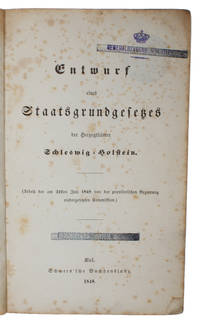
184859828Kiel, Schmers'sche Buchhandlung, 1848. 8vo. In the original blank blue wrappers. Provisional repair with tape to spine. Front-wrapper missing upper inner corner. Two stamps to half-title, title-page and verso of title-page. Upper outer corner of half-title missing, far from affecting text. Occassional brownspotting throughout. 34 pp. with a blank leaf inserted between every printed leaf (giving a total of 33 ff., including the blanks).
184859828Kiel Schmers'sche Buchhandlung 1848. 8vo. In the original blank blue wrappers. Provisional repair with tape to spine. Front-wrapper missing upper inner corner. Two stamps to half-title title-page and verso of title-page. Upper outer corner of half-title missing far from affecting text. Occassional brownspotting throughout. 34 pp. with a blank leaf inserted between every printed leaf giving a total of 33 ff. including the blanks. <br/><br/><em>The rare first printing of the drafting of the constitution by the provisional government for the Duchies of Schleswig-Holstein. In 1848 the Schleswig-Holsteiners decided to establish a provisional government and oust the Danish king. The subsequent war 1848-1851 achieved a status quo until a permanent solution between Denmark and Germany was reached in 1920. The 1848-1852 events in Schleswig-Holstein were a Danish-German confrontation. The underlying issues were complex: The kingdom of Denmark and the duchies of Schleswig and Holstein were component parts of the Danish Monarchy and were united in the person of the king/duke. Schleswig was a Danish fief Holstein a member of the German Confederation. A 1665 law introduced succession through the female line in Denmark with the survival of Salic law in the duchies held in abeyance. Schleswig had a strong Danish element in the north Holstein was German. "With the extinction of the male royal line in the offing Christian VIII declared in 1846 that the 1665 law applied to Schleswig and with some reservation to Holstein. Protests in the duchies had not been resolved when in the wake of the February revolution the liberals in Copenhagen took over and moved toward the annexation of Schleswig. In defiance the estates of Schleswig and Holstein set up a provisional government on March 24. Being composed of liberals and conservatives it obtained popular and official support in Germany and with Prussian military support gained control of most of the duchies by midsummer. But then Britain and Prussia intervened pressuring Prussia to make a truce with Denmark at Malmö August 26 1848 a truce which caused a parliamentary crisis in Frankfurt. In a short time Schleswig-Holstein had become the national issue and by acceding to the Malmö truce the Frankfurt Assembly severely damaged its political credit.Fighting resumed in 1849 and was ended by a July truce. After losing German military support the duchies were defeated in the 1850 campaign. The government abdicated on February 1 1851 and the Danish authorities took over a year later. In the final settlement the powers restored the Danish monarchy with the succession in the duchies to follow that of the kingdom Second London Protocol of May 8 1852. In separate notes the Danish government agreed to preserve the status of Schleswig and to abstain from steps leading to its incorporation. While the agreements restored the balance of power the relations between Danes and Germans suffered eroding popular sentiment for the Danish monarchy. Also Schleswig became a matter of outside concern permitting Prussian intervention in the case of Danish non-compliance." Ohio Univerty; Lawrence D. Steefel Sleswig-Holstein Question. </em> unknown
18501229871850. First Edition. CONSTITUTION SPOONER Lysander. A Defence for Fugitive Slaves Against the Acts of Congress of February 12 1793 and September 18 1850. Boston: Bela Marsh 1850. Octavo original wrappers; pp. 1-2 3-4. i-iv 5 6-72. $3200.First edition of the rogue abolitionist's provocative call for ""vigorous"" public resistance to a pattern in the 1793 and 1850 Acts and court decisions such as Prigg v. Pennsylvania that demonstrated the government's refusal ""to champion liberty or justice"" especially elusive in original wrappers.The 1850 Fugitive Slave Act ""exposed the futility of antislavery constitutionalism grounded in a commitment to the 'proper rules of interpretation'"" Knowles Seeing the Light 544. It ""evinced a clear congressional policy favoring harsh and summary enforcement of the rendition policy over any solicitude for procedural or substantive rights of alleged fugitives"" Cover Justice Accused 121. Spooner crafted his answer to this in a ""devastating critique"" of both the 1793 and 1850 laws Smith Lysander Spooner. Defence one of his most elusive and provocative works offers ""significant evidence of the ways in which the passage of the 1850 Fugitive Slave Act shook his faith in the ability of the nation's courts to interpret the constitution in a manner consistent with the dictates of natural justice"" Knowles 546. Closely analyzing ""reasons why the 1793 and 1850 laws were unconstitutional he made it very clear why the passage of the 1850 law pushed him away from the 'quiet argument' of the courtroom to 'more vigorous'"" public action. In Defence while he continued to argue the importance of ""procedural objections to the laws Spooner spent far greater time 1 explaining why the courts would not actually strike down either of the laws and 2 outlining 'The Right of Resistance': ways in which 'The People' could respond to what he now recognized as the 'ugly reality' of proslavery constitutionalism."" He notably pointed to ""the 1842 decision in Prigg v. Pennsylvania in which the Supreme Court held that under the Constitution's Supremacy Clause the 1793 Fugitive Slave Act trumped Pennsylvania's personal liberty law which had made it far more difficult for slaveholders to recover individuals they alleged were fugitive slaves In the face of this judicial reality and to ensure the 'maintenance' of the Constitution Spooner encouraged popular resistance"" arguing the Second Amendment ""gave 'The People' an absolute and unqualified' Constitutional 'right' to do so."" By 1860 he would utterly lose ""faith in the ability or willingness of the government especially the courts to champion either liberty or justice"" Knowles 545 552. First edition: as issued with printing of 1793 Act of Congress and 1850 Fugitive Slave Act preceding title page; front and rear wrapper interior with publisher's advertisements. Sabin 89607. Work 335. Text very fresh a few minor stains to front wrapper expert repairs to wraps on the spine. Near-fine. paperback
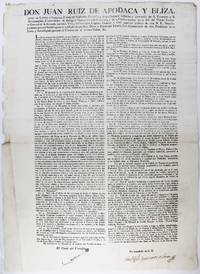
18203330Mexico City: July 11 1820. About very good. Large double-sheet broadside approximately 23.5 x 17 inches. Two sheets joined at central horizontal fold. Five chips at left edge not affecting text and some additional minor edge wear; otherwise light toning and dust soiling. Two contemporary manuscript signatures at foot; contemporary duty stamps on blank verso. Fascinating and otherwise unrecorded broadside that dictates the organization and process for the 1820 election of Mexican deputies to the Spanish Cortes during the second and last period of constitutional monarchy in Mexico. Colonial Mexico first achieved some representation in the Spanish government under the liberal Constitution of 1812 which lasted for two years before being revoked by Ferdinand VII upon his return to power in 1814. The reinstatement of the liberal constitution and the Cortes of Cadiz in 1820 however was not enough to prevent Mexico from obtaining full independence one year later. This broadside promulgated in Mexico on July 11 1820 by the colonial Viceroy Juan Ruiz de Apodaca y Eliza announces the renewed representation via regional elections to select Provincial Deputies for the Cortes and contains eight articles delineating the process by which these elections are to be held. In brief these articles order representation be apportioned according to the population as approximated from the 1792 census; divides Mexico into provinces for the purposes of the election; and places parameters on representation for each province. In all a very interesting window onto the formation of the brief final period of Spanish colonial rule in Mexico. July 11 unknown
18651260191865. First Edition. CONSTITUTION. Journal of the House of Delegates of the State of Virginia. for the Session of 18645. Alexandria: D. Turner 1865. Octavo original front printed wrapper respined renewed rear wrapper original string stitching; pp. 1-3 4-83 1. Housed in a custom chemise and clamshell box. $4500.First edition one of 500 copies of the momentous Journal featuring its February 9 1865 entry on the Alexandria Virginia government's passage of the 13th Amendment mere days after the U.S. Congress the first of the four Unionist southern states to pass the Amendment also featuring the governor's Message noting: ""though we have in inherited from our fathers of the revolution the blessings of a great nation yet they also left to us an inheritance of African slavery which has proved a bitter dreg in our cup of freedom"" a vital record of forces for constitutional change near the end of the Civil War.Soon after the 1860 election amidst southern secession ""the great questions of union or disunion war or peace hung in the balance. Probably the crucial weight on the scale was Virginia as long as the federal government did not seek to coerce the states Virginia secessionists were unable to achieve a majority. When Lincoln responded with force to the attack on Fort Sumter however the vote in Virginia went in favor of secession."" Subsequently a Virginia convention ""met in Wheeling on May 13 1861 it elected as Governor Francis Pierpont a western Virginian and ardent Unionist and arranged for the creation of a legislature to replace the body sitting in Richmond in July 1861 the new legislature met at the 'Restored Virginia' capital of Wheeling in a special session called by Pierpont."" Against its ""claim to represent a majority of Virginians"" a new state of West Virginia was created in 1863 and Pierpont's government moved to Alexandria to govern areas of Virginia under Union occupation Harrison Lawfulness of the Reconstruction Amendments 380-83.Scholars observe that the 13th Amendment its fellow amendments and Reconstruction as ""both a political process made possible by military successes and constitutional thought grew from wartime as well as post-Appomattox developments"" Hyman and Wiecek Equal Justice 247. This rare first edition of Journal of the House of Delegates substantiates that in documenting passage of the 13th Amendment by Pierpont's Virginia government mere days after the U.S. Congress passed the Amendment on January 31 1865. With that Virginia became the first of the four Unionist southern states that ratified the 13th Amendment. Of those Louisiana followed on February 17 with Arkansas and Tennessee that April. The 13th Amendment is the focus of the Journal's entry for February 9 1865 which states: ""Mr. Brownley called up Senate bill No. 12 entitled 'An Act to ratify the joint resolution of Congress passed January 31 1865 proposing an amendment to the Constitution of the United States.' The bill was read the first and second time and the rules were suspended and the bill read the third time and the bill passed."" Also notable herein is the complete printing of Governor Pierpont's opening Message where he notes: ""though we inherited from our fathers of the revolution the blessings of a great nation yet they also left to us an inheritance of African slavery which has proved a bitter dreg in our cup of freedom."" He speaks at length of the rights due people of color and the abolition of laws such as those that prohibit ""negro testimony"" or proscribe a ""different punishment for persons of African dissent"" from that of ""white persons.""""The legislature met for its second session on December 5 1864 The governor's message was a long and important document and indicated the changes of opinion that the war was bringing about. Pierpont gave his views upon the all-important negro question. He congratulated the constitutional convention which had met in the spring on the abolition of slavery in Virginia and advocated sweeping changes in the laws concerning negroes. The act prescribing different punishments for blacks should he said be altered in accordance with the amended constitution as well as the law for apprenticing them. The law prohibiting the education of negroes should be abolished His language was on the whole very moderate. He advised the legalizing of the marital relations of negroes and most important the establishment of public schools Notwithstanding the governor's advice no acts of great importance passed the legislature On February 9 1865 the assembly ratified the 13th Amendment to the Constitution of the United States. It adjourned on March 7"" Eckenrode Political History of Virginia During the Reconstruction. Faint ""U.N.C. Duplicate"" stamp to front wrapper.Text fine; just a bit of faint soiling and a tide line to fragile front wrapper. An excellent copy of this elusive item. unknown