1 369 résultats
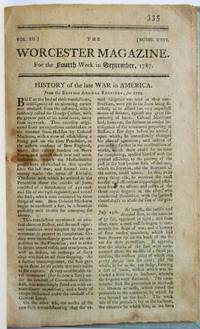
178737046Worcester: Isaiah Thomas 1787. Pages 335-352 with caption title as issued. Upper margins of several leaves trimmed closely shaving portions of several page numbers a couple of printer flaws with effect on a few letters. Good in modern pale grey paper over boards.<br/><br/> This early rare printing of the proposed Constitution-- certainly one of the earliest-- appears at pages 349-352 under the heading "Proceedings of the Federal Convention." Isaiah Thomas started the Worcester Magazine in April 1786. It was "The octavo continuation of Isaiah Thomas' newspaper The Massachusetts Spy necessitated by his opposition to the tariffs on paper and the tax upon advertisements in newspapers which were repealed in April 1788" Lomazow. <br/>Lomazow 20. Evans 20159. Mott 92-93. Isaiah Thomas unknown books
193512045Washington D. C.: The United States Flag Association 1935. Illustrated. 1 vols. 8vo. Full polished tan calf in a cloth slipcase bookplate of Harold Greenhill fine. Illustrated. 1 vols. 8vo. The United States Flag Association unknown books
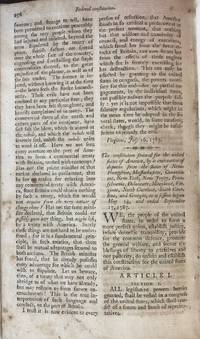
178737045Philadelphia: Printed by Mathew Carey 1787. 3 212-311 1 pp. Widely scattered light foxing; final few leaves with some blank inner margin wear. Pages 276-286 print in Very Good condition the proposed U.S. Constitution claimed as its first magazine printing. Overall Good in modern pale grey paper over boards.<br/><br/> This September issue is credited along with another Philadelphia publication 'The Columbian Magazine' as the first periodical printing of the Constitution of the United States. The prefacing paragraph and Preamble are also printed: "The Constitution framed for the united states of America by a convention of deputies from the states . at a session begun May 14 and ended September 17 1787. We the people of the united states in order to form a more perfect union establish justice." After the Constitution signatures in type of George Washington and other delegates listed by state are printed; followed by Washington's two transmittal letters to the States and Congress's resolution signed in type by Charles Thomson as Secretary "recommending the appointment of state conventions to consider the preceding constitution". <br/> The Constitution is not the only item of importance contained in this September number. It also has an early American printing of Benjamin Franklin's "Information for those who wish to remove to America" first printed privately in Passy in 1784; and several other essays on American commerce politics and culture.<br/>Lomazow 22e. Evans 20194. Printed by Mathew Carey unknown books
1935496501935. Constitution United States. Emphasizing Americanism: The Constitution of the United States of America. Chicago: The Americana Corporation 1935. 563-578 pp. Pamphlet worn and slightly soiled. Internally clean. $25. unknown books
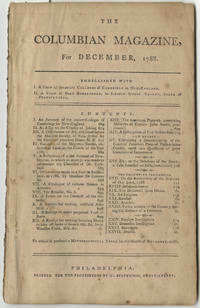
178830007.048Philadelphia PA 1788. Softcover. Fine. The Columbian Magazine. Magazine. The Columbian Magazine Philadelphia Pa. December 1788. 52 pp. 5 x 8 in. Lacking plates. This title has the honor of being the first successful American magazine having begun in September 1786 and lasting until December 1792. Although many titles existed earlier none enjoyed the success of lasting beyond a few issues or a couple of years.Opens with five pages on ""An Account of the Ancient Colleges at Cambridge in New England."" that being Harvard University. pp. 669-673.A recipe for making artificial Asses milk p. 698.With ""The American Plutarch - Memoirs of Captain John Smith"" pp. 699-703 continued for a previous issue and concluded in the next.A section on ""American Intelligence"" pp. 715-718 with the latest news reports including an item from Edenton North Carolina:""a new convention be recommended for the purpose of reconsidering the new constitution held out by the federal convention as a government for the United States."" p. 716.With a ""List of Senators of the United States Already Chosen"" by state pp. 717-718.Also mention of the officers for the Masonic Lodge at Philadelphia p. 716. paperback books
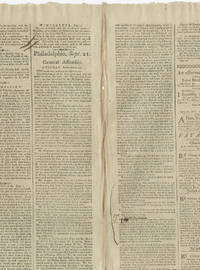
178721449.18Philadelphia PA 1787. No binding. Fine. Pennsylvania Packet and General Advertiser. Newspaper. Pennsylvania Packet and General Advertiser September 21 1787. John Dunlap Philadelphia Pa. 4 pp. 12 x 18 3/4 in. Pennsylvania's representatives to the Constitutional Convention including Benjamin Franklin present the Constitution to the Representatives of the Pennsylvania State legislature. A contemporary report of the end result of the Philadelphia Convention's efforts over the summer of 1787 less than a week after the Convention concluded. ""Sir we have now the honor to present to this house the plan of government for the United States which has been determined upon by the federal convention. As soon as the speaker had concluded Dr. Franklin rose and delivered a letter from the delegates to the house which being read consisted of a recommendation to the legislature."" p. 2 col. 4Reports on the proposal of the Constitution to Pennsylvania. ""To the Honorable the Representatives of the Freemen of the Commonwealth of Pennsylvania.your petitioners have seen with great pleasure the proposed constitution of the United States and as they conceive it to be wisely calculated to form a perfect union of the states as well as to secure to themselves and posterity the blessings of peace liberty and safety they have taken this method of expressing their earnest desires that the said constitution may be adopted as speedily as possible by the state of Pennsylvania."" p. 3 col.1.Contains a section entitled: ""Origin of the Island of Nantucket. An Indian Tradition."" ""On the west end of Martha's Vineyard are high cliffs of variegated coloured earths known by the name Gayhead.The Indians who live about this spot have a tradition that a certain deity resided there before the Europeans came into America."" p. 3 col.4.Benjamin Franklin 1706-1790 Born in Boston he originally worked as a printer for his older brother. After moving to Philadelphia he started his own newspaper the Pennsylvania Gazette in which he published his ideas in support of American independence. He was very involved in the writing of the Declaration of Independence and during the Revolutionary War was appointed Ambassador to France where he negotiated the important alliance between the two nations. Franklin was also known for his science experiments most notably with regards to electricity.ConditionNear fine books
178824836Boston MA 1788. No binding. Condition: Fine. Massachusetts Centinel illustrator. Newspaper. Massachusetts Centinel February 13 1788 Volume VIII pp. 171-174. Boston: Benjamin Russell. 4 pp. 9 5/8 x 14 7/8 in. This newspaper is replete with Constitution-related content including minutes from the debates of Massachusetts' State Ratifying Convention - everything from discourse on standing armies to Fisher Ames' hearkening back to 1775 with "WE MUST UNITE OR DIE"; a poem to Washington on his birthday; a fictional dialogue The Federal Anti-Federalist Returned to His Neighbours; a rare example of one of Benjamin Russell's famed 'Pillars' illustration series; and a great deal of reporting on the popular reception of the news of ratification expressed in particular by an enormous parade and surrounding celebrations. The Massachusetts Centinel employed the Federal Pillars political imagery to announce the ratification of the Constitution by successive states. In this issue the Centinel announces the pending ratification by New Hampshire. "This day the Convention of the State of New Hampshire meet at Exeter for the purpose of erecting another PILLAR to support the great Federal Superstructure; by ratifying the proposed Constitution." On February 6 1788 Massachusetts ratified the United States Constitution by a vote of 187 to 168 the sixth and largest state to do so. Two days later the people of Boston engaged in a grand procession led by the "Mechanicks" and Tradesmen of Boston "to express their approbation of the conduct of the Gentlemen who represented this town in the late Convention" p3/c2. A sampling of the groups of marchers most of whom carried implements and tools of their professions festooned for the occasion as detailed here p4c1-2: 73 Blacksmiths; 43 Shipwrights; 75 Rope-makers with part of a rope-walk on a sled and martial music; 30 Mast-makers; 36 Sail-makers; 34 Ship-joiners; 30 Block-makers pulley makers; 6 Mathematical Instrument Makers makers of navigation equipment etc.; 53 Coopers; 20 Boat-builders; 6 Pewterers; 40 Bakers 50 Shoe-makers; 56 Taylors; 26 Hatters; 20 Ship-builders; 136 Carpenters; 70 Masons; 30 Wheelwrights; 15 Printers; as well as a dozen other tradegroups such Bookbinders; Goldsmiths and Jewelers Saddlers Tobacconists Tanners Curriers Leather-dressers Cabinetmakers Carvers Painters Tinsmiths Coppersmiths and 250 of the "principal merchants in the town." Toward the middle of this assemblage thirteen horses pulled the ship "FEDERAL CONSTITUTION" manned by a crew of thirteen. A subtext of much of this was an emphasis on domestic manufactures as well as a celebration of Boston's power and potential in maritime trade.At this event "WE THE PEOPLE" of Boston "in GRAND PROCESSION MOVING" passed an ordinance to rename Long Lane as Federal Street in commemoration of the site where the convention had sat. The ordinance concluded "GIVEN under our auspices.the FIRST YEAR of OUR real political federal existence.GOD SPEED THE CONSTITUTION!" p1/c1. That night a long boat called "the Old Confederation" which had been exhibited during the parade was drawn to the Common and condemned "as unfit for any further service." The boat was immediately burned "in presence of an applauding concourse of citizens" p3/c2. On February 12 the twelve delegates who represented Boston in the ratifying convention including John Hancock and Samuel Adams responded to the procession in a letter to "the Committee of Tradesmen of the Town of Boston." Excerpt: "We endeavoured that our conduct in the late Convention should be governed by the magnitude of our subject:-And after the most mature deliberation we severally decided according to the best light of our understandings and the dictates of our consciences." "We are happy to find that our decisions have so fully corresponded with the sentiments and wishes of our constituents."<br /> books
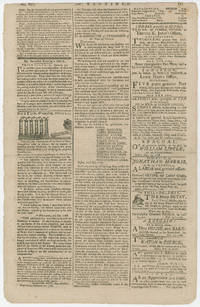
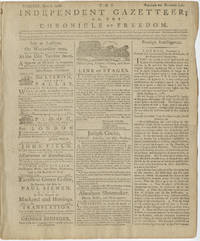
178830007.003Philadelphia PA 1788. No binding. Fine. Independent Gazetteer; or The Chronicle of Freedom. Newspaper. Independent Gazetteer; or The Chronicle of Freedom Philadelphia Pa. May 6 1788. 4 pp. 9 1/2 x 11 1/2 in. The Maryland ratifying convention suggests some amendments along with their approval of the Constitution. ExcerptsFrom page 3:""From the MARYLAND GAZETTE or April 29 1788. The CONVENTION of this state on Saturday last determined to ratify the proposed plan of Federal Government. -YEAS 63 NAYS 11-And then appointed a committee of thirteen members to consider and report amendments to be recommended to the people. -The following amendments were proposed by a member and referred to the committee who are now sitting-And it is hoped that the great and essential rights of the people will be declared and secured.- PROPOSED AMENDMENTS.Wherefore whenever the ends of Government are perverted and public liberty manifestedly endangered and all other means of redress are ineffectual the people may and of right ought to object to reform the old or establish a new Government-that the doctrine of nonresistance against arbitrary power and oppression is absurd slavish and destructive of the good and happiness of mankind. All imposts and duties laid by Congress shall be placed to the credit of the state in which the same be collected. That there shall be no national religion established by law; but that all persons be equally entitled to protection in their religious liberty. That the Supreme Federal Courts shall not admit to fictions to extend its jurisdiction; nor shall citizens of the same state having controversies with each other be suffered to make collusive assignments of their rights to the citizens of another state for the purpose of defeating the jurisdiction of the State Courts; nor shall any matter or question already determined in the State Courts be revived or agitated in the Federal Courts. That Congress have no power to lay a Poll-Tax. That the people have a right to freedom of speech of writing and publishing their sentiments and therefore that the freedom of the PRESS ought not to be restrained and the printing presses ought to be free to examine the proceedings of Government and the conduct of its officers.""From page 2: Protesting the Slave Trade by Boycotting West Indian Produce""A CAUTION.WHEREAS in the year 1787 some vessels were fitted out at the port of Philadelphia for the iniquitous purpose of stealing the inhabitants of Africa from all the endearments of domestic life; one of which vessels has succeeded in obtaining a number of poor blacks and has taken the to a port in the West Indies where they are under the iron hand of oppression. From this shameful traffic this horrid source the proprietors of the vessel have purchased some West India produce which after landing at Wilmington they have brought up to this city and offered for sale. It is a grateful circumstance to the supporters of the common rights of mankind that the virtuous inhabitants of the city reprobate the horrid idea.-A correspondent hopes that the citizens will further testify their disapprobation of the practice by turning with indignation from the purchase of any property thus basely procured by men so lost to the common feelings of humanity; notwithstanding the patriotic convention at which Washington presided have declared that this abominable traffic shall be continued for TWENTY years by the people of America.From page 1:An advertisement with engraving for a ""Line of Stages"" between Philadelphia and New York started by four partners who split off from an established stage line and promising better service. From page 4:An advertisement for another different ""New Line of Stages."" And a report on the creation of a Philadelphia committee for the relief of the nearly 100 Americans captured by Algerian corsairs and Barbary pirates. unknown books
1789100147<p>8vo later calf backed marbled boards 320 202 pp. Edges and covers rubbed occasional bit of foxing but overall very good. The most important feature of this collection is an early British printing of the United States Constitution p.289-300. Also contains a curious description of two Negro children with some unusual physical markings see p.53-55. Very interesting coverage of a few executions including a woman who was hanged for forgery is also provided.</p> J. Dodsley hardcover books
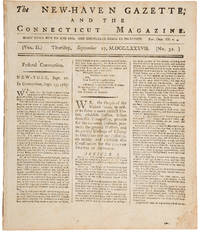
178726098<p>"<i>WE the People of the United States in order to form a more perfect union establish justice insure domestic tranquility provide for the common Defence promote the general welfare and secure the blessings of liberty to ourselves and our posterity do ordain and establish this constitution of the United States of America</i>."</p> <b>CONSTITUTION.</b>Newspaper. <i>The New-Haven Gazette and The Connecticut Magazine</i>. September 27 1787. M.DCC.LXXXVII No 32. Printed and Published by Josiah Meigs. Signed in type by George Washington and the other 38 delegates who signed the Constitution. 8 pp. Quarto 8.625 x 10.125 inches. 249-256 though what should be page 255 is mis-numbered 247 as is the case with the other copies we have seen of this edition. Accompanied by title and index leaves printed slightly later for binding after end of year.<br /><p><b>Historical Background</b></p><p>Having just been approved by the Constitutional Convention on September 17th the complete text of the Constitution was published in the <i>New-Haven Gazette</i>just ten days later along with the transmitting documents conveying the Convention's request that it be laid before Congress and afterwards submitted to "<i>a convention of Delegates chosen in each state by the People thereof.</i>" Resolved that if nine States ratify electors should be chosen for a presidential election and that the machinery of the new government be set in place.</p><p>The Articles of Association Congress in New York debated for two days and a day after this printing officially sent the Constitution to the states for ratification. State ratification conventions would soon pit Federalist against Anti-Federalist in impassioned debates over the implications of the Constitution and its extension of national government power and influence.</p><p>This is the earliest available Connecticut printing of the Constitution. The Connecticut Journal printed it one day earlier but we can find no copies in market sales records of the last 30 years.</p><p>The text of the Constitution is preceded here by George Washington's letter to Congress and followed by the Resolution for ratification. Evans 20563; Lomazow 18b.</p><p><b>Condition</b></p><p>Gathering of four leaves paginated 249-252 and two loose leaves. Mild yellowing with a hint of discoloration and spot or two of foxing; soft crease each vertically and horizontally bisecting all leaves; small handful of faint dampstains at margins of first and final leaf; barely perceptible inked signature at lower corner of recto of first leaf; hint of residue discoloration along center fold where newspaper was removed from bound volume.</p><p>Title and index leaves softly browned and a bit brittle with edges roughened where removed from bound volume; both bisected by soft horizontal crease; faint staining to leaves particularly recto of title; some mild chipping to edges of title-leaf particularly fore-edge with fold starting to split at either end about two inches in from either direction; previous owner inking at recto of both leaves; corners of index leaf creased.</p><p>Newspaper in fine condition remarkably clean and bright with very good title and index leaves. Housed in custom red leather case cover stamped in gilt.</p> books
1986201643Washington: Congressional Quarterly 1986. hardcover. very good-. Illus. 8vo decorated boards back cover lightly soiled. Washington: Congressional Quarterly 1986.<br/><br/> Collection of essays chosen from This Constitution magazine.<br/><br/> Congressional Quarterly unknown books
178830007.048Philadelphia PA 1788. Softcover. Fine. The Columbian Magazine. Magazine. The Columbian Magazine Philadelphia Pa. December 1788. 52 pp. 5 x 8 in. Lacking plates. This title has the honor of being the first successful American magazine having begun in September 1786 and lasting until December 1792. Although many titles existed earlier none enjoyed the success of lasting beyond a few issues or a couple of years.Opens with five pages on ""An Account of the Ancient Colleges at Cambridge in New England."" that being Harvard University. pp. 669-673.A recipe for making artificial Asses milk p. 698.With ""The American Plutarch - Memoirs of Captain John Smith"" pp. 699-703 continued for a previous issue and concluded in the next.A section on ""American Intelligence"" pp. 715-718 with the latest news reports including an item from Edenton North Carolina:""a new convention be recommended for the purpose of reconsidering the new constitution held out by the federal convention as a government for the United States."" p. 716.With a ""List of Senators of the United States Already Chosen"" by state pp. 717-718.Also mention of the officers for the Masonic Lodge at Philadelphia p. 716. paperback
1980KOS02201258Heibonsha 1980. Soft Cover. Fine. KOS02201258 Heibonsha paperback
18341215671834. First Edition. DORR Thomas Wilson. An Address to the People of Rhode-Island From the Convention Assembled at Providence on the 22nd Day of February and Again on the 12th Day of March 1834 to Promote the Establishment of a State Constitution. Providence: Cranston & Hammond 1834. Octavo period-style half diced calf gilt marbled boards pp. i-v 6-60. $2400.First edition of Dorr's foundational Address prompting his role as instigator and leader of the Dorr Rebellion placing him ""in the front rank of the political reformers of Jacksonian America.Born into privilege Rhode Island's Thomas Dorr became ""a political insurrectionary who hastened the demise of the royal charter of 1663 and the adoption of a written constitution"" Wiecek Peculiar Conservatism 242. Following the American Revolution by the 1820s Rhode Island remained the only state that clung to its colonial charter which ""restricted suffrage to white men who possessed real estate valued at a minimum of $134"" Chaput Proslavery and Antislavey Politics 662-63. It had ""evolved from the most to the least democratic state"" Lemons Rhode Island's Ten Turning Points 62. ""Dorr's political goals'free suffrage' with no discrimination against the foreign-born 'one-man one-vote' an independent judiciary a more powerful and dynamic executive the secret ballotthough not permanently achieved in Rhode Island during his lifetime placed him in the front rank of the political reformers of Jacksonian America"" ANB.In 1834 Dorr ""asked the General Assembly to call a convention to revise the state constitution in favor of taxpayer-militia suffrage and to adopt 'equal representation'"" Wiecek 242. In this major Address delivered at that convention and ""composed primarily by Dorr"" Conley Democracy in Decline 255 he states: ""No form of a Constitution can be worth much if in this State the Legislative power is in the hands of less than one third part of the qualified voters. A few political managers rule the whole State as they please against the will of two thirds of the freeman and three fourths of the people"" emphasis in original."" To Dorr the state's ""strange adherence to the charter"" left Rhode Island with an ""inequality of representation too unjust to be much longer tolerated."" In 1841 after Dorr was elected ""the People's governor"" under the state's ""People's Constitution"" he became the leader of the 1842 Dorr rebellion which historian Sean Wilentz calls ""'a striking and exceptional case in the history of American democratization before the Civil War' calling it no less than 'a deadly serious test of democracy's meaning and democracy's future.'"" The Dorr Rebellion increasingly viewed as the ""most significant political and constitutional event between the Age of Jackson and the election of Lincoln Dorr's constitutional understanding had roots not only in the Revolution and the post-Revolutionary era; it remained a vibrant part of American constitutionalism"" Chaput Rhode Island Question 55-56. Sabin 70537. American Imprints 26527. Text generally fresh with light scattered foxing. hardcover
1331349109.Gpaperback. Good. Access codes and supplements are not guaranteed with used items. May be an ex-library book. paperback
0267627491.Ghardcover. Good. Access codes and supplements are not guaranteed with used items. May be an ex-library book. hardcover
1332006329.Gpaperback. Good. Access codes and supplements are not guaranteed with used items. May be an ex-library book. paperback
1019516534.Ghardcover. Good. Access codes and supplements are not guaranteed with used items. May be an ex-library book. hardcover
1019648112.Ghardcover. Good. Access codes and supplements are not guaranteed with used items. May be an ex-library book. hardcover
1019477075.Ghardcover. Good. Access codes and supplements are not guaranteed with used items. May be an ex-library book. hardcover
133478177X.Gpaperback. Good. Access codes and supplements are not guaranteed with used items. May be an ex-library book. paperback
18256784Paris: Dondey-Dupre Pere et Fils 1825. Hardcover — Tapa dura. 133x80mm. 5¼x3¼". Paris Dondey-Dupre Pere et Fils 1825. En 12º 133 x 80mm. 110 pp. 1 h. Encuadernación de la época en piel. Primera edición francesa. La Constitución Federal de los Estados Unidos Mexicanos de 1824 entró en vigor el 4 de octubre de ese año después del Imperio Mexicano de AgustÃn de Iturbide. En la nueva Constitución la República tomaba el nombre de Estados Unidos Mexicanos y era definida como una República Federal Representativa. Esta traducción francesa es rara en comercio. Dondey-Dupre Pere et Fils hardcover
1017036888.Ghardcover. Good. Access codes and supplements are not guaranteed with used items. May be an ex-library book. hardcover
101813235X.Ghardcover. Good. Access codes and supplements are not guaranteed with used items. May be an ex-library book. hardcover