1 369 résultats
1527762106.Gpaperback. Good. Access codes and supplements are not guaranteed with used items. May be an ex-library book. paperback
0365520187.Gpaperback. Good. Access codes and supplements are not guaranteed with used items. May be an ex-library book. paperback
1390412660.Gpaperback. Good. Access codes and supplements are not guaranteed with used items. May be an ex-library book. paperback
19513406073Cambridge, University Press, 1951. XXIV, 636 S. OLwd.
19643328000München, Szczesny, 1964. XIII, 354 S. OLwd (mit OUmschlag).
200332422Paris Grande Loge Nationale de France 2003 in-8°
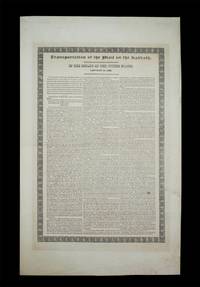
182969246Kentucky 1829. UNITED STATES CONSTITUTION; BROADSIDE. BROADSIDE. Transportation of the Mail on the Sabbath. In the Senate of the United States. Kentucky: 1829.<br> <br> Full Description:<br> <br> UNITED STATES CONSTITUTION. BROADSIDE. Transportation of the Mail on the Sabbath. In the Senate of the United States. Kentucky: January 19 1829.<br> <br> An important and interesting broadside supporting the separate of church in state in so as it applies to the delivery of mail on Sunday the Sabbath. Broadside folio 16 3/4 x 10 1/2 inches; 428 x 266 mm. With a caption title printed above three columns separated by rules. All within a decorative woodcut border. Mounted at the top edge within a portfolio mat. Some minor toning and a few small spots of dampstaining. A One and one half-inch closed tear at right-hand margin just touching the border. Overall very good.<br> <br> This is a significant document in the history of the United States Constitution in relation to the concept of the separation of church and state. Christian leaders demanded that the Government institution of the Postal Office not work on Sunday as their God had deemed this the Sabbath. The following document discusses that while many Christians observe the Sabbath on Sunday others including their Jewish neighbors observe the Sabbath on Saturday. Demanding that the government institution not work on Sunday for religious reasons goes directly against the Constitution. The report states "With these different religious views the committee are of opinion that congress cannot interfere.-It is not the legitimate province of the legislature to determine what religion is true or what false. Our government is a civil and not a religious institution. Our constitution recognizes in every person the right to choose his own religion and to enjoy it freely without molestation. Whatever may be the religious sentiments of citizens and however variant they are alike entitled to protection from the government so long as they do not invade the rights of others." It goes on to powerfully state "Extensive religious combinations to effect a political object are in the opinion of the committee always dangerous. This first effort of the kind calls for the establishment of a principle which in the opinion of the committee would lay the foundation for dangerous innovations upon the spirit of the Constitution and upon the religious rights of the citizens. If admitted it may be justly apprehended that the future measures of government will be strongly marked if not eventually controlled by the same influence. All religious despotism commences by combination and influence; and when that influence begins to operate upon the political institutions of a country the civil power soon bends under it and the catastrophe of other nations furnishes an awful warning of the consequence."<br> <br> The five-person committee for this report consisted of Richard Johnson of Kentucky who later went on to serve as the country's 9th vice president under Martin Van Buren as well as future President John Tyler of Virgina Ellis of Mississippi Silsbee of Massachusetts and Johnson of Louisiana.<br> <br> "The opening of post offices on Sunday led to a national debate about the relationship of the federal government to the Sabbath day. The argument which raged from 1810 to 1830 involved whether the national government would exist as a secular commercial republic committed to a separation of church and state or as a Christian commonwealth. The U.S. postmaster general Gideon Granger responded by persuading Congress in 1810 to pass legislation to open all 2300 post offices seven days a week and transport mail every day. Congress immediately began to receive petitions from numerous religious denominations urging repeal of the law. Under strong public pressure House and Senate committees formed to study the postal law. While the chair of the House committee waffled on the subject the head of the Senate committee swayed Congress to keep the law. Gen. Richard M. Johnson of Kentucky a devout Baptist wrote in the committee's 1829 report that congressional action to stop Sunday mail would be unconstitutional. Johnson reminded Americans that they had religious freedom and that government had no right to coerce the religious homage of anyone. The invention of the telegraph in 1844 ultimately spelled the end of Sunday mail. It was now possible to get market information without the mail system. By the 1850s postmaster generals were eliminating the movement of most mail on Sunday." Free Speech Center Caryn E. Neumann.<br> <br> HBS 69246.<br> <br> $1750. Kentucky unknown
1528594061.Gpaperback. Good. Access codes and supplements are not guaranteed with used items. May be an ex-library book. paperback
200445772La Documentation Française 2004 La Documentation Française 2004. In-8 broché de 232 pages. Très bon état
La Documentation Française 2004. In-8 broché de 232 pages. Très bon état
1885488691Paris, Pichon, 1885. VI, 933 S. Halbleder der Zeit (Stempel auf Titel, Rücken fehlt).
1773WOC-1755Paris, Chez Debure Père & A Orléans, Chez la Veuve Rouzeau-Montaut, 1773. 2 volumes in-12 (17,3x3x10cm) relié en 1 volume plein veau marbré d'époque, dos à nerfs orné de caissons et fleurons, titre et tomaison sur maroquin rouge, tranches rouges. VIII,275pp. + 258pp.+ 1ff de catalogue des ouvrages de M. Pothier qui se vendent à Orléans et à Paris en 1772.
1634456743Ingolstadt, Haenlin, (1637) u. 1634. 1 Bl., 87 S., 1 Bl., S. 87-224; 1 Bl., 13 S. Moderner Pappband. [2 Warenabbildungen]
1734129710Ex Officina Joannis Maire Ex Officina Joannis Maire 1734. In-16 relié plein vélin à recouvrement (11*6cm). Titre en dos. 1 feuillet blanc, titer gravé, 380 pages + 5 feuillets blanc. Ex-libris
Ex Officina Joannis Maire 1734. In-16 relié plein vélin à recouvrement (11*6cm). Titre en dos. 1 feuillet blanc, titer gravé, 380 pages + 5 feuillets blanc. Ex-libris
19582083002116204433Deokdo County Library Dokdo County Constitution Memorial Museum 1958. Soft Cover. Fine. Number of books: 15 Deokdo County Library (Dokdo County Constitution Memorial Museum) paperback
200676532Washington DC: U. S. Government Printing Office 2006. Presumed First Edition First printing. Wraps. Good. iv 1580 pages. Illustrations. Occasional footnotes. Serial No. 109-70. Format is approximately 5.75 inches by 9.25 inches. Cover has some wear and soiling. This is the first of a series of hearings that the Subcommittee planned to hold examining the Voting Rights Act also known as the VRA. It had been 25 years since Congress last extended the number of the temporary provisions of the VRA. Six provisions were scheduled to expire in 2007 including sections 4 5 6 7 8 and 203. These hearings will examine the impact of the Voting Rights Act over the last several decades and its continued role in protecting minority voting rights. The ability of our citizens to cast a ballot for their preferred candidate ensures that every voice is heard most importantly the right to vote safeguards our freedoms and all other rights enshrined in the Constitution. The sacredness of the right to vote is reflected in the protection afforded by the 15th amendment which States ''the right of citizens of the United States to vote shall not be denied or or abridged by the United States or by any State on account of race color or previous condition of servitude.'' For too many of our fellow citizens in our history this has not always been the case. Our country has had a troubled history of invidious and disparate treatment in the most fundamental process of a democracy namely voting. The VRA pushed back against this history and challenged racial discrimination from a number of different angles. U. S. Government Printing Office paperback
1862HIST0222Prag, Tempsky 1862. 44 S., Priv. Buntpapiereinbd., geringe Gebrauchsspuren, Innentit. gestemp. Stellungnahme zum Februarpatent womit man die Verfassung im Kaisertum Österreich aus dem Jahr 1861 bezeichnet.
101991372X.Ghardcover. Good. Access codes and supplements are not guaranteed with used items. May be an ex-library book. hardcover
19533462195London, Oxford, 1953. XIV, 195 S. OLwd (Stempel auf Titelrückseite).
1986201643Washington: Congressional Quarterly 1986. hardcover. very good-. Illus. 8vo decorated boards back cover lightly soiled. Washington: Congressional Quarterly 1986.<br/><br/> Collection of essays chosen from This Constitution magazine.<br/><br/> Congressional Quarterly unknown books
1527737012.Gpaperback. Good. Access codes and supplements are not guaranteed with used items. May be an ex-library book. paperback
0365442275.Gpaperback. Good. Access codes and supplements are not guaranteed with used items. May be an ex-library book. paperback
New English Paperback. Roy. 8vo. (23 x 16 cm). In English. 264 p. The Young Turks: Struggle for the Ottoman Empire, 1914-1918. The Unionists hoped to do so by avoiding any further wars and ending their isolation by forming an alliance with the Triple Entente composed of England, France and Russia. When they were turndown by the Entente powers, they turned to Germany. Berlin finally signed the alliance after the war had begun in Europe in August. Germany's reason was ideological: the Ottoman Sultan-Caliph could broaden the war by declaring jihad or "holy war" against the Entente powers, causing Muslims to rebel in British India and Egypt, French North Africa, and the Russian Caucasus. Though the Ottomans were allied with Germany, they believed that the alliance did not commit them to enter the war. But their treasury was empty and the economic situation precarious. Only Germany was willing to give loans, but only on the condition they enter the war. Istanbul was forced to submit and entered the war after the Black Sea incident when Ottoman ships -led by a German admiral- bombarded Russia's ports on 29 October and the Entente declared war on the Ottomans in November. Istanbul declared jihad on the 11th and that turned a European war into a world war, thus extending it by perhaps three years. This book is a study of the Young Turks and their struggle to save the Ottoman Empire during the Great War of 1914-1918. It is the sequel to The Young Turks the Committee of Union and Progress in Turkish Politics, 1908-1914.
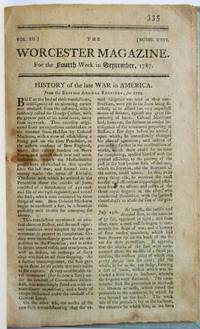
178737046Worcester: Isaiah Thomas 1787. Pages 335-352 with caption title as issued. Upper margins of several leaves trimmed closely shaving portions of several page numbers a couple of printer flaws with effect on a few letters. Good in modern pale grey paper over boards.<br/><br/> This early rare printing of the proposed Constitution-- certainly one of the earliest-- appears at pages 349-352 under the heading "Proceedings of the Federal Convention." Isaiah Thomas started the Worcester Magazine in April 1786. It was "The octavo continuation of Isaiah Thomas' newspaper The Massachusetts Spy necessitated by his opposition to the tariffs on paper and the tax upon advertisements in newspapers which were repealed in April 1788" Lomazow. <br/>Lomazow 20. Evans 20159. Mott 92-93. Isaiah Thomas unknown books