1 369 résultats
Eight Volumes. Over 5000 pages. 8vo. 220 mm. Text clean and tight. Nineteenth century full leather bindings, with the gilt arms of a English bishop on each board. Spines nicely decorated in gilt. Gilt lettered black morocco labels. All edges marbled. Some dings, wear, and weakness to the bindings, but still quite attractive. Armorial book plate of Henry James William Stillingfleet (1826-1887), Rector of Hampton Bishop, Herefordshire. The impressive coat of arms on the boards of the bindings are possibly those of his ancestor, Edward Stillingfleet (1635-1699), Bishop of Worcester. Henry Hallam (1777-1859) was an famed English historian. His works as presented here "took a place in English literature which was not seriously challenged until the 20th century." - Wiki. **PRICE JUST REDUCED! W107
1994474931Tübingen, Mohr, 1994. XXI, 396 S. Originalleinen mit Schutzumschlag.
19463127840Hamburg, Hoffmann und Campe, 1946. 174 S. OPpbd (Rücken leicht lädiert).
1989634860Wien, Springer, 1989. X, 300 S. Mit Porträt. Originalpappband (Rücken mit Bibliotheksignatur unter Tesa).
1989618958Wien, Springer, 1989. X, 300 S. Mit Porträt. Originalpappband.
1989605145Wien, Springer, 1989. X, 300 S. Mit Porträt. Originalpappband.
1989479923Wien, Springer, 1989. X, 300 S. Mit Porträt. Originalpappband.
191252044Berlin, Fortschritt, 1912. 165 S. Halbleder der Zeit (mit eingebundenem OKart.) (Stempel auf Titel, Bibliotheks-Rückenschild, Rücken etwas berieben).
197065517Johannesburg: Black Sash 1970. Paperback. Very Good. 20p. Wrapper. 25cm. A few red ink underlinings & notes. James Michener's ownership stamp. <br/><br/> Black Sash paperback books
19673195760München, Beck, 1967. IX, 157 S. OLwd (mit OUmschlag).
19493359998Göttingen, Vandenhoeck & Ruprecht, 1949. 63 S. OKart.
19433258897Stuttgart, Kröner, 1943. XXXV, 301, 47 S. OLwd (mit OUmschlag).
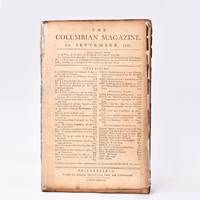
1787365066Philadelphia: Seddon Spotswood Cist and Trenchard 1787. 3 618-674. Without 2 plates. 8vo. Disbound fire damage at edges leaves detached. 3 618-674. Without 2 plates. 8vo. Along with a printing in the American Magazine among the earliest printings of the Constitution in a periodical. "One of the best of the eighteenth century magazines was the Columbian of Philadelphia. Considered from beginning to end the Columbian Magazine with its sequel the Universal Asylum affords an extremely valuable treasury of materials which reflect its own times and the war years immediately preceding. it was the handsomest American magazine of its century" Mott. Seddon, Spotswood, Cist and Trenchard unknown
VG (no dj, clean coarse blue cloth with gilt titles and decoration spine and front board, gilt on spine dull,a very good clean tight copy with no marks or inscriptions, faint browning endpapers, bottom corner last 2 or 3 pages creased) octavo 351pp. Stated first edition. The significant statements of American democracy from the Mayflower Compact to the first Inaugural Address of Franklin Roosevelt: declarations, court decisions, public papers, speeches etc. With introductory essay by the editor.
188922085Paris Plon, Nourrit et Cie 1889 In-12 XII- 302 pp
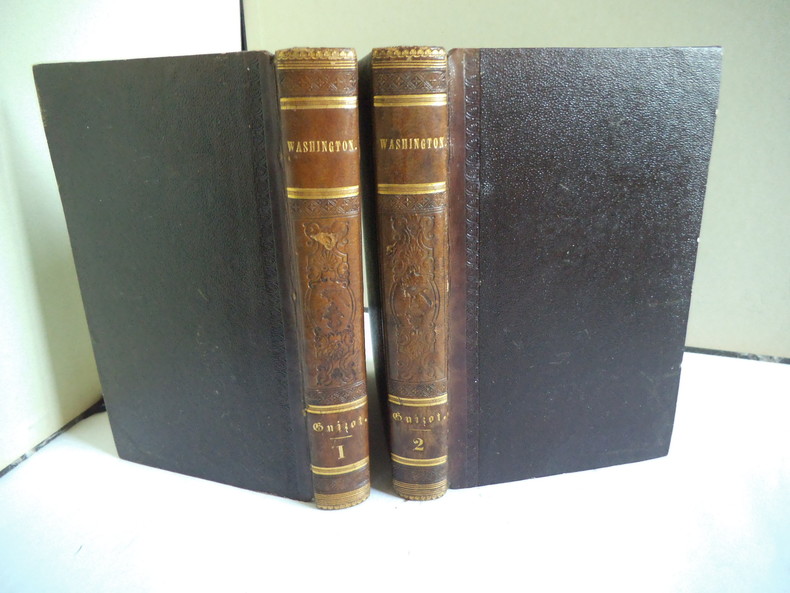
11572Fondation de la République des Etats-Unis d’Amérique. Vie de WASHINGTON, histoire de la guerre d’indépendance et de la fondation de la République des Etats Unis d’Amérique. Traduit de l’anglais de M. Jared Sparks par Ch. et précédé d’une introduction dur le caractère de Washington et son influence dans la révolution des Etats Unis d’Amérique. Deux tomes en deux volumes in 8 demi cuir marron foncé, fers en long à froid, titre tomaison, roulette, filets dorés. Roulette à froid sur les plats. Tome premier : faux-titre, portrait de Washington sous serpente, par GEOFFROY d’après le tableau de STUART. Titre, orné d’un aigle étoilé, CLIX, médaille d’honneur offerte à G. WASHINGTON par le congrès, 291 pages. Tome second : faux-titre, portrait gravé de Marthe WASHINGTON, titre orné de l’aigle étoilé, 440 pages. Grande carte dépliante, en couleurs, des Etats Unis d’Amérique comprenant une partie des districts de l’ouest et de la Nouvelle Bretagne publiée par J. ANDRIVEAU-GOUJON. Paris Didier libraire éditeur 1851. Tranches marbrées pour les deux tomes. Rousseurs en début et fin de chaque tome.
19753435560Neustadt/Aisch, Schmidt, 1975. 314 S. Mit Porträt. OKart.
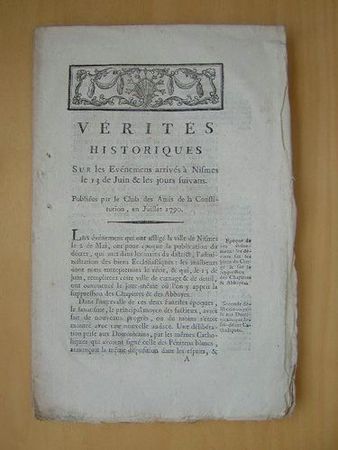
179019142Vérités Historiques sur les Evénemens arrivés à Nismes le 13 de Juin & les jours suivans. Publiées par le Club des Amis de la Constitution, en Juillet 1790 ; 1 brochure in-8, sans nom, s.d. (1790), 32 pp.
194674203Couverture souple. Broché. 40 pages.
200676448Washington DC: U. S. Government Printing Office 2006. Presumed First Edition First printing. Wraps. Good. iii 1 302. 6 pages. Illustrations. Occasional footnotes. Some bottom corners curved at front and back. The chairman stated: Today we will examine the impact that Federal examiners and observers have had on increasing minority participation in the political process and the continued need for these provisions in the future. The Voting Rights Act of 1965 is a landmark piece of federal legislation in the United States that prohibits racial discrimination in voting.78 It was signed into law by President Lyndon B. Johnson during the height of the Civil Rights Movement on August 6 1965 and Congress later amended the Act five times to expand its protections.7 Designed to enforce the voting rights guaranteed by the Fourteenth and Fifteenth Amendments to the United States Constitution the Act secured the right to vote for racial minorities throughout the country especially in the South. According to the U.S. Department of Justice the Act is considered to be the most effective piece of federal civil rights legislation ever enacted in the country. U. S. Government Printing Office paperback
200676534Washington DC: U. S. Government Printing Office 2006. Presumed First Edition First printing. Wraps. Good. Serial No. 109-79. Volume I ONLY. Volume I v 1 1684 6 pages. During this hearing Representative John Lewis of Georgia stated "The Voting Rights Act helped expand our democracy and open up our democracy to elect hundreds of thousands and millions of our citizens who had been kept out let them in. The Voting Rights Act was needed then and it is needed now. The purpose of section 5 is very unique and very important. It prevents discriminatory plans from being enacted in the first place. It put the burden on the judiciary to show that the plan does not discriminate against minority voters. Congress Lewis continued "Prior to section 5 the burden was on the minority voters to challenge the voting practice; and every section was good at coming up with different procedures that had the same result discrimination. Anita Earls' testimony talks in some detail about the recent example how this is still happening. The difference is that we have section 5 to prevent these practices from harming minority voters. Many people like the court said that we have come a long ways; and again today I would say that we've come a distance. We've come a long way and that is true. We're not the same Nation that we were 40 years ago but it's clear today that we have not come far enough. Section 5 is still needed. Today section 5 prevents discrimination and redistricting and changes that move voting locations out of minority neighborhoods into less accessible areas. These are issues that are different from the fight to register to vote but they are no less fundamental." U. S. Government Printing Office paperback
200676537Washington DC: U. S. Government Printing Office 2006. Presumed First Edition First printing. Wraps. Good. Serial No. 109-103. 4 volume set. Volume I v 1 1453 5 pages. Volume II v 1. 1455-2388 2. Volume III v 1 2389-4296. Volume IV v 1 4297-5711 3 pages. Footnotes. Illustrations. The Subcommittee will be holding its tenth hearing examining the Voting Rights Act of 1965 and the temporary provisions that are to expire. They're set to expire in 2007 unless we reauthorize by Congress which I think most of us anticipate will occur. The Subcommittee examined each of the expiring provisions in great detail. This afternoon we examine the evidence of continued discrimination against racial and language minority citizens since 1982 that have been compiled by a number of non-governmental organizations who will be testifying. I'd thank these organizations for the time and effort that they have put into completing these reports and in making sure that this Committee and Congress has before it a complete and accurate record of discrimination over the last 25 years. In continuing to reauthorize the temporary provisions Congress on four separate occasions examined the extent to which discrimination continued to exist by analyzing information such as enforcement statistics minority voter registration rates minority voter turnout and litigation pursued to protect minority voting rights. Federal agencies such as the United States Commission on Civil Rights were instrumental in investigating analyzing and reporting back to Congress on the state of minority voting during each consideration. Each time Congress concluded based upon the evidence presented that the exceptional conditions which existed in 1966 continued to exist in 1970 1975 1982 and in 1992 when it was last reauthorized. This afternoon the Committee continues to examine whether the exceptional conditions warranting the extension of the temporary provisions continue to exist in 2006. U. S. Government Printing Office paperback
200676533Washington DC: U. S. Government Printing Office 2006. Presumed First Edition First printing. Wraps. Good. Serial No. 109-79. Two volumes. Volume I v 1 1684 6 pages Volume II v 1 1685-3375 pages. During this hearing Representative John Lewis of Georgia stated "The Voting Rights Act helped expand our democracy and open up our democracy to elect hundreds of thousands and millions of our citizens who had been kept out let them in. The Voting Rights Act was needed then and it is needed now. The purpose of section 5 is very unique and very important. It prevents discriminatory plans from being enacted in the first place. It put the burden on the judiciary to show that the plan does not discriminate against minority voters. Congress Lewis continued "Prior to section 5 the burden was on the minority voters to challenge the voting practice; and every section was good at coming up with different procedures that had the same result discrimination. Anita Earls' testimony talks in some detail about the recent example how this is still happening. The difference is that we have section 5 to prevent these practices from harming minority voters. Many people like the court said that we have come a long ways; and again today I would say that we've come a distance. We've come a long way and that is true. We're not the same Nation that we were 40 years ago but it's clear today that we have not come far enough. Section 5 is still needed. Today section 5 prevents discrimination and redistricting and changes that move voting locations out of minority neighborhoods into less accessible areas. These are issues that are different from the fight to register to vote but they are no less fundamental." U. S. Government Printing Office paperback
200676535Washington DC: U. S. Government Printing Office 2006. Presumed First Edition First printing. Wraps. Good. Serial No. 109-83. Part I ONLY. Volume I iv 1446 22 pages. This Committee will focus on section 203 the provision authorizing bilingual language assistance to American citizens who are members of covered language minority groups and who have limited English proficiency. Section 203 has not been revisited by Congress since 1992 and like the sections that we have discussed in previous hearings is set to expire in 2007 unless reauthorized. The Voting Rights Act was enacted in 1965 in response to a history of racial discrimination against some of our Nation's citizens. In 1975 Congress expanded the Voting Rights Act to include section 203 and its companion section 4f. Section 203 requires certain jurisdictions to provide bilingual election assistance-including notices instructions information and ballots-to citizens who are members of a designated language minority group and who have limited English proficiency. As cited in the 1975 House Report section 203 was added in response to ''an extensive evidentiary record demonstrating the prevalence of voting discrimination and high illiteracy rates among language minorities.'' This record revealed that similar discrimination patterns and practices that had been used to prevent African-Americans from voting were being administered against Asian-Americans American Indians Native Alaskans and citizens of Hispanic origin. These citizens are more than likely to live in environments in which the dominant language is other than English. Section 203 breaks down these barriers by providing citizens in a language minority group with the assistance necessary to participate in the political process. Section 203 has enabled an increased number of minority citizens to register and cast ballots as revealed in the last Census and latest election records. U. S. Government Printing Office paperback