4 064 résultats
1973013112Moscou - Moskau The Young guard - Molodaja gvardia 1973 In-4 Cartonnage et jaquette illustrée de l'éditeur
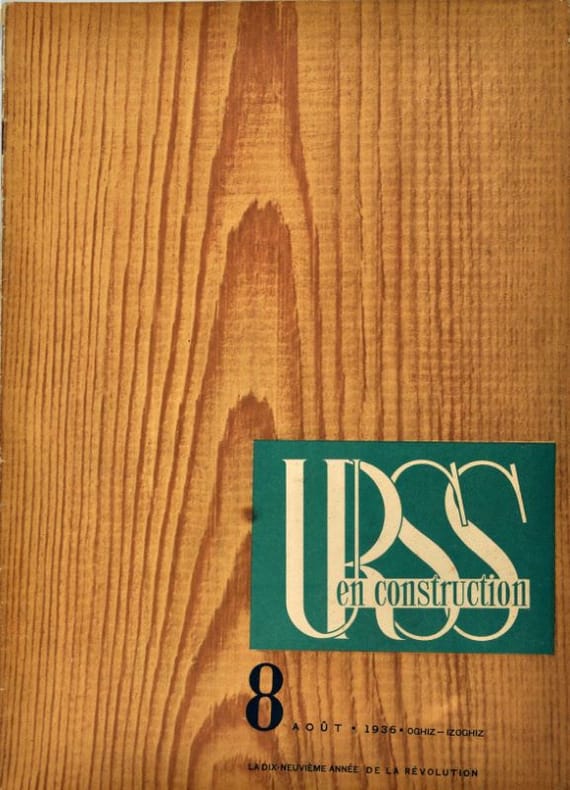
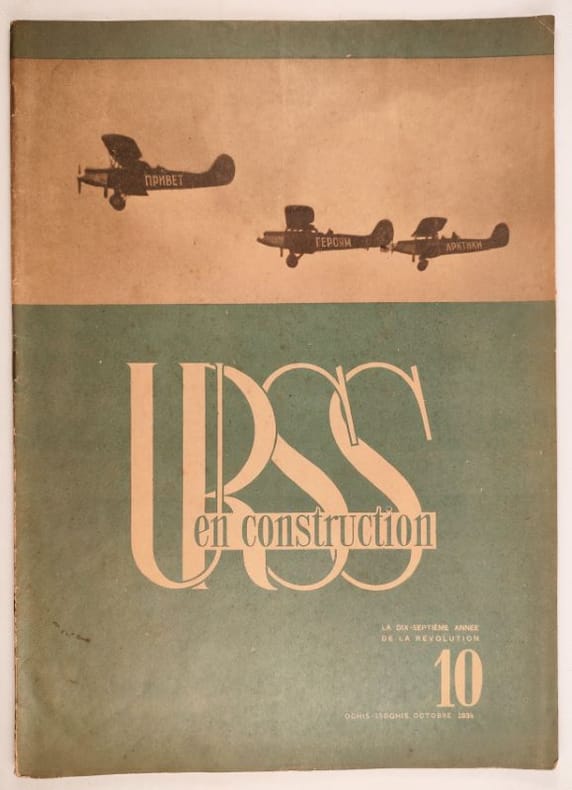
19361047151936 Moscou, Isoghis, 1936, 416x300mm, 40p., un petit dépliant avec 12 photographies fixé à la page 8, une carte sur un rabat, broché sous couverture imitation bois. (104715)
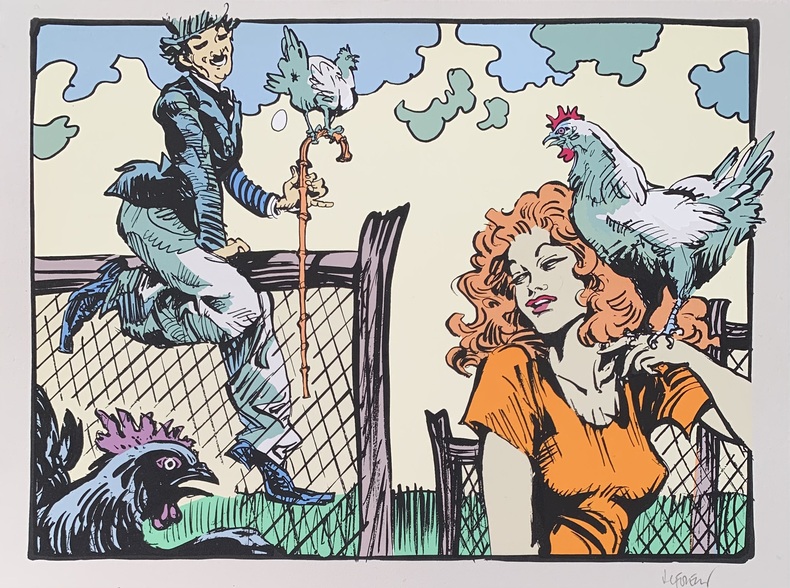
awd-1004Strasbourg, Baby Lone, 1986. Portfolio in-4 à l’italienne en toile bicolore, titre sur le 1er plat (6 pp. découpées en diagonale contenant les 2 textes et la justification). En regard : 4 sérigraphies en couleurs signées de Jean-Claude Forest, dans un compartiment. Conception : Daniel Sardet. Tirage à 126 ex.
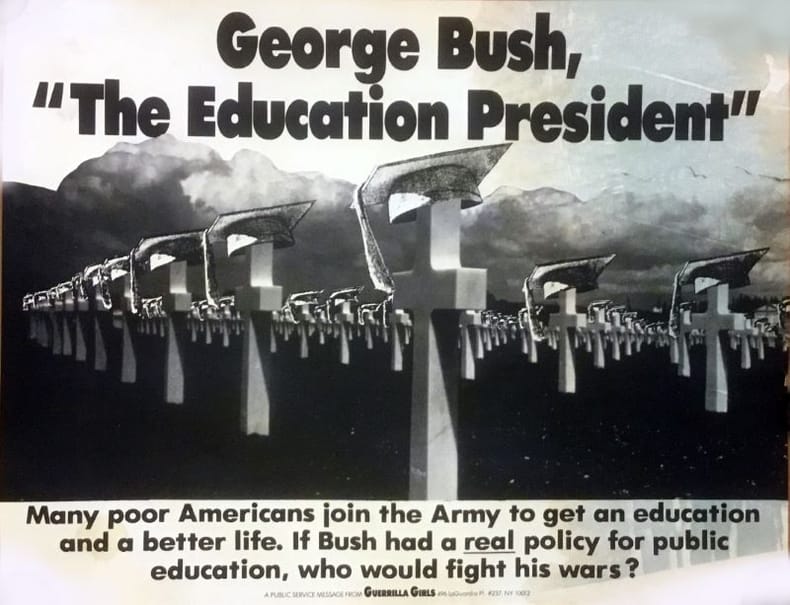
104193Affiche 432x552mm impression offset.Trous de punaises mouillure.
19308-0-278o.O., Rudolf Renner M.d.L. / Peuvag (Druck), 1930. 8°, 16 Bll, Klammerheftung
193658956ABLeipzig, BI Bibliographisches Institut, 1936 - 1942. 4° (25x17) je Band etwa 800 S. (zweispaltig paginiert), mit zahlr. teils farb Abb. im Text und auf Tafeln, Band 7 mit anatomischem Modell in Kartentasche (so komplett), einheitl OHldrbde mit LdrEcken, hellgraues Leder, brauner LeinenBezug, goldRückenPrägung, 9+1 Bände : Band 1 - 9 + 12 (so komplett), 8. Aufl. Rücken minimalst berieben, schöne gepflegte Exemplare,
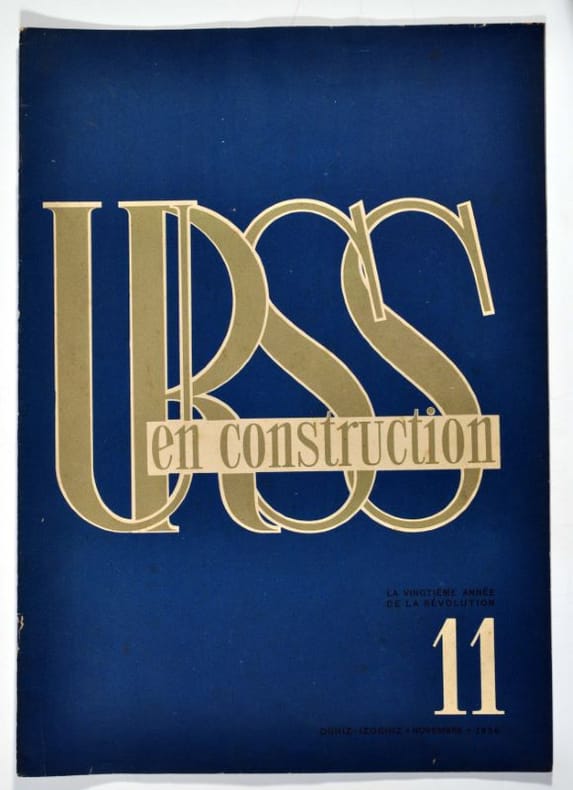
19361047181936 Moscou, Izoghiz, 1936, 416x300mm, 32p., broché sous couverture imprimée. (104718)
167 pages. Black and white plates, including tissue-protected frontispiece. Author was a Captain in America's Military Intelligence Division during WWI. A compilation of his fascinating and informative letters. Gift greetings atop front free endpaper otherwise contents clean and unmarked. Light age-toning to contents. Binding intact. Somewhat above-average external wear and soiling. A sound copy. Book
194449042Die Wehrmacht, Bln. 1944. Mit sehr zahlreichen s/w Abbildungen. Folio. OBrosch. Heft 9 mit durchgehendem Einriß (3 cm) am Rücken. Heft 16 mit Gekritzel auf der Rätselseite. Sonst nur kleinere Gebrauchspuren.
18134Central Office of Information Grand in-folio à l'italienne Couverture rigide à anneaux Londres
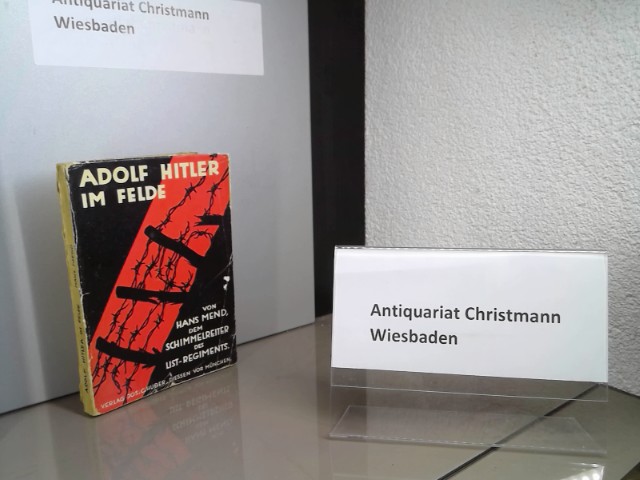
193160636Diessen : Huber 1931. 192 S. : mehr. Taf. ; 8°, Schrift: Fraktur / Altdeutsche Schrift., Eigentümersignatur auf Vorsatzblatt (Ulrich Crämer deutscher Historiker und in der Zeit des Nationalsozialismus Professor an der Universität München.) Softcover/Paperback, Papier und Schnitt stärker bräunlich, sonst Ecken und Kanten gebrauchsspurig, sonst Exemplar in gutem Erhaltungszustand
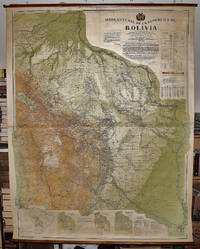
19362309280012Sociedad de Ingenieros de Bolivia y Centro de Propaganda y Defensa Nacional La Paz 1936. Maps. Very Good. Large color map of pre-WWII Bolivia. 146 x 185 cm. Mounted on muslin wood rods top and bottom. Scale 1:1000000. Relief shown by gradient tints and spot heights. Includes text climate diagram and 4 inset maps. Inset maps of: Vias de comunicacion internacional Sud America -- Vialidad y comunicaciones en Bolivia -- Riquezas explotables en Bolivia -- Isogonas magneticas para los anos 1930 y 1940 -- Perfil del territorio. <br> Note: This is a large heavy map. Additional postage will apply depending on delivery location Sociedad de Ingenieros de Bolivia y Centro de Propaganda y Defensa Nacional, La Paz, unknown
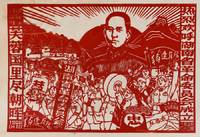
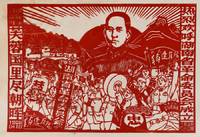
157440No publication details. No date. Large Chinese Cultural Revolution papercut on red paper with paper backing. This papercut features a crowd of people cheering together for the establishment of Shanghai Revolution Committee. Among them two female red guards are holding a banner showing the name of the committee people on left corners are playing musical instruments many are holding high of the little red book of Mao's quotations. There is a head and shoulders portrait of Mao Zedong's with the sun with its bold rays extending behind him. <br> <br>Excellent condition blocks of text in Chinese papercuts sheet measures 50.3 x 73.2cm. Text in right margin reads "Many Cheers on the Founding of the Revolution Committee of Shanghai City./February 5th 1967". The dates here shows the committee was established on February 5th 1967. <br> <br>Text in left margin reads "China Military China Daily Editorial./The victory of January Revolution last for ten thousand years./ January 12th 1967." The dates shows when the article was published in the newspaper. <br> <br>In January 1967 a political campaign led by 张春桥 Zhang Chunqiao and supported by Mao Zedong had undergone in Shanghai. Zhang and other leaders of this campaign took over the local Shanghai government and established a local revolution committee by rebellion factions. This event marks the beginning of the power seizure movement nationwide and it propels the Cultural Revolution into full swing. . No publication details. unknown
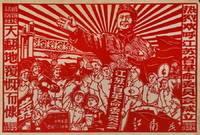
157438No publication details. No date. Large Chinese Cultural Revolution papercut on red paper with paper backing. Papercut features a crowd of people cheering together for the establishment of Jiangsu Revolution Committee. Among them two people are holding a banner showing the name of the committee some soldiers in uniform are playing musical instruments some are holding the little red book of Mao's quotations a worker on left corner is holding a flag showing 囍 Double Happiness and a peasant is lifting a banner showing The Highest Order from Central Communist Party of China which says "Never forget the class struggle". A head and shoulder's portrait of Mao Zedong the sun with its bold rays extending behind him and a road-rail bridge in the background completes the picture. <br> <br>Excellent condition blocks of text in Chinese papercuts sheet measures 49.9 x 73.4cm. Text in right margin reads "Many Cheers on the Founding of the Revolution Committee of Jiangsu Province./March 24th 1968". The dates here shows the committee was established on March 24th 1968. <br> <br>Text in left margin reads "China Military China Daily Editorial./Heaven-and-earth overturned bringing great changes. People are overjoyed./ March 25th 1968." This phrase is quoted from a poem by Mao Zedong. The dates shows when the article was published in the newspaper. . No publication details. unknown
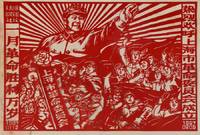
160161No publication details. No date. Large Chinese Cultural Revolution papercut of red paper loosely presented on paper backing. This papercuts features a crowd of people cheering together for the establishment of Hunan Revolution Committee. Among them two people are holding a banner showing the name of the committee some of them are playing musical instruments and the majority of them are holding their hands high with the little red book of Mao's quotations. Mao Zedong's head and shoulder portrait the sun with its bold rays extending behind him. Views of mountains and villiage are also at the background. <br> <br>Excellent condition blocks of text in Chinese papercuts sheet measures 51.7 x 71.7cm. Text in right margin reads "Many Cheers on the Founding of the Revolution Committee of Hunan Province./April 8th 1968". The dates here shows the committee was established on April 8th 1968. <br> <br>Text in left margin reads "China Military China Daily Editorial./Confederate roses are opening beautifully at my home town. The Sunshine at dawn is shining there/ April 10th 1968." This phrase is quoted from a poem by Mao Zedong. The dates shows when the article was published in the paper. <br> <br>The blocks of texts on the banners and flags are the names of the committee and rebel factions. . No publication details. unknown
157441No publication details. No date. Large Chinese Cultural Revolution papercut of red paper loosely presented on paper backing. This papercuts features a crowd of people cheering together for the establishment of Hunan Revolution Committee. Among them two people are holding a banner showing the name of the committee some of them are playing musical instruments and the majority of them are holding their hands high with the little red book of Mao's quotations. Mao Zedong's head and shoulder portrait the sun with its bold rays extending behind him. Views of mountains and villiage are also at the background. <br> <br>Excellent condition blocks of text in Chinese papercuts sheet measures 49.4 x 71.9cm. Text in right margin reads "Many Cheers on the Founding of the Revolution Committee of Hunan Province./April 8th 1968". The dates here shows the committee was established on April 8th 1968. <br> <br>Text in left margin reads "China Military China Daily Editorial./Confederate roses are opening beautifully at my home town. The Sunshine at dawn is shining there/ April 10th 1968." This phrase is quoted from a poem by Mao Zedong. The dates shows when the article was published in the paper. <br> <br>The blocks of texts on the banners and flags are the names of the committee and rebel factions. . No publication details. unknown
19199148CHamburg:, Centralverein deutscher Staatsbürger jüdischen Glaubens., [1919]. (ca. 29,4 x 23 cm). 2 S. Original-Flugblatt. Papier wurde gefaltet, sonst wohlerhalten. Altersentsprechend sehr guter Zustand.
Very Good Turkish In modern photograph album including 40 photographs. In various sizes. Album size: (20x16 cm). Descriptive notes on backsides of photographs. 1934 Fevzi Çakmak and military stuff in Izmir.; [An inspection].; On a board (ship) (Small size).; Train riding practice in 1936, Tekirdag.; [In a train].; [Afyon] Kocatepe in [1]941 on railways (Small size).; Procession in Tekirdag - 1936 (Small size).; [On a board (ship)] (Small size).; Fevzi Çakmak and military stuff.; Mariners in 1935.; Fevzi Çakmak with a machine gun.; Fevzi Çakmak on ship's board with binoculars in 1935.; Artillery practice.; Inspection of aviators in Eskisehir by Fevzi Çakmak and other stuff in 1932 etc. The Thrace Maneuvers (Trakya Manevralari) were conducted by the Turkish Armed Forces in 1937 between 17 and 20 August under the command of the Chief of General Staff Marshal Fevzi Çakmak. Prior to the upcoming World War II, it was carried out both as a review of the level of preparation of the armed forces and as a show of strength for potential enemy threats. First of all, the fascist movement led by Benito Mussolini in Italy and then the Nazis, led by Adolf Hitler in Germany, after they took the power to aggressively take up arms and run again to share the land in the European continent, were regarded as a sign of an upcoming war. Therefore, Turkish state officials, especially Atatürk, decided to get military exercises to prepare the armed forces for a military confrontation and to intimidate potential threats.
104703(104703)
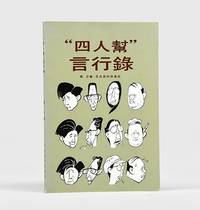
1977151285Hong Kong: Wenhua ziliao gongying she 1977. Chairman Mao's widow under attack First edition first printing of this collection of propaganda cartoons seldom seen in commerce and presenting here in exceptional condition. This visually striking work was issued by a Beijing-backed publisher in Hong Kong to bring to the colony the tumultuous politics of the post-Mao mainland in particular the denunciations of a fallen political faction led by Chairman Mao's widow. The roots of the present publication lie in the dramatic political changes that gripped the People's Republic of China in autumn 1976. After Mao's death in early September a new leadership grouping quickly coalesced around the up-and-coming politician Hua Guofeng and less than a month after Mao's passing Hua arranged the arrest and imprisonment of a rival wing of the communist party leadership led by Mao's widow Jiang Qing. Hua's faction argued that Jiang and her allies posed an existential threat to Mao's revolutionary legacy. Jiang along with Zhang Chunqiao Yao Wenyuan and Wang Hongwen were quickly christened the "Gang of Four" by state media and they became the go-to scapegoats for the chaos of the Cultural Revolution years 1966-1976. Ultimately their fate was decided in a sensational televised trial in 1981 at which they were sentenced to lengthy prison sentences. After the "Gang's" arrest to make the official narrative stick and to prepare the way for the trial state propaganda organs pumped out huge quantities of anti-"Gang" agitprop. This material was often visual with professional and amateur caricaturists and cartoonists drafted in to draw memorable condemnations of the "Gang's" political crimes. The present work anthologises some of the best of these drawings from the Chinese mainland for readers in Hong Kong. The publisher's Beijing links can be seen in the way the text accompanying the cartoons mirrors the party lines emanating from communist newspapers such as the People's Daily while the blurb on the rear wrapper talks of the Chinese people's "hatred" of the "Gang." The caricatures present all the standard political refrains of state media: the work begins with images of Jiang Qing showing her pseudo-imperial political aspirations while her allies toady at her feet; Zhang Chunqiao and Yao Wenyuan become grotesque pen-wielding ideologues; and Wang Hongwen is depicted primping and preening ready to take on the position of premier. The "Gang" are often depicted together as a choir singing counter-revolutionary anthems as a group indulging in an hedonistic decidedly un-socialist lifestyle and as a four-headed monster with tentacles extending across the political world. Quite apart from their entertainment value these materials were extremely successful. The anti-"Gang" narrative remains in vogue today and still exerts a strong influence on academic research into modern Chinese politics. Octavo. Cartoons and drawings throughout title page and copyright page printed in blue. Original green paper wrappers title and caricatures printed in red white and black. Spine lightly sunned with touch of wear to foot. A fine copy. unknown
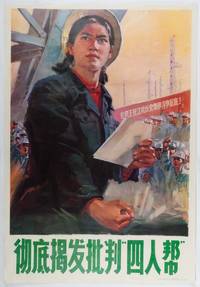
1977215861Beijing.: 人民美术出版社. People's Fine Arts Publishing House. 1977. Large anti-Gang of Four propaganda poster featuring a heroic young female worker in an industrial setting. Some lightly browned holes along upper edge of poster. In very good condition colours fresh and bright. 77 x 53cm. Poster was designed by Sun Quan 孙荃 who was assigned to the People's Fine Arts Publishing House in 1973. The background banner calls for people to swear to struggle together to the end against the anti-Party group of Wang Zhang Jiang and Yao. . 人民美术出版社. People's Fine Arts Publishing House. unknown
In-8° pp. 17 nn. Con ill. a piena pagina a colori. Copertina in cartoncino edit. ill. a colori con sovracoperta ill. Tracce del tempo ma ancora in buono stato. Pubblicazione di propaganda usata per le zone italiane limitrofe all'Austria; sulle didascalie in basso sono state applicate delle striscie di carta con la traduzione in italiano.
Very Good German n modern aesthetic full leather bdg. Folio. (32 x 24 cm). Bilingual in German and Turkish. 103, [1] p., b/w plates. Includes exhibition booklet (15 pp., b/w ills.), and text of the speech of German ambassador (Franz von Papen) for this exhibition (4 pp.). "The New German Architectural Exhibition opened in Ankara Exhibition House between 31st January and 15th February 1943 was one of the exhibitions opened during World War II. This exhibition occupied a distinctive place on the public agenda due to its size and effect in media on that date. A great number of Turkish authorities, foreign diplomatic representatives, and journalists attended the exhibition, which was opened with great efforts, and the leading role of the German Ambassador in Ankara, Franz von Papen, and such a situation caused the exhibition to attract attention. Even though the civil architectural and engineering works stopped completely in Germany during the War and some of the projects were draft and incomplete, they tried to be exhibited to give the impression of Nazi Germany's "great power" with the aim of propaganda. In Turkey's press, great praises were presented in writings towards the magnificence and architects of German architecture. Not only axis powers but also allied powers tried to attract the attention of the Turkish Government and the public agenda in Turkey using propaganda methods. As a result of such attempts, the UK opened exhibitions in 1944 on English architecture in Ankara first and then in Istanbul. Similar praises spent for German architecture were also presented to that of the UK. At this point, it may be stated that as for the War, Turkey followed a policy of active neutrality, Turkish media also followed the same policy." (Source: Küçük, Evren: An Example of Nazi Germany's Propaganda in Turkey: German Architectural Exhibitions in Ankara and Istanbul).
Very Good Arabic Original wrapper, missing back cover. Foolscap 8vo. (17 x 13 cm). In Arabic. 117, [1] p., b/w ills. and one map. Scarce illustrated Arabic book of the Afghan people living in different regions in Afghanistan, written in the period of Mohammed Daoud Khan (1909-1978), who was an Afghan politician and general who served as prime minister of Afghanistan from 1953 to 1963. It's published as the seventh book of the "Peoples of the World Series". Second Edition. Fifteen copies in OCLC 235990862, 29876584.
Very Good French Original hand-colored complete set of postcards including 10 pieces depicted Joan of Arc's life and statue. Jeanne d'Arc, 1409-1431. Size: 45x27,5 cm. In French. Had colored. Including 10 pieces of standard sized postcards. It depicted Joan of Arc's statue in armor with depictions around her, which are hand-colored and contain scenes from her life. 1. Jeanna D'Arc dans sa prison. 2. Jeanne Darc blessee devant Paris. 3. Jeanne Darc acclamee. 4. Depart de Vaucouleurs 1422. 5. Jeanne Darc a Domremy 1423. 6. Jeanne Darc a Chinon. 7. Prise d'Orleans 1428. 8. Au Sacre de Charles VII Reims 1429. 9. Arrestation a Compiegne 1430. 10. Rounen 1431. No editor name and printed info. 'Made in France'. Slightly on margins. Minor fading on pictures. Otherwise a good set. Joan of Arc nicknamed "The Maid of Orléans" (French: La Pucelle d'Orléans), is considered a heroine of France for her role during the Lancastrian phase of the Hundred Years' War and was canonized as a Roman Catholic saint. She was born to Jacques d'Arc and Isabelle Romée, a peasant family, at Domrémy in northeast France. Joan claimed to have received visions of the archangel Michael, Saint Margaret, and Saint Catherine of Alexandria instructing her to support Charles VII and recover France from English domination late in the Hundred Years' War. The unanointed King Charles VII sent Joan to the Siege of Orléans as part of a relief army. She gained prominence after the siege was lifted only nine days later. Several additional swift victories led to Charles VII's consecration at Reims. This long-awaited event boosted French morale and paved the way for the final French victory. On 23 May 1430, she was captured at Compiègne by the Burgundian faction, a group of French nobles allied with the English. She was later handed over to the English and put on trial by the pro-English Bishop Pierre Cauchon on a variety of charges. After Cauchon declared her guilty, she was burned at the stake on 30 May 1431, dying at about nineteen years of age. In 1456, an inquisitorial court authorized by Pope Callixtus III examined the trial, debunked the charges against her, pronounced her innocent, and declared her a martyr. In the 16th century, she became a symbol of the Catholic League, and in 1803 she was declared a national symbol of France by the decision of Napoleon Bonaparte. She was beatified in 1909 and canonized in 1920. Joan of Arc is one of the nine secondary patron saints of France, along with Saint-Denis, Saint Martin of Tours, Saint Louis, Saint Michael, Saint Rémi, Saint Petronilla, Saint Radegund and Saint Thérèse of Lisieux. Joan of Arc has remained a popular figure in literature, painting, sculpture, and other cultural works since the time of her death, and many famous writers, playwrights, filmmakers, artists, and composers have created, and continue to create, cultural depictions of her. (Wikipedia).