4 064 résultats
In-8°, 24pp, legatura in carta semplice In-8°, 24pp, paper binding
In-8°, 24pp, legatura in carta semplice, intonso In-8°, 24pp, paper binding, uncut
1914100783Berlin, Verlag d. Vereinigung der Kunstfreunde Ad. O. Troitzsch o.J. (1914). 40 doppelblattgr. farblithogr. Bögen. Ca. 44 x 34 cm (Bogen), 4°, dunkelrot. HLwd. mit marmor. Deckeln.
Very Good Turkish, Ottoman (1500-1928) Original very decorative 1/4 leather bdg. Raised bands, ornaments gilded on four compartments of five. Foolscap 8vo. (17 x 12 cm). In Ottoman script. 173 p. Framed text in a style of early 19th century mostly seen in the transition period from manuscripts to the printing. Slightly faded on boards, stains on margins of two pages. Otherwise a very good copy. Harputî Ishak Efendi was a 19th-century statesman and Islamic scholar in the Ottoman Empire. After completing his first education in his hometown, he came to Istanbul and received a license from "Sahn-i Seman Madrasahs" in Fatih, Constantinople. While teaching in Istanbul madrasas, he taught "huzur dersleri" [i.e. the peace lessons] of Sultan Abdulaziz. He continued these lessons for many years as an educator. During the reign of Sultan Abdülhamit II, he was a commission member in the Ministry of Foundations (Waqfs), as a teacher of junior high, and as a qadi of Isparta and Medina. Harputi Ishak was an accomplished theological instructor and writer. In 1861, he published the Sems al-hakikat against Karl Pfander's ideas. During the 1860s he was a teacher at the prestigious Darü'l-Maarif secondary school. Harputî Ishak then rose within the religious scholarly ranks while an instructor at the Fatih Medrese, and he gained the attention of Sultan Abdülaziz. In the 1870s, he held the position of molla, as he was an instructor at the Darü'l-Maarif, and attained the rank of Istanbul payesi (rank of the qadi of Istanbul). His literary ventures had the official sanction and reflected so-called traditionalist views of Sultan Abdulaziz's administration in contrast to Euro-centric reformers such as Ali Pasha. In 1874, he wrote the Kashifu'l-esrâr ve dafiu'l-eshrar, against Bektashism. On the third page of the work, Ishak Efendi stated that he divided the book into three parts. The first part includes Fadlullah el-Hurufi (prophet, or, leader of Hurufism) and the basic principles of Bektashism, the second part, the criticism of Abdülmecid Firisteoglu's work named Isknâme [i.e. The book of light], and third part, the criticism of the views against religion in Câvidânnâme (The sacred book of Hurufis by their leader, Fazlullah). Ishaq says that all Hurufis and Bektashis are the enemies of Islamic religion in his book, which he describes as Hurufi and attacks in this direction. (Source: AN ANTI-ISLAMIC POLEMIC IN 1878 OTTOMAN ISTANBUL: S.W. KOELLE'S GIDAÜ'L-MÜLAHAZAT, by Scott Rank). It is not known how many copies of the book written by Ishaq were published in any source, but it is known that the readers and the public of the period were influenced by this Sunni-origin counter-discourse. Second Edition. Özege 10358.; OCLC 892728564.; Library of Congress. Karl Süssheim Collection, no. 785.
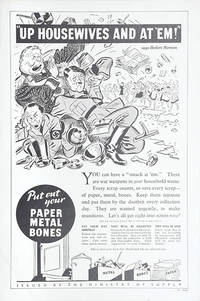
1940173612London: Issued by the Ministry of Supply 1940. A striking British wartime poster appealing for salvage showing Hitler Goebbels and Goering cowering under a barrage of newspapers pots and bones thrown by a mob of British housewives. The poster tells housewives that "you can have a 'smack at 'em'. There are war weapons in your household waste". It instructs them to separate out paper metal and bones from their house waste to be collected and used in munition manufacturing. The title is a quote from Herbert Morrison which was also used for a Pathé newsreel and a popular song. Offset lithograph 379 x 252 mm. Tiny chip at foot light crease at head. In very good condition. unknown
2014015772Paris Editions Dilecta 2014 Cartonnage toilé et étui éditeur
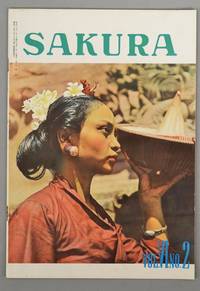
1944888911944. JAPANESE PROPAGANDA Asahi Shimbunsha. SAKURA. Volume 6 #2 #31 overall. Large wrappered staple bound illustrated photomagazine in the tradition of FRONT and HOMELIFE. This number published in February of 1944 celebrated the plans for a cross continental railway to cross Eurasia from Tokyo to Berlin complete with an undersea tunnel from Japan to the mainland. SAKURA magazine was written in English Chinese and French. The whole world seems to lay at the feet of the Axis in this rosy scenario as sketched throughout the magazine. East Asia under the guidance of Imperial Japan is on the march to build a new world. Yet by February of 1944 the Red Army was in Poland and the Ukraine Sevastopol was cut off times were bleak for the 1000 year Reich indeed. Closer to home the Allies had "turned the corner" in the Western Pacific had isolated the large Japanese force at Rabaul and were headed north towards the homeland. At some point during the war reality and appearance began a rapid divergence and as the end approached it became all pure delusion. All of which does not obviate what an amazing visual feast SAKURA is from the covers to the ads a consistent message of normalcy progress and steadfast purpose in a great task. unknown
1944888911944. JAPANESE PROPAGANDA Asahi Shimbunsha. SAKURA. Volume 6 #2 #31 overall. Large wrappered staple bound illustrated photomagazine in the tradition of FRONT and HOMELIFE. This number published in February of 1944 celebrated the plans for a cross continental railway to cross Eurasia from Tôkyô to Berlin complete with an undersea tunnel from Japan to the mainland. SAKURA magazine was written in English Chinese and French. The whole world seems to lay at the feet of the Axis in this rosy scenario as sketched throughout the magazine. East Asia under the guidance of Imperial Japan is on the march to build a new world. Yet by February of 1944 the Red Army was in Poland and the Ukraine Sevastopol was cut off times were bleak for the 1000 year Reich indeed. Closer to home the Allies had "turned the corner" in the Western Pacific had isolated the large Japanese force at Rabaul and were headed north towards the homeland. At some point during the war reality and appearance began a rapid divergence and as the end approached it became all pure delusion. All of which does not obviate what an amazing visual feast SAKURA is from the covers to the ads a consistent message of normalcy progress and steadfast purpose in a great task. unknown books
17711001881771. Romae Typis. Sac. Congregationis de Propag. Fide 1771. Woodcut vignette on titlepage. 16pp. some foxing. 19th century blue wrappers. One of the rare publications of the Propagande Fide that was established in 1626 for propaganda among the Eastern peoples. Ferdinand II presented Illyrian types for a missal and the Mediciean and other Oriental types from the Stamperia Vaticana were added to its stock while Stefano Paolini engraved others. It continued its existence throughout the XVIIth and XVIIIth centuries: Bodoni received his early training here. In 1789 most of the types were taken to Paris where in 1805 an edition of the Lord's Prayer in 150 languages was printed as a compliment at the time of Napoleon's coronation. Much of the type still remains at the Imprimerie Nationale. c.f. Birrell & Garnett 14. unknown
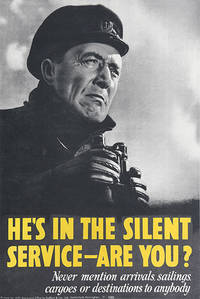
1942173606Nottingham: Printed for H.M. Stationery Office by Stafford & Co. Ltd 1942. One of the series of "careless talk" posters produced by the British government during the Second World War presenting a tight-lipped heroic sailor with the appeal to "never mention arrivals sailings cargoes or destinations to anybody". The British government feared both that enemy agents may hear vital secrets and that rumours may spread and undermine the war effort. Offset lithograph 370 x 249 mm. In fine condition. unknown
<p>25 x 21 cm, album oblungo ad anelle metalliche, cartoncino editoriale illustrato a colori con tecnica cromolitografica, titoli in rilievo. Pagine (1), 12. Una pagina di testo con l'elenco degli architetti dei padiglioni e 12 grandi fotografie originali in bianco e nero a tutta pagina su carta fotografica lucida (25x21 cm). Alcune vedute d'insieme dell'exposition, dove compare anche il padiglione dell'Italia dell'architetto Marcello Piacentni ed i dettagli dei singoli padiglioni più rappresentativi come quello della Germania nazista di Albert Speer e dell'architettura stalinista russa di Boris Iofan che fronteggiavano sul Trocadéro. In copertina interessante composizione grafica con il logo dell'esposizione sovrapposto ad una veduta fotografica della città, il tutto incorniciato da bandiere dove spicca la bandiera della Germania con la svastica nazista e quella della Russia comunista con falce e martello. Leggero alone alla prima copertina, fotografie ottimamente conservate. Raccolta assai rara, che si distingue per formato e qualità dalle più comuni raccolte fotografiche delle architetture dell'exposition del 1937.</p>
In-8°, 8pp, legatura in cartoncino decorato In-8°, 8pp, decorated cardboard
92 pages. Features: Nice colour ad for the 1953 Ford Customline Fordor Sedan; Magnificent full-page photo ad for Allis-Chalmers Tractor Division features Montreal's Miron & Freres Ltd. using an HD-20G, the world's largest tractor shovel with a 4-yard bucket; Very colourful full-page ad for BA service stations; Great colour photo full-page ad for the General Electric Twin-System refrigerator; The fight over Vitamin E - a bonus length feature on how Dr. Evan Shute and Dr. Wilfred Shute claim to be using Vitamin E to improve major health problems of their patients - with photos; Response to the Vitamin E article by the Canadian Medical Association; The corpse that hoaxed the Axis - Part One of the amazing story of how "Major Bill Martin" was part of a British Secret Service plot to mislead the Nazis into thinking the Allies would invade Sardinia, not Sicily; Anna had to be a clown - Claudia Anna Russell-Brown is a funny lady! - with large photo; The Duke of Edinburgh - the man behind the Queen - part 7 and final instalment of series "The Family in the Palace"; Can the West Stand Peace? - will Malenkov's peace offensive increase the danger of a slump and turn it into a propaganda victory for the Communists?; Louis Hemon - Vagabond Genius - article with photos; The Strange Death of Daddy Daniels (fiction); Henry Morgan and Company Limited, of Montreal, are the holdest and most courtly department store keepersin Canada - article with great photos; Never tell a woman anything (humour); The fastest man on four legs - Horse Jockey Johnny Longden - article with photos; Colour ad for the Chevrolet Bel Air 4-Door Sedan; Nice vintage colur ad for Cycla-matic Frigidaire refrigerators; Nice full-page two-colour ad for 1953 GMC trucks; Electrohome television and radio ad; Excellent colour photo Caterpillar ad inside back cover shows 1953 scraper in action plus a rare 1923 photo of a tractor pulling a scraper which is loading a horse-drawn wagon with earth; Great Coke ad on back cover shows smiling woman at gas station; and more. Clean and unmarked with moderate wear. A quality vintage copy. Book
16 pages. Features: George Viereck responds to alleged inaccuracies in the New York Times; German Brutality - Louvain (Leuven), Belgium; Where the Jews Stand - Leon Sanders writes about the Czar; The Expansionn of Russia - by David S. Levy; S.C. Nukerji, President of the Independent Hindusthan Society, offers sympathy to the people of Germany and Austria; Are the Germans justified in punishing Antwerp?; H.G. Wells and the War, by R.L. Orchelle; The Treason - a poem by Ernest Bruncken; Illustration of an imagined conversation between the Kaiser and Uncle Sam; Four Weeks of German Strategy - a review of events of the war; Prof. John W. Burgess Champions Germany (part 1); What other publications are saying about us; Average wear. Unmarked. Binding intact. A sound copy of this rare early issue. Magazine
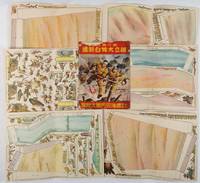
1933214182東京. Tokyo.: 博文館. Hakubunkan. Showa 81933. Six colour card cutout sheets folded as issued 39 x 27cm original wrapper with instructions 28 x 21cm. Paper wrapper chipped and torn with a little loss now neatly repaired with washi. Instructions are complete and the card sheets are in very good condition. This papercraft diorama kit was issued as a supplement to the children’s magazine Tankai in April 1933. The kit recreates scenes from the Japanese attack outside Shanghai in February 1932. During the mission to break through the Chinese defence line three Japanese soldiers were killed and subsequently celebrated as national war heroes known as 爆弾三勇士 The Three Brave Bombing Soldiers. Their bravery was highly revered and they became symbols of courage and sacrifice. <br> <br>The kit includes six platforms that when combined create a rising scene from the creek bed section. It depicts Japanese soldiers attacking Chinese buildings positioned on a hill supported by artillery and tanks. The set features numerous cutouts of Japanese soldiers in action while a smaller number of cutouts portray frightened Chinese fighters. Through this diorama young children learned about the conflict by recreating battle scenes and identifying with the war heroes during play. The kit not only served as a form of entertainment but also as a tool for instilling nationalistic pride and wartime ideology in the younger generation. . 博文館. [Hakubunkan]. unknown
192521639ABKhar'kov / Kharkiv, Izdatel'stvo Proletarij, 1925. Kl. 8°. 54 pages. Half-cloth, stapled binding with an illustrated cover. Die Versandkosten für Kunstwerke und mehrbändige Werke können von den Standard-Versandkosten abweichen. 2nd edition. Waterstained, several stamps,
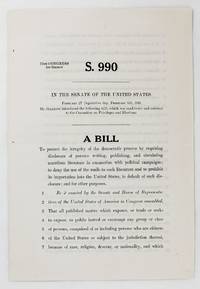
19415699Washington DC 1941. Very good plus. 51pp. Original self wrappers. Soft horizontal crease. A slip-bill printing of the Gillette Propaganda Exposure Bill of 1941 proposed by Iowa Senator Guy Gillette. The bill sought "to protect the integrity of the democratic process by requiring disclosure of persons writing publishing and circulating scurrilous literature in connection with political campaigns; to deny the use of the mails to such literature and to prohibit its importation into the United States in default of such disclosure; and for other purposes." The text of the bill opens by attempting to outlaw "all published matter" which causes "public hatred or contempt" for any American citizen "because of race religion descent or nationality" during national elections and those in Hawaii Alaska and Puerto Rico. The bill also sought to establish an Office of Minority Relations to enforce the law and provided penalties to anyone breaking the new law. The final line of the bill states that it should be referred to as the "Propaganda Exposure Act 1941." Calling for honesty fairness and equal treatment in American political elections It'll never pass and it didn't. unknown
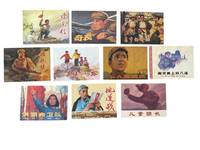
1963233101963. Post-Revolution ChinaCommunism PRC Cultural Revolution propaganda set of 10 lianhuanhua graphic novel booklets issued by the PRC propaganda press system between 1963 and 1984 centered on the culture revolution model soldiers anti-Japanese resistance and child heroism. The covers name campaigns and exemplary figures through titles including Chicken Feather Letter Surprise Attack Tunnel Warfare Honghu Red Guards Good Eighth Company on Nanjing Road Heroic Little Eighth Route and Capture the Enemy Flag while the interior pages state explicitly political morals like "The deepest source of the power of war lies among the masses" followed by "Revolutionary war is a mass war." Another photographed page frames sacrifice as Maoist instruction declaring: "Thousands upon thousands of martyrs for the interests of the people laid down their lives heroically before us; let us hold high their banner and advance along the path marked by their blood!"<br /> Illustrated PRC propaganda comic booklets. China: various provincial PRC presses 1963-1984. Set of 10 illustrated booklets each approximately 4 x 5 inches ranging from about 60 to 200 pages. Titles include Chicken Feather Letter Surprise Attack Tunnel Warfare Honghu Red Guards Good Eighth Company on Nanjing Road Heroic Little Eighth Route and Capture the Enemy Flag. The photographed title and colophon pages place the group across multiple provincial publishing systems including presses in Beijing Shanghai Zhejiang Shandong Tianjin Liaoning and Shaanxi. The booklets were designed for mass distribution using narrative episodes of soldier heroes and youth protagonists to glorify CCP ideology.<br /> These booklets were a central tool through which the PRC circulated revolutionary history and Maoist political language to mass readers especially younger readers in cheap durable heavily illustrated form. The concentration here on anti-Japanese struggle disciplined PLA units local militia action and heroic children gives the set a distinct documentary value as evidence of CCP socialist pedagogy across two decades. Clean complete and in very good condition. These 10 booklets preserve the language and narratives by which the Cultural Revolution propaganda system distributed CCP ideology to mass readership. unknown
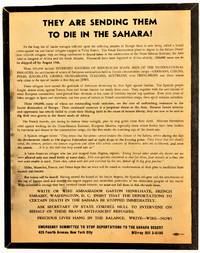
1941189981941. Broadside issued in 1941 by the Emergency Committee to Stop Deportations to the Sahara Desert articulating an urgent appeal against the forced deportation of anti-fascist refugees by the Vichy French government during the early years of the Second World War. Written by Edward K. Barsky a leading figure in the Joint Anti-Fascist Refugee Committee the document calls on American citizens to intervene diplomatically by contacting both the French Embassy in Washington D.C. and the U.S. Secretary of State. The broadside documents contemporary awareness of mass deportations and forced labor policies under the Pétain regime describing plans to remove large numbers of refugees-including veterans of the Spanish Civil War members of the International Brigades and political exiles from across Europe-to labor camps connected to the Trans-Saharan Railroad. The text situates these actions within broader patterns of repression highlighting the targeting of anti-fascist populations and the international composition of those affected. As such the document provides primary-source evidence of early wartime advocacy efforts in the United States responding to refugee persecution and authoritarian policies in Vichy-controlled territories.<br /> <br /> Single-page printed broadside. New York: Emergency Committee to Stop Deportations to the Sahara Desert 1941. Measuring approximately 10.25 x 8 inches. Printed in black text within a ruled border on brown paper. The text consists of a headline explanatory statement and direct appeal for public action including instructions to contact diplomatic officials.<br /> <br /> Light wear consistent with age; text clear and legible; overall very good condition. A scarce wartime advocacy document reflecting early American engagement with the European refugee crisis under Vichy rule. unknown
pp. xviii, 60 Tipped in color plates with facing text. Wide margins. Printed on heavy gray paper. Title page printed in red and black. Uncut. Top edge gold. Chiswick Press Edition de Luxe. Edition Limited to only 1,050 copies, of which 1,000 are for sale. Limitation signed in pencil by Louis Raemaekers. Folio. 14 x 19". Original cloth backed marbled boards binding. Leather spine labels, worn. Extremities worn with small loss. Binding has some soiling. Still, a very nice copy of a magnificent book, documenting the most powerful illustrative art of World War One. **PRICE JUST REDUCED! WWI 1
193925067(Bln, Deutscher Verlag, 1939). Zusammengestellt vom Werbedienst der Tobis Film. Beschreibt die Produktion des Jahres mit Nennung der DarstellerInnen und des Regisseurs. Mit sehr zahlreichen Abbildungen und zu jedem Film ein Kleinplakat. Graphische Gestaltung von Herbert Dassel. Es zeichneten Cyran, Dassel, Fennecker, Geffers, Keil, Kossatz, Kranz, Markowski, Orasch, Thiele, Trich und Wywiorski. 33/32,5 cm. 220 ungez. S. OLeinen mit montiertem Titelschildchen. Vorderes fl. Vorsatz mit Knick, sonst schön.
In 4° (19,5x15 cm); 77, (1), (2 b.) pp. Legatura coeva in piena pergamena. Qualche lieve difetto. Una fascetta antica che integra piccole mancanze di carta sul lato esterno bianco delle prime tre carte e due piccole pecette che integrano due piccoli forellini agli angoli bianchi esterni delle ultime due carte. Un forellino alla quarta carta tocca una lettera nelle glosse laterali. Nelle ultime quattro carte leggermente sfrangiato l’angolo esterno, ininfluente, nel margine bianco e lontano dal testo. Nel complesso esemplare genuino in buone-ottime condizioni di conservazione. Prima non comune edizione di quest’opera, uscita anonima ed attribuita, fra gli altri al Marchese Bedmar Alfonso de la Cueva (1572-1655), ambasciatore spagnolo a Venezia, a Marcus Welser e a Possevino che rappresenta una dei più forti pampleth antiveneziani del seicento, tanto inviso alla Serenissima da esser espressamente ordinato dal Minor Consiglio, di recuperare tutte le copie possibili dell’opera e di distruggerle. Il celebre avvocato e bibliografo francese, Étienne-Gabriel Peignot (Arc-en-Barrois, 15 maggio 1767 – Digione, 14 agosto 1849), nella sua opera “Dictionnaire des Ouvrages Condamnes au feu” scrive riferendosi a quest’opera “"Ouvrage seditibux et rare. Il a ete Brulè par ordre du Senat de Venise. On n'en connait pas l'auteur precisement…Il pretend monster dans cet ouvrage que la Republique de Venise n'est pas nee libre, qu'elle est un ancien domaine de l'Empire, et que, par consequent l'Empereur et l'Empire conserrvent sur la Republique leurs droits et leurs memes pretentions. Cet auteur semble avoir prevu la sorte de Venise. Quoi qu'il en soit, son livre a donnè lieu a' Fra Paolo (Sarpi) de Faire l’Histoire du Concile de Trente pour Mortifier la cour de Roe, et il n'y a que trop bien. Reussiò (II, p. 144-145). Melzi, Dizionario di opere anonime e pseudonime, III, p. 93; Parenti, Dizionario dei luoghi di stampa falsi, inventati o supposti, p. 143; Autori italiani del Seicento, III, p. 226-227, n. 1013-1016. (II, P.144-145)”. Rara opera. Rif. Bibl.: Haym, vol. I, pag. 97, n. 2 "edizione rara abbriciata dal senato"; Cicogna, 894; Lozzi, 6133; Platneriana 420.
1944MILI2266Berlin, Stollberg Sept 1939 - Juni 1944. 112 (statt 116) Halbmonatslieferungen in 45 (statt 47) Bdn. ( die letzten 4 Lieferungen = Mai/Juni 1944 fehlen). Pro Lieferung ca. 100 S. u. einige Abb. a. Taf. OHLn. bzw. Oppbde. Einige Rücken mit Lichtspuren, etw. berieben, Schnitte fleckig, ein Rücken mit einer kleinen Fehlstelle, ein weiterer Rücken aufgeplatzt, Band 1939 durch Wassereinwirkung beschädigt, daher Seiten teilweise verfärbt, vereinzelt Bibliothekszettel auf den fliegenden Vorsatzblättern. Das offizielle NS-Berichtwerk, entstanden in Zusammenarbeit von Reichspropagandaministerium und OKW. Selten.
20771Paris, Bernard Grasset, “Les Cahiers Verts”, N°1, 1921 ; in-12 (198 x 130 mm), bradel demi-maroquin prune à grain long, titre doré, couverture et dos conservés, non rogné (reliure un peu postérieure) ; 205 pp., [1] f. d’Achevé d’imprimer ; [4] pp. “Les Cahiers Verts” par Daniel Halévy, présentation de cette nouvelle collection.
1054541 Budapest, ed.Mûvelt Nép, 1955, 79 pages comportant 34 photographies. Relié en toile, 29,2x20,5 cm. Préface de Móricz Zsigmond et Móricz Virág, texte Boldizsár Iván.