Antiquariat.de

Antiquariat Tautenhahn · DE - Lübeck190,00 €
4 064 résultats
Very Good Turkish, Ottoman (1500-1928) Contemporary (early 19th century) quarter brown cloth with marbled boards, "Yahudi ebrûsu" end-papers. Roy. 8vo. (23 x 16 cm). In Ottoman script (Old Turkish with Arabic letters). 90 p., numbered with Arabic numeric system in pencil, around seven illustrated schemes of magical diagrams. Written on a probably 17th-18th century European paper with "Crescent" watermark, naskh script with "harakât", black and red ink. Early and a rare posthumous manuscript copy of this 18th-century Islamic majmua, containing the treatment methods and drug compositions against physical and spiritual diseases, with material and magical suggestions, copied 32 years after the author's death by a "Hafiz" with an addendum of new drugs and treatments compiled from older annotations of this work. "In the first part of the work on spiritual medicine, verses, prayers, talismans, and magic formulas in the Islamic culture like "wafqs" that are believed to be treated; in the second part, on physical medicine, drug formulas from various material objects for physiological diseases are shown." (Çagrici). Harputî was an 18th-century poet and prose from Harput (Kharberd). In the introduction to the manuscript, he stated that he is not a doctor, but that he writes practices that can heal patients due to his experiences. Despite this, the text was widely used in Ottoman medicine in the 18th and 19th centuries.
Very Good Turkish, Ottoman (1500-1928) Original chromo-lithograph map on cloth. 63x98 cm. In Ottoman script (Old Turkish with Arabic letters). Chipped on extremities, some wear on folds, foxing, and stains on margins and cloth with small holes. Overall a good/fair copy. First separate edition of this rare and attractive chromo-lithographic map of the Imperial Ottoman lands in Europe, as well as the Bosphorus and Crete in separate panels, drawn by Turkish infantry major El-Hac Nasrullah b. El-Hac Nâsir from Daghestan, during the last period of the rule of Sultan Abdulhamid II, with praise to the Sultan. The map gives detailed information on the lower left telegraph and postal codes of the Imperial vilayats such as Bosnia, Bulgaria, Algeria, Egypt, and Tunisia, etc. Additionally, on the lower right, demographic statistics and data of vilayats and some cities. This rare map shows the complete Ottoman Balkans according to the Ottoman administral system. West Anatolia and West Black Sea Coats on the east, Adriatic coasts on the east, and Ottoman Greece, Bulgaria, Albania, and Bulgaria are included on the map. These countries are separated by Selanik (Thessaloniki), Roumeli, Monastery, Ioannina, Kosovo, and Shkodra vilayats.
Very Good Turkish Original artwork in watercolor, Indian ink, and dry paint. 11,5x9,5 cm. This rare original artwork of Mary and Jesus comes along an exceptional provenance of Turkish cartoonist Semih Balcioglu (1928-2006), with his handwritten note on verso "Cemal Nadir'in bir kompozisyonudur" [i.e. It's composed by Cemal Nadir]. Signed on right lower as "C. N". Unpublished work. Cemal Nadir was a Turkish cartoonist. He was born in Bursa, Ottoman Empire on 13 July 1902. His father Sevket was a calligrapher (Turkish: Hattat) employed in courts. After finishing high school, he began working as a sign painter in Bursa. He also created cartoons, and his first cartoon appeared in Diken (literally: "The Thorn") periodical. Although he moved to Istanbul and tried to be a full-time cartoonist, he could not make it and he returned to Bursa. The Alphabet reform of 1929 gave Cemal Nadir a second chance to show his talent. When Turkey adopted the Latin alphabet replacing the Ottoman Turkish alphabet in Arabic script, all sign boards were necessarily changed, and he worked hard to meet the demand. The same year, he moved once more to Istanbul to work for the daily Aksam. Later, he also drew for the newspaper Son Posta, as well as for satirical magazines such as Akbaba. He also contributed to Yedigün. During this period, he published the satirical magazine Amcabey. During World War II, he drew anti-Nazism cartoons in the daily Cumhuriyet. In 1946, Republican People's Party (CHP) invited him to run for a seat in the parliament. However, he refused the invitation, he said that with political affiliation he would not be able to create cartoons.
Very Good Turkish, Ottoman (1500-1928) Original color postcard shows Tripoli War in 1911 and Arabic / Libyan tribes organized by Ottoman Turks and Italian soldiers. Can be seen Turkish / Ottoman flags. 9x14 cm. In Ottoman script and French on verso. Some traces of folding. Otherwise a good copy. [OTTOMAN PROPAGANDA / TRIPOLI / POSTCARD] Osmanlilar ile Italyanlar Trabluss muharebesinde. [i.e. Tripoli War with the Ottoman Turks and Italians]. La guerre Turco-Italienne - La bataille de Taraboulous.
Very Good Turkish In modern photograph album including 40 photographs. In various sizes. Album size: (20x16 cm). Descriptive notes on backsides of photographs. 1934 Fevzi Çakmak and military stuff in Izmir.; [An inspection].; On a board (ship) (Small size).; Train riding practice in 1936, Tekirdag.; [In a train].; [Afyon] Kocatepe in [1]941 on railways (Small size).; Procession in Tekirdag - 1936 (Small size).; [On a board (ship)] (Small size).; Fevzi Çakmak and military stuff.; Mariners in 1935.; Fevzi Çakmak with a machine gun.; Fevzi Çakmak on ship's board with binoculars in 1935.; Artillery practice.; Inspection of aviators in Eskisehir by Fevzi Çakmak and other stuff in 1932 etc. The Thrace Maneuvers (Trakya Manevralari) were conducted by the Turkish Armed Forces in 1937 between 17 and 20 August under the command of the Chief of General Staff Marshal Fevzi Çakmak. Prior to the upcoming World War II, it was carried out both as a review of the level of preparation of the armed forces and as a show of strength for potential enemy threats. First of all, the fascist movement led by Benito Mussolini in Italy and then the Nazis, led by Adolf Hitler in Germany, after they took the power to aggressively take up arms and run again to share the land in the European continent, were regarded as a sign of an upcoming war. Therefore, Turkish state officials, especially Atatürk, decided to get military exercises to prepare the armed forces for a military confrontation and to intimidate potential threats.
Very Good Turkish Original new year greetings card with an embossed printing 'Is Bank building' illustration in a futuristic style, with its embossed logo 'Is'. 17x12 cm. In Turkish. Folded leaflet. It includes a business card of branch manager attached into a folded leaflet. Signed by the manager of Ayaspasa Branch in Istanbul. Is Bank, or, Isbank is a commercial bank in Turkey. Following the culmination of World War I in 1918 and the subsequent dissolution of the Ottoman Empire in 1922, Turkey was declared a republic, and Mustafa Kemal Atatürk was elected by parliament as the first president of Turkey. Atatürk was quick to realize that the government needed a national bank to rebuild Turkey's economy following the debacle of the war. Türkiye Is Bankasi, the first truly national bank in the Turkish Republic was founded on 26 August 1924 at the First Economy Congress in Izmir. Atatürk appointed Celâl Bayar, his close aide, and then the Minister of Exchange Construction and Settlement as the president of the newly-formed bank. Isbank began operations with two branches and 37 staff under the leadership of Celal Bayar, its first general manager. The bank was established with a capital of 1 TL Million of which 250'000 TL was covered by Atatürk, and the rest by private investors. In 1927 the capital was raised by 2 Million TL so it could be merged with the National Credit Bank as equal partners.
Very Good Serbo-Croatian Original color lithographed print poster. Mounted on cardboard. Slight chip on the left corner, not loose. A good poster. 44x28 cm. In Serbo-Croatian. Artist signature: Kun, [Gleb?]. Red and black theme on the white surface. The peasant Serbian woman with her head and right hand raised to the sky is depicted. Antifastictika Fronta Zena [i.e. The Women's Antifascist Front] was a Yugoslav feminist and anti-fascist mass organization. The predecessor to several feminist front groups in the former Yugoslavia, and present-day organizations in the region, the "AFZ" was heavily involved in organizing and participating in the Partisans, the communist and multi-ethnic resistance to the Nazi occupation of Yugoslavia during World War II. It was formed by volunteers on 6 December 1942 in Bosanski Petrovac at the First National Conference of Women. In its early days, the organization was called the Antifascist Organization of Women (AOZ). In Croatia, the organization was named the Antifascist in front of women of Croatia. In Slovenia, there were a number of titles: Antifascist women association, Antifascist Front Women, Antifascist Front of Women. It was founded under the name of the Slovenian Antifascist Women Association. There was also a Slovenian Anti-Italian Women's Union. In Macedonia, it was called Antifascist front of women of Macedonia (Antifasisticki front na zenite na Makedonija). In Serbia, there was the Antifascist Front of Women of Serbia, including the Antifascist Front of Women of Vojvodina (based in Subotica). Before World War II, many women organizations advocated for peace, fighting against the different totalitarian forces that were growing across Europe. During the war, however, many women organized themselves within the antifascist movement and strengthened their position. This is confirmed by the first document of the Supreme Headquarters and the National Liberation Army volunteer Yugoslavia, which at that time was the supreme authority in the liberated territories. In various documents, it confirmed women's active and passive voting rights, which they already possessed prior to 1941, as outlined in the Constitution, but were not allowed to exercise. [.] Women began to massively involve the NOP as soldiers, medical staff, politicians, and MPs. Different female structures, which were established in 1941 under various names, have been associated in the wider areas, and as of 6 December 1942, held the first National Conference of Women. The conference was attended by 166 delegates from all over Yugoslavia, except for Macedonia, because they did not occur because of both distance and security concerns. Then the Conference founded the Antifascist Front of Women with the aim of mobilizing women for assisting new units, helping partisan government bodies, participation in armed and sabotage actions, and for the development of 'Brotherhood and Unity' among women. AFZ played an influential role in the Second World War, after the Invasion of Yugoslavia. The NLA attracted about two million women. In military units, there were 110 000 women. During the war, 2,000 women became officers. AFZ Committees were also responsible were collecting clothes for the NOV, caring about children, wounded soldiers, working as front-line nurses, and performing agricultural tasks. Of the 305,000 fallen soldiers between 1941-1945, 25000 were women, and of the 405,000 injured 40,000 were women. The issue of legal equality did not arise, because the women through their participation in the national liberation movement had arguably already achieved certain rights. All that after FOCA regulations on the principles of equality enshrined in the later constitutions "new" Yugoslavia, and various laws, the result of the struggle of women themselves in the feminist and anti-fascist women's organizations before the war, as well as their struggle during the war. [.].
Very Good French Original hand-colored complete set of postcards including 10 pieces depicted Joan of Arc's life and statue. Jeanne d'Arc, 1409-1431. Size: 45x27,5 cm. In French. Had colored. Including 10 pieces of standard sized postcards. It depicted Joan of Arc's statue in armor with depictions around her, which are hand-colored and contain scenes from her life. 1. Jeanna D'Arc dans sa prison. 2. Jeanne Darc blessee devant Paris. 3. Jeanne Darc acclamee. 4. Depart de Vaucouleurs 1422. 5. Jeanne Darc a Domremy 1423. 6. Jeanne Darc a Chinon. 7. Prise d'Orleans 1428. 8. Au Sacre de Charles VII Reims 1429. 9. Arrestation a Compiegne 1430. 10. Rounen 1431. No editor name and printed info. 'Made in France'. Slightly on margins. Minor fading on pictures. Otherwise a good set. Joan of Arc nicknamed "The Maid of Orléans" (French: La Pucelle d'Orléans), is considered a heroine of France for her role during the Lancastrian phase of the Hundred Years' War and was canonized as a Roman Catholic saint. She was born to Jacques d'Arc and Isabelle Romée, a peasant family, at Domrémy in northeast France. Joan claimed to have received visions of the archangel Michael, Saint Margaret, and Saint Catherine of Alexandria instructing her to support Charles VII and recover France from English domination late in the Hundred Years' War. The unanointed King Charles VII sent Joan to the Siege of Orléans as part of a relief army. She gained prominence after the siege was lifted only nine days later. Several additional swift victories led to Charles VII's consecration at Reims. This long-awaited event boosted French morale and paved the way for the final French victory. On 23 May 1430, she was captured at Compiègne by the Burgundian faction, a group of French nobles allied with the English. She was later handed over to the English and put on trial by the pro-English Bishop Pierre Cauchon on a variety of charges. After Cauchon declared her guilty, she was burned at the stake on 30 May 1431, dying at about nineteen years of age. In 1456, an inquisitorial court authorized by Pope Callixtus III examined the trial, debunked the charges against her, pronounced her innocent, and declared her a martyr. In the 16th century, she became a symbol of the Catholic League, and in 1803 she was declared a national symbol of France by the decision of Napoleon Bonaparte. She was beatified in 1909 and canonized in 1920. Joan of Arc is one of the nine secondary patron saints of France, along with Saint-Denis, Saint Martin of Tours, Saint Louis, Saint Michael, Saint Rémi, Saint Petronilla, Saint Radegund and Saint Thérèse of Lisieux. Joan of Arc has remained a popular figure in literature, painting, sculpture, and other cultural works since the time of her death, and many famous writers, playwrights, filmmakers, artists, and composers have created, and continue to create, cultural depictions of her. (Wikipedia).
Very Good German n modern aesthetic full leather bdg. Folio. (32 x 24 cm). Bilingual in German and Turkish. 103, [1] p., b/w plates. Includes exhibition booklet (15 pp., b/w ills.), and text of the speech of German ambassador (Franz von Papen) for this exhibition (4 pp.). "The New German Architectural Exhibition opened in Ankara Exhibition House between 31st January and 15th February 1943 was one of the exhibitions opened during World War II. This exhibition occupied a distinctive place on the public agenda due to its size and effect in media on that date. A great number of Turkish authorities, foreign diplomatic representatives, and journalists attended the exhibition, which was opened with great efforts, and the leading role of the German Ambassador in Ankara, Franz von Papen, and such a situation caused the exhibition to attract attention. Even though the civil architectural and engineering works stopped completely in Germany during the War and some of the projects were draft and incomplete, they tried to be exhibited to give the impression of Nazi Germany's "great power" with the aim of propaganda. In Turkey's press, great praises were presented in writings towards the magnificence and architects of German architecture. Not only axis powers but also allied powers tried to attract the attention of the Turkish Government and the public agenda in Turkey using propaganda methods. As a result of such attempts, the UK opened exhibitions in 1944 on English architecture in Ankara first and then in Istanbul. Similar praises spent for German architecture were also presented to that of the UK. At this point, it may be stated that as for the War, Turkey followed a policy of active neutrality, Turkish media also followed the same policy." (Source: Küçük, Evren: An Example of Nazi Germany's Propaganda in Turkey: German Architectural Exhibitions in Ankara and Istanbul).
Very Good Turkish Original color illustrated cover. Folio. (32 x 24 cm). In Turkish. 17, [1] p., color, and b/w ills. Anti-propaganda of Japan in 1936. An amazing cover illustration of Japanese anti-propaganda and USSR (Soviets). It's seen a yellow octopus wrapped around the world complete with its arms and with a treacherous smile on its face. A Japanese anti-propaganda. "Sari tehlike: Dünyayi kizil tehlikeden koruyacagim!" [i.e. Yellow hazard: I will protect the world from the Red hazard]. This great cover was illustrated by Cemal Nadir [Güler], (1902-1947). He was a Turkish cartoonist. Güler is the surname he assumed after the Surname Law of 1934. Cemal Nadir was born in Bursa, Ottoman Empire on 13 July 1902. His father Sevket was a calligraphist (Turkish: Hattat) employed in courts. After finishing high school, he began working as a sign painter in Bursa. He also created cartoons, and his first cartoon appeared in Diken (literally: "The Thorn") periodical. Although he moved to Istanbul and tried to be a full-time cartoonist, he could not make it and he returned to Bursa. The Alphabet Reform of 1929 gave Cemal Nadir a second chance to show his talent. When Turkey adopted the Latin alphabet replacing the Ottoman Turkish alphabet in Arabic script, all signboards were necessarily changed, and he worked hard to meet the demand. In the same year, he moved once more to Istanbul to work for the daily Aksam. Later, he also drew for the newspaper Son Posta, as well as for the satirical magazines such as Akbaba. During this period, he published the satirical magazine Amcabey. During World war II, he drew anti-Nazism cartoons in the daily Cumhuriyet. In 1946, the Republican People's Party (CHP) invited him to run for a seat in the parliament. However, he refused the invitation, he said that with political affiliation he would not be able to create cartoons. He used his conflicting cartoon characters to criticize the social problems of that time in the country. (Ak'la Kara ("Black and White")., Dede ile Torun ("The Grandpa and the Grandson")., Dalkavuk ("The Sycophant")., Yeni Zengin ("Nouveau riche")., Salamon).
Very Good Turkish, Ottoman (1500-1928) Original very attractive chromo-lithograph print of Soviet Tatarstan emblem. 24x17 cm. Bilingual in Tatar and Ottoman script. Eight paper-tapes on the extremities of paper. "Sekil 20" [i.e. Figure 20] written. It shows a peasant holding a sickle and a worker holding a pickaxe have joined their hands. The sun rises out of a wreath knitted with spikes and an arrow is drawn with a bow. Inside the wreath, "Tatar Sûrâlar Cumhuriyeti" is written in Arabic letters. In the lower part, hammer and sickle symbols stand out. Info about this emblem and its artist, and from which source it's taken couldn't be found. Litho.
Very Good Turkish, Ottoman (1500-1928) Paperback. Pictorial propaganda cover. Folio. (39 x 26 cm) In Ottoman script. 1821-1836 pp., ills. [PROPAGANDA COVER: OTTOMANS! PARTICIPATE IN THE LOAN THAT WILL MAKE OUR NAVY LIKE IRON!] Donanma. Donanma-yi Humayun'un haftalik gazetesidir. Istikbal denizlerdedir! No: 163-113. 20 April 1334. Extremely rare with pictorial folio-sized cover. Attractive and rare pictorial cover art called to participate in the loan that will make more powerful the Ottoman naval forces at the end of World War 1.
Very Good Turkish Original periodical. Pages are uncut and untrimmed. 4to. (29 x 20 cm). In Turkish. 20 p. Hüseyin Nihâl Atsiz was a prominent Turkish nationalist writer, novelist, poet, and philosopher. Nihâl Atsiz identified as a racist, Pan-Turkist, and Turanist, and was claimed to be a sympathizer of the Nazi government, but he denied it. He was the author of over 30 books and numerous articles. He was in strong opposition to the government of Ismet Inönü, which he criticized for co-operating with the communists. He was accused of plotting to overthrow the government. He first studied at the Military School of Medicine but was expelled due to his ultra-nationalist views and activities. He then began to study at the Teachers College in Istanbul and the Istanbul University School of Literature and graduated from both in 1930. Following he became assistant to Professor Fuat Köprülü at Istanbul University. He challenged the Turkish History Thesis and following this incident he was dismissed from the University. After he worked in different high schools as a teacher and was a researcher at the Süleymaniye Library from 1949 until 1969. After his retirement in 1969, he kept publishing Ötüken. His last magazine Ötuken was published from 1964 to 1975.
Fine Turkish Original brochure. Small cr. 8vo. (21 x 10 cm). In English. [10] p. on 5 folded leaves. [SOVIET PROPAGANDA LEAFLET on the MAGAZINES] Soviet newspapers and magazines published in foreign languages 1980. V/O Mezhdunarodnaya Kniga X. Includes a brief catalogue which contains small descriptions of 22 Soviet propaganda periodicals; 14 bookstore worldwide which described as 'subscription may be placed with the following firms:' containing Turkey bookstores as well as Afghanistan, Thailand, Cyprus, Hong Kong, Iran, Nepal, Sri Lanka, Burma and Singapore; and a subscription order form with their prices of each newspapers, magazines and journals on verso. Any copy located in OCLC. Extremely rare.
Very Good Turkish, Ottoman (1500-1928) Contemporary quarter leather bdg. Handsomely bound. Six raised bands to spine, the second compartment has the title, the fifth has "issue 1-104", and the sixth has ex-owner's name of the volume, "Semseddin" lettered gilt. Original end-papers of the period. Slightly age-toned on the lower pages, fading on extremities of boards, overall a very good volume. Folio. (41 x 29 cm). In Ottoman script (Old Turkish with Arabic letters) and Turkish with Latin letters. This folio volume consists of 104 issues of the periodical, each issue has 4 pages, which has mostly color illustrated covers as well as several b/w ones. A rare togetherness of the first 104 issues of this Turkish satirical magazine, richly illustrated with thousands of attractive illustrations and caricatures, was published in Istanbul twice a week every Wednesday and Saturday with at least four, at most eight pages, during the Letter Revolution 1928, when the transition from the Arabic alphabet to new Latin letters was ensured. The collection provides an invaluable resource, reflecting the changes in society during and after the Letter Revolution in New Turkey, 1928, placing the new Latin alphabet instead of old Arabic letters and contributing to the development of reading and writing skills of the new Turkish society, as well as "creating the basis for the rapid social evolution in the young Turkish Republic Revolution" soon after the proclamation of the Republic in 1923. The newspaper had a printing house with the same name headquartered in Bab-i Ali (The Sublime Porte of Constantinople), the place where the heart of the Ottoman press was. Burhan Cahid Morkaya left Karagöz Newspaper and founded Köroglu Newspaper in 1928 and wanted the people living in Istanbul and Anatolia to be able to read and write new letters. Indeed, during the period of its publication, Köroglu Newspaper reached the most remote corners of the New Turkish Republic with its attractive cartoons covering local and mostly international subjects. In addition to this news and cartoons, Morkaya also published Turkish reading passages with Arabic letters that were transcripted into Latin letters. Therefore, he created a great positive effect that facilitated the transition to new letters during the Turkish Alphabet Revolution. Duman 1155.
Very Good Turkish, Ottoman (1500-1928) Contemporary green cloth bdg. Slight scratches on faded cloth, with slight foxing on pages. Overall a good copy. Cr. 8vo. (20 x 14 cm). In Ottoman script (Old Turkish with Arabic letters). 238, [2] p., 1 b/w portrait of Nezihe, ills. First and only edition of this exceedingly rare first book including a "May 1" poem, written by a Turkish female poet Yazar Nezihe. Nezihe was considered as one of the female poets in the Ottoman Period. She is known as a writer of the first Turkish poem for International Workers' Day on May 1. Yasar Nezihe differed from other female poets of the period in the sense of her life story and a contrary literary identity. Throughout her lifetime, she wrote poems about her penurious and challenging childhood as well as her love life and marriages. Being known as the first female poet whose works were published in Aydinlik Dergisi (i.e. Enlightenment Journal), Yasar Nezihe also became prominent for supporting labor unrests and her activist identity. She was recognized as a socialist poet who gave voice to poverty in her poems. She wrote the poem named "Gazete Sahiplerine" (i.e. To Newspaper Owners) addressing the executives with the intent of supporting laborers who were on strike because of the disagreement between newspaper owners and Mürettipler Cemiyeti (i.e. Typesetters Society). (Source: Wikipedia). This is her second poetry book. Being the first female poet wrote in Aydinlik Dergisi, Yasar Nezihe Bükülmez was accused of being a communist because of her writings, her membership of Osmanli Amele Cemiyeti [The Ottoman Workers' Society], and support for labor unrests and was arrested. Book has a biographical introductory text by Rifat Necdet Evrimer, (1898-1971) who was a Turkish/Ottoman poet, educator, and biographer in which is important being the earliest male gaze in its period. Özege 5645.; TBTK 6996.; Five copies in OCLC: 25346925 (Four copies) and 1030875484 (One copy).
Very Good Turkish Original illustrated wrappers. Lithograph. Name and inscription on cover. A very good set. Roy. 8vo. (24 x 17 cm). In Turkish (Modern). 4 books set: (8 p.; 8 p.; 8 p.; 8 p.), richly color ills. Probably all books of the set published in 1964 altogether. First and only edition of this extremely rare set published for propaganda on "an ideal women's image" in the Republican Turkey period after the 1960 Coup d'Etat. In addition to the early period posters and brochures printed for the purpose of propaganda for women to join the defense ranks during the War of Independence, (1919-1922), the Ministry of Education continued to publish books to determine the social roles of Turkish women after the proclamation of the Republic. In the Republican era, the propaganda style on women was carried out with such books titled "How to raise children, How to be a good housewife, etc.". This set is one of the book sets including four books titled i.e. Children of Fatma, Birth preparation of Fatma, When Fatma's child was born, and How Fatma feeds her child. "Fatma" character symbolizes in this book series the idealized Turkish woman according to the social norms of that period. Not in OCLC., Not in the Turkish National Library.
Very Good English Original wrappers. 4to. (27 x 19 cm). In English. 15 p. Uncommon pamphlet of the declaration that "The PRG is not a government in South Vietnam" in the last years of the Vietnam War (1954-1975), consisting of three parts, published one year after the PRG was separated from both South Vietnam and North Vietnam by the 1973 Paris Peace Treaty as an independent entity was signed, and one year ago it became the nominal government of South Vietnam as the Republic of South Vietnam following the Fall of Saigon on 30 April 1975. The Provisional Revolutionary Government of the Republic of South Vietnam (Vietnamese: Chinh phu Cach m?ng Lam thôi Công hôa Miên Nam Viêt Nam), was formed on June 8, 1969, by North Vietnam as a purportedly independent shadow government that opposed the government of the Republic of Vietnam (South Vietnam) under President Nguyên Vân Thiêu and then as a country after the Fall of Saigon with the name Republic of South Vietnam from 30 April 1975 to 2 July 1976. "[.] Therefore, out of an abiding respect for truth, and in order to prevent misunderstandings that could be harmful to relations between countries, the Government of the Republic of Viet-Nam deems it necessary to set the record straight, and to show conclusively that the self-proclaimed "Provisional Revolutionary Government of South Viet-Nam" cannot legitimately be considered a real government." (From the introduction). Four copies in OCLC worldwide, not in the US libraries: 218501365, 934117889.
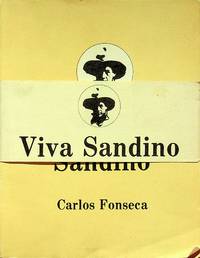
198420200304006Departamento de Propaganda y Educacion Politica del FSLN 1984-01-01. Paperback. Good. Departamento de Propaganda y EducacioÌn PoliÌtica del FSLN Published Date: 1984. Text in Spanish. A collection of 5 books published in connection with the commemoration of the 50th Anniversary of the murder of the General of Free Men and Father of the Popular and Anti-Imperialist Revolution Augusto C. Sandino. Collection includes: Programa Historico del FSLN; Viva Sandino by Carlos Fonseca; Ideario Politico de Augusto Cesar Sandino by Carlos Fonseca; Sandino Guerrillero Proletario by Carlos Fonseca; and Idario Sandinista by Jose B. Escobar. Books are held together by the publishers paper band that says "Viva Sandino" with an image of Sandino. All books are in good condition with some light bumping and creasing to edges and light overall scuffing and soiling. Publisher's band has a few nicks and tears and light soling as well. NOT Ex-Library. Now in an archival-quality removable Brodart Cover. Departamento de Propaganda y Educacio?n Poli?tica del FSLN paperback
Fasc. in 8°, pp. 72 n.n. compl. ill. Bross. edit. ill.
Il Mattino Illustrato del 5.7.1937
62 pages. Fold-out map. Written in English. "Instead of miracles expected by the Pentagon, the 1965-66 dry season in South Vietnam has ended with the flop of the U.S. strategic plan... To help the reader understand the causes and reasons of this important victory of the L.A.F. and people of South Vietnam... we publish hereafter an article by an authoritative military commentator of the National Front for Liberation, carried by the Quan Doi Nhan Dan, organ of the Vietnam People's Army. We have thought it opportune to add an account of facts, a balance sheet of the operations and a map." - from Publisher's Note. Average wear. Unmarked. Binding intact. Sound copy. Book
1940901385AGH. M. Stationery Office:, um 1940. Farblitograhie: Blattmaß: 38 x 25,5 cm.
1917R300261649Imprimerie Steel. 1917. in-4. Broché. Bon état, Couv. convenable, Dos satisfaisant, Intérieur frais. Londres, Imprimerie Steel, (1917), plaquette in 4, broché, nombreuses photos, 24 pp.. . . . Classification Dewey : 940.3-Première Guerre mondiale 1914-1918