[PARLIAMENT]Biblio.com
5 709 résultats
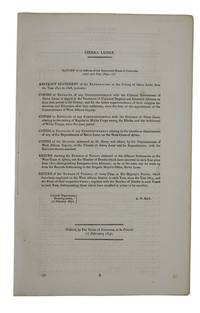
1830AQ27625London: s.n. 1830. 95pp 1. Disbound. Later resewn. A trifle creased. A series of correspondence relating to the administration of the British colony of Sierre Leone in particular extracts of the colonial government in regard to the 'treatment of captured negroes and liberated Africans on their first arrival in the colony and for the better superintendence of their religious instruction and education after their settlement' and 'the raising of regular and militia corps among the blacks and the withdrawal of white troops'. From the recently dispersed library without any indication of such of British scholar and senior civil servant William St Clair 1937-2021 and presumably used by him in his research for his acclaimed book The Grand Slave Emporium: Cape Coast Castle and the British Slave Trade 2006. . Folio. [s.n.] unknown
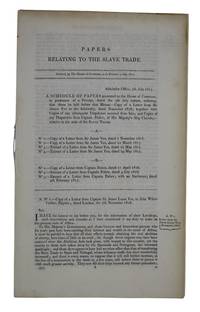
1817AQ27624London: s.n. 1817. 10pp 2. Docket title to verso of terminal leaf. Sewn as issued. Three old horizontal folds. A clean and crisp copy. A selection of seven papers printed by order of the House of Commons regarding the Africa slave trade. The initial four letters contain reports of Royal Navy officer Sir James Lucas Yeo 1782- 1818 then commander-in-chief on the west coast of Africa with special responsibility for the anti-slavery patrol. He commences with the disheartening revelation that 'efforts toward obtaining the real abolition of slavery have been of little or no avail; for though fewer negroes may have been enslaved since the Abolition Acts took place with respect to this country yet the cruelty to those now taken away by Spaniards and Portuguese has increased quadruple; and those Acts appear to have had no other effect then that of transferring the Slave Trade to Spain and Portugal whose inhuman traffic has since wonderfully increased'. Yeo proceeds to provide accounts of numerous vessels recently seized both by himself and Captain Fisher who authors the final three letters reproduced here including the capture Portuguese brig San Antonio carrying 600 enslaved Africans and the American schooner Rosa sailing under Spanish colours trafficking 276. . Folio. [s.n.] unknown
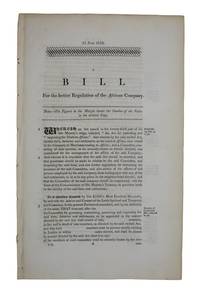
1819AQ27617London: s.n. 1819. 5pp 1. Docket title to verso of terminal leaf. Disbound. Three old horizontal folds. An apparently unrecorded parliamentary bill proposing amendments to the 1750 Act for extending and improving the Trade to Africa specifically reducing the number of committee members and restraining the trade opportunities of the African Company of Merchants. The bill was seemingly never enacted.; the Company was abolished in 1821 with all assets passing to the Crown. From the recently dispersed library without any indication of such of British scholar and senior civil servant William St Clair 1937-2021 and presumably used by him in his research for his acclaimed book The Grand Slave Emporium: Cape Coast Castle and the British Slave Trade 2006. . Folio. [s.n.] unknown
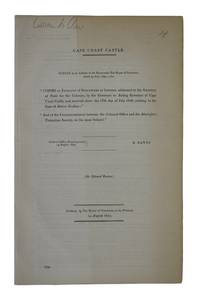
1850AQ27621London: s.n. 1850. 26pp 2. Docket title to verso of terminal leaf. Disbound. Later resewn. Early alternate pagination in manuscript to upper corners. From the recently dispersed library of William St Clair with his distinctive pencilled ownership inscription to head of title. A series of dispatches relating to the violent torture of Cape Coast native Robert Erskine. In 1847 whilst a domestic in the service of Captain Augustus William Murray of the 1st West-India Regiment and stationed at the infamous Cape Coast Castle Erskine was accused of having stolen sundry articles of jewellery from the officer. Despite his protestations of innocence and a lack of any evidence connecting him with the crime Erskine was brutally tortured for eight days. In consequence of his torment he lost the use of his hands. It was later ascertained that the actual culprit was a soldier of the 1st West India Regiment and likely one of the individuals who engaged in Erskine's maltreatment. A year after the event the Aborigines Protection Society took up Erskine's case and successfully prosecuted it in 1851. From the recently dispersed library without any indication of such of British scholar and senior civil servant William St Clair 1937-2021 and presumably used by him in his research for his acclaimed book The Grand Slave Emporium: Cape Coast Castle and the British Slave Trade 2006. . Folio. [s.n.] unknown
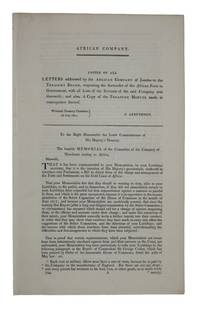
1821AQ27623London: s.n. 1821. 14pp 2. Docket title to verso of terminal leaf. Disbound. Later resewn. Three old horizontal folds. A rare survival of copies of correspondence relating to act to divest the African Company of Merchants of the charge and management of forts and settlements on the Gold Coast of Africa and transfer their control to the Crown. The act that abolished the company was passed in May 1821 and the transfer ownership of eight forts including the notorious Cape Coast Castle was affected on 3rd July the day after these letters were ordered by Commons to be printed. They contain listings of the Company's employees and respective salaries and abstract of annual stipends paid to local Kings and Cabboceers. From the recently dispersed library without any indication of such of British scholar and senior civil servant William St Clair 1937-2021 and presumably used by him in his research for his acclaimed book The Grand Slave Emporium: Cape Coast Castle and the British Slave Trade 2006. OCLC records copies at just two locations Florida and NLW; COPAC adds no further. . Folio. [s.n.] unknown
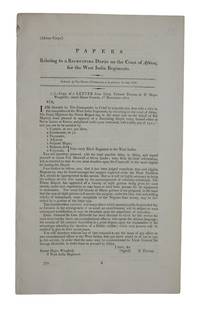
1812AQ27619London: s.n. 1812. 9pp 2. Docket title to verso of terminal leaf. Disbound. Later resewn. Early alternate pagination in manuscript to upper corners. The second located copy a series of dispatches relevant to the establishment of a British Army recruiting station at either Sierra Leone or Gorée. Under the authority of the Prince Regent Brevet Major Wingfield of the 8th West India Regiment was charged with determining the most suitable location for the depot with the assistance of inter alia one sergeant and two corporals 'from every Black Regiment in the West Indies' and that 'such eligible Negroes as may be found amongst the cargoes captured under the Slave Abolition Act should be appropriated to this service'. From the recently dispersed library without any indication of such of British scholar and senior civil servant William St Clair 1937-2021 and presumably used by him in his research for his acclaimed book The Grand Slave Emporium: Cape Coast Castle and the British Slave Trade 2006. OCLC records a single copy UWI; COPAC adds no further. . Folio. [s.n.] unknown
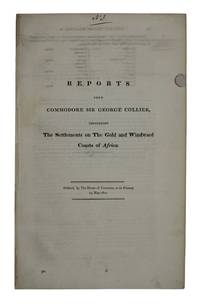
1820AQ27620London: s.n. 1820. 17pp 1. Disbound. Later resewn. Three old horizontal folds sealing wax remnant to title ink-stamp pf the Institute of Historical Research to verso. The second located copy of an annual report submitted by Royal Navy officer Sir George Collier 1774-1824 on the condition of the African Company's forts and settlements. Between 1818 and 1821 Collier commanded the six-ship coast of Africa squadron with a remit to suppress the slave trade a charge he undertook with zeal significantly reducing the traffic of slaves from the continent. In 1820 his work was recognised by election to honorary life membership of the African Institution. From the recently dispersed library without any indication of such of British scholar and senior civil servant William St Clair 1937-2021 and presumably used by him in his research for his acclaimed book The Grand Slave Emporium: Cape Coast Castle and the British Slave Trade 2006. OCLC and COPAC together record a single copy Southampton. . Folio. [s.n.] unknown
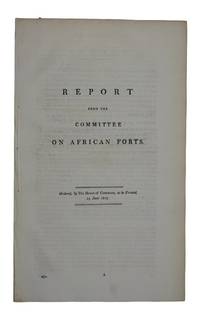
1817AQ27622London: s.n. 1817. 63pp 1. Disbound. Later resewn. Terminal leaf creased. The report of a parliamentary committee appointed to evaluate the condition of the state of trade and establishments of the African Company issued four years prior its ultimate dissolution by the British Government in 1821. With the exception of the major forts such as Cape Coast Castle many British forts were not particularly well defended nor maintained and as such their efficacy as a deterrent to slave traders greatly diminished. Parliament frustrated by this reduced effectiveness pursued a policy of reducing the number of African Company settlements through the abandonment of any upon strict inquiry not found to be of service in a sufficient degree to warrant their expenditure. From the recently dispersed library without any indication of such of British scholar and senior civil servant William St Clair 1937-2021 and presumably used by him in his research for his acclaimed book The Grand Slave Emporium: Cape Coast Castle and the British Slave Trade 2006. OCLC and COPAC together record copies at just six locations California NLW NYPL Senate House Southampton and UoL. . Folio. [s.n.] unknown
1984127210American Art Enterprises 1984. Very Good. Vol. 1 Nos. 1 3 5 August October December 1984 $3.50 cover price Parliament News dist. b/w approx. 28pp ea stapled softcover quartos. Three vintage adult magazines featuring nude & pornographic photography of solo & paired women most pages w/ blocked vignettes a few full-pg photos ads for Marlowe Sales & Gourmet Video meant to serve as a preview of the publisher's upcoming magazine issues began August 1984 short-lived series 1985 issues seen. Black/white throughout centerfolds ads lists. V1 N1: August July 1984 Finger Friggin' Latin Babes Chunky Asses Lesbian Lovers Tits 4 U Black & Lusty centerfold Hot Wet Pussys Strip Tease Hot Legs Floppers Roommates Fanny notables Mona Page Barbara Alton Leslie Winston. V1 N3: October October 1984 Erect Nipples Lesbian Girls Anal Babes Tip Top Split Beavers Pussy Poking centerfold King Size Sultry Black Dolls Geisha Girls Snatch Licking Lesbians Legs & Asses notables Barbara Alton Candye Kane. V1 N5 December 1984 Hefty Mamas Black Girl Review Poppin Mamas Hanging Breasts Creamers Bottom centerfold Lesbian Seduction Legs Legs Legs Shaved Dildo Babes Girl-Loving Girls Ass Parade. Very Good Plus rubbing & light foxing brief creases remainder clips small sticker on front 8/84. For mature consenting audiences. Scarce. American Art Enterprises paperback
RGW187685 folding tables appendices; 96pp. 8vo disbound in paper wrappers Detailed accounts of income and expenditure. For example one table gives the cost of the Army including the £53502 paid to American forces. unknown
18331365495London 1833 - 1871. Mixed Editions. Hardcover. Quarto 64 pages alternating blank leaves pp. 1133-1164 pp. 209-239 pp. 225-256 pp. 425-431 pp. 413-416 pp. 261-306 pp. 797-800 2 pages pp. 861-870; G-; Half-bound sheepskin and buckram boards with black spine labels and gilt lettering to spine and front cover; Boards show moderate plus wear to corners significant cracking and wear to leather along joints and light wear overall; Back board and spine have separated from textblock but all elements intact; Textblock has light age-toning to speckled edges; Numerous ink emendations in 18th-century hand apparently by individual involved in drafting or implementing the Thames Valley Drainage Act; Possibly the hand of Robert Harding Milward whose armorial bookplate appears on the front paste-down. RWO. Shelved in Netdesk Office Case #1. A collection of ten acts passed by Parliament between 1833 and 1871 privately bound with holograph annotations in margins. Collection prefaced by the text of the Thames Valley Drainage Act of 1871 and all successive acts bound-in are related to the history and content of the 1871 Act. Appears to have been privately bound by Robert Harding Milward a Birmingham solicitor whose career ended ignominiously in 1903 following revelations of fraudulent activity. His precise role if any in the authoring passage or implementation is unclear but presumably relates to his role as solicitor in the funding of public works projects. 1365495. Special Collections. hardcover
178420795London: J. Debrett 1784. 37 1 advt pp. Disbound a couple of spots else Very Good. <br /> <br /> First and only edition. "Considers the question whether the system of a strong responsible parliamentary administration should be restored" NUC. In England ministers are "responsible to parliament for their conduct and looking up to parliament for support; and not as in despotic governments the mere instruments of the will of an arbitrary master." This is "the great palladium of the Constitution." <br /> The author attacks "Lord B." Bute and the King for subverting this system during the events leading to the American Revolution and giving the executive arm of government over to "men ever unfriendly to liberty." <br /> FIRST EDITION. J. Debrett unknown
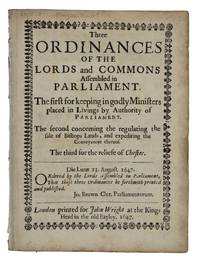
1647AQ20484London: Printed for John Wright 1647. 2 6pp. Disbound. Leaves toned scattered spotting. Three parliamentary pronouncements including edict for the raising of fund to support those impacted by the plague in Chester. . First edition. Quarto. Printed for John Wright unknown
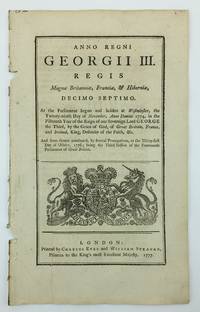
17771224London: Printed by Charles Eyre and William Strahan. 1777. First edition. Folio 32 x 20cm. Unbound. 2 1083-1095. Woodcut coat of arms to the title page decorative woodcut initial to the first text page text in black letter. A very good copy with some creasing to the foot of pp.1091-1092 due to an original paper flaw minor toning and a little wear to the left-hand margin where once bound within a larger volume. London: Printed by Charles Eyre and William Strahan. unknown
AQ33467Edinburgh: Printed by Evan Tyler 1633 between 1640 and 1651 66pp 10. ESTC S122278 Wing S1168A. Bound with: The acts made in the second parliament of our most high and dread sovereign charles.Acts past and done in this present Session of Parliament the eleventh of June 1640. Edinburgh. Printed by Robert Young and Evan Tyler 1641. 160pp 20. ESTC R33336 Wing S1168D. And: The acts done and past in the first session of the third parliament.Holden at Edinburgh and beginning the fourth of June 1644. and ending the 29. day of July the same year 1644. Edinburgh. Printed by Evan Tyler 1644. 2 104pp 6. ESTC R12952 Wing S1162. And: Acts Done and Past in the second third fourth & fifth sessions Of the First Triennal parliament.Holden at Edinburgh Stirling Pearth and St. Andrews respective: Beginning at Edinburgh the seventh day of January 1645. and ending at St. Andrews the 4. of February 1646. Edinburgh. Printed by Evan Tyler 1646. 2 102pp 4. ESTC R208334 Wing S1163. And: Acts done in the sixth session of the first triennial parliament.Holden at Edinburgh; Beginning the third of November 1646. and ending the twenty seventh of March 1647. Edinburgh. Printed by Even Tyler 1647. 2 78pp 12. ESTC R11735 Wing S1164. And: Acts done and past in the first session of the second triennial parliament.Holden at Edinburgh; Beginning the second day of March 1648. and Ending the tenth of June 1648. Edinburgh Printed by Evan Tyler 1648. 2 69 68-70pp 6. ESTC R21983 Wing S1165. And: Acts Done and Past in the second session Of the second Triennal parliament.Holden at Edinburgh Beginning the 4. of January And ending the 16. of March 1649. 2 112pp 10. Short tear to title. ESTC R19064 Wing S1166. And: Acts Done and past in the third session Of the second Trienniall parliament Of our Soveraign Lord Charles the II Holden at Edinburgh Beginning the twenty third of May and ending the seventh day of August 1649. Edinburgh. Printed by Evan Tyler 1649. 2 20pp 21-22 leaves 21-43pp 15. With a folding table. Short tear to folding table at gutter. ESTC R19030 Wing S1167. Folio. Contemporary blind-ruled calf. Rubbed and marked joint starting. Pastedowns sprung armorial bookplate of Maule of Kellie engraved by A. Burden to verso of upper board scattered spotting occasional damp-staining. A comprehensive collection of the complete printed output of the Scottish Parliamentary Sessions which occurred during the reign of Charles I reflecting perhaps the most tumultuous period of political and social history in early modern Scotland and printing some key constitutional tenets of an increasingly independent Scottish government. The first Scottish Parliament of Charles I's reign met at Edinburgh in June 1633 and whilst it marked the highpoint of his authority in the country it also sowed the seeds for what would supersede it; the establishment of a coherent opposition to increasingly burdensome royal rule the declaration of a National Covenant and the outbreak of the Bishops Wars. By the time Charles I's second Scottish parliament met seven years later power over the legislature had been secured by the Covenanting party; the acts passed and the resulting constitutional settlement which endured for over a decade saw the newly muscular body securing control over the executive and future judicial appointments. Included in this printed account of the acts are 'Act XXXIII. Act for the Committees of Estates' and 'Acts XXXVIII. Ordaining the whole subjects and leiges of this Kingdome to obey maintaine and defend the Conclusions Acts and Constitutions of this present session of Parliament' which respectively established a revolutionary committee structure replacing the Lords of the Articles and tied - by oath - individual Members of Parliament to the authority of decisions made by the body. The result of these steps and the clamorous British context in which they existed during the Wars of the Three Kingdoms was - as witnessed by this large volume - far more frequent sittings of parliament and a considerable growth in the remit and output of its Acts. The sixth act of the second sitting of the second parliament for example ratified the London Treaty - a considerable victory for the Covenanting Party - whilst the fifth act of the first sitting of the Triennial parliament of 1644 ratified with a full printing of it within the text the Solemn League and Covenant preserving the sanctity of the reformed religion in Scotland and leading to an alliance between the Scottish Parliament and the English Parliament of Cromwell. Much of the remainder of these acts which record the output of the full six sittings of the first Triennial parliament and the first three sittings of the second Triennial parliament concerns the preparations for a military invasion of England in 1648. However on defeat a coup ensured the replacement of the regime by radical Covenanters who after the execution of Charles I by the English Parliament as the 14th Act of the second session of the second triennial parliament Proclaimed Charles II as 'King of great Britain France and Ireland' the condition that he subscribed to the National Covenant of 1637 for the subjects of all his kingdoms. The Maule of Kellie bookplate engraved presumably by Archibald Burden of Edinburgh in this copy suggests early eighteenth-century Scottish ownership; given the content of the volume a likely candidate would be Harry Maule of Kellie 1659-1734 Scottish Jacobite army officer and scholar the third son of George Earl of Panmure. . Printed by Evan Tyler, 1633 [between 1640 and 1651] unknown
1878PCT78VIC97Melbourne: John Ferres Government Printer 1878. 1878. folio. pp. 80. folding lithographed map. several text illus. disbound scattered library rubberstamps. Including the journal of exploration of Port Phillip made by Charles Grimes Surveyor-General of New South Wales 1802-03 together with a copy of his map the order book of Lieutenant-Governor Collins during the stay at Port Phillip 1803-04 and the journal of the Rev. Robert Knopwood Chaplain to the settlement 24 April 1803 to 31 December 1804 &c. cfFerguson 15655. Soft cover. Melbourne: John Ferres, Government Printer, [1878]. Paperback
6867London 1733. Sheets" ; 37 x 24 cm.Ten pages printed on a total of the six leaves of three folio bifoliums leaf dimensions roughly 40.5 x 25 cm. The first part apparently intended to fold around the others is unpaginated and printed on the recto of the first leaf and the verso of the last leaf of the bifolium. Each page consists of a list divided into three columns of small print giving details of the vote with the names of the members their constituencies and a key revealing biographical information e.g. 'Privy-Counsellors' sic and 'for and against Maintaining the Hessian Troops'. The first section is aged and with several closed tears and with some loss resulting in damage to three words. The second and third sections are in better condition though creased and on aged paper and stitched together and paginated 3-10. Pp.3-6 consist of the section entitled 'The Lords Protest' reporting a debate on the Bill in the House of Lords on 23 February 1732. Pp.7-10 carry the poem with pp.9-10 consisting of 'Britannia Excisa: Britain Excis'd. Part II. Tune of Packington's Pound.' At the head of p.7 is a sensational engraving 11.5 x 16.5 cm of a five-headed monster pulling a coach in which a figure Walpole sits complacently. The monster representing the bill flings goods this way and that with its mouths while two figures on foot run for cover. The first part of the poem begins 'Folks talk of Supplies To be rais'd by Excise Old Caleb is bloodily nettl'd;'. The first stanza of the second part reads 'Ye Knaves and ye Fools ye Maids Widows and Wives Come cast away Care and rejoice all your Lives; For since England was England I dare boldly say There ne'er was such Cause for a Thanksgiving Day; For if we're but wise And vote for the Excise Sir Blue-S--ing Walpole 'Sir Blue String' alluding to the ribbon of his Order of the Garter declares as you know he ne'er lies! He'll dismiss the whole Custom-House rascally Crew And fix in each Town an Excise-man or two.' Excessively scarce: the copies on COPAC consisting of electronic reproductions of the British Library copy. See Image of first folio page "An Exact List .". [London, 1733.] unknown
18035000976Edinburgh: printed by Sir D. Hunter Blair & J. Bruce 1803. Folio pp. 1-14 disbound. <p><p>One of the most important amendments to the laws of Transportation formalising the requirement for convict vessels to carry a Surgeon and thus directly responsible for a huge improvement in mortality rates. The Act is also interesting for noting some of the abuses rampant aboard convict transports and other passenger vessels travelling from Britain.</p> <p>The First Fleet had been provisioned by the Admiralty itself and the Surgeons on board led by John White had an excellent record. From the Second Fleet onwards the task was contracted to private companies infamously derelict on the Second Fleet itself and with wildly varying results over the ensuing decade. On several occasions officers colluded to deny the convicts their correct rations so that the surplus could be sold upon arrival at Port Jackson for a handsome profit. A plan to return convicts to naval vessels was scuppered by the ongoing conflict with France.</p> <p>This Act regulated the terms of carrying all passengers free or convict detailing acceptable provisioning and the role of the Surgeon and allowing for a bond of £50 per head to be paid by the owners of any vessel. Although abuses continued aboard the convict transports conditions did improve overall and the casualty rate for convicts sent to New South Wales fell from one in ten between 1795 and 1801 to one in forty-six for the period 1802-1812. One paradoxical result was that British conservatives started to criticise the transports as being too comfortable and therefore a poor deterrent to crime.</p> </p> . printed by Sir D. Hunter Blair & J. Bruce unknown
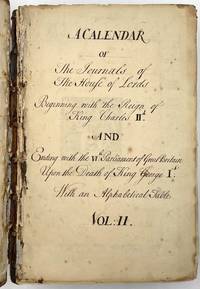
2787Binding split in half along center spine with boards still attached by cords; title strip peeling; boards heavily rubbed and worn with loss to corners and board edges; slight toning scattered foxing throughout; manuscript pages are remarkably bright and clean. Overall a very appealing document with binding a challenge in need of restoration. <p>A Calendar of the Journals of the House of Lords Beginning with the Reign of King Charles II d and Ending with the VI th Parliament of Great Britain Upon the Death of King George I: with an Alphabetical Table Vol. II 1660 - 1727. April 25th 1660 - May 9th 1727. </p> <br /> <p>Manuscript Calendar of the Journals of the House of Lords April 25th 1660 - May 9th 1727. </p> <br /> <p>Folio approx. 15 x 10 inches. 722pp Alphabetical Table. Contemporary full leather gilt-stamped title to spine spine and board edges tooled in gilt lettered paper thumb tabs large contemporary armorial engraving tipped-in. Housed in modern cloth-covered clamshell case by Ruth L. Heginbottom. </p> . unknown
181449404House of Commons 1814. Sm. folio 32pp on laid paper some negligible age-staining; disbound a very good bright crisp legible copy ideal for framing and display. 54 Geo. III. Session 1813-14; granted Royal Assent 27 July 1814. House of Commons, unknown
0259286257.Gpaperback. Good. Access codes and supplements are not guaranteed with used items. May be an ex-library book. paperback
0266194958.Ghardcover. Good. Access codes and supplements are not guaranteed with used items. May be an ex-library book. hardcover
1804907M9London: John Stockdale 1804. First edition. Paperback. Very Good Indeed. 8" by 5". Not Stated. A very scarce pamphlet by Robert Plumer Ward in support of William Pitt the Younger against the Addington Ministry. The first edition of this work bound in paper wraps though lacking the front of the wrap. This political pamphlet was written anonymously by the barrister politician and novelist Robert Plumer Ward 1765-1846 in support of William Pitt the Younger against Henry Addington's administration. This pamphlet was prompted by the anonymously written A Few Cursory Remarks upon the State of Parties 1803 by Thomas Richard Bentley. Ward wrote in response to this pamphlet and in response to Ward John Adolphus wrote A Letter to Robert Ward Esq. M.P. 1804 setting off a pamphlet war. Bound in paper wraps; lacking the front of the wrap. Externally generally smart with losses to the backstrip. Internally firmly bound. Pages are bright and clean except for occasional light offsetting. Very Good Indeed John Stockdale paperback
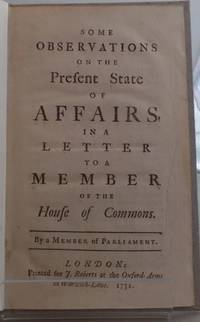
1731BS44TRACT14London: J. Roberts 1731. Hardback. First edition first issue 1731. No half-title. 34pp. Boards a little faded. A very pleasing copy. bs44. 1st Edition. Hard Cover. Very Good. J. Roberts Hardcover
180555576Portsea: Williams Printer 1805. 8vo. 15 pp. Fifteen-page pamphlet. Lacks wrappers. Leaves slightly edgeworn. Scarce Portsea imprint. . Very Good. Wraps. 1805. Williams, Printer 1805 paperback