Great Britain ParliamentBiblio.com
5 709 résultats
152840484X.Gpaperback. Good. Access codes and supplements are not guaranteed with used items. May be an ex-library book. paperback
20066rcjlParliament of the Republic of South Africa 2006. First Edition. Hardcover. Very Good/Very Good. 0x0x0. Publication of 193 pages. The dust jacket is a little shelf rubbed. The boards are in good condition. There is light foxing on the first and last blank pages as well as on the inner part of the jacket. Internally the pages are clean and complete. Tightly bound and presented in cellophane. The binding is excellent. GK. Our orders are shipped using tracked courier delivery services. Parliament of the Republic of South Africa hardcover
1918165701918. Representation of the People Act 1918. 8 Geo. 5. Ch. 64 Printed by Percy Lunch Humphries & Co. Ltd. for Normal Gibb Scorgie C.V.O. C.B.E. Controller of His Majesty's Stationery Office and King's Printer of Acts of Parliament. First edition. 161 pages. Original paper wrappers. 9 1/2 x 6 in. The Representation of the People Act of 1918 granted the vote to women over the age of 30 who met a property qualification. The same Act gave the vote to all men over the age of 21. As a result of this act 8.5 million women joined the electorate and made up almost 40% of all voters in the United Kingdom. This was a great victory for the women's suffrage movement which had been calling for voting rights since the 1830s. Militant suffrage groups in the UK were even known for campaigns of destruction and mayhem in order to keep their issue in the forefront of everyone's minds. unknown
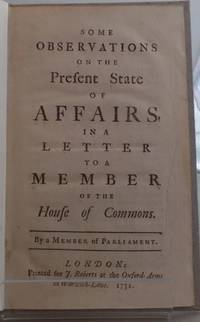
1731BS44TRACT14London: J. Roberts 1731. Hardback. First edition first issue 1731. No half-title. 34pp. Boards a little faded. A very pleasing copy. bs44. 1st Edition. Hard Cover. Very Good. J. Roberts Hardcover
0260814814.Ghardcover. Good. Access codes and supplements are not guaranteed with used items. May be an ex-library book. hardcover
1528494687.Gpaperback. Good. Access codes and supplements are not guaranteed with used items. May be an ex-library book. paperback
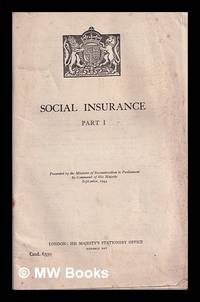
1944369103London: His Majesty's Stationery Office 1944. First Edition. Softcover. Good copy in original stiff card wrappers with some wear and tear as with age. Remains well-preserved overall; bright and clean. Physical description; 64 pages. Subjects; Social Insurance. Parliamentary Reports. Minister of Reconstruction to Parliament. London: His Majesty's Stationery Office paperback
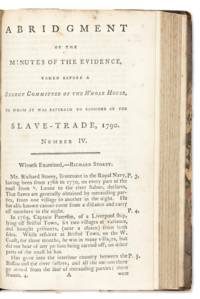
1789187101789. Committee of the Whole House of the British Parliament investigation into the Atlantic slave trade recorded in Abridgment of the Minutes of the Evidence Taken Before a Committee of the Whole House to Whom It Was Referred to Consider of the Slave Trade published 1789 to 1791 presenting one of the earliest parliamentary documentary compilations addressing the operation and human consequences of the transatlantic slave trade. The volumes preserve testimony gathered during parliamentary inquiries that examined the practices of British slave traders and the treatment of enslaved Africans transported across the Atlantic. These proceedings formed part of the political campaign in Britain that eventually culminated in the abolition of the British slave trade in 1807. The collected evidence includes statements from ship surgeons naval officers merchants and other witnesses whose accounts describe the conditions experienced by enslaved Africans during capture transport and plantation labor.<br /> <br /> Abridgment of the Minutes of the Evidence Taken Before a Committee of the Whole House To Whom It Was Referred to Consider of the Slave Trade. London: 1789-1791. First edition first printing. Four volumes bound in two books. The compilation reproduces testimony presented before Parliament concerning the organization and operation of the slave trade and includes firsthand statements describing the physical suffering and resistance of enslaved Africans during transport. Surgeon Alexander Falcon-Bridge who had firsthand experience aboard slave ships described acts of despair among captives: he "Has known several enslaved persons to refuse sustenance with a design to starve themselves. refusing to take medicines when sick because they wished to die. Many other slaves expressed the same." Another witness Royal Navy surgeon Thomas Trotter recorded the emotional trauma experienced by captives during embarkation noting that "Slaves on being brought on board showed signs of extreme distress and despair from a feeling of their situation and regret at being torn from friends and connections." The volumes therefore preserve testimony that exposed the violence and human suffering embedded within the Atlantic slave trading system.<br /> <br /> During the eighteenth century European and American traders transported millions of Africans across the Atlantic through a commercial system that relied on maritime networks linking West Africa the Caribbean and the Americas. Parliamentary investigations of the slave trade in the late eighteenth century were fueled in part by abolitionist activism and public campaigns demanding government inquiry into the practice. Publications of witness testimony such as this abridged parliamentary record circulated evidence used by reformers advocating the end of the trade. Four volumes bound in two books with folding table in the fourth volume. Octavo format. Contemporary marbled quarter calf bindings with modern bookplates on the front past down. Wear present with most spine titles lacking and foxing primarily affecting the title pages; text remains clear. Overall condition very good. unknown
1391941179.Gpaperback. Good. Access codes and supplements are not guaranteed with used items. May be an ex-library book. paperback
1396734341.Ghardcover. Good. Access codes and supplements are not guaranteed with used items. May be an ex-library book. hardcover
0331188392.Ghardcover. Good. Access codes and supplements are not guaranteed with used items. May be an ex-library book. hardcover
0260204242.Gpaperback. Good. Access codes and supplements are not guaranteed with used items. May be an ex-library book. paperback
1837216148London : H.M.S.O. 1837. First Edition. Paperback. Near fine copy in the original stiff-card wrappers; edges very slightly dust-dulled and toned. Remains particularly and surprisingly well-preserved; tight bright clean and especially sharp-cornered.; 8vo 8"" - 9"" tall; 43 pages; Description: iv 43 p. : tabs. ; 36 cm. Subjects: Great Britain. Parliament. House of Commons -- Poverty -- Poor law -- General Policy and Administration -- 19th century. Reports of committees ; 266. London : H.M.S.O. paperback
1854432639London : H. M. S. O. 1854. First Edition. Softcover. Good paperback copy; edges somewhat dust-dulled and nicked. Remains quite well-preserved overall. Subjects; Great Britain. Parliament. House of Lords. Poor laws. London : H. M. S. O. paperback
0364230592.Gpaperback. Good. Access codes and supplements are not guaranteed with used items. May be an ex-library book. paperback
0364868589.Ghardcover. Good. Access codes and supplements are not guaranteed with used items. May be an ex-library book. hardcover
17195606021 pages Published by J. Roberts paperback
20411Allestree Hall Derbyshire . 11 April 1859. 4pp. 12mo. Bifolium. In good condition lightly aged. He declares his belief that he will 'act well in accordance with what I stated on the nomination day in 1857 by pursuing the course followed by me since I have been in parliament & abstaining from voting either way on the ballot'. The subject is one concerning which he feels 'great difficulty': 'I fully appreciate the evils of intimidation & bribery which the ballot is intended to cure although I hope that they are gradually diminishing & will be still further diminished when we have fewer small constituencies'. He greatly doubts whether secret voting as it is called would have all the effects attributed to it & whether it would not produce serious evils of another kind.' He commented on the relative successes of the method in France the United States and Canada'. As he has a 'serious doubt' regarding tne question it is 'advisable to abstain from voting upon it' but this is not to say that it is right for a member of parliament 'to avoid all difficult subjects by this course. I certainly have not done so myself . this is the only matter on which I hbave not voted at all'. He is sorry to 'go against the opinions' of any of his constituents and knows that he has 'annoyed some of them by my votes in the church rate question but there my mind was made up. I could have no hesitation.' Note: Secret ballot introduced in 1872. Allestree Hall [ Derbyshire ]. 11 April 1859. unknown
244615 August 1818. Cowes Isle of Wight. See the entries in the Oxford DNB for his father Sir Francis Baring 1740-1810 and his son Thomas Baring 1799-1873. At the time of writing he was working with the merchant bankers Hope & Co. in Amsterdam but growing 'so disgusted with the drudgery of the counting house' that he wanted to abandon commerce for the law. 1p 4to. In good condition lightly aged with neat traces of windowpane mount adhering to the edges of the blank reverse. Folded for postage. Signed ‘Tho. Baring.’ Recipient not named. Reads: ‘Dear Sir / As I observe in the papers that the British is to be closed on ye. 8th. I shall be obliged to you to send to Mr. Gower and desire him to convey my pictures without loss of time the weather being favourable to Stratton - Have you had a good season and what have been your receipts’. In a postscript he acknowledges receipt of his letter. 5 August 1818. Cowes, Isle of Wight. unknown
13978From the Waterloo Hotel on his crested letterhead. 10 June 1863. 4pp. 12mo. Bifolium with mourning border. In good condition on lightly-aged paper with slight traces of glue from mount along one edge. A hurried letter illegible at points. 'You will see the name of yr. respectable <friend> at the end of the enclosed Petition from My Own Hand. She has no right to refer to me for any further knowledge of herself and her husband or his position of art - than that of my having understood him to be an artist in a state of much distress labouring under loss or decay of sight & that I for some years I might almost <> I gave him occasional relief. <> That has ceased now for a very long time. I think he must have been long dead but I have an impression that I ceased to meet his or rather her applications at last for some other cause -'. He concludes by asking for the return of papers and stating that he will not be able to meet the recipient 'at the exhibition'. From the Waterloo Hotel, on his crested letterhead. 10 June 1863. unknown
19143His Majesty's Receipt of Exchequer London. 1743. Good firm and signature repaired on reverse on aged worn and damaged page. Laid out in the usual fashion with printed text completed in manuscript. Records payment to Brown on an annuity as Assignee of Charles Williams'. [ His Majesty's Receipt of Exchequer, London. ] 1743. unknown
22511Docketed 7 August 1812. Valediction of Letter only 19 x 9cm laid down on similar sized piece of paper from collection of similar valedictions most of which mention the Duke of York as recipient. Text: "news from Ld Wellington at which I sincerely rejoice I have the honour to be Sir with the greatest respect & attachment Yr obdt Servt J Shelley." Docketed by HRH probably or secretary Date and Sender and from a large collection of similar valedictions similarly docketed so often to the Duke of York "Royal Highness" etc that they may reveal the fate of his incoming correspondence or part of it. [Docketed ] 7 August 1812 unknown
2376311 December 1711; no place. See Powell’s entry in the Oxford DNB. While presiding over the 1712 trial of Jane Wenham for witchcraft he ruled that there was ‘no law against flying’. 1p long 8vo. On recto of first leaf of bifolium. Folded twice. On laid paper with government watermark with two blind-stamped sixpenny tax stamps at head of page. Text intact but with wear closed tears and slight loss to some edges and a crease. Text by Powell himself signed ‘John Powell’ with red wax seal without any impression. Signed at foot of page: ‘Wittness W Price’. Endorsed with date on reverse of second leaf. The text reads: ‘Know all men by these Presents that I Sr John Powell Knt. One of the Judges of her Matie’s Court of Queens Bench at Westminster: Doe hereby Constitute & appoint: John Horsman my Clerk to be my trewe & Lawfull Attorney to Ask Demand & Receive out of her Matie’s Receipt of Excheqr at Westminster the Summe of two Hundred & ffifty Pounds soo much being Due to me for my ffee or Salary for Michaelmas Terme Last: & the sd. John Horsmans Receipt together with these Presents shall be a Sufficient Discharge for the Same given Under my Hand & Seale this Eleventh Day of December 1711’. 11 December 1711; no place. unknown
16301Undated late eighteenth century. London address on reverse. The card is 6 x 8 cm with the engraved image of the Basilica 5 x 7 cm within a ruled border with 'Sr. John Goodricke' in copperplate in a cartouche at the foot. In fair condition aged and lightly ruckled and spotted. In a contemporary hand on the reverse: 'No 9 Somerset Street. Portman Square'. An attractive and unusual item. Goodricke's connection with St Peter's is unclear but a common feature shared with Bramham Park is the presence of an obelisk. Goodricke's son was the noted 'deaf astronomer' John Goodricke 1764-1786. Undated (late eighteenth century). London address on reverse. unknown
2492215 March 1853; Leeds. An interesting letter linking two similar individuals like Baines Buckingham had also served as a Yorkshire Member of Parliament in his case for Sheffield as a radical between and 1835; and both men were newspaper proprietors. See the entries for Baines with those for Buckingham and his son in the Oxford DNB. 4pp 12mo. Bifolium. In good condition lightly aged and folded for postage. Addressed to ‘J. S. Buckingham Esq’ and signed ‘Edw Baines’. He begins by saying that he will try and promote Buckingham’s ‘son’s introduction to this part of the country as a Lecturer’. According to L. S. Buckingham’s ODNB entry his travels with his father had provided him with ‘experiences that he later put to good use when he was a lecturer’. A difficulty the son will face Baines feels ‘will be the name he bears for his father’s reputation is so high that it will not be easy to sustain the comparison’. Baines goes on to explains a change which has taken place from the former means of ‘negociating between Lecturers & their Institutes in our Yorkshire Union’ adding that if Buckingham will send him the subjects of his son’s lectures he will ‘recommend it to our Committee for their Mid-Summer list’. He also offers to lay newspaper testimonials ‘before the Committee of our Leeds Institute: but I believe they have made their arrangements for this season.’ He turns to ‘the Total Abstinence cause’ to which J. S. Buckingham has ‘rendered immense service’. Baines has recently published his own ‘Testimony’ ‘of which you may be pleased to see a copy’. He feels ‘a difficulty in advocating the Maine Liquor Law on the ground of its interference will personal liberty. But the American democrats are putting the wholesome chain upon themselves very fast.’ He ends by conveying his family’s regards to Buckingham’s. 15 March 1853; Leeds. unknown