Sternheim, Carl (1878-1942)Antiquariat.de

3 536 résultats
192615529Paul Zsolnay Verlag, Berlin-Wien-Leipzig, 1926. 129(4) Seiten, OLeinen Handschriftliche Notiz von Berthold Viertel ("September 1934 standen wir an Heinrichs Grab in Paris"). Mehrzeiliges handschriftliches, englisches Zitat von D.H.L [D.H. Lawrence?] von unbekannter Hand. Wohl Berthold Viertel, aus dessen Bibliothek das Buch ursprünglich stammt. Im beigelegten Marbacher Magazin wird allerdings erwähnt, dass sich Viertel im genannten Zeitraum (Septemer 1934) in Santa Monica, USA aufgehalten hat. Gutes Exemplar. Das Buch stammt aus der Bibliothek eines Autographensammlers. Good copy. Signed by the author. Very rare. First german edition.
19507436BB(London, um 1950). 1Suschitzky, o.T. (Cat / Katze) um 1950
2002Khe01501Oldenburg (Igel Verlag) 1993 - 2002 (= Erste Ausgabe). 8°, 8 grüne Originalleinenbände mit Originalklarsichtumschlägen (Hardcover), 2746 S., 1
193825323AB(Den Haag, Mouton & Co. u. Selbstverlag, 1938 ff). Einblattdrucke, Prospekte, Neujahrswünsche u.ä. in unterschiedlichen Formaten, einige Papiere etw. stockfl., ger. Gebrauchssp.; insges. schöne Expl.
19343000LParis, Europäischer Merkur 1934. Farbig illustr. OBrosch (W. Mehring). 125 S., 1 Bl. und mit eingeb. Korrekturzettel (Druckfehler). Mit neun Textillustr. vom Verfasser. Unbeschnittenes Exemplar. 8°. Einband mit Randbeschädigungen u. stellenweise etwas stockfl. Widmung von 1939 auf Vortitel. Papierbedingt gebräunt.
193313726Berlin : Stössinger 1933. 102 S. ; gr. 8 Original-Halbpergamentband, Einband oben ausgeblichen, Rückenvergoldung, sonst Exemplar in guten Erhaltungszustand
193658093ABAntwerpen, Leon de Lee, (1936). 101 S., 1 Bl. Orig.-Broschur mit Deckeltitel.
192514549J.M. Spaeth Verlag, Berlin, 1925. 195 Seiten, OLeinen. Lesebändchen. Auf dem Titelblatt gewidmet und signiert ["Dem Angler Stroh, der die Dichter ködert, herzlich der gefangene Zweig 1929]. Gutes Exemplar. Fine copy. Signed by the author. Das Buch stammt aus der Bibliothek eines Authographensammlers. Wikipedia: "Heinz Stroh war zwischen 1924 und 1933 Literatur- und Theaterkritiker bei der Berliner Börsenzeitung, und Thomas Mann revanchierte sich 1926 für freundliche Rezensionen bei ihm mit einer signierten Porträtphotographie. Stroh floh nach der Machtergreifung 1933 zunächst nach Prag, wo er in der Zeitschrift Selbstwehr, in der Jüdischen Revue und im Jüdischen Almanach (1937)[1] veröffentlichte. Thomas Mann setzte sich für ihn als einen fähigen, sorgsamen und vielseitigen Schriftsteller ein und gab ihm 1934 bei seinem Prag-Aufenthalt ein Interview, war allerdings mit dessen Wiedergabe nicht einverstanden, weil das Interview bei Manns Ausbürgerungsverfahren gegen ihn verwendet wurde. Im Jahr 1939 musste Stroh nach London fliehen, wo er bei einem deutschen Luftangriff ausgebombt[2] und 1940 als feindstaatlicher Ausländer für einige Zeit interniert wurde. Im Jahr 1945 kehrte er als Angehöriger der alliierten Streitkräfte nach Deutschland zurück. Er blieb in Deutschland, wurde Zeitungsredakteur in Nürnberg und gab erneut das Büchlein mit den Kindheitsnovellen heraus. In Nürnberg versuchte er, dem Kulturleben mit der Gründung einer Thomas Mann-Gesellschaft einen neuen Akzent zu geben. Thomas Mann hat ihn dort am 4. August 1949 besucht."
193879564Bilthoven, De Gemeenschap, 1938. 231 S., roter Kopfschnitt, Original-Leinwand mit roter Titelschrift, 8°. Deutsches Exilarchiv 5031. - Sternfeld/Tiedemann 427. - Wilpert/Gühring 17. Fortsetzung von "Radetzkymarsch". Hardcover Einband minim angestaubt, Text durchgehend mit Bleistiftunterstreichung.
1946FSKB0300London, Faber and Faber [1946]. 19 x 25 cm. 16 nn. Bll. (einschl. Tit.). Durchgehend ill., 16 S. in Farbe, Einband angestaubt, abgegriffen, Hinterdeckel m. Kritzeleien; innen stellenweise fingerfleckig. Lang 62.
1940ZEIT1297[Paris], s.l. 1940. 14x9,7 cm. 64 S., OBrosch., Umschlagtitel. Papierbedingt gebräunt, Titelbl. mit kl. Einriss, ansonsten gut erhalten, ohne Stempel od. Anstreichungen Klandestine französische Propagandaausgabe mit Teilen des Aufsehen erregenden Buches von Rauschning. Gespräche zwischen Rauschning und H. hatten in dieser Form niemals stattgefunden, doch war das Werk lange Zeit Bestandteil der antifaschistischen Propaganda. Die vorliegende Broschüre, bisweilen irrig als Tarnbroschüre kategorisiert, enthält u.a. Teile des Kapitels "Hitler privat" (= Kapitel 18 d. engl. u. Kapitel 43 d. franz. Übers.), die in der deutschsprachigen Ausgabe nicht enthalten waren. - Exilarchiv 4705. Kirchner III, Seite 143 ff.
19376381Paris, Editions du Carrefour, 1937. 281, [6] S., mit zahlreichen s/w-Abbildungen nach Fotografien und von Dokumenten auf Tafeln und im Text. Original-Broschur, mit Schutzumschlag, 8°. Deutsches Exilarchiv 4203. - Sternfeld/Tiedemann, 147. Mit Original-Schutzumschlag, gestaltet von Jean. Selten. Softcover Umschlag berieben, etwas fleckig und aufgehellt. Im Gelenk und an Kanten und Ecken bestossen, am Rücken unten mit kleiner Fehlstelle, Schnitt etwas angestaubt. Auf der Titelseite und einigen weiteren Seiten kleine Bibliotheksstempel.
194138972New York, Modern Age Books, 1941. 376 S., OLwd.
193314821ABAmsterdam, Querido, 1933. 8°. Titelportrait, XV, 287 (1) S. OLn. Kopffarbschnitt., 1
1943147547Los Angeles, Pazifische Presse, 1943. 53 S. 22*17 cm. OHalblederband
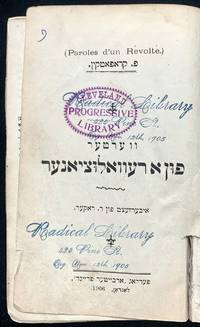
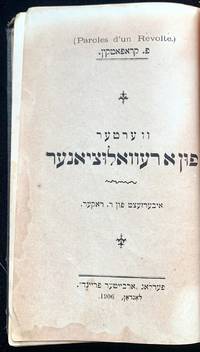
190643217London: "Arbayter fraynd 1906. First Yiddish edition. Period boards 8vo xiii 426 pages 19 cm. In Yiddish. Title translates as “Words from a Revolutionary.â€<br> Translation of “Paroles d'un re´volte´.†Includes translation of the forewords by the author and Elise´e Reclus. Includes bibliographical references.<br> “During his long exile Kropotkin wrote a series of influential works the most important being ‘Paroles d’un révolté’ 1885; “Words of a Rebelâ€.Kropotkin’s aim as he often remarked was to provide anarchism with a scientific basis. In Mutual Aid which is widely regarded as his masterpiece he argued that despite the Darwinian concept of the survival of the fittest cooperation rather than conflict is the chief factor in the evolution of species. Providing abundant examples he showed that sociability is a dominant feature at every level of the animal world. <br> Among humans too he found that mutual aid has been the rule rather than the exception. He traced the evolution of voluntary cooperation from the primitive tribe peasant village and medieval commune to a variety of modern associations—trade unions learned societies the Red Cross—that have continued to practice mutual support despite the rise of the coercive bureaucratic state. The trend of modern history he believed was pointing back toward decentralized nonpolitical cooperative societies in which people could develop their creative faculties without interference from rulers clerics or soldiers.â€<br> SUBJECTS: Anarchism. OCLC: 19303211.<br> Ex-library with early 19th Century left-wing library markings see photos. Good- Condition YID-48-41-LXCCGG-’e. London: "Arbayter fraynd unknown
190643219London: "Arbayter fraynd 1906. First Yiddish edition. Period boards 8vo xiii 426 pages 19 cm. In Yiddish. Title translates as “Words from a Revolutionary.â€<br> Translation of “Paroles d'un re´volte´.†Includes translation of the forewords by the author and Elise´e Reclus. Includes bibliographical references.<br> “During his long exile Kropotkin wrote a series of influential works the most important being ‘Paroles d’un révolté’ 1885; “Words of a Rebelâ€.Kropotkin’s aim as he often remarked was to provide anarchism with a scientific basis. In Mutual Aid which is widely regarded as his masterpiece he argued that despite the Darwinian concept of the survival of the fittest cooperation rather than conflict is the chief factor in the evolution of species. Providing abundant examples he showed that sociability is a dominant feature at every level of the animal world. <br> Among humans too he found that mutual aid has been the rule rather than the exception. He traced the evolution of voluntary cooperation from the primitive tribe peasant village and medieval commune to a variety of modern associations—trade unions learned societies the Red Cross—that have continued to practice mutual support despite the rise of the coercive bureaucratic state. The trend of modern history he believed was pointing back toward decentralized nonpolitical cooperative societies in which people could develop their creative faculties without interference from rulers clerics or soldiers.â€<br> SUBJECTS: Anarchism. OCLC: 19303211.<br> Spine is taped.Tight binding but text block is clean and intact. Good Condition YID-48-40-LXCCGG-’e. London: "Arbayter fraynd unknown
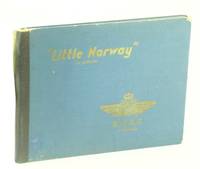
1943811h1965Toronto: S. J. Reginald Saunders Publishers. Poor. 1943. First Edition. Hardcover. The first 32 pages serve as an introduction to the Norway of today and yesterday accompanied by many black and white photos. The remaining 92 pages describe the history of "Little Norway" established in Canada around the Toronto Island Airport shortly after Germany occupied Norway in WWII. Profusely illustrated with black and white photos we see and read how Norwegian military forces were trained and lived in Canada. Includes names and photos of the Norwegian leaders of this project four photos of the Muskoka aerodrome opened by Crown Prince Olav on May 4th 1942 photos of V.I.P. visitors headshot photos of dozens of unidentified headquarters staff members and an aerial photo of "Little Norway" a completely modern military camp. Undated but appears to be circa 1943. Text in English. Very heavily worn with many military library markings and binding issues. Spine taped. Oblong 12" x 9.25". Not pretty but a worthy reference copy of this important facet of Norwegian and Canadian WWII history. Cooke 3rd Edn p.343. ; 8vo . S. J. Reginald Saunders Publishers hardcover
Very Good Armenian Original half bound leather bdg. Large demy8vo. (22 x 15,5 cm). In Armenian. 675 p. Prior to Soviet rule, the Dashnaksutiun had governed the First Republic of Armenia. The Socialist Soviet Republic of Armenia was founded in 1920. Diaspora Armenians were divided about this: supporters of the nationalist Dashnaksutiun did not support the Soviet state, while supporters of the Armenian General Benevolent Union (AGBU) were more positive about the newly founded Soviet state. From 1828 with the Treaty of Turkmenchay to the October Revolution in 1917, Eastern Armenia had been part of the Russian Empire and partly confined to the borders of the Erivan Governorate. After the October Revolution, Bolshevik leader Vladimir Lenin's government announced that minorities in the empire could pursue a course of self-determination. Following the collapse of the empire, in May 1918 Armenia, and its neighbors Azerbaijan and Georgia, declared their independence from Russian rule and each established their respective republics. After the near-annihilation of the Armenians during the Armenian Genocide and the subsequent Turkish-Armenian War, the historic Armenian area in the Ottoman Empire was overrun with despair and devastation. A number of Armenians joined the advancing 11th Soviet Red Army. Afterward, Turkey and the newly proclaimed Soviet republics in the Caucasus negotiated the Treaty of Kars, in which Turkey resigned from its claims to Batumi to Georgia in exchange for the Kars territory, corresponding to the modern-day Turkish provinces of Kars, Igdir, and Ardahan. The medieval Armenian capital of Ani, as well as the cultural icon of the Armenian people Mount Ararat, were located in the ceded area. Additionally, Joseph Stalin, then acting Commissar for Nationalities, granted the areas of Nakhchivan and Nagorno-Karabakh (both of which were promised to Armenia by the Bolsheviks in 1920) to Azerbaijan. From 12 March 1922 to 5 December 1936, Armenia was a part of the Transcaucasian SFSR (TSFSR) together with the Georgian SSR and the Azerbaijan SSR. The policies of the first Soviet Armenian government, the Revolutionary Committee (Revkom), headed by young, inexperienced, and militant communists such as Sarkis Kasyan and Avis Nurijanyan, were implemented in a highhanded manner and did not take into consideration the poor conditions of the republic and the general weariness of the people after years of conflict and civil strife. Such was the degree and scale of the requisitioning and terror imposed by the local Cheka that in February 1921 the Armenians, led by former leaders of the republic, rose up in revolt and briefly unseated the communists in Yerevan. The Red Army, which was campaigning in Georgia at the time, returned to suppress the revolt and drove its leaders out of Armenia. Convinced that these heavy-handed tactics were the source of the alienation of the native population to Soviet rule, in 1921 Moscow appointed an experienced administrator, Alexander Miasnikian, to carry out a more moderate policy and one better attuned to Armenian sensibilities. With the introduction of the New Economic Policy (NEP), Armenians began to enjoy a period of relative stability. Life under the Soviet rule proved to be a soothing balm in contrast to the turbulent final years of the Ottoman Empire. The Armenians received medicine, food, as well as other provisions from the central government and extensive literacy reforms were carried [.] Only one copy is located in OCLC: 782028953 (National Library of Israel - Jewish National Library).
24743‘18bre sic 1855’ Wimbledon London. An interesting letter indicating the networks of sympathisers who assisted those fleeing to England in the years following the revolutions of 1848. In the July 1895 edition of the Atlantic the subject of this letter the Christian Socialist J. M. Ludlow in reviewing Nadaud’s memoirs described him as ‘a friend of my own of many years’ standing’. The present item was written in the seventh of the eighteen years of Nadaud’s English exile part of which was spent as a teacher in Wimbledon under the name ‘Henri Geo. Nadaud’. The identity of the recipient is not known. 4pp 16mo. Bifolium on grey paper. Worn and with a small part of one corner torn away but in fair overall condition. Folded once for postage. Sixty-six lines of text addressed to ‘Cher Mons Delabussière’ and signed ‘Martin’. He begins by explaining why he has not been able to return in person the ‘numéro’ of a periodical that Delabussière has sent him and that he has read with great pleasure. He had previously made arrangements about altered worktimes with a colleague. He goes on to ask whether Delabussière would like to dine with him the following Wednesday and whether he would like him to invite ‘Boura’ and another man as well. He states that he does not recall talking to Boura on the subject of a letter ‘écrite par le monsieur ou je suis à celui que je venais de quitter. / Le fait de votre réussite parle assez haut en lui même pour que aucun on dit ne puisse atteindre votre amore propre. Si on n’avait pas eu confiance en vous je n’y pourais pas été appele’ He hopes that Delabussière's ‘association’ brings him money as friends are rare and a man is placed in the scales of wealth rather than of honour. He has distributed Delabussière's prospectuses along with his own calling card and bids him visit ‘un de mes bons amis Mr Ludlow avocat anglais 3 Old Square Lincom-inn sic’ and tell him that he is ‘le professeur de Mechanics institution’ and ‘il aura peut être un collège à vous offrir’. It will be worth his while ‘car ces messieurs font des sacrifices énormes pour l’education du peuple anglais’. He gives a few further instructions regarding how to approach Ludlow ending ‘Il sait toute mon affaire je ne lui cache rien!’ ‘18bre [sic] 1855’ [Wimbledon, London]. unknown
193414482Zürich, Oprecht & Helbling, 1934. 8vo. Mit Original-Holzschnitten von Clément Moreau. 98 S. OLwd. m. Orig.-Schutzumschlag m. beidseitig. Holzschn.-Illustr. Roter Kopfschnitt.
Publishers cloth. 8vo. 279, [1] pages. 20 cm. First edition. In German. Inscribed by author on endpage, dated September 1941. Theodor Herzl, his life and his legacy. With frontispiece portrait of Herzl and 18 accompanying photographs. A detailed biography of the life and work of Theodore Herzl written on the eve of Hitlers ascent to power; with a forward by Albert Einstein on Herzl and a forward by Thomas Mann on constructive work in Palestine. Written by Manfred George (18931965) , born Manfred Cohn Georg, a journalist and editor. Born in Berlin, he took a degree in law and became a prominent newspaper editor and writer. Georg excelled as a political writer and as a film and drama critic. Among his books is Theodor Herzl, sein Leben und sein Vermaechtnis (1932) . When the Nazis came to power, Georg went to Prague, worked there for several years, and in 1938 immigrated to the U. S. In New York, he took over Aufbau (subtitled Reconstruction) , founded in 1924, originally the newsletter of the German-Jewish New World Club. Under his editorship, Aufbau became a German-language weekly representing the German-Jewish immigrant community and acquired a circulation of more than 30, 000. George was one of the outstanding figures of America's German-Jewish community. (EJ 2007) . Subjects: Biography - Herzl, Theodor, 1860-1904. Exile Literature German Jewish Authors. OCLC lists 12 copies, but only 1 copy in the US (Yale) . Light shelf wear to cloth, otherwise fresh. Very Good+ Condition. (MX-36-7)
183325934Paris/Lpz., Heideloff und Campe, 1833. 2 Bände in einem Buch (alles). 16,9/10,5 cm. 4,VI,144/VIII,186 S. Leinen der Zeit mit Rückenvergoldung. Recht schön.
185413404CBHamburg, Hoffmann und Campe, 1854. 8°. 1 Bl. 322; XVIII, 319; 2 Bl. 310 S. Blindgeprägtes Leinen der Zeit mit Rückenprägung, Initialen 'J.B.', 1 3 Bände.
189132335ABLondon, Osgood, McIlvaine & Co. 1891. 1. Edition. 2 Bände. (2 vols.) gr.8°. XV/409, X/574 S. mit zahlreichen zum Teil ganzseitigen Illustrationen im Text und a. Tafeln. OLeinen mit leichter ornamentler Verzierung in Farbe und Wappen in Gold a. Deckel, Goldaufschrift a. Deckel und Rü., leichte Rü. Vergoldung, Kopf Goldschnitt, Einband etwas fleckig und leicht bestoßen, Vorsätzte erneuert, innen ganz sauber, gut erhalten. 1