121 résultats
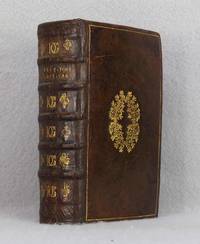
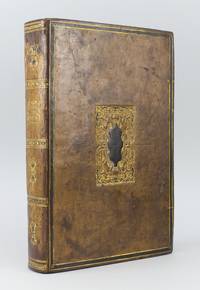
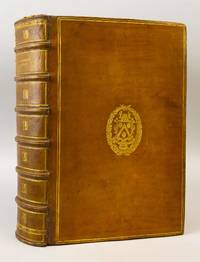
1581ST20964Geneva: Excudebat Henrius Stephanus 1581. Second Estienne Edition. 320 x 212 mm. 12 1/2 x 8 1/2". 6 p.l. 584 76 pp.Edited and with annotations by Henri Estienne. <br/> FINE 17TH CENTURY SPRINKLED CALF PRIZE BINDING covers gilt with French fillet border oblique fleur-de-lys at corners SUPRA LIBROS OF CARDINAL MAZARIN AT CENTER raised bands spine compartments with fleurs-de lys at center and corners edges gilt over marbling old repair to head of spine. Printer's device Schreiber 18 on title. WITH 1692 COLLÈGE MAZARIN PRIZE PRESENTATION to Laurence Thibault for Greek oratory signed by the head of College P. J. Le Chapelier with seal of the college attached tipped onto title page. Main text in Greek dedication to James VI of Scotland and Estienne's annotations in Latin. Renouard 149.6; Hoffmann III 577; Dibdin II 567; USTC 450908. Lower corner of back board somewhat bumped leather slightly marked other very modest exterior wear but the stately binding in nearly fine condition. First five quires with two tiny wormholes to tail margin final signature with a little creasing other insignifcant imperfections but AN ESPECIALLY FRESH CLEAN AND BRIGHT COPY INTERNALLY the leaves crackling when you turn them.<br/> <br/> This copy of what Renouard calls the "far superior" Estienne Xenophon is offered in a very attractive binding that was used as a prize for a student at the Collège Mazarin near the close of the 17th century. Best known to his contemporaries as an historian and general as well as an opponent of Athenian democracy Xenophon ca. 430-354 B.C. was a student of Socrates and aside from Plato's his works contain the only surviving examples of Socratic dialogues. Although born in Athens Xenophon greatly admired Sparta and its political structure and he eventually went to war for Sparta against the Athenians this earned him land in Sparta but unsurprising exile from Athens. Xenophon's philosophical writings found popularity in the Renaissance and some scholars have suggested that Machiavelli was particularly influenced by Xenophon's more "practical" i.e. ruthless approach to politics. The present 1581 printing is among the most highly regarded Renaissance editions of Xenophon's works. The printer and scholar Henri Estienne II 1528-98 was a brilliant classicist best known for producing "Thesaurus Graecae Linguae" 1572 a standard reference for 300 years. He produced his first Xenophon in 1561 but fully revised the text for the present edition. Dibdin tells us that "the edition of 1581 has more intrinsic value than the preceding one" and Renouard notes that it is "not as pretty as the 1561 edition but far superior." Our copy fittingly was presented as a prize for Greek oratory to a student at the Collège Mazarin founded by a bequest from the former first minister of France Jules Cardinal Mazarin 1602-61. Mazarin was not just a prince of the Church and an advisor to the Sun King but one of the greatest bibliophiles of his day with a library of 40000 volumes that became the foundation of the Bibliothèque Mazarine. Our book is bound in a style appropriate to that famed collection with Mazarin's personal supralibros at the center of each board. The partly printed award certificate bound in at the front indicates that Laurence Thibault had won second prize for Greek oration in the college's "solemn games" honoring the royal recognition of the college. It is signed by the head of the college Pierre-Jean Le Chapelier de Mauron who held a doctorate from the Sorbonne and simultaneously served as abbot of the Abbey of Ste Marie-de-Boquen in Brittany. Excudebat Henrius Stephanus unknown
1583ST15026Paris: Arnold Sittart 1584; Heidelberg: Peter Santandrea 1583. 178 x 111 mm. 7 x 4 3/8". 14 p.l. cccix pp. 13 leaves last blank; lxxv 10 ccxvi 22 pp.; 2 leaves 84 pp.; 1 1-196 18 pp.; 62 pp. Two works in several parts bound in one volume. With annotations and commentary by Antonio Augustin Joseph Scaliger and Fulvio Orsini. <br/> Pleasing contemporary calf covers with central gilt wreath of olive branches raised bands spine panels gilt with cipher "D C G" at center flanked by a palmette and a vegetal trefoil gilt titling bottom panel with "OD" and "I8" on either side of the cipher. Printers' devices on the title pages decorative woodcut initials and headpieces. Front pastedown with what appear to be early library shelf markings; one page with neat early marginalia. Adams V-590 and F-390. Covers slightly marked spine with a bit of superficial crackling and with one short crack in the middle of bottom panel the text with faint browning and isolated minor soiling a few leaves with long shallow creases not affecting legibility otherwise in excellent condition the binding solid and without significant wear and the leaves generally clean fresh and smooth.<br/> <br/> This glossary of recondite Latin words and phrases was no doubt bound for a contemporary bibliophile with an extensive library. The "OD" and "I8" at the bottom of the spine appear to be the indication of a shelf location--not something frequently encountered on spines of this period. This designation and the location notation on the front pastedown that clearly relates to it "Arm. 0. Tab 4. Loc. 18" suggest a library of some complexity and an educated owner who believed in careful organization. While we have not been able to identify "D C G" she would seem also to have been a person of taste and good sense. The binding is attractively decorated while still being practical for scholarly use. The work itself has gone through a number of changes of fortune. The story begins when Verrius who lived in the time of Augustus compiled a valuable work full of information on everything from grammar to mythology. Unfortunately his text has been largely lost; the authentic fragments fill only the first few leaves of our volume. His work was epitomized by Festus a ca. third century scholar but Festus was not a very good epitomizer and to make matters worse all of his entries have been lost up to the letter "M." Luckily an epitome of the epitome from "A" to "Z" had been made by Paul the Deacon in the eighth century. Valuing the handbook for its information on the writing of correct Latin Renaissance scholars went to work on this puzzle in the 15th century and a first version of Paul was published by Zarotus in Milan in 1471. Later scholars published Festus and the great French classicist Joseph Scaliger 1540-1609 was largely responsible for bringing definitive order out of chaos. His scholarly edition reconstructs the work of Festus as far as one can filling in the gaps caused by missing pages in the manuscript with conjectures and rectified material from Paul. Peter Santandrea unknown
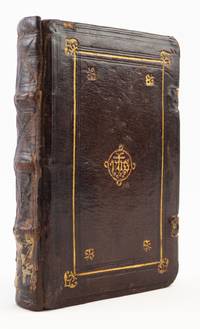
1538ST19567-018Venetiis Venice: in officina heredum Luceantonii Junte hiers of Lucantonio Giunta 1538. 149 x 104 mm. 5 7/8 x 4". 8 143 of 144 leaves lacking leaf p6. <br/> Contemporary Venetian morocco rebacked preserving original blind-ruled spine and corners rounded off and renewed covers each with blind-ruled borders and a gilt- and blind-ruled panel with gilt fleurons in each inner and outer corner central gilt IHS monogram raised bands brass clasps renewed all edges gilt and gauffered lacking final endleaf. Printer's device on title numerous historiated woodcut initials first page of text with woodcut border two full-page woodcut illustrations. Printed in red and black. Essling 181; Sander 5970 under "autres éditions"; EDIT 16 CNCE 11880. Original spine somewhat crackled bottom compartment with slight surface loss perhaps from removal of a label covers with several but insignificant small dings very minor dampstain at extreme top edge of a few leaves other trivial imperfections but a clean fresh and bright copy in an attractive early binding.<br/> <br/> Offered in what is probably its original binding this is a very rare edition of a Psalter done by one of the leading Venetian printing families of the 15th and 16th centuries. A major figure in the Italian book trade Lucantonio Giunta 1457-1538 began his career as a bookseller in Venice in 1477 and became a printer there in 1489. Together with family members and carefully arranged partnerships Giunta expanded his printing empire into numerous cities in Europe including Lyon Lisbon Antwerp Frankfurt and Salamanca. The present book was printed just after the death of Lucantonio whose heirs would continue to run the family business which grew prosperous in part because of its specialty in producing liturgical works such as this. The contents here are routine but the well-preserved decorative period binding makes the volume definitely worth having. in officina heredum Luceantonii Junte [hiers of Lucantonio Giunta] unknown
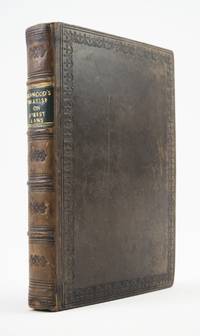
1598ST20689London: Printed by Thomas Wight and Bonham Norton 1598. FIRST PUBLISHED EDITION and First Edition under this Title. 192 x 139 mm. 7 5/8 x 5 1/2". 8 p.l. 154 162-65 159-67 1 blank 6 leaves. Errors in pagination but text complete. <br/> Late 19th century dark brown calf covers tooled in blind with plain rules and fleur-de-lys roll raised bands spine panels with small blind-stamped ornament black morocco label marbled endpapers neat repairs to ends of both joints. Front pastedown with engraved armorial bookplate of Godfrey Wentworth Woolley Park. Beale T-413; Mellon/Podeschi 15; Schwerdt II 7; STC 17291; ESTC S111993.<br /> Extremities slightly rubbed boards a little chafed in spots text lightly pressed but not washed a bit of browning to edges and occasional minor marginal foxing or traces of corner creases but quite an excellent copy the text clean and still fresh throughout and the perfectly suitable binding with no significant wear.<br/> <br/> This is a pleasing country gentleman's copy of the first published treatise on the laws governing English forests. Our author the fittingly named woodsman John Manwood d. 1610 served as gamekeeper of Waltham Forest as well as a justice of the New Forest. DNB tells us that he was possibly a barrister at Lincoln's Inn which would explain his interest in and knowledge of the law. Manwood tells us in the dedicatory epistle that he composed the present work in response to the precarious state of forest preservation stating that "so many do daily so contemptuously commit such heynous spoiles and trespasses" against the country's woodlands but "verie little or nothing as yet is extant concerning the Lawes of the Forrest" to help manage such behaviors. Our copy comes from the first published edition following only the 1592 pamphlet entitled "A Brefe Collection of the Lawes of the Forest" issued for private circulation and now extraordinarily rare. According to DNB the present treatise is "the only substantial work on the subject ever to reach the press" making it an enduringly useful source for those interested in the topics contained which include laws about hunting and perambulation in forests. It remained the standard work on the subject until the 19th century and Schwerdt writes that it has been "invaluable to students and lovers of ancient sport." Our copy is from the library of Yorkshire landowner Godfrey Wentworth 1773-1834 who served as High Sheriff of Yorkshire from 1796-97 and in the House of Commons from 1806-08. He probably had no need for a later printing of the work. Printed by Thomas Wight and Bonham Norton unknown
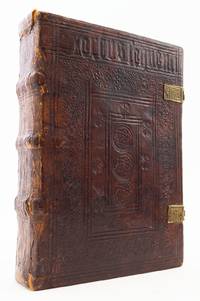
1556ST20472Basel: Hieronymus Froben 1556. First Edition of this Latin Translation. 343 x 235 mm. 13 1/2 x 9 1/4". 4 p.l. 730 142 2 blank pp. 12 leaves. Translated from the Greek by Petrus Nannius and Wolfgang Musculus. <br/> Contemporary blind-stamped pigskin over bevelled wooden boards by Balthasar Wernher of Lauingen covers framed by palmette rolls and a roll signed with the initials B. W. that features half-figures of Christ as Salvator Mundi St. Paul St. John the Baptist and King David central panel of upper cover with vertical palmette rolls the blank frame around it with the letters "M G" above the panel separated by turnip tool the date 1557 below the panel central panel on the lower cover with the same tooling but surrounded by a frame with a roll of medallions of the Reformers raised bands ink lettering to a couple of panels two original brass catches and catchplates one catchplate defective. Printer's woodcut device to title page and final page numerous decorative woodcut initials. Title page with three early ink owner inscriptions; occasional early ink marginalia and underlining. VD16 A 3980; Adams A-2083; Hoffmann I 415. For the binding: Haebler I 475 3; EBDB roll r003786 and workshop w004477. Binding somewhat soiled and chafed pigskin at one corner rubbed away one-inch circular hole on back board a contemporary issue with tooling impressed on the wood beneath isolated minor marginal stains or mild foxing other trivial imperfections but an extremely pleasing copy very fresh internally with excellent margins in a completely satisfying unrestored contemporary binding.<br/> <br/> This collected edition of the writings of the Church Father and leading advocate of the doctrine of the Trinity comes in a lovely binding by a known German workshop. The Einbanddatenbank "Bookbinding Database" or EBDB of the German Research Foundation attributes the Salvator Mundi/St. Paul/King David/John the Baptist roll to Lauingen binder Balthazar Wernher ca. 1525-74/75 whose initials appear in the panel featuring Christ. His workshop was active ca. 1555-75; the date on our binding indicates it was produced near the beginning of his career. One of the four great Eastern Doctors of the Church and the Patriarch of Alexandria St. Athanasius ca. 297 - 373 led the fight against the Arian doctrine which held that Christ was a creation of God the Father rather than consubstantial with Him. Athansius’ writings on the Incarnation and the Trinity which make up most of the text here were enormously influential. According to Catholic historian Cornelius Clifford "Athanasius was the greatest champion of Catholic belief on the subject of the Incarnation that the Church has ever known and in his lifetime earned the characteristic title of 'Father of Orthodoxy' by which he has been distinguished ever since." The English theologian and Cardinal John Henry Newman declared Athanasius a "principal instrument after the Apostles by which the sacred truths of Christianity have been conveyed and secured to the world." This translation of his writings was one of the final works by the Dutch humanist Petrus Nannius Pieter Nannick 1496-1557 a contemporary of Erasmus. The printer here was Hieronymus Froben who took over the family business from his father Johann Froben 1460-1527 a central figure in the printing history of the 15th and early 16th centuries who played a key role both in the intellectual ferment of the northern Renaissance and the theological turmoil of the Reformation. Our substantial large folio binding with its thick boards and four sets of muscular double bands provides an appropriate reflection of the weightiness of the works it contains. [Hieronymus] Froben unknown
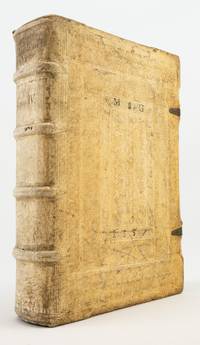
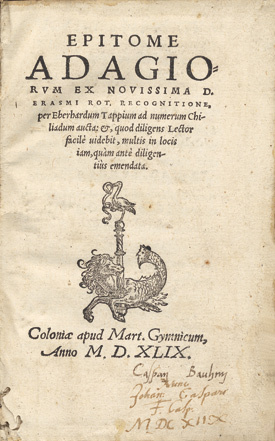
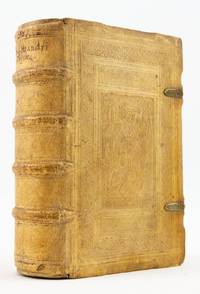
15499472Cologne, Mart. Gymnicus, 1549 ; in-8 ; plein vélin estampé sur ais de bois, dos à trois gros nerfs, fermoirs de cuivre (reliure de l'époque) ; (16) y compris le titre, 632, [634], (76) pp. index, (1) f. blanc (*, AZ, Aa-Xx - 8, Yy - 4).
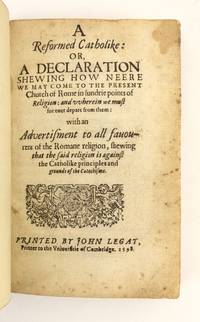
1598ST16441Cambridge: John Legat 1598. Second Printing. 153 x 98 mm. 6 x 3 7/8". 4 p.l. 375 1 pp. <br/> Modern sprinkled calf blind-ruled covers raised bands flanked by double gilt rules brown morocco label remnants of paper library shelf label at tail of spine. Printer's device on title page. Front pastedown with bookplate of the Fox Pointe Collection; rear pastedown with deaccession stamp of Bradford City Libraries. STC 19736; ESTC 19736. ◆Spine just faintly sunned leaves lightly browned due to paper quality and trimmed a bit close at head grazing headline on a couple of leaves isolated marginal stains or tiny rust spots but an excellent copy fresh and clean in a sympathetic binding with few signs of wear.<br/> <br/> This was an important work in establishing distinctions in liturgy and doctrine between the Catholic Church and the Church of England written by a moderate puritan whom DNB considers "perhaps the most significant English theologian of his age." Perkins 1558-1602 was one of the most popular voices of his time speaking from a Calvinist puritan point of view; while he could be virulently anti-Catholic he did not believe in repudiating the English church only in reforming it. According to DNB "The genius of Perkins's work did not lie in its originality—his theology represents a conventional recital of Calvinist scholasticism in virtually every respect. His gift lay rather in bringing to a broad audience a variety of theological and moral issues popularizing essentially technical discussions and therefore as Fuller observed humbling 'the towering speculations of philosophers into practice and morality.'" The present work spread his polemical influence beyond England to the Continent; even the Catholic bishop William Bishop admitted he had "not seene any book of like quality published by a Protestant to contain either more matter or delivered in better method." Both the 1597 first edition and our 1598 second printing are rare: no other copies of either edition are recorded at auction by RBH or ABPC in the past 50 years. John Legat unknown
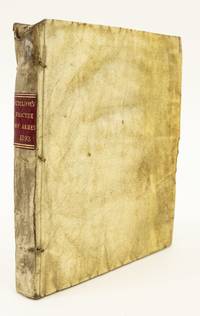
155453133ABLugduni (Lyon), Matthias Bonhomme, 1554-1555. C.a. 33,5 x 21 cm. (16) S., (24) Seiten Register, 583 Seiten; (10) S., 242 S., (10) Seiten Register. Mit Druckermarke, Porträt und 470 Holzschnitten . Späterer Ganzpergamentbände. 2 Bände. [8 Warenabbildungen]
1552ST12878Parisiis: Apud Ioannem de Roigny 1552. 325 x 210 mm. 12 3/4 x 8 1/4". 1 p.l. title 776 pp. 20 leaves last blank. Collates as in Adams and Schweiger. <br/> Attractive contemporary calf over thick pasteboards covers with painted black and gilt rule frame center of both boards with large elaborate rectangular strapwork ornament in black and gilt flat spine divided into panels by gilt rules and cresting roll three spine panels with black and gilt ornament similar to those on the covers one panel with gilt titling inside an escutcheon all edges gilt the joints edges and portions of the spine at top and bottom very expertly renewed. Numerous fine "criblé" and other decorative initials and 145 WOODCUT SCENES measuring approximately 2 x 3" some of the cuts repeated. Front pastedown with "HB" book label of Heribert Boeder; title page with ink inscription of Johann Adolph Freitag dated 1653 and with library stamp of the College of Notre Dame Villefranche sur Saone. Adams E-1033; Dibdin II 470; Hoffman II 68-69; Mortimer 512; Schweiger II 1060. ◆Spine slightly faded and discolored in spots color of the cover leather a bit uneven two pages with ink stain touching but not obscuring a word of text isolated rust spots but a very pleasing copy the text unusually fresh clean and bright and the carefully restored binding completely solid and certainly pleasing.<br/> <br/> This is a large-format illustrated printing of the "Comedies" bound in a more restrained version of the painted entrelac bindings in vogue in 16th century a binding tall and dignified enough to suit its contents. Dibdin describes this as "a most excellent edition" that contains "almost all the valuable treatises upon the author up to the period of its publication" and notes that "it is of rare occurrence." There were two issues of this 1552 edition; our colophon dated to 17 Calendas Decembris Anno 1551 indicates that we have the first. Terence's six extant plays the ancestors of drawing room and modern situation comedies feature crusty fathers rebellious sons and impertinent slaves whose machinations solve the playwright's intricate complications of plot. The plays were popular throughout the Middle Ages and the Renaissance and still retain their appeal. The text of the plays in large and attractive italic type is surrounded here by the commentary in smaller italic of Donatus fourth century A.D. and others. Each scene is preceded by a woodcut depicting the actors on a curtained stage. While very simple in composition these are animated and frequently amusing. According to Mortimer our text and scholarly apparatus are mostly reprinted from Girolamo Scoto's Venice edition of 1545 and the scene cuts "are extremely close copies of the Italian blocks used by Scoto.". Apud Ioannem de Roigny unknown
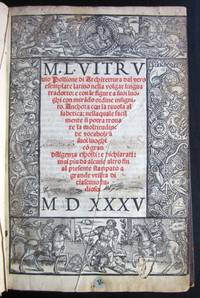
1535SAV123Venice: Nicolo de Aristotele detto Zoppino 1535. Hardcover. Very Good. Folio 295 x 190mm. 12 I-CX 110ff. Signatures: AA6-BB6; A8-N8; O6. Title printed in red and black with woodcut block border depicting strewn armor and dueling knights with wreathed portrait of Cicero at top and plaques with monogram initials of Roman Emperors Fabius Maximus Julius Caesar and Alexander Magnus. 136 woodcut in-text illustrations depicting lives of primitive humans the famous Vitruvian Man on p. XXII constellations rules for perspective and other mathematical figures and diagrams of architecture. Woodcut historiated chapter initials throughout of repeating portraits. Translated by Benedetto Giovio 1471-1545. Edited by Francesco Lutio Durantino. 19th-century calf with decorative stamps spine stamped in gilt TRAT DE ARCH endpapers renewed; loose in binding some margins trimmed close some light worming at least six early cancelled inscriptions on title leaf CX with significant excision otherwise an crisp and clean text block with wonderful woodcut impressions. 19th-century inscription on fly-leaf Famoza Archi-tectura. Another 19th-century inscription on front flyleaf Presented to the Mercantile Library Association of New York by Philip A Reach .Consul/ Lisbon Jan. 7 1848. Sold in 1958 on removal of Architecture Books from the Library pencil note. Rare illustrated Durantino edition of Vitruvius printed in Venice by Zoppino in 1535. This Vitruvius work was first printed in 1521 for Como. As it gained notoriety another edition in the vernacular Italian was prepared by Giovanni Antonio and Pietro de Nicolino da Sabbio in 1524. It incorporated woodcuts from a 1511 Latin edition produced by Giovanni Giocondo in Venice Tacuino. This Zoppino printing had a newly redesigned title-leaf with an elaborate woodcut border of chivalric battle scenes between Augustus Caesar Julius Caesar and Alexander the Great. The 136 in-text woodcuts are an all too interesting miscellany of late-medieval life nature and architecture and are characteristic of Vitruvian ideals in regards to proportion ornament language space place and beauty. The famous figure of Symmetria Vitruvian Man is present on p. XXII. Both the 1524 and 1535 editions were widely read by an Italian public. Vitruvian principles deeply influenced early Renaissance artists thinkers and architects who believed they were rediscovering an ancient discipline which would be the foundation of their culture. <br/><br/>Rare illustrated Durantino edition of Vitruvius printed in Venice by Zoppino in 1535. This Vitruvius work was first printed in 1521 for Como. As it gained notoriety another edition in the vernacular Italian was prepared by Giovanni Antonio and Pietro de Nicolino da Sabbio in 1524. It incorporated woodcuts from a 1511 Latin edition produced by Giovanni Giocondo in Venice Tacuino. This Zoppino printing had a newly redesigned title-leaf with an elaborate woodcut border of chivalric battle scenes between Augustus Caesar Julius Caesar and Alexander the Great. The 136 in-text woodcuts are an all too interesting miscellany of late-medieval life nature and architecture and are characteristic of Vitruvian ideals in regards to proportion ornament language space place and beauty. The famous figure of Symmetria Vitruvian Man is present on p. XXII. Both the 1524 and 1535 editions were widely read by an Italian public. Vitruvian principles deeply influenced early Renaissance artists thinkers and architects who believed they were rediscovering an ancient discipline which would be the foundation of their culture. Nicolo de Aristotele detto Zoppino hardcover books
1535SAV123Venice: Nicolo de Aristotele detto Zoppino 1535. Hardcover. Very Good. Folio 295 x 190mm. 12 I-CX 110ff. Signatures: AA6-BB6; A8-N8; O6. Title printed in red and black with woodcut block border depicting strewn armor and dueling knights with wreathed portrait of Cicero at top and plaques with monogram initials of Roman Emperors Fabius Maximus Julius Caesar and Alexander Magnus. 136 woodcut in-text illustrations depicting lives of primitive humans the famous Vitruvian Man on p. XXII constellations rules for perspective and other mathematical figures and diagrams of architecture. Woodcut historiated chapter initials throughout of repeating portraits. Translated by Benedetto Giovio 1471-1545. Edited by Francesco Lutio Durantino. 19th-century calf with decorative stamps spine stamped in gilt TRAT DE ARCH endpapers renewed; loose in binding some margins trimmed close some light worming at least six early cancelled inscriptions on title leaf CX with significant excision otherwise an crisp and clean text block with wonderful woodcut impressions. 19th-century inscription on fly-leaf Famoza Archi-tectura. Another 19th-century inscription on front flyleaf Presented to the Mercantile Library Association of New York by Philip A Reach .Consul/ Lisbon Jan. 7 1848. Sold in 1958 on removal of Architecture Books from the Library pencil note. Rare illustrated Durantino edition of Vitruvius printed in Venice by Zoppino in 1535. This Vitruvius work was first printed in 1521 for Como. As it gained notoriety another edition in the vernacular Italian was prepared by Giovanni Antonio and Pietro de Nicolino da Sabbio in 1524. It incorporated woodcuts from a 1511 Latin edition produced by Giovanni Giocondo in Venice Tacuino. This Zoppino printing had a newly redesigned title-leaf with an elaborate woodcut border of chivalric battle scenes between Augustus Caesar Julius Caesar and Alexander the Great. The 136 in-text woodcuts are an all too interesting miscellany of late-medieval life nature and architecture and are characteristic of Vitruvian ideals in regards to proportion ornament language space place and beauty. The famous figure of Symmetria Vitruvian Man is present on p. XXII. Both the 1524 and 1535 editions were widely read by an Italian public. Vitruvian principles deeply influenced early Renaissance artists thinkers and architects who believed they were rediscovering an ancient discipline which would be the foundation of their culture. <br/><br/>Rare illustrated Durantino edition of Vitruvius printed in Venice by Zoppino in 1535. This Vitruvius work was first printed in 1521 for Como. As it gained notoriety another edition in the vernacular Italian was prepared by Giovanni Antonio and Pietro de Nicolino da Sabbio in 1524. It incorporated woodcuts from a 1511 Latin edition produced by Giovanni Giocondo in Venice Tacuino. This Zoppino printing had a newly redesigned title-leaf with an elaborate woodcut border of chivalric battle scenes between Augustus Caesar Julius Caesar and Alexander the Great. The 136 in-text woodcuts are an all too interesting miscellany of late-medieval life nature and architecture and are characteristic of Vitruvian ideals in regards to proportion ornament language space place and beauty. The famous figure of Symmetria Vitruvian Man is present on p. XXII. Both the 1524 and 1535 editions were widely read by an Italian public. Vitruvian principles deeply influenced early Renaissance artists thinkers and architects who believed they were rediscovering an ancient discipline which would be the foundation of their culture. Nicolo de Aristotele detto Zoppino hardcover
1585ST20050Leipzig: Georgius Desner 1585. FIRST EDITION. 170 x 110 mm. 6 3/4 x 4 1/4". 28 p.l. 494 pp. 1 leaf blank; 3 p.l. 463 pp. <br/> FINE CONTEMPORARY BLIND-STAMPED PIGSKIN over bevelled wooden boards covers framed by decorative lattice roll upper cover with central panel depicting Judith a sword in her right hand the head of Holofernes in her left signed "M R" above the caption; lower cover with a panel showing Jael in the act of killing Sisera her left hand holding a chisel to his temple her right hand holding a hammer raised to strike a blow the plate signed "M R" at the end of the caption raised bands ink titling at head of spine and on fore edge edges stained red two original brass clasps. Title page with 17th century ownership inscription of Georg Laurence Seydenbecher; verso of title with round blue ink armorial stamp; occasional neat ink marginalia in an early hand. VD16 N 413; USTC 684027. For the binding: Haebler I 381-82. ◆Text slightly and uniformly toned because of paper quality half a dozen quires a bit more browned isolated small ink stains or foxing pigskin with minor soiling to edges just a hint of wear to lower corners but A FINE COPY the contents thoroughly fresh and the unsophisticated binding with beautifully distinct stamps.<br/> <br/> This is a very rarely seen copy of an outline of the essentials elements for a humanist education written by a noted German pedagogue and offered here in a wonderful blind-stamped binding featuring two fierce biblical heroines. Symbols of courage embraced by the Reformation Jael and Judith appeared on front and back covers of a number of 16th century bindings and both are shown here in elegant Renaissance garb clutching the weapons they used against enemies of Israel. Jael offered the Canaanite general Sisera refuge in her tent following a battle and having lulled him to sleep with warm milk is shown on the rear cover here in the act of striking a stake through his temple. Beneath the image is the text "Sic pereant omnes inimici tui Domine" "So perish all of your enemies Lord" Judges 5:31. Judith pretended to seduce the Assyrian Holofernes then got him drunk and cut his head off; here on our front cover she triumphantly displays his head brandishing his sword. Below her is a verse from Psalms: "Voluntatem timentium es faciet dominus" "He will do the will of them that fear him" Psalm 144. We did not find these plates in EBDB or any of the usual reference works but they are likely the work of bookbinder Matthias Radmann who became a master binder in Leipzig in 1546 and who signed his work "M R" often at the end of a caption as on the Jael plate. A student of Melanchthon Michael Neander 1525-95 became director of the college of Ilefeld where he developed an influential curriculum with a heavy emphasis on Latin and Greek classics rhetoric philosophy history theology physical science and geography; the school attracted students from all over Europe. In our volume he collects excerpts of important authors on these and associated subjects beginning with the Greek Fathers on theology and continuing through philosophy mathematics medicine chemistry history natural sciences geography rhetoric poetry and grammar. Our 1585 edition seems to be the sole printing and is very rare. Bindings of this sort are almost never found now so clean and with their elaborate blind decoration so extraordinarily sharp. Georgius Desner unknown
1597ST15850London: Printed by the Widow Orwin for Thomas Man 1597. FIRST EDITION. PRESENTATION COPY. 187 x 130 mm. 7 3/8 x 5 1/8". 5 p.l. 93 pp. <br/> 20th century gray paper boards. Printer's device on title page. Title page inscribed "Gyven to name inked through but perhaps "Thomas Langham" by the aucthor Jo. Norden"; tail margin of title inscribed "Constantin Adyn his booke"; 19th century ink signature of Benjamin Hynam on recto and verso of title. Front pastedown with early 20th century bookseller's description pasted on. STC 18614; ESTC S113322. ◆Boards a bit soiled but otherwise unworn minor dust-soiling or browning to head margins one quire a little browned occasional trivial smudges or tiny rust spots but an excellent copy generally clean and fresh.<br/> <br/> Written during a fallow period in the author's regular career as a cartographer this work emphasizing the importance of service to God for all leaders and common soldiers in the sovereign's army was inscribed by the author to a friend or patron. One of several works Norden dedicated to the earl of Essex it got our author into professional difficulties when Essex's enemy Robert Cecil rose to power and was in a position to impede Norden's career as a mapmaker. Norden quickly tried to push responsibility onto a "false Norden" from Kent he was from Somerset but biographer Frank Kitchen has established that the shared "interests backgrounds written expression everyday circumstances and style" indicate there was but one author. Though best known for his surveys and maps--including the first county maps of England to include roads--the pious Norden ca. 1547-1625 also produced numerous works of devotion and prayer among them the enormously popular "A Pensive Mans Practice" which went to 40 editions in his lifetime. While his sincere religious sentiments are not to be doubted it must be acknowledged that Norden was most moved to write these manuals when he was between surveying jobs and short of money. Aimed at soldiers of every rank the present work urges the "necessity of the fear and service of God" and "the use of all divine virtues both in commanding and obeying practicing and proceeding in the most honorable affairs of war." Norden also encourages civilians to support and respect the military and to pray for men-at-arms. This is an especially rare work: OCLC and ESTC find five copies in U.S. libraries and except for the two copies in the Cottesloe Library there seems to have been only one other--defective--copy at auction listed by RBH and ABPC. The present item is even more desirable as an extremely uncommon presentation copy signed by a 16th century English author. The Constantin Adyn who owned our copy is likely the early seventeenth-century schoolmaster otherwise known as Constantine or Constantinus Adyn fl. 1605-25 whose school was situated in Brighton according to Church of England records. The latest owner is likely the Anglo-Russian writer bibliophile and watchmaker Benjamin Hynam 1769-1859 a prominent figure in the distinguished Hynam family imperial watchmakers to Russian royalty. In the late eighteenth century the Hynams maintained a presence in both St Petersburg and London. Printed by the Widow Orwin for Thomas Man unknown
1504ST18751Basel: Michael Furter 1504. 220 x 138 mm. 8 x 5 1/2". CXXII 10 LXX 1 leaves. <br/> EXCELLENT CONTEMPORARY BLIND-TOOLED CALF covers panelled in blind title stamped in gothic letters at head of upper cover central panel with vertical row of three large rosettes EBDB tool s013635 this enclosed by a frame with eight carnation stamps EBDB tool s013643 then by a roll-tooled frame filled with circles containing flowers fruit and stars EBDB tool r000675; Kyriss 84 Roll 6 lower cover similarly framed but with central panel divided by diagonal blind rules into four compartments each containing a large rosette raised bands spine panels with one or two floral medallion stamps upper cover with original brass catches stamped "IVIII" newer clasps and leather straps probably newer pastedowns fore edge with the number "75" in ink subtle repairs to head and tail of spine as well as lower corner on back cover. Title and opening page with decorative woodcut initials main title and sectional title each with woodcut vignette and full-page woodcut on verso. VD16 T-653; VD16 H-6510; Adams L-1124 L-1123. For the binding: Kyriss 84 Tafel 171 Rolle 6; EinbandDatenbank EBDB tools s013635 and r000675 workshop w002075. An ink stain touching text on one leaf and slightly affecting four adjacent leaves but the vast majority of the contents clean fresh and in fine condition. Quarter-inch crack at top of each joint with leather across the spine consequently becoming a small flap light signs of wear to leather hinges mostly open--but the binding entirely sound with almost no wear at all to the joints. An extremely attractive volume THE REMARKABLY WELL-PRESERVED BINDING FEATURING FINE DEEP IMPRESSIONS OF ITS STAMPS.<br/> <br/> This is a rare early compilation of Medieval liturgical chants in an appealing binding by an Augsburg workshop. Kyriss dubbed this bindery Hirsch-Rolle I for its distinctive deer i.e. "hirsch" roll tool and noted it was active 1483-1532. EBDB the bindings database of the Berlin State Library has identified 26 bindings in German libraries from this workshop. The wide attractive floral roll here is most unusual among the binding's wide array of design elements from flowers and plants to stars all contained in tightly packed circles that bring bubbles to mind. Our two texts contain "sequences"--words sung between the Gradual and the Gospel on festival occasions--written by among others Gregory the Great the fourth century bishops Hilarius of Poitiers and Ambrose of Milan and fifth century Latin Christian poet Coelius Sedulius. They were printed by Michael Furter d. ca. 1516-17 who operated a press in Basel from 1489 into the second decade of the 16th century. He was especially known for the decorative nature of his volumes. Haebler's "Typenrepertorium" counted 12 sets of embellished woodcut initials Furter employed; examples from two of these sets may be seen here on the title page of the first work and at the opening of the text in both. The woodcut illustrations here are also notable. The title woodcut Schramm XXII 1263 on the first work is a depiction of the Magi presenting gifts to the Christ Child and his mother done early in the career of Albrecht Dürer 1471-1528. It was one of the "Basel Prayer Book Woodcuts" 25 illustrations likely meant for a "Hortulus Animae" Johann Bergmann von Olpe intended to print in 1494 but never issued. A large striking woodcut depicting the Christ Child at the center of a sunburst surrounded by medallions with the devices of the four Evangelists appears on the verso of the title in the first work and on the title page of the second. On the verso of the second title page is a woodcut of the Crucifixion from the "Postilla" by Guillelmus Parisiensis Basel 1491 Schramm XXII 336. This is an especially affecting and detailed scene: Mary Magdalene clings to the foot of the cross while Jesus looks serenely down at the Virgin Mary who is collapsing in the arms of another woman as several soldiers jeer. On either side of Christ the souls of the thieves crucified with him are being taken one--who had asked to be remembered when Jesus came into his Kingdom--by angels the other by demons. A banner marked with the SPQR of the Roman Empire flutters in the background. All in all this is a very pleasing exemplar of post-incunabular book-making. Michael Furter unknown
1578ST15632London: Printed by John Kingston for Andrew Maunsell 1578. First Edition in English. 189 x 134 mm. 7 3/8 x 5 1/4". 4 87 1 leaves with foliation errors but complete.Translated from the Latin by Thomas Twyne. <br/> Retrospective half pigskin over marbled boards raised bands red morocco label. Title with woodcut ornament head- and tailpieces many decorative initials. Printed in black letter. Front pastedown with Macclesfield bookplate for the South library; title with inscription in ink "Dulcius ex ipso fonte bibuntur aquae" "Sweetly the waters have been drunk from the fountain itself" and with the initials "D. Fl." see below; a couple of contemporary annotations in ink one slightly shaved; numerous marginal readers' marks in ink and pencil. STC 6231; ESTC S105155. Paper a shade or two less than bright title somewhat soiled a dark stain affecting the upper corner of ff. 24-28 touching text but all is legible; still an overall very good clean copy in a pleasing new binding.<br/> <br/> This is the first appearance in English of Daneau's 1576 "Physica Christiana" the foundational work of "Mosaic physics" which attempted to reconcile the account of creation in Genesis with scientific knowledge of the natural world in order to create a "Christian natural philosophy." Though obviously theological in origin "Christian Physics" is nevertheless substantially a work of natural history generally adopting the Aristotelian worldview then prevalent. The first of two parts is a disquisition on creation a long Socratic dialogue on the meaning of the opening chapters of Genesis. The second part which occupies a good deal more than two-thirds of the volume is a broader treatise on nature including discussion of such things as light and shadow meteors the rainbow thunder precious stones glass gold various trees stars and planets fish birds elephants foxes and many more topics. A Calvinist theologian forced into itinerancy because of his incautiously expressed opinions Daneau 1530-95 produced a considerable number of books mostly commentaries on the Bible and controversial works written against Lutherans and Catholics alike. Our copy has a couple of curious contemporary marginal annotations. On the verso of fo. 2 at the beginning of the second chapter someone noted "Five / speciall / copies of na- / turall phi- / losophye." And at the head of fo. 39 mis-numbered 40 recto is the inscription "Sr. Walter Rawley Laureatus poeta May 4 anno reg. Eliz. 39 anno dom. 1598." There is nothing in Raleigh's biography that can account for his being mentioned as poet laureate in 1598; in that period he was occupied in naval pursuits against the Spanish armada. It has been suggested that our copy was once owned by scholar and translator Andrew Hartwell 1553-1606 a bibliophile who sometimes used the Latin motto which appears on the title page here and who marked passages in his books with the floret-like squiggle seen here on ff. 3-12. At the same time the "D. Fl." inscription on the title page resembles the ownership mark used by the celebrated 17th century bibliophile antiquary politician and magistrate Sir Daniel Fleming 1633-1701. Later the book was securely located in the great library of the earls of Macclesfield which was sold in 12 sales at Sotheby's from 16 March 2004 to 2 October 2008 for some £22 million at the time approximately $40 million. The library was dispersed when the 9th Earl Macclesfield Richard Timothy George Mansfield Parker b. 1943 who was described by the "Independent" as leading an "unconventional lifestyle" was forced to leave his 14th century Shirburn Castle after a protracted family dispute. Called by the paper "a sleeping beauty" his crenellated home had a moat a drawbridge and at the time of the Earl's departure a repair bill of approximately £2.6 million. Despite the building's dilapidation the books in the very large library were distinguished for being uniformly well preserved were almost always in their original bindings and were a sensation at auction for more than four years. The present work is rare: ABPC and RBH locate just one other copy at auction in the past 40 years. [Printed by John Kingston] for Andrew Maunsell unknown
1593ST15853London: Deputies of Christopher Barker 1593. FIRST EDITION. 185 x 140 mm. 7 1/4 x 5 1/2". 12 p.l. 328 327-342 pp. <br/> Contemporary limp vellum yapp edges flat spine with later red morocco label. Inside front cover with ink owner's inscription of George Wilson dated November 1 1854; front flyleaf with engraved armorial bookplate of Thomas Francis Fremantle; early pen trials to title page old mathematical calculations on rear endpaper. Cockle 57; STC 23468; ESTC S117986; Heuser Beatrice "Strategy Before Clausewitz: Linking Warfare and Statecraft 1400-1830" 2017 chapter 5: "A National Security Strategy for England: Matthew Sutcliffe the Earl of Essex and the Cadiz Expedition of 1596." ◆Vellum a bit soiled half-inch chip to head of spine two-inch crack to fore edge of front cover title page with small ink stain and light soiling other trivial imperfections in the text but still an excellent copy clean and fresh internally and in a sound binding.<br/> <br/> This rare treatise addressing all aspects of war has been cited by military historian Beatrice Heuser as perhaps a unique example of a case "in which a civilian an 'armchair strategist' published a book containing a comprehensive concept for how to conduct a war with a specific enemy that was applied in practice." According to Heuser Sutcliffe penned "a national security strategy for England" and one that Robert Devereux Earl of Essex to whom the work is dedicated put into practice in the country's ongoing conflicts with Spain leading to the operation that resulted in the successful capture of Cadiz in 1596. Sutcliffe had met Essex at Trinity College Cambridge where he had likely served as one of the young earl's tutors. DNB observes that Sutcliffe who studied law before becoming a doctor of divinity applied his legal training to this work in which he examines not only fortifications aggressive and defensive tactics and the practical considerations of recruiting paying feeding and housing armed forces but also discusses laws and regulations governing the military. Cockle notes that the work "was well known both at home and abroad" and that it "urged the importance of military studies." Following this consequential work Sutcliffe restricted his writings to theological subjects and enjoyed a 40-year career as dean of Exeter Cathedral. This work is rare in the marketplace: ABPC and RBH find just three other copies at auction in the past 40 years. Deputies of Christopher Barker unknown
15465968Venice: Cornelio Adelkind for Daniel Bomberg 1546. First edition. Very Good. Folio 32 cm; 93 leaves. Text in Hebrew. Title within architectural border reproduced in Amram "Makers of Hebrew Books in Italy" p. 215 also in the Jewish Museum's 1989 exhibition catalogue "Gardens and Ghettos: the Art of Jewish Life in Italy" page 50. Some section headings within ornamental borders. Bound in c19 or c20 dark red crushed morocco ruled in gilt and decorated with arabesques on both boards; spine with raised bands and compartments tooled and titled in gilt; green polished leather doublures with red crushed morocco dentelles bordered in pointillé accented with arabesques; green moiré free endleaves. Edges gilt. Binding not signed. Joints and crown adroitly reinforced with Japanese paper; corners somewhat worn down. Occasional contemporary notes in manuscript in text; brief stain on leaf mem-tet and lightly along the bottom edge of leaves nun-bet and nun-gimmel. Text otherwise pristine. Title page light possibly washed. Old library ink stamps from an institution in Warsaw on title page. Red morocco ex-libris of mining magnate and philanthropist Adolph Lewisohn 1849-1938. References: Adams T-766; BM Italian 674; Steinschneider 7304 #1; Amram 215 illustration and 222. <br /><br />First printed edition editio princeps of the 11th century commentary on portions of the pentateuch by the Bulgarian poet and Talmudist Tobiah ben Eliezer. Published by the house of the seminal printer of Hebrew books Daniel Bomberg under the supervision of his scholar-in-residence extraordinaire Cornelio Adelkind. Venetian law at this time limited Hebrew publishing to Gentile printers. Bomberg a protestant from Antwerp entered this lucrative market and with Adelkind's help became its prime exponent until his death in 1549. Cornelio Adelkind for Daniel Bomberg hardcover
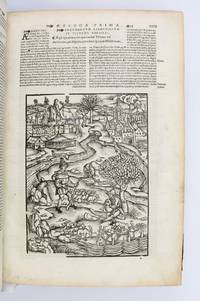
1529ST20181Lugduni Lyon: Jean Crespin 1529. 326 x 215 mm. 13 x 8 1/2". 6 leaves 12-268 pp.; 1-95 1 pp.; 1-600 pp. 8 leaves. Three sections in one. Edited by Josse Badius Ascensius. <br/> Restrained 17th century mottled calf covers triple ruled in blind with oblique gilt fleurons in each corner raised bands neatly rebacked and recornered with modern deep brown morocco marbled endpapers edges sprinkled. WITH 203 TOTAL ILLUSTRATIONS comprised of 190 different woodcuts 11 of which repeat once and one repeating twice. The first title printed in black and red with an elaborate woodcut border; the second title with a fleur-de-lys device. With criblé initials throughout in three sizes many historiated. Handwritten book label of Tobias Gutberleth on title see below title additionally with ink ownership inscription of G. van Olden Junior dated 1860. Front flyleaf with pasted-in manuscript inscriptions of "Francis" and "R. E. Hattiule". Line numbers in ink in a contemporary hand through much of the volume. Mortimer 538; Renouard "Badius Ascensius" III 377; Adams V 474; Brunet V 1282; Graesse VI 336. Binding yawning a bit edges somewhat rubbed but a solidly restored and perfectly acceptable binding. Light smudges of no consequence here and there other trivial defects but internally very clean fresh and bright.<br/> <br/> This is a well-preserved copy of a 16th century printing of Virgil's "Opera" profusely illustrated with wonderfully detailed woodcuts replete with charm and drama. Initially produced in Strassburg for Johann Grüninger’s 1502 Vergil our striking set of illustrations was reused in the 1515 German translation of the Aeneid and then in Sacon’s 1517 Lyon printing which bears many similarities to the present edition. While the plates do show some of the wear expected with this level of reuse—Mortimer notes that several had split by the time of the 1517 printing—the impressions here are nevertheless quite good and the illustrations are no less compelling than befoe. The anonymous artist whom Mortimer describes as having "a skilled hand and lively imagination" has provided animated scenes that perfectly match the content of the text. They range from the charming pastoral images that accompany the Eclogues and Georgics full of cheerful farmers and leaping stags to the dramatic battle scenes of the Aeneid with their fierce heroes in full 15th century armor grotesque monsters and elaborately rendered cities engulfed by leaping flames all overlooked by the pantheon of unconcerned gods. The text here is framed by the commentary of French scholar and printer Josse Badius Ascensius as well as by the commentaries of Filippo Beroaldo Giovanni Pierio Valeriano Bolzani and others. The present copy was owned early in its history by Tobias Guberleth 1609-62 poet and head of the Leeuwarden Latin school. Jean Crespin unknown
1572ST14214bBasileae: Ex officina Heruagiana per Eusebium Episcopium 1572. 385 x 250 mm. 15 1/4 x 10". 18 p.l. 744 pp. 16 leaves; 368 pp.; 218 pp. 13 leaves.Edited by Hieronymus Wolf and Vincentius Opsopäus. <br/> IMPOSING CONTEMPORARY CALF COVERS WITH GILT FRENCH FILLET BORDER CENTRAL COAT OF ARMS OF JACQUES AUGUSTE DE THOU as a bachelor within a laurel wreath raised bands spine gilt in double-ruled compartments with de Thou's cipher at center older repairs to front joint and to two-inch tear on front cover. Printer's device on title and final pages. Dibdin I 478. ◆Front joint with three-inch crack at tail a little fraying at head of spine a few minor marks to cover but the binding still sturdy the leather lustrous and the gilt bright. Leaves a shade less than bright due to paper quality with a dozen or so quires a little browned isolated paper defects to margins additional trivial imperfections otherwise a fine copy internally clean and fresh with comfortable margins.<br/> <br/> This Latin and Greek edition of the works of Demosthenes and Aeschines fourth century B.C. Greek orators and rivals comes from the illustrious collection of French historian bibliophile and statesman Jacques-Auguste de Thou who assembled one of the greatest libraries of his day. Our binding bears the arms and cipher used by de Thou as a bachelor; after his marriage in 1587 he combined his arms with those of his wife in his supralibros and incorporated her initials in the cipher. Demosthenes 384-322 B.C. was as famous an orator in the ancient world as Homer was a poet and though he wrote no books his many speeches had considerable political importance in his time were recorded and collected and have been much analyzed by generations of students of language and rhetoric. Often printed as here with the works of Demosthenes were the three extant orations of Aeschines ca. 390-314 B.C. He was the arch-enemy of Demosthenes and one can see in Aeschines' public life and orations a concerted attempt to discomfit his rival. In his oration "Against Ctesiphon" for example Aeschines argues that a crown intended for Demosthenes to honor his services to Athens ought not to be awarded. As an orator he was possessed of a learned and impassioned eloquence but in comparison with Demosthenes he lacked taste judgment and moral authority. A pupil of Melanchthon and a major scholar of the period Hieronymus Wolf 1516-80 came to prominence according to Sandys with his editions of Suidas of Isocrates beginning in 1570 and of Demosthenes. For the text here he relied on a manuscript in the Augsburg Library the codex Augustanus primus. Jacques-Auguste de Thou 1553-1617 served French kings Henri III and Henri IV negotiated the Edict of Nantes one of the earliest decrees of religious tolerance in Europe and produced a history of contemporary France noted by modern historians for its scientific and detached approach but condemned in his day for its objective view of Protestantism. A devoted bibliophile and scholar he amassed a library of more than 9000 volumes by the time of his death. Bindings from his collection continue to be very actively sought after. Ex officina Heruagiana, per Eusebium Episcopium unknown
15465968Venice: Cornelio Adelkind for Daniel Bomberg 1546. First edition. Very Good/First printed edition editio princeps of the 11th century commentary on portions of the pentateuch by the Bulgarian poet and Talmudist Tobiah ben Eliezer. Published by the house of the seminal printer of Hebrew books Daniel Bomberg under the supervision of his scholar-in-residence extraordinaire Cornelio Adelkind. Venetian law at this time limited Hebrew publishing to Gentile printers. Bomberg a protestant from Antwerp entered this lucrative market and with Adelkind's help became its prime exponent until his death in 1549. . Folio 32 cm; 93 leaves. Text in Hebrew. Title within architectural border reproduced in Amram "Makers of Hebrew Books in Italy" p. 215 also in the Jewish Museum's 1989 exhibition catalogue "Gardens and Ghettos: the Art of Jewish Life in Italy" page 50. Some section headings within ornamental borders. Bound in c19 or c20 dark red crushed morocco ruled in gilt and decorated with arabesques on both boards; spine with raised bands and compartments tooled and titled in gilt; green polished leather doublures with red crushed morocco dentelles bordered in pointillé accented with arabesques; green moiré free endleaves. Edges gilt. Binding not signed. Joints and crown adroitly reinforced with Japanese paper; corners somewhat worn down. Occasional contemporary notes in manuscript in text; brief stain on leaf mem-tet and lightly along the bottom edge of leaves nun-bet and nun-gimmel. Text otherwise pristine. Title page light possibly washed. Old library ink stamps from an institution in Warsaw on title page. Red morocco ex-libris of mining magnate and philanthropist Adolph Lewisohn 1849-1938. References: Adams T-766; BM Italian 674; Steinschneider 7304 #1; Amram 215 illustration and 222. Cornelio Adelkind for Daniel Bomberg hardcover books
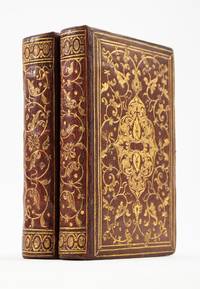
1568ST20921Lutetia Paris: Robert Estienne II 1568. 128 x 87 mm. 5 x 3 1/2". Two volumes. <br/> LOVELY CONTEMPORARY RED MOROCCO GILT covers with large central azured arabesque surrounded by curling vines with azured leaves smooth spines with similar vines head and foot of spines with egg-and-dart roll similar to one used by Claude de Picques second volume with faint blind lettering to spine all edges gilt perhaps with some minor early restorations but if so then done with such care as to preclude certainty. Housed in modern suede-lined calf-backed clamshell boxes with magnetic closures. Printer's device on titles and final page decorative initials and headpieces. Front pastedown of volume I with ex-libris of Georgios Arvanitidis. Renouard 171:1; Schreiber 239; Darlow & Moule 4633; Adams B-1670. See: Verron "Les Reliures de l'Entrée de Charles IX à Paris 1572 . . . réalisées par Claude Picques" in Bulletin du Bibliophile 2014 no. 2 pp. 282-98. Just a touch of rubbing to extremities front hinge of second volume open but everything quite tight text with occasional mild browning small spots trivial smudges or tiny worm trails but A BEAUTIFUL COPY clean and fresh internally and the bindings tight and lustrous with very bright gilt<br/> <br/> With exceptional visual appeal these two precious volumes shining with gilt and containing the Greek New Testament from the renowned Estienne family of printers are of special interest because of their typography their bindings and their provenance. With the expressed goal of printing Greek texts from manuscripts in the royal library at Fontainebleau François I established the post of royal printer in Greek in 1539 appointed Robert Estienne I 1503-59 to the position in 1542 and commissioned the renowned Claude Garamond to cut a new Greek font for this project. To design the type the King called on his own celebrated calligrapher Angelo Vergecio who produced in collaboration with Garamond three different sizes of what came to be called the Royal Types or "grecs du roi." According to Schreiber "These cursive Greek types are universally acknowledged as the finest ever cut." In 1548 and 1549 Robert Estienne issued the press' first Greek Testament known as the "O mirificam" edition for the opening of the dedication to the king in 16mo or "pocket" format using the smaller font of Garamond's "grecs du roi." In 1550 Robert a Protestant moved to Geneva while his son Robert II 1533-70 a Catholic remained in Paris and took over as the royal printer in Greek. Our 1568 Testament--the only one issued by the son--is a reprinting of the "O mirificam" edition but expanded with the critical apparatus from the 1550 folio edition issued by the father. Schreiber notes that our edition is interesting from a typographical point of view as it contains an even more minute version of the already small grecs du roi type for the Table of Chapters. The exceptionally pretty volumes are done in the style of royal binder Claude Picques fl. 1539-78 and employ a decorative roll very similar to one that appears on the spine of the vellum bindings Picques did for "L'Entrée de Charles IX à Paris" 1572. Our volumes once graced the library of Constantinople collector Georgios Arvanitidis 1876-1953 whose library included a number of Estienne Greek editions. They were later in the distinguished library of Frederick B. Adams 1910-2001 director of the Pierpont Morgan Library from 1948-69 and then president of the prestigious Association Internationale de Bibliophilie from 1974-83. And they were featured in the celebrated 1929 Gumuchian catalogue of 398 historically exceptional bindings as item #71. Robert Estienne II unknown