[Lactance]Livre Rare Book
121 résultats
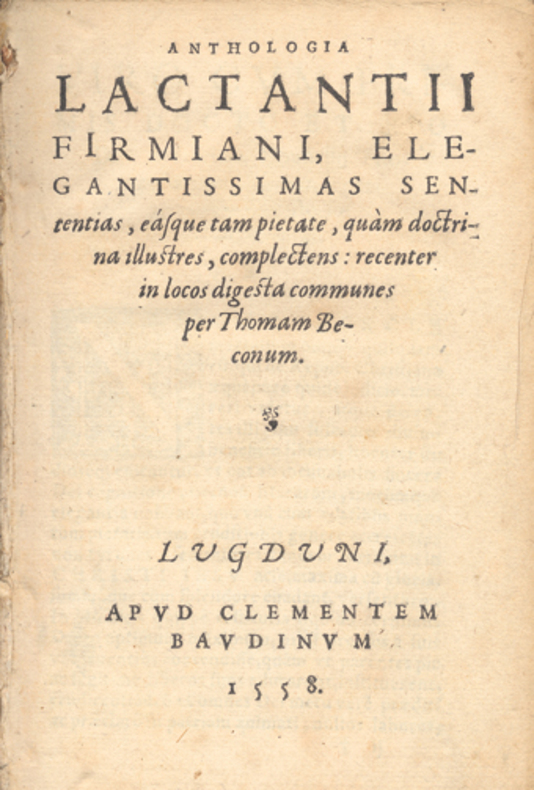
15581254Lyon, Clément Baudin, 1558, in-8 ; plein veau bordeaux foncé, dos à nerfs orné de fleurs de lys, double filet doré d'encadrement des plats avec quatre grandes fleurs de lys dorées en écoinçons, toutes tranches dorées (reliure du XVIIIe) ; (16) ff., le dernier blanc, 246 pp., (5) ff. dont 3 blancs.
15841317490Venedig, D. Farri, 1584. 416 num. Bl., 4 Bl. (das letzte weiß). Mit Holzschnitt-Druckermarke auf d. Titel u. am Ende wiederholt. Neuer Ppbd (etwas braunfleckig, Bl. 415 mit Abschnitt der unteren Ecke ohne Textverlust, alter Besitzvermerk auf Titel).
15931317599Köln, H. Falckenburg, 1593 (irrig: 1293). 24 Bl., 288 S., 8 Bl. (das letzte weiß). Neuer Ppbd (gleichmäßig leicht gebräunt, Titel angestaubt u. mit Stempel auf Rückseite, die 2 Bl. Namensregister statt am Anfang hier in der letzten Halbdekade eingebunden).
15431317565(Antwerpen, J. Graphaeus, 1543?). 12 Bl., 159 num. Bl.; 12 Bl., 184 num. Bl. Ldrbd d. Zeit mit Blindprägung von Streicheisen, Rollen- u. Einzelstempeln (ohne Rücken u. Schließen, Gelenke gelockert, durchgehend mit Nässespuren, etwas feuchtwellig u. braunfleckig, anfangs u. am Ende einige Blatt mit stärkerem Braunfleck an d. unteren Ecke, die letzten 8 Bl. mit ca. 1,5 cm langer Wurmspur im Text, wenige Anstreichungen von alter Hand, Titel u. Schlussblatt mit alten Besitzvermerken).
1528623590Tübingen, U. Morhard, März 1528. Kl.-Folio. 6 nn. Bl., 22 num. Bl. Moderner Pappband.
1570621929(Genf, H. Stephanus (Estienne)), 1570. Folio. 10 Bl., 278 (recte 292) S., 2 Bl.; 194 S., 1 weißes Bl. Mit Holzschnitt-Druckermarke auf dem Titel. Moderner Pappband. [2 Warenabbildungen]
1550621339Basel, J. Oporinus, 1550?). 6 (statt 8) Bl., 500 (recte 398) S., 17 Bl. (das letzte weiß). Dunkelbrauner Leder d. Zeit über Holzdeckeln mit Blindprägung von Rollen- und Einzelstempeln (berieben, Schließen fehlen, Rückenbezug am Kopf mit Fehlstelle, Vorsätze entfernt). [2 Warenabbildungen]
1576621701(Lyon, J. De Tournes für) J. du Puys in Paris, 1576. Folio. 10 Bl., 677 S., 18 Bl. Mit zahlreichen Criblé- Initialen u. 4 großen Holzschnitt-Initialen aus einem Figuren-Alphabet. Leder d. Zeit (berieben, Ecken bestoßen, Rücken u. Vorsätze erneuert). [2 Warenabbildungen]
1541184818N: N 1541. 1541-1577. 1 1541 E. Whitchurch London. The Byble in Englysh. S.T.C. 2074. 35.7 cm. x 25.5 cm. 2 1549 J. Daye and W. Seres. The Byble. S.T.C. 2077. 30 cm. x 20 cm. piece torn from lower right hand corner of leaf. This edition of the Matthew's Bible is also known as 'The Bug Bible' and 'The Wife-Beater's Bible'. 3 1561 J. Kyngston. Chaucer's Workes. S.T.C. 5075. 31 cm. x 21.5 cm. 4 1574 H. Bynneman Binneman for Humfrey Toye. John Whitgift. The Defense of the Aunswere to the Admonition. S.T.C. 25430. 27 cm. x 18.5 cm. 5 1577 Lucas Harison. Raphael Holinshed. The Chronicles of England Scotlande and Irelande. S.T.C. 13568. 28.3 cm. x 20 cm. 1541-1577. Together. N unknown
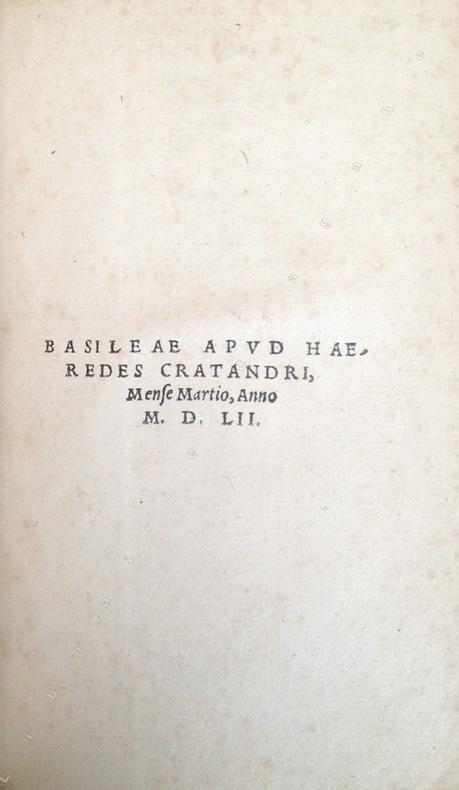
15524366Basilae (Bâle), Haeredes Cratandri [Mense martio 1552] ; petit in-8 ; pleine basane havane, dos à nerfs décoré et doré, pièce de titre rouge, roulette décorative dorée d'intérieur, tranches mouchetées de rouge (reliure ancienne du XVIIIe siècle) ; 654 pp. y compris le titre.
155894362Zürich, Andreas Geßner, 1558. [8] Bl., 703 S. Mit ca. 610 Holzschnittabb. im Text u. Holzschn.-Druckermarke aT. 8vo. 19 cm. Ohne Einband.
160097208[Heidelberg], Commelinus [Hieronymus Commelinus Erben], 1600. [7] Bll., 274 S.; 1 Vakatbl., 291 S. Mit Druckermarke aT, einig. Holzschnitt-Vignetten u. -Initialen. 17 cm. Geflecktes Pergament d. Zt. m. eingeschlagenen Vorderkanten, und hs. Rückentitel.
15551186Lyon, Jean de Tournes et Guillaume Gazeau, 1555, in-16 ; plein vélin ivoire, titre manuscrit (reliure de l'époque) ; (24) feuillets (titre, dédicace, index des plantes en grec, latin, français, italien), 976 pages, (8) feuillets d’explications.
154588786Venetia [Venedig], Heredi de Pietro Ravani e Compagni, 1545. 245 (von 252) num. u. 4 ungezählte Blätter mit ornamentaler oder figürlicher Holzschnitt-Bordüre. Mit illustr. Holzschnitt-Titel, zahlr. Zierinitialen u. 1 Schlussvign. sowie 182 (von 187) ganzseit. Holzschnitten. Im Kolophon Druckermarke: Gekrönte zweischwänzige Nixe, die beide Flossen mit den Händen emporhebt. Kl.-8vo. 14,5 cm. Buchblock lose in flexiblem Ganzpergament-Umschlag d. Zeit. Mit späterem privaten Schuber zum Erhalt des Druckes.
1555621763Basel, H. Petri, 1555. Folio. 48 Bl., 1499 (recte 1503) S. Mit Holzschnitt-Druckermarke (am Ende wiederholt). Blindgeprägter Schweinsleder d. Zeit über Holzdeckeln (gebräunt u. berieben, Bezug an den unteren Ecken aufgeplatzt, Schließen fehlen). [2 Warenabbildungen]
1551623374Lyon, J. Frellon, 1551. 20 Bl., 613 S. Mit Holzschnitt-Druckermarke auf dem Titel. Moderner Halbleder mit Rückenschild.
1598D6965Venice: apud haeredes Melchioris Sessae 1598. First Venice Edition. Hardcover. Very Good. Folio 310 x 210mm. 2175pp. 1 301pp. 2 12pp. 175pp. 1. Contemporary dark brown goatskin title and preliminaries lacking and supplied in early manuscript with illustrated printers device some browning and staining least severe after page 9. 17th-century inscriptions on rear endpaper for Index Capitum a medical students description of the various parts. Pictorial wood-engraved ex-libris by Leo Wyatt for Lord Norwich on front endpaper. <br/><br/>First Venice Edition of Capivaccios philosophical practica in Galenic teachings a pillar for medical students of the Renaissance. First edition printed in Frankfurt in 1594 under the title Practica Medicina. Capivaccios lectures were posthumously edited by Johann Hartmann Beyer. This is the first Venice edition of these lectures on the healing sciences by one of the leading Italian medical practitioners of his time is edited by Giovanni Bernardo Sessa. Capivaccio died at Padua in 1589 where he had taught at the university for 27 years. He was a specialist in venereal diseases for which he had developed certain successful cures guarding his secrets jealously from colleagues. Capivaccio applied a philosophical approach to his practica so much so that it is doubtful if it was ever much used as a vade mecum. By writing at such great lengths it is clear Capivaccio wished to educate students rather than give them a handbook. Apart from the wish to restore Galenic teachings and to educate students one motive for Capivaccios practica may have been to bolster the claims of university doctors over the central providers of medical expertise in the Renaissance namely priests wise-women magicians herbalists and travelling empirics. This work important to the reform of the practice of medicine and to the wider concept of dogmatism or rationalism in medicine the Renaissance physician could use Capivaccios work to locate the causes of diseases as well as its signs. NLM/Durling 816. apud haeredes Melchioris Sessae hardcover books
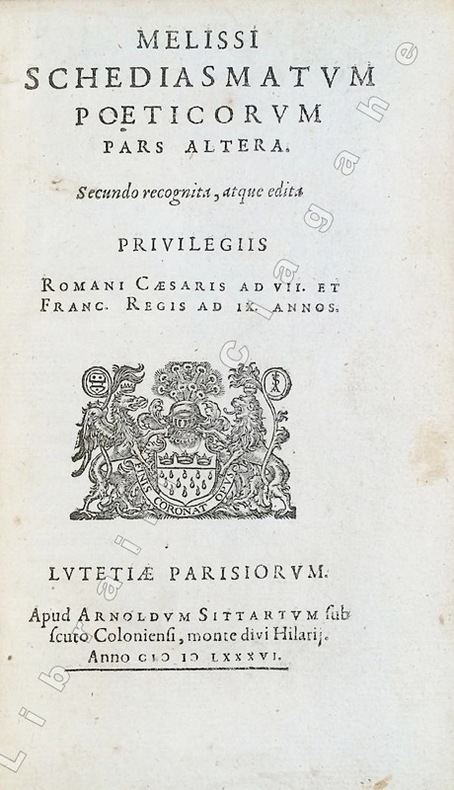
15861231Paris, Arnould Sittart, 1586, deux volumes in-12 ; plein veau glacé caramel, pièces de titre et tomaison de maroquin grenat, tranches rouges (rel. du XVIIIe siècle) ; (1) f., 562 pp., (7) ff. d'index ; 157 pp., (2) pp. d'index, 325 pp., (10) ff. d'index, privilège, Melissus lectori, epigrammata ad Paulum Melissum Schedium. Trois parties en deux volumes.
158852305[Köln, ca. 1588]. Bildmaß ca. 37 x 48 cm. Unter Passepartout im Rahmen mit breiten Holzleisten (Rahmenmaß: 63 x 74 cm).
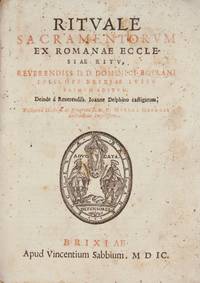
159941148Brixiæ Brescia: Apud Vincentium Sabbium 1599. Quarto. Full contemporary vellum with manuscript titling to spine. 1f. recto verso blank p. 3 dedication p. 4 "Tabula" 5-143 i blank pp. Printed in red and black. Typeset throughout. With decorative woodcut initials and woodcuts of religious scenes at head of each chapter.<br /> <br /> Title with large oval woodcut device incorporating saints and Latin motto "Ecclesiæ Brixiani Advocata Defensores."<br /> <br /> Includes ca. 35 pages of neumatic musical notation on red 4-line staves scored for solo voice. <br /> <br /> With 17th and 18th century annotations to front pastedown canceled "M. A" M. Dona . F. B. and front free endpaper in two hands: the first "Ego Carolus Fontana . 1699" and the second Barthoi Campagnola Archipbri sta Caecilia Verona dono Antonij Piccoli Verone Archibri Terrentiani Brixien Diacesis die 10 Feris 1734." Annotation to verso of rear free endpaper "L h P. Ego Carolus Fontana de Rsa Pa habita Gambar 1699." <br /> <br /> Binding worn soiled and stained with a few minor tears to edges and spine; remnants of early vellum ties. Moderate foxing to title; occasional light foxing minor soiling dampstaining and small stains; mispagination from p. 57. OCLC 1 copy only at the Sistema Bibliotecario Ticinese in Switzerland. OPAC SBN 1 copy only at the Biblioteca di Studi Giuridici e Umanistici in Milan. Apud Vincentium Sabbium unknown
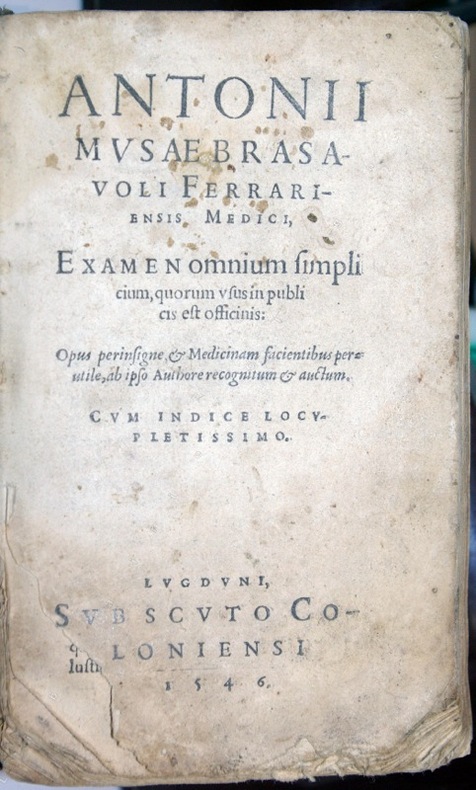
15466335Lyon, Sub scuto Coloniensi (Joannes et Franciscus Frellonii fratres), 1546 ; in-16 ; vélin souple de l'époque ; 862 pp., (29) ff. d'index, la dernière page "Lugduniexcudebant Ioannes et Franciscus Frellonii fratres 1546".
15781316603(Frankfurt/M. Chr. Egenolffs Erben für A. Lonicer et. al.), 1578. 127 num. Bl., 65 n.num. Bl. (die 3 letzten weiß). Flexibler Pgtbd d. Zeit (Einbd knitterspurig u. fleckig, durchgehend mit schwacher Nässespur u. etwas fingerfleckig, Ecken anfangs u. am Ende etwas geknickt, wenige Unterstreichungen von alter Hand, Titel angestaubt u. mit Stempel).
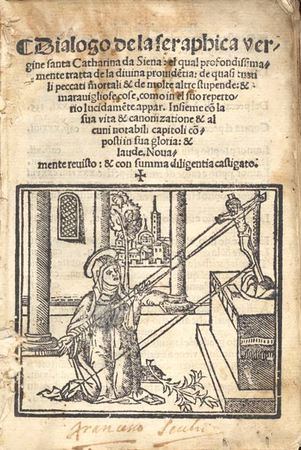
15406505Venetia (Venezia), Marchia Sessa, 1540 ; in-8 ; plein vélin vieil ivoire (reliure de l'époque) ; (32) ff., 224 ff., le dernier verso blanc ; grand bois gravé (88 x 78 mm) en page de titre représentant Sainte Catherine recevant les stigmates et marque d'imprimeur à la suite du collophon, achevé d'imprimer du 29 avril 1540, date anniversaire de la mort de la Sainte (29 avril 1380).
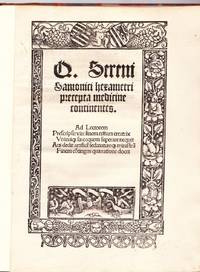
15156404Leipzig: Valentin Schumann "in officina Valentini Dammandri" 1515. Fine. Octavo 21 cm; 32 leaves. Title and postscript set in large gothic type; text in roman. Woodcut title page within four-sided border includes human figures with stylized plants a putto birds etc. About 66 woodcut initials. In recent quarter leather over marbled boards. References: Durling 4189; BM/STC German 815; This edition not in Adams Wellcome Osler etc. Title page reproduced in J. Luther "Die Titeleinfassungen der Reformationszeit" pl. 89. <br /><br />From what modern scholarship can discern Serenus was a poet who had a keen interest in medical science and pharmaceuticals. He is famous for using the formula "abracadabra" in the treatment of illness and for amassing a personal library of 60000 scrolls. The 1107 hexameter lines that make up this essay were inspired by the "Medicina Plinii" a book of pharmacy by a pseudo-Pliny of the mid-4th-century as well as the real Pliny's Natural History and the Greek guide to materia medica by Dioscorides. The text consists of prescriptions and remedies for about 65 different diseases. The poem was extremely influential in the practice of Late-Antique and Medieval medicine. It was reprinted 21 times between the first edition of 1484 and 1731 apart from inclusion in many compilations of medical texts. As late as 1866 it was translated into German Prescriptions cover a range of ailments from headache itching elephantiasis bad breath gall stones pimples treatment of wounds and even money bites. The text is followed by Remmius Flavianus "Carmen de ponderibus et mensuris" a versified explanation of weights and measurees specifically for use by physicians. Valentin Schumann ("in officina Valentini Dammandri") hardcover
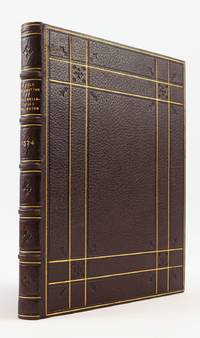
1574ST19871Heidelberg: Imprinted by Michael Schirat 1574. First Edition in English. 194 x 151 mm. 6 5/8 x 6". 6 p.l. last blank 193 pp. 2 leaves final blank. <br/> Very nice late 19th century dark maroon morocco by Lloyd of London stamp-signed on front turn-in covers framed by gilt and blind rules blind ruling at corners raised bands spine panels with blind-stamped quatrefoil gilt lettering gilt-ruled turn-ins quatrefoil cornerpieces all edges gilt. Lacking the folding "Table of Discipline" called for in ESTC. Front pastedown with armorial bookplate of Albert Ehrman; rear pastedown with Ehrman's faded ink stamp bookplate of "Bibliotheca Broxbourniana / J. P. W. E. / 17 March 1949 / ex dono A. & R. E." STC 24184; ESTC S118505; USTC 507892. Text washed and pressed but except for the first and last few leaves without the typical resultant darkening and fading otherwise an extremely attractive copy still fresh the margins especially wide and the binding lustrous and scarcely worn.<br/> <br/> First issued in Latin in the same year as our edition this is the major work of English puritan Walter Travers 1548 - 1625 applying the Calvinist presbyterian system of ecclesiastical government to the episcopal Church of England. According to DNB for Calvin and Travers alike "the duty of the theologian was merely to identify the church's structure and apply it to contemporary circumstances. It was in this last respect that Travers's originality lay for he subtly adapted Calvin's biblical model to an English context. In order to undermine the diocesan episcopate of the English church Travers started off with an examination of the role of bishops in the New Testament showing that they were not part of a separate hierarchy with authority over other clergy but merely ministers of local congregations. He also differed from Calvin in identifying elders as a type of deacon rather than a separate kind of minister." Our book was written during Travers' 1570-76 sojourn in Geneva where he became a friend of Calvin's successor Theodore Beza. Afterwards he ministered to English merchant marines in Antwerp where he refused to use the Book of Common Prayer for worship. Despite this when Travers returned to England he became chaplain to Elizabeth's chief minister William Cecil and tutor to his son. As DNB notes "his close ties to influential courtiers of a Calvinist inclination" would be key to Travers' career keeping him out of serious trouble despite his strongly presbyterian views. Our volume has a distinguished provenance coming from the celebrated Broxbourne library of Albert Ehrman 1890-1969 a diamond merchant who gathered a fine collection of books at his home at Broxbourne in Hertfordshire. He spent half a century collecting books specializing in incunabula and early bindings as well as early type specimens and bibliographies. Feather says that "his collecting was intelligent and scholarly for he sought to illustrate the history of printing and the book trade and the early development of trade binding." Ehrman also authored learned articles on fine bindings and the history of printing. The present work is uncommon: we could trace just five copies at auction since 1979; only the 1979 copy contained the folding "Table" and that one was noted as "slightly defective and mounted on linen.". Imprinted [by Michael Schirat] unknown