Zaritsky, JosephAntiquariat.de

48 779 résultats
200012173DBTel Aviv., Gordon Gallery., 2000. 29 x 24,5 cm. 72 unpaginierte S. OKarton mit illustriertem OUmschlag., 12173D Erste Auflage. Gutes bis sehr gutes Exemplar.
199811814DBGenua., Museo d'Arte Contemporanea., 1998. 28 x 21 cm. 141 S. Illustrierter OKarton., 11814D Erste Auflage. Einbandkanten mit kleinen Bereibungen, etwas angestaubt. Sonst gutes Exemplar.
197560711ABMünster., Westfälischer Kunstverein., 1975. 23 x 20 cm. 152; 28 S. OKunststoff-Ringbuch., 60711AB 1. Auflage. Etwas angestaubt. Gutes bis sehr gutes Exemplar.
197410179DBMailand., Gallerie d'arte Vinciana., 1974. 24 x 17 cm. 16 unpaginierte S. OBroschur., 10179D Erste Auflage. Einbandkanten etwas nachgedunkelt und mit kleinen Bereibungen, leicht angestaubt. Sonst noch gutes Exemplar.
200192694Mainz, Gutenberg-Museum, 2001. 66 S. Mit zahlr., teils ganzseit. Abb. 29 cm. OKart.
1996753DBMailand., L'Arca Edizioni., 1996. 34 x 24 cm. 143 S. OKarton mit illustriertem Klappenumschlag., 753D Erste Auflage. Schnitt minimal lichtrandig, private Stempel des Vorbesitzers auf den Innendeckeln. Sonst gutes bis sehr gutes Exemplar.
200056682ABNew York., Peter Blum Edition., 2000. 33 x 22 cm. 80 unpaginierte S. OEnglisch-Broschur mit Pergaminumschlag., 56682AB First edition, 1500 copies. Tadelloses Exemplar.
20051568EBDüsseldorf., Richter Verlag., 2005. 30,5 x 24 cm. 111 S. Illustrierter OPappband., 1568E Erste Auflage. Kapitale und Stoßkanten minimal berieben, Einband leicht fleckig. Sonst gutes Exemplar.
201194383Ohne Ort u. Verlag, ( 2011]. 24 nn S. Mit 15 farbigen Wiedergaben von Ölkreiden Zanders. 20,5 cm. OKart.
201492709Berlin, Michael Zeh Verlag, [2014]. 91 S. Mit ca. 140 farbigen Abb. Quer-8vo (21 x 26 cm). OKart.
198232024ABKöln., DuMont Verlag., 1982. 30 x 25 cm. 527 S. OLeinen mit illustriertem OUmschlag., 32024A Erste Deutsche Ausgabe. Umschlagkanten mit minimalen Bereibungen, kleine handschriftliche Widmung verso Vorsatz. Sonst gutes bis sehr gutes Exemplar.
19829430Köln, DuMont, 1982. Leineneinband, Schutzumschlag, 4°, 527 S., farbige Vorsätze, zahlreiche Abbildungen, überwiegend farbig; -Papier minimal gebräunt, sehr gutes Exemplar.
19762086EBNew York., The Solomon R. Guggenheim Museum., 1976. 29 x 23 cm. 747 S. (insgesamt) OLeinen., 2086E_1 2 Bände. Erste Auflage. Einbände etwas berieben, fleckig und angestaubt am Buchschnitt. Sonst gute Exemplare.
Acquaforte, 1978, firmata e datata in lastra in basso al centro. Firma a matita Beppi Zancan in basso a destra. Esemplare stampato su carta cina, in perfetto stato di conservazione. Beppi Zancan nacque a Torino il 14 febbraio del 1936 da una famiglia di origine veneta di giuristi, medici e docenti universitari. Durante la guerra, riparó con la famiglia nella villa di Viverone, dove trascorse alcuni degli anni piú belli della fanciullezza insieme al fratello Giampaolo, divenuto poi uno tra i più noti avvocati penalisti italiani. Rientrato a Torino, frequentó il liceo classico presso l’Istituto Sociale dei padri Gesuiti, dove si distinse come studente brillante e geniale. Si laureó in giurisprudenza con Norberto Bobbio, del quale fu assistente, elaborando una tesi di filosofia del diritto sul concetto di giustizia in Dostoevskij, che fu molto apprezzata e che ottenne numerosi riconoscimenti. L’amore per Dostoevskij, che Beppi leggeva anche in lingua originale, rimase una costante della sua intera esistenza. Assolto il servizio militare a Casale, tornó a Torino dove, abbandonó la carriera universitaria, per una sua incompatibilitá con le formalitá piú rigide e canoniche, da artista intenso ed eccentrico qual era. Trasferitosi a Milano, incontró Arrigo Polillo, direttore della rivista Musica Jazz e direttore del personale di Arnoldo Mondadori, che, apprezzatene le doti di musicista e riconosciutone l’estro creativo, lo volle con sé come pubblicitario e creativo. É di questo periodo, nel 1967, la sua prima mostra personale di incisioni, ordinata presso la galleria L’Arte Antica di Torino. Si trattava di incisioni di grandissimo talento tecnico, strettamente correlate al lavoro del Maestro ideale di Beppi Zancan, Rembradt. Nel 1971 espose di nuovo all’Arte Antica di Torino e al Gabinetto delle Stampe di Milano e nel 1974 al Casinò di Sanremo. Nel 1974, divenne giornalista professionista e, nel 1975, gli fu affidata la direzione de Il Mago, una delle più importanti riviste di fumetti italiane, sulle cui pagine trovavano spazio tavole di giovani autori italiani esordienti così come strisce straniere, prevalentemente umoristiche. In quello stesso anno conobbe Carlotta Frattini, che divenne sua moglie l’anno successivo. Ancora nel 1976, ordinò una nuova mostra di incisioni, nuovamente presso la galleria L’Arte Antica, mentre la prima esposizione torinese di opere pittoriche avvenne soltanto nel 1981, presso la galleria Quaglino di piazza San Carlo; qui espose le sue tele, in cui l’impronta dei grandi impressionisti, tra i quali soprattutto Van Gogh e Cezanne emergeva forte ed evidente. La pennellata di Beppi Zancan rimane tuttavia personale e autonoma, pur riflettendo ardentemente l’ammirazione per quei grandi. Etching, 1978, signed and dated in plate at lower center. Signature in pencil Beppi Zancan at lower right. Example printed on china paper, in perfect condition. Beppi Zancan was born in Turin on February 14, 1936 into a family of Venetian origin of jurists, doctors and university professors. During the war, he took refuge with his family in the villa in Viverone, where he spent some of the best years of his childhood together with his brother Giampaolo, who later became one of the most famous Italian criminal lawyers. Back in Turin, he attended the classical high school at the Social Institute of the Jesuit Fathers, where he distinguished himself as a brilliant and brilliant student. He graduated in law with Norberto Bobbio, of whom he was an assistant, elaborating a thesis on the philosophy of law on the concept of justice in Dostoevsky, which was much appreciated and received numerous awards. The love for Dostoevsky, which Beppi also read in the original language, remained a constant throughout his life. After completing his military service in Casale, he returned to Turin where he abandoned his university career, due to his incompatibility with the most rigid and canonical formalities, as an intense and eccentric artist that he was. After moving to Milan, he met Arrigo Polillo, director of the magazine Musica Jazz and personnel director of Arnoldo Mondadori, who, appreciating his talents as a musician and recognizing his creative flair, wanted him with him as a publicist and creative. It is of this period, in 1967, his first personal exhibition of engravings, ordered at the gallery L'Arte Antica in Turin. These were engravings of great technical talent, closely related to the work of Beppi Zancan's ideal master, Rembrandt. In 1971 he exhibited again at the Arte Antica of Turin and at the Gabinetto delle Stampe of Milan and in 1974 at the Casino of Sanremo. In 1974, he became a professional journalist and, in 1975, he was entrusted with the direction of Il Mago, one of the most important Italian comics magazines, on the pages of which there were tables of young Italian authors as well as foreign strips, mainly humorous. In that same year he met Carlotta Frattini, who became his wife the following year. Still in 1976, he ordered a new exhibition of engravings, once again at the gallery L'Arte Antica, while the first Turinese exhibition of paintings took place only in 1981, at the Quaglino gallery in Piazza San Carlo; here he exhibited his canvases, in which the imprint of the great impressionists, among whom above all Van Gogh and Cezanne emerged strong and evident. Beppi Zancan's brushstroke, however, remains personal and autonomous, even though it ardently reflects his admiration for those great artists.
20102587EBBarcelona / Köln., Loft Publications / FKG., 2010. 30 x 30 cm. 597 S. OLeinen mit illustriertem OUmschlag., 2587E Einbandkanten mit minimalen Bereibungen, Umschlag minimal berieben, Besitzstempel auf Vorsatz, sonst gutes bis sehr gutes Exemplar.
7387DBMailand., Galleria Artra., o.J. 21 x 21 cm. 20 unpaginierte S. OBroschur., 7387D Erste Auflage. Einbandkanten etwas lichtrandig und mit kleinen Bereibungen. Sonst gutes Exemplar.
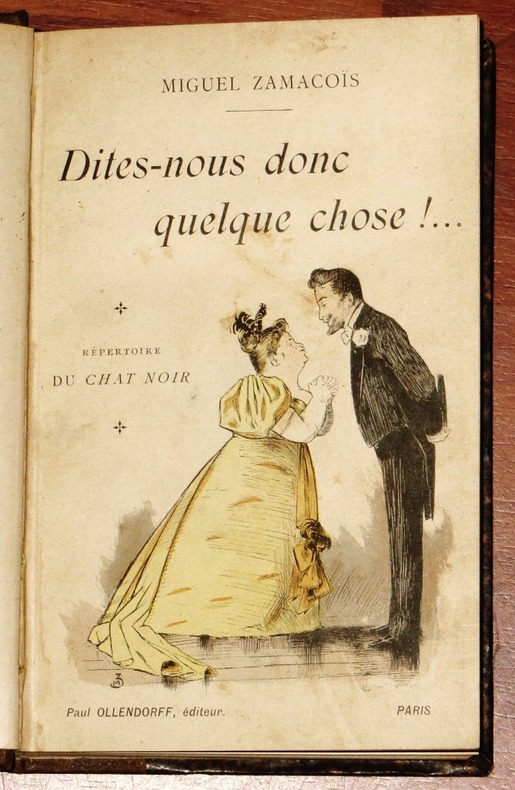
1896166931896 Paris, Paul Ollendorff éditeur, 1896. Édition originale. In-12 de 152 - XV pp., avec le catalogue de l'éditeur in fine. Reliure bradel, demi-percaline brune, titre doré, nom du propriétaire en queue. Couverture d'origine illustrée par l'auteur, conservée, un peu salie. Des rousseurs éparses, surtout sur les premières pages, sinon bon état.
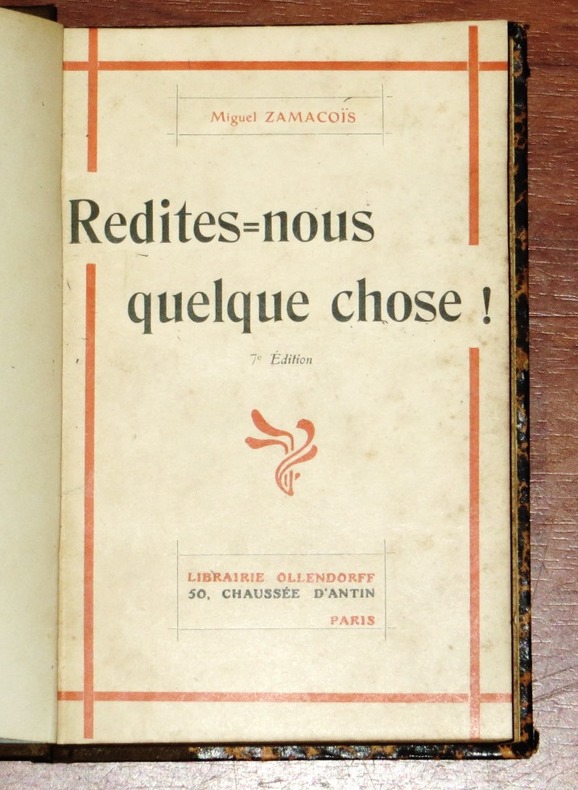
16697Paris, Paul Ollendorff éditeur, 1909, avec mention de 7ème édition. In-12 de 281 pp. Reliure bradel, demi-percaline brune, titre doré. Couverture d'origine conservée, salie. Reliure et intérieur en bon état, exempt de rousseurs.
1968245986Poznan, 1968. 179 S. (Prace Wydz. Filolog./Filolog. germanska 5).
196711565DBLos Angeles., Felix Landau Gallery., 1967. 15 x 15,5 cm. 16 unpaginierte S. Illustrierter, geprägte OBroschur., 11565D Erste Auflage. Einbandkanten mit kleinen Bereibungen. Sonst gutes bis sehr gutes Exemplar.
Format 44x62 cm. 8 pages. Rousseurs.
19283130EBBerlin., Albertus-Verlag., 1928. 30 x 22,3 cm. 131 S. OKarton mit illustriertem OKlappenumschlag., 3130E Erste Auflage. Umschlag und Einband angestaubt, mit Randläsuren und kleinen Knicken. Bindung gelockert, erste Seiten angelöst. Name auf Innendeckel recto, sonst noch gutes Exemplar. Neue Architektur der Groszstädte. Herausgeber: Dr. Leopold Zahn.
19461140064(Olten, Vereinigung Oltner Bücherfreunde), 1946. 59 S., 3 Bl. OHldrbd. m. Kopfgoldschnitt in Schuber.
199096880Berlin, Karin Kramer, ( 1990). 194 S. 21 cm. OKart.
200297365München, Deutscher Taschenbuch Verlag DTV, ( 2002). 334 S. (= dtv Premium 24299). 21 cm. Orig.-Engl. Brosch.