114 résultats
15881259142Ingolstadt, D. Sartorius, 1588. Kl.-4to. 2 Bl., 47, (1) S. Neuer Ppbd (Ränder etwas braunfleckig, Titel angestaubt u. mit Quetschfalte).
156595743Wittenberg, Johannes Crato, 1565. [8] Bll, 559, [1] S., [6] Bll. Mit Titelholzschnitt u. Holzschnitttafel (Druckermarke). Pgt. des frühen 18. Jhdts. auf 3 durchgezog. Bünden u. 2 Fitzbünden, mit hs. Rückentitel.
1543621488Köln, J. Gymnich, 1543. 16 Bl., 348 S., 2 Bl. Mit Holzschnitt-Druckermarke auf dem Titel. Kalbleder d. Zeit über Holzdeckeln (berieben, Rücken erneuert, Schließen fehlen). [2 Warenabbildungen]
1555621763Basel, H. Petri, 1555. Folio. 48 Bl., 1499 (recte 1503) S. Mit Holzschnitt-Druckermarke (am Ende wiederholt). Blindgeprägter Schweinsleder d. Zeit über Holzdeckeln (gebräunt u. berieben, Bezug an den unteren Ecken aufgeplatzt, Schließen fehlen). [2 Warenabbildungen]
1541184818N: N 1541. 1541-1577. 1 1541 E. Whitchurch London. The Byble in Englysh. S.T.C. 2074. 35.7 cm. x 25.5 cm. 2 1549 J. Daye and W. Seres. The Byble. S.T.C. 2077. 30 cm. x 20 cm. piece torn from lower right hand corner of leaf. This edition of the Matthew's Bible is also known as 'The Bug Bible' and 'The Wife-Beater's Bible'. 3 1561 J. Kyngston. Chaucer's Workes. S.T.C. 5075. 31 cm. x 21.5 cm. 4 1574 H. Bynneman Binneman for Humfrey Toye. John Whitgift. The Defense of the Aunswere to the Admonition. S.T.C. 25430. 27 cm. x 18.5 cm. 5 1577 Lucas Harison. Raphael Holinshed. The Chronicles of England Scotlande and Irelande. S.T.C. 13568. 28.3 cm. x 20 cm. 1541-1577. Together. N unknown
158852305[Köln, ca. 1588]. Bildmaß ca. 37 x 48 cm. Unter Passepartout im Rahmen mit breiten Holzleisten (Rahmenmaß: 63 x 74 cm).
15811241399Genf, P. Saint-André, 1581. Kl.-4to. 12 Bl., 224, 298 S., 3 (statt 27) Bl., 1 Falttabelle. Flexibler Pgtbd d. Zeit (Einbd angestaubt, feuchtwellig u. ohne die Schließbänder, Tabelle mit hinterlegtem Einriss, ohne die letzten 24 Bl. mit den im Titel genannten kurzen Anmerkungen gebunden u. mit entsprechender zeitgenössischer Notiz auf d. Titel).
15465968Venice: Cornelio Adelkind for Daniel Bomberg 1546. First edition. Very Good. Folio 32 cm; 93 leaves. Text in Hebrew. Title within architectural border reproduced in Amram "Makers of Hebrew Books in Italy" p. 215 also in the Jewish Museum's 1989 exhibition catalogue "Gardens and Ghettos: the Art of Jewish Life in Italy" page 50. Some section headings within ornamental borders. Bound in c19 or c20 dark red crushed morocco ruled in gilt and decorated with arabesques on both boards; spine with raised bands and compartments tooled and titled in gilt; green polished leather doublures with red crushed morocco dentelles bordered in pointillé accented with arabesques; green moiré free endleaves. Edges gilt. Binding not signed. Joints and crown adroitly reinforced with Japanese paper; corners somewhat worn down. Occasional contemporary notes in manuscript in text; brief stain on leaf mem-tet and lightly along the bottom edge of leaves nun-bet and nun-gimmel. Text otherwise pristine. Title page light possibly washed. Old library ink stamps from an institution in Warsaw on title page. Red morocco ex-libris of mining magnate and philanthropist Adolph Lewisohn 1849-1938. References: Adams T-766; BM Italian 674; Steinschneider 7304 #1; Amram 215 illustration and 222. <br /><br />First printed edition editio princeps of the 11th century commentary on portions of the pentateuch by the Bulgarian poet and Talmudist Tobiah ben Eliezer. Published by the house of the seminal printer of Hebrew books Daniel Bomberg under the supervision of his scholar-in-residence extraordinaire Cornelio Adelkind. Venetian law at this time limited Hebrew publishing to Gentile printers. Bomberg a protestant from Antwerp entered this lucrative market and with Adelkind's help became its prime exponent until his death in 1549. Cornelio Adelkind for Daniel Bomberg hardcover
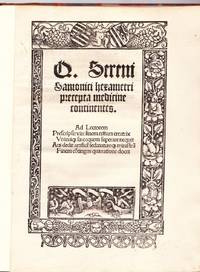
15156404Leipzig: Valentin Schumann "in officina Valentini Dammandri" 1515. Fine. Octavo 21 cm; 32 leaves. Title and postscript set in large gothic type; text in roman. Woodcut title page within four-sided border includes human figures with stylized plants a putto birds etc. About 66 woodcut initials. In recent quarter leather over marbled boards. References: Durling 4189; BM/STC German 815; This edition not in Adams Wellcome Osler etc. Title page reproduced in J. Luther "Die Titeleinfassungen der Reformationszeit" pl. 89. <br /><br />From what modern scholarship can discern Serenus was a poet who had a keen interest in medical science and pharmaceuticals. He is famous for using the formula "abracadabra" in the treatment of illness and for amassing a personal library of 60000 scrolls. The 1107 hexameter lines that make up this essay were inspired by the "Medicina Plinii" a book of pharmacy by a pseudo-Pliny of the mid-4th-century as well as the real Pliny's Natural History and the Greek guide to materia medica by Dioscorides. The text consists of prescriptions and remedies for about 65 different diseases. The poem was extremely influential in the practice of Late-Antique and Medieval medicine. It was reprinted 21 times between the first edition of 1484 and 1731 apart from inclusion in many compilations of medical texts. As late as 1866 it was translated into German Prescriptions cover a range of ailments from headache itching elephantiasis bad breath gall stones pimples treatment of wounds and even money bites. The text is followed by Remmius Flavianus "Carmen de ponderibus et mensuris" a versified explanation of weights and measurees specifically for use by physicians. Valentin Schumann ("in officina Valentini Dammandri") hardcover
15601310526Mainz, Fr. Behem, 1560). Kl.-Folio. 5 (statt 6) Bl., 400 S., 3 Bl. Neuer Ppbd (fehlender Drucktitel ergänzt, geringf. braunfleckig, teilw. mit kl. Nässespur im oberen weißen Rand, die ersten Blatt mit kl. Wurmgang im Außenrand, vereinzelt Marginalien von alter Hand).
15431317565(Antwerpen, J. Graphaeus, 1543?). 12 Bl., 159 num. Bl.; 12 Bl., 184 num. Bl. Ldrbd d. Zeit mit Blindprägung von Streicheisen, Rollen- u. Einzelstempeln (ohne Rücken u. Schließen, Gelenke gelockert, durchgehend mit Nässespuren, etwas feuchtwellig u. braunfleckig, anfangs u. am Ende einige Blatt mit stärkerem Braunfleck an d. unteren Ecke, die letzten 8 Bl. mit ca. 1,5 cm langer Wurmspur im Text, wenige Anstreichungen von alter Hand, Titel u. Schlussblatt mit alten Besitzvermerken).
15901216918Verona, Sebastiano dalle Donne, 1590. Kl.-8vo. 20 Bl., 182 S., 1 Bl. weiß. Flex. Pgtbd d. Zeit (Rücken lädiert, Schließbänder entfernt, Einbd fleckig u. knickspurig, Besitzvermerke von alter Hand a. Vorsatz, durchgehend leicht braunfleckig, durchgehender kl. Wurmgang).
158688432Venetia, Giovanni Baptista Bonfadius, 1586. 309 Bll., [5] S. 12mo. 14 x 8 cm. Flexibles OPergament.
155894362Zürich, Andreas Geßner, 1558. [8] Bl., 703 S. Mit ca. 610 Holzschnittabb. im Text u. Holzschn.-Druckermarke aT. 8vo. 19 cm. Ohne Einband.
15731216906Venedig, G. B. u. M. Sessa (am Ende: M. Sessas Erben), 1573. 4 Bl., 385 (statt 389) num. Bl., 1 Bl. weiß. Mit Holzschnitt-Druckermarke auf d. Titel. Neuer schlichter Ppbd (durchgehend etwas fleckig u. gebrauchsspurig, die ersten 7 Bl. am Rand beschnitten u. teilw. angerändert, 4 Bl. (= 261-64) fehlen, Paginierung nach Bl. 356 u. 384 fehlerhaft).
155453133ABLugduni (Lyon), Matthias Bonhomme, 1554-1555. C.a. 33,5 x 21 cm. (16) S., (24) Seiten Register, 583 Seiten; (10) S., 242 S., (10) Seiten Register. Mit Druckermarke, Porträt und 470 Holzschnitten . Späterer Ganzpergamentbände. 2 Bände. [8 Warenabbildungen]
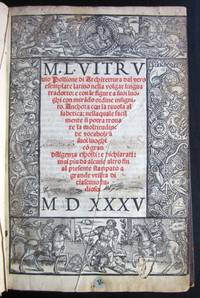
1535SAV123Venice: Nicolo de Aristotele detto Zoppino 1535. Hardcover. Very Good. Folio 295 x 190mm. 12 I-CX 110ff. Signatures: AA6-BB6; A8-N8; O6. Title printed in red and black with woodcut block border depicting strewn armor and dueling knights with wreathed portrait of Cicero at top and plaques with monogram initials of Roman Emperors Fabius Maximus Julius Caesar and Alexander Magnus. 136 woodcut in-text illustrations depicting lives of primitive humans the famous Vitruvian Man on p. XXII constellations rules for perspective and other mathematical figures and diagrams of architecture. Woodcut historiated chapter initials throughout of repeating portraits. Translated by Benedetto Giovio 1471-1545. Edited by Francesco Lutio Durantino. 19th-century calf with decorative stamps spine stamped in gilt TRAT DE ARCH endpapers renewed; loose in binding some margins trimmed close some light worming at least six early cancelled inscriptions on title leaf CX with significant excision otherwise an crisp and clean text block with wonderful woodcut impressions. 19th-century inscription on fly-leaf Famoza Archi-tectura. Another 19th-century inscription on front flyleaf Presented to the Mercantile Library Association of New York by Philip A Reach .Consul/ Lisbon Jan. 7 1848. Sold in 1958 on removal of Architecture Books from the Library pencil note. Rare illustrated Durantino edition of Vitruvius printed in Venice by Zoppino in 1535. This Vitruvius work was first printed in 1521 for Como. As it gained notoriety another edition in the vernacular Italian was prepared by Giovanni Antonio and Pietro de Nicolino da Sabbio in 1524. It incorporated woodcuts from a 1511 Latin edition produced by Giovanni Giocondo in Venice Tacuino. This Zoppino printing had a newly redesigned title-leaf with an elaborate woodcut border of chivalric battle scenes between Augustus Caesar Julius Caesar and Alexander the Great. The 136 in-text woodcuts are an all too interesting miscellany of late-medieval life nature and architecture and are characteristic of Vitruvian ideals in regards to proportion ornament language space place and beauty. The famous figure of Symmetria Vitruvian Man is present on p. XXII. Both the 1524 and 1535 editions were widely read by an Italian public. Vitruvian principles deeply influenced early Renaissance artists thinkers and architects who believed they were rediscovering an ancient discipline which would be the foundation of their culture. <br/><br/>Rare illustrated Durantino edition of Vitruvius printed in Venice by Zoppino in 1535. This Vitruvius work was first printed in 1521 for Como. As it gained notoriety another edition in the vernacular Italian was prepared by Giovanni Antonio and Pietro de Nicolino da Sabbio in 1524. It incorporated woodcuts from a 1511 Latin edition produced by Giovanni Giocondo in Venice Tacuino. This Zoppino printing had a newly redesigned title-leaf with an elaborate woodcut border of chivalric battle scenes between Augustus Caesar Julius Caesar and Alexander the Great. The 136 in-text woodcuts are an all too interesting miscellany of late-medieval life nature and architecture and are characteristic of Vitruvian ideals in regards to proportion ornament language space place and beauty. The famous figure of Symmetria Vitruvian Man is present on p. XXII. Both the 1524 and 1535 editions were widely read by an Italian public. Vitruvian principles deeply influenced early Renaissance artists thinkers and architects who believed they were rediscovering an ancient discipline which would be the foundation of their culture. Nicolo de Aristotele detto Zoppino hardcover
160097390[Leiden], Christophorus Raphelengius, 1600. 372 S. 12mo. 11cm. Pgt. d. Zt.
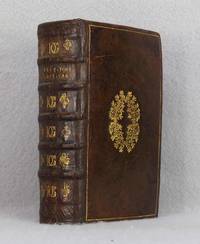
1583ST15026Paris: Arnold Sittart 1584; Heidelberg: Peter Santandrea 1583. 178 x 111 mm. 7 x 4 3/8". 14 p.l. cccix pp. 13 leaves last blank; lxxv 10 ccxvi 22 pp.; 2 leaves 84 pp.; 1 1-196 18 pp.; 62 pp. Two works in several parts bound in one volume. With annotations and commentary by Antonio Augustin Joseph Scaliger and Fulvio Orsini. <br/> Pleasing contemporary calf covers with central gilt wreath of olive branches raised bands spine panels gilt with cipher "D C G" at center flanked by a palmette and a vegetal trefoil gilt titling bottom panel with "OD" and "I8" on either side of the cipher. Printers' devices on the title pages decorative woodcut initials and headpieces. Front pastedown with what appear to be early library shelf markings; one page with neat early marginalia. Adams V-590 and F-390. Covers slightly marked spine with a bit of superficial crackling and with one short crack in the middle of bottom panel the text with faint browning and isolated minor soiling a few leaves with long shallow creases not affecting legibility otherwise in excellent condition the binding solid and without significant wear and the leaves generally clean fresh and smooth.<br/> <br/> This glossary of recondite Latin words and phrases was no doubt bound for a contemporary bibliophile with an extensive library. The "OD" and "I8" at the bottom of the spine appear to be the indication of a shelf location--not something frequently encountered on spines of this period. This designation and the location notation on the front pastedown that clearly relates to it "Arm. 0. Tab 4. Loc. 18" suggest a library of some complexity and an educated owner who believed in careful organization. While we have not been able to identify "D C G" she would seem also to have been a person of taste and good sense. The binding is attractively decorated while still being practical for scholarly use. The work itself has gone through a number of changes of fortune. The story begins when Verrius who lived in the time of Augustus compiled a valuable work full of information on everything from grammar to mythology. Unfortunately his text has been largely lost; the authentic fragments fill only the first few leaves of our volume. His work was epitomized by Festus a ca. third century scholar but Festus was not a very good epitomizer and to make matters worse all of his entries have been lost up to the letter "M." Luckily an epitome of the epitome from "A" to "Z" had been made by Paul the Deacon in the eighth century. Valuing the handbook for its information on the writing of correct Latin Renaissance scholars went to work on this puzzle in the 15th century and a first version of Paul was published by Zarotus in Milan in 1471. Later scholars published Festus and the great French classicist Joseph Scaliger 1540-1609 was largely responsible for bringing definitive order out of chaos. His scholarly edition reconstructs the work of Festus as far as one can filling in the gaps caused by missing pages in the manuscript with conjectures and rectified material from Paul. Peter Santandrea unknown
15721236139Köln, D. Baum, 1572. 617, (1) S., 17 Bl. Flexibler Pgtbd d. Zeit (Einbd mit Wasserschaden, Gelenke weitgehend gelöst, durchgehend mit Nässespuren u. im unteren Rand stockfleckig, die ersten 5 Bl. an d. unteren Ecke etwas multschig u. beschädigt, Name auf Titel, einige Unterstreich. von alter Hand).
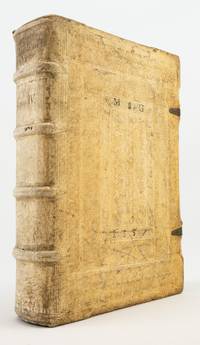
1556ST20472Basel: Hieronymus Froben 1556. First Edition of this Latin Translation. 343 x 235 mm. 13 1/2 x 9 1/4". 4 p.l. 730 142 2 blank pp. 12 leaves. Translated from the Greek by Petrus Nannius and Wolfgang Musculus. <br/> Contemporary blind-stamped pigskin over bevelled wooden boards by Balthasar Wernher of Lauingen covers framed by palmette rolls and a roll signed with the initials B. W. that features half-figures of Christ as Salvator Mundi St. Paul St. John the Baptist and King David central panel of upper cover with vertical palmette rolls the blank frame around it with the letters "M G" above the panel separated by turnip tool the date 1557 below the panel central panel on the lower cover with the same tooling but surrounded by a frame with a roll of medallions of the Reformers raised bands ink lettering to a couple of panels two original brass catches and catchplates one catchplate defective. Printer's woodcut device to title page and final page numerous decorative woodcut initials. Title page with three early ink owner inscriptions; occasional early ink marginalia and underlining. VD16 A 3980; Adams A-2083; Hoffmann I 415. For the binding: Haebler I 475 3; EBDB roll r003786 and workshop w004477. Binding somewhat soiled and chafed pigskin at one corner rubbed away one-inch circular hole on back board a contemporary issue with tooling impressed on the wood beneath isolated minor marginal stains or mild foxing other trivial imperfections but an extremely pleasing copy very fresh internally with excellent margins in a completely satisfying unrestored contemporary binding.<br/> <br/> This collected edition of the writings of the Church Father and leading advocate of the doctrine of the Trinity comes in a lovely binding by a known German workshop. The Einbanddatenbank "Bookbinding Database" or EBDB of the German Research Foundation attributes the Salvator Mundi/St. Paul/King David/John the Baptist roll to Lauingen binder Balthazar Wernher ca. 1525-74/75 whose initials appear in the panel featuring Christ. His workshop was active ca. 1555-75; the date on our binding indicates it was produced near the beginning of his career. One of the four great Eastern Doctors of the Church and the Patriarch of Alexandria St. Athanasius ca. 297 - 373 led the fight against the Arian doctrine which held that Christ was a creation of God the Father rather than consubstantial with Him. Athansius’ writings on the Incarnation and the Trinity which make up most of the text here were enormously influential. According to Catholic historian Cornelius Clifford "Athanasius was the greatest champion of Catholic belief on the subject of the Incarnation that the Church has ever known and in his lifetime earned the characteristic title of 'Father of Orthodoxy' by which he has been distinguished ever since." The English theologian and Cardinal John Henry Newman declared Athanasius a "principal instrument after the Apostles by which the sacred truths of Christianity have been conveyed and secured to the world." This translation of his writings was one of the final works by the Dutch humanist Petrus Nannius Pieter Nannick 1496-1557 a contemporary of Erasmus. The printer here was Hieronymus Froben who took over the family business from his father Johann Froben 1460-1527 a central figure in the printing history of the 15th and early 16th centuries who played a key role both in the intellectual ferment of the northern Renaissance and the theological turmoil of the Reformation. Our substantial large folio binding with its thick boards and four sets of muscular double bands provides an appropriate reflection of the weightiness of the works it contains. [Hieronymus] Froben unknown
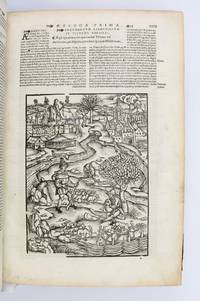
1529ST20181Lugduni Lyon: Jean Crespin 1529. 326 x 215 mm. 13 x 8 1/2". 6 leaves 12-268 pp.; 1-95 1 pp.; 1-600 pp. 8 leaves. Three sections in one. Edited by Josse Badius Ascensius. <br/> Restrained 17th century mottled calf covers triple ruled in blind with oblique gilt fleurons in each corner raised bands neatly rebacked and recornered with modern deep brown morocco marbled endpapers edges sprinkled. WITH 203 TOTAL ILLUSTRATIONS comprised of 190 different woodcuts 11 of which repeat once and one repeating twice. The first title printed in black and red with an elaborate woodcut border; the second title with a fleur-de-lys device. With criblé initials throughout in three sizes many historiated. Handwritten book label of Tobias Gutberleth on title see below title additionally with ink ownership inscription of G. van Olden Junior dated 1860. Front flyleaf with pasted-in manuscript inscriptions of "Francis" and "R. E. Hattiule". Line numbers in ink in a contemporary hand through much of the volume. Mortimer 538; Renouard "Badius Ascensius" III 377; Adams V 474; Brunet V 1282; Graesse VI 336. Binding yawning a bit edges somewhat rubbed but a solidly restored and perfectly acceptable binding. Light smudges of no consequence here and there other trivial defects but internally very clean fresh and bright.<br/> <br/> This is a well-preserved copy of a 16th century printing of Virgil's "Opera" profusely illustrated with wonderfully detailed woodcuts replete with charm and drama. Initially produced in Strassburg for Johann Grüninger’s 1502 Vergil our striking set of illustrations was reused in the 1515 German translation of the Aeneid and then in Sacon’s 1517 Lyon printing which bears many similarities to the present edition. While the plates do show some of the wear expected with this level of reuse—Mortimer notes that several had split by the time of the 1517 printing—the impressions here are nevertheless quite good and the illustrations are no less compelling than befoe. The anonymous artist whom Mortimer describes as having "a skilled hand and lively imagination" has provided animated scenes that perfectly match the content of the text. They range from the charming pastoral images that accompany the Eclogues and Georgics full of cheerful farmers and leaping stags to the dramatic battle scenes of the Aeneid with their fierce heroes in full 15th century armor grotesque monsters and elaborately rendered cities engulfed by leaping flames all overlooked by the pantheon of unconcerned gods. The text here is framed by the commentary of French scholar and printer Josse Badius Ascensius as well as by the commentaries of Filippo Beroaldo Giovanni Pierio Valeriano Bolzani and others. The present copy was owned early in its history by Tobias Guberleth 1609-62 poet and head of the Leeuwarden Latin school. Jean Crespin unknown