119 résultats
179039482Paris 1790. A PRISTINE COPY of this rare example of French revolutionary Judaica a satire against Mirabeau. 1 37 pp. Printed with large margins on extremely fine laid paper. 8vo. Sewn into plain blue wraps as issued ENTIRELY UNCUT. A bit of faint old staining else FINE AND BRIGHT. Barbier II 334. Rare and important. <br/><br/> paperback
17951150145Tours, Letourmy et Paris, Berry, an 3 (= 1795). Zus. über 1150 S., 14 Kupfertaf. v. Antoine Borel, darunter die Bildnisse von Mirabeau und seiner Geliebten Sophie Ruffey. Hldrbde d. Zeit m. schlichter Rverg. (etwas berieben, gering braunfl.
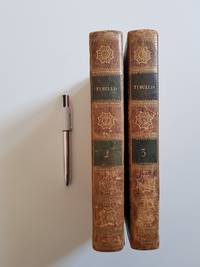
17958233Paris: Jahyer et Geslin 1795-1798. Lievi sbucciature sui dorsi complessivamente ben conservato; leggera gora sull'ultima carta del tomo secondo e sulla tavola all'antiporta del tomo terzo della suite dedicata alle Elegie lieve gora sull'angolo della segnatura “e†del tomo terzo; una tavola del tomo secondo slegata ma presente. Tre volumi opera completa in mezza pelle ottocentesca con titoli dorati e falsi nervi sul dorso sbucciature 8vo cm13x21.5 pp 4 XX 375 1 4 593 1 4 388; complessive 15 tavole. Segnatura: 2 a10 A-Z8 Aa4 2 A-Z8 Aa8 Bb2 Cc4 C4 bianca e incollata alla sguardia 3 a-z8 aa2 bb8. Lievi sbucciature sui dorsi complessivamente ben conservato; leggera gora sull'ultima carta del tomo secondo e sulla tavola all'antiporta del tomo terzo della suite dedicata alle Elegie lieve gora sull'angolo della segnatura “e†del tomo terzo; una tavola del tomo secondo slegata ma presente. Elegie di Tibullo con traduzione di Mirabeau a fronte; seguono la versione anch'essa con testo a fronte del Liber Basiorum di Jean Second Jan Everaerts e alcune novelle di argomento mitologico. La traduzione del Livre de Baisers fu composta da Mirabeau durante la prigionia a Vincennes e dedicata all'amante Sophie de Ruffey il cui nome è sostituito nel testo a quello di Neera “parce qu'il m'eût été impossible d'adresser à une autre qu'à Sophie des choses si tendresâ€; qui pubblicata per la prima volta e imprimée sur l'original écrit de la main de Sophie questa raccolta di 19 basia più Un bacio è poco di Guarini anch'esso liberamente tradotto a fronte è adorna del noto ritratto di Sophie col motto In Bel Corpo anima bella inciso da Jean-Louis Delignon su disegno di Antoine Borel. L'apparato iconografico è quasi interamente firmato da Borel ed è composto dai ritratti di Sophie e di Mirabeau quest'ultimo inciso da Etienne Claude Voysard e da dodici tavole incise da François-Rolland Elluin per le elegie di Tibullo; un'ulteriore quindicesima tavola è dedicata alla traduzione de La rete di Vulcano overo gli amori di Marte et di Venere di Ferrante Pallavicino che apre il terzo volume disegnata da Clément-Pierre Mariller e incisa da Jean Baptiste Michel Dupréel. Qualche dubbio nelle bibliografie sulla datazione di quest'opera presumibilmente completata fra il 1795 e il 1798 e qui offerta nella variante con frontespizio con la data posteriore AN VI 1798 nonostante il colophon del tomo II porti la data AN 3 1795. Cohen-Ricci II 993; Graesse VII 159 Jahyer et Geslin unknown
1798LRB589Paris: s.n. Rue S. AndrédesArts n° 46 1798 Titre : Élégies de Tibulle suivies des Baisers de Jean Second Tome second Tibulle suivi de Contes et Nouvelles Tome troisièmeAuteur : Tibulle Albius Mirabeau HonoréGabriel Riqueti Second Jean Janus SecundusLieu : ParisÉditeur : s.n. Rue S. AndrédesArts n° 46Date : An VI 1798Nombre de volumes : 2 volumes tomes 2 et 3 seulsReliure : Pleine basane marbrée de l'époque encadrement de filets dorés sur les plats dos lisses richement ornés de fleurons et roulettes pièces de titre et de tomaison vert sombre doréesIllustrations : Nombreuses figures gravées hors texte dont frontispice 'Sophie' signé Borel del. et Delignon sculp. ; titre du t. II annonçant « avec quatorze figures » t. III « avec figures »Langue : Texte latin et traduction française en regardContenu : Tome II : Élégies de Tibulle suivies des Baisers de Jean Second traduction par Mirabeau avec planches gravées. Tome III : Tibulle suivi de Contes et Nouvelles par Mirabeau notamment 'Le Filet de Vulcain ou les Amours de Mars et Vénus' avec figures.Particularités d'exemplaire : Avis de tirage imprimé indiquant qu'il « a été tiré quelques exemplaires de cet Ouvrage sur papier vélin et un trèspetit nombre sur grand papier vélin superfin »État : Bel ensemble d'époque frottements d'usage aux plats et aux coiffes petites épidermures et coins émoussés ; mors localement fendillés sans gravité ; papier vélin frais dans l'ensemble avec rousseurs et brunissures éparses pâles mouillures marginales à quelques feuillets ; belles impressions des taillesdouces. Signé par l'auteur. Hardcover. Good. s.n., Rue S. André?des?Arts, n° 46 hardcover
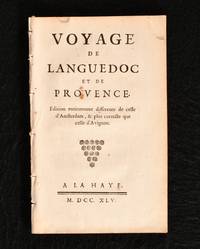
1745726L2Changuion: A La Haye 1745. Disbound. Good. 7.5" by 4.5". None. A scarce French pamphlet on the province of Languedoc which is modern-day Occitanie. The title page notes that this edition is 'Entierement Differente de celle d'Amsterdam & plus correcte que celle d'Avignon.'Worldcat notes the author as Victor de Riqueti marquis de Mirabeau. de Roqieto was a French economist of the Physiocratic school.In French. A fascinating recollection of a trip to Languedoc. This work is in both prose and poetry. Disbound. Externally generally smart with light spots to the front and rear wrap. Chip to the head of front wrap. Internally binding is tender in places. Pages are bright with just the odd spots to pages. Good A La Haye unknown
179120281Paris Venezia Hotel d'Aguillon Zatta 1791. In 8° antico bross. muta coeva pp. 2 bb. 127 3 bb. La dicitura scritta al frontespizio fa rientrare questa tiratura seppur coeva alla prima almeno ad una seconda ed aumentata edizione uscita dopo il 2 aprile 1791 giorno della morte del Mirabeau. La prima edizione contava un minor numero di pagine 4 n.n. 95 11 ed aveva ritratto in antiporta Cabinet d'expertise Edgard Daval e Biblioteca Nazionale dell'Australia . Ottimo e fresco esemplare in barbe Paris (Venezia), Hotel d'Aguillon (Zatta) unknown
1791002480Paris: Imprimerie Nationale 1791. Tre opere in un volume in 8o. Legatura coeva in mezza pelle dorso a nervi con tassello di titolo "Pieces diverses". E. O. Prima edizione per le tre opere. --- Travail sur l'éducation publique trouvé dans les papiers de Mirabeau l'Ainé; publiés par PJG Cabanis. 206 pagine --- Mirabeau.: Elemens du droit politique. Par M. professeur en droit. 1ere livraison. Al termine: Paris Impr. de la Feuille du Jour. 280 pagine --- Extrait de mon journal dediés aux manes de Mirabeau. Par Felix Faulcon deputé. Paris Cussac Barrois et Poitiers Barbier. Septembre 1791. 2-VIII errore per VI-128pp. --- Mirabeau presenta le sue idee sull'istruzione pubblica contrarie ad una scuola "di parte" e favorevole alla libertà d'insegnamento. Imprimerie Nationale unknown
1760EIRéo[MI72Paris: 1760. 1760. 12mo. pp. vi 426 2. modern bds. Published the same year as the first edition in quarto format. Mirabeau's strong criticisms of French methods of finance and taxation in this work particularly his attacks on the tax-farmers led to his temporary imprisonment and banishment from Paris. "It is not as might be supposed a mere plea for the Impôt Unique. It proposes a reorganization of financial administrative machinery the abolition of the Fermes a reduction in taxation upon salt with the object of increasing the total yield and a special tax upon tobacco farms. The Domaine the post and the Mint were to be further sources of revenue. Many just and valuable remarks on taxation are scattered throughout the volume and entitle the author to rank as one of the earliest important writers on the subject." Palgrave Einaudi 3946. Goldsmiths' 9603. Higgs 2298. Kress 5884. cfCioranescu II 45631. cfStourm pp. 100-101. cfTchemerzine VIII 285. Palgrave II pp. 774-78. F. [Paris]: 1760. unknown
1761AR27GTBN25924Not Stated 1761. Hardback original full calf with gilt titles. Marbled end-papers. 17.5 x 10.5cm. viii 422pp. Important pre-French Revolution text on tax this edition published the year after the 1760 first printing. Spine rather age discoloured. A little foxing to first few pages otherwise contents clean and unmarked. Firmly bound from Ombersley Court with the bookplate of Lord Sandys on the front pastedown. . Hard Cover. Very Good. Not Stated Hardcover
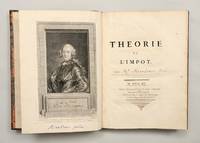
176083935No place: no printer 1760. First edition of a spirited and able attack upon the financial administration of France and especially upon the "fermiers généraux" whom Mirabeau regarded as parasites preying upon the vitals of the nation. The work highlights the problems and injustices of the French system of taxation and added fuel to the fire of the coming revolution. The king disapproved of the work; Mirabeau was imprisoned on 16 December 1760 but through the efforts of Madame de Pompadour and others was released on Christmas Eve under orders to leave Paris for his estate at Bignon. The work proposes a reorganization of financial administrative machinery the abolition of the "Fermes" a reduction in the taxation upon salt with the object of increasing the total yield and a special tax upon tobacco farms. The domaine the post and the mint were to be further sources of revenue. The author ranks as one of the earliest important writers on taxation. Higgs notes that the book is "of real importance in the history of financial theory" The Physiocrats p. 57. Quarto 257 x 192 mm. Additional engraved frontispiece portrait of the author. Contemporary sprinkled calf spine ruled and decorated gilt in compartments red morocco label sprinkled edges. Spine ends and corners skilfully repaired. Manuscript note to title-page "par Mr Mirabeau père" with a short verse "helas dans le Siècle ou nous sommes / pour avoir dit la vérité / Mirabeau cet ami des hommes vient de perdre la liberté" in a neat calligraphic hand. Occasional light foxing. A very good copy. Goldsmiths' 9836; Higgs 2881; INED 3204; Kress 6120. unknown
176084111No place: no printer 1760 & 1761. OF REAL IMPORTANCE IN THE HISTORY OF FINANCIAL THEORY" - a BEAUTIFUL COPY First edition of both works pairing Mirabeau's Théorie de l'Impôt his spirited and able attack upon the financial administration of France especially the "fermiers généraux" whom Mirabeau regarded as parasites preying upon the vitals of the nation with Pesselier's counterattack notable for its terse affirmation of the characteristically Physiocratic doctrine that agriculture holds a privileged place in the economic system. Mirabeau's work highlights the problems and injustices of the French system of taxation and added fuel to the coming fire of the revolution. The king disapproved of the work; Mirabeau was imprisoned on 16 December 1760 but was released on Christmas Eve through the efforts of Madame de Pompadour and others under orders to leave Paris for his estate at Bignon. The work proposes a reorganization of financial administrative machinery the abolition of the "fermes" a reduction in the taxation upon salt with the object of increasing the total yield and a special tax upon tobacco farms. The domaine the post and the mint were to be further sources of revenue. Mirabeau ranks as one of the earliest important writers on taxation. Higgs notes that the book is "of real importance in the history of financial theory" The Physiocrats p. 57. Pesselier was one of the most forceful critics of the physiocrats. Of the products of the soil Pesselier here writes "Elles procurent un profit net et durable puisqu'elles sont à l'abri de l'imitation" "They provide a net and lasting profit since they are safe from imitation". Two works bound in a single vol. quarto 255 x 193 mm. Contemporary French mottled calf spine decorated gilt in compartments red morocco label marbled endpapers. Housed in a brown morocco-backed book-form case. Engraved armorial bookplate to front pastedown. Lower edge a little rubbed with corners worn very occasional spotting; very good copies. Mirabeau: Einaudi 3946; Goldsmiths' 9602; Higgs 2297; INED 3209; Kress 5883. Pesselier: Brunet I 1118; Einaudi 4409; Goldsmiths' 9695; Higgs 2534; INED 3524; Kress 5964. unknown
17891211150005S. Bladon 1789-01-01. Hardcover. Good. 2 volume set. 21 cm. Contemporary leather binding. London edition. Clean unmarked pages. Scuffs to spine leather. Vol. 1 front hinge starting. <br><br> A fascinating account of the end of Frederick the Great's reign and the relation of 18th century pre-revolutionary France to the Prussian regime. <br><br> Provenance: From the library of Ambassador William H.G. FitzGerald. <br><br> References: Caillet 7588. Hayn/Gotendorf I296. Barbier 2831. Martin & Walter 24476. Cioranescu 45214. Wolfsteig 42787 S. Bladon hardcover
178914145Dublin: P. Byrne 1789. FIRST IRISH EDITION. Contemporary calf spine and edges lightly worn; generally an excellent copy with a contemporary signature of Juliana Pratt dated 1843 on title.  . First edition a variant of a two-volume work published in London with few copies located in America. We do not know the priority of this Irish edition. <br /> <br /> After a preliminary trip to Berlin in early 1786 Mirabeau was dispatched that July on a mission to the royal court of Prussia. Returning in January he published a full account in his Secret History of the Court of Berlin 1787. This account denounced the Prussian court as scandalous and corrupt described the King of Prussia as weak and overly emotional and labeled Prince Henry of Prussia brother of Frederick the Great and a guest of the French court as narrow-minded and incompetent. The resulting uproar was an extreme embarrassment for the French government which quickly censored the book but could not prevent its widespread notoriety. Mirabeau’s episode provided inspiration to many more radical publishers who came to regard him as a leader of the coming revolution.<br /> <br /> Even Thomas Jefferson who was serving as the United States Minister to France during this period wrote to Mirabeau complimenting his “writings and talents†and provided him with materials that Jefferson wanted Mirabeau to use in future publications. P. Byrne unknown
1789016762London: S. Bladon 1789. xxiv 364 391p. Two volumes. A good set the front cover of vol. 1 and the back cover of vol. 2 both have very weak hinges the spine ends and the forecorners of the covers are worn the leather on some of the covers shows wear and there is a bit of scribble on the front free endpaper of vol. 1. First Edition. Full Leather. 8vo - over 7¾" - 9¾" tall. S. Bladon hardcover
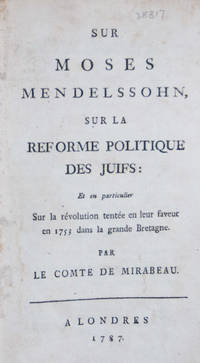
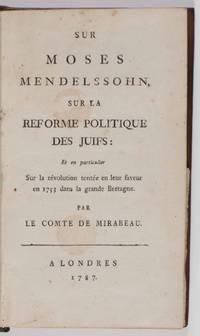
178738317London: NP 1787. First edition. Hardcover. g. Octavo. 68 130pp. Original spotted calf with gold lettering and tooling on spine. Marbled endpapers and paper edges. Decorative head- and tailpieces. Honoré Gabriel Riqueti comte de Mirabeau 1749-1791 was a leader of the early stages of the French revolution. A noble before 1789 Mirabeau was involved in numerous scandals that left his reputation in ruins. However during the early years 1789-91 of the French Revolution he rose to the top and became the voice of the people. A successful orator he was the leader of the moderate position favoring a constitutional monarchy built on the model of Great Britain. Mirabeau became interested in the Jewish question during his visits to Holland in 1776 England in 1784 and Prussia in 1786. Influenced by the enlightened members of the Jewish communities in the capitals of these three countries he was particularly attracted by the image of Moses Mendelssohn. In "Sur Moses Mendelssohn sur la réforme politique des Juifs" a book resulting from the author's journey Mirabeau argued that the faults of the Jews were those of their circumstances. Although his main reason for admiring Mendelssohn was that 'humanity and truth' seemed much clearer to him than 'the dark phantoms of the Talmudists' he did not consider Judaism an immoral faith and he defended it against attacks both old and new. In the course of his argument he repeated Christian Wilhelm von Dohm's assertion that 'the Jew is more of a man than he is a Jew'. Quoting from Turgot and Rousseau in support of his pro-Jewish arguments Mirabeau affirms that history proves that 'the Jews considered as men and as citizens were greatly corrupted only because they were denied their rights'. Like Dohm he advocated preserving some measure of Jewish autonomy a view he developed in his memorandum to Frederick the Great of Prussia "De la monarchie prussienne" 1788 but he envisaged it as a transitory phenomenon; the organized Jewish community would wither away and die as the Jews entered fully into the economic and social life of the majority. Mirabeau continued to work for the emancipation of the Jews as he saw it. In the debate of Dec. 24 1789 he denied Rewbell's assertion that 'they the Jews do not regard themselves as citizens' and followed Clermont-Tonnerre in stating that the very fact that the Jews were requesting equality was proof of their desire to cease being Jewish in any separatist way. Binding rebacked but retaining most of its original spine. Calf darkened and partly cracked along edges. Front hinge starting. Previous owner's annotation in Latin along outer margin of page 68. Text in French. Binding in overall fair interior in very good condition. Moses Mendelssohn 1729-1786 was a German Jewish philosopher to whose ideas the Haskalah the 'Jewish enlightenment' of the eighteenth and nineteenth centuries is indebted. Although himself a practicing orthodox Jew he has been referred to as the father of Reform Judaism. Born to a poor Jewish family in Dessau and originally destined for a rabbinical career Mendelssohn educated himself in German thought and literature and from his writings on philosophy and religion came to be regarded as a leading cultural figure of his time by both Christian and Jewish inhabitants of the Holy Roman Empire. <br /> <br /> Christian Wilhelm von Dohm 1751-1820 was a German historian and political writer. Although a Christian he was a staunch advocate for Jewish emancipation. In 1781 at the suggestion of his friend Moses Mendelssohn Dohm published a two-volume work entitled "Über die Bürgerliche Verbesserung der Juden" On the Civil Improvement of the Jews which argued for Jewish political equality on humanitarian grounds. It was widely praised by the Jewish communities in Berlin Halberstadt and Surinam. <br /> <br /> Stanislas Marie Adélaïde comte de Clermont-Tonnerre 1757-1792 was a French military officer and a politician during the French Revolution. He was twice elected president of the National Constituent Assembly where he advocated a moderate liberal policy especially in the matter of removing restrictions for the Jews and Protestants. NP hardcover
1787D19716London 1787. First Edition . Hardcover. Near Fine. London: 1787. Half red morocco with gilt spine and marbled paper over boards. The most notable titled rebel to espouse the cause of political liberty and to hold office in Revolutionary France Count Mirabeau was also among the most distinguished advocates of Jewish emancipation in his troubled country. In this book published two years before the fall of the Bastille he turns the blazing intensity of the Enlightenment on the views of Moses Mendelssohn a man he greatly admired. Mirabeau draws strong philosophical similarities between Mendelssohn in Prussia and another heroic iconoclast Thomas Jefferson in Virginia. <br /> <br /> <br/><br/> hardcover
178748852A Londres i.e. Strasbourg: N.p. 1787. First edition. Hardcover. Very good. Two parts octavo. 68130pp. Cancel title page. Contemporary tree calf; gilt spine in compartments morocco lettering piece; marbled endleaves; silk ribbon marker. Light soiling at title and a few leaves occasional mild foxing. A very good copy handsomely bound.<br /> <br /> First edition of this polemical work by the celebrated French statesman and political writer Gabriel-Honoré Riquetti comte de Mirabeau 1749-1791. Here he argues "that the degradation of the Jews was due to the squalid conditions in which they were being compelled to live. It was chiefly based on what he had seen in Germany where among other developments he witnessed part of the Pantheismusstreit the public controversy over Lessing’s Spinozism which erupted in the 1780s and in which Mirabeau firmly took the side of the deceased Lessing and the Spinozistes†Israel Radical Enlightenment 716. Moses Mendelssohn 1729-1786 was considered the greatest Jewish philosopher of his time. Mirabeau devotes much of the present work to the public arguments of the Pantheismusstreit in which Mendelssohn was challenged either to demonstrate the fallibility of Christian dogma or to convert to Christianity. With a bio-bibiography of Mendelssohn and an account of the Naturalization Act of 1753 in England which gave full civil rights to Jews but was revised soon after. References: Bamberger 584. Cioranescu 45331. ESTC T-83507. Meyer Moses Mendelssohn Bibliographie 733. [N.p.] hardcover
179118566Paris: Chez Petit & Maugi 1791. 8vo. Modern wrappers. 30 pages. Some light spotting. 8vo. In the introduction the editor voices his strongly anti-Jacobin sentiments- "traitez les jacobins comme on traite les fous et le bonheur pourra renaître en France." The author writes warning the people of the falseness behind the "liberties" touted to the people. M & W III 24413 Chez Petit [&] Maugi unknown
17911353601Paris: Imprimerie Nationale 1791. First Edition. Octavo 4 35 pages 8 pages; G; Side-sewn pamphlet with original blue wrappers; Covers show moderate wear overall with light plus curling to corners moderate wear to paper on spine and light soiling overall; Textblock has light plus age-toning overall light curling to some corners an ink emendation from a former owner illegible on title page and substantial ink emendations to the insides of the front and back covers. 1353601. Special Collections. Imprimerie Nationale unknown
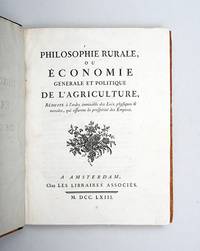
1763153616Amsterdam: Chez les Libraires Associés 1763. The new science of economics Rare first edition presenting "perhaps the most complete and magisterial account of the views of the Physiocratic school" Higgs. "Quesnay collaborated very substantially in preparing this last major work contributing the final chapter with further explanations and manipulations of his Tableau Économique analysis" The New Palgrave. Schumpeter calls the work "the first of the four textbooks of physiocrat orthodoxy" p. 225. It contains for the first time Quesnay's masterful explanation of his Tableau Économique "one of those works in the history of economics which have often been regarded as an anticipation of modern theories" Schumpeter p. 242. Originally printed as a pamphlet of 16 pages in 1758 in a minute number of copies Quesnay's Tableau Économique was first revealed to the public as the final part of Mirabeau's L'Ami des Hommes in 1760. In the Philosophie rurale Quesnay for the first time gives a full explanation of his system. The Tableau économique is credited as the "first precise formulation" of interdependent systems in economics and the origin of the theory of the multiplier in economics. An analogous table is used in the theory of money creation under fractional-reserve banking by relending of deposits leading to the money multiplier. In a letter to Mirabeau written late in 1758 Quesnay remarks "J'ai taché de faire un tableau fondamental de l'ordre économique pour y représenter les dépenses et les produits sous un aspect facile à saisir et pour juger clairment des arrangemens et des dérangemens que le gouvernement peut y causer" translated: "I have tried to make a fundamental table of the economic order in order to represent the expenses and the products in an aspect easy to grasp and to judge clearly of the arrangements and disturbances that the government can cause there". "A most remarkable analysis of the economic condition of his country" Palgrave the Tableau économique "is the most important and famous work of Physiocracy and has often been regarded as a summary of the entire corpus of Physiocratic economics. The Tableau has also been regarded as the analytical synthesis of the logical structure of Quesnay's economics or at least as its most relevant aspect. The Tableau économique is one of those works in the history of economics which have often been regarded as an anticipation of modern theories. The Tableau has been considered a first rough presentation of Keynes's multiplier and as a sort of general equilibrium system of a Walrasian type. For others the Tableau is an input-output table. Because of the Tableau Quesnay has been regarded as an early econometrician. The Tableau has also been interpreted as the first classical system of price determination thus anticipating Marx's reproduction schemes and Sraffa's price system" Giovanni Vaggi in The New Palgrave. Quarto 260 x 192 mm. With 3 engraved plates including the Tableau économique. Contemporary quarter marbled sheep orange paste paper sides light blue endpapers. Housed in a black cloth flat-back box by the Chelsea Bindery. Neatly restored at extremities insect abrasion to spine slight cockling to paste paper sides contents clean and fresh. A very good copy. Goldsmiths' 9836; Higgs 2881; INED 3204; Kress 6120; Mattioli 2435. hardcover
1790002172Paris: Imprimerie Nationale 1790. In 8o di 23 pagine. Senza copertine. Prima edizione. Plaidoyer pour la liberté absolue du commerce et de lindustrie. Contro lobbligo di far arrivare in un solo porto predeterminato le merci provenienti dallIndia. Ined 3190bis. Imprimerie Nationale unknown
1790AQ27988Paris: De l’imprimerie nationale 1790. 23pp 1. Later printed buff wrappers. Book-label of Peter Stewart Young to verso of upper wrapper scattered spotting. The sole edition of Mirabeau’s response to Fontenay's proposal made on behalf of the Commerce Committee that demanded that the duties on returns from India should be directed solely to the port of Lorient. Mirabeau advocates absolute freedom of commerce and industry and stands against any form of obligation imposed on traders to have their goods from India delivered to a specific port. . First edition. 8vo. De l’imprimerie nationale unknown
179032925Paris: Bureau de la collection historique des Mémoires relatifs au règne de Louis XV. 1790. Fine. Bureau de la collection historique des Mémoires relatifs au règne de Louis XV. Paris 1790 12.50 x 21 cm relié First edition. Posthumous publication by Soulavie. Contemporary full sheep binding. Smooth spine decorated with double gilt fillets title-labels headcaps worn joints rubbed numerous scuffs corners slightly bumped. Emmanuel Armand de Vignerot du Plessis de Richelieu duc d'Aiguillon was appointed governor of Brittany in 1753; until 1770 he was in open war with the Parliament of Brittany appointed by the king in a regional state that desired above all to preserve its privileges. Louis XV had to intervene several times in agreement with the duc d'Aiguillon. The memoirs record the numerous intrigues at court to destroy the duc d'Aiguillon. A final memoir concerns Louis XV's beautification projects in Nantes and Paris. Bureau de la collection historique des Mémoires relatifs au règne de Louis XV. unknown