93 488 résultats
M., Blas Román, 1771, 19 x 14 cm., plena piel, 8 h. + VI + 175 págs. + 1 estado plegado.
16413Genève, 1787. With 7 folding tables. 3 volumes in 2. iv, 103, (1) pp.; iv, 115, (1) pp.; viii, 160 pp. 8vo. Modern half morocco, spine gilt in compartments, gilt lettering, marbled boards. Kress B.1265; not in Goldsmiths; not in Einaudi; Stourm p. 143; Conlon 87:663. Original edition, very rare. Volume 2: Contenant les avantages & la solution des prétendus inconvéniens du papier national, avec le tableau des révolutions progressives qu'ont éprouvé les finances, depuis M. de Sully, jusqu'à la Régence inclusivement and volume 3: Examen impartial des divers comptes rendus au Roi depuis M. l'abbé Terray, jusqu'à l'Assemblée des Notables.Of significant interest at the eve of the Revolution. - The word 'Salon' stamped on all title-pages, with at the bottom of all title-pages catalogue or shelf indications.
18080A Paris, Chez Herissant fils, 1766. 2 volumes. xii, (4), 528 pp.; (8), 530, (2, errata) pp. 8vo. Contemporary half calf, spine with raised bands, contrasting labels with gilt lettering, marbled boards, corners, red edges, slightly worn. Conlon 66:949 (under Hérissant); Kress S.4454; not in Goldsmiths; not in Einaudi; not in Higgs. First edition. Interesting collection dealing principally with numerous cities and villages (such as Annonay, Avalon, Avesnes, Bourg de Charenton, Mantes, Milly-en-Gatinois, Montargis, etc., etc., their history, culture, natural history, wine production, etc.) and important persons in the kingdom of France. According to the 'Avertissement', the work is based on material not used in the 1768-1778 edition of Lelong's Bibliothèque Historique, also published by Hérissant. Much material for that work was obtained through correspondance with 'des sociétés savantes' but Lelong did not use all of it. Quérard lists the work under Fevret de Fontette.
18836Londres, 1775. 2 volumes in 1. (1), 155, (1) pp.; 275, (3) pp. 8vo. Contemporary marbled calf, spine gilt with raised bands, red morocco label with gilt lettering, small damage to joint at the foot of the volume. First work: Kress 7193; not in Goldsmiths; not in Einaudi; this edition not in INED; cf: Camus 1566; Peinot, Livres Condamnés, i, p. 43 (with wrong date). Third edition, published in the same year as the first edition, first edition with this title. Pierre-François Boncerf, French writer on agrarian subjects. While a clerk in the ministry of finance under Turgot he published a pamphlet, Les inconvénients des droits féodaux. According to Palgrave the work was published with the consent of Turgot. In it he attacked the contemporary system of feudal dues as ruinous to those who pay them, of little advantage to its benificiaries and contrary to the principles of freedom. The solemn condemnation of the pamphlet by the parlement of Paris, which the king vetoed, and the ensuing controversy in the press, in which Voltaire took a prominent part, established Boncerf's reputation and resulted in the translation of the work into many European languages. The pages 70-end contain the relevant texts by Montesquieu. The first edition was published anonymously, the second edition under the assumed name M. Francaleu. Second work: Higgs 6537; INED 3188 (1831 edition); Martin & Walter 24430; not in Goldsmiths (see 11518 for the second edition).First edition. Philosophical and political study on despotism and its effects it pretents to refute the theories of Rousseau while the author in reality attacks straight forward the government. Of actual value seems again his remark 'La nation finit toujours par être plus puissante que le tyran lorsque le pouvoir arbitraire parvenu à son dernier délire a dissous tous les liens de l'opinion et épuisé les ressources que la terre offre à ceux qui la cultivent en liberté. Ainsi les hommes se vengent tôt ou tard.' 'Dans cet insolent libelle, intitulé Essai sur le Despotisme, sous couleur de réfuter les théories de Jean-Jacques sur la bonté naturelle de l'homme, l'auteur s'attaquait de front aux pouvoirs' (Duc de Castries, Mirabeau, p. 105). Important work proclaiming democratic ideas and openly attacking despotism: 'Après cette vue philosophique générale, l'ouvrage s'attaquait seulement au 'despotisme d'un seul'' (Duc de Castries, op.cit)
27235A Franckfort, Chez Joseph-André Vanebben, 1745. [8], 96 pp. Small 8vo. Modern half calf, corners, marbled boards, gilt lettering to spine. Querard 516: Conlon 45:606; INED 738; Goldsmiths' 8184; Kress S.3721; not in Einaudi; not in Mattioli. Scarce first edition of this interesting contribution to "the heated and prolonged debate on luxury that took place during the eighteenth century (which can be) best understood as part of the age's growing awareness of fundamental transformations taking place in its socio-economic order. Some of the period's most important and influential thinkers joined in this debate, engaging in what amounted to a comprehensive reevaluation of socioeconomic, political and economic thinking. (.....) This is undoubtedly one of the reasons why the debate on luxury resonated so widely and deeply. At its very inception, it called into question the nature and survival of traditional values in an evolving commercial civilization" (Encyclopedia of the Enlightenment, vol 2, p. 440.) L'auteur, né à Pondichery en 1690, mort à Paris en 1757, "distingue entre le luxe de génie qui est utile, et le luxe de moeurs, celui de la table, des habits et des meubles, qui est néfaste" (INED.)The "Letter" is followed by Examen du IXe chapitre de l'Essai politique sur le Commerce (by Melon), Lequel renferme une espece d'Apologie du Luxe, followed by Fragmens d'un Auteur Grec, trouvés depuis peu dans la Bibliothèque d'Oxfort, & traduits en François, which also deals with the topic of "luxe", and followed by Dialogue pourquoi il est si difficle aux personnes d'un certain mérite de s'avancer dans le monde.Boureau Deslandes Lettre sur le luxe, "written for the Académie royale des sciences de Paris and royal academies of St. Petersburg, London, Edinburgh, Bologna, Prussia, and Sweden, revealed his growing concerns that Frenchmen failed as subjects and citizens. The Lettre begins: "Luxury is a pernicious thing in a state." Boureau Deslandes defined luxury as "an agreeable or brilliant superfluity, that adds to postmortem the indispensable needs of life: they are goods, advantages that one can absolutely do without, but that one procures for oneself out of vanity, due to an intemperance of taste, often because of a strong attachment to what is in style; finally, it is an excess where the price or value depends solely on imagination, and that has nothing in itself to do with reality." He distinguished between two kinds of luxury: luxe de genie and luxe de moeurs. The first was a positive luxury that allowed for the progress of culture, and the development of beauty and perfection; the other led to the corruption of taste and morality. Boureau Deslandes lauded the "noblest" examples of art, painting, literature, philosophy, and science that attested to the "perfection" of culture and the "honor of the state." Such products contrasted against the luxe de table, luxe d'habits, luxe de meubles and "ridiculous" excesses that inundated the market. "France," he argued, "is now a country of decoration," where "simple mores conforming to nature are banished." Extravagance, he described, was most apparent in Paris, where trends in furniture and jewelry changed three times a year. Luxury, he continued, created disorder in the state by confounding orders and ranks. Clothes, fashion, and tastes tended toward uniformity until one failed to distinguish "those who by birth or by employment must necessarily be distinguished." Worse, useless commodities "ruined health" and "rendered men less strong, less courageous, less able to continue work." This luxe, Boureau- Deslandes warned, "prepared the liveliest nation for death"" (Takeda, Junko Thérèse. Between Crown and Commerce: Marseille and the Early Modern Mediterranean, p. 191 ff.) - A bit browned.
16499A Londres et se vend à Paris, Chez la veuve Delormel & Fils, 1757. Together 4 works bound in 1 volume. (4), 60, 107, (1) pp.; xxiv, 224 pp.; 109, (1) pp.; 67, (1) pp. and 1 table. 8vo. Contemporary polished calf, spine richly gilt, raised bands, gilt triple fillets on sides, red label with gilt lettering, a very nice copy. First work: Kress 6086-7; Goldsmiths 9873; INED 1276; Higgs 3017. First issue of the first edition. In this vehemently written work, the fermiers-généraux were accused of corruption. It caused the author's imprisonment in the Bastille. The volume was printed by Lambert and distributed by Ormancy, who also were arrested. Four years after its publication the book was still sold secretly at high prices.Second work: Not in Kress; Conlon 75:640 (claiming two volumes).First edition.Of importance for the history of the years preceding the Revolution.Third work: Conlon 82:401.First edition.Fourth work: INED 620; Conlon 57:547.First edition.
16498A La Haye, 1764. Together 3 volumes in 1. (4), 60, 107, (1) pp.; (2), 26 pp.; 24 pp. 8vo. Contemporary marbled calf, spine gilt in compartments, red label with gilt lettering, red edges, lightly worn, some spots. First work: Kress 6086; Goldsmiths 9873; INED 1276; Higgs 3017; Conlon 63:751. First issue of the first edition. In this vehemently written work, the fermiers-généraux were accused of corruption. It caused the author's imprisonment in the Bastille. The volume was printed by Lambert and distributed by Ormancy, who also were arrested. Four years after its publication the book was still sold secretly at high prices. Second work: Not in Kress; Goldsmiths 10025; Higgs 3018; INED 4797; Conlon 63:752.First edition.According to Goldsmiths this is not by Darigrand, but a reply to Darigrand's work, INED also believes this work to be written by another, anonymous, author, Conlon lists it under Darigrand.Third work: Not in Kress; Goldsmiths 10020; Higgs 3268; INED 4778; Conlon 64:441.First edition.Loosely inserted: ARRET de la cour du parlement de Rouen, qui ordonne que la brochure intitulée: Réponse à l'auteur de l'anti-financier, fera lacerée & brulé par l'exécuteur de la Haute-Justice, au pied du grand escalier de palais; enjoint à ceux qui en auroient des exemplaires, de les apporter au Greffe de la Cour, pour y être pareillement lacérés & brulés, &c. Du 9 Avril 1764. (Drop-head title). A Rouen, Chez J.J. le Boullenger, (1764).Not in Kress; Goldsmiths 10017; Higgs 3252.
Prima edizione. Leggero foxing su alcune carte, piccolo forellino di tarlo, nel complesso un esemplare molto buono. Segnatura manoscritta di antico possessore alla prima sguardia. Di grande rarità, presente in Iccu in una sola copia (Biblioteca d'arte e di storia di San Giorgio in Poggiale - Bologna). Pregevole raccolta di ordinanze, risalenti ai primi del Seicento, rivolte ai sensali e ai “cozzoni” (i sensali di animali, e in particolari di cavalli) della città di Bologna e del suo contado, in materia di commercio. Seguono le ‘Addizioni’ ai capitoli seicenteschi, datate al 1731. Il volume è stampato da Lelio dalla Volpe, attivo nella prima metà del Settecento, e che divenne uno dei più importati tipografi-stampatori di Bologna. Al frontespizio grande stemma xilografico, all’interno pregevoli testatine e finalini a motivi floreali; in apertura, notevole capolettera con paesaggio agreste.
Ottimo esemplare, freschissimo. Timbri di prestigiosa collezione. Grande stemma al frontespizio. Rara pubblicazione del progetto per riorganizzare la città di Codigoro in tutte le sue forme. Diviso per Capitoli [Ufficio del Sindaco, Ufficio dei Consoli alle Vetovaglie, Ufficio del Proveditore, ecc. Nessuna copia riscontrata in Biblioteche Pubbliche.
Seconda edizione aumentata. Ottimo esemplare a pieni margini. La prima edizione apparve a inizio secolo sempre in Milano. In Napoli si stampò una contraffazione di questa seconda edizione aumentata, che si distingue dall’originale per numero di pagine (241) ed è priva di errata. Parenti, Rarità vol. VI, pp. 345-350
Rara prima edizione. Ottimo esemplare stampato su carta forte. Molto belle le tavole: una con la Pianta Topografica della situazione della città di Faenza e territorio circostante, da Goro a Rimini, da Bologna a Ravenna; l’altra con il prospetto in linea orizzontale del Po allo sbocco del Fosso Vecchio in Faenza. Relazione con progetto, motivazioni e conto economico per la realizzazione di un canale navigabile da Faenza al Po all’altezza di Comacchio per rendere più veloce lo scambio di merci rispetto al trasporto via terra.
Fioriture sparse, ma ottimo esemplare in barbe. “I lavori campestri principali”: Semi di piante campestri principali, Semi e piante ortive ne prati artificiali e da prati naturali, generi ad uso de bestiame, arbori ed arbusti fruttiferi ortivi e campestri, viti di uve pregevoli, Piante boschive ordinariamente spontanee ... UNITO: stesso autore, Principj di agricoltura della gioventù. Seconda edizione. Bologna, Nell’Istituto delle Scienza, 1793, pp. 260 [4]. Qualche fioritura nelle carte della seconda opera, ma bell’esemplare con grandi margini.
Seconda edizione notevolmente ampliata. Alcune pagine uniformemente brunite per la qualità della carta, ma esemplare molto bello. Etichetta di prestigiosa collezione alla prima sguardia. Questa seconda edizione, uscita lo stesso anno della prima, risulta molto più lunga e dettagliata. Vignetta calcografica al frontespizio, belle iniziali e fregi xilografici. Alla tavola illustrata ritratto dell’autore.
18722Paris, Chez L'Huilier, Delaunay, 1819. With engraved map. (4), xvi, 156 pp. 8vo. Modern boards, label with gilt lettering. Sabin 5568; Howes B.467; not in Streeter sale; not in Muller; not in Leclerc. The only French version. The name of the author is misspelled as Birkbecks on the title. Birckbeck purchased 6.000 acres of land on English Prairie, Illinois, in 1816, founding thereon the city of New Albion. The author did much to inspire and direct British emigrants into that area. The French translator considers the wealth of information supplied also of great interest for French people who might wish to emigrate to the United States. The work includes a wealth of information on economic and social conditions in that part of the United States. - One leaf (pp. 63/64) neatly repaired, without loss of text, and some small loss of paper in outer blank margin of half-title and title.
17872227London, J. Walter, 1787-89. 4to. Mit allegorischem Frontispiz, 2 gefalteten Weltkarten u. 1 gefalteten Tabelle. Neue Halbleder mit je 2 Rückenschildern u. etwas Rückenvergoldung. [2 Warenabbildungen]
Edizione originale. Ottimo esemplare (uniforme brunitura alle carte (a pagina 25 applicata carta sottomisura, manoscritta autografa con grafia dell’epoca, recante commenti in merito al resto). Edizione censita solo in tre biblioteche italiane.
Un volume in 12mo di 63pp. Ritratto inciso dell'arciduca Francesco in antiporta. Cartonato del tempo; dorso spaccato - Terza edizione, dopo la prima di Vienna del 1791 e l'edizione di Parigi, di questo saggio la cui importanza è stata ricordata da Benedetto Croce, che assieme ad Einaudi ha sottolineato anche l'opera del De' Giuliani come anticipatore delle tesi del Malthus (Laterza, 1934, nella introduzione alla ristampa del Saggio). Sulla figura del De' Giuliani, vedi il saggio di Giorgio Negrelli, "L'illuminista diffidente", il Mulino, 1974.
1786143054En la Imprenta de Benito Cano Madrid, En la Imprenta de Benito Cano, 1786. In-8 relié pleine basane de l'époque, dos lisse à faux nerfs, pièce de titre de matroquin rouge. Filet doré sur les plats. Faux-titre, titre, 4 feuillets non chiffrés, 571 pages, tableaux et 23 planches dépliantes en fin. Ecrito en Frances por Mr. Beguillet Abogado del Parlamento de Paris : Extractado y traducido al Castellano con algunas notas y un supplemento Por Don Felipe Marescalchi. L'édition française date de 1773, imprimée à Dijon sous le titre "Traité de la connaissance générale des grains et de la mouture par économie". Exemplaire bien complet et en bon état. Peu courant.
Madrid, En la Imprenta de Benito Cano, 1786. In-8 relié pleine basane de l'époque, dos lisse à faux nerfs, pièce de titre de matroquin rouge. Filet doré sur les plats. Faux-titre, titre, 4 feuillets non chiffrés, 571 pages, tableaux et 23 planches dépliantes en fin. Ecrito en Frances por Mr. Beguillet Abogado del Parlamento de Paris : Extractado y traducido al Castellano con algunas notas y un supplemento Por Don Felipe Marescalchi. L'édition française date de 1773, imprimée à Dijon sous le titre "Traité de la connaissance générale des grains et de la mouture par économie". Exemplaire bien complet et en bon état. Peu courant.
in-8, pp. 517, legatura coeva p.pelle, titolo e fregi oro al dorso (non fresca). Seconda edizione di importante trattato economico-finanziario, dedicato a Vittorio Amedeo II di Savoia. Vi sono dettate le regola del commercio e delle operazioni bancarie e movimenti di denaro tra le varie piazze d'Europa, con particolare riferimeno a quella di Torino.. Kress Library n.327. Cat. Fondazione Einaudi, III, p.24..
1925000328Amsterdam Société d'édition "Elsevier" 1925
Two volumes. Royal octavo. Pp. iv, 507; 508. Plus a suite of blank leaves at the end of each volume, apparently for notations. Hardcover, uniformly bound in contemporary half calf and matching foliage paper over boards, spines with raised bands, gilt lettered and decorated direct, corners abraded, rubbed at extremities, handsome marbled endpapers, red ribbon markers, a small dampmark at foot margin of first few leaves of one volume. A nice set in handsome binding, overall in a very good condition. ~ First edition. A German translation, "Die Volkswirthschaftslehre vom Standpunkte des Christenthums" appeared in 1867. Only little is known about the Abbot Corbière. He was born in 1803 in Saint Lieux Lafenasse and at the age of 25 joined the "Societas Presbyterorum a S. Sulpitio", a move which had a great influence on his life thereafter. In 1945 he published "Le Guide de la conscience. Ouvrage contenant les divers traités de la morale chrétienne et des sacraments, à l'usage des simples fidèles." He died in 1865. For more on Corbière's life, and comments on his contribution to economic thought, see "Corbière und die soziale Theorie in der katholischen Kirche des 19. Jahrhunderts" by Gerhard Merk (Die Neue Ordnung" Vol. 20, 1966). Rare. OCLC 36957989 locates only 6 copies worldwide. KVK locates just one copy, that in the British Library.
17440017411744 A Amsterdam, Chez Pierre Mortier, & A Paris, Chez Huart, 1744. In-quarto (200 X 255) veau fauve, dos cinq nerfs, caissons dorés, encadrement à froid sur les plats, roulette dorée sur les coupes, tranches rouges (reliure de l'époque) ; 1 feuillet blanc, faux-titre, frontispice, titre, XXVIII pages (préface du traducteur et vie de l'auteur), 1 feuillet non chiffré (table), 425 pages, 9 pages non chiffrées (errata & table des matières), un feuillet blanc.
244443Paris, Foulon [Imprimerie de Plassan], 1819, in-8, [2] ff. n. ch., 245 pp., demi-basane fauve marbrée, dos lisse orné de fins hachurés et petits fleurons dorés, pièces de titre brique ["Politique. 1819-1820" et "Hommage d'auteurs"], tranches citron mouchetées de rouge (reliure de l'époque). Coiffes et dos très frottés, un mors supérieur fendu.
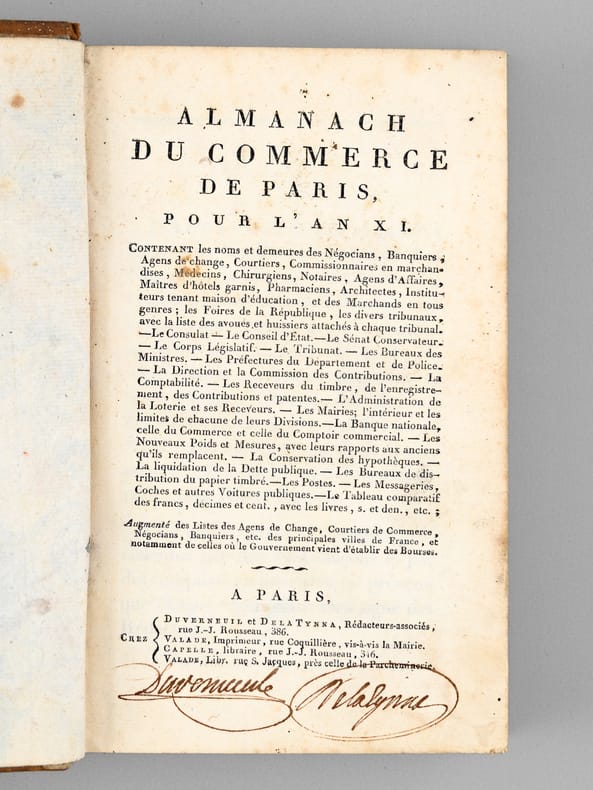
1802667681 vol. in-8 reliure de l'époque pleine basane racinée, dos lisse orné, Chez Duverneuil et De La Tynna, Capelle, Valade, A Paris, s.d. [ 1802-1803 ], 8 pp., 4 ff., cix-600 pp. avec un tableau dépliant