Dummies, Crash Test,Biblio.com

50 résultats
6009286like new. unknown
19792090502113715932Not Available 1979. Soft Cover. Fine. The book is in fine condition. Not Available paperback
19802090502113702442Not Available 1980. Soft Cover. Fine. The book is in fine condition. Not Available paperback
24360Auto safety pioneer long before Ralph Nader popularized the topic in "Unsafe at Any Speed" this University of Minnesota mechanical engineering professor 1931-63 patented the first retractable safety seat belt in 1963 and the "black box" flight recorder in 1960; he also improved hydraulic bumpers dashboards and collapsible steering columns. Signed First Day Cover 6½" X 3½" cancelled in Baltimore Maryland on 3 September 1965 and with "Firsy Day of Issue" boldly stamped. Single 5-cent "Stop Traffic Accidents" stamp at upper right. Fine. At lower left beneath the postal cancellation Ryan signs large and bold in blue ballpoint. Attractive and very scarce. unknown
20132090202120411270strange days 2013. Soft Cover. Fine. Number of books: 1 strange days paperback
19792090502113709239Not Available 1979. Soft Cover. Fine. The book is in fine condition. Not Available paperback
20061-0316017345Little Brown & Co 2006. SAL. New. 64 pages. 9.00x12.00x0.25 inches. Little Brown & Co unknown
1801206295.Gpaperback. Good. Access codes and supplements are not guaranteed with used items. May be an ex-library book. paperback
2006Q-0316017345Little Brown Books for Young Readers 2006-06-21. Hardcover. New. In shrink wrap. Looks like an interesting title! Little, Brown Books for Young Readers hardcover
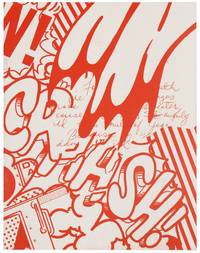
199230787New York: Sidney Janis Gallery 1992. Bright wrappers; close to fine. First Edition. Slim quarto. Exhibition catalog for show at Sidney Janis Gallery Mar. 5 - 28 1992. Descriptive catalogue of 18 exhibited works printed to verso of rear wrapper with five of these works illustrated by reproductions; four in color. New York: Sidney Janis Gallery unknown
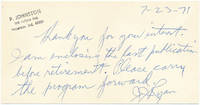
24444Auto safety pioneer long before Ralph Nader popularized the topic in "Unsafe at Any Speed" this University of Minnesota mechanical engineering professor 1931-63 patented the first retractable safety seat belt in 1963 and the "black box" flight recorder in 1960; he also improved hydraulic bumpers dashboards and collapsible steering columns. ANS 1p heavy stock 6¼" X 3¼" n.p. 1971 July 23. Near fine. Penned boldly in blue ballpoint. Nice note thanking an admirer and "enclosing the last publication before retirement." Closes off with a true crusader's salutation: "Please carry the program forward." A quite uncommon autograph. unknown
192026780Blackie & Sons 1920 HARDBACK NO DUSTJACKET GOOD Condition NO JACKET NO DATE circa 1920 . Reprint Book Condition: Good with FOXING to Interior pg & Light Wear. Grey pictorial covers with Green of 2 Women in Hats & Man Looking at Signpost near Trees . Top of spine split and damaged contents VG. 255 pgs NO ADS IN BACK corner dings NO ADS BACK Slight Lean bk. Hardcover. Fine/No Jacket. Blackie & Sons hardcover
19981708140531043Madacy Records 1998-11-03. DVD. Like New. DVD plays perfectly & the case looks good. Madacy Records unknown
193124565NY USA: Cupples & Leon Company 1931 HARDBACK NODustJacket1931 Early Edition Book Condition: GOOD- AS-IS. NOJACKET. 12mo . Red Illustrated Cloth hard cover of Boy on front with scuffs and stains Wear. Chap Book. Interior slight rub wear some lite stains Mild FOX 210 pgs ADS IN back ends with Motor boys on Wing Book spine FADED. Hardcover. Good/No Jacket. NY, USA: Cupples & Leon Company hardcover
24359Auto safety pioneer long before Ralph Nader popularized the topic in "Unsafe at Any Speed" this University of Minnesota mechanical engineering professor 1931-63 patented the first retractable safety seat belt in 1963 and the "black box" flight recorder in 1960; he also improved hydraulic bumpers dashboards and collapsible steering columns. PDS 3pp 8½" X 11" Los Angeles California 1967 October 10. Near fine. Single staple hole at upper corner; original light mailing folds. Mimeographed "Abstract" for a talk given by Ryan at the 11th STAPP Car Crash Conference at UCLA titled "The Hydraulic Bumper -- Automatic Seat Belt Package on Ground Vehicles." In the upper left corner of the first page Ryan signs and inscribes it bold in blue ballpoint: "J.J. Ryan to / Paul Johnston / 7-23-71." With original envelope. Quite unusual and scarce. unknown
0205140912.Ghardcover. Good. Access codes and supplements are not guaranteed with used items. May be an ex-library book. hardcover
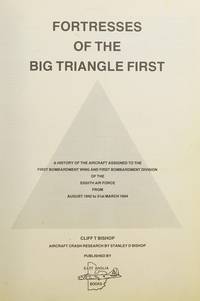
198690439Elsenham Bishops Stortford England: East Anglia Books 1986. First Edition and presumed first printing. Hardcover. Very good/Very good. The format is approximately 8.5 inches by 12 inches. 320 pages. Explanation of Terminology. Illustrations. Map. Tables/Tabular Data. Technical Data. Selected Bibliography. Research Sources. Index. Illustrated dust jacket. The dust jacket has minor wear and soiling. Slight corner bumps. Cliff Bishop is a Structures Design Engineer and the proprietor of East Anglia Books which specialized in U.S.A.F. and World War Two history. He served in the Royal Air Force in the 1950's. He had been personally involved in the dismantling and rebuilding of B-17 aircraft one for the Imperial War Museum. He researched the information for this work over a ten year period. His brother Stanley specialized in air crash investigating and research on missing aircrews. VIII Bomber Command of the United States Army Air Forces was established early in 1942. The first combat operations began in July with first heavy bomber operations in August. Its bomber units were deployed in the UK chiefly around East Anglia. From June 1943 it was the daylight bombing part of the Combined Bomber Offensive against Germany. It was redesignated as Eighth Air Force on 22 February 1944. The Eighth Army Air Force 8 AAF was a United States Army Air Forces combat air force in the European theater of World War II 1939/41–1945 engaging in operations primarily in the Northern Europe area of responsibility; carrying out strategic bombing of enemy targets in France the Low Countries and Germany; and engaging in air-to-air fighter combat against enemy aircraft until the German capitulation in May 1945. The 1st Bombardment Wing was initially formed in France in 1918 during World War I as a command and control organization for the Pursuit Groups of the First Army Air Service. It was re-established in the United States as the first wing formed in the reorganized United States Army Air Service created in August 1919 to control three groups patrolling the border with Mexico after revolution broke out there. As the 1st Wing the unit was one of the original wings of the GHQ Air Force on 1 March 1935. During World War II it was one of the primary B-17 Flying Fortress heavy strategic bombardment wings of VIII Bomber Command and later Eighth Air Force. It was inactivated on 7 November 1945. After the Pearl Harbor Attack initially supervised Heavy Bomber Operational Training at Tucson AAF. Re-designated as 1st Bombardment Wing and reassigned to VIII Bomber Command and deployed to England July–August 1942. In England mission was command and control of B-17 Flying Fortress bombardment groups stationed in East Anglia receiving operational orders from VIII BC headquarters and mobilizing subordinate groups for strategic bombardment attacks on enemy targets in Occupied Europe. Operated primarily from RAF Bassingbourn Cambridgeshire. Served in combat in the European Theater of Operations ETO from August 1942 until 25 April 1945 receiving a Distinguished Unit Citation DUC for an attack on aircraft factories in Germany on 11 January 1944. Returned to the United States in August 1945. Almost all the bomber and fighter groups and squadrons in Cambridgeshire were commanded by the First Bomber Wing in Brampton renamed the First Bomber Division and finally renamed in 1944 the First Air Division. By the war’s end the 8th Air Force was spread over 112 airfields across East Anglia flying B-17 and B-24 heavy bombers B-26 Marauder medium bombers P-38 Lightning P-47 Thunderbolt and P-51 Mustang fighters as well as Spitfires and Mosquito bombers provided by the RAF. Throughout the war the 8th Air Force dropped 700000 tons of bombs on Germany and occupied Europe flew 600000 bomber and fighter sorties and destroyed over 15000 enemy aircraft by air-to-air engagements ground strafing or by bomber crew engagement. 35000 men and women would serve with the 8th Air Force during the war with many thousands never returning home. Much of that enormous effort was planned and executed from the Grange in Brampton. East Anglia Books hardcover
1979428like new. unknown
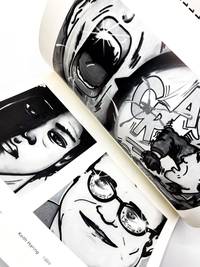
198330786New York: Sidney Janis Gallery 1983. Minor edge-wear to illustrated wrappers; near fine. First Edition. Thin quarto. Catalogue for the exhibition "Post-Graffiti" at Sidney Janis Gallery New York Dec. 1 - 31 1983. An important early catalogue marking the transposition of graffiti from the streets of New York to the white cube of the gallery featuring images of works by Jean-Michel Basquiat Daze Keith Haring Lady Pink Angel Ortiz and Kenny Scharf among other artists. With introductory texts by Dolores Neumann and Sidney Janis. Cover design by Crash. New York: Sidney Janis Gallery unknown
1941235251941. Northwest Airlines Flight 5 crash archive documenting one of the most deadly commercial aviation disasters in the carrier's early history pairing operational views of Northwest's Douglas airliners with contemporary evidence from the fatal October 30 1941 crash near Moorhead Minnesota. Flight 5 was a scheduled transcontinental Northwest Airlines route traveling from Chicago toward Seattle through Minneapolis Fargo Billings Butte and Spokane when its Douglas DC-3A-269 registration NC21712 encountered severe icing and poor visibility during approach. The aircraft plunged to the ground in fog and freezing conditions killing twelve passengers and two crew members. Captain Clarence F. Bates emerged as the sole survivor. The subsequent Civil Aeronautics Board investigation concluded that dangerous ice accumulation on the wings played a critical role in the disaster making the crash an important chapter in the evolution of commercial aviation safety during the final weeks before America entered the Second World War.<br /> <br /> Archive of four silver gelatin photographs and a contemporary newspaper clipping photographs approx 3.5" x 5" to 5" x 7" circa 1941. The photographs capture Northwest Airlines aircraft in active service during the same period as the disaster. One image shows a Northwest airliner standing on a frozen airfield with registration number NC21711 visible on the tail and prominent "Northwest" and "U.S. Mail Air Express" markings along the fuselage. Another view depicts a woman posing beside the company's large winged emblem with mail and express service markings visible near the tail section. A third photograph records ground operations beneath a Northwest aircraft as personnel stand near a baggage cart marked "Shell" illustrating the everyday routines of America's growing commercial airline network. A final image looks outward from above an aircraft wing toward the horizon placing the viewer inside the world of prewar air travel. The accompanying newspaper clipping dramatically contrasts these routine scenes with aerial views of the burned wreckage of NC21712 near Moorhead identifying the disaster the fourteen fatalities the role of fog and icing and Captain Bates' remarkable survival.<br /> <br /> The archive place the optimism and expansion of early commercial aviation beside the harsh realities of flying in an era when weather forecasting radio navigation aircraft de-icing technology and long-distance passenger service were still developing. Created less than six weeks before the United States entered World War II the archive captures Northwest Airlines at a pivotal moment when passenger travel air mail contracts and express cargo routes were rapidly connecting the Midwest Northern Plains Rocky Mountains and Pacific Northwest. The juxtaposition of aircraft operating normally in service with contemporary documentation of Flight 5's destruction transforms the group into more than a simple airline archive-it becomes a visual record of the risks ambitions and technological challenges of American aviation on the eve of wartime expansion.<br /> <br /> Light handling wear mild curling toning and creasing to the newspaper clipping; photographs remain very good. A tightly related aviation archive combining identifiable Northwest Airlines aircraft visible registration numbers airline operations and one of the carrier's most significant prewar disasters. unknown
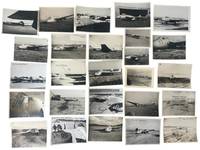
1957233541957. De Havilland Vampire jet photographs documenting French Air Force training accident inspection and air base control at Meknès Morocco in the years immediately following Moroccan independence with direct evidence of how Base École 708 recorded aircraft damage runway incidents and jet operations within the shrinking French military presence in North Africa. French military personnel are identifiable not through portraiture but through the administrative system embedded in the material itself: repeated verso stamps reading Section Photo 21/708 Meknès dated from 1957 to 1959 and technical annotations that turn the group into an official working record rather than informal aviation imagery. The historical force of the archive lies in that function. Meknès served as a major French fighter training center the de Havilland Vampire formed part of its early jet instruction program and the base remained active until its dissolution in 1961 placing these photographs within the last phase of French air force operations in Morocco after France recognized Moroccan independence in 1956.<br /> <br /> Photo archive of approximately 27 silver gelatin photographs approximately 4.5 x 3.5 inches each Meknès Morocco 1957 to 1959. The images center on multiple de Havilland Vampire aircraft marked with large fuselage letters including TT UA RD RG RE and UM photographed from the nose wing cockpit tail and runway line in a methodical sequence. Several prints isolate impact evidence and structural damage: one close view marks "traces de frottement" on a crushed nose section another labels "cockpit avion abordeur / plan gauche avion abordé" and others identify "vue générale" "vue 3/4 arrière" and "axe de la bande" showing that the planes were being recorded for inspection orientation and incident analysis. Additional photographs show grounded jets in grass beside the field aircraft parked on the tarmac in rows hangar exteriors and broad runway views with service vehicles nearby. The versos carry dated Meknès section stamps penciled numbering and occasional reference notes from French military photographic and cinematographic services preserving the bureaucratic chain by which the images were produced filed and cross referenced.<br /> <br /> The archive belongs to the first generation of French jet aviation in North Africa. The Vampire was among the earliest jet fighters used by the French Air Force and Meknès was one of the key training sites where pilots moved into jet instruction before the school later shifted to newer aircraft and eventually left Morocco. In that setting aircraft photography was not decorative; it was part of the operational machinery of flight training maintenance and accident inquiry. These prints preserve that machinery at the moment when French colonial authority in Morocco had formally ended but French bases and training institutions still operated on Moroccan soil linking jet modernization to decolonization and military retrenchment. Written notes and official stamps throughout; light handling wear from use otherwise well preserved. Overall good condition. unknown
1979428-nnew. unknown
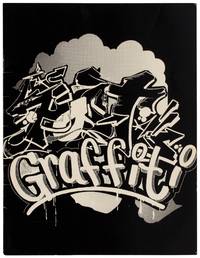
198453609New York: Sidney Janis 1984. First edition. Very good plus. Scarce catalogue of this early joint exhibition by graffiti artists Crash and Daze at the Sidney Janis gallery in New York. Artists and frequent co-exhibitors Daze and Crash were both born in New York City in the early 1960s and both began building a style and a reputation in their teens in the late '70s first meeting in 1977. In October 1980 Crash curated the first major graffiti show Graffiti Art Success for America at Fashion Moda in the South Bronx; Daze was first featured in a gallery space in 1981 in the Beyond Words exhibition alongside Jean-Michel Basquiat and Keith Haring. Crash's own portraits of Basquiat and Haring are among the nine pieces illustrated in this catalogue selected from the 18 and 19 works in each artist's exhibition checklist. 11'' x 8.5''. Original saddle-stapled black and white wrappers. 9 black and white plates. 8 pages. Light edgewear and rubbing to wrappers. (Sidney Janis) unknown
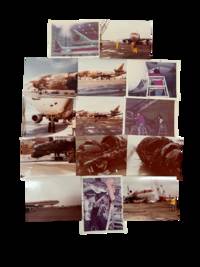
1978233051978. Continental Airlines Flight 603 disaster photographs documenting the burned wreckage and structural damage of the DC 10 runway overrun at Los Angeles International Airport on March 1 1978 one of the most consequential American aviation accidents of the late 1970s and a major catalyst for changes in tire safety standards rejected takeoff procedures and aircraft evacuation systems. Flight 603 a Continental Airlines DC 10 10 scheduled from Los Angeles to Honolulu attempted to abort takeoff after multiple tire failures near decision speed on a wet runway; the aircraft overran runway 6R at LAX the left main landing gear collapsed beyond the pavement fuel tanks ruptured and a major fire engulfed the underside and left side of the aircraft during evacuation. The NTSB recorded 2 deaths and 28 serious injuries in its formal report while later accounts place the eventual death toll at 4 after additional passengers later died from injuries sustained in the crash.<br /> Photo archive of 14 color snapshot photographs each approximately 3.5" x 4.5" Los Angeles International Airport California March 1978. The photographs show Continental Airlines McDonnell Douglas DC 10 10 N68045 after the accident resting heavily fire damaged on the runway and adjacent overrun area. Multiple images focus closely on the burned underside of the fuselage where large sections of aluminum skin have been completely burned away exposing the aircraft's internal rib structure wiring insulation and lower cabin framework. Other views show extensive scorching along the left side of the aircraft blackened and partially melted fuselage panels around the wing root and landing gear area collapsed structural sections beneath the passenger cabin and debris scattered across the wet runway surface. Several photographs widen outward to show emergency and recovery operations surrounding the aircraft including personnel service vehicles cranes and towing equipment positioned around the destroyed DC 10. One image records the full profile of the aircraft from a distance emphasizing the scale of the burn damage extending across much of the fuselage exterior. Together the photographs document not merely the existence of the accident but the specific physical consequences of the runway overrun and post crash fire: ruptured lower fuselage sections exposed aircraft structure burned cabin undersides and the recovery environment at LAX immediately after the disaster. <br /> Flight 603 became an important case study in late twentieth century aviation safety because the accident linked tire failure runway conditions aircraft stopping performance and evacuation survivability within the emerging era of mass deregulated air travel. The NTSB investigation led to recommendations intended to "significantly reduce the incidence of tire failures during takeoffs and rejected takeoffs" while later FAA and industry reforms addressed tire testing standards takeoff performance calculations and the durability and fire resistance of emergency evacuation slides. These photographs preserve the material evidence behind those institutional and engineering changes documenting the burned airframe and structural destruction that transformed Flight 603 into a major reference point in modern commercial aviation safety history. Minor wear from handling. Overall very good condition. unknown
30433Milan: Gabriele Mazzotta 1984. Near fine in near fine dust jackets; matching slipcase with very light soiling to the gray cloth else near fine. Uncommon in the deluxe edition. Deluxe Edition. Quarto. Two hardcover volumes in matching slipcase. Published to accompany an influential group show of American graffiti artists that traveled through Italy this monograph features essays from curator Francesca Alinovi and gallerist Tony Shafrazi printed in both Italian and English a hip hop glossary and mostly-color reproductions of works from the likes of A One Jean-Michel Basquiat Crash Futura 2000 Richard Hambleton Keith Haring Jenny Holzer & Lady Pink and Lee Quiñones along with artist bios. This deluxe hardcover edition features a second volume—Quattordio Graffiti edited by Italian art critic Tommaso Trini—reproducing newspaper coverage from the exhibition's stops through Bologna Milan and Rome and documenting works produced by Delta 2 Ero Phase 2 and Rammellzee during their artist residencies at the sponsoring IVI paint factory in the Piedmontese village of Quattordio. Text in Italian for this second volume. Milan: Gabriele Mazzotta unknown