205 résultats
1838List601Most Latin America 1838. Mostly Latin America 1809 - 1838. Over 150 pieces comprising over 280 pages .5 linear feet. The Massachusetts merchant Captain Eliphalet Smith Jr. 1780-1838 was a merchant trading primarily in Latin America during the Revolutionary Period. Described by the Chilean historian Diego Barros Arana as "an unscrupulous adventurer who saw in the countries struggling for independence nothing more than a field for his speculations" Smith bore witness to many seminal events in the continent's political history. These letters offer first-hand accounts of such events as the Sieges of Cadiz and Montevideo Admiral William Brown's victories in the Argentinian Independence War the Peruvian silver trade Simon Bolivar's arrival in Guayaquil and the battles of Real Felipe Fortress. <br /> <br /> Smith's business correspondence from the period sheds light on the pro-Regency networks active in the Americas during the period as his loyalties - like most merchants - were based on the Spanish Armada's control of trade. The tensions between Smith and the nascent Chilean government came to a head when goods from Smith's ship the Brig Macedonian were seized by Lord Cochrane Vice Admiral of the Chilean Squadron in two separate incidents in 1818 and 1821. The ensuing legal disputes would cast a long shadow over relations between the United States and Chile until the cases were resolved by international tribunal. The collection includes several original documents relating to the episodes including Smith's recollections of the events and several letters to investors describing the confiscated goods. <br /> <br /> Smith's efforts and their tacit support by the U.S. government make him a key figure in early relations between the United States and the new Latin American regimes. In 1822 an agent of the United States State Department acknowledged that "the Brigs Canton and Macedonian were for more than three years constantly violating blockades neutral and belligerent rights and supplying the royalists and flew the Spanish flag." Likewise historian Patricia Marks writes that Smith had business connections with Spanish merchants in Peru and refers to a quote from Viceroy to Peru JoaquÃn de la Pezuela: "Smith and the Macedonian became anathemas to the patriots. San MartÃn is reputed to have said that he did more damage to the cause of liberty than any other man." Historian Joseph Byrne Lockey points out that Smith's actions had greater implications regarding the perception of the United States in revolutionary-era Latin America: "The conduct of Captain Smith supported in so far as it was legal by the government at Washington contributed together with other incidents of a similar sort not a little to the dimming of the earlier impression of the Patriots that the United States would be in the struggle their friend and ally." <br /> <br /> The collection here consists of 153 documents from Smith's estate including letters received by Smith mercantile inventories and holograph copies of letters sent by Smith during the period. Correspondents include Smith's contacts in Latin America and his creditors in the United States. As a collection the documents relay scarce firsthand accounts of several seminal political events and map an extensive network of mercantile contacts and inventories. They are worthy of further research by scholars of the political history of Latin America and Spain and of early United States / Latin American relations as well as scholars of trade between China and Latin America. <br /> <br /> Overall the collection presents an uncommon opportunity to acquire primary source material from Latin America's Revolutionary Period. We find records from the Macedonian and Smith in the Forbes family collection at Harvard as well as some later documents relating to Smith's claims at the University of Virginia Special Collections. We find no publicly held examples of Smith's personal correspondence or papers prior to 1820. A full write-up and inventory is available in our PDF catalog. unknown books
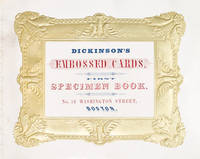
1842232013Boston: Samuel N. Dickinson 1842. Printed title in blue and red within an embossed gilt ornamental frame one printed "Notice" from the publisher dated June 1842 49 specimens of embossed cards many tinted some printed all mounted to stiff card stock; and 7 sheets of "Embossed Specimens of Printed Billets" sewn to a stiff printed card. Oblong 4to. Bound in an album of contemporary half calf and marbled paper boards with red leather label on upper cover stamped in gilt "Dickinson's Embossed Cards" calf shows much deterioration and corrosion although the sewing is still intact 28 specimen cards have been removed and are no longer present some minor soiling and foxing but generally vey clean and sound internally custom morocco backed folding box. Printed title in blue and red within an embossed gilt ornamental frame one printed "Notice" from the publisher dated June 1842 49 specimens of embossed cards many tinted some printed all mounted to stiff card stock; and 7 sheets of "Embossed Specimens of Printed Billets" sewn to a stiff printed card. Oblong 4to. Christian Gobrecht's Copy. With a very interesting presentation note from a previous Philadelphia owner Alfred Darrach dated 1928 affixed to the front pastedown identifying the original owner his grandfather as Christian Gobrecht 1785-1844 artist engraver embosser inventor engraver to the U.S. Mint and from 1840-1844 the 4th United States Engraver of the Mint where he was responsible for the creation of several new models and designs including the famous Seated Liberty design which appeared on a variety of American coins from 1836 through 1890. <br/>Gobrecht designed many notable medals coins and dies during his career but he also "invented a speaking doll and later a camera lucida. He also produced engravings for calico printers and dies for bookbinders. He engraved the brass dies for embossing the Morocco covers of the Boston Token from 1831 - 1836 as well as the eagle cover of the Philadelphia Token. Among the medals he engraved were the Charles Willson Peale medal the Franklin Institute medal etc ." - DAB.<br/>A remarkable specimen album in and of itself all the more so for having belonged to one of America's most important engravers. We cannot say for sure but it is entirely likely that if Gobrecht himself did not design many of the dies for this embosser he may have used the album for his own work and possibly removed the cards which are no longer present. Samuel N. Dickinson unknown books
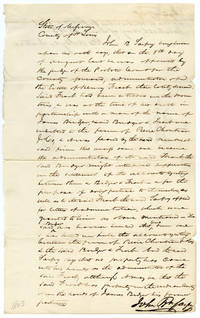
1843WRCAM42012St. Louis 1843. 1p. docketed on verso. Folio. Old fold lines; some separation at folds a few repaired with older archival tape. Quite clean and bright. Good. A remarkable window into the business dealings of famed mountain man Jim Bridger this signed manuscript affidavit of John P. Sarpy testifies to his actions on behalf of the estate of fellow fur trader Henry Fraeb who was killed by Indians in the Rocky Mountains. Sarpy who was a partner in the major firm of Pierre Chouteau & Co. had worked closely with Fraeb and knew him well. In his affidavit he writes about the Chouteau Company's concerns about Jim Bridger Fraeb's partner at the time of his demise and the difficulty of getting Bridger to pay his debts. Dated at St. Louis Sarpy's affidavit states: <br> <br> ".on the 8th day of August last he was appointed.administrator of the estate of Henry Fraeb then lately deceased. Said Fraeb had been a trader in the mountains & was at the time of his death in partnership with a man of the name of James Bridger & said Bridger & Fraeb were indebted to the firm of Pierre Chouteau Jr. & Co. & it was feared by the members of said firm that unless some one became the administrator of the said Fraeb the said Bridger might interpose difficulties in the settlement of the accounts existing between them & Bridger & Fraeb. & for the purpose of doing justice to themselves as well as to the said Fraeb the said Sarpy applied for letters of administration which were granted to him as above mentioned. The said Bridger has however since this time been here & has settled in full the accounts existing between the firm of Pierre Chouteau Jr. & Co. & the said Bridger & Fraeb. And the said Sarpy says that no property has come into his hands as the administrator of the said Fraeb although it may be that the said Fraeb has property in the mountain country or in the hands of James Bridger his former partner." <br> <br> Though he may have been one of the greatest and most beloved mountain men of all time Jim Bridger was not the best debt in the world nor did Pierre Chouteau & Co. forget business. unknown books
184324188St. Louis 1843. 1pp. docketed on verso. Folio. Old fold lines; some separation at folds a few repaired with older archival tape. Quite clean and bright. Good. Jim Bridger's bad debts.<br/> <br/>A remarkable window into the business dealings of famed mountain man Jim Bridger this signed manuscript affidavit of John P. Sarpy testifies to his actions on behalf of the estate of fellow fur trader Henry Fraeb who was killed by Indians in the Rocky Mountains. Sarpy who was a partner in the major firm Pierre Chouteau &. Co. had worked closely with Fraeb and knew him well. In his affidavit he writes about the Chouteau Company's concerns about Jim Bridger Fraeb's partner at the time of his demise and the difficulty of getting Bridger to pay his debts. Dated at St. Louis Sarpy's affidavit says that "on the 8th day of August last he was appointed.administrator of the estate of Henry Fraeb then lately deceased. Said Fraeb had been a trader in the mountains & was at the time of his death in partnership with a man of the name of James Bridger & said Bridger & Fraeb were indebted to the firm of Pierre Chouteau Jr. & Co. & it was feared by the members of said firm that unless some one became the administrator of the said Fraeb the said Bridger might interpose difficulties in the settlement of the accounts existing between them & Bridger & Fraeb. & for the purpose of doing justice to themselves as well as to the said Fraeb the said Sarpy applied for letters of administration which were granted to him as above mentioned. The said Bridger has however since this time been here & has settled in full the accounts existing between the firm of Pierre Chouteau Jr. & Co. & the said Bridger & Fraeb. And the said Sarpy says that no property has come into his hands as the administrator of the said Fraeb although it may be that the said Fraeb has property in the mountain country or in the hands of James Bridger his former partner." Though he may have been one of the greatest and most beloved mountain men of all time Jim Bridger was not the best debt in the world nor did Pierre Chouteau & Co. forget business. unknown books
1870WRCAM55334Osage Mission Ks 1870. Hand-drawn and hand-painted watercolor sign on a 14 x 18 3/4-inch sheet of cardstock. Pencil sketch for the same sign on the verso. Small chips at lower corners some light soiling. Very good. A remarkable and very attractive handmade sign for D.B. Gregory's livery stable in Osage Mission Kansas. Undated the style of the sign suggests a date of the 1870s. The center of the sign shows a lovely illustration in profile of a horse pulling a single-rider four-wheeled carriage along a dirt road. The text above the illustration reads "D.B. Gregory & Co." and below: "Livery & Sale Stables / Best Stock / Horse & Buggies / Main Bet. County & Neosho Strs. / Osage Mission Kan." The lettering is in black with blue and purple shadowing and "Osage Mission Kan." is drawn in a very ornate style. The entire sign is decorated with purple watercolor ornamentation. On the verso is a pencil sketch of the horse and the lower half of the carriage likely a preliminary sketch for the finished illustration. <br> <br> David B. Gregory born in 1846 in Iowa established his livery business with his brother in Osage Mission now St. Paul Neosho County Kansas by the early 1870s. An advertisement in the March 23 1873 issue of the OSAGE MISSION TRANSCRIPT describes Gregory's livery as having a "fine and well selected stock of horses and carriages.the best matched teams for style and speed in the city. Saddle horses for ladies and gents a specialty that defy competition." Settlers came to the region around Osage Mission in the 1840s following the founding of nearby Fort Scott in 1842. Osage Mission itself was founded in 1847 by Father John Schoenmakers as a mission to local Indian tribes and then grew into a town in its own right serving as a trading post and gateway for commerce and westward exploration. By the late 1860s it had grown to nearly 900 people with a hotel boarding house saloon stables general store hardware store and blacksmith. <br> <br> A rare significant and informative survival from the American frontier. unknown books
18052612Leipzig: E. Z. Steinacker 1805. 3 parts small oblong 4to 178 x 219 mm. 20; 18; "19" recte 20 pp. Each part with half-title only titles supplied on the wrappers. 12 plates of oval hand-colored tinted aquatints by Geissler. Occasional light foxing to text. Publisher's original pale green printed wrappers some wear and creasing sewing loose in part 1.Only Edition a high spot of nineteenth-century German book illustration a fine copy in the rare original wrappers. In impressionistic prose an anonymous author delivers a dozen diverting vignettes of salesmen and their customers at the annual Leipzig trade fair weaving stories around Geissler's masterly hand-colored aquatints. This delightful suite was issued in parts published to coincide with the two 1804 Leipzig fairs at Easter and Michaelmas and the 1805 Easter fair. Together Geissler's aquatints and the text portray fortunetellers a peep show and its barker performing jugglers and musicians Russian dancers Transylvanian and Greek merchants in their native dress shoemakers Jewish clothing vendors processions of horses for sale horse traders and peddlers and fraudsters of every ilk. One of the oldest trade fairs in Europe by the eighteenth century the Leipzig fair had become the main venue for trade with Eastern Europe a perfect artistic subject for Geissler who had spent most of his twenties traveling through Russia and the Ukraine.Geissler's first subject part 1 Scene 1 is a second-hand bookseller. Surrounded by trunks of dusty books and pictures this poorly dressed oddball is a master of patter. His efforts to sell two popular 17th-century prayerbooks Arndt's Paradies-Gärtlein and Michael Cubach's Gebetbuch to a couple of wary customers is rendered verbatim. Other than the fact that the books are recommended for their usefulness the tactics of persuasion have not changed in two centuries. Meanwhile in the background two street urchins "two sons of the Vorstadt poorer outlying areas of town from the Order of the Barefoot" steal a defective copy of a red-bound issue of the Taschenbuch "wishing to return it to precisely the place mentioned in the title" i.e. their pockets. A poor book collector arrives; he is granted credit. This inimitable scene is completed by two more characters a French emigré hoping to find a "La Fontainesque novel" for a few pennies and a poet for hire shown from the back in the aquatint whose tragi-comic portraits are gleaned from their clothing hairstyles and gestures as rendered by Geissler.Equally astute and moving are the portraits of Russians and Eastern Europeans who appear in five scenes. In the final chapter in part 2 the anonymous author - an "unnamed Leipzig man of letters a friend of Geissler's who worked for a Modemagazin fashion magazine probably Baumgartner's" Wustmann p. 23 - quotes Geissler's own description of the wild Russian dancing and singing of the last night of the fair in a moving paean to Slavic soulfullness sharply contrasted with Germanic stiffness.The son of a Leipzig goldsmith and mineral dealer Geissler had trained at the Art Academy there but his major influence was the illustrator Johann Salomo Richter from whom he learned the taste for hand-colored aquatint portraits of the common people and genre scenes of everyday life. Geissler spent 1790 to 1798 in Russia serving as the expedition artist with the German scientist Peter Simon Pallas on his travels in the Caucasus and southern Russia. On his return to Leipzig Geissler published the Pallas works as well as his own illustrated accounts of Russian customs and costumes. Creatively gifted Geissler was also skilled at marketing his works. He established close relations with Leipzig publishers for whom he produced numerous children's books. The present "Scenes from the Leipzig Fair" was his most important publication during the period between his return from Russia and the Napoleonic wars. He later produced illustrated reportages of the Battle of the Nations Völkerschlacht in Leipzig and individual war images for newspapers almanacs and even peep shows. In the US OCLC locates copies at Brown Rice University and University of Wisconsin. Lipperheide 828 DfG 5; G. Wustmann C. G. H. Geissler der Zeichner der Völkerschlacht Leipzig 1912 pp. 23-24 and 115 note 24;; Rümann Die illustrierten deutschen Bücher des 19. Jahrhunderts 1926 504; Thieme Becker 13:351-2. E. Z. Steinacker unknown books
18721427091872. TRADE CATALOGUE -- NURSERYMAN'S GUIDE. DEWEY D.M. Nurseryman's Specimen Book of American Horticulture and Floriculture Fruits and Flowers Ornamental Trees Shrubs Roses &c. D.M. Dewey's American fruit & flower plates colored from nature 2300 varieties. With a chromolithographic title page and 56 stencillled plates of fruits flowers and 9 chromolithographic plates plates of fruits flowers and trees. 8vo. 220 x 140 mm bound in contemporary morocco rebacked. Rochester N.Y.: D.M. Dewey n.d. ca. 1872. An early American trade catalogue of Fruit Flowers Trees and Nursery stock issued according to the Smithsonian Library "ca. 1872" by the firm of D.M. Dewey Rochester N.Y. Many of the plates have captions giving name of variety of plant and brief information on main characteristics and growing season. The Smithsonian copy contains only 24 plates compared to the 40 in the above copy. "Nurserymen's plates were an American innovation. They were made by various methods the most distinctive being painted in watercolors. In design and coloring these plates were more akin to folk painting than to the commercial art of their time" Charles von Ravenswaay "Drawn and Colored from Nature" in Antiques Magazine March 1983 pp. 594-599. Some minor wear overall in excellent condition. See Raphael. An Oak Spring Pomona Nos 63 to 66. unknown books
1900263502Lyon France: J. Bouvard & Cie 20 Rue Lafont 1900. 14 thick card sheets with samples centrally mounted vertically to recto and verso some sheets quite thick to accommodate larger epaulets each with manuscript notations of name size etc. 11-3/4 x 6-3/4 inches. Black cloth album with the printed label of "J. Bouvard et Cie Fabrique de Dorures Soireries Ornaments d'Eglise" to front paste-down. Some wear commensurate with age and use spotting and thumbsoiling apparently complete with all samples backing possibly restored at an early date. 14 thick card sheets with samples centrally mounted vertically to recto and verso some sheets quite thick to accommodate larger epaulets each with manuscript notations of name size etc. 11-3/4 x 6-3/4 inches. This very unusual French sample book contains a large range of epaulets and sequin samples with a few lettering and star samples. J. Bouvard & Cie 20, Rue Lafont unknown books
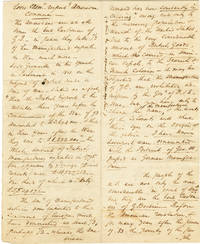
1807WRCAM56123Great Britain 1807. Manuscript written in eight columns on rectos and versos of two quarto sheets. Old folds two smalls spots of light soiling. Accompanied by four leaf typed transcription. Very good. An interesting but unattributed and apparently unpublished manuscript essay with a caption title reading "Loose Memo. Respectg. American Commerce." The gist of the memo is set forth in the first sentence: "The Americans are at all times the best customers of G.B. - in peace they take 1/3 of her manufactured exports - in War much more." In addition to the eager American market for British goods the author notes that British goods are often trans-shipped via America to other markets where Great Britain would not normally have access thanks to America's neutral status: ".you have only to change the name of the manufacturer & the wants of the Colonists will shut their eyes on the origin of the fabric. I have known Liverpool ware ornamented with the Portrait of Geo. III passed as German manufactures." <br> <br> The author notes that while the understandable economic downturn during the Revolution and for several years after the "peace of '83" resulted in some problematic credit relations between the U.S. and the British market much has changed. "The industry & the enterprise of our countrymen aided no doubt by the enjoyment of a neutral position has enabled them to throw off their dependence on the British merchant or manufacturer. They now have a sufficient capital of their own and a very important proportion of their imports are now paid for in ready money or in bills at short sight." The author explains that American merchants are able to export their surpluses of their own production and surplus British goods to the Continental market and transfer that money directly to creditors in Great Britain with an added perk: "The result of this species of trade must be ruinous to France. She is drained of her wealth to enrich & invigorate her enemy." <br> <br> Finally the author provides a specific example of this favored trading relationship with regard cotton. At this time the author estimates that Great Britain imports three- fifths of all cotton from the United States - some 150000 bags of cotton annually weighing 250lbs. each. The U.S. buys back nearly one-third of all cotton goods manufactured in Great Britain yielding a net profit of over £2.5 million to Great Britain. The author adds that this ratio holds for almost all raw materials produced in the United States. <br> <br> This essay was almost certainly written during the earlier part of the Napoleonic Wars; the author cites an 1801 speech by Lord Grenville which helps narrow the date range and it seems unlikely the Embargo Act of 1807 had been passed yet. Regardless the essay promotes Anglo-American trade and cooperation at least insofar as it enriches Britain and cripples France at a time when other forces were driving the two countries toward war. unknown books
187754690Indianapolis IN: Indianapolis Journal Co 1877. Trade catalogue. 8vo. 32 pp. 4-page inserted price list dated March 1877. Profusely illustrated with seven black and white wood-engraved plates four large black and white illustrations in text and five striking folding chromolithograph plates. Original printed green wrappers foxed. Very good. <br/>A scarce catalogue of heavy agricultural machinery with five brilliantly colored folding plates chromolithographed by Chandler Indianapolis depicting the "double canvass separator Hasselman separator oscillator thresher agricultural engine and the Eagle horse power." Romaine records nothing from this firm. OCLC locates several items from this firm but nothing before 1883. 1219. <br/><br/> Indianapolis Journal Co unknown books
189621325New York and elsewhere 1896. Folio. 14 1/2 x 12 inches. Approximately 350 larger ephemeral items and about 200 small scraps mounted on both pastedowns and recto and verso of 22 leaves. All leaves browned 3 leaves split vertically others with margins chipped some loosely inserted. Original rose-coloured glazed paper-covered boards lower cover blocked in blind and lettered 'Pat. March 76' in blind the upper cover blocked in gilt with three shaped raised panels with gilt borders enclosing chromolithographic images backstrip blocked in gilt corners rounded some fading to upper cover and backstrip inner hinges broken<br/> <br/>A spectacular album with an unusually rich assortment of advertising and trade cards including a selection chromolithographed designs of birds after Audubon.<br/> <br/>Internal evidence suggests that the album was probably assembled by a New York State resident living just south of Rochester - possibly from near Bath Cohocton or Canandaigua the patent date of the album gives a 'now earlier than' date whilst there are a number of dated items amongst the scraps the latest being 1896. Included are a large number of cards issued by local businesses as well as more national concerns like a fine series of six advertising cards for 'Wright's Indian Vegetable Pills" featuring toddlers playing baseball "Tum on ets' p'ay ball"; "See me tech it!"; "Aint dot out!"; "I'se bo'en home"; "I'se dot it!". There are also 33 'Arm & Hammer' bird cards after designs by John James Audubon 13 from the Arm & Hammer Brand / Church & Co. "Beautiful Birds of America" Collectors' Card 1st Series from 1894; the others probably from the second series. unknown books
1873002874Washington DC: Published by Order of the Secretary of War 1873. First Edition. Good. Six maps for: Monday February 17 1873 - 11 P. M.; Tuesday February 18 1873 - 7:35 A. M.; Tuesday February 18 1873 - 4:35 P. M.; Wednesday February 19 1873 - 7:35 A. M.; Wednesday February 19 1873 - 4:35 P. M.; Wednesday February 19 1873 - 11 P. M.; 8 3/4 x 11 1/2; relief shown by hachures and gradient tints; small reference table in the lower half of the image; edges brittle with small chips and cuts; overall in good to very good condition. A scarce collection of maps their publication began in January of 1871 with no less than 3 maps being published every day. Samuel Morse's invention of the telegraph had made it possible to easily observe gather and transmit data from different points over the entire country. A small note at the head read: "All observations made at the same moment of actual not local time." Released by the US Army's Signal Service the maps were intented to be primarily used by farmers and merchants. They were published in at least three different sizes and formats the current being one of the smaller ones. These particular maps showed precipitation and wind velocity at various elevation points. Published by Order of the Secretary of War unknown books
1801WRCAM44263Dieppe France 1801. 1p. printed circular letter on a folded folio sheet the blank fourth page addressed in manuscript and postmarked at Boston Oct. 23 1801 and with a "Ship" cancel. Docketed on the fourth page as well. Old folds some edge wear small tears at edges of fold fourth page torn from wax seal. Very good overall. An interesting and rare artifact of the attempt to rebuild French-American trading relations in the wake of the so-called "Quasi- War" between the two nations. The Quasi-War was an undeclared conflict between the United States and France during John Adams' administration in the late 1790s manifested mostly in naval engagements between the two nations. The war wreaked havoc on American commerce with France which only began to be rebuilt with the Convention of 1800. The present printed circular was created by "Le Baron fils" the former American consular agent in Dieppe and was apparently sent to a variety of American merchants encouraging them to once again send shipments of American goods to that French port. <br> <br> Not much is known of Le Baron fils though he did correspond with Benjamin Franklin and he served as the American consular agent at Dieppe for several years. This copy of Le Baron fils' circular was sent to prominent New York merchant and politician Nicholas Low and is dated in manuscript July "24." It is addressed to Low in manuscript on the fourth page and his name is also written in the upper left corner of the circular. In the printed text Le Baron fils states: "you may see by the inclosed Price Current of our Colonial & American goods not present here that our prices are more advantageous than in Bordeaux as we are more in the center of the Republick nearer to Paris Rouen Amiens and all the Chiefest manufacturing towns of France." Low is encouraged to "consign me some goods the sale of which shall be attended to with the greatest care and the proceeds of which will be sent to you either in goods from this country or in Bills on Paris London or Hamburgh at your choice." The printed text concludes by giving the names of the American consuls at Paris and Hamburg as well as two English trading houses as references to Le Baron fils' character. Le Baron fils adds in manuscript: "Mr. J. Clason & Mr. C. Codwise of yr place can give you an account upon my house in case you want quick information." unknown books
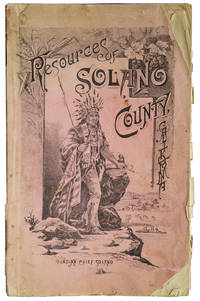
1887248583Oakland CA: Enquirer Print 1887. Numerous full-page plates plus one double-page plate and a folding frontispiece map. 84pp. In a half morocco and cloth folding box spine gilt. Original pictorial wrappers. Wrappers soiled and quite chipped especially at the edges and along the spine. Map edgeworn and with a closed tear in the center. Final four leaves chipped in upper outer corner else clean internally. A good copy overall. Numerous full-page plates plus one double-page plate and a folding frontispiece map. 84pp. A scarce promotional for Solano County California in the northeastern part of the Bay Area. The text gives a general description of the county with an emphasis on its agricultural potential and also includes in-depth looks at Vallejo Vacaville Suisun Benicia and other towns. The illustrations show prominent buildings homes ranches and the variety of agricultural crops cultivated locally. The map shows several of the townships of the county at a scale of six miles to an inch. Rocq 14643. Eberstadt 132:164 Enquirer Print unknown books
1887WRCAM42822Oakland: Enquirer Print 1887. 84pp. including numerous full-page plates plus one double-page plate and folding frontispiece map. Original pictorial wrappers. Wrappers soiled and quite chipped especially at edges and along spine. Map edgeworn and with a closed tear at center. Final four leaves chipped in upper outer corner else clean internally. A good copy overall. In a half morocco and cloth folding box spine gilt. A scarce promotional for Solano County California in the northeastern part of the Bay Area. The text gives a general description of the county with an emphasis on its agricultural potential and includes in-depth looks at Vallejo Vacaville Suisun Benicia and other towns. The illustrations show prominent buildings homes ranches and the variety of agricultural crops cultivated locally. The map shows several of the townships of the county at a scale of six miles to an inch. ROCQ 14643. EBERSTADT 132:164. Enquirer Print hardcover books
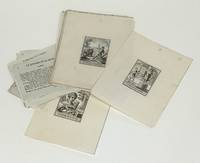
18256446A Paris: chez E. Jourdan quai des Augustins n. 17 1825. Sixteen numbered poems printed on trimmed laid paper the largest measuring 8 x 8.5 cm. accompanied by sixteen corresponding engraved plates sheet sizes circa 12.75 x 9.75 cm. and images 5 x 3.75 cm. The imprint is provided at the bottom edge of plates no. 6 and 14. Bonbon box trade cards to be collected by children the texts including fables and poems four apiece by La Fontaine Abbé Aubert Pierre- Louis Ginguené and Antoine Le Bailly. Near fine. Bibliographie de la France 1825 no. 825 records the following publication page 871: Dont la publication et la vente sont autorisées conformément à la loi du 25 mars 1822 art. XII et à l'ordonnance du roi du 1o mai 1822. 865. Douze Planches divers petits sujets pour bonbons. A Paris chez Jourdan quai des Augustins n. 17. chez E. Jourdan, quai des Augustins, n. 17 unknown books
1870315110New York: George Blackie & Co 1870. Woodcut illustrations throughout. 12mo. Publishers pink pictorial wrappers. Woodcut illustrations throughout. 12mo. Includes marked playing cards gambling and magic books magic tricks novelties and all sorts of curiosities and miscellany such as "False Moustaches that cannot be detected when worn" offered by New York wholesale agents George Blackie & Co. George Blackie & Co unknown books
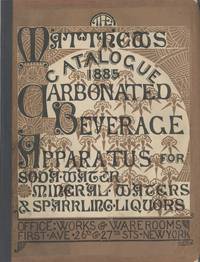
18857887New York: John Matthews Apparatus Co 1885. Quarto 104 pages. Fully illustrated. A lovely trade catalogue for this important manufacturer of bottling equipment soda fountains and carbonation apparatus. The fountains get progressively larger and more elaborate. Also includes siphon boxes for home delivery of soda water. Edges of wrappers and one or two pages with repair corners bumped. Some soiling throughout. In elaborately decorated printed wrappers. Good. Rare. OCLC locates just one copy in this series; Noling page 283. John Matthews Apparatus Co unknown books
18854833New York: John Matthews Apparatus Co 1885. Quarto 104 pages. Fully illustrated. A lovely trade catalogue for this important manufacturer of bottling equipment soda fountains and carbonation apparatus. The fountains get progressively larger and more elaborate. Also includes siphon boxes for home delivery of soda water. Edges of wrappers and one or two pages with repair corners bumped. Some soiling throughout. In elaborately decorated printed wrappers. Good. Rare. OCLC locates just one copy in this series; Noling page 283. John Matthews Apparatus Co unknown books
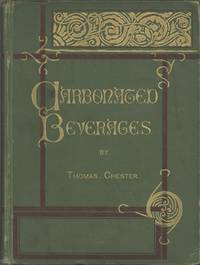
18826662New York: P.H. Reilly Wood-Cut and Color Printer 25 Rose Street 1882. Quarto 27 x 20.5 cm. 108 4 166 2 pages. Profusely illustrated. Text in two columns. Table of contents at rear. FIRST EDITION. An early - perhaps the first - history of carbonated beverages. Issued together with a trade catalogue for the soda water supply firm of John Matthews of New York an important manufacturer of bottling equipment soda fountains and carbonation apparatus. The fountains get progressively larger and more elaborate and with wonderful names: "The Citadel" "The Horicon" "The Adriatic" "The Fire-Eater" "The Nepenthe" and "The Snow Queen". There I also an outdoor soda fountain "The Street Spa". Also included are the auxiliary equipment of the carbonated water industry like siphon boxes for home delivery of soda water. The historical work and the trade catalogue were issued in celebration of the firm's 50th Anniversary. Some pencil scribbles to a few pages. Text block shaken; free front endpaper lacking. In publisher's brown and gilt-decorated green cloth corners rubbed and extremities a bit worn. Better than good. With the ownership signature of "Leopold F. Schmidt Deer Lodge Montana" and a more recent "Olympia Brewing Company". Very scarce. OCLC records two copies with this pagination Loma Linda Univ. & Hagley Museum and four copies with just 108 pages presumably just the history; Noling Beverage Literature page 104 for the 108 page version. P.H. Reilly, Wood-Cut and Color Printer, 25 Rose Street hardcover books
1816WRCAM39129London: Ordered by the House of Commons to be Printed 1816. 2pp. plus docket title printed on verso of second leaf. Folio. Early horizontal folds. Near fine untrimmed. Official Parliamentary draft printing of a commercial agreement between the United Kingdom and the United States passed just over a year after the signing of the Treaty of Ghent. The convention of commerce establishes that the same import and export duties be applied to goods carried by American and British ships in direct British- American commerce. Duties on and bounties for prize ships and goods are also put on the same terms. This version of the bill would have been printed while the question was being considered by Parliament. Not in Kress or TPL and not listed on OCLC. Ordered, by the House of Commons, to be Printed unknown books
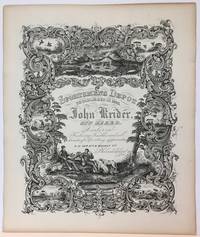
185061392Philadelphia PA: The company 1850. Engraved broadside 14 x 12 inches text executed in several sizes and styles of lettering. Krider was a long-time Philadelphia sporting goods dealer and sportsman and the author of Krider's Sporting Anecdotes 1853. Henderson p. 158 dating the broadside "ca. 1850". OCLC locates four copies Clements American Antiquarian Society Hagley Museum Library of Congress. Margins a little browned several short tears into margins but a very good example of a handsome sporting exhibition broadside. #8465. <br/><br/> The company unknown books
185051153Philadelphia: The company 1850. Printed broadside 14 x 12 inches employing several sizes and styles of type including several nice display types. Krider was a long-time sporting goods dealer and sportsman and the author of Krider's Sporting Anecdotes 1853. Henderson p. 158 dating the broadside "ca. 1850". OCLC locates a single copy Hagley Museum. A little browning in the margins but a very good example. <br/><br/> The company unknown books
1883236859Kansas City Missouri: Press of Ramsey Millett & Hudson 1883. Illustrated with 2 full-page Engravings. 76 pp. 1 vols. 8vo. Original wrappers printed in red and black. Vertical crease to front wrap and a few corners previously turned down a few prices realized in pencil. Very good. Illustrated with 2 full-page Engravings. 76 pp. 1 vols. 8vo. Over sixty-five Galloway bulls and heifers on the block giving detailed pedigree. With an introduction by Matthews explaining the his interest in the breed. Not in OCLC Press of Ramsey, Millett & Hudson unknown books
184336988London: Printed by T.R. Harrison 1843. Folio. 19 1 blank pp. New stitching light rubberstamp in upper blank portion of title page else Very Good.<br/><br/> England used her mighty naval power in a massive effort to stamp out the International Slave Trade. The major roadblock to a Treaty with the United States was English board-and-search tactics reminiscent of the objectionable practice that had helped to bring on the War of 1812. England claimed the right to board and search any vessel suspected of carrying on the Trade. The Earl of Aberdeen reports to Lord Ashburton on the "clamour about the right of search liberty of the seas &c." which "has already created so much excitement in the United States." Secretary of State Daniel Webster and his British counterpart settled the dispute in the Webster-Ashburton Treaty which also resolved the question of Maine's boundary with Canada.<br/> This publication treats exclusively the issues involved in the Slave Trade. The Correspondence describes "the nature of the stations or baracoons in which Slaves are collected on shore to be sold to the traders"; the areas of West Africa where the trade occurs; and the tactics of the ships which convey the slaves.<br/>OCLC 1007185044 2- Lib. Canada York U as of August 2020 and many facsimiles. Printed by T.R. Harrison unknown books