5 418 résultats
18821A Paris, Chez Desain (Leiden, Luzac), 1767. 4 volumes. (8), 411, (1) pp.; (4), 343, (1) pp.; (4), 331, (1) pp.; (4), 396 pp. 12mo. Contemporary marbled calf, spines richly gilt in compartments, red labels with gilt lettering, marbled edges, small damage to front joint of vol. 4. Higgs 4071; INED 12; Sabin 3726; Einaudi 55; Echeverria & Wilkie 767/2; JFBL A32; not in Kress (cf.: 6310); not in Goldsmiths. Second edition, originally published in 1766. In this his principal work Serionne rejected the Physiocratic theories of production and taxation; he also refused to accept the prevailing opinion that the population of France was diminishing rapidly. He strongly believed that the discovery of America had stimulated European agriculture and industry, improving levels of employment and that colonial commerce had itself contributed to an increase in the population of Europe (See: Spengler, French Predecessors of Malthus, pp. 315-321). After having run into serious difficulties in France, the author was forced to leave France. This edition with the 'Paris' imprint was apparently destined for export from Holland. - Half-title and first blanks slightly loose at foot in volume one, a very fine copy, with bookplate of G. de Ste Marguerite, very likely belonging to the family of De Bonnet, seigneurs de la Baume, de Saint-Marguerite et de Costefrède.
18389A Amsterdam, et se trouve à Paris, Chez Hochereau, Desaint, Lacombe, 1768. 3 parts in 1 volume. (2), 152 pp.; 69, (1) pp.; 201, (1) pp. 12mo. Contemporary marbled calf, spine gilt, red morocco label, gilt lettering, gilt stamped unidentified arms in upper compartment, marbled edges. Kress 6516; Goldsmiths 10441; Einaudi 4432; INED 273; Higgs 4373; Leblanc 99; Weulersse, i, pp. 160-161. First edition. I: Premier Traité sur le commerce des bleds.II: Second Traité Sur la Mouture des Grains, & sur le Commerce des Farines.III: Troisième Traité, sur la Fabrication et le commerce du pain, et sur le vrai moyen de pourvoir aux approvisionnements publics. Nicolas Baudeau (1739-c1792). Born at Amoise, Baudeau entered the church, becoming a Canon and Professor of theology at the Chancelade Abbey. He was subsequently called to Paris in the service of Archbishop de Beaumont. In 1765, Baudeau founded the periodical Ephémérides du Citoyen, at that time a journal defending the mercantile system, in oppostion to Quesnay and his followers. Baudeau however was converted to Physiocracy in 1766 by Mirabeau and he turned his journal over to the promotion of physiocracy. He was the editor till late 1768 when he handed editorial responsibility to Dupont de Nemours. Perhaps the most interesting of Baudeau's many writings is his systematic exposition and development of the Physiocratic theory of luxury, the most complete version of that theory and as such wrongly ignored. The Avis au Peuple 'est un livre pratique, semi-technique, puisqu'il s'agit de mouture et de boulangerie; une oeuvre d'expédient, pourrait-on-dire, écrite en vue de remédier d'urgence à la cherté, 'enfin d'aider aux vues saines et généreuses de l'Administration, qui en de telles circonstances porte seule le poids de la misère du peuple et de l'ignorance des subministrations'' (Weulersse). - Lacks the title-page to the third part. Very rare.
19368A Paris, Chez Despilly, Le Clerc, 1761. With engraved frontispiece. xvi, 341, (3) pp. 8vo. Contemporary marbled calf, spine gilt with raised bands, red edges. INED 382; Higgs 2578; Musset-Pathay 1514; not in Kress; Goldsmiths, and Einaudi. First edition. 'Agronomique. De la décadence de l'agriculture, du commerce et des arts dans la province d'Artois, et des moyens de les ranimer. 'Ce n'est pas dans la simple agriculture que consiste le seul bonheur d'un État; c'est dans tous les Arts de nécessité première'' (INED).Contains statistical information on all sorts of commerce in all sorts of products among which wine, cotton, fish, tobacco, etc. as well as on a large number of professions: Peintres, Boulangers, Bouchers, Traiteurs, Miroitiers, Potiers, etc. - Small stamp on title. Very good copy.
17247No place, 1769. With 1 folding table. 147, (1, Avis au relieur) pp. 8vo. Modern red half morocco, marbled boards, gilt lettering. Einaudi 2247; Higgs 4642; Leblanc, De Thomas More à Chaptal, contribution bibliographique à l'histoire économique, 290; not in Kress; not in Goldsmiths; not in INED. First edition.There are some copies of the first edition (and this is one of those copies), where the pages 122-124 contain a long note, not present in all copies of the first edition, which note refers to the session of the Parlement de Paris. In this note the author defends the Abbé Baudeau and his work Avis aux honnêtes gens qui veulent bien faire, a work which had become the subject of a request for its prohibition. Most copies of the first edition are without this printed note and in these copies the pagination jumps from page 123 to 126. Why this note was apparently withdrawn and no longer printed in later produced copies is unknown. During the discussion on free trade of grains several 'Parlements' gave their opinions. 'Celui de Dauphiné donnait solennellement, le 26 avril 1769, un Avis qui était une exposition magistrale de la doctrine physiocratique, d'une orthodoxie impeccable. 'Ouvrage excellent à tous égards, s'écrie Dupont en l'annonçant aux 'lecteurs patriotes' aux 'bons citoyens'; ouvrage que nos derniers neveux baigneront encore des larmes de leur reconnaissance, comme nous l'avons fait nous-même en le lisant.' ..... l'Avis fut rendu public. L'impression produite pouvait être si forte que le Parlement de Paris s'arrangea pour faire disparaître la brochure: 'Cet ouvrage est devenu bientôt excessivement rare, écrit Bachaumont, parce que le système qu'on propose à Sa Majesté est totalement opposé à ce que les Parlements de Paris et de Rouen ont écrit sur cette matière, et que cette première Compagnie n'a pas trouvé bon qu'on répandit sous ses yeux un écrit si contraire à sa façon de penser.' Le manifeste du Parlement de Dauphiné n'en émut pas moins l'opinion , et son succès rejaillit sur le parti tout entier' (Weulersse, i, p. 200). 'Le Parlement du Dauphiné se fait défenseur de l'Edit de 1764, donc de la liberté du commerce des grains et de la concurrence. Il s'élève contre les entraves et les limitations qui lui sont apportées' (Leblanc, op.cit.) - Extremely rare.
18196No place, 1769. With 1 folding table. 145 (misnumbered 147, pagination jumps from 123 to 126, text complete; 2, (Avis au relieur, blank) pp. 8vo. Contemporary blind paper covers with paper label on spine, very nice copy, entirely unpressed, with very wide margins and uncut. Einaudi 2247; Higgs 4642; Mattioli 334; Leblanc, De Thomas More à Chaptal, contribution bibliographique à l'histoire économique, 290; not in Kress; not in Goldsmiths; not in INED. First edition.There are a few copies which contain a long note on the pages 122-124, which note refers to the session of the Parlement de Paris. In this note, not printed in this copy, which is why the pagination jumps, the author defends the Abbé Baudeau and his work Avis aux honnêtes gens qui veulent bien faire, a work which had become the subject of a request for its prohibition. Copies with this note have consecutive pagination: why this note was apparently withdrawn and no longer printed in later produced copies is unknown, but it does explain the jump in pagination. During the discussion on free trade of grains several 'Parlements' gave their opinions. 'Celui de Dauphiné donnait solennellement, le 26 avril 1769, un Avis qui était une exposition magistrale de la doctrine physiocratique, d'une orthodoxie impeccable. "Ouvrage excellent à tous égards, s'écrie Dupont en l'annonçant aux 'lecteurs patriotes' aux 'bons citoyens'; ouvrage que nos derniers neveux baigneront encore des larmes de leur reconnaissance, comme nous l'avons fait nous-même en le lisant."....... l'Avis fut rendu public. L'impression produite pouvait être si forte que le Parlement de Paris s'arrangea pour faire disparaître la brochure: "Cet ouvrage est devenu bientôt excessivement rare, écrit Bachaumont, parce que le système qu'on propose à Sa Majesté est totalement opposé à ce que les Parlements de Paris et de Rouen ont écrit sur cette matière, et que cette première Compagnie n'a pas trouvé bon qu'on répandit sous ses yeux un écrit si contraire à sa façon de penser.'' Le manifeste du Parlement de Dauphiné n'en émut pas moins l'opinion , et son succès rejaillit sur le parti tout entier' (Weulersse, i, p. 200). In short, the opinion expressed in this text (in favour of free trade, competition, etc.) was quite the opposite of the opinion held by the magistrates, and hence they decided it was not a good idea to have a text circulate that was so opposed to their way of thinking. 'Le Parlement du Dauphiné se fait défenseur de l'Edit de 1764, donc de la liberté du commerce des grains et de la concurrence. Il s'élève contre les entraves et les limitations qui lui sont apportées' (Leblanc, op.cit.) - Extremely rare.
67761aafMaestricht, Jean-Edme Dufour, M. DCC. LXXV., (1775), in-8vo, frontispice gravé par Helman d'après Eisen + 2 ff. + 170 pp., cartonnage récent recouvert de papier marbré dans le style de l'époque, pièce de titre rouge doré au dos. Bel exemplaire.
60077aafParis, Imprimerie Impériale, 1857, gr. in-8vo, 2 ff. + 511 p. + 2 planches dépl. (Plan d'ensemble de l'exposition / Plan de la cérémonie de cloture le 15 novembre 1855), qqs rousseurs épars, qqs lignes rouges, tirage sur beau papier (Hollande?) epais, pt. timbre rouge ‘N’ avec tête d'aigle sur le faux-titre ainsi ce texte en bleu ‘Admirable travail / monument de la première exposition !’, reliure en demi-chagrin à nerfs verte, dos orné de caissons doré et orné d'une abeille, plat devant avec texte doré ‘Don de S.A.I. le Prince Napoléon Président de la commission impériale’, le verso aux armes de Napoleon. Qqs pt. traces d'usage et ou tâches, en tout un très bel exemplaire avec 3 tranches dorées.
18481A Amsterdam (Paris), 1775. 32 pp. 8vo. Modern half morocco, gilt lettering. INED 733 (Bourdon-Desplanches) & 2917 (Linguet); Kress 7134 (listed under Linguet but attributing it also to Bourdon-Desplanches); Einaudi 3413 (attribution to Linguet); not in Goldsmiths; not in Higgs; Leblanc 162 (listed under Linguet but attributing it also to Bourdon-Desplanches). First edition. The usual attribution of the Observations sur le Commerce des Grains is to Dupont de Nemours, see INED and Einaudi. However, Dupont de Nemours' work was written as early as 1770. The author of these Observations against which Bourdon-Desplanches writes, is G.J.B. Target. The complete title of Target's work is: Observations sur le commerce des grains, écrites en décembre 1769, Amsterdam, et Paris, Cellot, 1775. The text of Bourdon-Desplanches' vehement refutation starts: 'Vous venez, Monsieur, d'imprimer, en 1775, ce que vous écrivies, dites-vous, en 1769 .....' The Lettre à l'auteur .... has sometimes been attributed to Linguet, but Darline Gay Levy, who wrote an important study on Linguet, attributes this work to Bourdon-Desplanches (see page 354). Target's work was a plea in favor of freedom of trade in grain, while Bourdon-Desplanches' response is vehemently opposing the idea of absolute and unlimited freedom of trade in grain. - Small dampstain in lower inner margin, not touching any text.
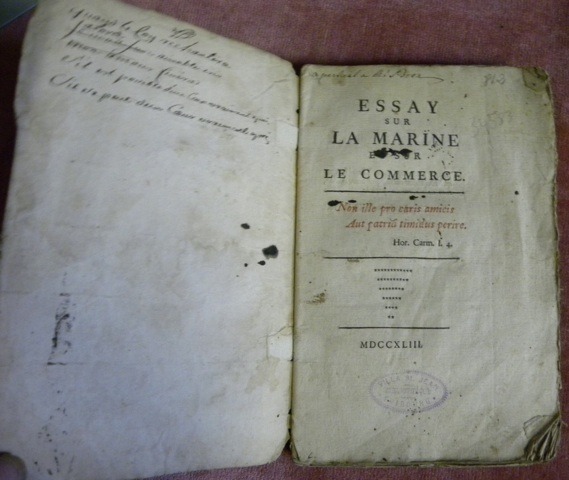
34584Sans lieu, 1743, 215x140mm, 176pages, broché. Couverture papier marbré, non rogné, coins cornés, cachet de bibliothèque sur la page de titre.
18138A Paris, De l'Imprimerie de d'Houdry, 1774. (2), xvi, 295, (1) pp. 8vo. Contemporary marbled calf, spine gilt with raised bands, label with gilt lettering. Kress 6996; Goldsmiths 11130; Einaudi 726; INED 859; Higgs 5973; Conlon 74:730; not in Mattioli. Scarce first edition. The author was director of the Compagnie des Indes. The work is entirely in favour of colbertism and insists on industrial expansion.
17841A Paris, Chez la veuve Duchesne, 1779. (4), xliv, 484, (12) pp. 8vo. Contemporary marbled calf, spine gilt with raised bands, label with gilt lettering, red edges. Musset-Pathay 1648; Kress B.179; Goldsmiths 11796; INED 885; McCulloch, p. 34 (note); Mattioli 474; not in Einaudi. First edition. 'Auteur très laborieux et très exact dans ces citations; il a traduit plusieurs ouvrages anglais sur le commerce .... Ouvrage extrèmement remarquable, le meilleur peut-être qui ait été écrit sur le même sujet. Il est très préférable à beaucoup d'autres très recherchés' (Coquelin & Guillaumin). '.... author of a very learned and able treatise 'Sur l'administration des Terres chez les Romains ....' (McCulloch). Important work on the republican virtues of Rome, it was the last published work by Butel.
18827A Londres, et se vend à Paris, Chez Le Breton, Desaint, Pissot, Lambert, 1755. xxiv, 336 pp. 12mo. Modern marbled boards, red leather label with gilt lettering. Kress 5421; Higgs 1030; INED 884; Goldsmiths 9028 (without the preliminaries); not in Einaudi; Conlon 55:545; Sabin 9602; JFBL B635; Howes B.1049; Leclerc 241; Echeverria, pp. 15n and 19; not in Muller. First edition, second issue ('Italic type' as identified by Echeverria & Wilkie) and without the errata on page xxiv and with the errata corrected. Butel-Dumont argues that Great-Britain owes her power and wealth to the colonies. He analyses the commerce and trade as well as the population of the British colonies at the time of the Guerre du Canada. With the outbreak of the Seven Years War, many of whose battles were to be fought in the New World, considerable curiosity about the British colonies was excited. This was one of the books profiting from this curiosity. It emphasized the phenomenal growth and prosperity of the colonies. 'This is the first extensive French text on the British North American colonies and was occasioned by the heightened tensions preceding the Seven Years War. It gives accounts of the geography, history, religion, government, economics, trade, and products of the several colonies' (Echeverria & Wilkie). According to INED this work was also attributed to Véron de Forbonnais. - Tiny hole in half-title and title, modern ex-libris on the front paste-down.
36554aafDresden, H. Klemm, o.J., (1898), gr. in-8°, X + 152 S., Stempel a.d. Titelbl., Original-Pappband.
24854A Londres, Chez Fletcher Gyles, dans Holborn, 1755. (4), 430, (6, Table des Chapitres) pp. 12mo. Contemporary half calf, spine gilt in compartments, gilt lettering, floral ornament in each compartment, green paper covered boards, all edges red. Kress 5423; Goldsmiths 8989; Einaudi 846; INED 933; Higgs 938; En Français dans le Texte, 159; Leblanc 57; Antoin E. Murphy, Richard Cantillon: entrepreneur and economist; T. Hutcheson, Before Adam Smith, pp. 163-178. First edition of Cantillon's great work, 'the most systematic statement of economic principles before Adam Smith's Wealth of Nations' (Roll, p. 121). 'The economic repute of Cantillon, for a time completely obscured by the glory of Adam Smith, can never have rested upon the popularity of his little book, now one of the scarcest works in economic literature .. The influence of the book is evidenced not only by the number but by the distinction of its students, including Gournay, Quesnay, Mirabeau, Turgot, and Adam Smith. It gave birth to Mirabeau's l'Ami des Hommes and apparently suggested much of the Tableau Oeconomique of Quesnay and parts of the Wealth of Nations .. Cantillon avoided, as Jevons has pointed out, the one-sidedness of the Physiocrats; and yet has been marked out as a Physiocrat .. Jevons thought Cantillon wrote 'with the scientific precision of a Cairnes or a Cournot,' and Prof. Marshall refers to his 'thoroughly scientific manner of discussion' .. In France the Essai has been pretty continuously read (see e.g. Ganilh, Des Systèmes d'Economie Politique, 2d. ed. 1821), and so stimulating and suggestive does it remain that its direct influence may be found to be not yet exhausted' (Palgrave, i, pp. 214f). Roll has called this work 'the most systematic statement of economic principles, before the Wealth of Nations' (History of Economic Thought, p. 121).Cantillon, a French banker of Irish extraction, was influenced by Petty, but his own influence was principally felt by the Physiocrat school: Higgs maintains that Quesnay took his fundamental principle of Physiocracy from the Essai. The Essai was written about 1730 and circulated in manuscript. Cantillon died in 1734 and the work was first published in 1755 in French, not in English, as stated on the title.The Essai has been quoted by Smith, Condillac, and Quesnay, plagiarised by Harris and Postlethwayt, and called by Jevons 'more emphatically than any other single work the cradle of political economy'. The work is divided into three sections: a general introduction to political economy, a treatise on currency, and a study of foreign commerce and exchange.'Since the 'discovery' of Cantillon by the English-speaking world following Jevons's enthusiastic article (1881), no less than justice has been done to the merits of the Essay .. Jevons himself noted that Cantillon had presented a treatment of currency, foreign exchanges, banking and credit which, judged against the work of its period, he felt to be 'almost beyond praise' .. It was likewise recognized as early as Jevons that Cantillon had set out the leading ideas of Adam Smith's 'important doctrine concerning wages in different employments' .. and that the Essay contained .. 'an almost complete anticipation of the Malthusian theory of population' (The New Palgrave, i, p. 318). - A very good copy.
177428805le cap-français - saint-domingue 1774 une SOMMATION D'HUISSIER (DOCUMENT ORIGINAL) (de 2 pages, manuscrites à l'encre brune sur papier vergé ligné filigrané : "I (coeur) P (coeur) F", format : 22 centimètres de large x 34 centimètres de haut, SOMMATION D'HUISSIER A LA REQUETE DE MME VEUVE DE LA BARONIE DEMEURANT EN FRANCE, REPRESENTEE EN CETTE COLONIE PAR LES SIEURS CLAVIER DE MINIAC ET CAMUZAT DE MAUROY NEGOCIANTS AU CAP (CAP-FRANCAIS - SAINT-DOMINQUE), POUR EMBARQUER 28 BARRIQUES ET DEMI DE SUCRES A BORD DU NAVIRE "LE QUARTIER MORIN" DE NANTES (PARTICIPATION DE FRANÇOIS BERTHRAND DE CUVRES ARMATEUR NANTAIS) , CAPITAINE SUBRA , QUI SONT ACTUELLEMENT CHEZ LE MAGASINIER VIAUD A L'EMBARCADERE DE LA PAROISSE DE LIMONADE, SUIVANT LA CONVENTION SIGNEE PAR UNE CHARTE PRIVEE SIGNEE PAR SUBRA ET LES SIEURS CLAVIER DE MINIAC ET CAMUZAT DE MAUROY NEGOCIANTS AU CAP, LE CAP-FRANCAIS, LE 5 DECEMBRE 1774, signature manuscrite in-fine de : JACQUES SAUVREZY HUISSIER AU CAP-FRANCAIS,
186323281863 Paris, Imprimerie Impériale, 1863, fort volume in-folio broché, 742 pages, publication du Conseil Supérieur de l'Agriculture, du Commerce et de l'Industrie, très bon état
18321A Paris, Imprimerie de Madame Huzard, 1821. 23, (1) pp. 8vo. Modern boards, morocco label with gilt lettering. Kress C.696; not in Goldsmiths; not in Einaudi. First edition. Claude-Anthelme Costaz was one of the founders, in 1802, of the Society for the Encouragement of National Industry (Société pour l'encouragement de l'industrie nationale.) He was also the one commissioned to produce statistical tables concerning manufactures and industry. He produced three of them which showed the situation and its development with the dates 1789, 1800 and 1812 as the three different points of measurement and comparison. The present text is 'en grande partie, extrait d'un ouvrage que j'ai publié, il y a environ quatre ans, sur l'Administration de l'agriculture, du commerce, des arts, des manufactures, et des subsistances. Lorsque je le rédigeai, je ne prévoyais pas que la France touchait au moment où l'on demanderait le rétablissement des corps de marchands et des communautés d'arts et métiers' (Avertissement).
17327A Amsterdam, chez Arkstée & Merkus, 1758. Together 2 works in 1 volume. 151 pp.; 206, (2, publisher's catalogue) pp.; (2), xxiv, 113 pp. Small 8vo. Contemporary calf, spine gilt with raised bands. First work: Kress 5597; Goldsmiths 9241; Einaudi 1383; Higgs 1478; INED 1227; not in Mattioli; Conlon 57:658.First edition.Coyer wrote his famous La Noblesse Commerçante ... in 1756. He outlined in this work the advantages for the noblity if they were to be engaged in commerce, and the advantages of a commercial active nobility for the State: development of commerce and trade, rise in population growth and consumption. The work generated a substantial polemic and against the many criticisms of his system the Abbé Coyer wrote this defense, particularly against the Chevalier d'Arcq's La Noblesse Militaire. Second work: Kress 5663; Goldsmiths 9395; Einaudi 397; Higgs 1728 (under Durey de Meynieres) & 1793 (under Belot); INED 391; Conlon 58:664. First edition.'C'est en répriment le luxe qui dévore les citoyens, énerve leur courage, dépeuple les provinces et dévaste les campagnes' (INED). - Preliminairies of the second work browned.
18489A Paris, Chez les Libraires Associés, 1764. vi, (2), 194 pp. 12mo. Contemporary marbled calf, spine gilt in compartments, gilt lettering, front joint with short split at head and foot. Kress 6183 (edition published in Rotterdam of 204 pp.); INED 1869 (edition published in Rotterdam of 204 pp.); Goldsmiths 9943; Einaudi 1929; Higgs 3343; Leblanc 244 (edition published in Rotterdam of 127 pages only); Conlon 64:787 (edition published in Rotterdam of 204 pp). First edition. Apparently there are at least three editions published in the same year, no priority established. Observations concerning economics, finances, justice, the army, education and population (the christian morals are favorable to population whereas luxury is not): deals furthermore with 'L'Argent', 'Du Luxe', 'Des Subsides', 'Des Obligations de la Patrie envers les Citoyens', 'De L'Administration des Finances', 'Des Impôts', 'Des Rentes', 'Des Pensions', 'Des Charges', 'Des Ambassades', 'Des Guerres', 'De la Discipline Militaire', 'Des Réformes', 'Des Désertions', 'Des Grades Militaires', 'Des Fondations', 'De L'Usure', 'Des Loteries', 'Des Monnoyes', 'Des Marchandises', 'Des Voitures & des Postes', 'Des Chemins', 'Des Mines d'Or & d'Argent', 'De l'Agriculture', 'De la Population', 'Du Commerce', 'De l'economie particuliere', etc.
16035No place, 1757. 2 volumes. (2), 302 pp.; (2), 392 pp. 12mo. Contemporary marbled calf, spines gilt in compartments, red labels with gilt lettering, marbled edges, small loss of calf to front cover of volume 2, very lightly rubbed. McCulloch 46; Kress 5600; Goldsmiths 9242; Higgs 1465; not in Einaudi; Conlon 57:669; not in Mattioli. First French edition, first published in 1744. The French translator, J.P. de Gua de Malves, added extensive comments and therefore this French version is sought after. Sir Matthew Decker, director of the East India Company, merchant and pamphleteer, was born in Amsterdam. In the present work he urges the replacement of all customs and excise duties by a single tax on the consumption of luxury goods - a kind of income tax with the merits, as it was conceived in the eighteenth century, that the taxpayer voluntarily assesses himself by choosing to consume such articles and to such an extent as he wishes. Decker argues strongly against restrictions on trade, emphasizing the significance of industry and trade to the welfare of the country. He would exempt the houses inhabited by the poor from all duties - not on grounds of social sympathy but because it would necessarily lower their wages and consequently increase the competitive strength of British exports; he advocates the luxury tax because it would check luxury, the bane of virtue and industry. He was opposed to monopolies and bounties and was skeptical as to whether trade can ultimately be forced into 'an unnatural channel,' thus anticipating the discussion on the operation of natural laws in the economic world. In some respects he is considered an important precursor of Adam Smith. 'The first part of the work is devoted to a detailed criticism of the fiscal difficulties under which England is labouring; the second part to showing the intricate connection between the trade of a country and the value of the land; while in the third part Decker displays the great sources of wealth and prosperity possessed by England (and over her two chief rivals, France and Holland), and shows how the references he suggests would permit her to avail herself of these, her natural strength' (Palgrave, i, p. 519).
7253aafAmsterdam, J.C. van Kesteren, 1824, in-8°, VI + 294 S. / IV + 286 S., mit insgesamt 2 gestochenen Titelblättern mit Kostümen und 4 Ansichten. Band 2 teils mit kleinem Wasserfleck in der oberen Ecke, leicht gebräunt, Halbleinenbände mit etwas Rverg., die Kapitäle etwas beschabt. Sehr gutes Exemplar.
18768A Amsterdam, Chez J.L. de Lorme, 1704. Title printed in red and black. With 1 folding table. (10), 317, (1) pp. 12mo. Contemporary calf, spine gilt with raised bands, red label with gilt lettering. Kress 2421; Goldsmiths 4038; Einaudi 1626,note; Sabin 98172n; Alden & Landis 704/56; Echeverria & Wilkie 704/7; not in Howes; not in Streeter; not in Leclerc; not in Muller; not in JFBL. The best edition, with extensive notes added. One of at least 7 editions published in 1704. Originally published in 1703. As a matter of fact there never was an English edition, but the author apparently preferred to pass it off as such to avoid problems with the authorities, since he represented the French court as an ambassador in The Hague. Anti-British work that surveys British trade and commerce in Europe and that with the American colonies and the Indies predicting that the Navigation Acts will result in revolt and independence for the British North American colonies. "Sets out the advantages and disadvantages of the Spanish War of Succession to Great Britain's commercial interests, together with the advantages to Spain of free trade in her colonies. This work is remarkable as containing a distinct prophecy of the revolt of the American colonies from Great Britain" (Encyclopaedia Britannica Online).
27205A Paris, Chez Cellot & Jombert, 1778. [2], 452, [4, Privilege du Roi, Fautes à corriger, blank] pp. 12mo. Contemporary marbled calf, spine richly gilt in compartments, label with gilt lettering, red edges, a nice copy. Sabin 21037; Leclerc 868; Faÿ 11; Howes D.528; Monaghan, French Travellers in the United States, 580B; Muller 1597; not in Streeter sale; not in Kress; not in INED; Echeverria, Mirage in the West, p. 74; Echeverria & Wilkie, 778/20; Chadenat i, 813. First edition of this important work dealing with the War of Independence of the British colonies. An early French account of the Revolution, published about the time of the French entry into the war on the side of the Americans. "Day-by-day account of events from Gage's arrival at Boston until French recognition" - Howes. The author favours free trade with the American colonies, which had just been officially recognised as an independent state. Pp. 433-450 contain: Traité d'amitié et de commerce conclu entre le Roi et les Etats-Unis de l'Amérique septentrionale, le 6 février 1778 and U.S. Declaration of Independence: Declaration des Répresentans des Treize Provinces-Unies de l'Amérique, assemblées en Congrès-Général, le 4 juillet 1776 (pages 340-351.)
18629A Paris, Chez Nyon, Didot le jeune & Saugrain le jeune, 1762. xxxvii (misnumbered xxxvi), (3), 389, (3) pp. 12mo. Contemporary marbled calf, spine gilt with raised bands, red label with gilt lettering, corners very lightly bumped. Kress 6015; Goldsmiths 9786; Einaudi 1688; INED 1644; Higgs 2771. First edition of a study on the relationship between the value of coinage, citing numerous sources, grain prices and other vital commodities. The avertissement compares various European currencies and attempts to establish their real value by referring to workers' and soldiers' wages and assessing their purchase powers, while the introduction proposes a way of determining a fair price for wheat. The author's approach is predominantly historical (the title refers to a 794 edict which fixed the price of grain), providing a wide variety of statistical information. - Title-page and a few pages very lightly spotted.
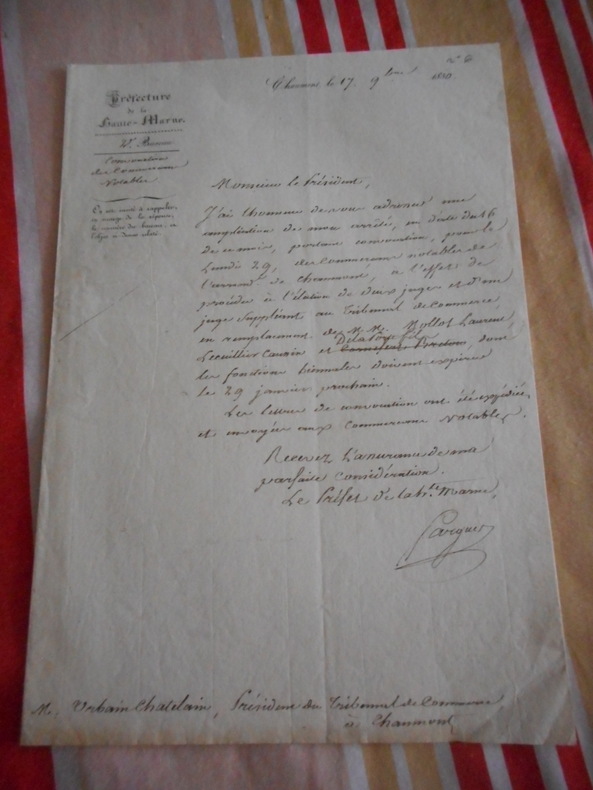
183049953Lettre manuscrite de Fargues, éphémère préfet de la Monarchie de Juillet, pour la convocation des commerçants notables, pour voter au renouvellement du tribunal de commerce de Chaumont. Président du tribunal de commerce = Urbain Chatelain.