5 417 résultats
18066A Amsterdam, Chez Jacques Coeur, à la corne d'Abondance (Paris), 1756. 3 volumes. xii, 372 pp.; 406 pp.; 350 pp. 8vo. Contemporary marbled calf, spines richly gilt in compartments, labels with gilt lettering and numbering. Mars 27; Weulersse, i, p. xxvii; Kress 5526; Goldsmiths 9082; Einaudi 2659; Mattioli 1481; INED 2079; Higgs 1145. First edition, second issue. Einaudi's copy is identical with ours, about the Kress and Goldsmiths copies not much can be said, both collections contain more than one copy and they both indicate that there is one copy with a third volume with the indication 'Nouvelle édition', as does our third volume. According to Mars, Ange Goudar, cet inconnu, essai bio-bibliographique, the third volume came from the same press as the first two volumes but with a different ornamental typography. Between the first issue and this issue, there appeared, according to Mars, a parisian contrefaçon, all published in 1756. This is the main work of Goudar. It was used by the demographer Süssmilch in his Die goetliche ordnung. Voltaire had a copy in his library and Diderot wrote about the book in a letter to Sophie Volland. Preceding Mirabeau's l'Ami des Hommes by a few months, it marks an important date in the history of political economy, and made Goudar one of the leading figures of the school of 'des agrariens et populationnistes', not to be mixed with the Physiocrats, which they preceded and with whom they disagreed on various points. 'Of the pre-physiocratic French writers who approached the population problem in terms of agricultural values and reforms, Ange Goudar (1720-1791) was the most important' (Spengler, French predecessors of Malthus, pp. 56-67.) Spengler's analysis is elaborate and shows the crucial importance of this work. - Some corners somewhat damaged.
17250A Paris, Chez Henrics, Brumaire An 9 (octobre 1800). iv, 350, (2) pp. Large 8vo. Contemporary tree calf, spine richly gilt in compartments, red label and gilt lettering. Kress B.4197; Goldsmiths 17829; Einaudi 2859; not in Mattioli; INED 2232; Stourm, p. 318; Catalogue de l'Histoire de France, iii, p. 211. First edition. Deals with the political situation of France in comparison with the other European nations: The political situation before the war; General thoughts on the present situation of France; Present situation of France considering its allies; Present situation of France considering its ennemies; Present situation of France considering the neutrals; Internal situation of France, followed by two chapters dealing with: 'Population et industrie de la France' and with 'Moeurs et Lois de la France.' According to Barbier the work was composed not only under supervision of Talleyrand but even partly written by him. Alexandre-Maurice Blanc de Lanautte, Comte d'Hauterive, was diplomat and economist, born in Aspres (Hautes-Alpes) on 14 April 1754. He went with Choiseul-Gouffier to Constantinopel, spent some years in New York, and returned to France in 1798 and started working for the Ministry of Foreign Affairs. From the 18th Brumaire to the fall of the Empire he was involved in all the major negociations of the period. - Small hole in half-title, occasional light spotting, small library stamp on half-title, a very attractive copy.
15440A La Haye, Chez Pierre de Hondt, 1739. Titles printed in red and black, with folding table on two sheets and 1 engraved plate. 6 volumes in 3. (2), 204 pp.; (2), 312 pp.; (2), 208 pp.; (2), 286 pp.; (14), 294 pp.; (18), 246 pp. Small 8vo. Modern overlapping vellum, red morocco labels. Kress 4447; Goldsmiths 7712; Einaudi 3728; INED 1553; Mattioli, 2247; Conlon 39:427; JFBL M162; European Americana, 739/191; not in Sabin. The only edition of this important work. An account of the financial operations of John Law and his 'Compagnie des Indes', including a great number of important memoirs, letters patent, decrees, declarations, etc. Barthélemy Marmont du Hautchamp (1682 - ab. 1760) was an admirer of John Law's system and his book is not written without partiality but has yet been recognized as the best contemporary history of the system and its most precious source. John Law's operations began with the foundation in 1716 of the 'Banque Générale', soon afterwards renamed 'Banque Royale'. This was followed by the scheme of colonization known as 'Mississippi scheme' in the 'Compagnie des Indes' which, by absorbing various other chartered companies, acquired the monopoly on the trade to America, Africa and China. Moreover, the company obtained the monopoly of tobacco, the control of the mint, the payment of the national debt, and the farm of the taxes. Within a few years Law's companies thus got almost complete control over France's overseas trade, its currency and public finances, to the extend that Law's companies at one point owned more than half of the then known United States. In 1719 the 'Compagnie des Indes' and the 'Banque Royale' were united, and the promising outlooks of the new company lead to an unprecedented speculation in its shares. As known the bubble burst in 1720, cash payments were suspended and Law fled from the country, leaving behind ruined many of his former supporters.The last 2 volumes contain the full texts of the 'mémoires', 'letters patentes', 'édits', 'déclarations', 'arrêts', etc., mostly by the Conseil d'État, as well as many other documents of which many are dealing with the 'Compagnie d'Occident', and the 'Compagnie des Indes Orientales et de la Chine', on which documents the author based this thorough and important history.Marmont du Hautchamp was born in Orléans and fermier des domaines in Flanders. He was also the author of the famous and very rare Histoire générale et particulière du visa (also published in The Hague, in 1743) which also dealt with the activities of John Law and the Mississippi bubble.
16593A Berlin, 1757. iv, xviii, 435, (1) pp. 12mo. Contemporary marbled calf, spine richly gilt with raised bands, gilt lettering, red edges. Higgs 1474; Kress 5617 (incomplete copy); Weulersse, i, xx; this edition not in Goldsmiths, Einaudi & INED. The best edition. Including the 'Arrêt du Conseil d'Etat du Roi, qui, entr'autres dispositions, ordonne que le commerce de toute espèce de grains sera libre entièrement par terre et par les rivières, de province à province, dans l'intérieur du Royaume. Du 17 Septembre 1754', to which referrence is made in the Avertissement. The basic importance of agriculture in the life of the French nation was equally emphasized by C.J. Herbert, who held labor and land to be the primary resources of a nation, and agriculture its basic industry. Upon agriculture depended a nation's power and wealth, its ability to colonize, the fruitfulness of its commerce, and the capacity of its territory to support population. Having demonstrated the basic importance of agriculture to the political and economic strength of France, Herbert indicated that French agriculture was languishing, and its revivification was essential to the aggrandizement of the nation and to the felicity of its inhabitants; ..... Herbert advocated the improvement of grain markets and prices through inauguration of the right to export grain, modifications in the tax system, and the establishment of a research bureau to discover how agriculture could be improved, and why some provinces were more favorable to agriculture, manufacturing, and population growth than others. (Spengler, French predecessors of Malthus, pp. 67-72). Valuable work, cited with praise by Adam Smith.
16124A Paris, Chez l'auteur, Moutard, Desenne, 1789. 32, 176 pp. 8vo. Modern half vellum, marbled boards, vellum corners, label with gilt lettering. Kress B.1655; Goldsmiths 13928; Stourm 190; INED 3007; Martin & Walter, i, 8288; Monglond, i, p. 244, all listing copies in which the 32 preliminary pages are lacking, as almost always. First edition. The first 32 pages which are apparently nearly always lacking contain: "Adresse à l'Assemblée nationale, ou précis des élémens du plan général." A new financial system proposed, followed by 25 projects of decrees. - First two leaves a little stained.
16748A Paris Debeure 1756. In-8° relié (17 X 10 centimètres), pleine basane de l’epoque, dos orné à nerfs, XII-251-344 pages. Assez bon état, frottement au dos,aux coiffes et coins.
50659aafZürich, Buchdruckerei K. Neidhart & Co., 1951, in-4to, 98 S. ill. mit Zeichnungen v.Rolf Gfeller + 34 Tafeln mit Fotogr. Abb. Nikolaus Vonwiller (Vintage Einkaufszentrum !) (3 Falttafeln). Original-Pappband,
17054A Amsterdam, et se trouve à Paris, Chez A.M. Lottin, 1760. xii, 335, (1, errata) pp. 8vo. Contemporary marbled calf, spines richly gilt with gilt lettering, very, very lightly rubbed. Kress 5864; Goldsmiths 9570; Higgs 2216; Leblanc, De Thomas More à Chaptal, 380; INED 2428; not in Einaudi; Conlon 60:867. First edition. 'Deux parties dans cet ouvrage: la première est consacrée au commerce dans l'Antiquité et à l'époque contemporaine; la seconde concerne les diverses branches de la production, les banques et les manufactures' (Leblanc, op.cit.) - Copy from the Fürstlich-Starhemberg'sche Familien Bibliothek Schloß Eferding.
16078A Amsterdam, 1770. (12), 557, (5) pp. 8vo. Contemporary marbled calf, spine gilt with raised bands. INED 2756; Einaudi 3297; Goldsmiths 10608; Higgs 5135; not in Kress. First edition. 'Chaque article est accompagné d'abondantes reférences bibliographiques' (INED). Interesting overview of the political and economic thought of the Enlightenment, including long chapters on Holland, Great Britain, political economy, commerce, women, liberty, Rousseau, colonies, etc., etc. The bibliography on political economy is found under the word 'connoissance' and deals mainly with the physiocratic school, each entry contains an important bibliographical section.
1881235Paris, Imprimerie typographique Kugelmann, 1881 In-8, reliure postérieure bleue nuit, coiffes et coins usés. XIV-888 pages
24728A Paris, Chez Humblot, 1776. xiv, (2), 410 pp. 8vo. Contemporary marbled calf, spine gilt in compartments, red label with gil lettering, red edges, corners and spine-ends very rubbed. This edition not in Kress, Goldsmiths, Einaudi and INED. Rare edition, the address of Humblot is pasted over the address of earlier editions, Pissot. Necker condemned the physiocratic doctrine of free trade and was in favour of government control. The physiocrats attacked his ideas with much energy. In 1789 Necker got a chance to put his ideas into practice, which led to disastrous results.
19320A Paris, Chez Vallade, 1776. (8), 724 pp. 4to. Contemporary marbled calf, spine gilt with raised bands, red label with gilt lettering, red edges. Kress 7236; Goldsmiths 11424; Einaudi 2155; Camus 2132; Pardessus, Bibliothèque de Jurisprudence Commerciale, 59; not in INED. First edition and rare. Dedication to Hue de Miromesnil, followed by an Avis du Libraire. The main work is divided into two parts: the first deals with the 'Assertions Consulaires' from the edict of 1563 by which the Juge-Consuls of Paris were created and all following legislation and further creation of similar positions; the second part deals with the 'Lettres de change & billets de Commerce' and contains a collection of (legal and commercial) propositions concerning trade, commerce and business. The author also shows how, based on the same principles, opposing views and even contradictory legislation has grown in time. This work collects many documents and laws and regulations issued over the previous centuries with the relevant jurisprudence and is a very interesting and useful sourcebook. - Very good copy.
17189A Amsterdam, Aux dépens de la Compagnie, 1754. Two works bound in one volume. 258 pp.; (2), xiv, 186 pp. 12mo. Contemporary marbled calf, spine gilt in compartments, red labels with gilt lettering, joint lightly rubbed. First work: Kress 5376; Goldsmiths 8914; Einaudi 4196; INED 3409; Higgs 738; not in Mattioli. Second edition, published in the year of its first publication. 'Economique. Richesse acquises par la France depuis Henri IV grâce à son commerce maritime; état de la Grande Bretagne, puis celui de la France de Louis XV comparé à la France de Louis XIV; nécessité du commerce maritime; examen de la traite des nègres, des colonies, du commerce du Nord, etc.' (INED). ). Deals with the colonies both French and English, Canada, etc.'Devenuz assez rare' quoted by Higgs. Pierre-André O'Heguerty, Comte de Magnières (1700-1763), was received in 1718 as 'avocat au Parlement de Paris' and became the President of the 'Conseil supérieur de l'Ile de Bourbon' in 1741. The above work was published in 1754, and reprinted in 1756 at the end of the Discours politiques de Hume. This is the second seperate edition. In this work he gives a translation of the Navigation Act, suggesting that such an Act should also be developped for France (Leblanc, De Thomas More à Chaptal, 381).The folding plate gives the 'produit du travail des nègres.'Second work: Kress S.3978; Higgs 766 (erroneously claiming 2 volumes); cf.: Goldsmiths 8818; INED 1734 (both listing the 1753 edition); not in Einaudi.Second edition.The first edition appeared in 1753. Includes remarks on the introduction of luxury through the system of John Law. The author's name spelled on the titlepage as: Deon de Beaumont. Copy with the pages 93/4 and 119/20 in the revised version, the cancelled versions removed. Annotations on first flyleaves and title. - Stamp of Ville d'Orange, Bibliothèque Municipale on half-title of second work and on the last page of the first work, second stamp Bibliothèque d'Orange on half title second work, half-title of second work strengthened in inner margin and repaired on verso, armorial ex-libris 'Lud. de Sausin' on front paste-down, a little foxed, author's name in ink on title of first work, and some contemporary handwritten notes on the front free blanks concerning these works and the authors.
17127A Leyde, 1754. Title printed in red and black. vi, (8), 408 pp. 12mo. Contemporary marbled calf, spine richly gilt with floral ornaments, red morocco label with gilt lettering, red edges. Kress 5381; Goldsmiths 8916; Higgs 742; Leblanc, De Thomas More à Chaptal, 123; Mattioli 2861; Weulersse, i, p. xix; INED 3607; not in Einaudi (other editions); not in Menger. Second edition. In all, four editions were published in 1754. The work was being published as a translation but was actually written by Louis-Joseph Plumart (or Plumard) de Dangeul who used the pseudonym of John Nickolis. 'd'Argenson admire beaucoup cet ouvrage, qu'il place même audessus de l'Esprit des Lois de Montesquieu' (Stourm, p. 98). 'Documentation particulièrement riche, accompagnée d'observations personnelles sur la population, les classes sociales, le commerce, l'économie' (INED). 'Mid-eighteenth-century populationism is best represented in the works of Plumard de Dangeul, Goyon de la Plambaine and Jaubert. Dangeul was concerned primarily to combat celibacy, the principal check (in his opinion) to population growth; for he looked upon such growth as a ''certain sign'' of the "health of the body politic'', as a stimulator of agriculture and manufactures, and as a partial source of relief to the taxpayers (the cost of government being relatively fixed).' 'The forces unfavorable to population growth operated more powerfully in some social classes than in others. Both the marriage rate and fertility within marriage were lower in the military class than in any other group; they increased in the following order: magistrates, financiers, merchants, artisans, comfortable laborers, and uncomfortable laborers. In general, Dangeul concluded, the French social system valued least and burdened most heavily the more useful classes, and thereby checked their increase and that of the population as a whole' (Spengler, French predeccessors of Malthus, pp. 82-86). The second part of the work deals with England: advantages of its geographical isolation, its natural ressources, its government and its commerce. - Beautiful copy.
17125A Leyde, 1754. Title printed in red and black. vi, (8), 408 pp. 12mo. Contemporary red morocco, gilt fillets on sides, spine richly gilt with gilt stamped ornaments and gilt lettering, all edges gilt, some very, very light wear, one scratch to front cover, corners lightly bumped, a beautiful copy. Kress 5381; Goldsmiths 8916; Higgs 742; Leblanc, De Thomas More à Chaptal, 123; Weulersse, i, p. xix; INED 3607; not in Einaudi (other editions); not in Menger. Second edition. In all, four editions were published in 1754. The work was being published as a translation but was actually written by Louis-Joseph Plumart (or Plumard) de Dangeul who used the pseudonym of John Nickolis. 'd'Argenson admire beaucoup cet ouvrage, qu'il place même audessus de l'Esprit des Lois de Montesquieu.' (Stourm, p. 98). 'Documentation particulièrement riche, accompagnée d'observations personnelles sur la population, les classes sociales, le commerce, l'économie.' (INED) 'Mid-eighteenth-century populationism is best represented in the works of Plumard de Dangeul, Goyon de la Plambaine and Jaubert. Dangeul was concerned primarily to combat celibacy, the principal check (in his opinion) to population growth; for he looked upon such growth as a 'certain sign' of the 'health of the body politic', as a stimulator of agriculture and manufactures, and as a partial source of relief to the taxpayers (the cost of government being relatively fixed).' 'The forces unfavorable to population growth operated more powerfully in some social classes than in others. Both the marriage rate and fertility within marriage were lower in the military class than in any other group; they increased in the following order: magistrates, financiers, merchants, artisans, comfortable laborers, and uncomfortable laborers. In general, Dangeul concluded, the French social system valued least and burdened most heavily the more useful classes, and thereby checked their increase and that of the population as a whole' (Spengler, French predeccessors of Malthus, pp. 82-86). - With a handwritten ex-dono by the author on second blank leaf, binding by Derome (?).
19338A Lausanne, 1780. 235, (misnumbered 135), (1, errata) pp. 8vo. Contemporary marbled calf, spine gilt with red label and gilt lettering, red edges, small damage to top of spine. Kress B.308; Goldsmiths 12044; Einaudi 4508; INED 3645; Coquelin & Guillaumin, ii, p. 424; not in Mattioli. First and only edition, a reply to Rillet de Saussure's Lettres sur l'imprunt et l'impot, 1779. 'Bonnes doctrines. L'auteur y attaque les emprunts avec une chaleur philosophique; mais il n'en appreciait pas les effets utiles dans des circonstances données' (Coquelin & Guillaumin). 'Economique et financier. Passages sur le luxe et son imposition; sur la nécessité de reculer l'âge minimum de la prononciation de voeux religieux; sur les successions collatérales' (INED). - A very good large paper copy.
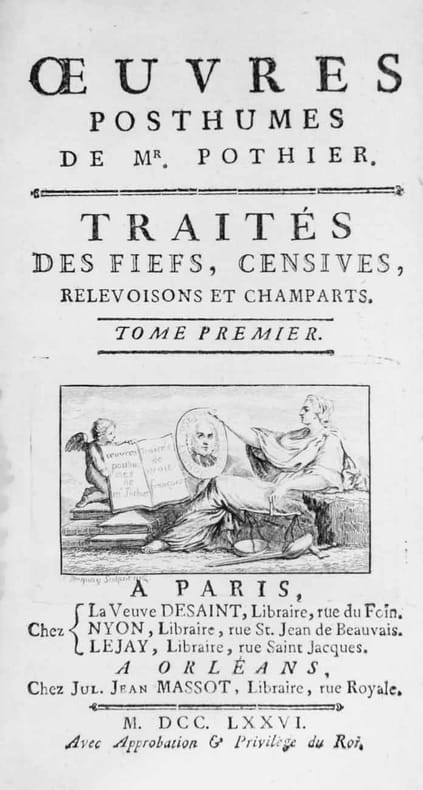
76992aafParis, La Veuve Desaint, Nyon Libraire, Lejay Libraire & A Orléans Chez Jul. J. Massot, 1776, pt. in-8°, 4 ff. + XVI + 461 p + 1 ff Errata / 2 ff + XII + 500 p. + 2 ff (errata, approbation), 4 premiers feuillets du T. 2 légères traces d'humidité en-tête, reliures en veau d'époque, dos à nerfs richement dorés aux petits fers, pièces de titre en maroquin, filet doré sur les coupes, frottements au dos et coiffe tirée du tome 1.
24270A Amsterdam, Et se trouve à Paris chez Duchesne, 1756. xlvii, (1), 352 pp. 12mo. Contemporary marbled calf, spine richly gilt with raised bands, red label with gilt lettering, red edges. Echerverria & Wilkie 56/40; Sabin 75520; Chadenat 4121; JFBL S61; INED 4034; Higgs 1501; Kress 5567; Conlon 56:1257; not in Goldsmiths; not in Einaudi. First edition, and very rare, of this work which discusses in 18 letters and at the moment the Seven Years' War was about to start, the consequences of the presence of various European nations in North America with the aim to find some sort of balance of power between the various colonizing European nations, to avoid a war and to encourage commerce and trade. 'There are several issues of this edition occasioned by cancellanda (D4-5, D11-12, E10, G11, and I5-8, all of which are present in this copy). No copy is known, however, that is not a mixture of both canellanda and cancellantia: thus, what the original text was as first printed is problematic. (.....) In the two BN copies, (....), the imprint date has been alterted in manuscript to read M.DCC.LVII. (This is also the case with the present copy where the second 'I' has been added in manuscript.) This is a series of letters dated July-September 1756, forming an essay on international power politics with special reference to European colonial systems in America' (Echeverria & Wilkie).'Intéressant pour l'origine de la guerre du Canada' (Chadenat). 'A consideration of Europe's involvement in North America with a view to establishing a balance of power among the colonizing nations which would eliminate war and encourage commerce' (JFBL). 'Déterminer la nature des divers équilibres propres aux différentes colonies septentrionales et méridionales des peuples de l'Europe, en étudiant les variations de leurs cultures, leur commerce, leur population, leurs différentes distances, etc.' (INED). - Contemporary signature and author's name in blank portion of title.
18392A Amsterdam, Chez Marc-Michel Rey, 1776. 2 volumes. xx, 389, (3) pp.; (4), 474, (2) pp. 8vo. Contemporary marbled calf, spine gilt with red labels and gilt lettering, red edges. INED 4116; Einaudi A.867; not in Kress; not in Goldsmiths; Leblanc 113; Mattioli 3269. First edition of this very interesting expostion dealing with the laws of society, the relation between men, man and society, natural and positive law, the role of economics, demography, luxury, property, religion, individual liberty, liberty of the press, free speech, etc. etc. and how society should be organized, governed and managed, this is both a work of sociology, economics, politics and legislation seeking the well-being and happiness of societies and population through proper and rational legislation and organization. 'Économie politique. Doctrine plus agrarienne que populationniste, très proche de celle des physiocrates' (INED, giving a long and extensive analysis of the work). There are sections discussing population (Schmid advocates a continuous increase), family life, property (he defends private ownership of land), luxury, religious toleration, (Schmid is in favour), taxation (Schmid favours direct over indirect taxation), commerce (he advocates, among other things, free trade for the colonies and an autonomous government) and war. One of the best expositions of the body of economic thought of the time.Further sections deal with: De l'Autorité souveraine; Des Forces de la Société; Des Rapports d'une Société avec les autres Sociétés; Du bonheur de la Société; Des Loix positives. George-Louis Schmid (or Schmidt), born in Avenstein in 1720, entered the service of the Duke of Saxe-Weimar and retired in 1757 to Nyon in the Vaud. He had close relations with Voltaire, Diderot and d'Alembert and the other leading philosophes of the 18th century. He belonged, together with authors such as Rillet de Saussure, Delolme and Iselin to a group of important Swiss authors actively participating in the European debates of those days and historians now believe that Swiss authors like these were unique in their attempts to reconcile traditional republican and Christian standards of social justice with the imperatives of economic growth. For this reason, they came to occupy a central position in European debates and the essay competitions of the Economic Society of Bern were closely watched elsewhere in Europe. - Some occasional browning. An excellent copy of a scarce work.
20019aafZürich, Heidegger, 1763, in-8°, 188 S., geringe Wurmspur in S. 83-104 praktisch ohne Textverlust, unaufgeschnitten, leicht stock- und staubfleckig, Wasserflecken am unteren Rand, unbeschnitten, Broschüre d’attente / Pappband.
18588A Amsterdam, et se trouve à Paris, Chez Desaint et Saillant, 1759. iv, 307, (1) pp. 12mo. Contemporary marbled calf, spine gilt in compartments, label with gilt lettering, red edges. Kress 5819; Einaudi 5860; Higgs 1981; INED 4410; Leblanc 217; Conlon 59:1259; not in Goldsmiths. First edition of this critical analysis of Coyer's famous work, La Noblesse Commerçante. Vento agrees with Coyer's insistence on the development of industry and trade but disagrees that this should (also) be a task of the nobility. 'Sans partager l'opinion de Coyer, l'auteur de La Noblesse Commerçante, Vento admet cependant la nécessité de développer le commerce, et expose quelques moyens aptes à le favoriser. En outre, Vento juge le célibat des prêtres et des officiers nécessaire, raison qui etaye encore sa théorie selon la noblesse ne doit pas déroger en s'occupant de commerce' (INED).
6128Lille, Peterinck-Cramé, 1785. In 4 de 8 pp.
5528Agen, Veuve Noubel et fils aîné, an VI (1798). Placard de 38 x 50 cm sur vergé.
5360Sans lieu ni date (Anvers, 1932). In 8 cartonnage orné 33 pp. avec une carte en couleurs du royaume de Belgique, un frontispice au pochoir représentant les produits de la firme, des bois (Anvers dans le temps) et des portraits du fondateur et de ses succe
1281Montpellier, Ricard, sans date (début XIXème). 16 pp. in 4° déreliées, mouillures pâles tout du long.