15 993 résultats
16035No place, 1757. 2 volumes. (2), 302 pp.; (2), 392 pp. 12mo. Contemporary marbled calf, spines gilt in compartments, red labels with gilt lettering, marbled edges, small loss of calf to front cover of volume 2, very lightly rubbed. McCulloch 46; Kress 5600; Goldsmiths 9242; Higgs 1465; not in Einaudi; Conlon 57:669; not in Mattioli. First French edition, first published in 1744. The French translator, J.P. de Gua de Malves, added extensive comments and therefore this French version is sought after. Sir Matthew Decker, director of the East India Company, merchant and pamphleteer, was born in Amsterdam. In the present work he urges the replacement of all customs and excise duties by a single tax on the consumption of luxury goods - a kind of income tax with the merits, as it was conceived in the eighteenth century, that the taxpayer voluntarily assesses himself by choosing to consume such articles and to such an extent as he wishes. Decker argues strongly against restrictions on trade, emphasizing the significance of industry and trade to the welfare of the country. He would exempt the houses inhabited by the poor from all duties - not on grounds of social sympathy but because it would necessarily lower their wages and consequently increase the competitive strength of British exports; he advocates the luxury tax because it would check luxury, the bane of virtue and industry. He was opposed to monopolies and bounties and was skeptical as to whether trade can ultimately be forced into 'an unnatural channel,' thus anticipating the discussion on the operation of natural laws in the economic world. In some respects he is considered an important precursor of Adam Smith. 'The first part of the work is devoted to a detailed criticism of the fiscal difficulties under which England is labouring; the second part to showing the intricate connection between the trade of a country and the value of the land; while in the third part Decker displays the great sources of wealth and prosperity possessed by England (and over her two chief rivals, France and Holland), and shows how the references he suggests would permit her to avail herself of these, her natural strength' (Palgrave, i, p. 519).
E13627reu. Hardcover. Fine. Overszied hardcover in navy blue cloth lettered in gilt. 426 pp. with index. Reropduction doule page map. Facsimile reprint of the 1908 edition printed by the Government Printing Office. Fine previous owner's name and date 199 on front free endpaper. Issued without dust jacket. <br/><br/> hardcover
27205A Paris, Chez Cellot & Jombert, 1778. [2], 452, [4, Privilege du Roi, Fautes à corriger, blank] pp. 12mo. Contemporary marbled calf, spine richly gilt in compartments, label with gilt lettering, red edges, a nice copy. Sabin 21037; Leclerc 868; Faÿ 11; Howes D.528; Monaghan, French Travellers in the United States, 580B; Muller 1597; not in Streeter sale; not in Kress; not in INED; Echeverria, Mirage in the West, p. 74; Echeverria & Wilkie, 778/20; Chadenat i, 813. First edition of this important work dealing with the War of Independence of the British colonies. An early French account of the Revolution, published about the time of the French entry into the war on the side of the Americans. "Day-by-day account of events from Gage's arrival at Boston until French recognition" - Howes. The author favours free trade with the American colonies, which had just been officially recognised as an independent state. Pp. 433-450 contain: Traité d'amitié et de commerce conclu entre le Roi et les Etats-Unis de l'Amérique septentrionale, le 6 février 1778 and U.S. Declaration of Independence: Declaration des Répresentans des Treize Provinces-Unies de l'Amérique, assemblées en Congrès-Général, le 4 juillet 1776 (pages 340-351.)
18768A Amsterdam, Chez J.L. de Lorme, 1704. Title printed in red and black. With 1 folding table. (10), 317, (1) pp. 12mo. Contemporary calf, spine gilt with raised bands, red label with gilt lettering. Kress 2421; Goldsmiths 4038; Einaudi 1626,note; Sabin 98172n; Alden & Landis 704/56; Echeverria & Wilkie 704/7; not in Howes; not in Streeter; not in Leclerc; not in Muller; not in JFBL. The best edition, with extensive notes added. One of at least 7 editions published in 1704. Originally published in 1703. As a matter of fact there never was an English edition, but the author apparently preferred to pass it off as such to avoid problems with the authorities, since he represented the French court as an ambassador in The Hague. Anti-British work that surveys British trade and commerce in Europe and that with the American colonies and the Indies predicting that the Navigation Acts will result in revolt and independence for the British North American colonies. "Sets out the advantages and disadvantages of the Spanish War of Succession to Great Britain's commercial interests, together with the advantages to Spain of free trade in her colonies. This work is remarkable as containing a distinct prophecy of the revolt of the American colonies from Great Britain" (Encyclopaedia Britannica Online).
18629A Paris, Chez Nyon, Didot le jeune & Saugrain le jeune, 1762. xxxvii (misnumbered xxxvi), (3), 389, (3) pp. 12mo. Contemporary marbled calf, spine gilt with raised bands, red label with gilt lettering, corners very lightly bumped. Kress 6015; Goldsmiths 9786; Einaudi 1688; INED 1644; Higgs 2771. First edition of a study on the relationship between the value of coinage, citing numerous sources, grain prices and other vital commodities. The avertissement compares various European currencies and attempts to establish their real value by referring to workers' and soldiers' wages and assessing their purchase powers, while the introduction proposes a way of determining a fair price for wheat. The author's approach is predominantly historical (the title refers to a 794 edict which fixed the price of grain), providing a wide variety of statistical information. - Title-page and a few pages very lightly spotted.
74125Trenton NJ: John A. Roebling's Sons Company. First edition. Small octavo. 24 pp. with a plethora of photographic illustrations. Publisher's sewn blue printed wrappers with a window in the front cover to display a biplane aloft. Small marginal tear not afecting any text. A very good copy. None located by OCLC. The Roebling's history in Trenton dates to 1848 when John A. Roebling purchased 25 acres of land in Chambersburg Best known today as the "father of the Brooklyn Bridge" Roebling and the company he founded supplied cables from Trenton to most of the major suspension bridges built in United States during the first half of the 20th century. Among the dozens of major bridges using Trenton-made cable are New York City's Williamsburg Manhattan and George Washington Bridges as well as the Golden Gate Bridge in San Francisco.Roebling Lofts converted the "Clark Street Rope Shop" Building 101 erected in 1917 during WW I. It was an ultra-modern facility for its time with massive windows and a fire resistant design. It replaced an older factory that burned down in late 1915 allegedly by German saboteurs. Building 101 specialized in light- and medium-gauge wire rope such as used in aircraft. Perhaps the factory's most famous customer was Charles Lindbergh who specified Roebling wire for The Spirit of St. Louis the plane he flew non-stop from New York to Paris in 1927. This has been called the single most influential flight in aviation history excepting the 1903 first-flight by the Wright Brothers who also used Roebling cables for bracing wings. Lindbergh used Roebling products for control cables to brace the wings for the ignition harness and the plane's lightning rod. The testing lab for the aircraft business was located on the 4th floor of the Clark Street factory including a massive machine designed to simulate stresses on wings. The machine survives in place on the 4th floor and is being preserved in a lounge for use by residents of Roebling Lofts. John A. Roebling's Sons Company unknown
Sound publication with clean pages and clear content. Light wear of back cover.
17825638Zweyte vermehrte und verbesserte Auflage. 2 in 1 Band. Mit 2 (wiederholten) gest. Titelvignetten (wohl von Franz Nicolaus Rolffsen). Hamburg, Fritsch und Ruprecht, 1782. 8vo. (19,2 x 12,2 cm). 2 Bl., 368 S., 1 Bl. Zwischentitel, S. 369-796. Halblederband d. Zt. mit rotem Rückenschild sowie blind- u. goldgeprägtem Rücken.
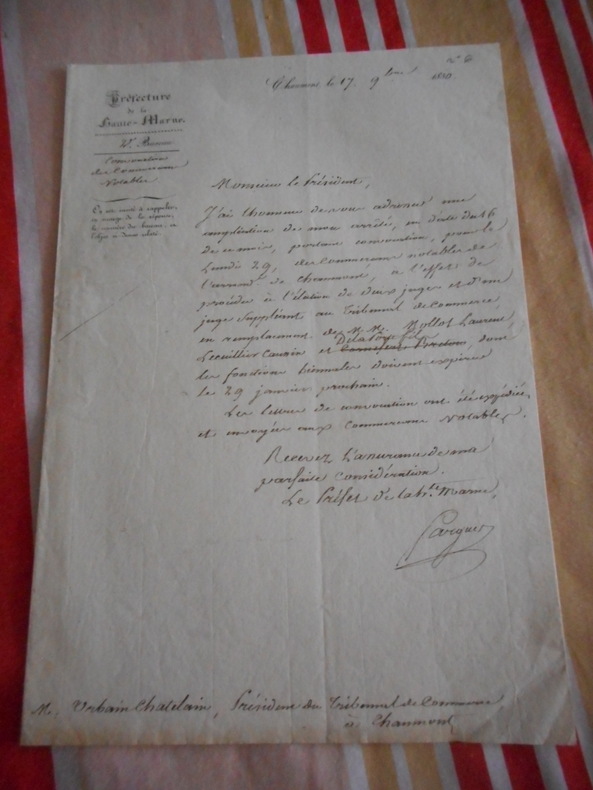
183049953Lettre manuscrite de Fargues, éphémère préfet de la Monarchie de Juillet, pour la convocation des commerçants notables, pour voter au renouvellement du tribunal de commerce de Chaumont. Président du tribunal de commerce = Urbain Chatelain.
191 p. Very mildly XLib. Two small stamps on first fly leaf. Lightly browned. Fly leaves very dampstained but not text. 16mo. 165 mm. Original full leather binding, scuffed and pitted. Hardbound. Good. Title continues: 'Exhibiting at One View, the Amount of Value of any Number or Quantity of Goods or Merchandise, from One up to Ten Thousand.' These reckoners were extremely popular in early America. They were an essential tool in trades of every sort. Evans 33730. PALIB 6
191 p. Browned. Margins torn without loss on two leaves. Slight loss of a few numbers on pages 99/100. 16mo. 165 mm. Original full leather binding, worn. Front board detached. Title continues: 'Exhibiting at One View, the Amount of Value of any Number or Quantity of Goods or Merchandise, from One up to Ten Thousand.' Hardbound. Fair. These Ready Reckoners were essential to all classes of Americans from landed squires to agricultural laborers. Evans 33730. EVANS1
a535941959. 4to. 200pp. many monochrome photo illustrations wraps. Near VG light wear. . paperback
1865354277Detroit 1865. 8pp. printed in double columns. Dbd. Separating a bit at folds else very good. 8pp. printed in double columns. Dbd. An interesting post-Civil War economic tract this vigorous attack on the principles of free trade appeals to farmers workers and mechanics in the West and Northwest to push for protectionist trade policies. Ward contends that only by raising duties on imported goods can the United States "keep the principal part of our coin at home." <br/><br/> unknown
176428707Paris: Aux dépens de la Compagnie 1764. 1 vols. 12mo. 19th century marbled boards paper manuscript label. Blanks at front and back removed marginal repair to title some soiling at front and back else very good with the signature of La marquise des Armoises d'espineaux with the 1765 date throughout. 1 vols. 12mo. Not in Kress Aux dépens de la Compagnie unknown
19802091502135420527Not Available 1980. Soft Cover. Fine. Number of books: 1 Not Available paperback
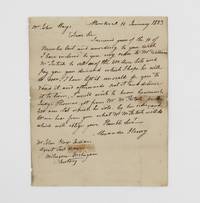
1823374695Montreal 1823. 1p. 1p. "I received yours of the 10 of November last and according to your wish I have inclosed to you my order to Mr. William MacIntosh to sell one of the 400 acre lots and pay you your demand which I hope he will do soon. I have left it unsealed for you to read it and afterwards seal it and deliver to him. I would wish to know how much Judge Thomas got from Mr. MacIntosh for the 400 acre lot which he sold by his order and let me hear from you what Mr. MacIntosh will do . unknown
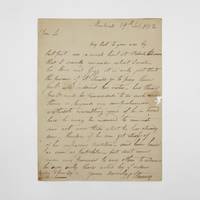
1802374694Montreal 1802. 1p. Slight loss of paper caused by removal of wax seal on right margin not affecting text. Old fold. Else fine. 1p. An excellent autograph letter signed from this prominent fur trader explorer and author of TRAVELS AND ADVENTURES IN CANADA AND THE INDIAN TERRITORIES published in 1809. Henry was sixty-three at the time this letter was written and mainly occupied with directing fur operations from Montreal. He evidently writes concerning his son's bad debts: "My last to you was by last post was so much hurt by Robert's behavior that I scarcely remember what I wrote. his Horse and Gigg it is only just that the produce of it should go to pay those Gentm who indorsed his notes - how these Gentm could be persuaded to do such a thing is beyond my comprehension without consulting you. if he is turned loose he may be induced to commit some act worse than what he has already done - therefore if he can get clear of his imposing creditors - send him here as soon as possible - but dont come under any promise to any other to whom he owes only those acted by yr orders. unknown
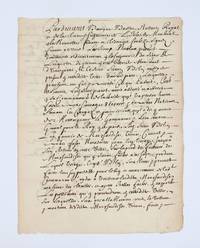
1688368775Montreal 1688. In French. 2pp. recto and verso on a single leaf. Signed by Perrot Bleinz and notary Benigne Basset. With an English transcription. Quarto. Old folds. Near fine. Provenance: Archibald de Léry MacDonald; Lawrence Lande. Exhibition: An Exhibition of Early Documents and Printed Material Relating to the Beginnings of Trade in North America from the Private Collection of Dr. Lawrence M. Lande McGill University May 30-July 15 1985 with an 8-page exhibition catalogue. In French. 2pp. recto and verso on a single leaf. Signed by Perrot Bleinz and notary Benigne Basset. With an English transcription. Quarto. Scarce seventeenth century voyageur fur trade contract for an expedition to the wilderness to trade with the Ottawa signed by one of the most important early traders and explorers of Canada and the upper midwest. "Partnership agreements such as this one of Nicholas Perrot are of great rarity" Lande.<br /> <br /> Perrot 1644-1717 was an explorer interpreter trader commandant diplomat and seigneur. He was one of the best-known figures in the early fur trade of New France particularly during the latter part of the 17th century and took possession of large tracts of land in the Great Lakes region in the name of King Louis XIV. His travels commonly took him deep into unexplored territory and he was the first Frenchman to explore the Upper Mississippi in what is now Wisconsin and Minnesota.<br /> <br /> Perrot arrived in New France about 1660 as a young donné or contracted assistant in the company of Jesuit Missionaries and travelled to the western Great Lakes region where he gained the friendship of the local First Nations people by trading guns for furs believing that they were entitled to defend themselves from their enemies. He also took the opportunity to learn several Native languages which served him well during his career. Perrot soon entered the fur trade full time and began forming business partnerships. He enlisted himself as a translator with government authorities and participated in peacekeeping missions to bring warriors of several First Nations together to sign peace treaties. By 1685 he was appointed Commandant-in-Chief at Bais des Puants present day Green Bay Wisconsin and surrounding regions and travelled to the upper reaches of the Mississippi River in the territory of the Sioux tribes where he built Fort St. Antoine in present-day Minnesota.<br /> <br /> During the spring of 1687 in preparation for taking part in raids on Indian villages in the Seneca country Perrot left his store of furs with the Jesuits at St. Francois-Xavier mission in present-day Wisconsin. While out with the raid party a fire at the mission destroyed his entire fur inventory valued at more than 40000 livres. Financially ruined Perrot returned to Montreal to deal with creditors and renew partnership agreements like the present.<br /> <br /> In the summer of 1688 Perrot partnered with Simon Bleinz to undertake an expedition to trade with the Ottawa Indians and other Nations. Perrot had always been a staunch ally of Governor Frontenac and had obtained a fur trade license from the governor for this venture to ensure that his activities were in keeping with the rules and regulations of the trade.<br /> <br /> The agreement states that Perrot would supply Bleinz with goods food provisions a canoe and other necessary supplies for the voyage and that Bleinz would convey the goods to the trading area and do all that he was able for the success of the partnership. Bleinz had the option of taking at his own expense six shirts two capots or hooded coats of blanket cloth moosehide or other material and one rifle to trade for his own personal profit. The pelts resulting from the venture were to be distributed evenly amongst Bleinz another unnamed associate of the partnership and Perrot. An "apichimon" or bonus of six beaver pelts was to be paid to Bleinz by the partnership upon the successful conclusion of the expedition. <br /> <br /> "Perrot who was often unappreciated even during his lifetime was France's best representative among the Indians of the west. His knowledge of the languages of the country his natural eloquence the happy blend of daring and coolness that were the essence of his character had made it possible for him to win the esteem confidence and even affection of the Indians. The Potawatomis the Menominees the Foxes the Miamis the Mascoutens and the Sioux granted him with the honours of the pipe of peace the rights and prerogatives enjoyed by their own chiefs. His credit was not less among the Ottawas and the Hurons. During the last four decades of the 17th century at a time when alliance with the nations of the west was indispensable in order to ward off the Iroquois peril and allow access to new territories Perrot thanks to the influence that he had acquired rendered valuable assistance to the colony" Dictionary of Canadian Biography.<br /> <br /> The present document is from the famed collection of Lawrence M. Lande 1906-1998 detailed as item 107 in his second bibliography of his collection The Founder of our Monetary System John Law Compagnie des Indes & the Early Economy of North America Montreal: 1984. Lande began collecting manuscript material relating John Law the Compagnie des Indes and the fur trade - North America's first economy - as early as the 1960s principally working with dealers Izzy Ehrlich and Alfred Van Peteghem purchasing material from the collections of Thomas Phillips Philip Sang and historian Archibald Lery MacDonald the assemblage of which Van Peteghem termed an "unparalleled feat." All of the printed material and many of the documents were donated by Lande in his lifetime; however a grouping of the manuscript items including the present document were sold by his heirs after his death. Lande Founder of our Monetary System 107 unknown
191322042Paris: Printed by D. Michaud 1913. First edition. Paperback. Light wear to wrappers pages slightly toned else very good. Printed green wrappers 12.5 x 9.5 inches 26 pp. illustrated. <br/><br/>Trade catalogue of metal garden contructions including fences gates arbors topiary frames bird cages coops etc. The firm Maison Dutourleau Fils Beausejour 50 Parc Saint-Maur Seine is listed in the 1891 edition of Jardins de France. No copies of this catalogue found on OCLC/Worldcat. Printed by D. Michaud paperback
18532276Hamburg, Herold'sche Buchhandlung, 1853. 41 S. ANGEBUNDEN: Die Stellung der Hansestädte. (Teil) II.: In näherer Beziehung auf Hamburg. Ebda., 1854. 95 S. Mit Tab. Spät. HLn.
18066A Amsterdam, Chez Jacques Coeur, à la corne d'Abondance (Paris), 1756. 3 volumes. xii, 372 pp.; 406 pp.; 350 pp. 8vo. Contemporary marbled calf, spines richly gilt in compartments, labels with gilt lettering and numbering. Mars 27; Weulersse, i, p. xxvii; Kress 5526; Goldsmiths 9082; Einaudi 2659; Mattioli 1481; INED 2079; Higgs 1145. First edition, second issue. Einaudi's copy is identical with ours, about the Kress and Goldsmiths copies not much can be said, both collections contain more than one copy and they both indicate that there is one copy with a third volume with the indication 'Nouvelle édition', as does our third volume. According to Mars, Ange Goudar, cet inconnu, essai bio-bibliographique, the third volume came from the same press as the first two volumes but with a different ornamental typography. Between the first issue and this issue, there appeared, according to Mars, a parisian contrefaçon, all published in 1756. This is the main work of Goudar. It was used by the demographer Süssmilch in his Die goetliche ordnung. Voltaire had a copy in his library and Diderot wrote about the book in a letter to Sophie Volland. Preceding Mirabeau's l'Ami des Hommes by a few months, it marks an important date in the history of political economy, and made Goudar one of the leading figures of the school of 'des agrariens et populationnistes', not to be mixed with the Physiocrats, which they preceded and with whom they disagreed on various points. 'Of the pre-physiocratic French writers who approached the population problem in terms of agricultural values and reforms, Ange Goudar (1720-1791) was the most important' (Spengler, French predecessors of Malthus, pp. 56-67.) Spengler's analysis is elaborate and shows the crucial importance of this work. - Some corners somewhat damaged.
672p. Inked ownership of Christian Kieffer (a 19th century Mayor of Lancaster, PA) on front fly leaf. Large 8vo. 9" x 5 4/3" in 8's. Original full brown cloth binding decorated and embossed in blind. Spine lettered in gold. Quarter inch loss at head of spine. James Gutherie served in the Kentucky legislature, 1827-41. U.S. Secretary of treasury, 1853-57. A Unionist, he put his Louisville and Nashville Railroad at the disposal of federal troops, 1861-65. Served as U.S. Senator, Democrat, from Kentucky (1865-1868). Hardbound. Very good. ECON/BUS BOX 1
17250A Paris, Chez Henrics, Brumaire An 9 (octobre 1800). iv, 350, (2) pp. Large 8vo. Contemporary tree calf, spine richly gilt in compartments, red label and gilt lettering. Kress B.4197; Goldsmiths 17829; Einaudi 2859; not in Mattioli; INED 2232; Stourm, p. 318; Catalogue de l'Histoire de France, iii, p. 211. First edition. Deals with the political situation of France in comparison with the other European nations: The political situation before the war; General thoughts on the present situation of France; Present situation of France considering its allies; Present situation of France considering its ennemies; Present situation of France considering the neutrals; Internal situation of France, followed by two chapters dealing with: 'Population et industrie de la France' and with 'Moeurs et Lois de la France.' According to Barbier the work was composed not only under supervision of Talleyrand but even partly written by him. Alexandre-Maurice Blanc de Lanautte, Comte d'Hauterive, was diplomat and economist, born in Aspres (Hautes-Alpes) on 14 April 1754. He went with Choiseul-Gouffier to Constantinopel, spent some years in New York, and returned to France in 1798 and started working for the Ministry of Foreign Affairs. From the 18th Brumaire to the fall of the Empire he was involved in all the major negociations of the period. - Small hole in half-title, occasional light spotting, small library stamp on half-title, a very attractive copy.
15440A La Haye, Chez Pierre de Hondt, 1739. Titles printed in red and black, with folding table on two sheets and 1 engraved plate. 6 volumes in 3. (2), 204 pp.; (2), 312 pp.; (2), 208 pp.; (2), 286 pp.; (14), 294 pp.; (18), 246 pp. Small 8vo. Modern overlapping vellum, red morocco labels. Kress 4447; Goldsmiths 7712; Einaudi 3728; INED 1553; Mattioli, 2247; Conlon 39:427; JFBL M162; European Americana, 739/191; not in Sabin. The only edition of this important work. An account of the financial operations of John Law and his 'Compagnie des Indes', including a great number of important memoirs, letters patent, decrees, declarations, etc. Barthélemy Marmont du Hautchamp (1682 - ab. 1760) was an admirer of John Law's system and his book is not written without partiality but has yet been recognized as the best contemporary history of the system and its most precious source. John Law's operations began with the foundation in 1716 of the 'Banque Générale', soon afterwards renamed 'Banque Royale'. This was followed by the scheme of colonization known as 'Mississippi scheme' in the 'Compagnie des Indes' which, by absorbing various other chartered companies, acquired the monopoly on the trade to America, Africa and China. Moreover, the company obtained the monopoly of tobacco, the control of the mint, the payment of the national debt, and the farm of the taxes. Within a few years Law's companies thus got almost complete control over France's overseas trade, its currency and public finances, to the extend that Law's companies at one point owned more than half of the then known United States. In 1719 the 'Compagnie des Indes' and the 'Banque Royale' were united, and the promising outlooks of the new company lead to an unprecedented speculation in its shares. As known the bubble burst in 1720, cash payments were suspended and Law fled from the country, leaving behind ruined many of his former supporters.The last 2 volumes contain the full texts of the 'mémoires', 'letters patentes', 'édits', 'déclarations', 'arrêts', etc., mostly by the Conseil d'État, as well as many other documents of which many are dealing with the 'Compagnie d'Occident', and the 'Compagnie des Indes Orientales et de la Chine', on which documents the author based this thorough and important history.Marmont du Hautchamp was born in Orléans and fermier des domaines in Flanders. He was also the author of the famous and very rare Histoire générale et particulière du visa (also published in The Hague, in 1743) which also dealt with the activities of John Law and the Mississippi bubble.
16593A Berlin, 1757. iv, xviii, 435, (1) pp. 12mo. Contemporary marbled calf, spine richly gilt with raised bands, gilt lettering, red edges. Higgs 1474; Kress 5617 (incomplete copy); Weulersse, i, xx; this edition not in Goldsmiths, Einaudi & INED. The best edition. Including the 'Arrêt du Conseil d'Etat du Roi, qui, entr'autres dispositions, ordonne que le commerce de toute espèce de grains sera libre entièrement par terre et par les rivières, de province à province, dans l'intérieur du Royaume. Du 17 Septembre 1754', to which referrence is made in the Avertissement. The basic importance of agriculture in the life of the French nation was equally emphasized by C.J. Herbert, who held labor and land to be the primary resources of a nation, and agriculture its basic industry. Upon agriculture depended a nation's power and wealth, its ability to colonize, the fruitfulness of its commerce, and the capacity of its territory to support population. Having demonstrated the basic importance of agriculture to the political and economic strength of France, Herbert indicated that French agriculture was languishing, and its revivification was essential to the aggrandizement of the nation and to the felicity of its inhabitants; ..... Herbert advocated the improvement of grain markets and prices through inauguration of the right to export grain, modifications in the tax system, and the establishment of a research bureau to discover how agriculture could be improved, and why some provinces were more favorable to agriculture, manufacturing, and population growth than others. (Spengler, French predecessors of Malthus, pp. 67-72). Valuable work, cited with praise by Adam Smith.