17 079 résultats
181448997Boston: Henry Channing 1814. 1 vols. 8vo. Modern brown buckram bright crimson morocco title label on upper cover original wrappers bound in. Bookplate of Henry Cabot Lodge. Some fading to covers some foxing else very good. 1 vols. 8vo. This William Ellery Channing 1782-1842 was the uncle of the more famous American Transcendentalist poet William Ellery Channing II 1817-1901. The elder Channing graduated with distinction from Harvard at the ripe age of 18. His first and only pastoral settlement was a small church on Federal Street in Boston June 1803. Shortly thereafter Channing became closely identified with the intellectual movement that ultimately spawned the North American Review and a number of other journals. Channing gradually grew into a significant opponent of slavery without ever joining forces with the abolitionists or approving of what he deemed their "extremist" tactics. Channing's writings on Bonaparte such as the present title and other political figures earned him a solid literary and critical reputation in Europe as well as America. <br/><br/> Henry Channing hardcover
115556Very Good. Folio 314 × 201 mm one page of printed text with manuscript insertions on 'Ministere de l'Instruction publique et des Cultes' letterhead 10 May 1856. The lengthy decree is written in a neat secretarial hand; two folds a few creases and short sealed tears at the top and bottom edges; slight traces of prior mounting on the verso; in very good condition. The decree confirms the appointment of Georges Frédéric Fallot as Lutheran pastor in the parish of Dampierre-les-Bois near Audincourt Doubs. It is countersigned by Hippolyte Fortoul Ministre de l'Instruction publique et des Cultes. The decree was apparently cancelled soon after it was issued; it is crossed out with the word 'annulé' added in ink in the left-hand margin and a pencilled cross through the blank registration stamp. Napoleon III 'the nephew of Napoleon I was the first President of France from 1848 to 1852 and the last French monarch from 1852 to 1870. First elected president of the French Second Republic in 1848 he seized power in 1851 when he could not constitutionally be re-elected and became the Emperor of the French. He founded the Second French Empire and was its only emperor until the defeat of the French army and his capture by Prussia and its allies in the Franco-Prussian War in 1870' Wikipedia. <p>Provenance: Collection of The Hon Barry Jones AC. unknown
199630752Rio de Janeiro : Ed. Paz e Terra, 1996. 366 p. : nombr. ill. 8°. 9a ed., 10a reimpr. Softcover orig. ingl.
43992501-nnew. unknown
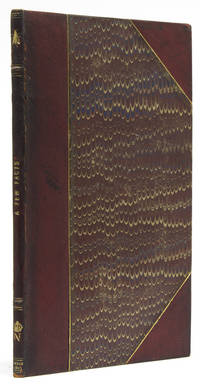
182542527London; Amsterdam: Printed for John Stockdale; Gedruckt bij C.A. Spin 1825. Frontispiece portrait of Napoleon to the first work; engraved folding plate 11 x 20 inches to the second work. 15; 8; 8 pp. 1 vols. 8vo. Three quarter red morocco. Slightly rubbed. Presentation inscription "From the Author" who remains anonymous on title page of first work. Spotting on last leaf of third work. Frontispiece portrait of Napoleon to the first work; engraved folding plate 11 x 20 inches to the second work. 15; 8; 8 pp. 1 vols. 8vo. "A Few Facts ." is an examination of just causes for war and a call for freedom of the press: Let liberty be the signal for battle; proclaim the liberty of the press to tyrants and that a free people dare to tell them they are such."<br/>The second title is a description and illustrated key to the massive painting of the battle of Waterloo by J. W. Pieneman now housed in the Rijksmuseum in Amsterdam. An English equivalent was published in London later in the year 1825 when the picture was exhibited in Hyde Park near Grosvenor Gate. One copy of first title in OCLC LC; second title KB1294 B 6 not in OCLC Printed for John Stockdale; Gedruckt bij C.A. Spin unknown books
19544St. Cloud 7 May 1811. In French. 14 lines on 1 page perfect for display 9 x 7 inches one pinhole with the discreet authentication blindstamp of the Rossignol Napoleon Collection Paris. Napoleon Bonaparte 1769-1821. Henri Jacques Guillaume Clarke duc de Feltre 1765-1818 born of Irish parents Minister of War from 1807 and Marshal of France. Napoleon came to depend on his authority and he was instrumental in organising the administration and building the Grande Armée in 1811-12. unknown
6550472172.Gpaperback. Good. Access codes and supplements are not guaranteed with used items. May be an ex-library book. paperback
18033595823/05/1803. <blockquote><p>James Monroe and Robert Livingston receive the Treaty signed by Napoleon notification of French ratification and instructions from the French: Deliver this ""to the President of the United States without delay to do what must be done"" and secure American ratification</p><p> </p><p>This doubled the size of the United States and is one of the most significant moments in American history; In 2019 this document was saved from a fire at the Karpeles Manuscript Library and survived</p></blockquote><blockquote><p>This document central to the Louisiana Purchase is among the most important we have ever carried</p><p> </p></blockquote><p>https://vimeo.com/1180578110share=copy&fl=sv&fe=ci</p><p> </p><blockquote><p>Hear more on <a href=""https://www.raabcollection.com/tags/podcast"">Inspired by History</a>:</p><p> </p><p><iframe style=""width: 100%; max-width: 660px; overflow: hidden; border-radius: 10px;"" src=""https://embed.podcasts.apple.com/us/podcast/a-historic-manuscript-central-to-the-louisiana-purchase/id1796821278i=1000761089641"" height=""175"" frameborder=""0"" sandbox=""allow-forms allow-popups allow-same-origin allow-scripts allow-storage-access-by-user-activation allow-top-navigation-by-user-activation""></iframe></p></blockquote><p>The Louisiana Purchase stands as one of the most transformative acts in American history instantly doubling the size of the young republic and securing U.S. control of the Mississippi River and the vital port of New Orleans. Negotiated at a moment of shifting global power—amid Napoleon’s imperial ambitions the threat of imminent renewed war with Great Britain and the collapse of French plans in the Caribbean—the agreement reshaped the geopolitical balance of North America and set the United States on a path toward continental expansion and emergence as a major world power.</p><p>As the United States had spread across the Appalachians the Mississippi River became an increasingly important conduit for the produce of America’s West which at that time referred to the land between the Appalachians and the Mississippi. Since 1762 Spain had owned the territory of Louisiana which included 828000 square miles. The territory made up all or part of fifteen modern U.S. states between the Mississippi River and the Rocky Mountains. The Pinckney Treaty of 1795 had resolved friction between Spain and the United States over the right to navigate the Mississippi and the right for Americans to transfer their goods to ocean-going vessels at New Orleans. With the Pinckney treaty in place and the weak Spanish empire in control of Louisiana American statesmen felt comfortable that the United States’ westward expansion would not be restricted in the future.</p><p>This situation was threatened by Napoleon Bonaparte’s plans to revive the French empire in the New World. He planned to recapture the valuable sugar colony of Haiti from a slave rebellion and then use Louisiana as the granary for his empire. France acquired Louisiana from Spain in 1800 and took possession in 1802 sending a large French army to St. Domingue and preparing to send another to New Orleans. Americans became very apprehensive about having the more-powerful French in control of the Mississippi and New Orleans. President Thomas Jefferson noted “There is on the globe one single spot the possessor of which is our natural and habitual enemy. It is New Orleans.†He determined to do something to change this situation.</p><p>In addition to making military preparations for a conflict in the Mississippi Valley in April 1803 Jefferson sent former Minister to France James Monroe to join present Minister to France Robert Livingston to try to purchase New Orleans and West Florida for as much as $10 million. Failing that they were to attempt to create a military alliance with England. Meanwhile the French Army in St. Domingue was being decimated by yellow fever and war between France and England was on the horizon. Napoleon decided to give up his plans for Louisiana and offered a surprised Monroe and Livingston the entire territory of Louisiana - all 828000 square miles of it - for $15 million. That was three cents per acre. Although buying all of Louisiana far exceeded their instructions from President Jefferson Monroe and Livingston saw the golden opportunity and agreed. The treaty was signed on April 30 1803.</p><p>The treaty itself actually consisted of three linked agreements: the Treaty of Cession by which France transferred the Louisiana territory to the United States and guaranteed rights of property religion and eventual citizenship to its inhabitants; a first convention establishing that the United States would pay 60 million francs about $11.25 million to France through government bonds as the purchase price; and a second convention by which the United States assumed 20 million francs about $3.75 million in claims owed to American citizens for prior French seizures and commercial losses. Together these three instruments formed the full legal structure of the purchase bringing the total cost to 80 million francs or roughly $15 million.</p><p>The French ratification of the Louisiana treaty and conventions was dated May 22nd and signed by Bonaparte Foreign Minister Talleyrand Minister of the Treasury Barbé de Marbois and Hugues Bernard Maret who as the secretary of state was responsible for promulgating laws and decrees. It was delivered to the representatives of the United States Robert R. Livingston and James Monroe who here sign to acknowledge receipt of the treaty to be sent to President Thomas Jefferson ""without delay.""</p><p>Historic <strong>manuscript</strong> DS <strong>signed</strong> <em>""Jas. Monroe""</em> <em>""Rob. R. Livingston""</em> and ""Barbé Marbois"" in French Paris May 23 1803 being the monumental document recording France's sale to the US of Louisiana just approved by Napoleon Bonaparte and the French government.</p><p><em>""Today May 23 1803 we Barbé-Marbois Minister of the Public Treasury named by the French People as Minister Plenipotentiary and Robert R. Livingston Minister Plenipotentiary of the United States of America and James Monroe Minister Plenipotentiary and envoy extraordinaire of the said States at a meeting in one of the rooms of the Hotel du Public Treasury in Paris Citizen Barbé-Marbois transmitted to us Robert Livingston and James Monroe: 1. The treaty concluded and signed by us on 10 Floreal an 11 30 April 1803 and the two conventions concluded and signed by us on the same date. Said treaty and conventions in three separate instruments written on vellum parchment and bearing the grand seal of the French Republic imprinted in red wax ratified by the First Consul Napoleon of the French Republic signed by the Minister of Foreign Affairs Ch. Mau. Talleyrand and countersigned by the Secretary of State Hugues B. Maret; therefore the said treaty and conventions are to be sent by us to the President of the United States without delay and for him to take the necessary steps. For which we have signed the present document in two copies one for the French ambassador and one for the American ambassadors.""</em> With loss to one letter of Monroe's signature.</p><p>It is interesting to note that Barbé Marbois who played a key role in negotiating the Louisiana Purchase Treaty and delivered the signed ratification was former ambassador to the United States and had lived in the U.S. for years spoke English and married an American. He was well connected in the U.S. and was elected a Foreign Honorary Member to both the American Academy of Arts and Sciences John Hancock and John Adams were also members and the American Philosophical Society Thomas Jefferson was also a member and the two dealt extensively. He was a logical choice to negotiate the treaty.</p><p>There was some delay in getting the ratified treaty to the United States and Jefferson did not see the treaty until early July 1803. When news of the sale reached the United States people were incredulous and mostly elated. President Jefferson however was in a quandary. He had always advocated strict adherence to the letter of the Constitution yet there was no provision empowering him to purchase territory. Given the public support for the purchase and the obvious value of Louisiana to the future growth of the United States however Jefferson decided to ignore the legalistic interpretation of the Constitution and forgo the passage of a Constitutional amendment to validate the purchase. This decision contributed to the principle of implied powers of the federal government.</p><p>Because the treaty stipulated that the American ratification must be concluded by October 30 Jefferson hurriedly convened a special session of Congress on October 17. The United States Senate consented to ratification of the treaty with a vote of 24 to 7 on October 20. On the following day October 21 1803 the Senate authorized Jefferson to exchange the ratification document with France take possession of the territory and establish a temporary government.</p><p>In very good condition with repaired loss to the right edge truncating the final letter of Monroe's signature.</p><p>This document central to one of the most significant moments in American history is one of the most important we have ever carried. It is from the famed collection of The Karpeles Manuscript Library from which it was rescued during a fire in 2019.</p><p><img class=""alignnone wp-image-25018 size-post-window"" src=""https://cdn.raabcollection.com/wp-content/uploads/20231204144051/Folder-site-11-1600x1327.jpg"" alt="""" width=""1600"" height=""1327"" /></p> hardcover
1015863833.Ghardcover. Good. Access codes and supplements are not guaranteed with used items. May be an ex-library book. hardcover
1015869106.Gpaperback. Good. Access codes and supplements are not guaranteed with used items. May be an ex-library book. paperback
0331169045.Ghardcover. Good. Access codes and supplements are not guaranteed with used items. May be an ex-library book. hardcover
8vo., First Edition; green cloth, gilt back, a near fine copy in unclipped dustwrapper.
pp. viii, 171, (4)[Publisher's catalogue] + Plus frontis and full page plates. 8vo. Original full gold decorated pictorial green cloth binding. Spine dust spotted otherwise a nice copy. HUMOR 1
1955963Y37London: The Folio Society 1955-1960. Cloth. Near Fine. 8.5" by 5.5". Not Stated. A beautiful set of Folio Society edition memoirs including the trial of Charles I and the Waterloo Campaign by Napoleon. The Folio Society editions of these important historical memoirs. Comprising five volumes in total. In the original cloth bindings with lovely ornate gilt decorations. With numerous monochrome plates throughout the set. A Journal of the Terror 1955 - Consists of two memoirs. Those of Clery valet-de-chambre to Louis XVI during his imprisonment in the Temple and of Abbe Edgeworth de Firmont who attended the King during his last hours. Edited by Sidney Scott. With a frontispiece and seven plates. The Waterloo Campaign by Napoleon Bonaparte 1957 - Edited and translated by Somerset de Chair. With a frontispiece one further plate and numerous sketched maps. A Memoir of the 'Forty-Five' by The Chevalier de Johnstone 1958 - Edited with an introduction by Brian Rawson. With a frontispiece and seven plates. The Trial of Charles I: A contemporary account taken from the memoirs of Sir Thomas Herbert and John Rushworth 1959 - Edited by Roger Lockyer. With a frontispiece and seven plates. Memoirs of Louis Philippe Comte de Segur 1960 - Edited with an introduction by Eveline Cruickshanks. With a frontispiece and eleven plates.Collated complete. In the original decorative cloth bindings. Externally excellent with minimal signs of shelf wear and slight fading to the spine cloth of 'Louis Philippe' and 'Waterloo Campaign'. Internally firmly bound. Pages are bright and clean with the only exception being offsetting to the endpapers of 'Journal of Terror' and 'Waterloo Campaign'. Near Fine The Folio Society hardcover
LFA-126740467Un ouvrage de 46 pages, format 100 x 125 mm, illustré, broché couverture couleurs, s.d., Courvoisier, collection "Les Dîners sous l'Empire", bon état
20234BROCHE - 14X23 -319 pp - éditions LE GRAND LIVRE DU MOIS - 2003
1945R240049498LES EDITIONS OUVRIERES. 1945. In-12. Broché. Etat d'usage, Tâchée, Dos satisfaisant, Papier jauni. 135 pages + 115 pages.. . . . Classification Dewey : 944.051-Histoire de Napoléon 1er
200234427Paris Éditions du Grenadier, Bernard Giovanangelli, éditeur 2002
1988LFA-126710809Un ouvrage de 232 pages, format 210 x 300 mm à l'italienne, broché, illustré de tableaux généalogiques, publié en 1988, (Paris), bon état
1891RO80162833SAVINE Albert. 1891. In-12. Broché. A relier, Plats abîmés, Dos abîmé, Intérieur acceptable. 324 pages. Ouvrage débroché : dos fendu, manques et petites déchirures sur les bords de couverture.. . . . Classification Dewey : 944.051-Histoire de Napoléon 1er
2020115113Cherche Midi 2020 Cherche Midi, Coll. Documents, 2020, 286 p., broché, bon état.
37349Maurice Devries - édition originale s.d In-4 n.p. illustr. nombreux documents et lettres en fac-simile contrecollés ou joints sous pochettes intégrées couverture a rabats de l'éditeur exemplaire numéroté A64 nous joignons a l'ouvrage la lettre requette de Louis Pasteur de 1867 a Napoléon III une exortation a fonder un laboratoire afin de poursuivre ses travaux lettre double-page en fac-simile sous chemise imprimée unknown
1332522114.Gpaperback. Good. Access codes and supplements are not guaranteed with used items. May be an ex-library book. paperback
0331646153.Ghardcover. Good. Access codes and supplements are not guaranteed with used items. May be an ex-library book. hardcover
18268-0-441St. Petersbourg, Pluchart, 1826. 4°, 15 S., Interimsbroschur