(Virginia Slavery). Faulkner, Charles JBiblio.com
1 561 résultats
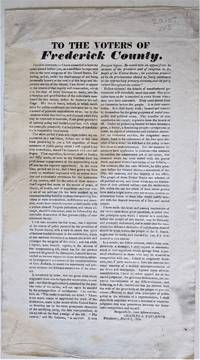
1833713Winchester Va. 1833. Broadside 4to. 290 x 160 mm. 11 ¼ x 6 ¼ inches. Printed in two columns signed in type by Charles J. Faulkner at Winchester dated March 8 1833 at conclusion. Lightly dust-soiled pale stain affecting perhaps one-third of the left-hand margin and column of text. Neatly silked on verso. Withal about very good. Following the August 1831 Nat Turner rebellion in Southampton County a last effort was made by moderate Virginians to gradually abolish slavery. Faulkner a 26-year-old lawyer and assemblyman along with Thomas Jefferson Randolph sponsored legislation to free all children born of slave parents after July 4 1840. His speech emphasized the evil of slavery for Southern white labor noting that slavery "converts the energy of the community into indolence--its power into imbecility--its efficiency into weakness.Shall society suffer that the slave-holder may continue to gather his crop of human flesh" As the Assembly was malapportioned in favor of the Tidewater slaveocracy the proposal lost rather narrowly and nearly thirty years later the Confederacy was assured of Virginia's succession. It is perhaps not surprising that Faulkner "comparatively a stranger" to the county but a member of the Virginia House of Delegates at this time 1831-34 was not successful in his campaign to represent Virginia in the U.S. Senate. However Faulkner was elected to three terms in Congress from Virginia in the 1850s. He was elected to Congress from West Virginia after the Civil War. In the interim he served as Minister to France during the Buchanan administration and on the staff of Stonewall Jackson. Dictionary of American Biography. Not in Hummel. Not found in American Imprints for 1833 and not in the 1830-1839 title index. OCLC records four copies at The Library of Virginia University of Virginia Virginia Historical Society and American Antiquarian Society. unknown
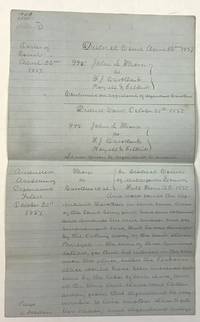
185740346Matagorda County Texas 1857. Six pages in neat ink manuscript on lined pale blue legal paper. Fine. The document is probably the record for Carothers' appeal of the Court's judgment in favor of Thorn.<br /> <br /> The parties having waived a jury trial the Court found in favor of Thorn the Plaintiff. In addition to the failure to pay Thorn for the hire of Taswell Thorn claimed that Carothers had failed to pay $100 rent to Thorn for farming on Thorn's property. <br /> Carothers said that the slave Bridget upon whom Carothers had relied for performing work on the property had been "taken away" apparently by Thorn during the term of the agreement. Bridget's absence Carothers said caused his nonperformance and thus excused his failure to pay. The Court disagreed and ordered Carothers to pay the amount of the notes plus costs and interest. unknown
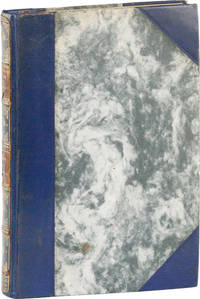
188452888Boston: Printed by the Order of the City Council 1884. First Edition. Small quarto 26.5cm; marbled paper over navy blue calf spine in seven compartments with six raised bands leather labels titling and decorative elements stamped in gilt on spine; marbled endpapers; engraved portrait frontispiece1011-70 with an additional 31 leaves bound in. Armorial bookplate of Walter Merriam Pratt on front pastedown. Re-backed with the original spine laid down; light wear to upper and lower board edges with some touch-up to leather at crown and heel; Very Good. A grangerized copy containing 22 ANS and ALS ca.1-4pp one autograph sentiment a 4.25" x 6.5" cabinet card signed by Phillips and several clipped portraits of various sizes depicting Phillips his wife and his son in uniform. Most prominent among the letters are those written to G.W. Putnam 6 H.G. Denny 2 R.L. Winthrop 2 John Boyle O'Reilly 1 and an October 8 1853 ALS to abolitionist and social reformer Gerrit Smith in which he claims to have mislaid his letter but is available to come to Brooklyn either on 15 December or 5 January 1854 and that his fee would be fifty dollars. Handsome volume memorializing American abolitionist and orator Wendell Phillips 1811-1884 commissioned by the City of Boston in an edition of 5000 copies. Nearly half the text is comprised of the eulogy by George William Curtis and includes extensive remarks by city council members and aldermen a prayer by Rev. Minot J. Savage an address by the Mayor and a poem by Mrs. Mary E. Blake. A proud son of Boston Phillips abandoned a career in law after being converted to the cause of abolitionism by William Lloyd Garrison in 1836. He was a frequent speaker at meetings of the American Anti-Slavery Society active in the free-produce movement a member of the Boston Vigilance Committee and an early advocate of women's rights. Later in life he turned considerable effort towards gaining equal rights for Native Americans and together with Helen Hunt Jackson and Massachusetts Governor William Claflin helped found the Massachusetts Indian Commission. cf.BAL 4347. Printed by the Order of the City Council unknown
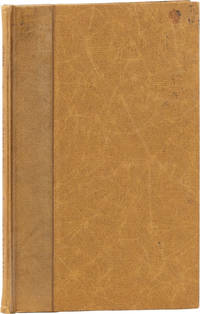
186063532New York: Published and for sale at 5 Beekman Street 1860. First Edition. 12mo. 20th-c. binding of tan calf over paper-covered boards; marbled page edges; 951pp. About fine and complete; the pamphlet appears to have been offered without cover wrappers in any case not noted by Blanck.<br /> <br /> Uncommon first edition of this late tract by the important abolitionist and feminist Lydia Maria Child 1802-1880. Child's intention with this work was to make a direct case to southern slaveholders based not on any moral grounds but purely on business hoping that the Caribbean example would convince southerners that abolition could be achieved without wrecking their economy. "Child suggested to Samuel B. May the publisher .that the title page omit any mention of the American Anti-slavery Society giving only an address but no publisher. She even considered issuing the tract anyonymously but decided that her notoriety would probably help rather than hinder its circulation" see Karcher The First Woman in the Republic: a Cultural Biography of Lydia Maria Child. Durham 1994; p.428ff. Blanck notes two editions in 1860 as well as a reissue in 1862; this with verso of the final leaf unprinted is the first. Rarely encountered in commerce. BAL 3189. Published and for sale at 5 Beekman Street unknown
18361691Boston: Isaac Knapp 1836. About very good. xvi13-238pp. 12mo. Original publisher's blue boards with black sheep spine gilt. Boards rubbed corners and spine moderately worn. Text lightly foxed. Scarce work addressing the anti-slavery work of George Thompson following his visit to America. Thompson 1804-1878 was British lecturer and reformer who worked as a commercial clerk.<br/><br/>"Thompson first came to prominence in 1831 when he was recruited by the London Anti-Slavery Society's Agency Committee as an itinerant lecturer. In the run up to the Emancipation Act of 1833 he became the most effective British anti-slavery lecturer since Thomas Clarkson. With the struggle against British slavery apparently won Thompson was instrumental in reorienting anti-slavery effort towards the Americas and particularly the United States. . In 1834 he encountered the charismatic American abolitionist William Lloyd Garrison. Recognizing Thompson's talent Garrison invited him to travel to the United States with his growing family to labour there on behalf of the enslaved people of America" - DNB. Thompson employed sarcasm and vitriol in his orations attacking anti-abolitionist sentiment across the northern states. In the process he failed to make very many friends or converts and alienated those with more moderate views.<br/><br/>"Opponents attacked him as a foreign interloper and an anti-American agitator. They also discovered a scandal in Thompson's past alleging that in 1829 he had absconded with £80 embezzled from his employer. His supporters angrily rejected this charge though Thompson later privately admitted it was true he eventually repaid the sum in full. Hostility increasingly turned violent and in fear of his life he was smuggled out of the country in October 1835 returning to a hero's welcome in Britain" - DNB.<br/><br/>This work is a rebuttal made by Thompson's American supporters aggregating information from British sources to defend his good name and abolitionist efforts after fleeing America for his homeland. It includes some of Thompson's speeches on slavery in America given before audiences in Scotland and England and discusses his work with the American Anti-Slavery Society. Though there are a handful of institutional copies the work is scarce on the market and does not appear in auction records over the pasty forty years.<br/> Sabin 9324. American Imprints 36449. Isaac Knapp unknown books
17680Used; Like New/Used; Like New. Rare pair of Anti-Slavery tokens produced for the Society for Effecting the Abolition of the Slave Trade established by Granville Sharp and Thomas Clarkson in 1787. The first shows the society's emblem of a chained African man naked and kneeling "Am I not a Man and a Brother" around the perimeter on obverse "May Slavery & Oppression Cease Throughout the World" around the perimeter and clasped hands in print formats generally one is black and one white in the center on reverse. The other example shows a kneeling woman and "Am I not a Woman & a Sister" 1838" on obverse "United States of America" with backwards "N" olive wreath with "Liberty / 1838" in center on reverse. These were commissioned by the American Anti-Slavery society to evoke pity for enslaved women as well as to foster equal rights for women.  Bronze. Diam. 1 5/16 inches 30 mm.  First somewhat worn and the "Sister" is slightly worn on recto just a few high points and the date below "Liberty" on the verso; the "Brother" with a loss on the recto. Not formally "graded" but overall very good.<br>Josiah Wedgewood 1730-1795 a dedicated abolitionist and close friend of Thomas Clarkson designed the "logo" of the kneeling slave for the Society for the Abolition of Slavery in 1787. This was taken up by the American abolitionists and in 1835 Patrick Reason a young black engraver created a version of a kneeling woman that bore the caption "Am I not a Woman and a Sister" This image together with that of the infamous slave ship's hold are without question the most iconic of the anti-slavery movement on both sides of the Atlantic. unknown books
184137610Boston: J.A. Collins 1841. Original printed and illustrated green wrappers ink stain along half the front wrapper's blank inner margin with engraving of Lady Liberty surrounded by slaves and freedom-loving white people. Stitched. 36pp. Title page and text illustrations. Lightly foxed. Very Good. <br/><br/> A scarce Almanac also appearing with a publication date of 1840. The Almanac is noteworthy for its excellent content on the Amistad incident including portraits of Cinque and others. <br/> "Things for Abolitionists to Do" recommends working to establish schools for free children of color. Also included are "Hints to Anti-Slavery Debaters;" an "Ecclesiastical Roll of Infamy" listing northern clergy of the Methodist Episcopal Church who voted for a resolution prohibiting "colored persons to give testimony against white persons;" and a "Congressional Roll of Infamy" of Northern congressmen who voted for the Gag Rule prohibiting Congress from entertaining petitions to abolish slavery in Washington D.C. As to the presidential campaign the authors say "President Van Buren and General Harrison have both publicly taken the side of the oppressor against the oppressed and the God of the oppressed. Both of them glory in it." <br/>Dumond 83 this imprint. Drake 4222. J.A. Collins unknown books
1877CAT0113J.A. Brush: Minnesota 1877. 2 ¼ x 4 inch image on slightly larger mount. Fine. Chambers a seven-year-old boy at the time of the Civil War followed the soldiers Jasper Dickey and David Scofield from Georgia back to their homes in Minnesota. The two soldiers raised him. He died in 1936 at the age of seventy-eight. Inscription on album page from which photograph was removed reads "Samuel Chambers / Zumbrota Minnesota. / Born a slave but followed northern troops to Minnesota at close of war." Verso identifies the photographer as J.A. Brush of 223 Nicollet Av. Minneapolis. A fine example. Minnesota unknown books
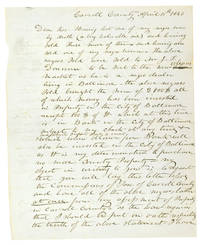
1848262219Carroll County Maryland 1848. 2 pp. pen and ink on signle sheet. 4to. Light creasing from prior folding. 2 pp. pen and ink on signle sheet. 4to. Reading in part: "Having lost one of my negro men by death a big valuable one and having sold three more of them and having also sold one of my negro women - the above negros were sold to Mr. Joseph S. Donovan to be sent to the New Orleans market as he is a negro dealer living in Baltimore - the above negroes sold brought the sum of $2800 all of which money has been invested in property in the city of Baltimore . My object in writing to you is to request that you will lay this letter before the Commissioner of Tax of Carroll County and have all of the above negroes taken at once from my assets .". unknown books
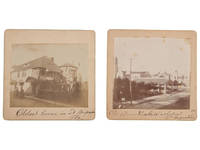
1897185871897. Albumen photographs of slavery-related sites circa 1890s document physical locations tied to the sale and habitation of enslaved people in the United States and the persistence of those sites in post-Emancipation visual culture. The images include a pavilion in St. Augustine Florida identified in contemporary sources as a site where enslaved Africans were bought and sold a photographic negative depicting outbuildings identified as Mississippi slave quarters and a mounted view of the González Alvarez House a colonial structure associated with early settlement in St. Augustine. Together the photographs provide material evidence of how spaces connected to slavery were recorded labeled and circulated in the late nineteenth century linking architectural survival to the historical memory of enslavement in both the Southeast and the Gulf South.<br /> <br /> Collection of three albumen photographs. United States circa 1890s. One mounted photograph approximately 3 3/16 x 3 inches bears the ink inscription "Old Slave Market Cathedral St. Augustine Fla." and depicts the waterfront pavilion constructed in the early nineteenth century originally used as a commercial market and identified in local records as a site of slave trading. One photographic negative approximately 3 1/2 x 3 3/4 inches shows three small structures identified as Mississippi slave quarters. One mounted photograph approximately 3 1/8 x 2 5/8 inches is inscribed "Oldest house in St. Augustine Fla. Built in the early 1700s" depicting the González Alvarez House. Mounts and inscriptions indicate a documentary intent linking the images to historically significant sites.<br /> <br /> By the late nineteenth century sites associated with slavery were being reframed within local historical narratives often presented as landmarks while still retaining traces of their earlier function within systems of forced labor and sale. The identification of the St. Augustine pavilion as a slave market in inscription and record aligns the image with documented urban sites of sale in Spanish and later American Florida while the Mississippi quarters image extends the archive into the plantation landscape of the postbellum South. The grouping provides a concise visual record of how structures tied to enslavement were preserved interpreted and circulated in photographic form decades after abolition. Minor adhesive residue to one mount small tear to negative and light toning and staining to mounts; overall good condition. unknown
1833713Winchester Va. 1833. Broadside 4to. 290 x 160 mm. 11 ¼ x 6 ¼ inches.  Printed in two columns signed in type by Charles J. Faulkner at Winchester dated March 8 1833 at conclusion. Lightly dust-soiled pale stain affecting perhaps one-third of the left-hand margin and column of text. Neatly silked on verso. Withal about very good. Following the August 1831 Nat Turner rebellion in Southampton County a last effort was made by moderate Virginians to gradually abolish slavery. Faulkner a 26-year-old lawyer and assemblyman along with Thomas Jefferson Randolph sponsored legislation to free all children born of slave parents after July 4 1840. His speech emphasized the evil of slavery for Southern white labor noting that slavery "converts the energy of the community into indolence--its power into imbecility--its efficiency into weakness.Shall society suffer that the slave-holder may continue to gather his crop of human flesh" As the Assembly was malapportioned in favor of the Tidewater slaveocracy the proposal lost rather narrowly and nearly thirty years later the Confederacy was assured of Virginia's succession. It is perhaps not surprising that Faulkner "comparatively a stranger" to the county but a member of the Virginia House of Delegates at this time 1831-34 was not successful in his campaign to represent Virginia in the U.S. Senate. However Faulkner was elected to three terms in Congress from Virginia in the 1850s. He was elected to Congress from West Virginia after the Civil War. In the interim he served as Minister to France during the Buchanan administration and on the staff of Stonewall Jackson. Dictionary of American Biography.  Not in Hummel. Not found in American Imprints for 1833 and not in the 1830-1839 title index. OCLC records four copies at The Library of Virginia University of Virginia Virginia Historical Society and American Antiquarian Society. unknown books
184125455PARIS 1841-45 -in-8 demi-basane 31 plaquettes du même Auteur, reliées en 2 volumes, reliure demi-basane (half binding sheepskin) bleu-marine in-octavo, dos long (spine without raised band)décoré "or" (gilt decoration), Auteur et Titre frappés "or" (gilt title) avec 4 filets fins "or" de part et d'autre, 4 filets fin "or" en place des nerfs et en tête et en pied, papier marbré vert, crème et marron aux plats (cover with marbled paper), toutes tranches lisses (all smooth edges), sans illustration (no illustration), Oeuvres Reliées comme suit : TOME I ...... 1- Précis de l'Affaire Douillard-Mahaudière adressé à la Chambre des Députés, 20 pages, 1841, Paris Imprimerie de Cosse et G.-Lagionie Editeur, 2- Mémoire du Conseil des Délégués des Colonies à M. le Baron DUPERRE Amiral de France, Ministre de la Marine et des Colonies, 28 pages, 1841, Paris Imprimerie de Cosse et G.-Lagionie Editeur, 3- Conseil des Délégués des Colonies. a Monsieur le Ministre de l'Agriculture et du Commerce, 21 pages, 1841, Paris Imprimerie d'Ad. Blondeau Editeur, 4- Avis de M. JOLLIVET, Délégué de la Martinique à Monsieur le Ministre de la Marine et des Colonies, sur le projet d'Ordonnance relatif à l'emprisonnement disciplinaire des Esclaves, 24 pages, 1841, Paris Imprimerie d'Ad. Blondeau Editeur, 5- ANALYSE DES OPINIONS ET VOTES DES CONSEILS GENERAUX DE L'AGRICULTURE, DES MANUFACTURES ET DU COMMERCE, SUR LA QUESTION DES SUCRES : Lettre de Mr A. JOLLIVET, Membre de la Chambre des Députés, Délégué de la Martinique à Messieurs les Présidents et Membres du Conseil Supérieur du Commerce, SUR LA QUESTION DES SUCRES, 18 pages, 1842 Paris Imprimerie d'Ad. Blondeau Editeur, 6- Des Missions en France de la Société Abolitionniste Anglaise et Etrangère, par M. JOLLIVET, Député d'Ille-et-Vilaine, Délégué de la Martinique, 15 pages, sans date (1841)Paris Imprimerie d'Ad. Blondeau Editeur, 7- Question des Sucres dans la Chambre des Communes d'Angleterre - Du Travail Libre et du Travail Forcé. Leur Influence sur la Production Coloniale, par M. JOLLIVET, Député d'Ille-et-Vilaine, Délégué de la Martinique, Bon à Tirer avec dernières corrections de fautes et parfois de phrases rajoutée de la main de l'Auteur avant impression définitive par l'Editeur, 27 pages, Mai 1841 Paris Imprimerie d'Ad. Blondeau Editeur, 8- De L'Expropriation Forcée dans les Colonies de la Martinique, de la Guadeloupe et de la guyane par M. JOLLIVET, membre de la Chambre des Députés, 70 pages, 1842 Paris Imprimerie d'Ad. Blondeau Editeur, 9- Du Projet de Loi tendant à Régler les Attributions Financières des Conseils Coloniaux par M. JOLLIVET, membre de la Chambre des Députés, 51 pages, 2 Avril 1842 Paris Imprimerie d'Ad. Blondeau Editeur, 10- De la Philantropie Anglaise par Mr JOLLIVET, membre de la Chambre des Députés (deuxième edition), 55 pages, 1842 Paris Imprimerie d'Ad. Blondeau Editeur, 11- Discours de Mr JOLLIVET, Député d'Ille-et-Vilaine, dans les Séances des 28 et 30 Mai 1842, 15 pages, 1842 Paris Imprimerie de Cosse et G.-Laguionie Editeur, 12 - LETTRE ET REPONSE AU JOURNAL DES DEBATS, par M. JOLLIVET, Membre de la Chambre des Députés, Délégué de la Martinique, 14 pages, 1842 Paris Imprimerie de E.-B. DELANCHY Editeur, 13 - LETTRES de M. A. JOLLIVET, Membre de la Chambre des Députés et Délégué de la Martinique, 31 pages, 1842 Paris Imprimerie de E.-B. DELANCHY Editeur, 14- Analyse des Délibérations et Avis des CONSEILS COLONIAUX des Gouverneurs et des Administrateurs des Colonies sur les PROJETS D'EMANCIPATION(ABOLITION DE L'ESCLAVAGE), de la Commission présidée par M. Le Duc de Broglie, Par M. JOLLIVET, Membre de la Chambre des Députés, 69 pages, 1843 Paris Imprimerie Bruneau Editeur, 15 - L'EMANCIPATION ANGLAISE (ABOLITION DE L'ESCLAVAGE) Jugée par ses Résultats - Analyse des Documents Officiels Imprimés par ordre de M. le Ministre de la Marine et des Colonies, par M. JOLLIVET, Membre de la Chambre des Députés, Délégué de la Martinique, 104 pages, 1842 Paris Imprimerie de Moquet et Hauquelin Editeur, 16 - Enquête Parlementaire sur les COLONIES ANGLAISES publiée en Septembre 1842 - ANALYSE DE L'ENQUÊTE par M. JOLLIVET, Membre de la Chambre des Députés, 48 pages, 1843 Paris Imprimerie de Bruneau Editeur, 17- QUESTION DES SUCRES par M. JOLLIVET, Membre de la Chambre des Députés, 86 pages, 1843 Paris Imprimerie de Bruneau Editeur, 18 - PARALLELE entre les COLONIES FRANCAISES ET LES COLONIES ANGLAISES, Appendice au Rapport du Duc de Broglie par M. JOLLIVET, Membre de la Chambre des Députés, Délégué de la Martinique, 40 pages, 1843 PARIS Imprimerie de Bruneau Editeur, TOME II ..... 1 - Lettre de M. JOLLIVET, Membre de la Chambre des Députés, Délégué de la Martinique, au Rédacteur du Journal des Débats, 13 pages, 1844 Paris Imprimerie de Bruneau Editeur, 2 - Note Présentée au Conseil des Ministres Par M. JOLLIVET, Membre de la Chambre des Députés, Délégué de la Martinique, sur UN PROJET DE LOI RELATIF A LA CONSTITUTION POLITIQUE DES COLONIES, 23 pages, sans date (1844)Paris Imprimerie de Bruneau Editeur, 3 - A LOS HABITANTES DE LA ISLA DE CUBA (texte en espagnol ...par A. JOLLIVET, diputado de la camara de francia, y delegado de la Martinica), 23 pages, 1844 Paris imprimerie d'Ed. Proux et Cie Editeur, 4 - HISTORIQUE DE LA TRAITE ET DU DROIT DE VISITE. Par M. JOLLIVET, Membre de la Chambre des Députés, 35 pages, 1844 Paris Imprimerie de Bruneau Editeur, 5 - PETITIONS DE QUELQUES OUVRIERS ET OUVRIERES DE PARIS POUR L'ABOLITION IMMEDIATE DE L'ESCLAVAGE - VERITABLE SITUATION DES NOIRS DANS LES COLONIES FRANCAISES Par M. JOLLIVET, Membre de la Chambre des Députés, 20 pages, 1844 Paris Imprimerie de Bruneau Editeur, 6 - Observations Présentées par M. JOLLIVET, Délégué de la Martinique, devant la Commission de la Chambre des Pairs sur LE PROJET DE LOI (SUR L'ESCLAVAGE DES NOIRS), Tendant à Modifier les Articles 2 et 3 de la loi du 24 Avril 1833 - Séance du 11 Juin- 81 pages, 1844 Paris Imprimerie de Bruneau Editeur, 7 - QUESTION DES SUCRES EN ANGLETERRE. - DU TRAVAIL LIBRE ET DU TRAVAIL ESCLAVE, par M. JOLLIVET, Membre de la Chambre des Députés, 23 pages, 1845 Paris Imprimerie de Bruneau Editeur, 8 - DOCUMENTS AMERICAINS, ANNEXION DU TEXAS, EMANCIPATION DES NOIRS(ABOLITION DE L'ESCLAVAGE), POLITIQUE DE L'ANGLETERRE, par M. JOLLIVET, Membre de la Chambre des Députés, 40 pages, 1845 Paris Imprimerie de Bruneau Editeur, 9- ANNEXION DU TEXAS - NOUVEAUX DOCUMENTS AMERICAINS Publiés par M. JOLLIVET, Membre de la Chambre des Députés, 55 pages, 1845 Paris Imprimerie de Bruneau Editeur, 10 - DOCUMENTS AMERICAINS, 3ème Série. LES ETATS UNIS D'AMERIQUE ET L'ANGLETERRE. ANNEXION DU TEXAS. L'OREGON, par M. JOLLIVET, Membre de la Chambre des Députés, 74 pages, Avril 1845 Paris Imprimerie de Bruneau Editeur, 11 - LES COLONIES FRANCAISES DEVANT LA CHAMBRE DES PAIRS. Analyse de la Discussion Générale du Projet de Loi sur le Régime Colonial, par M. JOLLIVET, Membre de la Chambre des Députés, 112 pages, 1845 Paris imprimerie de Guiraudet et Jouaust Editeur, 12 - Chambre des Députés - Session de 1844-1845 - DISCOURS prononcé par M. JOLLIVET, Député d'Ille-et-Vilaine dans la discussion générale du projet de loi relatif aux COLONIES, Séance du 29 Mai 1845, 31 pages, extrait du Moniteur Universel du 30 Mai 1845, 1845 Paris Imprimerie Panckoucke Editeur, 13 - DISCOURS prononcés par M. JOLLIVET, Député d'Ille-et-Vilaine, dans la discussion des articles du projet de loi relatif au REGIME DES COLONIES, Séances des 2, 3 et 4 Juin 1845, extraits du Moniteur Universel des 3, 4 et 5 Juin 1845, 36 pages, 1845 Paris Imprimerie Panckoucke Editeur,
210609[Paris], Imprimerie du Patriote François, s.d. (1791) in-4, 3 pp., broché sous couverture d'attente de papier marbré.
239790Paris, L. Pelletier, an XII - 1804 in-8, [2] ff. n. ch., VIII pp., pp. 5-194, demi-basane fauve à coins, dos lisse, tranches mouchetées de rouge (reliure à l'imitation).
Rilegato con “De usu antiquae locutionis libri duo” (Anversa, 1606) e con “De operis servorum liber” (Anversa, 1608). In -8°, pp. (4), 336, 158, 107, (3); piena pergamena con titolo manoscritto al dorso. Popma è teorico della sinonimia, fra i più citati nella prima edizione del Dizionario dei sinonimi del Tommaseo (1830), che fa riferimento proprio al “De differentiis verborum”. Popma was a theoric of synonyms, one of the first scholars facing this question.
178515723Genève, Paris, [], 1785. In-8 de 14-(2)-292 pp., veau fauve, dos lisse orné, pièce de titre en maroquin (reliure de l'époque).
1798PHO-2264Paris, Tavernier, An VI [1798)]. In-8° de [4], 343 pp. 3 cartes dépliantes & Paris, Directeurs de l'Imprimerie du Cercle Social, 1792, l'an premier de la République Française. 171 pp. Basane fauve racinée, dos long orné, p. de t. en maroquin rouge, filet doré sur les coupes, tranches citron (Reliure de l'époque). Annotations anciennes dans les marges. Accident à la coiffe de tête, usure aux coins, frottements au dos.
1732PHO-1798Paris, Veuve Delormel et René Josse, 1732. In-12, plein veau, dos orné, pièce de titre rouge, tranches rouges (Reliure de l'époque). Ex-libris et ex-dono manuscrits anciens au titre, frottements et épidermures, coiffe sup. accidentée, 1 coin usé, manque le plan de Troie.
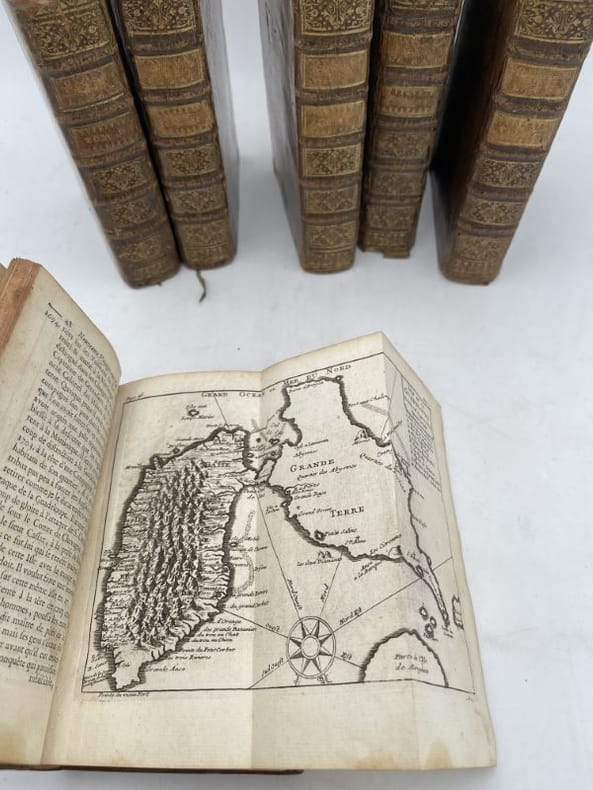
1742177261Guillame Cavalier A Paris, chez Guillaume Cavalier, 1742. 6 volumes sur 8, manquent tomes V et VIII, In-12 reliés pleine basane brune, dos à nerfs très ornés, pièces de titre et de tomaison, tranches rouges, gardes de papier marbré. Tome I : 472 pages, portrait gravé en frontispice et 20 planches dont 11 dépliantes - Tome II : 444 pages, 17 gravures dont 3 dépliantes et une dont il manque une partie, une page présente un trou avec manque de texte. Tome III : 475 pages, 31 gravures dont 14 dépliantes - Tome IV : 533 pages, 12 gravures dont 4 dépliantes. Une page présente une déchirure sur cinq centimètres sans perte de texte - Tome V : Manquant - Tome VI : 502 pages, 6 gravures en bon état, une gravure manquante et 7 gravures avec manques importants - Tome VII : 516 pages et 4 gravures dont une dépliante. Soit un total de 88 gravures en bon état et, comme décrit ci-dessus d'autres avec manques. Reliures un peu frottées, 4 coiffes arasées avec petits manques de cuir, coins un peu émoussés, corps des volumes en état très correct, sauf le tome VI qui a souffert des affres du temps et de la manipulation. Marque d'appartenance du temps contrecollée dans chaque volume "Monsieur Castel, Receveur de la Chambre à sel et Entreposeur du Tabac, au Mur de Baret " (actuellement Barrez). Mention, en page de titre, de nouvelle édition augmentée considérablement et enrichie de figures en tailles-douces. Bibliographie Brunet.
232912Paris, Garnery, an premier de la République (1792-1793) 3 vol. in-8, viij pp., 399 pp. ; [2] ff. n. ch., vj pp., pp. 7-[415] (mal chiffrées 435) ; [2] ff. n. ch., iv pp., pp. 5-436, demi-basane brique, dos lisses ornés de guirlandes et filets dorés, pièces de titre et de tomaison noires, coins en vélin vert, tranches mouchetées (reliure du début du XIXe).
174923232Paris Didot 1749 In-12 ( 4 Volumes ) Du tome IX au tome XII, 478 pp et 2 cartes , 486 pp , 3 gravures et 5 cartes , 429 pp 1 carte et 5 gravures et 508 4 cartes et 3 gravures
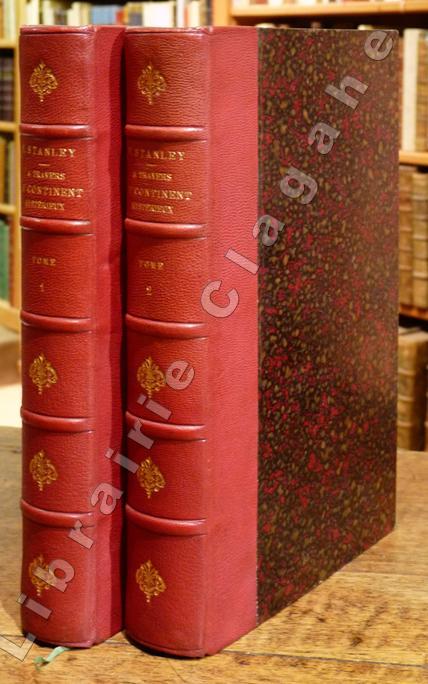
187912907Paris, Hachette, 1879 ; 2 tomes in-8 ; demi-chagrin rouge-cerise, fleurons décoratifs et titre dorés (reliure de l'époque) ; (12), IV, 496 ; (4), 544 pp., 2 frontispices, 9 cartes en couleurs dont 2 très grandes dépliantes en fin de chaque volume et 2 dépliantes, dont celle du fleuve Lingstone (Congo) et de ses chutes.
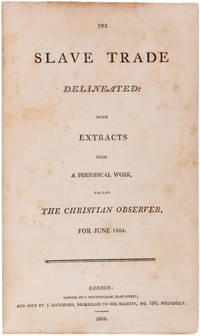
180521055261805. London: Whittingham for Hatchard. 1805. 8vo. Recent marbled wrappers; pp. 20 printed in two columns; one corner of title-page clipped light browning; a good copy of a great rarity.This combined offprint opens with a first-hand report by 'Leo Africanus' of a journey recently made on a slave ship from West Africa to the West Indies. On board the ship the Captian told the visitors and traveller 'that a slave ship was a very different thing from what it had been represented. We should find the slaves rejoicing in their happy state' p. 3. The truth however showed the sheer horror of this crime against humanity at high sea. This is followed on page ten by a discussion of a Hatchard-published pamphlet on the abolition of the slave trade. The present pamphlet is concluded by the refutation of the printed Letter to the Right Honorable W.Pitt containing some new Arguments against the Abolition of the Slave Trade in which the author Britannicus had argued 'if we give freedom to the negroes we shall ourselves indubitable become slaves of Bonaparte' p. 13. Post-truth over two hundred years ago. unknown
101301 P., Veuve Tilliard et Fils, An VII, petit in-8° de 230 pp.-f.bl., relié demi-basane noire d'époque, dos lisse orné, titre or sur pièce peau rouge ; mouillure angulaire en tête jusqu'à la page 19, à peine perceptible jusquà la page 160 puis descendant vers le deuxième tiers des pages et finissant plus marquée de la p. 209 au feuillet de garde.
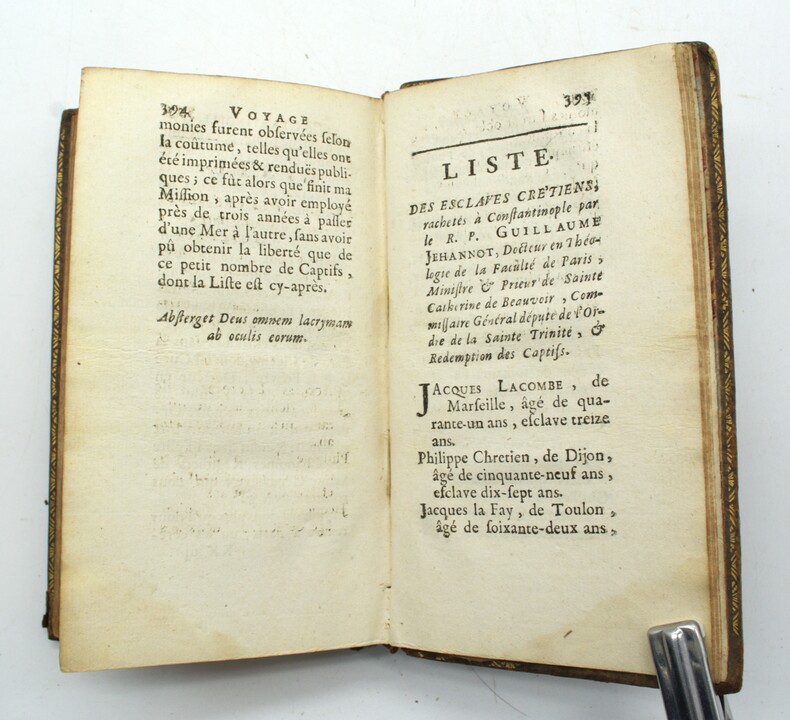
1369393Paris: Chez Louis Anne Sevestre et Pierre François Giffaré, 1721 in-16, titre, [7]-169-lx ("Liste des Esclaves rachetez")-306 ("La tradition de l'Eglise pour le rachat des captifs")-(6), 2 gravures, l'une en double page ("Audience du Deï d'Alger donné à Mr. Dusault ...."). Reliure veau d'ép., usures, coiffes manquantes, coins de toile postérieurs, pièce de titre et n° de classement sur étiquettes de papier, qq rousseurs, déchirure transversale sans manque de papier page 103. Edition originale. (Barbier IV,1095).