DUPERRE Victor Guy ( Amiral Baron )Livre Rare Book
1 561 résultats
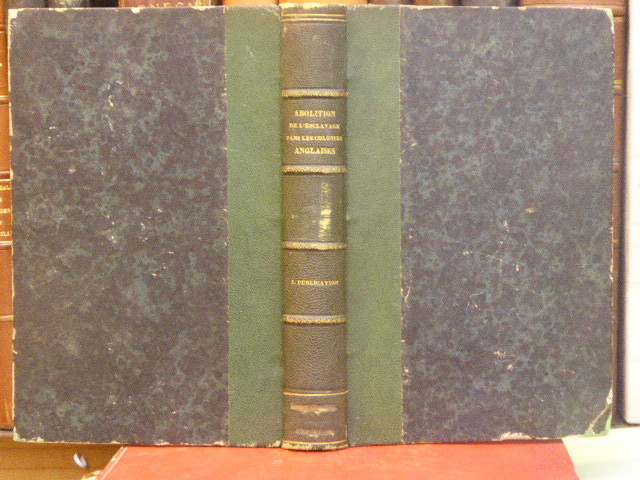
733216Imprimerie Royale Paris 1841 In-8 ( 230 X 155 mm ) de XVI-546 pages, demi-chagrin vert sapin, dos à nerfs orné de chaînettes dorées. EDITION ORIGINALE très rare. Usures minimes aux coupes, bel exemplaire, très pur imprimé sur beau papier vergé.
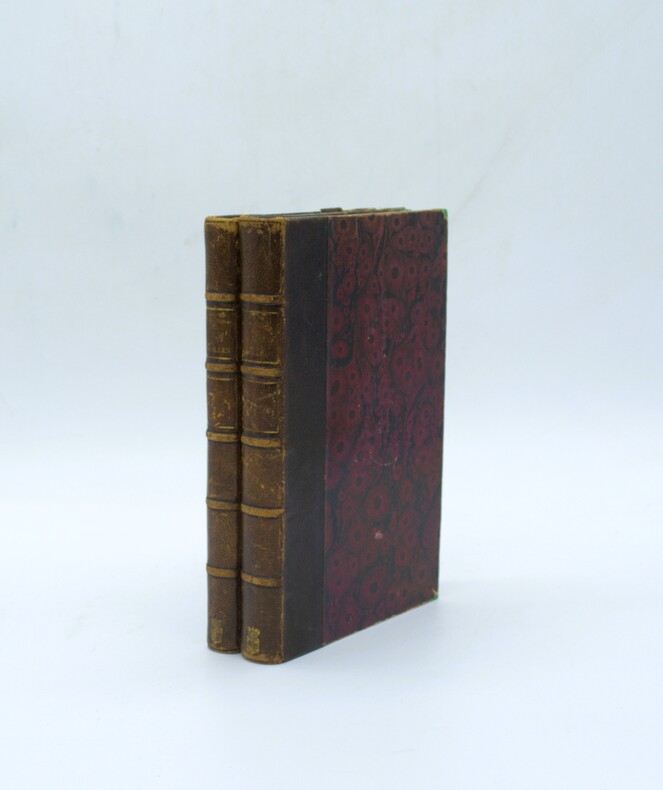
1842PHO-2339Paris, Dauvin et Fontaine Libraires, 1842, Au Comptoir Des Imprimeurs-Unis, 1844, 2 volumes in-8 (21,5x13,5cm), VIII-356 pp., 481 pp., demi chagrin époque, dos à nerfs avec auteur et titre, armoiries dorées en pied, ex-libris en page de garde (Bruneau, officier de vaisseau).
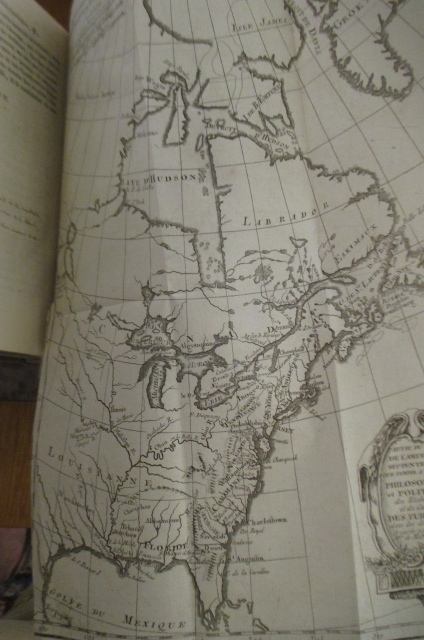
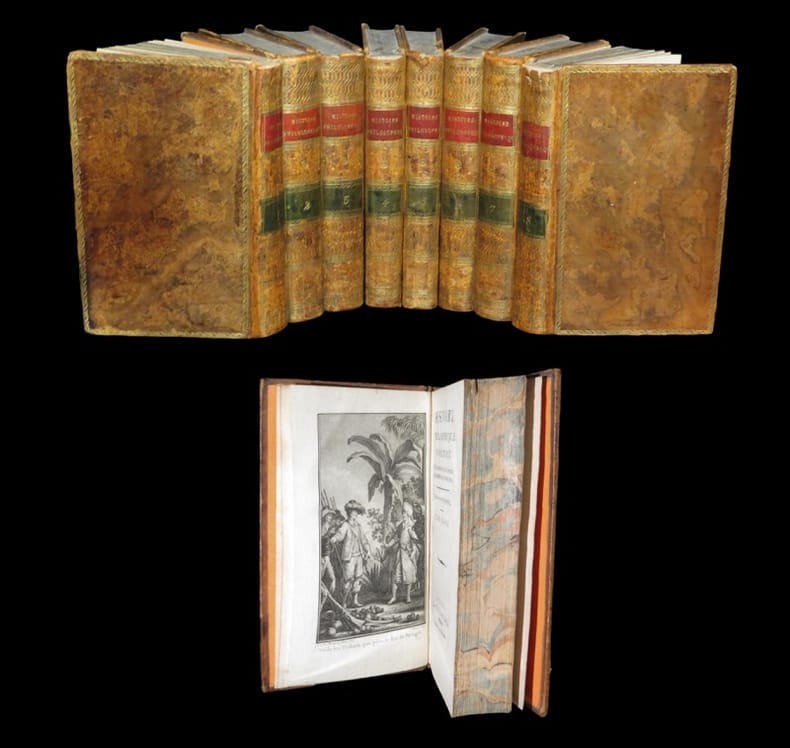
his2518Mchez lezs libraires associés., A La Haye 1776 - 7 volumes IN8. Reliure d'époque en demi-veau blond. Dos lisses avec pièces de titres et de tomaison en maroquin. Tranches mouchetées.(Trois coiffes usées). Bonne édition complète du portrait gravé de l'auteur et des sept cartes
1842106407<p>Folded letter sheet four pages and remnant of wax seal. Creases at folds normal aging; otherwise very good or better. The letter is to Henry J. Carter Stockbridge Mass. from his brother. An unemployed 20 year-old Massachusetts teacher who had left home the year before in "exceeding hard times" Edward had gone to Baltimore – where some 50 teachers were out of work – and taken a job working for a wealthy man who had 4 acres of farm land worked by slaves. "…he has given me the office of overseer to look after the blacks in their work. O but you ought to see me walk over the lot with my cane in my hand to see how my work is going on. Then you ought to see the darky when he wants anything of me come up and take off his hat before he speaks…" Praising the "fine folks live in this beautiful part of the world" Carter proves that even a Massachusetts Yankee could quickly adapt to Southern culture and make peace with slavery. The letter is unsigned. </p>
18604105Missouri: April 1 1860. Very good. 4pp. on a single folded sheet. Original mailing folds minor toning. An informative letter written by Charles H. Cram in Missouri to a friend in New England dated "April Fools Day 1860" in red pencil at the top of the first page. Cram mentions hoop skirts Pike's Peak and slavery while trying to decide whether to continue westward during the latter years of the California Gold Rush. Cram's letter reads in part: "Everybody is going to Pikes Peak but me. I think some of them will wish they were back again but they have got the gold fever and nothing else will cure them. I have learned better than to follow the biggest nois and the great rush. The emigrants to Pikes Peake will most of them will have to sleep on the ground and depend on the rifle for something to eat. I may start for Santa Fe about the first of June. I can git 15 dollars a month to drive a teem to Santa Fe. If I do cross the plains I shall go to California but if I have good health I shall stay here though I do not like to live in a slave state."<br /> <br /> In another portion of his letter Cram addresses his correspondent's question of whether slaves and freedpersons wore hoop skirts in Missouri. Cram writes: "You wanted to know if niggers wore hoops. Some do and some don't some slaves in broadcloth and silk and some go nearly naked. Slaves have there stent to do so much & if they do more they are payed for it. Most of them have a piece of ground that they call their own. What time they get they work on it. That is how they git their fine cloths. There is not a nigger in Missouri that works as hard as I do but I have consolation that I can work only when I am a mind to. You tell Albert not to start out among strangers as I did for he will find the people different in the country from them in New England."<br /> <br /> Cram then speaks to the emigrant populations he encounters out west as well as the agricultural bounty and animal life of Missouri: "The greatest difficulty I had was to learn the French and German language. I have been for weeks where I could not understand a word but now I can understand anything that comes along. But now for something else. The peach trees are in flower and the woods look green. Cattle and horses pick their living here the year round. I have not seen a barn in the country. The way to feed a horse is to tie him up to a tree and throw him a few ears of corn on the ground. I cannot rite to day much for there is half a dozen in the room talking about pikes peak or some young lady and how many negroes her father owns etc."<br /> <br /> Cram ends his letter with some advice for his friends back east: "Tell Mr. Bosworth that if he can rais $500 that he had better go to Cansas Kansas and go to farming. If you can persuade Andrew Marshall to go west it will be a good lesson for him."<br /> <br /> A mid-19th century manuscript letter with informative observations on the clothing of slaves and with notable observations of western life in Missouri. April 1 unknown
18393013Washington D.C. 1839. Fair. 3pp. Large folio. Separated into six pieces with a very small section of the final attestation lacking altogether. Still highly readable. A wounded but important document. A rare and historically-important document relating to slavery in the District of Columbia which was outlawed on April 16 1862 nearly nine months before the issuance of the Emancipation Proclamation. The present document is an indenture made between William G. Howison and Alexander Hunter Esquire both citizens of Washington D.C. associated with property conveyed to Hunter by the deceased Joseph Birch. In 1824 Birch conveyed to Hunter land "and also a negro man slave for life named Lewis - another named George - two horses - 4 cows - 3 calves." The document indicates that Lewis was subsequently sold for four hundred dollars and George was sold to Birch in his lifetime. Documents recording the movement of slaves within the District especially among two citizens of the city are rare in the market. unknown
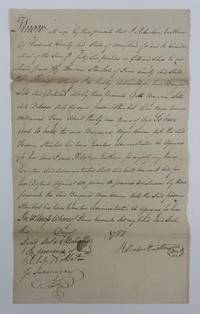
17884111Frederick County Md: March 7 1788. About very good. 1p. folio docketed on verso. Old folds short splits along a couple of fold lines minor toning. An impactful manuscript document from the early national period in Maryland formalizing the sale of a slave woman in Frederick County. The sale was made by Robertson Eastburn whose family emigrated from England to Maryland in the early 18th century. The document reads in part: "In consideration of the sum of forty six pounds in Gold and Silver to me in hand and paid by Frederic Strombol.I do hereby Acknowledge have Bargain'd Sold and Delivered and by these presents doth Bargain Sell and Deliver Unto the said Frederic Strombol One Negro Woman named Torry about thirty years of age To Have and to hold the said Bargained Negro woman unto the said Frederic Strombol."<br /> <br /> Slavery in Maryland lasted over 200 years from its beginnings in 1642 when the first Africans were brought as slaves to St. Mary's City to its end following the Civil War. In 1664 under the governorship of Charles Calvert 3rd Baron Baltimore the Assembly ruled that all enslaved people should be held in slavery for life and that children of enslaved mothers should also be held to the same standard of law. 19th-century American slave sale documents are growing increasingly scarce in the market. March 7 unknown
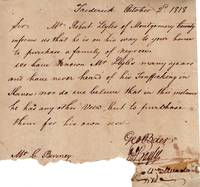
181812956Frederick MD: October 2 1818. 1p. docketed on verso. Roughly torn along bottom edge minor foxing and spotting. Good condition. An uncommon document in Maryland slave history in which George Baer the future mayor of Frederick and a few other men attest that another local citizen named Robert Lyles is not a slave trader. The document reads in part: "Lyles is on his way to your house to purchase a family of negroes. We have known Mr. Lyles many years and have never heard of his Trafficking in Slaves nor do we believe that in this instance he has any other view but to purchase them for his own use." Baer served as mayor of Frederick from 1820 to 1823; his correspondent "C. Burney" is perhaps Clotworthy Birney 1765-1845 a farmer and real estate trader living near Taney Town. An unusual Maryland slave document concerning a slave owner who just wants to buy slaves for his own use not traffic in them because that's somehow better. October 2 unknown
183612488New York September 1836. Used; Like New/Used; Like New. Folio. 4 pp printed in four columns per page. Tears around edges creased and with significant toning to the upper front half and extensive foxing throughout. <br><br><br />This rare monthly an organ of the American Anti-Slavery Society began in July 1835 and ended with the February 1839 issue. Among other interesting features the present issue prints a "Form of a Petition for the Abolition of Slavery in the District of Columbia. To The Congress of the United States." Not in Lomazow Mott Sabin. OCLC records copies from all the other years but no copies of this issue. <br><br><br />While there was opposition to slavery in the nation's capital the greater forces against slavery came from the outside through newspapers and petitions. Many petitioned Congress to end slavery in the nation's capital and the organizing efforts in the District included the Washington Abolition Society which was organized in 1827. But the opposition to ending slavery and the slave trade in the District was such a contested issue that a gag rule instituted in 1836 prohibited a discussion of slavery on the floor of Congress. Though Abolitionists including John Quincy Adams vehemently opposed the gag rule standard-bearers of slavery in the District fought tirelessly for it. Eventually in 1848 the House of Representative passed a resolution to prohibit the slave trade in the District of Columbia. Although the resolution did not gain enough traction to end the slave trade in the District it played an influential role in the congressional debates over slavery and the slave trade. The Compromise of 1850 admitted California in the Union as a free state; the former Mexican territories were admitted as part slaveholding states and part free soilers states; and the slave trade in the District of Columbia was abolished. The 1850 Compromise provided the necessary momentum for the enactment of the District of Columbia Compensated Emancipation Act of April 16 1862 that abolished slavery in the Nation's Capital. unknown books
18772027Havana 1877. Very good. 1p. on a bifolium. Removed from a a bound volume with unobtrusive stabholes at gutter margin. Light wear at edges; light dust soiling and damp staining. Remarkable bidsheet submitted by a Cuban business in response to a newspaper advertisement for an auction of slaves for hire held in Havana during November 1877. The firm Jado Sarasúa y Compañia writes that "Enterada del anuncio publicado en la Gaceta fecha 9 del corriente para el arrendamineto en publica subasta de los esclavos existentes en el Asilo de San Jose pertenecientesa Bienes Embargados y sujentadose en un todo al pliego de Condiciones inserto en la misma Gaceta hace la siguente proposicion." Below is a list of fourteen slaves mostly women and the prices that the company is willing to offer for the slaves being rented ranging from ten to seventeen pesos per month. Signed and dated at the bottom "Habana Noviembre 14 de 1877. unknown books
1836WRCAM52765N.p. likely Augusta 1836. 62pp. Folded sheets stitched. Minor foxing and toning. Very good. Untrimmed. A rare Maine slip-bill document resolving that the citizens from Maine and other states should not interfere with the issue of slavery in slave-holding states. The legislature writes: "Any interference therefore of a State or the inhabitants of a State with the domestic concerns of another State is dangerous as having a direct tendency to create jealousies between the States and thereby weakening the attachment to the Union which is our only security against domestic dissensions and foreign aggressions." <br> <br> This is a somewhat surprising position for the state of Maine to have taken at the time. Maine came into the Union in 1820 as a free state to balance the admission of the slave- owning state of Missouri. Also Maine opposed the admission of the Republic of Texas in 1836 the same year the present document was printed on the basis of Texas' position on slavery. It is curious that they would take two seemingly opposite positions in the same year. Still the legislature printed the resolution and authorized copies to be sent to the four southern slave-owning states mentioned in the title. unknown books
1842106407<p>Folded letter sheet four pages and remnant of wax seal. Creases at folds normal aging; otherwise very good or better. The letter is to Henry J. Carter Stockbridge Mass. from his brother. An unemployed 20 year-old Massachusetts teacher who had left home the year before in "exceeding hard times" Edward had gone to Baltimore – where some 50 teachers were out of work – and taken a job working for a wealthy man who had 4 acres of farm land worked by slaves. "…he has given me the office of overseer to look after the blacks in their work. O but you ought to see me walk over the lot with my cane in my hand to see how my work is going on. Then you ought to see the darky when he wants anything of me come up and take off his hat before he speaks…" Praising the "fine folks live in this beautiful part of the world" Carter proves that even a Massachusetts Yankee could quickly adapt to Southern culture and make peace with slavery. The letter is unsigned. </p> books
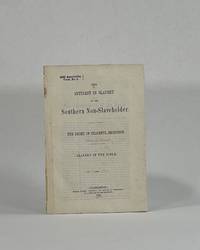
18609565Charleston: Steam-Power Presses of Evans & Cogswell 1860. Disbound. Very Good binding. Octavo. 30 2 blank pp. First edition. Removed from binding. Vertical crease from old fold; a few instances of pencil bracketing; De Bow's name is penciled in on the title page by a later hand. Generally a well preserved copy. <br /> <br /> One of a series of pamphlet issued by Charleston's "1860 Association" a group of wealthy slave-holders who moved to promote immediate secession. In this tract De Bow a Charlestonian by birth who was living and publishing pro-Southern essays in his New Orleans Commercial Review of the South and Southwest offers and economic argument about the "benefits" of slavery on the Southern worker's wages and working condition. De Bow's essay is followed by extracts from an article on the rights of secession as well as lengthy extracts from a sermon by Rev. Henry J. Van Dyke "The Character and Influence of Abolitionism" in which this Northern pastor argues that abolitionism has no Biblical foundation and that its principles are misrepresented for men's gain. Uncommon in commerce. Parrish & Willingham 5330; Confederate Hundred 28; Work p. 399; Afro-Americana 5157; Turnbull III p. 298. Steam-Power Presses of Evans & Cogswell unknown
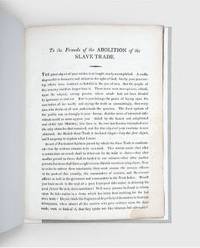
1807190225London: W. Flint 1807. First edition published soon after the abolition of the slave trade in the British Empire appealing for Britain to make the international end of the trade a core part of its aims in the ongoing Napoleonic Wars. Quarto 248 x 194 mm 4 pp. Recent white and grey boards printed paper label to front cover. Light stain at bottom fore corner and light spotting: a good copy. hardcover
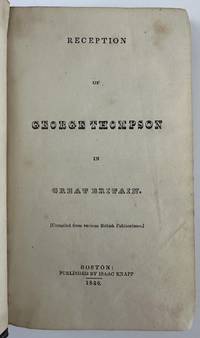
18361691Boston: Isaac Knapp 1836. About very good. xvi13-238pp. 12mo. Original publisher's blue boards with black sheep spine gilt. Boards rubbed corners and spine moderately worn. Text lightly foxed. Scarce work addressing the anti-slavery work of George Thompson following his visit to America. Thompson 1804-1878 was British lecturer and reformer who worked as a commercial clerk. "Thompson first came to prominence in 1831 when he was recruited by the London Anti-Slavery Society's Agency Committee as an itinerant lecturer. In the run up to the Emancipation Act of 1833 he became the most effective British anti-slavery lecturer since Thomas Clarkson. With the struggle against British slavery apparently won Thompson was instrumental in reorienting anti-slavery effort towards the Americas and particularly the United States. . In 1834 he encountered the charismatic American abolitionist William Lloyd Garrison. Recognizing Thompson's talent Garrison invited him to travel to the United States with his growing family to labour there on behalf of the enslaved people of America" - DNB. <br /> <br /> Thompson employed sarcasm and vitriol in his orations attacking anti-abolitionist sentiment across the northern states. In the process he failed to make very many friends or converts and alienated those with more moderate views. "Opponents attacked him as a foreign interloper and an anti-American agitator. They also discovered a scandal in Thompson's past alleging that in 1829 he had absconded with £80 embezzled from his employer. His supporters angrily rejected this charge though Thompson later privately admitted it was true he eventually repaid the sum in full. Hostility increasingly turned violent and in fear of his life he was smuggled out of the country in October 1835 returning to a hero's welcome in Britain" - DNB.<br /> <br /> This work is a rebuttal made by Thompson's American supporters aggregating information from British sources to defend his good name and abolitionist efforts after fleeing America for his homeland. It includes some of Thompson's speeches on slavery in America given before audiences in Scotland and England and discusses his work with the American Anti-Slavery Society. Though there are a handful of institutional copies the work is scarce on the market and does not appear in auction records over the pasty forty years.<br /> <br /> Sabin 9324. American Imprints 36449. Isaac Knapp unknown
1850106404<p>Folio manuscript legal sheets 11 pp. plus docketing on final back sheet. Traces of wax in some margins. Paper is browned and aged some minor creasing at folds margin hole on a couple of pages not affecting text; otherwise very good. This is a very complex legal case about the ownership of two slaves. These manuscript documents are signed by the three Constables deposed as witnesses. The testimony is taken at the law offices of Lysander G. Gordon. It seems that an individual who owed people money was forced to give the slaves to a sheriff and were then sold to William Knox in Southern Tennessee. However it appears that the slaves actually belonged to someone else. These documents try to sort though this mess. </p>
1850106404<p>Folio manuscript legal sheets 11 pp. plus docketing on final back sheet. Traces of wax in some margins. Paper is browned and aged some minor creasing at folds margin hole on a couple of pages not affecting text; otherwise very good. This is a very complex legal case about the ownership of two slaves. These manuscript documents are signed by the three Constables deposed as witnesses. The testimony is taken at the law offices of Lysander G. Gordon. It seems that an individual who owed people money was forced to give the slaves to a sheriff and were then sold to William Knox in Southern Tennessee. However it appears that the slaves actually belonged to someone else. These documents try to sort though this mess. </p> books
239927Paris, Imprimerie de Firmin Didot frères, 1839 in-8, 39 pp., en feuilles, cousu.
238357Paris, J. G. Dentu, décembre 1819 in-8, [2] ff. n. ch., ij pp., 134 pp., un f. n. ch. (Article particulier, retiré du texte, à la fin de la page 107 [relatif à la traite]), dérelié.
M4327P, Emery, 1822 , 2 vols in8br , couverture muette éditeur, cx-409-503pp , 1 portrait frontispice. Langue: Français
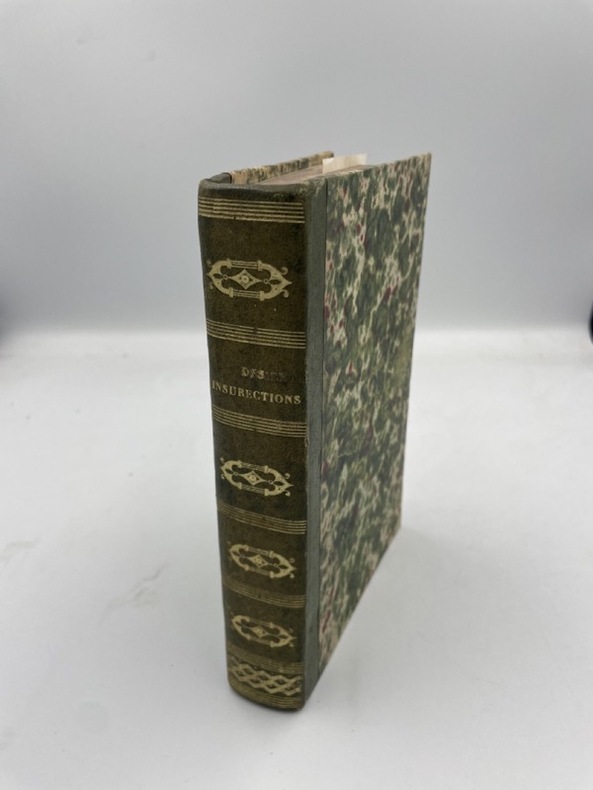
238672Paris, chez les directeurs de l'Imprimerie du Cercle social, 1793 fort volin-8, 614 pp., 3 pp. [Déclaration de l'auteur de l'ouvrage intitulé, Des Insurrections], demi-veau vert, dos lisse orné de filets, guirlande losangée et larges fleurons dorés, tranches marbrées (reliure de la Restauration). Dos uniformément insolé et passé, petite galerie de vers pp. 59-82, 209-226, 257-274, avec perte de quelques lettres.
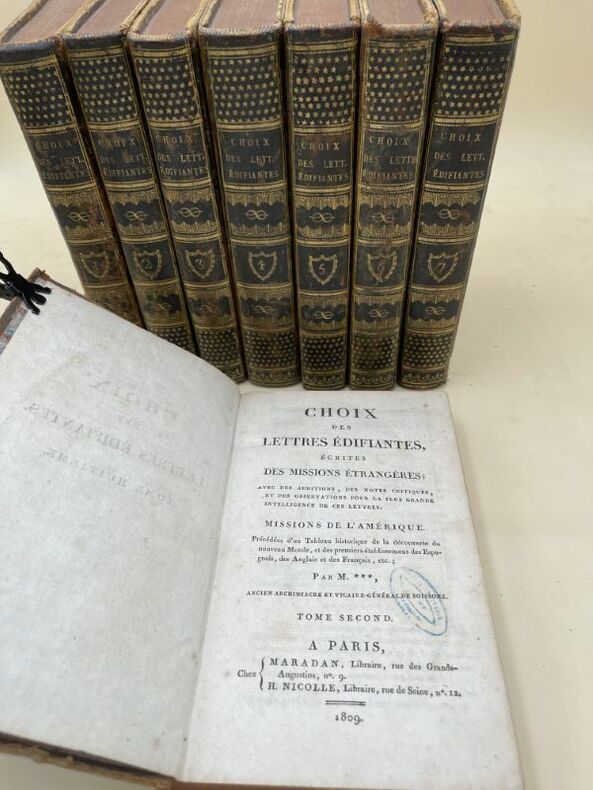
180899912953Maradan A Paris, chez Maradan, 1808 - 1809. 8 volumes In-8 relié pleine basane marbrée, dos lisses très ornés. cviii + 400 + 451 + 458 + 568 + 427 + 507 + 487 + 514 pages. Reliures frottées, coins émoussés. Intérieurs en très bon état. Edition originale. Ouvrage contenant d'innombrables articles, entre autres : Sur l'Afrique et l'esclavage, le Mexique, la Turquie, la Syrie, le commerce dans le Levant, la Perse, l'Empire Birman, la Chine, le Tonkin ainsi qu'un très grand nombre de renseignements sur les moeurs et coutumes, les métiers etc. Malgré les défauts signalés bon exemplaire.
226959Douai, Pierre Bogart, 1635 in-16, titre-frontispice gravé, 264 pp., typographie en petit corps, manquent les pièces liminaires, dont la dédicace ([6] ff. n. ch.), veau brun granité, dos à nerfs cloisonné et fleuronné, tranches rouges (reliure de l'époque). Coins un peu abîmés.
177531351A Paris, chez Berry, 3ème année de l'ère Républicaine [1795]. 8 vol. au format in-8 (203 x 130 mm) de 2 ff. n.fol., 1 frontispice gravé n.fol., iv, iv - 500 pp. ; 1 frontispice gravé n.fol. et 548 pp. ; 2 ff. n.fol., 1 frontispice gravé n.fol. et 536 pp. ; 2 ff. n.fol., 1 frontispice gravé n.fol. et 447 pp. ; 2 ff. n.fol., 1 frontispice gravé n.fol. et 383 pp. ; 1 frontispice gravé n.fol. et 456 pp. ; 1 frontispice gravé n.fol. et 531 pp. ; 2 ff. n.fol., 1 frontispice gravé n.fol. et 516 pp. Reliures uniformes de l'époque de plein veau flammé blond, double filet doré et frise dorés encadrant chacun des plats, dos lisses ornés d'un double filet d'encadrement doré, filets gras dorés, doubles filets maigres dorés, entrelacs de filets gras et maigres dorés formant croisillons, fleurons dorés, semis de petits fleurons trapézoïdaux dorés, entrelacs de filets maigres dorés formant chaînettes, pièces de titre de maroquin vieux-rouge, pièces de tomaison de maroquin émeraude, titre doré, tomaison dorée, palette dorée en queue, filet doré sur les coupes, tranches jaspées.
1751PHO-1113A Paris, chez Durand et Pissot, 1751. 2 volumes in-12, X -258 pages ; (2 ff), 313 p. Plein veau raciné époque (Coiffes endommagées, coins, coupes et mors épidermés. Infime galerie de ver n'affectant pas le texte aux pages 57 à 64 du tome I)