111 résultats
1864106405<p>Single 8vo sized sheet 5 1/2" x 8 1/2" duplicate receipt signature printed and hand written some aging; but very good or better. This receipt is signed by A.M. Kennedy for John D. Kennedy. Printed and Handwritten Document Signed. Columbia South Carolina. Jan. 18 1864 "Duplicate Receipt" for $2000 paid by the state to Confederate commander John D. Kennedy as "compensation for his slave named Robert lost by reason of the employment of said slave by the authorities of the Confederate Government upon the military fortification in this State." John Doby Kennedy was born on January 5 1840 in Camden South Carolina the son of a Scots immigrant. John was a student at South Carolina College. He was a wealthy man and reportedly owned 60 slaves. On the day this receipt was issued to his brother 24 year-old John Doby Kennedy was on the battlefield commanding his South Carolina Infantry regiment having fought in the battles of Chancellorsville and Gettysburg and that year in the Shenandoah Campaigns after which he was given the rank of Brigadier General. Opposing General Sherman's advance until the bitter end he did not surrender until two weeks after Lee met Grant at Appomattox. civilwarintheeast website. </p> books
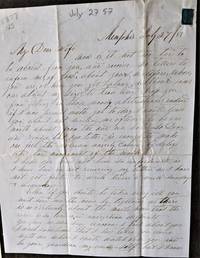
1857708Memphis 1857. 4to. letter sheet. 250 x 195 mm. 9 ¾ x 15 ½ inches. 4 pp. about 840 words. Folded in thirds. Written in black ink faded brown in very legible hand. Jesse McCallum was a hay dealer from Cincinnati Ohio who travelled away from his family on business forays. In this case he writes from Memphis Tennessee complaining about the heat and commenting on the "darkies" as follows: ". the sun is scorching from 10 am to 4 pm the difference is very perceptible I think the heat is greater on account of the drought the ground is parched up and dry.the streets are deserted in the middle of the day but the darkies will be down in the hottest part of the day in the sun and sleep with the sun shining full in their face and appear to enjoy it as much as a white man would in the shade what a difference collar sic makes.the south could not get along well without its black population one months work in the sun of the south would cure the bitterest abolitionist of the north of his bitter oposition sic to institutions of slavery and come over without a groan to be a slave owner if compelled to earn his living by cultivating the soil." McCallum thinks "we will do well on this load of hay.as hay is advancing" and also comments about his wife's lack of correspondence and reminds her that he writes twice a week. The last page is particularly affectionate--he remarks about being a "bachelor husband" and adds ; ". the only true enjoyment I have had was when I recd your letter since I left you and now Elly if you wish me to enjoy myself write often." Jesse McCallum often spelled Mc Collum in historical records was born in Ohio in 1819. In 1850 he was working as a stone cutter. By 1860 he was living with wife Eleanor Welsh and  six children in Marysville Yuba California. In the Civil War he was a Union Corporal 81st Illinois Infantry Company A. In 1870 he was making "gas machines". He died in Marysville in 1880. unknown books
1836WRCAM46521Pittsburgh: Alexander Jaynes 1836. 8pp. Dbd. Lightly and evenly tanned. Very good. "The question of Slavery being before the General Assembly of 1836 on petition from many members of the church that the Assembly would bear their testimony against the practice of slaveholding as a SIN it has been thought proper to reprint the testimonies and acts of former Assemblies on the same subject from the official Minutes without note or comment." Only three copies located in OCLC at Princeton Oberlin and the Library Company of Philadelphia. Alexander Jaynes unknown books
1836WRCAM46520Pittsburgh: Alexander Jaynes 1836. 36pp. Dbd. Light foxing and toning contemporary pencil notations. About very good. A discourse given on the great evils of slavery and the polarization it is causing among the northern and southern states. Relatively scarce though the titlepage indicates that it was printed "For Gratuitous Distribution." Alexander Jaynes unknown books
182919216Albany: Printed by Websters and Skinners 1829. First edition. Some wear to the untrimmed edges; long closed tear to one leaf from the upper edge no loss; some light soiling and a few small stains; a very good copy. Unbound pamphlet stitched as issued 6 x 9.13 inches untrimmed 24 pages. When therefore the fetters whether gradually or suddenly shall be stricken off and stricken off they will be from those accumulating millions yet to be born in bondage it is evident that this land unless some outlet be provided will be flooded with a population as useless as it will be wretched. . . . Whether bond or free their presence will be for ever a calamity." The organizational proceedings of the first iteration of the New-York State Colonization Society intended to help the national organization settle free blacks in Africa. Lib. Co. Afro-Americana 7116; American Imprints 39836. Printed by Websters and Skinners, unknown books
14476SAUGNIER Mess. and Brisson. London G.G. J. and J. Robinson1792. First edition in English after the French first edition of 1791. Voyages to the Coast of Africa: Containing an Account of Their Shipwreck on Board Different Vessels and Subsequent Slavery and Interesting Details of the Arabs of the Desert and of the Slave Trade as Carried on at Senegal and Galam. 12mo 21.5 x 14 cm; i viii 500 pp three parts and a narrative First Voyage - To Senegal; The Second Part - Voyage to Galem and Return to France; The Third Part- Commerce of Senegal and Galam; Narrative of the Shipwreck and Captivity of M De Brisson bound in one volume lacking the map recent blue cloth with gilt spine title lettering.<br/>Saugnier was shipwrecked on January 17 1784 near Cape Leven and Brisson in July 1785 at Cape Blanco both in the Spanish zone of Rio del Oro. A fascinating account of shipwreck and slavery from a first hand account including details on the economic aspects of slavery. Faded spine page 31 misnumbered 13 page 85 has an ink stain to it and pages 460 and 461 are misnumbered 444 and 445 although the text is confirmed correct; good solid copy. unknown books
163153 handwritten documents in ink regarding the sale of slave girls in Cuba. The documents are written in Spanish and include details such as purchase price age and names of the girls being sold. Documents are large: 12 ½ x 8 ¾ in. Some shadows from storage with other documents paper acidification from ink. Some losses from ink acidification and wormholes. Marks from previous binding along left edge. Sale documents are numbered at bottom of pages with signatures and all have stamp from Cuban government. Good condition. One of the documents includes the year 1875 dating some of these papers to the dwindling years of the slavery in Cuba which was officially outlawed in 1886. unknown books
12584Group of two partly-printed tax receiptstwo receipts collected by Sheriff Farrar of Mecklenburg County and Aylor Sheriff of Madison. Both receipts are dated 1861. 1 is for "Slaves and money $6.80" and "War Tax of $1.36." Dated August 23 1861 and signed by Sheriff Farrar. The other is signed by Sheriff Aylor. In excellent condition. A nice group of slave tax receipts. unknown books
1854CAT0114New York: H. Long 1854. First Edition. 8vo publisher's brown cloth 259 pp. Good Plus. The Vermont-born Chase moved to Tennessee in 1838. He was elected as a member of the Democratic Party to the Twenty-ninth and Thirtieth Congresses serving from 1845-1849 before returning north to New York City to practice law. In this work of fiction which is mostly intended as a diatribe against the hypocrisy of the English he proposes that "The African adopts him-self with greater readiness than the white man." In his view wage slavery in the North and in England was worse than the slavery in the South. An uncommon first edition copy. Some wear and tears to boards some light marginal foxing to contents but still sound and usable good plus condition overall. H. Long unknown books
163143 handwritten documents in ink regarding the sale of slave girls in Cuba. The documents are written in Spanish and include details such as purchase price age and names of the girls being sold. Large size Documents 12 ½ x 8 ¾ in. Some shadows from storage with other documents paper acidification from ink. Some losses from ink acidification and wormholes. Marks from previous binding along left edge. Sale documents are numbered at bottom of pages with signatures and all have stamp from Cuban government. Good condition. One of the documents includes the year 1875 dating some of these papers to the dwindling years of the slavery in Cuba which was officially outlawed in 1886. unknown books
182532015London: Knight and Bagster 1825. One of several editions issued in 1825. Folio 4pp. Self wraps some marginal soiling and nicks bent at folds a very good copy. Library Company Afro-Americana 4293. OCLC lists just the Library Company copy; not in Dumond or Work. Formed because the 1807 Act to abolish the slave trade had failed to diminish "the prevalence of the very evils which it was one great object of the Abolition to remedy" the Society reviews the stranglehold that West Indian slavery is gaining. Its proceedings examine conditions in each of the West Indian colonies including "the threat of Jamaica to renounce her allegiance" to Britain. Information is also presented concerning Haiti and the effect of that country's upheavals on the British colonies. Knight and Bagster unknown books
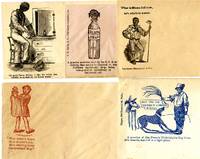
186536346Philadelphia Lancaster PA and elsewhere: Magee Philadelphia Zahm Lancaster and three others 1865. Five postal covers all in Very Good condition:<br/> a. "The latest Contraband of War." A working slave stands confidently: "Whar is Massa Jeff now dat's what's de matter."<br/>Weiss C-BL-16.<br/> b. "Him fader's hope / Him moder's joy / Him darling little / Contraband Boy." A white man holds a little black baby.<br/>Weiss C-BL-11.<br/> c. A medicine bottle labeled "Black Drop" with the head of a Negro at its top: "A popular medicine used by the C.S.A. aristocracy that cannot be obtained in any Northern apothecary shop being com-POUND-ed exclusively on the sacred soil." italics instead of caps in the original. "S.H. Zahm & Co. Publishers Lancaster Pa." <br/>Weiss C-BL-12.<br/> d. A black man polishes boots in a house. Referring to Ben Butler's capture of New Orleans he says "By golly Massa Butler I like dis better dan workin' in de field for ole Sesesh massa." <br/>Weiss C-BL-59.<br/> e. "A member of Jim Francis' Philadelphia Dog Detective Gards has Jeff in a tight place." A black man holding some twigs looks down at a dog with collar labeled "Jeff." An observing donkey says "Jeff has the feelings of a prince of wails." Published by Magee 316 Chestnut Street Philadelphia.<br/>Weiss C-BL-35. Magee [Philadelphia], Zahm [Lancaster], and three others unknown books
184045421Mobile AL Aug. 10 1840. Autograph letter signed on first and second panels of single bifolium sheet 25.5cm.; approx. 370 words. Previous folds the whole rather wrinkled postally used on rear panel else Very Good. Letter from Jesse Bemis 1808-1843 a Mobile transplant to his brother David of Spencer Worcester Co. Massachusetts where Jesse was born. The author thanks his brother for some fly nets sent him "I have sold about half of them at some profit" later noting that "they are not only worn on horses but they are used to spread over the cradles of the Negro Children as a screen the Negro women also wear them to Church & on dressy occasions. I hope the Abolition Missionarys wont find it out before I can dispose of all that I have for frear that they will glut the market." Bemis goes on to describe the election of 1840 "the tightes sic election in the State that ever was it took place the 3d of this month in this County we elected the whig ticket throughout" and goes so far to mention that "The women say out with Van Buren & give us the credit system." Indeed the women had their way as Van Buren lost to Harrison in large part thanks to the efforts of the Whig Party. unknown books
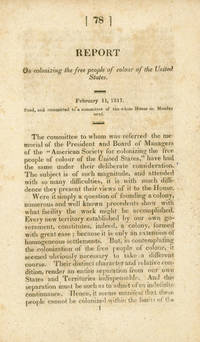
18179350WashingtonCity 1817. First Edition. 5 pp. 1 vols. 8vo. Disbound. Some foxing. First Edition. 5 pp. 1 vols. 8vo. First edition of the government's reply to the request of a group of Virginia planters for a "colony" to essentially rid them of the problem of "free coloured people." In December of 1816 a group of Virginia planters approached the government with a request asking for a location where freed blacks might be sent. In January this "memorial" was presented and in February it was answered with this "Report." This reply discusses location etc. In the end the government officially refused to have anything to do with the plan - thus the American Colonization Society was born. For a detailed account of these events see Dumond Anti-Slavery pp. 126-127. S&S 42738 2 copies unknown books
1831WRCAM40189Washington 1831. xxv1357pp. plus one folding map. Original cream printed wrappers. Minor chipping to head and foot of spine. Contemporary ownership inscription on front cover. Titlepage foxed light tanning to some leaves else clean and bright. Very good. Untrimmed. The Society attempted to alleviate the problem of slavery and degradation of free blacks by establishing a colony for them outside the United States preferably in Africa thereby "separating them WITH THEIR OWN CONSENT from the white race." The Society established the colony of Liberia in 1822 assisting African Americans to resettle there. The colony continued to grow for the next twenty years and Liberia declared itself an independent state in 1847. The folding map shows the colony of Liberia. This copy belonged to the Rev. Leonard Worcester of Peacham Vt. Worcester was a member of the Auxiliary Colonization Society of the State of Vermont. Not in AMERICAN IMPRINTS. A nice association copy. unknown books
1833WRCAM11280Washington 1833. xxii240pp. Original printed wrappers rear wrap lacking. Quite heavily foxed some old creases else good. The Society attempted to alleviate the problem of slavery and degradation of free blacks by establishing a colony for them outside the United States preferably in Africa thereby "separating them WITH THEIR OWN CONSENT from the white race." The Society established the colony of Liberia in 1822 assisting African Americans to resettle there. The colony continued to grow for the next twenty years and Liberia declared itself an independent state in 1847. Not in AMERICAN IMPRINTS. unknown books
1823WRCAM40185Washington City 1823. 711pp. Original blue-green wrappers. Minor chipping to head of spine. Some scattered foxing. Near fine. Untrimmed and unopened. The Society attempted to alleviate the problem of slavery and degradation of free blacks by establishing a colony for them outside the United States preferably in Africa thereby "separating them WITH THEIR OWN CONSENT from the white race." The Society established the colony of Liberia in 1822 assisting African-Americans to resettle there. The colony continued to grow for the next twenty years and Liberia declared itself an independent state in 1847. SHOEMAKER 11596. unknown books
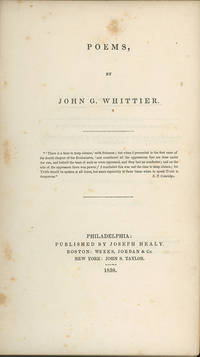
183828115Philadelphia: Joseph Healy; Boston: Weeks Jordan; New York: John S. Taylor 1838 1838. First edition. BAL 21710 binding A; American Imprints 53638. Edges a little rubbed; light foxing; very good copy. 12mo original floral patterned blue-green cloth gilt lettering on the upper board. ¶ An early and substantial collection of over 50 poems by John Greenleaf Whittier 1807-1891. The first part contains 24 of his memorable abolitionist poems collected for the first time with his approval. In 1837 Isaac Knapp of Boston published Whittier's Poems Written During the Progress of Abolition Question but it was issued without Whittier's permission and according to the poet was riddled with errors. Lending library label of the Suffolk Lyceum Library with their rules on the front paste-down. On the front free endpaper is an intriguing faint pencil inscription to a "Mrs. Mary Lincoln / a present from / Mr. Lincoln / March 10th 1845." Extensive research on this has led . . . nowhere. <br/><br/> Philadelphia: Joseph Healy; Boston: Weeks, Jordan; New York: John S. Taylor, 1838 unknown books
143781771 Newspaper with slavery ad. Boston. 15" by 10." The Almanack lists two advertisements relating to slavery "To be sold for want of employment a likely Negro Boy that won't drink rum he is about 14 years old." An interesting slavery related advertisement which chronicles a dark era in American history. Overall foxing some soiling and small tears. Otherwise very good condition. unknown books
1855WRCAM55824New York: American Anti-Slavery Society 1855. 36pp. Gathered signatures stitched as issued. Minor edge wear spotting and soiling. Very good. The scarce second edition of this anti- slavery pamphlet printed in New York by the American Anti-Slavery Society from the same "stereotype plates.without alteration" as the first edition printed in Hartford earlier the same year. The text focuses on an appeal to the American Tract Society to take a more vocal and concerted stand against slavery. The authors of the text accuse the American Tract Society of "suppression" of anti- slavery sentiment by censorship of certain works it publishes that speak against the institution and an overall sin of "studied and persistent ommission" by not itself issuing "a direct condemnation of the most giant iniquity of our land." The text is signed in print at the conclusion by "The Members of the Fourth Congregational Church Hartford Conn." The work was issued as the sixteenth entry in the American Anti-Slavery Society's "Anti-Slavery Tracts." SABIN 30676. American Anti-Slavery Society unknown books
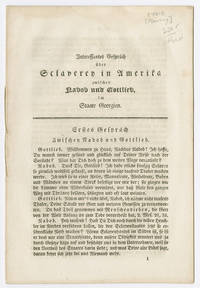
1840WRCAM54016N.p. but Germany 1840. 16pp. text in German. Stitched as issued. Very light dampstaining at top edge. Very good. An imaginary dialogue between a slaveholder and a missionary in Georgia. They debate the rights and wrongs of slavery with the slaveholder gradually crumbling before biblical evidence. A most unusual German tract on the American slavery controversy. unknown books
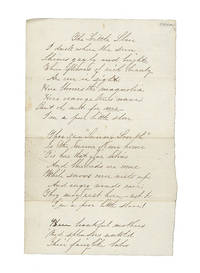
186134365Waterford Maine Feb 3rd 1861. In a neat nineteenth-century hand on a single leaf torn from a larger sheet of note paper. 1 vols. 5 x 8 inches. Old folds else fine. In a neat nineteenth-century hand on a single leaf torn from a larger sheet of note paper. 1 vols. 5 x 8 inches. "My mammy's worked out". Thirty-two line poem expressing pious sentiments at the plight of the child slave: "Here orange trees wave / But oh not for me -- / I'm a poor little slave . My mammy's worked out / And lies here in the grave / There's none to kiss me / I'm a poor little slave". unknown books
1856257105Washington D.C.: Globe Office 1856. Signed by Kelsey ordering 2500 and by James Livingston for 100 and another. Old folds. Blind embossed " Platner & Porter Cobngress" staionary. Signed by Kelsey ordering 2500 and by James Livingston for 100 and another. Globe Office unknown books
185633708Philadelphia 1856. 24pp disbound three small binding holes in blank left margin. Two early signatures of Wm. Thompson Shafer on title page. Light spotting throughout. About Good. <br/><br/> This scarce pamphlet says the "great issue" is whether "Slavery shall be allowed to overspread a territory of greater extent than that of the whole United States" and "whether the policy of our government is to continue to be that of Slavery Extension or Slavery Restriction." All the power of the presidency is "being used to force the withering and blighting scourge of Slavery upon the National domain." Pursuing this tyrannical course our government "shall lend its aid in striking a deathblow to the freedom of speech the liberty of the press and the security for life personal liberty possession and peace." <br/>LCP 4300. OCLC 22829199 4- LCP No. IL U Haverford Detroit Pub. Lib. as of April 2017. unknown books
1856WRCAM34592Montpelier 1856. 19pp. Self-wrappers. Upper edge gnawed and stained else good. This report from a committee of the Vermont House of Representatives was made in response to events in Kansas resulting from the introduction of slavery into that territory. According to the report Vermonters in Kansas had been harassed and attacked by pro-slavery forces with a situation of lawlessness ensuing. The Vermont House asserts the state's rights to protect its citizens in Kansas and allots a sum of $20000 to alleviate the suffering of afflicted Vermonters. OCLC locates only four copies. Quite scarce. OCLC 34605036. unknown books