224 résultats
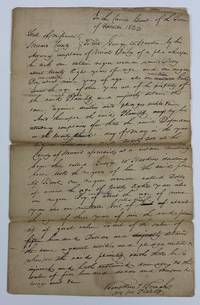
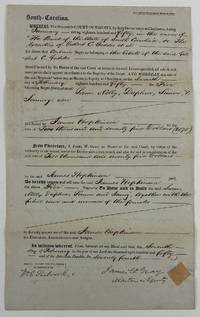
185012963Charleston SC: Printed by Walker & Burke February 7 1850. Partially-printed document completed in manuscript 13 x 8 inches. Old folds minor toning and offsetting. Very good. A very rare pre-printed form from antebellum South Carolina designed specifically for documenting the sale of slaves in Charleston in the mid-19th century. The document emanates from the Court of Equity and directs the estate of Gilbert C. Geddes to sell five named slaves to James Hopkinson for $2075. The names of the slaves are Sam Nelly Daphne Simon and Jenny. The document is signed by James W. Gray Master in Equity in the case of "Bank of the State of South Carolina vs. the Executrix of Gilbert C. Geddes et al" and by William E. Seabrook as witness. Gray adds a particularly insidious note near the bottom of the document when he writes that Hopkinson is entitled to "have and hold" the aforementioned five slaves "together with the future issue and increase of the females." Geddes 1806-1848 a wealthy Charleston resident owned more than a hundred enslaved people when he died; his father John Geddes served as governor of South Carolina 1818-1820. This is the first example of this document we have seen and a unique record of the transference of five slaves and particularly interesting for granting the new slaveowner the rights to future slave children. Printed by Walker & Burke, February 7 unknown
18224276Howard County Mo 1822. Good. Three documents totaling 3pp. folio the two earliest documents written on each side of the same leaf with an integral blank and attached to the third document with sealing wax each document docketed on verso. Some short separations along folds minor spotting two short tape repairs. A series of three documents recording a case of slave theft in Missouri. The plaintiff in the case George W. Hardin sues a man named Urial Bailey for stealing three slaves from the Hardin estate in Howard County Missouri. The first document is a sworn oath dated May 23 1822 by George Hardin stating that "He was lawfully possessed of the negroes.and that the same were unlawfully taken by Urial Bailey.from his properties and with out his consent within one year last past and that he is now lawfully entitled to the possession of the said negroes." The document is attested by the clerk and signed by Hardin.<br /> <br /> The second document is executed by Hardin's lawyers on the verso of his oath dated the same day and constitutes an order from the court to the Sheriff of Howard County informing him that "George W. Hardin hath come into the Circuit Court held in the town of Franklin and found sufficient sureties as well as his clamour to prosecute for a certain woman called Dolly about the age of twenty eight years also one negro boy of about the age of nine years named Nathan also one negro girl called Eliza about the age of three years all the property of the said Plaintiff.which a certain Uriel Bailey.hath taken and unjustly detains. You are hereby commanded that the said goods.be delivered to the said George W. Hardin and that.Uriel Bailey appear before the said Circuit Court to be held at the town of Franklin."<br /> <br /> The third document is executed by Hardin's lawyers on the verso of his oath dated September 1822 and lays out the facts of the case. It reads in part: "George W. Hardin by his Attorney Tompkins & French complains of Urial Bailey that he took the previously named slaves of great value. To wit of the value of fifteen hundred dollars.where fore the said Plaintiff saith that he is injured and hath sustained damages to the value of five hundred dollars and therefore he brings suit." Interestingly in this document Hardin's lawyers refer to the youngest slave Eliza as a "mulatto girl." Docketing on the integral blank attached to the oath and lawyer's document dated May 23 1822 indicate that Hardin was seeking "Replevin Damages" of $500 which the court seems to grant. <br /> <br /> The motive behind Urial or Uriel Bailey's thefts are not recorded here but the issue of slave stealing was not uncommon and had been going on in the American colonies and the fledgling United States for a long time. According to Timothy F. Reilly in "Slave Stealing in the Early Domestic Trade as Revealed by a Loyal Manservant" published in Louisiana History: The Journal of the Louisiana Historical Association Vol. 55 No. 1 Winter 2004 pp.5-39: "Slave stealing plagued domestic slaveholders as far back as the colonial period when those who would unlawfully deprive a property owner of human chattel were detested as 'Negro jockeys.' Whether operating in the northern or southern colonies a 'man-stealer' lurking about either as a piratical thief or as a high-minded abolitionist was guilty of one of the worst crimes against the sanctity of property. By the 1830s man stealing reached epidemic levels in parts of the South."<br /> <br /> Despite the seeming prevalence of slave theft for a long period of time in the United States primary source records of court cases are very scarce. unknown
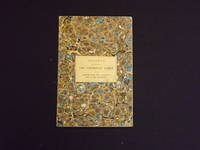
18361005398vo pamphlet marbeled wrappers with printed label on front cover 32 pp.some minor spine snd edge wear slight aging; very good or better.The work begins with the original source of funds for its "Charitable Fund" which began with estate of Robert Boyle in 1691. Since the 500000 Negro Slaves in the West Indies were mostly "infidels and heathens" converting them to Christianity would be doing them a favor and help the empire.Converting the slaves to Christianity would make them more virtuous more comfortable offer them a prospect of eternall happines and even make them better servants. Richard Clay,
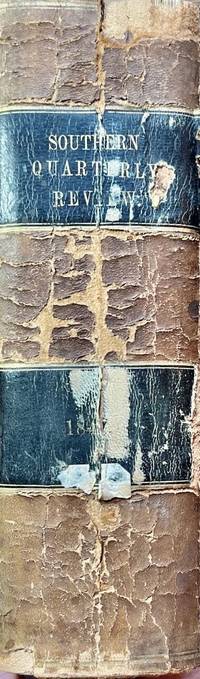
184736797Charleston: Burges & James 1847. Hardcover. Poor. Thick octavo. Two volumes. v index 1 page blank 524 pages; 536 pages v index 1 page blank 1. Ex-library copy with perforated stamp from "The University of The South Library" on the title page. Faded purple stamp page 101. Binding is in poor condition. Front cover is missing. Spine is dry cracked and chipped. Toning and light scattered foxing to the contents. <br /> <br /> Contents include articles on Adam Smith's Wealth of the Nations; Labor The Wilmot Provisio; China and the Chinese Life of Zachary Taylor; Carolina Sports; Slavery in the United States; Fanny Kemble and more. Poor to fair condition. Burges & James hardcover
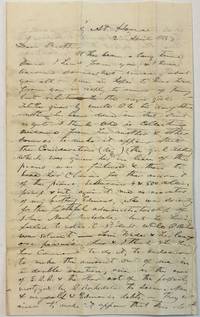
184740201Stewartsboro TN 1847. Folio 15" x 12-3/4" sheet folded to 7-1/2" x 12-3/4". 4 pp. Completely in ink manuscript integral address leave bearing Stewartsboro Tennessee April 3 1847 manuscript postal marking. mailing address on last page. The initials of the writer's name are difficult to decipher; this is our best guess. Old folds two short fold splits and a few tiny holes at fold corners. Wax seal remnant with tear at edge loss of a few letters some toning. Good to Very Good. <br /> <br /> The writer is concerned that Thomas had not responded to his letter "relating to the negro girl Tabitha given by Uncle R. to his daughter- nothing has been done in that suit as yet. I think she is collecting evidence from her mother & other sources to make it appear that the consideration viz the girl Tabitha which was given her in lieu of the piano was a failure & then to base her claim for the amount of the piano between 4 and 500 dollars princp. & int. against me as executor of my brother Edmond who was security for the faithful administrationship of John Nash Barksdale but he having failed to collect sd. debt while R. Barksdale was solvent. Levi Wade & her lawyer are persuading her. . . " He gives Thomas permission to "calculate on receiving a portion of the money for which Paulina sold. . . Negroes have advanced within 3 or 4 months but I fear one diseased as your boy Phil will command but a small price."<br /> Dr. Thomas Hill Read 1798-1874 of Tennessee settled in Macon County Illinois in 1831. He was the brother-in-law of Capt. David L. Allen one of the most prominent early citizens having married his sister. Dr. Read became known for his success in the treatment of children's ailments and was considered an expert in cholera infantum. He had a reputation for honesty and was said to have acted as administrator of more estates than anyone else in Macon County. Dr. Read was a member of the Decatur Board of Trustees in 1839 1841 1846 and 1847; County Treasurer from 1845-1846 and County Probate Judge from 1846-1849.<br /> John Nash Barksdale 1818-1844 Thomas Read's maternal cousin was born in Tennessee graduated from the University of North Carolina and became a lawyer. He practiced law in Tennessee for a few years and then moved to Columbus Mississippi and entered the law firm of his cousin Gen. William Barksdale. The Columbus bar announced that its members would wear the badge of mourning for thirty days following his death. "Death of John N. Barksdale" Republican Banner Nashville TN Dec. 6 1844 Page 2.<br /> Uncle R was likely Randolph Barksdale 1795-1844 Thomas H. Read's maternal uncle and John Nash Barksdale's father. Randolph settled in Tennessee with his father in 1808 and later established his own plantation. He was married three times and became the owner of a large estate and several slaves in Rutherford County Tennessee thanks to the wealth of his first wife. He also owned an estate near Chulahoma in Marshall County Mississippi. unknown
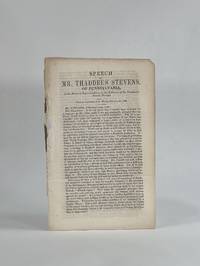
18508864Washington: Buell & Blanchard 1850. Disbound. near Very Good binding. Octavo. 8 pp. Removed from volume. Inner margin a bit irregular; horizontal creases from being folded. <br /> <br /> Stevens rails against "Southern gentlemen" who he argues have obstructed the business of Congress by speeches on the subject of slavery. The remedy Another speech on slavery. And no doubt the subject was indeed occupying Congress and the country. In fact the Compromise of 1850 and its Fugitive Slave Act was just months away from passage when Stevens took the floor with this searing speech against the institution of slavery and the Southern legislators who were holding Congress hostage. Stevens cites Mr. Clingman of North Carolina who in Stevens's words "was selected to open the debate in behalf of human bondage distinctly notified us that unless Congress as a condition precedent submitted to settle the Slavery question according to Southern demands there should be no legislation even the passage of the ordinary appropriation bills necessary to sustain the Government." A heated time indeed! Sabin 91565. Buell & Blanchard unknown
183836058Boston 1838. Hardcover. Fair. Octavo. Marbled paper covered boards with leather corners and spine. Red leather title label on the spine. Covers are worn. Toning to the end papers. Blind embossed stamp of the previous owner "Library of KJT Kevin John Twit" on the right front flyleaf. Incomplete: title page and issues for June October and December were not bound inside. Collation as follows: pages 1-240; pages 289-432; pages 481-528; 18 pages "A Sermon Occasioned by the Loss of the Harold and the Lexington Delivered at the Odeon January 26 1840 by William M. Rogers Pastor of the Franklin Street Church." Book and contents in fair condition. <br /> <br /> Articles include: "Contributions to Religious and Charitable Societies From Holders of Slaves"; "Triumphs of the Gospel in the South Sea Islands"; "Religious Notions of the North American Indians"; "The Cherokees"; "The Sandwich Islands" and more. hardcover
185435390Boston: Phillips Sampson and Company 1854. 1854. Hardcover. Fair. Small octavo. 1 viii 9-256 pages 4 pages advertisements 1. Folding frontispiece map. Blue cloth hardcover with blind stamped covers. Gilt title and decoration on the spine. Folding map has some wrinkling and creases. Cloth hardcover is shelf worn rubbed at the extremities and chipped at the head and base of the spine. Lean to the binding. Light scattered toning and foxing to the contents. Fair. <br /> <br /> Graff 1079. Phillips, Sampson and Company hardcover
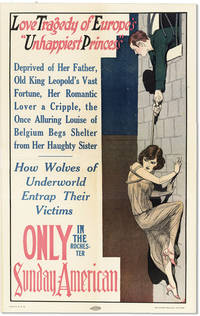
190415411Rochester: Office of the American 1904. Broadside extra lithographed in colors; 18" x 11". Single fold else fine. Colorful graphic depicting Princess Louise escaping from her asylum cell with the help of her illegitimate lover Geza Mattattich. The caption tempts readers with a White Slavery theme suggesting that Princess Louise has been lured to her ruin by a "Wolf of the Underworld." Unlocated. Office of the American unknown
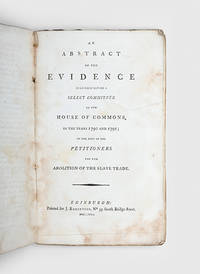
1791180598Edinburgh: Printed for J. Robertson 1791. Stepping up the campaign against slavery Second Edinburgh edition of this best-selling report on the colonial slave trade including a version of among the most famous abolitionist images the cross-section depicting the enslaved individuals transported aboard the Brookes. The Abstract is the first abolitionist work to ground its arguments not on biblical appeals or forceful rhetoric but on documented eyewitness accounts. Until 1790 the abolitionist campaign had been channelled through pamphlet and pulpit. After 1790 abolitionists turned to the new technique of mass petition campaigns against Parliament. The Abstract publishes the testimonies of the witnesses called by the petitioners arranging them thematically by chapter. Among others the select committee called planters traders naval officers and doctors. "The abolitionist petition campaign reached an apex during 1791-1792 where an unprecedented 519 abolitionist petitions coming from all over Britain were delivered to Parliament. Some 400000 persons signed these petitions 1 out of every 11 adults with Manchester alone contributing 20000 names from an adult population of about 30000" Fogel p. 212. Octavo pp. iv 128. Large folding plan of a slave ship folding map of the western coast of Africa tables in the text. Original paper wrappers spine lettered in manuscript ink edges uncut. Housed in custom orange cloth box. Contemporary presentation inscription from "Mr. Campbell" to "John White" on the front cover. Rubbing and chipping minor loss to spine and extremities browning and foxing to contents slight offsetting to plates folding plan loose: just about a very good fragile copy. ESTC N29168. William Fogel Without Consent or Contract 1989. hardcover
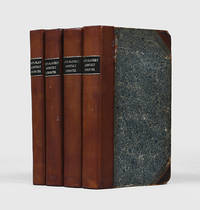
1827163198London: Printed for the London Society for the Mitigation and Abolition of Slavery in the British Dominions 1827-32. A new age of abolitionist agitation First collected editions being the full run under its original title of Zachary Macaulay's abolitionist magazine the leading organ of British abolitionist thought and campaigning. It was afterwards renamed the Anti-Slavery Reporter and has lasted under changing titles to this day. The journal "systematically collected information on the abuses of slavery" ODNB. "Highlighting the rise of abolitionist petition drives antislavery discussions in church and government venues and debates over unfree labor throughout the empire the paper celebrated a new age of abolitionist agitation" Newman pp. 44-45. The volumes collect the monthly issues from June 1825 to December 1831 with collective title pages and contents tables. 4 vols. octavo 216 x 129 mm. Contemporary half calf rebacked black morocco labels marbled sides edges speckled brown. Wear at extremities inner hinges reinforced a little browned and spotted: still very good copies. Richard S. Newman Abolitionism: A Very Short Introduction 2018. unknown
1862127191862. Front Page Headline reads "The Bill Abolishing Slavery in the District of Columbia Passed the House." Newspaper "The Detroit Free Press" April 12 1862. 19" x 26" 2 pages. Has a blow by blow account of the debate among the members of the House and the various amendments associated with the bill. It concludes "The bill was passed 93 agains 39." Also includes local national and international news as well as "News From the South." Some small tears at the left hand margin not affecting text. A diagonal crease runs across the top half of the paper and a small piece of yellow tape has adhered to the top margin. Overall in very good condition. unknown
0656338911.Ghardcover. Good. Access codes and supplements are not guaranteed with used items. May be an ex-library book. hardcover
1332593208.Gpaperback. Good. Access codes and supplements are not guaranteed with used items. May be an ex-library book. paperback
17101200341710. First Edition. SLAVERY ANONYMOUS. A True State of the Present Difference Between the Royal African Company and the Separate Traders. London: No publisher 1710. Slim octavo period-style full tan sheep gilt red morocco spine label raised bands; pp. 40. $1650.First edition of this argument against providing a monopoly over the British slave trade to the Royal African Company with tipped-in diagram of one of the Royal African Company's forts.This work attempts to highlight the irregularities of the business practices of the Royal African Company and to argue for the superiority of open trade in Africa particularly as a means of supplying slaves to the American plantations. Founded in 1660 by the royal Stuart family and the City of London the Royal African Company was founded to exploit natural resources like gold along the west coast of Africa. While the Royal African Company did participate heavily in the gold trade the majority of their income came from slave-trading. The Royal African Company was part of a concerted effortfully elaboration in the Navigation Actsto establish dominance in the slave trade since the Dutch had been the leading slave-traders prior to the Restoration. To that end the Royal African Company established a brutal and highly efficient slave-trading system eventually providing more slaves to the West Indies than any other company or state. The slaves were branded with the initials of the company or its longtime governor the Duke of York. Children were included in the transports. Between 1662 and 1731 the Company transported approximately 212000 slaves a fifth of whom died enroute. While the Company formally gave up slave-trading in 1731 they remained involved in the trade of ivory and gold dust industries dependent on labor exploitation and slavery. Goldsmiths 4605. Kress 2677. Early ink underlining and marginal notations.Small paper repair to diagram text and diagram trimmed close affecting portion of imprint and scattered catchwords not affecting readability. A very good copy. hardcover
133494363X.Gpaperback. Good. Access codes and supplements are not guaranteed with used items. May be an ex-library book. paperback
0243034016.Gpaperback. Good. Access codes and supplements are not guaranteed with used items. May be an ex-library book. paperback
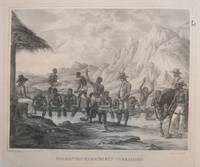
#[36399]München ca. 1830 Original lithographed plate by Meier E. Meyer and printed by J. Selb depicting the Brazilian diamond mines of Curralinho. Ca. 39 x 46 cm. From: Johann Baptist von Spix & Karl Friedrich Philipp von Martius Atlas zur Reise in Brasilien. - The atlas appeared in instalments and is rarely found complete. From 1817 to 1820 the botanist and traveller Martius 1794-1868 travelled in Brazil together with the zoologist Spix 1781-1826. Their journey was a scientific expedition financed by king Maximillian Joseph I of Bavaria. - Famous slavery print of the Brazilian diamond mines. - Unobtrusive dampstain in margin left lower corner mainly to be seen on verso few spots in margin otherwise a very fine copy. Borba de Moraes II p.p. 829; Bosch Brasilien-Bibliothek 346. unknown
1168936209.Ghardcover. Good. Access codes and supplements are not guaranteed with used items. May be an ex-library book. hardcover
33966London: John Murray Albemarle Street 1826. First edition 2 78 2pp. slight foxing of first few leaves folding table disbound. In reply to "An Address to the Members of the New Parliament on the proceedings of the Colonial Department." which held that if slaves were freed they would not work and as a consequence the colonialist's properties would fall into decay through lack of labourers. This pamphlet denies that the proceedings of the Colonial Department on the matter of Caribbean slavery had been injudicious and unauthorised. Ragatz p.451; Sabin 69410. London: John Murray, Albemarle Street, 1826 unknown
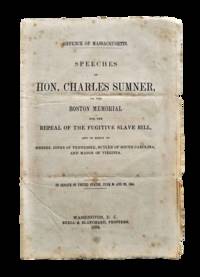
1854176351854. Abolition African Americana SUMNER Charles. Defence of Massachusetts. Speeches of Hon. Charles Sumner on the Boston Memorial for the Repeal of the Fugitive Slave Bill and in Reply To Messrs. Jones of Tennessee Butler of South Carolina And Mason of Virginia in the Senate of the United States June 26 and 28 1854. Washington D.C.: Buell & Blanchard Printers 1854. At the time that this description is being written just three copies are recorded in American institutions. OCLC search results are at best an estimate and can vary over time. The Memorial referred to in the title was a request by 2900 undersigners chiefly men of Boston Mass. to repeal the Fugitive Slave Bill of 1850. What follows is a transcription of Massachusetts Senator and famous abolitionist Charles Sumner's speeches in the ensuing debate: "Mr Jones. asks 'Can anyone suppose that if the Fugitive Slave Act be repealed this Union can exist' To which I reply at once that if the Union in any way be dependent on an Act-- I cannot call it a law-- so revolting in every regard as to that which he refers then it ought not to exist." Sumner goes on to argue amongst other things that the Fugitive Slave Act is parallel to the hated Stamp Act that sparked the Revolutionary War as well as to make spirited rebukes against the pro-slavery Senators Butler Mason and Jones: "The veteran Senator from Virginia Mr. Mason complained that I had characterized one of his "constituents" a person who went all the way from Virginia to Boston in pursuit of a slave as a Slave-Hunter. Sire I choose to call things by their right names. White I call white and black I call black. And where a person degrades himself to the work of chasing a fellow man who under the guidance of the north star has saught a freeman's home far away from the cofle and the chain that person whomsoever he may be I call a Slave-Hunter." Eight sheets folded to make one sixteen-page signature which is stitched along the left edge. Foxing throguhout pages chipped along margins. Dampstaining along two page edges. Delicate but in good condition. <br /> <br /> Charles Sumner January 6 1811 - March 11 1874 was an American statesman and United States Senator from Massachusetts. As an academic lawyer and a powerful orator Sumner was the leader of the anti-slavery forces in the state and a leader of the Radical Republicans in the U.S. Senate during the American Civil War. During Reconstruction he fought to minimize the power of the ex-Confederates and guarantee equal rights to the freedmen. During the war he was a leader of the Radical Republican faction that criticized President Lincoln for being too moderate on the South. Sumner specialized in foreign affairs and worked closely with Lincoln to ensure the British and the French refrained from intervening on the side of the Confederacy during the Civil War. As the chief Radical leader in the Senate during Reconstruction Sumner fought hard to provide equal civil and voting rights for the freedmen on the grounds that "consent of the governed" was a basic principle of American republicanism and to block ex-Confederates from power so they would not reverse the gains made from the Union's victory in the Civil War. unknown
184618128London; Chapman Brothers. 1846. The True 1st Edition. Hardback. Very good copy in the original blind-blocked fine-ribbed cloth. Minor nick to the spine crown with the usual dust-dulling to the bands and panel edges. Remains an uncommonly well-preserved example of a scarce and seminal title; 296 pages; Physical desc. : 296 p. ; 22 cm. Intended by the publisher as the first in a 'Library' of political and literary importance for discerning readers. Subject: Slaves - United States - Social conditions. The Clarke Family Narrative - Witness accounts - Jonathan Walker's Trial - etc. London; Chapman Brothers. hardcover
188037129Circa 1880. 1880. Good. - A slip of paper 2-3/8 inches high by 4-3/8 inches wide is inscribed & signed in black ink: "Let us thank God for the Saxon Grit / Robert Collyer". The paper is mounted on a piece of cream-colored card of approximately the same size. The card is unevenly cut & both paper & card are slightly rippled from the mounting. Good. <p>"Saxon Grit" is the title of an 1880 poem by Collyer about the Norman conquest of England in which the phrase recurs in each verse.<p>Robert Collyer 1823-1912 was an English-born American Unitarian clergyman. He became a Methodist minister in England in 1849. Emigrating to The United States in the following year he found employment as a hammer maker in Pennsylvania and soon began preaching on Sundays while still employed at the factory. His earnest rugged simple style of oratory won him great popularity but his advocacy for the antislavery cause then frowned upon by the Methodist authorities aroused opposition. He was tried for heresy and his license was revoked. Continuing as an independent preacher he joined the Unitarian Church in 1859. In 1860 he organized and became pastor of the Unity Church the second Unitarian Church in Chicago. The church grew to become one of the strongest Unitarian churches in the West and Collyer was regarded as one of the foremost pulpit orators in the country. He left Chicago in 1879 and became pastor of the Church of the Messiah now renamed the Community Church in New York City. In 1883 he was a featured speaker at the convention of the American Woman Suffrage Association where he spoke movingly about his deceased wife and their struggles over "the woman question". Circa [1880]. unknown
0656291591.Ghardcover. Good. Access codes and supplements are not guaranteed with used items. May be an ex-library book. hardcover
18651260191865. First Edition. CONSTITUTION. Journal of the House of Delegates of the State of Virginia. for the Session of 18645. Alexandria: D. Turner 1865. Octavo original front printed wrapper respined renewed rear wrapper original string stitching; pp. 1-3 4-83 1. Housed in a custom chemise and clamshell box. $4500.First edition one of 500 copies of the momentous Journal featuring its February 9 1865 entry on the Alexandria Virginia government's passage of the 13th Amendment mere days after the U.S. Congress the first of the four Unionist southern states to pass the Amendment also featuring the governor's Message noting: ""though we have in inherited from our fathers of the revolution the blessings of a great nation yet they also left to us an inheritance of African slavery which has proved a bitter dreg in our cup of freedom"" a vital record of forces for constitutional change near the end of the Civil War.Soon after the 1860 election amidst southern secession ""the great questions of union or disunion war or peace hung in the balance. Probably the crucial weight on the scale was Virginia as long as the federal government did not seek to coerce the states Virginia secessionists were unable to achieve a majority. When Lincoln responded with force to the attack on Fort Sumter however the vote in Virginia went in favor of secession."" Subsequently a Virginia convention ""met in Wheeling on May 13 1861 it elected as Governor Francis Pierpont a western Virginian and ardent Unionist and arranged for the creation of a legislature to replace the body sitting in Richmond in July 1861 the new legislature met at the 'Restored Virginia' capital of Wheeling in a special session called by Pierpont."" Against its ""claim to represent a majority of Virginians"" a new state of West Virginia was created in 1863 and Pierpont's government moved to Alexandria to govern areas of Virginia under Union occupation Harrison Lawfulness of the Reconstruction Amendments 380-83.Scholars observe that the 13th Amendment its fellow amendments and Reconstruction as ""both a political process made possible by military successes and constitutional thought grew from wartime as well as post-Appomattox developments"" Hyman and Wiecek Equal Justice 247. This rare first edition of Journal of the House of Delegates substantiates that in documenting passage of the 13th Amendment by Pierpont's Virginia government mere days after the U.S. Congress passed the Amendment on January 31 1865. With that Virginia became the first of the four Unionist southern states that ratified the 13th Amendment. Of those Louisiana followed on February 17 with Arkansas and Tennessee that April. The 13th Amendment is the focus of the Journal's entry for February 9 1865 which states: ""Mr. Brownley called up Senate bill No. 12 entitled 'An Act to ratify the joint resolution of Congress passed January 31 1865 proposing an amendment to the Constitution of the United States.' The bill was read the first and second time and the rules were suspended and the bill read the third time and the bill passed."" Also notable herein is the complete printing of Governor Pierpont's opening Message where he notes: ""though we inherited from our fathers of the revolution the blessings of a great nation yet they also left to us an inheritance of African slavery which has proved a bitter dreg in our cup of freedom."" He speaks at length of the rights due people of color and the abolition of laws such as those that prohibit ""negro testimony"" or proscribe a ""different punishment for persons of African dissent"" from that of ""white persons.""""The legislature met for its second session on December 5 1864 The governor's message was a long and important document and indicated the changes of opinion that the war was bringing about. Pierpont gave his views upon the all-important negro question. He congratulated the constitutional convention which had met in the spring on the abolition of slavery in Virginia and advocated sweeping changes in the laws concerning negroes. The act prescribing different punishments for blacks should he said be altered in accordance with the amended constitution as well as the law for apprenticing them. The law prohibiting the education of negroes should be abolished His language was on the whole very moderate. He advised the legalizing of the marital relations of negroes and most important the establishment of public schools Notwithstanding the governor's advice no acts of great importance passed the legislature On February 9 1865 the assembly ratified the 13th Amendment to the Constitution of the United States. It adjourned on March 7"" Eckenrode Political History of Virginia During the Reconstruction. Faint ""U.N.C. Duplicate"" stamp to front wrapper.Text fine; just a bit of faint soiling and a tide line to fragile front wrapper. An excellent copy of this elusive item. unknown