(Slavery) Peters, RichardBiblio.com
224 résultats
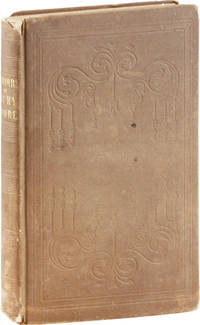
1842313227Philadelphia: stereotyped by L. Johnson 1842. First edition. 140 pp. 1 vols. 8vo. Original brown ribbed cloth rebacked with original spine laid down titled in gilt. Marginal dampstaining throughout scattered foxing some wear to boards good. First edition. 140 pp. 1 vols. 8vo. First edition of this report of this monumental Supreme Court decision regarding escaped slaves preceding by 15 years and rivaling in importance the Dred Scott case of 1857. "In Prigg the Court identified slavery as a core constitutional commitment with which states could not interfere. In this case the Court struck down northern states' 'personal liberty laws' established to protect alleged fugitive slaves from recapture without due process of law. When the professional 'slave catcher' Edward Prigg tried to remove Margaret Moran an alleged runaway he was unable to meet the burden of proof set out by Pennsylvania's 1826 Personal Liberty Law and failed to obtain the legal certificate permitting him to remove her. When Prigg proceeded to ignore this and removed Moran illegally to Maryland Pennsylvania convicted him of kidnapping. The US Supreme Court however overwhelmingly overturned Prigg's conviction 8-1 and pronounced state laws interfering with the return of alleged runaways a violation of the Fugitive Slave Clause." Beaumont The Civic Constitution 2014 p. 128. Blockson 9905; Dummond p. 140; Sabin 61207 stereotyped by L. Johnson unknown
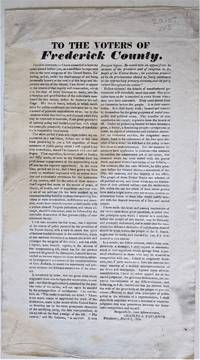
1833713Winchester Va. 1833. Broadside 4to. 290 x 160 mm. 11 ¼ x 6 ¼ inches. Printed in two columns signed in type by Charles J. Faulkner at Winchester dated March 8 1833 at conclusion. Lightly dust-soiled pale stain affecting perhaps one-third of the left-hand margin and column of text. Neatly silked on verso. Withal about very good. Following the August 1831 Nat Turner rebellion in Southampton County a last effort was made by moderate Virginians to gradually abolish slavery. Faulkner a 26-year-old lawyer and assemblyman along with Thomas Jefferson Randolph sponsored legislation to free all children born of slave parents after July 4 1840. His speech emphasized the evil of slavery for Southern white labor noting that slavery "converts the energy of the community into indolence--its power into imbecility--its efficiency into weakness.Shall society suffer that the slave-holder may continue to gather his crop of human flesh" As the Assembly was malapportioned in favor of the Tidewater slaveocracy the proposal lost rather narrowly and nearly thirty years later the Confederacy was assured of Virginia's succession. It is perhaps not surprising that Faulkner "comparatively a stranger" to the county but a member of the Virginia House of Delegates at this time 1831-34 was not successful in his campaign to represent Virginia in the U.S. Senate. However Faulkner was elected to three terms in Congress from Virginia in the 1850s. He was elected to Congress from West Virginia after the Civil War. In the interim he served as Minister to France during the Buchanan administration and on the staff of Stonewall Jackson. Dictionary of American Biography. Not in Hummel. Not found in American Imprints for 1833 and not in the 1830-1839 title index. OCLC records four copies at The Library of Virginia University of Virginia Virginia Historical Society and American Antiquarian Society. unknown
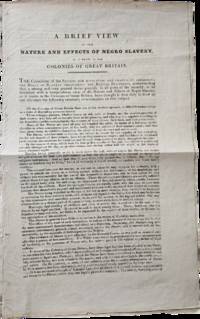
1823List3302London England: Ellerton and Henderson 1823. Three page document measuring 8 ½ x 13 ¼ inches. Folded with some small wrinkles at edges else Near Fine. A document produced by the Society for Mitigating and Gradually Abolishing the State of Slavery throughout the British Dominions better known as the Anti-Slavery Society. The group was founded in London in 1823 by a group of politicians philanthropists and businessmen including William Wilberforce Joseph Sturge and Zachary Macaulay. The document discusses the horrors of enslavement—even unfavorably comparing the British colonies’ conditions with those in the US—and decries the fact that after the 1807 Slave Trade Act essentially nothing more had been done to put “an end to a condition of society which so grievously outrages every feeling of humanityâ€. We find a single copy of the Ellerton and Henderson edition in physical format listed in OCLC as accession number 83930673. Ellerton and Henderson unknown
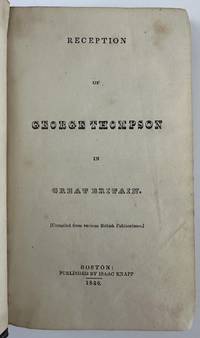
18361691Boston: Isaac Knapp 1836. About very good. xvi13-238pp. 12mo. Original publisher's blue boards with black sheep spine gilt. Boards rubbed corners and spine moderately worn. Text lightly foxed. Scarce work addressing the anti-slavery work of George Thompson following his visit to America. Thompson 1804-1878 was British lecturer and reformer who worked as a commercial clerk. "Thompson first came to prominence in 1831 when he was recruited by the London Anti-Slavery Society's Agency Committee as an itinerant lecturer. In the run up to the Emancipation Act of 1833 he became the most effective British anti-slavery lecturer since Thomas Clarkson. With the struggle against British slavery apparently won Thompson was instrumental in reorienting anti-slavery effort towards the Americas and particularly the United States. . In 1834 he encountered the charismatic American abolitionist William Lloyd Garrison. Recognizing Thompson's talent Garrison invited him to travel to the United States with his growing family to labour there on behalf of the enslaved people of America" - DNB. <br /> <br /> Thompson employed sarcasm and vitriol in his orations attacking anti-abolitionist sentiment across the northern states. In the process he failed to make very many friends or converts and alienated those with more moderate views. "Opponents attacked him as a foreign interloper and an anti-American agitator. They also discovered a scandal in Thompson's past alleging that in 1829 he had absconded with £80 embezzled from his employer. His supporters angrily rejected this charge though Thompson later privately admitted it was true he eventually repaid the sum in full. Hostility increasingly turned violent and in fear of his life he was smuggled out of the country in October 1835 returning to a hero's welcome in Britain" - DNB.<br /> <br /> This work is a rebuttal made by Thompson's American supporters aggregating information from British sources to defend his good name and abolitionist efforts after fleeing America for his homeland. It includes some of Thompson's speeches on slavery in America given before audiences in Scotland and England and discusses his work with the American Anti-Slavery Society. Though there are a handful of institutional copies the work is scarce on the market and does not appear in auction records over the pasty forty years.<br /> <br /> Sabin 9324. American Imprints 36449. Isaac Knapp unknown
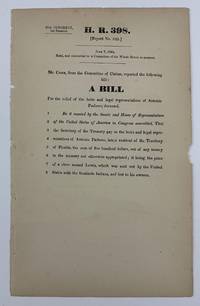
18445887Washington DC: June 7 1844. Very good. Broadside 12.25 x 7.75 inches. Light tanning shallow marginal chips and some fraying to left and right edges. An unrecorded slip-bill printing of a House Resolution with a phenomenal back story involving an erudite elusive and resourceful Florida slave. The slip bill authored by Howell Cobb U.S. Representative from Georgia stipulates that the Secretary of the Treasury pay the sum of five hundred dollars to the heirs and representatives of Antonio Pacheco a former resident of Florida the sum "being the price of a slave named Lewis which was sent out by the United States with the Seminole Indians and lost to his owners." That's where the plot thickens. The slave is now known to history as Luis Fatio Pacheco born in 1800 to enslaved parents on the "New Switzerland" plantation in Florida which was surrounded by a mix of Europeans Africans and Native Americans. As such Luis became fluent in several languages including Seminole which later made him a valuable asset.<br /> <br /> After a conflict with his owner Luis attempted to escape slavery in 1824 by fleeing to Spanish fisheries on Florida's Gulf Coast but he was captured by U.S. military authorities the following year. Skilled as he was in languages and literacy by the military Luis was sold in 1832 to Antonio Pacheco a Cuban merchant. After Antonio's death Luis became the property of Pacheco's widow. When tensions began to ratchet up again between American military forces and the Seminole tribe a U.S. Army officer made a deal to rent Luis from the Pacheco estate at the rate of $25 a month to take advantage of his services as an interpreter. In December 1835 Luis was accompanying a troop detachment led by Major Frances L. Dade in a march to reinforce Fort King near the present-day city of Ocala Florida. Evidently that day Luis was assigned as a scout; he has said to have attempted to warn Dade of a possible ambush by the Seminoles which went unheeded by the commander. The result is today known as the Dade Massacre in which Dade and most of his men were killed.<br /> <br /> According to the narrative provided by Luis who spoke Seminole he explained to the warriors that he was a slave and successfully pleaded for his life. Luis lived with the Seminoles as a captive for nearly two years before again managing to escape. In September 1837 Luis surrendered to the U.S. Army at Fort Peyton near St. Augustine. Soon after he was accused of collaborating with the Seminoles in the Dade Massacre. In 1841 negotiations between the US government and Seminole leader Coacoochee the Native American leader claimed Luis as his property captured in war. Coacoochee was permitted to take Luis together with other Black Seminoles to Oklahoma for resettlement. This event led to the claim by Anthony Pacheco‘s heirs for restitution of a lost slave. The Joint Committee on Claims approved the claim. Luis's story eventually became a focal point in the abolitionist argument against slavery and in 1858 Ohio representative Joshua R. Giddings published a book portraying Luis as a hero against the system. In any case the question of whether or not Luis betrayed Dade has never been completely resolved. June 7 unknown
184657411Boston: Anti-Slavery Office 1846. Sixth Edition. Two volumes bound in one; small octavo 20cm.; publisher's embossed cloth titled in gilt on spine1231115pp. Slight rubbing and wear to cloth heavier at board corners and with small loss at crown of spine; text tight and unmarked but moderately foxed; sound and Good. Contemporary ownership signature "Lucia A Haynes" to front free endpaper. <br /> <br /> A popular and much-reprinted anti-slavery novel though its sensational portrayal of an incestuous triangle between the protagonist Archy his sister Cassy and their father Colonel Moore generally inspired disgust more than abolitionist sympathy among contemporary reviewers. However the novel did provide "first-hand observation of Southern plantation life and slavery conditions" Friedland p. 129 based on the two years the author spent in Florida for the benefit of his health. For additional information see Louis S. Friedland "Richard Hildreth's Minor Works" in "The Papers of the Bibliographical Society of America" Vol. 40 no. 2 2nd Quarter 1946. LCP AFRO-AMERICANA 4798-4800 for other editions; SABIN 31790; WRIGHT I 1189. Anti-Slavery Office unknown
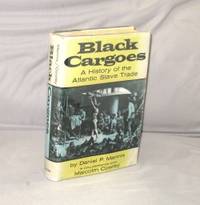
196229404<p>New York:: Viking Press 1962. Second Printing of the First Edition. A Very Good copy in a Very Good plus unclipped dust jacket with light edge wear to the extremities. The African slave trade in the Americas officially began in 1518 with the landing in the West Indies of the first black cargo direct from Africa and was offically suppressed in the United States in 1865. It is estimated that approximately 15 million Africans had crossed the Atlantic during this period. This book attempts to tell where the slaves came from how they were enslaved in Africa how they were purchased by sea captains how they wre transported and how the trip survivors were sold in West Indian and American markets.</p> Viking Press, hardcover
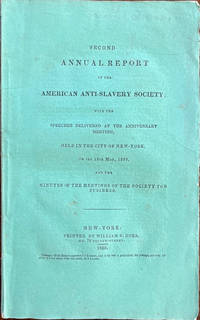
183560564New York: Printed by William S. Dorr No. 70 Fulton Street 1835. 8vo. 87 1 pp. Printed blue-green publisher’s softcovers contents on back cover punch-sewn at gutter margin as issued minor edgewear slight chipping to spine 1 closed tear w/ minor archival repair on inner back cover still VG- copy. First edition of this surprisingly uncommon report of the second meeting of this pioneering American abolitionist society founded by William Lloyd Garrison editor of The Liberator magazine and Arthur Tappan while also featuring contributions by Frederick Douglass and William Wells Brown an African-American freedman. The society was very controversial as by the mid-1830’s slavery was ensconced into the American economy feeding wealth not only to Southern planters but also Northern merchants textile factory owners and shipowners. The first meeting and later misrepresentation had set off violent the violent Farren riots in New York where abolitionists homes and properties were attacked. The 1835 meeting not only agreed on the Society Constitution but also used fundraising to sponsor a great postal campaign to flood the South with Abolitionist literature. White supremacists responded by seizing and destroying the mail and on July 29 1835 3000 people gathered to burn Abolitionist writings and burn three in effigy. The speeches detail the progress of the result of Great Britain freeing 800000 slaves encouraging continued efforts to enroll African-American children and freed slaves into schools and declared that “prejudice which excludes our colored brethren from the rights and privileges of Men the Society lays the axe at the root of slavery. It removes the final bugbear that ‘the Slaves will be worse off when emancipated.’†This also features the extended interview and discussion with Abolitionist former slaveholder James Gillespie Briney 1792-1857 who freed his slaves joined the American Anti-Slavery Society and founded The Philanthropist in Cincinnati OH in 1835 after selling his plantation. Worldcat locates 5 physical copies Cornell DLC NYPL Howard AAS Lib. Printed by William S. Dorr, No. 70 Fulton Street, paperback
186064001London UK: William Tweedie 337 Strand 1860. Small 4to. 5.25 x 7.5 in. xv 1 3-172 xi 1 pp. Woodcut-engraved frontisp. of the author still preserving tissue guard. Publisher’s ribbed plum-coloured cloth dark maroon coloured title label & price of 1 shilling 6 pence mounted front cover very minor chipping head & foot of spine slight fraying title label stamping dimmed and minor bumping to a couple corners still a VG copy w/ London UK bookseller’s label partially removed at gutter margin front pastedown. First edition first printing of the first book wholly devoted to the Underground Railroad published only in England and by an African-American/Native-American author. Mitchell was a pivotal figure in the Underground Railroad who also aided the escaped slave “Eliza†whose escape over the Ohio River ice inspired the key dramatic moment in Harriet Beecher Stowe’s pivotal Uncle Tom’s Cabin. “Eliza†was sheltered originally in the network by noted abolitionist John Rankin passed on to Mitchell who then subsequently ensured her safe passage along the network overseen by Levi Coffin 1798-1877. Ironically the passage of the 1850 Fugitive Slave Act which criminalized those aiding in the Underground Railroad to free slaves with fines of $ 1000 and six months imprisonment fueled resistance and forced Mitchell to publish this seminal work in Great Britain rather than the U.S. As a freeborn orphan Black in North Carolina Mitchell was forced into apprenticeship with a North Carolina plantation owner where he witnessed the deprivations of slavery and became inspired to aid African-American slaves to escape to Canada. From 1842-1855 he helped over 1300 slaves reach Canada from his Washington Court House Fayette County Ohio way station. This memoir recounts many anecdotes of the formerly enslaved including: one enslaved woman who died from frostbite while protecting her three children and a former slave John Mason brought Mitchell in just 19 months of that 13 year span “265 human beings whom he had been instrumental in redeeming from slavery.†Mitchell further recounts Mason’s recapture in Kentucky and later escape from New Orleans to Canada. Mitchell estimates in his book that 60000 enslaved peoples escaped into Canada on the Underground Railroad modern estimates range from 40000 to 100000. At the end of the 1850’s he moved to Toronto and began serving as a minister to African-American Baptist Free Mission congregations largely composed of freed slaves and the final section details the lives of these Canadian Black immigrants. In the final appendix he urgently pleads for a boycott of Southern cotton by Great Britain attempting to overcome resistance to the economic impact and hardship it would have on British cotton mills and related industries. Mitchell c. 1826-c.1879 was encouraged to write this historic work by W.H. Bonner A British abolitionist and had toured Britain in 1860 with William Howard Day and British abolitionist George Thompson to oppose the condition of slavery before the outbreak of the Civil War. This work is quite scarce with only 2 copies at auction in the last 50 years and both those appear to have been the 2nd edition which removed the hyphen in “Under-Ground†extended the title and a couple other revisions. William Tweedie, 337, Strand, hardcover
23092Without date or place. 3pp. 12mo. Bifolium on ruled laid paper. Fair: aged with a 12.5 x 5 cm section cut away from the top of the first leaf before the writing out of the poem. 63 lines divided into six nine-line stanzas. The stanzas are numbered and the poem is complete. The stanzas are numbered and the poem is complete. Written from the slave's point of view with the first stanza reading: 'I'm weary yet I cannot sleep Dark thoughts of morning make me weep For at the rising Sun I'm told I'll be converted into gold There's no escape I must be sold Because my master wants the gold And I'm his Slave yes I'm his Slave Because my master wants the gold And I'm his slave'. Last stanza describing the slave's flight to Canada: 'At last my dreadful journeys o'er I'm safe upon the farther shore St Georges cross floats over me I've found the land of Liberty. My youths renewed no more I'm old That fear is gone of being sold For now I'm Free Yes now I'm Free The fear is gone of being sold For now I'm Free.' No indication has been found that the poem was ever published. Without date or place. unknown
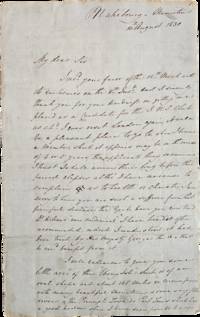
1830List2931Mahébourg Mauritius 1830. Single unsigned fourteen-page letter measuring 8 x 12 ¾ inches. Folded with some stains and pencil marks. Overall near fine. In 1830 Mauritius was a British colony captured from the French in 1810 during the Napoleonic Wars. It was originally a Dutch colony and the Dutch had introduced enslaved labor to the islands. Enslaved people were imported from Madagascar India and Southeast Asia to harvest the valuable ebony trees and later to farm sugarcane. It became a French colony in 1715 and among other provisions the French government awarded upper-class colonists large land grants each with twenty enslaved people to work them. Slavery was abolished in 1835 under British rule after which the planters still farming sugarcane turned to indentured servant labor from India and China alongside illegal slavery.1<br /> <br /> Offered here is a lengthy single letter written by an unknown author to an unknown recipient from Mahébourg in 1830 shortly before this radical change. The letter describes the lives and economic circumstances of the planters and merchants and of the non-white population particularly Malabar people and free and enslaved Black people.<br /> <br /> Noting that “every inch of ground that will produce sugar cane is planted with it†including “the former fine gardens to some of the Habitations†the author reports on the situation for sugar planters:<br /> <br /> “The price of sugar here is not more than 20/per Cwt. for the best quality which does not now remunerate the Planter as his expenses are becoming every day more heavy in consequence of their slaves diminishing . The want of Slaves induced many of the Planters to send for Chinese Labourers and several hundreds were imported at a great expense but unfortunately they did not answer and were obliged to be reshipped for their native Country again at the charge of those who sent for them.â€<br /> <br /> The author later notes that “nearly everyone of the Planters have heavy mortgages on their Estates and are obliged to pay this immense Interest which keeps them poor and will I fear ultimately ruin themâ€. In fact the planters in British Mauritius had extra duties on their sugar exports compared with their Caribbean counterparts. The shopkeepers on the other hand “calculate on retiring with a fortune in five years– therefore you will fancy what must be their prices also their profits.â€<br /> <br /> Though writing from Mahébourg the author describes the capital city of Port Louis at length especially its Malabar Indian and free Black residents—the lives of the latter particularly the free Black women seem especially grim. They write:<br /> <br /> “The Centre of Port Louis is inhabited by all the respectable people and many most excellent houses buildings– the Catholic Chapel the English Church amongst the number. The Suburbs to the West is the part occupied by about 3000 Malabars called ‘Malabar Town.’ – They are dressed mostly in white with Turbans ear rings c c and the females with ornaments in their noses and on their Toes as they generally go bare foot. – Once a year they have what is called a ‘Yamsee’ or a festival in honor of Mehomet which lasts for about a fortnight during which time they seem to get no sleep a continual beating of tom toms – jingling of bells – carrying pagodas which are made of various coloured paper and most richly ornamented followed by all the population of their Caste with their faces daubed with red white c and which has a most ludicrous appearance. The Suburbs to the South is called ‘black Camp’ – the Houses being very small and poor and inhabited by all the free blacks as well as many Mulattoes. – Also a certain class of females of the population of colour – who are visited immediately on the Arrival of a Ship the Crews soon enquiring the way to the ‘Camp.’â€<br /> <br /> As regards relations between the races the author recounts an incident that followed the 1828 abolition of the color bar which would ostensibly give the free non-white population the same rights as the whites:<br /> <br /> “The Theatre is a very good one but has been closed for several months past the Actors Actresses gone to Bourbon in consequence of the promulgation of the act ‘causing all free people of the population of Colour’ to have the same laws – the same privileges as the Whites’ fearing they ought come to the Theatre which they had hitherto been forbidden thereby cause disturbances as the French Whites detest them wd. not sit in the same box it was considered best to shut the Theatre which is a great loss to the Place it being the chief public amusement and indeed the only one we have here.â€<br /> <br /> Overall a detailed letter giving insight into life in a slave colony at a time when significant changes were on the horizon. Of interest to scholars of the colonial history of Mauritius and the second wave of British colonialism.<br /> <br /> 1 Truth and Justice Commission Report of the Truth and Justice Commission Vol. 1 Mauritius: Government Printing 2011. unknown
186135992New York: D. Appleton and Company 1861. First Edition. Wraps. Good. Wraps. 34 pages. Original printed stitched wraps with title on the outer cover. Light edge chips and to the covers. Front cover lightly soiled. Interior contents are clean. Inscribed at the top of the front cover but it does not resemble the author's signature. Speech given during an Alumni Association meeting Dartmouth. <br /> <br /> From wikipedia:<br /> <br /> Caleb Sprague Henry was born in Rutland Massachusetts on August 2 1804.2 He graduated from Dartmouth College in 1825 and studied theology at Andover Theological Seminary and New Haven.3. In 1828 he became a Congregational minister at Greenfield Massachusetts and in 1833 removed to Hartford Connecticut. In 1834 he started the American Advocate of Peace the organ of the American Peace Society. In 1835 he entered the ministry of the Protestant Episcopal church.1 He also became professor of moral and intellectual philosophy in Bristol College Pennsylvania 1835–1838. In 1837 with the aid of Rev. Francis L. Hawks he established the New York Review. He was professor of history and philosophy in New York University from 1839 to 1852. Later he was rector of various churches but was chiefly engaged in literary work. He translated Guizot's History of Civilization and other works from the French and was the author of several works including Compendium of Christian Antiquities 1837 Social Welfare and Human Progress 1860 and Satan as a Moral Philosopher 1877.4 He died in Newburgh New York on March 9 1884.25<br /> <br /> <br /> Sabin 31387. D. Appleton and Company unknown
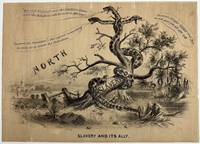
186412816N.p. 1864. Lithograph 14.5 x 20.5 inches. Noticeable toning small areas of light discoloration along top margin short closed tear to left edge minor dust-soiling numerous creases and wrinkles. About very good. A dramatic political cartoon issued during the Civil War and satirizing the dangerous influence of those who argue a compromise on slavery or an easy solution to the war. The work was likely issued in the midst of the 1860 but more likely the 1864 presidential election campaign. The central image of the lithograph involves a three-headed snake -- labeled "The People's Party" and emerging from the American "South" personified by a moss-covered swamp -- which is wrapped around the length of a large tree labeled "Slavery." Each snake vocalizes a different misleading message about the issue of slavery and compromise seemingly aligned with political entities such as the Peace Party and the Copperheads. The messages from each snake head read respectively "Extend Slavery over the Northern States and the Rebellion will be over in 60 days;" "Persevere till after election and then we will give you all you ask;" and "'Support the President' - but oppose everything he may do to crush the Rebellion." This latter message indicates the author of the work supported President Lincoln. The North is personified in the background at left by a depiction of the U.S. Capitol Building. The central image of the lithograph carries echoes of the story of the Book of Genesis with the involvement of a deceptive serpent amid the tree of life.<br /> <br /> The lithograph is signed in the stone at bottom right reading simply "Brooks." Though the work came to us proposing the identify of the artist as Reuben Brooks 1794-1870 we were ultimately unable to confirm this authorship. The lack of an imprint in the lithograph also precludes easy research and identification. In fact the rarity of the lithograph makes it difficult to expound much more about it at all. OCLC reports just a single copy at the Peabody Essex Museum and it is not listed in Weitenkampf or Reilly. Given its rarity and content the present lithograph offers an outstanding opportunity for further research and contextualization. unknown
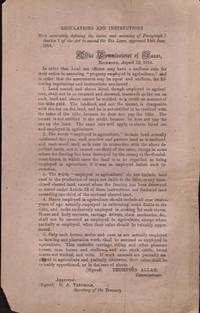
186435137Richmond: Treasury Department 1864. First Edition. Broadside. Fair. Approx. 8.5" X 5.25" broadside. Signed printed text Thompson Allan Commissioner; Approved G. A. Trenholm Secretary of the Treasury. 5 thin closed tears to the fragile paper no loss of content. A few small light spots. Fair only. <br /> <br /> Part 4 of the Regulations and instructions states; "Slaves employed in agriculture should include all over twelve years of age actually employed in cultivating crops liable to the tithe and cooks exclusively employed in cooking for such slaves. House and body servants carriage drivers slave mechanics &c. shall not be assessed as employed in agriculture except where partially employed when their value should be rateably apportioned." <br /> <br /> Parrish & Willingham 2175. Treasury Department unknown
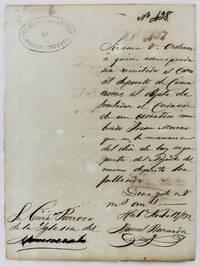
18723066Havana 1872. Very good. Manuscript form approximately 8.5 x 6.25 inches. Minor wear at edges; a few small worm holes. Contemporary ink stamp. Light tanning and offsetting. This 1872 manuscript form from a Havana jail the Celaduria de la Punta notes the death there of an "Asiatico" a Chinese indentured servant with the given name of Juan Macao and orders the transfer of the body to the mortuary for cremation. Indentured servants found themselves jailed for several reasons including suspicion of theft and other crimes recapture following runaway or mere suspicion of abandoning a contract. unknown
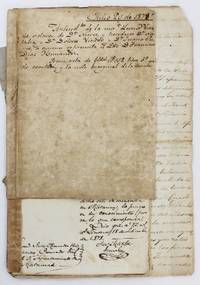
18784011Various places in Cuba 1878. Overall good. 29 leaves varying sizes. In contemporary ad hoc selfwrappers loosely stitched. Rear wrap tattered. Varying degrees of toning and wear. Scattered offsetting throughout. Fascinating gathering of documents and letters that present several cases of Cuban slaves applying for their own freedom in 1878. The gradual abolition of slavery on the island was enacted by Spain in 1880 but prior to this there were several bureaucratic mechanisms by which enslaved people could apply for or purchase their own manumission. The most interesting case amongst the present manuscript documents is the claim of a male slave that states he was born free in Puerto Rico but was somehow included in an inheritance as a young boy transported to Cuba and sold into slavery:<br /> <br /> "Un individuo que hoy se encuentran en la Cárcel del Alacranes y que dice nombrase Juhan ó José Julian Quintana y ser esclavo actualmente de Dn. Serapio Hernandez dueño de los ingenios Escorial ubicado en Colon y Sta. Rosa en Limonar y vecino de esa Ciudad calle del Rio ha solicitado se le restituyan un derechos de libertad por haber nacídolibre en Puerto Rico de donde á la edad de 5 ó 6 años le trajeron à esta Ysla y vencieron como esclavo."<br /> <br /> Interesting for the study of manumission in late-colonial Cuba and certainly worthy of further research. unknown
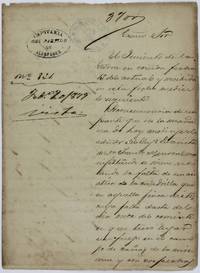
18792090Cuba 1879. About very good. 3pp. on a small bifolium. Contemporary ink stamps; accomplished in a fairly legible hand. Minor wear. A few small wormholes. Light tanning and dust soiling. Brief but very interesting manuscript report on the case of a missing Chinese indentured servant in the district of Alagranes near Matanzas. On February 18 1879 the owner of the plantation Juanita reports the missing person stating that there was a fire in his sugar cane field and it is thought that the laborer might have been burned. It seems that the present document serves to register the case with regional authorities in Matanzas and is a good record of the bureaucracy controlling indentured servitude in Cuba at this time. unknown
18095958Havana 1809. Good. 1p. on a bifolium. Printed form completed in manuscript. Previously folded. Small portion of upper left corner torn away and some scattered worming neither affecting text. Upper right of blank conjugate leaf clipped. Some scattered staining and offsetting with even tanning. An early 19th-century bill of sale for four slaves in Havana. The form completed in manuscript approves the sale by Doña Dolores Hernandez of "quatros negros" who had been brought from the coast of Africa on the slave ship Juno captained by Jabez Gibbs 1360 reales. It further states that the enslaved men are "Con la calidad de bozal alma en boca huesos en costal à uso de férias sin asegurar de tachas ni enfermedades mal de corazon gota coral de S. Lazaro ni orta qualesquiera que puede paceder la humana naturaleza porque toas corren por cuenta del comprador." The document is signed by the relevant authorities and dated March 26 1809. A good document of the slave trade in Cuba during the early 1800s. unknown
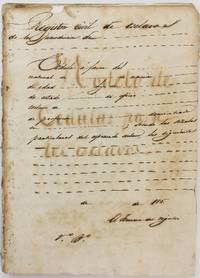
18503976Havana 1850. Good. 138pp. Folio. Stitched with remnants of leather binding along spine. A few blank leaves scattered throughout. Dampstaining and moisture damage at upper fore-edge of scattered leaves slightly affecting text. Moderate offsetting occasional ink burn. Light edge wear and tanning scattered foxing. An extensive list of slave owners in Cuba in the mid-19th century who were issued cedulas for their human property. Cedulas were integral documents for the identification and transportation of enslaved people in the bureaucracy of colonial Cuba and were usually required by the government. In the present manuscript the race and sex of the slaves being issued documents are usually identified -- Negra Negro mulata mulato Chino China e.g. -- though some are just entered as esclavos and there are several entries noted as dotaciones that is complements usually large of slaves on a plantation. The names of the owners are grouped alphabetically according to their first names generally though not in any strict order and the leaves of the manuscript are sometimes bound out of order. Often there are multiple listings of an owner most likely one for each slave in need of a cedula and in all there are approximately 2500 or more separate listings. The first leaf appears to be a model for the cedulas that were being issued to the listed slaveholders with dashes where the information on the slaves and slave owners is to be filled in. The entire document has the appearance of an index with numbers at the right side of each page indicating perhaps the page numbers in the master ledger where the original entry was made. Overall a fascinating and significant document. unknown
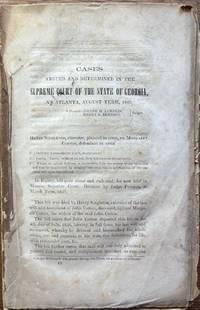
185736729Atlanta: State of Georgia 1857. Wraps. Fair. Stitched wraps. Pages 261-465. Missing the outer front cover that identifies the printer and location. Rear wrap missing. Rest of contents present. Untrimmed wraps lightly soiled on the front cover. Interior contents clean. Contents include a lengthy case regarding the American Colonization Society versus Lucius J. Gartrell administrator will of Francis Gideon deceased in the county of Fulton pages 448-465. State of Georgia unknown
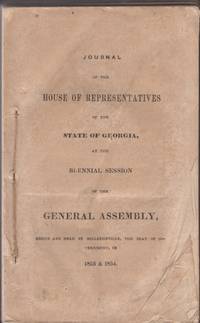
185335359n.p.: Georgia 1853. Wraps. Fair. String bound wraps. 1011 pages 1 page blank 1 37 page Index 1 page blank 1. Title page is page 1. Page 1 is toned and creased. Rear wrap is lightly toned with a few spots. Text block is not trimmed and the pages are uncut at the top edge. Moderate toning and foxing to the contents. <br /> <br /> Contents include a section on Slave and Free Persons of Color laws. Printer information or location not provided on the title page. A similar copy held by Emory University states the 1853 & 1854 Journal was printed in Savannah by S. T. Chapman. Emory's copy is has 904 pages while this copy has 1011 pages. Also Emory's copy does not have the hyphen in the word Biennial on the printed title page. Georgia unknown
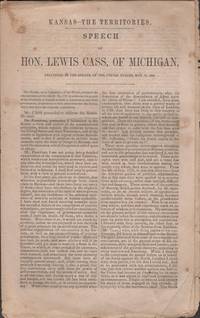
185634806Washington D.C.: Printed at the Office of the Congressional Globe 1856. First Edition. Wraps. Fair. Single sheet folded wraps. 8 pages. Light toning to the paper. Small holes at the fold intersections margins and edges. No loss of print. Light edge wear to the paper with minimal loss of a couple of letters. Speech covers recent violence and Kansas becoming a free State. Fair condition. Printed at the Office of the Congressional Globe unknown
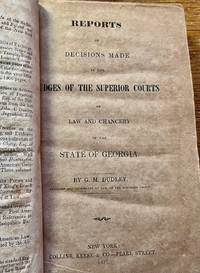
183736669New York: Collins Keese & Co 1837. First Edition. Hardcover. Poor. Octavo. 4 pages advertisements xxxii 4 blank leaves. Binding in poor condition. Spine missing and repaired with tissue paper. Hinges are glued and cracked. Heavy toning to the preliminary pages. Rest of text has light to moderate foxing and or toning. Contents include the a case relating to Slavery: a motion for a new trial concerning ownership of Slaves owned by the Coxe family on page 5. Scarce. Collins, Keese & Co hardcover
181935648Milledgeville: S. Grantland 1819. First Edition. Leather bound. Fair. Octavo. iv 463 pages. Polished sheepskin leather binding with red leather title label on the spine. A brown piece of linen tap used at the top and at the bottom of the spine. Covers rubbed. Internal hinges in good condition. Some arithmetic written on the right front flyleaf. "Augusta Wylie King 1929" written in blue pen on the verso of the right front flyleaf. Light toning and foxing to the contents. A few pages have ink splotches. Newspaper clipping stored between pages 342 343 has left stains to the pages. <br /> <br /> Contents include sections on "Free Negroes" and a section on "Slaves". 11 page list of subscriber names by county located in the back. Subscriber names are listed alphabetically by county. List includes the name of Daniel Ross of the Cherokee Nation. Fair.<br /> <br /> Shaw & Shoemaker 47639; Not in Sabin; Derenne Georgia Catalog Vol. I page 366 - "Probably printed in Philadelphia for notice of copyright on Sept. 28 1819 by Mathew Carey & Son as proprietors in Eastern District of Pa. appears on verso of the title page. S. Grantland unknown
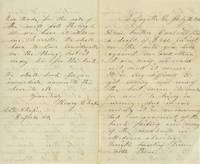
1861Cat338Lafayette Ohio 1861. Autograph letter signed 2 pp. Addressed to D. T. Chapin of Enfield Connecticut. Good condition with normal folds and light wear. A concise but revealing early Civil War letter combining financial anxiety agricultural reporting and clear-eyed political commentary on slavery and the future course of the conflict. Writing amid the first months of the American Civil War Chapin opens with the immediate purpose of the letter—forwarding “a draft of $240 for int. on the noteâ€â€”before situating the payment within a deteriorating economic landscape: “It is very difficult to get money now even of the best men.†He describes a local economy under strain noting “no market for wool to bring in money†compounded by regional instability “on account of the bank failing and many of the merchants in Medina closing†concluding bluntly: “Terrible bursting times with them.†Even the act of sending funds carries uncertainty as he cautions that “in these times I consider there is a risk in the best of banks.†Alongside these concerns Chapin provides a snapshot of agricultural conditions: “Corn is very backward and short wheat nearly middling grass rather below middling†summing up the situation as “rather tight times as well as troubled times.â€<br /> <br /> The most significant portion of the letter however turns to the war itself and the unresolved question of slavery. He writes:<br /> <br /> “We hope the end will be well but our nation will have to be humbled. It is well to put down rebellion but it is rather queer that the cause of the trouble must be let entirely alone. The nation will get their eyes open after a while. The President possesses the war power to abolish slavery and Congress possess the power also in my humble opinion and the time will come when they will have to do it unless the south run their heads so hard against the rock as to do it themselves.â€<br /> <br /> The letter closes with a brief note on a failed business transaction—“our trade for the sale of the mill fell throughâ€â€”underscoring the economic uncertainty of the moment before returning to family matters. Overall an evocative early Civil War letter by a merchant expressing fears and anxiety for the pending conflict. unknown