SlaveryABAA

111 résultats
1852100540<p>Letterpress braodsheet 10 3/4 x 6 1/4 text on both sides. Margins trimmed on both sides a little uneven on the left side close to words on reverse but not affecting text a few small stains in text. Indiana was for many years a site of refuge for escaping slaves. With this joint resolution the document declares that the only real way to do away with the injustice of slavery was to advocate emigration and colonialization of Africa.</p> books
1855WRCAM55824New York: American Anti-Slavery Society 1855. 36pp. Gathered signatures stitched as issued. Minor edge wear spotting and soiling. Very good. The scarce second edition of this anti- slavery pamphlet printed in New York by the American Anti-Slavery Society from the same "stereotype plates.without alteration" as the first edition printed in Hartford earlier the same year. The text focuses on an appeal to the American Tract Society to take a more vocal and concerted stand against slavery. The authors of the text accuse the American Tract Society of "suppression" of anti- slavery sentiment by censorship of certain works it publishes that speak against the institution and an overall sin of "studied and persistent ommission" by not itself issuing "a direct condemnation of the most giant iniquity of our land." The text is signed in print at the conclusion by "The Members of the Fourth Congregational Church Hartford Conn." The work was issued as the sixteenth entry in the American Anti-Slavery Society's "Anti-Slavery Tracts." SABIN 30676. American Anti-Slavery Society unknown books
1836WRCAM46520Pittsburgh: Alexander Jaynes 1836. 36pp. Dbd. Light foxing and toning contemporary pencil notations. About very good. A discourse given on the great evils of slavery and the polarization it is causing among the northern and southern states. Relatively scarce though the titlepage indicates that it was printed "For Gratuitous Distribution." Alexander Jaynes unknown books
14476SAUGNIER Mess. and Brisson. London G.G. J. and J. Robinson1792. First edition in English after the French first edition of 1791. Voyages to the Coast of Africa: Containing an Account of Their Shipwreck on Board Different Vessels and Subsequent Slavery and Interesting Details of the Arabs of the Desert and of the Slave Trade as Carried on at Senegal and Galam. 12mo 21.5 x 14 cm; i viii 500 pp three parts and a narrative First Voyage - To Senegal; The Second Part - Voyage to Galem and Return to France; The Third Part- Commerce of Senegal and Galam; Narrative of the Shipwreck and Captivity of M De Brisson bound in one volume lacking the map recent blue cloth with gilt spine title lettering.<br/>Saugnier was shipwrecked on January 17 1784 near Cape Leven and Brisson in July 1785 at Cape Blanco both in the Spanish zone of Rio del Oro. A fascinating account of shipwreck and slavery from a first hand account including details on the economic aspects of slavery. Faded spine page 31 misnumbered 13 page 85 has an ink stain to it and pages 460 and 461 are misnumbered 444 and 445 although the text is confirmed correct; good solid copy. unknown books
183441625Salem MA: W & S.B. Ives 1834. 8 pp. <br /><br />"The society organized January 27 A.D. 1834.--Salem Mass." Waterstained. Bound in original printed wrappers. Front wrapper detached but present. Uncommon. W & S.B. Ives books
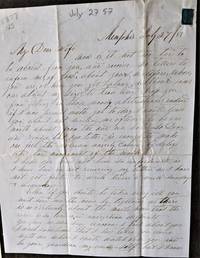
1857708Memphis 1857. 4to. letter sheet. 250 x 195 mm. 9 ¾ x 15 ½ inches. 4 pp. about 840 words. Folded in thirds. Written in black ink faded brown in very legible hand. Jesse McCallum was a hay dealer from Cincinnati Ohio who travelled away from his family on business forays. In this case he writes from Memphis Tennessee complaining about the heat and commenting on the "darkies" as follows: ". the sun is scorching from 10 am to 4 pm the difference is very perceptible I think the heat is greater on account of the drought the ground is parched up and dry.the streets are deserted in the middle of the day but the darkies will be down in the hottest part of the day in the sun and sleep with the sun shining full in their face and appear to enjoy it as much as a white man would in the shade what a difference collar sic makes.the south could not get along well without its black population one months work in the sun of the south would cure the bitterest abolitionist of the north of his bitter oposition sic to institutions of slavery and come over without a groan to be a slave owner if compelled to earn his living by cultivating the soil." McCallum thinks "we will do well on this load of hay.as hay is advancing" and also comments about his wife's lack of correspondence and reminds her that he writes twice a week. The last page is particularly affectionate--he remarks about being a "bachelor husband" and adds ; ". the only true enjoyment I have had was when I recd your letter since I left you and now Elly if you wish me to enjoy myself write often." Jesse McCallum often spelled Mc Collum in historical records was born in Ohio in 1819. In 1850 he was working as a stone cutter. By 1860 he was living with wife Eleanor Welsh and  six children in Marysville Yuba California. In the Civil War he was a Union Corporal 81st Illinois Infantry Company A. In 1870 he was making "gas machines". He died in Marysville in 1880. unknown books
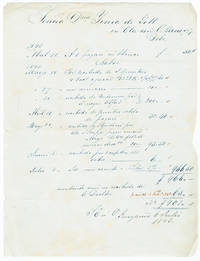
1843WRCAM55715Guayama Puerto Rico 1843. 1p. Quarto. Old folds a few short closed tears minor wrinkling. About very good. A record of a slave sale in Puerto Rico during the late Spanish colonial period. The document records various expenditures for "Senora Dna Yrma de Gott" for the spring and summer of 1843. Along with other expenditures from April to July 1843 the present manuscript document includes a line item from March 30 reading "recibido de Antonini por el negro Alfred." Apparently the señora received 200 Spanish dollars or pesos for Alfred the slave. The Spanish brought slavery to the island of Puerto Rico during the early colonial period. Slave labor fueled sugar production on the island reaching its peak in the early to mid-19th century. Slavery was finally abolished in Puerto Rico 1873 after years of slave revolts against Spanish colonial rule which began in 1868. Despite its long history of slavery records of slave sales from Puerto Rico are rarely encountered in the market. unknown books
183419536Boston: Russell Odiorne & Metcalf et al. 1834. First edition. Stitching evidently renewed at an early date; some wear and soiling light chipping and foxing; a good sound copy. Stitched pamphlet lacking wrappers 8.88 x 5.38 inches 80 pages. The notorious privateer and slave trader Pedro Gibert operating out of Colombia attacked the Salem brig Mexican off the coast of Florida in 1832 and set the American ship on fire. Captured off the coast of Africa by the Royal Navy in 1833 Gibert and his crew were brought to America for trial making him and two of his crew that last men to be hanged for piracy in the United States. It is interesting to note that one of the defense attorneys was David Lee Child 1794-18874 the abolitionist journalist and husband of Lydia Maria Child. Child had fought on the liberal side in Spain in 1823 as was fluent in Spanish which may have been the reason he was given the job of working with the Spanish-speaking prisoners--though the question of whether his liberal principles guided him to provide adequate counsel to defendants whose numb er included black sailors despite the fact that the Panda was a slave ship seems an open or at least under-explored question not addressed in any of the standard biographical sketches. This first edition of the Russell Odiorne and Metcalf edition of the trial did not include portraits; so-called second and third editions were published the same year had added plates. Sabin 69915. Traces of the original wrappers present. Russell, Odiorne & Metcalf [et al.], unknown books
186223579<p><i>"It is a fact that the enslavement of human beings has so far infused its insidious poison into the very hearts of the Southern people that they have come to believe and declare the evil of slavery to be a good and to require the power of Government to be exerted to maintain extend and perpetuate an institution that enables thousands to sell their own children to be enslaved with all their posterity into hopeless bondage." </i></p><p>The founder of New York City's Cooper Union for the Advancement of Science and Art echoes the language and logic of the Emancipation Proclamation as well as citing some Southern pro-slavery arguments to demonstrate their ridiculousness in this open letter to President Lincoln. Cooper and the Cooper Union had long been advocates of abolition and both Lincoln and Frederick Douglass had famously lectured at the institution.</p> <b>PETER COOPER. SLAVERY.</b>Pamphlet. <i>Letter of Peter Cooper on Slave Emancipation</i> Loyal Publication Society New York 1862 8pp. disbound.<p><b><br /></b></p><p><b>Excerpts:</b></p><p><i>"It is a fact that the enslavement of human beings has so far infused its insidious poison into the very hearts of the Southern people that they have come to believe and declare the evil of slavery to be a good and to require the power of Government to be exerted to maintain extend and perpetuate an institution that enables thousands to sell their own children to be enslaved with all their posterity into hopeless bondage." </i></p><p><i>"In the original formation of that Constitution it became absolutely necessary to make a compromise with that great and all pervading interest which had then already entered into the very life-blood of the nation rendering the formation of an union of States hopeless without such a compromise."</i></p><p><i>"The constitutional requirement to return fugitive slaves on their being demanded by Southern men having been acknowledged and performed by the States has been reaffirmed by an almost unanimous vote in Congress.These honest efforts on the part of the North to maintain peace and friendship were met by a relentless war waged for the destruction of the Constitution and the dissolution of the Union.<i>"</i></i></p><p><i>"The time has now come when Southern men must know that the Union must be preserved and it is for them to determine whether they will persevere in their rebellion until the North shall be compelled in the most reluctant self defence to render contraband of war the slaves and property of all persons found in arms against the laws and Government of the country."</i></p><p><b>Condition</b></p><p>Fine. Disbound and lacking front wrap.</p> books
184137610Boston: J.A. Collins 1841. Original printed and illustrated green wrappers ink stain along half the front wrapper's blank inner margin with engraving of Lady Liberty surrounded by slaves and freedom-loving white people. Stitched. 36pp. Title page and text illustrations. Lightly foxed. Very Good. <br/><br/> A scarce Almanac also appearing with a publication date of 1840. The Almanac is noteworthy for its excellent content on the Amistad incident including portraits of Cinque and others. <br/> "Things for Abolitionists to Do" recommends working to establish schools for free children of color. Also included are "Hints to Anti-Slavery Debaters;" an "Ecclesiastical Roll of Infamy" listing northern clergy of the Methodist Episcopal Church who voted for a resolution prohibiting "colored persons to give testimony against white persons;" and a "Congressional Roll of Infamy" of Northern congressmen who voted for the Gag Rule prohibiting Congress from entertaining petitions to abolish slavery in Washington D.C. As to the presidential campaign the authors say "President Van Buren and General Harrison have both publicly taken the side of the oppressor against the oppressed and the God of the oppressed. Both of them glory in it." <br/>Dumond 83 this imprint. Drake 4222. J.A. Collins unknown books
1836WRCAM52765N.p. likely Augusta 1836. 62pp. Folded sheets stitched. Minor foxing and toning. Very good. Untrimmed. A rare Maine slip-bill document resolving that the citizens from Maine and other states should not interfere with the issue of slavery in slave-holding states. The legislature writes: "Any interference therefore of a State or the inhabitants of a State with the domestic concerns of another State is dangerous as having a direct tendency to create jealousies between the States and thereby weakening the attachment to the Union which is our only security against domestic dissensions and foreign aggressions." <br> <br> This is a somewhat surprising position for the state of Maine to have taken at the time. Maine came into the Union in 1820 as a free state to balance the admission of the slave- owning state of Missouri. Also Maine opposed the admission of the Republic of Texas in 1836 the same year the present document was printed on the basis of Texas' position on slavery. It is curious that they would take two seemingly opposite positions in the same year. Still the legislature printed the resolution and authorized copies to be sent to the four southern slave-owning states mentioned in the title. unknown books
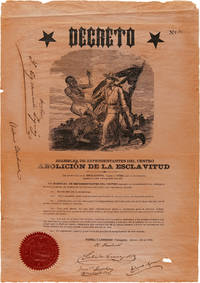
1869WRCAM56566Camagüey Cuba 1869. Pictorial letterpress broadside 18 1/2 x 13 inches. Numbered "54" in manuscript bearing the embossed red seal of the Republica Cubana and signed in ink by Salvador Cisneros y Betancourt Eduardo Agramonte Ignacio Agramonte Loyn áz Francisco Sánchez y Betancourt and Antonio Zambrana. Old horizontal folds minor creasing handful of small edge chips. Small hole in bottom margin just touching one ink signature. Very good condition. A rare and significant pictorial Cuban decree from the provisional rebel government abolishing slavery on the part of the island they controlled issued by the radical faction of the Cuban nationalists fighting against Spanish rule in the first months of the Ten Years' War. <br> <br> This proclamation is illustrated with a dramatic woodcut signed "LFR" depicting an ill-clad but exultant freed slave and a rebel celebrating in front of the Cuban flag. This decree stipulated freedom for all the enslaved people of Cuba in hopes that they would join the revolutionary struggle. The decree also provided for eventual compensation to slaveholders and ordered that freed individuals must serve the revolution either through military service or by continuing with their previous work. Among the important leaders who signed the present document were Salvador Cisneros y Betancourt as president just below the printed text and Ignacio Agramonte y Loynáz as secretary to the left of the engraving. <br> <br> The practical effect of this decree was modest as the rebels only controlled limited territory before their ultimate defeat and their territory was generally under the control of more conservative military commanders but such a proclamation joined a growing chorus of abolitionist sentiment in Cuba which finally realized the end of slavery in 1886. A powerful statement of anti-slavery policy in mid-19th century Cuba with a striking illustration of a jubilant slave celebrating his short-lived freedom. Rare with no copies recorded in OCLC. unknown books
18732024Cuba 1873. About very good. 3 folio leaves. Light wear at edges a couple of small chips at lower left edge of each leaf. Light tanning and foxing. Accomplished in a neat legible script. Scarce manuscript listing of slaves and indentured servants from a Cuban sugar plantation. The present list was made in January 1873 on the Ingenio Tartesio east of Havana near the small village of Las Pozas. On two separate sheets nine Chinese and twenty-eight African or Criollo men are listed as rented to the farm; on a third sheet eighteen slave births for 1873 and 1874 are recorded giving names mothers and dates of birth. The Chinese men are identified simply by first name and owner; the African and other slaves are listed with additional details such as nationality age owner. A section for additional observations notes which slaves have run away and at least one death. A fascinating document of slave hires on an isolated Cuban plantation during the 1870s. unknown books
1865974Santiago de Cuba 1865. Very good. 10 leaves. Removed from a larger volume and restitched. Minor wear and one small area of worming at edges. Light tanning and foxing. Accomplished in several legible hands. A fantastic set of manuscript records for a slave auction house the General Slave Depository in Santiago de Cuba dating to January 1865. Santiago along with Havana and Cienfuegos was one of three major sites for slave sales on the island during the 19th century. The first leaf of the document provides a statement that the documents were assembled in accordance with the rules established for slave auctions which had been updated and approved at the end of the previous year. The second two documents lay out mortgage agreements and financial obligations between the slave house and the Real Sociedad Economica de Amigos de Pais of the city in which the auction owners acknowledge debts and forthcoming payments on the order of several thousand pesos. Following these are two leaves containing a "Relacion de los esclavos ecsistentes en el deposito de esta Ciudad en el dia de la fecha" that is a list of slaves at the depository on the day of the auction and their owners and renters which perhaps were a part of the collateral for securing the loan. A total of twenty-nine slaves are listed and the leaf that follows certifies that the list is correct according the to the director and the auctioneer of the depository. The final two leaves provide official recognition of the loan from two distinct government offices. All documents are signed by the relevant parties and government officials involved in the agreement. In all the present group of documents provides a detailed assessment of debts and human assets of the slave auction house in Santiago de Cuba in the mid-1860s and is a fascinating and valuable document of the bureaucracy and regulation surrounding the financial realities of selling slaves in Cuba during this period. unknown books
18772027Havana 1877. Very good. 1p. on a bifolium. Removed from a a bound volume with unobtrusive stabholes at gutter margin. Light wear at edges; light dust soiling and damp staining. Remarkable bidsheet submitted by a Cuban business in response to a newspaper advertisement for an auction of slaves for hire held in Havana during November 1877. The firm Jado Sarasúa y Compañia writes that "Enterada del anuncio publicado en la Gaceta fecha 9 del corriente para el arrendamineto en publica subasta de los esclavos existentes en el Asilo de San Jose pertenecientesa Bienes Embargados y sujentadose en un todo al pliego de Condiciones inserto en la misma Gaceta hace la siguente proposicion." Below is a list of fourteen slaves mostly women and the prices that the company is willing to offer for the slaves being rented ranging from ten to seventeen pesos per month. Signed and dated at the bottom "Habana Noviembre 14 de 1877. unknown books
18842025Matanzas 1884. Still very good. 3 leaves plus 4pp. pamphlet in original plain wrappers string tied. Light wear at edges. A few very small worm holes. Contemporary ink stamps. Light tanning and foxing. The Spanish Cortes approved a gradual manumission law in 1880 for slaves in Cuba that provided for an eight-year period of patronato tutelage for all slaves liberated according to the law which essentially amounted to indentured servitude. The transition to the patronato system was overseen by a provincial network of government agencies called Juntas de Patronato. Most of the workings of the slave system were preserved but patrocinados as former slaves came to be known received a minimal set of legal rights and were to be paid a token wage. <br/><br/>This fascinating set of Cuban manumission documents from the Junta de Patronato of Matanzas records this process and contains a rare cedula de patrocinado an identification booklet stating a slave is now a freedman with a supporting sponsor. The cedula completed in manuscript states that "Moreno Luis Morejon Natural de Africa.Vecino del Potrero Miraflores.Patrocinado de Da Josefa Morejon de Rodriguez" is "Gratis Sin Enmienda" as of September 15 1881. The second leaf of the pamphlet prints the rights of the freedman and the responsibilities of the sponsor such as the provision of food clothing and nominal salary. <br/><br/>The second document present here is a contemporaneous manuscript letter from Josefa Morejon de Rodriguez confirming that she will act as sponsor for the freedman and the final document dated January 28 1884 and signed by Rodriguez and the relevant local magistrates states that the sponsorship has been completed and is now legally concluded. With the ink stamp of the Matanzas Junta Provincial on first page and the contemporary stamps of several other relevant authorities. An outstanding record of the process of gradual manumission in Cuba during the last years of legal slavery on the island with a rare surviving freedman's identification book. unknown books
18562026Remedios 1856. About very good. 4pp. on a large bifolium. Printed form completed in manuscript. Separated at fold repaired with tissue. Light wear at edges. Light tanning and foxing. Rare Cuban population census form listing the number of residents in and around the town of Remedios located on the northern central coast of Cuba in 1856. The present document completed in manuscript lists the population according to various categories such as ethnicity and race age range occupations marital status location of residence and several others. The census includes slaves of African origin newly arrived Chinese indentured servants "colonos Asiaticos" immigrant laborers from Yucatan freedmen and free white residents "Blancos". In all there are just over 2000 people living in and around Remedios at this time comprising just over 1300 free whites over 300 free people of color 460 slaves and 19 Chinese laborers. One of the most interesting sections records the population by place of residence which shows that the great majority people in the area lived on estancias with a good part of the remaining population living on livestock farms and sugar plantations. On the final page are two additional sections which enumerate the types of property farms and other enterprises in the regions and provide statistics on agricultural and industrial production and land usage along with some manuscript notes with the signatures of the census takers or local magistrates. An interesting document of slavery agriculture and population in rural Cuba during the mid-19th century. unknown books
182532015London: Knight and Bagster 1825. One of several editions issued in 1825. Folio 4pp. Self wraps some marginal soiling and nicks bent at folds a very good copy. Library Company Afro-Americana 4293. OCLC lists just the Library Company copy; not in Dumond or Work. Formed because the 1807 Act to abolish the slave trade had failed to diminish "the prevalence of the very evils which it was one great object of the Abolition to remedy" the Society reviews the stranglehold that West Indian slavery is gaining. Its proceedings examine conditions in each of the West Indian colonies including "the threat of Jamaica to renounce her allegiance" to Britain. Information is also presented concerning Haiti and the effect of that country's upheavals on the British colonies. Knight and Bagster unknown books
185019425Philadelphia March 20 1850. Portion of the blank leaf clipped traces of a partially-removed decal from the blank verso; a little foxed in very good condition. Quite legible. 1.5 pages in autograph ink on a lined blue folio approx. 250 words. Integral address. On the negotiation for and Methodist process of returning the missionary Seys to Liberia as a colonization agent: "I this morning presented your communication and also Mr. PinneyÃs to my colleagues. Their conclusion was expressed as follows. 'Agreed that we still abide by our decision of last year ñ That we have authority to make appointments to agencies for the Colonization cause ñ 2d That we are not willing to advise Br. Seys as to the expediency of his accepting such an agency but leave that to his own discretion. 3d That at present we see no insuperable difficulty in the way of his appointment as Agent of the Colonization Society of Maryland at the next session of the New York Conference provided that previous to that time he receives a commission from said society and decides to accept the appointment.' In order to relieve your mind on the other point I will inform you that I see no way of deciding the question of a Superintendent to Liberia for some time to come. We do not just it safe and proper to give personal advice to brethren in regard to such appointments." Seys was a native of Trinidad and according to later accounts of colonization societies had been an overseer on a family plantation until a conversion experience led him to Methodism abolition and emigration to the United States. Seys here appears to have been angling for a return to Liberia as a colonization agent a goal at which he seems to have succeeded; he would be named Minister and Consul to Liberia in 1866. With a preliminary typescript. March 20, unknown books
1864WRCAM53096Richmond 1864. Broadside 18 x 12 inches. Printed in three columns. Previously folded with a couple small separations along old fold lines. Light toning and foxing. About very good. A very scarce and quite interesting broadside circular printing of the act which allowed slaves and free blacks to be used in certain tasks by the Confederate Army during the Civil War as well as instructions for the conscription and induction of those men into the armed forces. The Confederacy was loath to arm any of its slave population but by 1864 could not spare any further manpower from their infantry to perform menial tasks and the government therefore passed a law allowing slaves to be used "in certain capacities" such as the construction of fortification the production of arms and the transport of materiel. The first column of this broadside comprises a full printing of that law while the remainder sets forth the rules for the impressment of slaves into military service for their care while in service and for the compensation of their owners. <br> <br> A fascinating piece that lays bare the desperation of the Confederacy for labor and supplies in early 1864. Not in Parrish & Willingham. unknown books
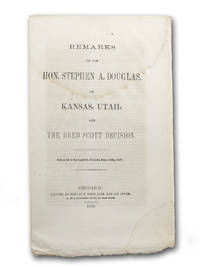
185718536Chicago: Printed at the Daily Times Book and Job Office 1857. First Chicago edition. Light damp-stain to the upper third of the sheet small stain to the lower outer corner; a very good copy. Original self-wrappers 10.25 x 6 inches 15 pages untrimmed. Unopened. Per Byrd "This speech was the first public expression of his views on the Dred Scott decision. In it he accepted the decision and insisted that 'the whole principle of Popular Sovereignty and self-government is sustained and firmly established by the authority of this decision.' " Byrd also notes this pamphlet was intended to lay the groundwork for his 1858 re-election. An edition printed in Springfield and an 8-page edition without an imprint also appeared the same year as well as an edition in German. Flake Mormon Bibliography 2985; Ante-Fire Imprints 250; Byrd 2635. Printed at the Daily Times Book and Job Office, unknown books
1818568111818. Calhoun signed the Revolutionary War pension claim of Robert Hamilton of Massachusetts who had been a Lieutenant in the Army of the Revolution. Some marginal chiping and tears at the fold affecting the "J" in the signature of J.C. Calhoun. A good copy. Wikipedia: "John Caldwell Calhoun:March 18 1782 - March 31 1850 was an American statesman and political theorist from South Carolina who is best remembered for his strong defense of slavery and for advancing the concept of minority rights in politics which he did in the context of defending Southern values from perceived Northern threats. He began his political career as a nationalist modernizer and proponent of a strong national government and protective tariffs. By the late 1820s his views reversed and he became a leading proponent of states' rights limited government nullification and opposition to high tariffs-he saw Northern acceptance of these policies as the only way to keep the South in the Union. His beliefs and warnings heavily influenced the South's secession from the Union in 1860-61. Calhoun began his political career with election to the House of Representatives. As a prominent leader of the war hawk faction Calhoun strongly supported the War of 1812 to defend American honor against Britain. He then served as Secretary of War under President James Monroe and in his position reorganized and modernized the War Department. In the 1824 presidential election he was the overwhelming choice of the electoral college for Vice President of the United States. He served under John Quincy Adams and continued under Andrew Jackson who defeated Adams in 1828. unknown books
186027124Washington DC: Buell & Blanchard Printers 1860. 1st separate. Not in Dumond. Disbound. VG some soiling. 15 1 pp. Last page with printer imprint/date. 8vo. <br/><br/> Buell & Blanchard, Printers unknown books
185027010Washington: Gideon & Co. Print 1850. 1st separate. INSCRIBED by Ashmun in the top margin. Self wrappers. Gd outer leaves soiled/some staining. 16 pp. Unopened. 8vo. <br/><br/>Not in Dumond. Gideon & Co., Print unknown books
196942016NY: Negro Universities Press 1969. Reprint of the 1861 edition. 8vo pp. 337. Appendix index. Top edge spotted o/w a VG tight copy. Negro Universities Press unknown books